
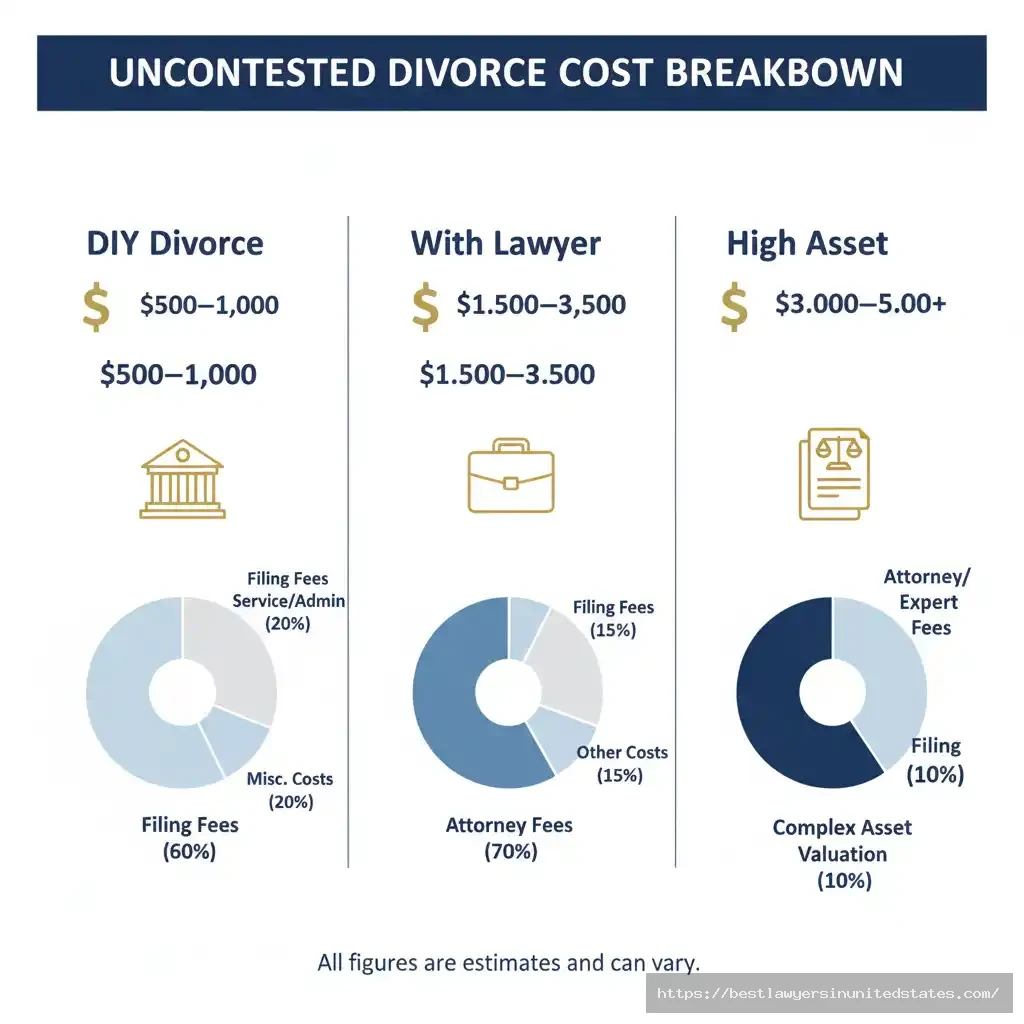
Quick Answer: An uncontested divorce costs between $500 and $5,000 depending on your state, whether you hire a lawyer, and your case complexity. DIY divorces average $500-$1,000, while lawyer-assisted uncontested divorces range from $1,500-$3,500. Filing fees alone cost $200-$435 in most states.
If you and your spouse agree on everything—property division, custody, support—you’re looking at the most affordable divorce option available. But the actual price tag varies wildly depending on where you live and how you handle the process.
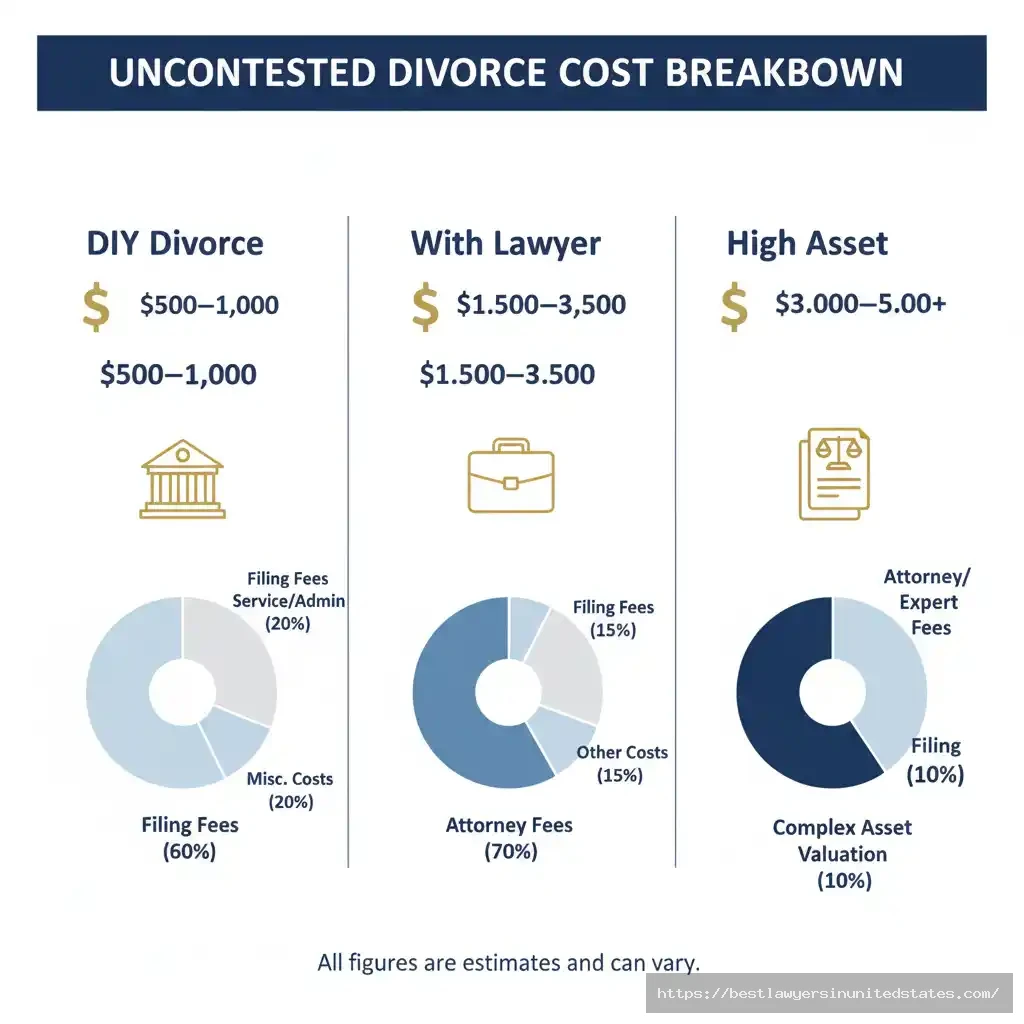
Let’s break down exactly what you’ll pay.
What Is an Uncontested Divorce?
An uncontested divorce means you and your spouse agree on all major issues without court intervention. No fighting over assets, no custody battles, no arguing about alimony.
You both sign off on the terms and present a settlement agreement to the court. The judge reviews it, signs the divorce decree, and you’re done.
Key requirements for uncontested divorce:
- Both spouses agree to divorce
- Agreement on property and debt division
- Child custody and support terms settled (if applicable)
- Spousal support terms agreed upon (if applicable)
- No major disputes requiring court hearings
This differs from a contested divorce, where disagreements force you into litigation—dramatically increasing costs to $15,000-$30,000 or more.
Average Uncontested Divorce Costs by State (2025)
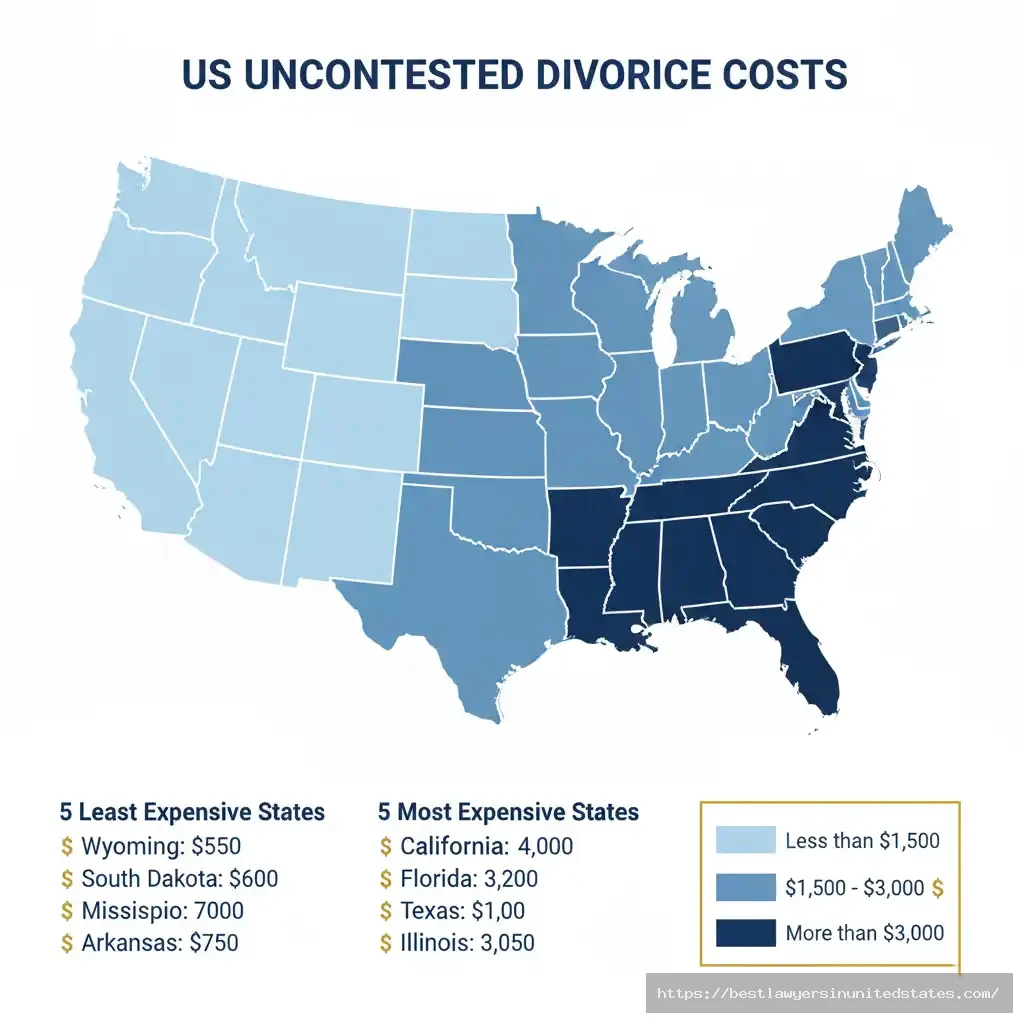
Here’s what you’ll actually pay in each state. These figures include filing fees plus estimated total costs for both DIY and lawyer-assisted divorces.
| State | Filing Fee | DIY Total Cost | With Lawyer Cost |
|---|---|---|---|
| Alabama | $290 | $500-$900 | $1,500-$3,000 |
| Arizona | $349-$399 | $600-$1,200 | $2,000-$3,500 |
| California | $435-$450 | $700-$1,500 | $2,500-$5,000 |
| Colorado | $230 | $500-$1,000 | $1,800-$3,200 |
| Florida | $409 | $650-$1,300 | $2,200-$4,000 |
| Georgia | $200-$220 | $500-$1,000 | $1,500-$3,000 |
| Illinois | $334-$388 | $600-$1,200 | $2,000-$3,800 |
| Kansas | $195-$400 | $500-$1,000 | $1,500-$3,000 |
| Maryland | $165-$185 | $450-$900 | $1,800-$3,500 |
| Michigan | $175-$255 | $500-$1,000 | $1,700-$3,200 |
| Missouri | $163.50 | $450-$900 | $1,500-$3,000 |
| Nevada | $326-$364 | $600-$1,200 | $2,000-$3,500 |
| New Jersey | $300 | $600-$1,200 | $2,000-$4,000 |
| New York | $335-$210 | $650-$1,400 | $2,500-$5,000 |
| North Carolina | $225 | $500-$1,000 | $1,500-$3,200 |
| Ohio | $175-$350 | $500-$1,100 | $1,500-$3,500 |
| Oklahoma | $272.14 | $550-$1,000 | $1,600-$3,000 |
| Pennsylvania | $236.75-$354 | $550-$1,200 | $1,800-$3,800 |
| South Carolina | $150 | $450-$900 | $1,500-$3,000 |
| Tennessee | $184-$313 | $500-$1,000 | $1,500-$3,200 |
| Texas | $300-$350 | $600-$1,200 | $1,800-$3,500 |
| Virginia | $86-$110 | $400-$900 | $1,500-$3,000 |
Note: County-level fees vary within states. Always check with your local Family Court or County Clerk’s office for exact filing fees.
Want to calculate your specific costs?
Divorce Cost Calculator
Get an estimated cost for your divorce based on your specific situation
Your Estimated Divorce Cost
Cost Breakdown
📧 Get a Personalized Consultation
Have questions about your specific situation? Contact our legal experts for guidance tailored to your needs.
Contact Us via EmailHow Much Does Divorce Cost in New York?
New York uncontested divorces cost $335 to file (reduced to $210 in some counties). Total DIY costs range from $650-$1,400, while hiring a lawyer runs $2,500-$5,000.
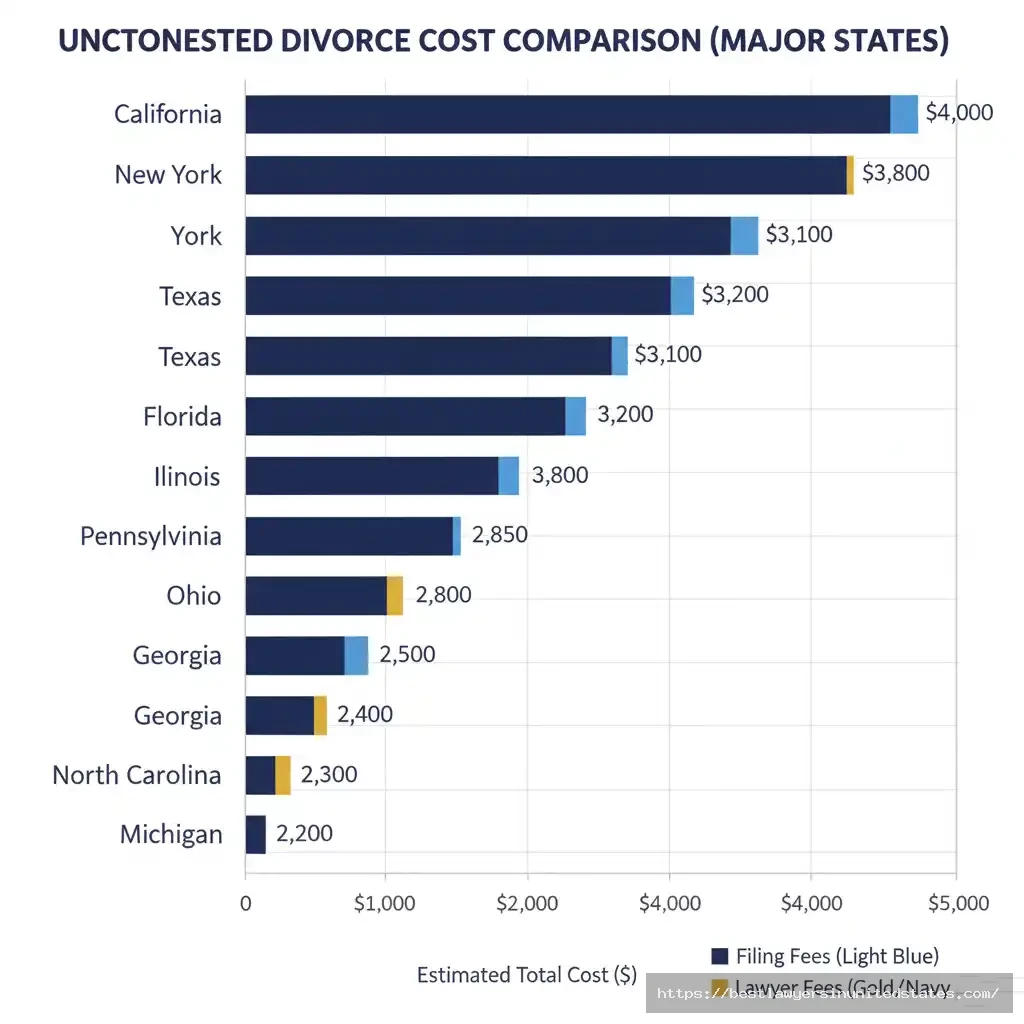
NYC costs more due to higher attorney rates ($300-$500/hour) compared to upstate New York ($200-$350/hour).
The mandatory waiting period in New York is zero days for no-fault divorces, making it one of the faster states.
What About Texas Divorce Costs?
Texas uncontested divorce costs start at $300-$350 for filing fees. DIY divorces cost $600-$1,200 total, while lawyer-assisted cases run $1,800-$3,500.
Texas requires a 60-day waiting period from filing to finalization—no exceptions.
Harris County (Houston) charges $328 for divorce petitions. Travis County (Austin) charges $285. Dallas County runs $318.
California Uncontested Divorce Expenses
California has the highest filing fees in the nation at $435-$450. DIY divorces cost $700-$1,500 total, while hiring a family law attorney costs $2,500-$5,000.
California’s 6-month mandatory waiting period from service of the summons means you can’t finalize faster even if both parties agree.
Urban areas like Los Angeles and San Francisco see higher attorney costs ($350-$500/hour) compared to rural counties ($250-$350/hour).
Florida Divorce Filing Fees and Costs
Florida charges $409 to file for divorce statewide. Total DIY costs run $650-$1,300, while lawyer-assisted uncontested divorces cost $2,200-$4,000.
Florida has no mandatory waiting period if you’ve completed the required parenting course (for couples with minor children).
Miami-Dade and Broward counties have the highest attorney rates at $300-$450/hour.
What Does an Uncontested Divorce Cost in Ohio?
Ohio’s filing fees range from $175-$350 depending on county. Franklin County (Columbus) charges $350. Cuyahoga County (Cleveland) charges $190.
DIY divorces cost $500-$1,100 total. Hiring a divorce lawyer runs $1,500-$3,500.
Ohio’s mandatory waiting period is 30 days from service of the divorce complaint to finalization.
Georgia Uncontested Divorce Pricing
Georgia charges $200-$220 to file in most counties. Fulton County (Atlanta) charges $220. Cherokee County charges $200.
Total DIY costs: $500-$1,000. With a lawyer: $1,500-$3,000.
Georgia requires a 31-day waiting period for divorces without minor children. With children, there’s no mandatory waiting period.
Illinois Divorce Cost Breakdown
Illinois filing fees range from $334-$388. Cook County (Chicago) charges $388. DuPage County charges $334.
DIY divorces cost $600-$1,200 total. Lawyer-assisted cases run $2,000-$3,800.
Illinois has no mandatory waiting period for uncontested divorces once you meet the 6-month residency requirement.
Pennsylvania Uncontested Divorce Fees
Pennsylvania charges $236.75-$354 depending on county. Philadelphia charges $354.75. Allegheny County (Pittsburgh) charges $236.75.
DIY total costs: $550-$1,200. With a lawyer: $1,800-$3,800.
Pennsylvania’s 90-day waiting period applies only if one spouse doesn’t consent. Mutual consent divorces can finalize as soon as both parties sign the affidavit.
North Carolina Divorce Expenses
North Carolina requires $225 to file for absolute divorce. DIY costs run $500-$1,000 total. Hiring an attorney costs $1,500-$3,200.
Important: North Carolina requires a 1-year separation period before you can file for divorce. This is one of the longest waiting periods in the country.
Mecklenburg County (Charlotte) and Wake County (Raleigh) have similar filing fees and attorney rates.
Michigan Filing and Total Costs
Michigan charges $175-$255 depending on county and whether you have minor children. Wayne County (Detroit) charges $255 with children, $175 without.
DIY divorces cost $500-$1,000 total. With a lawyer: $1,700-$3,200.
Michigan’s waiting period is 60 days without children, 6 months with minor children.
What You’re Actually Paying For: Cost Breakdown
Every uncontested divorce includes these core expenses:
Court Filing Fees
This is the fee to file your divorce petition with the county clerk. It’s non-negotiable and varies by state and county.
Fee range: $86-$450 depending on location.
What it covers: Processing your divorce petition, court administrative costs, and issuing the final divorce decree.
You pay this when you first file. Some states allow fee waivers if you qualify based on income (more on that below).
Attorney Fees (If Hiring a Lawyer)
Most divorce lawyers charge either a flat fee or hourly rate for uncontested divorces.
Flat fee range: $1,500-$3,500 for full representation Hourly rate range: $200-$500/hour Average total hours: 5-10 hours for straightforward uncontested cases
What’s typically included in flat fees:
- Initial consultation
- Document preparation (petition, settlement agreement)
- Filing with court
- Service of process coordination
- Court appearance (if required)
- Finalization and decree delivery
What’s usually extra:
- Contested issues that arise
- Multiple revisions to agreements
- Court filing fees
- Process server fees
Process Server Fees
You must legally notify your spouse of the divorce. Even in uncontested cases, proper service is required.
Cost range: $50-$150 depending on location and difficulty
Options:
- Sheriff’s office service: $40-$75
- Private process server: $75-$150
- Certified mail: $10-$20 (allowed in some states)
- Waiver of service: $0 (if spouse signs voluntarily)
Document Preparation Services
If you’re going DIY but want professional help with paperwork, document preparation services cost less than lawyers.
Cost range: $200-$500
What they provide:
- Completed divorce forms specific to your state
- Filing instructions
- Service guidance
What they don’t provide:
- Legal advice
- Court representation
- Strategy guidance
Warning: They’re useful for simple cases but can’t help if complications arise.
Notary Fees
Most divorce documents require notarized signatures.
Cost per signature: $10-$15 Average documents needing notarization: 3-5 Total notary costs: $30-$75
Many banks offer free notary services for customers. UPS stores and FedEx locations charge $10-$15 per signature.
Hidden Costs Most People Don’t Expect

Certified copies of divorce decree: $10-$25 per copy (you’ll need 2-3 minimum)
Parenting class fees: $50-$150 in states requiring divorce education for parents (Florida, Utah, Tennessee, others)
Credit report fees: $15-$30 if required for financial disclosure
Property appraisal: $300-$500 if dividing real estate
Vehicle title transfers: $15-$85 per vehicle
Name change documentation: $20-$50 for new driver’s license, passport, Social Security card
QDRO preparation: $500-$1,500 if dividing retirement accounts (Qualified Domestic Relations Order)
Mediation costs: $150-$400/hour if you need help reaching agreements (though this usually indicates a contested element)
Do You Need a Lawyer for an Uncontested Divorce?
Short answer: No, but it depends on your situation.

When DIY makes sense:
- No minor children
- Minimal assets (less than $50,000 total)
- No real estate to divide
- No retirement accounts to split
- Both parties are cooperative
- Simple debt division
- Neither spouse is hiding assets

When hiring a lawyer is worth the cost:
- You have children and need a solid parenting plan
- You own property together (house, rental properties)
- Retirement accounts need division (401k, pension, IRA)
- One spouse has significantly more assets or income
- There’s a business to value or divide
- You have concerns about fairness in the agreement
- You want protection from future claims
The ROI calculation: If you have more than $50,000 in marital assets, a lawyer’s fee of $2,500 easily pays for itself if they catch oversights in property division or future support obligations.
Many people start DIY and then hire a lawyer for limited scope representation—paying only for document review or specific advice ($300-$800).
How Much Do Lawyers Charge for Uncontested Divorces?
Divorce lawyer costs for uncontested cases break down two ways:
Flat Fee Arrangements (Most Common)
Range: $1,500-$3,500 for full representation
What you get:
- All document preparation
- Court filing
- One or two revisions to settlement agreement
- Communication with spouse’s attorney (if they have one)
- Court appearance if required
- Finalization
Advantages:
- Predictable cost
- No surprise bills
- Incentivizes efficiency
Typical flat fees by region:
- Rural areas: $1,500-$2,200
- Suburban areas: $2,000-$2,800
- Major cities: $2,500-$3,500
Hourly Rate Billing
Range: $200-$500/hour depending on location and experience
Average total hours: 5-10 for straightforward uncontested divorce
When lawyers charge hourly:
- Uncertain complexity
- Possibility of contested issues
- High-net-worth cases requiring detailed financial work
Hourly rate by experience:
- New attorneys (0-5 years): $200-$300/hour
- Mid-level (5-15 years): $300-$400/hour
- Senior/specialist (15+ years): $400-$500/hour
Retainer Fees Explained
Many lawyers require an upfront retainer—a deposit against future work.
Typical retainer for uncontested divorce: $2,000-$3,500
The lawyer bills against this retainer. If the case takes less time, you get a refund. If it exceeds the retainer, you pay the difference.
Limited Scope Representation
Also called “unbundled services”—you hire a lawyer for specific tasks only.
Common limited scope services:
- Document review only: $300-$800
- Settlement agreement drafting: $500-$1,200
- Court appearance representation: $500-$1,500
- Consultation and strategy: $200-$400
This hybrid approach saves money while still getting professional guidance on critical issues.
How to Negotiate Lawyer Fees
Yes, lawyer fees are negotiable. Here’s how:
1. Ask during the free consultation: “Is this fee negotiable based on case simplicity?”
2. Request a payment plan: Many lawyers allow monthly payments for uncontested divorces.
3. Offer to handle some tasks: “If I prepare the financial documents, can we reduce the flat fee?”
4. Get multiple quotes: Consultations are usually free. Compare 3-5 attorneys.
5. Ask what’s included: “Does this fee cover all revisions to the settlement agreement?”
Red flags for overcharging:
- Requiring $5,000+ retainer for simple uncontested divorce
- Refusing to provide a detailed fee agreement
- Vague answers about what’s included
- Pushing hourly billing for straightforward case
Can You Do an Uncontested Divorce Yourself?
Absolutely. Thousands of couples complete DIY divorces every year, especially in no-fault states with simplified procedures.
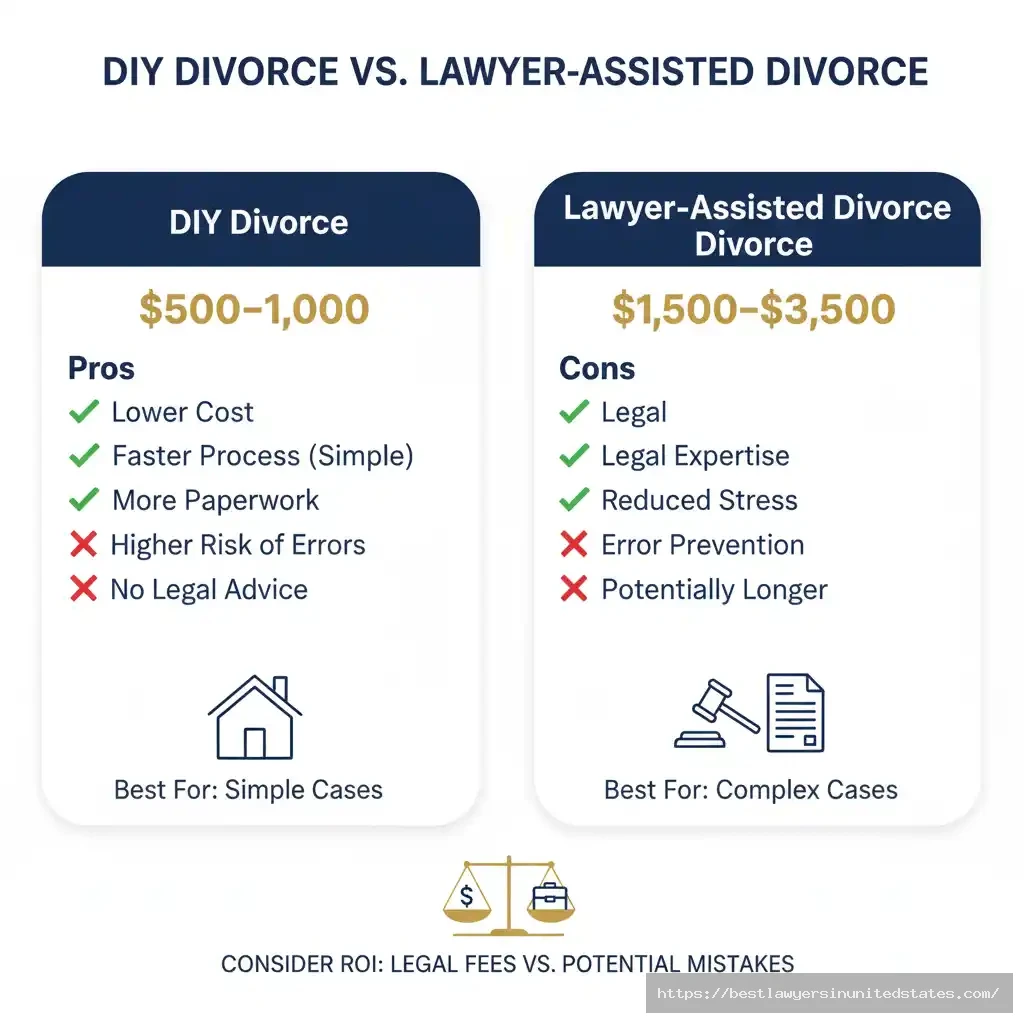
DIY divorce cost range: $500-$1,000 total
Step-by-Step DIY Process
Step 1: Check residency requirements (6 months in most states)
Step 2: Gather required documents
- Marriage certificate
- Financial statements (bank accounts, retirement accounts, debts)
- Property deeds and vehicle titles
- Tax returns (last 2-3 years)
- Children’s birth certificates (if applicable)
Step 3: Download state-specific divorce forms
- Visit your state court’s website
- Look for “self-help” or “forms” section
- Download petition, settlement agreement, and final decree templates
Step 4: Complete the paperwork
- Fill out petition for divorce
- Draft settlement agreement covering all assets, debts, custody, and support
- Complete financial affidavits
- Prepare proposed parenting plan (if children)
Step 5: File with the court
- Make 3 copies of everything
- Pay filing fee at county clerk’s office
- Get case number and file-stamped copies
Step 6: Serve your spouse
- Hire process server or use certified mail (if allowed)
- Spouse signs acknowledgment or waiver of service
- File proof of service with court
Step 7: Wait for mandatory period
- 30-180 days depending on state
- Spouse files response agreeing to terms
Step 8: Finalize the divorce
- Some states require brief court hearing
- Others approve by mail if uncontested
- Judge signs final decree
Step 9: Obtain certified copies
- Get 2-3 certified copies of the decree ($10-$25 each)
- Needed for name changes, property transfers, etc.
Risks of DIY Divorce
Paperwork errors: Incorrectly filled forms get rejected, causing delays and sometimes requiring re-filing (another filing fee).
Unfair agreements: You might not know what you’re entitled to. Property division laws vary by state—equitable distribution vs. community property.
Missing deadlines: Courts have strict timelines. Miss one and your case gets dismissed.
Inadequate child support calculations: States have specific formulas. Getting it wrong now means modification hearings later.
Overlooked assets: Retirement accounts, stock options, future bonuses can be marital property.
Tax implications: Who claims children? How does property division affect capital gains? DIY filers often miss these.
Online Divorce Services Comparison
Several companies offer guided DIY divorce for $139-$500:
| Service | Cost | What’s Included | Best For |
|---|---|---|---|
| DivorceWriter | $139-$159 | State-specific forms, filing instructions | Simple cases, no kids |
| CompleteCase | $299 | Forms + phone support | Moderate complexity |
| 3StepDivorce | $299 | Forms + filing service | Those needing extra guidance |
| LegalZoom | $499 | Forms + document review | Cases with some complexity |
| It’s Over Easy | $750-$1,500 | Mediation + document prep | Cases needing negotiation help |
What these services don’t provide:
- Legal advice
- Court representation
- Strategy for complex issues
- Protection if problems arise
They’re best for very simple divorces where both parties agree and assets are straightforward.
What Factors Affect Your Uncontested Divorce Cost?
Whether You Have Children
Divorces with minor children cost more due to additional requirements:
Extra costs with children:
- Parenting plan preparation: $300-$800 (if hiring help)
- Child support calculation worksheets
- Mandatory parenting classes: $50-$150
- Custody evaluation (if needed): $1,500-$5,000
Even in uncontested cases, judges scrutinize custody and support agreements carefully—often requiring revisions.
Property and Assets to Divide
More assets = more complexity = higher costs.
Simple asset division (minimal cost increase):
- Bank accounts
- Personal property
- One vehicle each
Moderate complexity (+$500-$1,500):
- House to sell or transfer
- Two vehicles
- Standard retirement accounts
- Credit card debt
Complex asset division (+$2,000-$5,000):
- Business valuation
- Multiple properties
- Stock options or RSUs
- Pension plans requiring QDRO
- Hidden or disputed assets
Your State’s Requirements
Some states make divorce easier and cheaper than others.
Lower-cost states:
- Simplified forms available
- Online filing options
- No mandatory court appearance
- Shorter waiting periods
- Lower filing fees
Higher-cost states:
- Complex paperwork
- In-person filing only
- Mandatory hearings
- Long waiting periods (6 months+)
- High filing fees ($400+)
Attorney Experience Level
In markets with many divorce lawyers, you have pricing options:
New attorney (0-5 years):
- Pros: Lower rates ($200-$300/hour), eager to prove themselves
- Cons: Less experience, may take longer
Mid-level (5-15 years):
- Pros: Good balance of experience and pricing ($300-$400/hour)
- Cons: May be busy, less personal attention
Senior/specialist (15+ years):
- Pros: Deep expertise, anticipates problems
- Cons: Highest rates ($400-$500/hour), often overkill for simple uncontested divorce
For straightforward uncontested divorces, mid-level attorneys offer the best value.
How Cooperative Your Spouse Is
This is the biggest variable in uncontested divorce costs.
Highly cooperative spouse:
- Signs everything promptly
- Communicates directly
- Doesn’t nitpick agreement terms
- Result: Minimal legal fees, fast process
Somewhat cooperative spouse:
- Takes time responding
- Requests minor changes
- Needs some convincing
- Result: Moderate legal fees, some delays
Uncooperative but not fully contesting:
- Slow to respond
- Disputes minor terms
- Creates unnecessary complications
- Result: Higher costs, risk of converting to contested
If your spouse starts disputing major terms, your “uncontested” divorce is actually contested—increasing costs to $5,000-$30,000.
How Long Does an Uncontested Divorce Take?
Timeline varies dramatically by state mandatory waiting periods:
| State | Waiting Period | Typical Total Time |
|---|---|---|
| Alaska | 30 days | 2-3 months |
| Arizona | 60 days | 3-4 months |
| California | 6 months | 7-9 months |
| Colorado | 91 days | 4-5 months |
| Florida | None (with class) | 1-2 months |
| Georgia | 31 days (no kids) | 2-3 months |
| Illinois | None | 2-3 months |
| Kansas | 60 days | 3-4 months |
| Michigan | 60 days (6 months with kids) | 3-7 months |
| Missouri | 30 days | 2-3 months |
| Nevada | None | 1-2 months |
| New York | None | 2-3 months |
| North Carolina | 1 year separation | 13-15 months |
| Ohio | 30 days | 2-3 months |
| Pennsylvania | None (mutual consent) | 3-4 months |
| Texas | 60 days | 3-4 months |
| Virginia | 6 months separation (no kids) | 7-9 months |
Fastest states: Nevada, Alaska, Wyoming (can finalize in 1-2 months)

Slowest states: North Carolina, Virginia, South Carolina (require long separation periods)
What causes delays:
- Incomplete paperwork
- Missing documents
- Court backlogs
- Spouse taking time to respond
- Scheduling hearing dates
Uncontested vs. Contested Divorce: Cost Comparison
Understanding the cost difference helps you appreciate the value of keeping things uncontested:
| Factor | Uncontested Divorce | Contested Divorce |
|---|---|---|
| Attorney fees | $1,500-$3,500 | $15,000-$30,000+ |
| Duration | 2-6 months | 12-24+ months |
| Court appearances | 0-1 | 3-10+ |
| Discovery costs | $0 | $3,000-$10,000 |
| Expert witnesses | $0 | $5,000-$20,000 |
| Mediation | Optional | Often required |
| Trial costs | $0 | $10,000-$50,000 |
| Total average cost | $2,000-$5,000 | $20,000-$50,000+ |
What turns an uncontested divorce into contested:
- Disagreement on property division
- Custody disputes
- One spouse hiding assets
- Refusing to sign settlement
- Demands for higher/lower support
The financial impact: A contested divorce can cost 10-20x more than an uncontested one.
Common Mistakes That Increase Divorce Costs
Not Disclosing All Assets
The mistake: Hiding accounts, understating property value, or “forgetting” to list assets.
The cost: If discovered, you face contempt of court charges ($500-$5,000 in fines), potential criminal charges, and a very angry judge who may penalize you in the final property division.
How to avoid it: Full disclosure from the start. List every account, property, debt, and asset—even if you think it’s separate property.
Improper Service of Papers
The mistake: Not properly serving your spouse according to state requirements.
The cost: Your case gets dismissed, and you pay another filing fee ($200-$450) to restart the process. If you attempt service yourself when state law requires a third party, you’ve wasted months.
How to avoid it: Follow your state’s service rules exactly. When in doubt, hire a process server ($50-$150) to ensure compliance.
Missing Court Deadlines
The mistake: Forgetting to file required responses or attend scheduled hearings.
The cost: Your case gets dismissed, or the court enters a default judgment—potentially giving your spouse whatever they asked for without your input.
How to avoid it: Mark every deadline on multiple calendars. Set reminders 7 days and 2 days before any deadline.
Failing to Follow State Requirements
The mistake: Skipping mandatory parenting classes, not completing financial affidavits, or using the wrong forms.
The cost: Delayed finalization (adding months), rejection of paperwork (requiring re-submission), or denied divorce petition (wasted filing fee).
How to avoid it: Carefully review your state court’s divorce checklist. When in doubt, call the clerk’s office or pay a lawyer $200-$400 for a consultation.
Not Reviewing Settlement Agreement Carefully
The mistake: Signing an agreement without understanding all terms or future implications.
The cost: You may waive rights to assets, agree to unfair support terms, or accept a parenting plan that doesn’t work for your schedule. Modification requires going back to court—costing $2,000-$5,000.
How to avoid it: Read every word of your settlement agreement. Even if you’re doing DIY, pay a lawyer $300-$800 for document review before signing.
Letting Emotions Drive Decisions
The mistake: Giving up assets out of guilt, agreeing to unfair terms to “just be done,” or making financial decisions based on anger.
The cost: Long-term financial harm worth thousands to tens of thousands of dollars.
How to avoid it: Take time before agreeing to terms. Consult a financial advisor ($200-$500) if dividing significant assets.
What If You Can’t Afford a Divorce?
Financial hardship shouldn’t trap you in an unhappy marriage. Several options make divorce accessible even on a tight budget.
Fee Waivers: How to Qualify
Every state allows indigent parties to request a fee waiver for court filing costs.
Typical income requirements:
- At or below 125% of federal poverty guidelines
- Currently receiving government assistance (food stamps, Medicaid, SSI)
- Unable to afford basic necessities
How to apply:
- Complete fee waiver application (available at clerk’s office or online)
- Provide proof of income (pay stubs, tax returns, benefit letters)
- Sign affidavit stating you can’t afford fees
- File with divorce petition
- Judge approves or denies
What it covers:
- Filing fees
- Service fees
- Certified copy costs
What it doesn’t cover:
- Attorney fees (though some programs help with this)
Fee waiver approval rate: 70-80% of qualified applicants get approved.
Legal Aid Organizations by State
Legal aid societies provide free or low-cost legal services to qualifying individuals.
Income requirements: Usually at or below 125-200% of poverty level ($15,000-$30,000 for single person)
What they provide:
- Full representation in some cases
- Limited scope assistance
- Document preparation help
- Self-help workshops
How to find legal aid in your state:
- Visit lawhelp.org and enter your ZIP code
- Call your State Bar Association’s referral service
- Contact Legal Services Corporation (lsc.gov)
Major legal aid networks:
- Legal Services Corporation: 1-202-295-1500
- American Bar Association Free Legal Answers: abafreelegalanswers.org
- National Legal Aid & Defender Association: nlada.org
Application process:
- Call intake hotline
- Provide income documentation
- Describe legal issue
- Wait for case review (1-4 weeks)
- Get assigned attorney or services
Important: Legal aid offices are overwhelmed. Apply early and have patience.
Pro Bono Lawyer Programs
Many private attorneys take a few cases per year for free (pro bono).
How to find pro bono help:
- State bar association pro bono programs
- Local bar association referral services
- Law school clinics
- Volunteer Lawyers Programs
Contact your state bar:
- Alabama State Bar: 1-800-354-6154
- State Bar of California: 1-800-843-9053
- Florida Bar: 1-800-342-8011
- State Bar of Georgia: 1-404-527-8700
- Illinois State Bar: 1-800-252-8916
- New York State Bar: 1-800-342-3661
- State Bar of Texas: 1-800-204-2222
- Ohio State Bar: 1-800-282-6556
Eligibility: Income guidelines plus case type (family law cases often prioritized).
Payment Plans for Attorney Fees
Many divorce lawyers offer payment plans for uncontested divorces since the costs are predictable.
Common payment plan structures:
- $500-$1,000 down payment
- Monthly payments over 3-6 months
- No interest (sometimes small fee)
How to negotiate:
- During free consultation: “Do you offer payment plans?”
- Explain your budget constraints honestly
- Propose a payment schedule that works for you
- Get payment terms in writing
Example payment plan:
- Total flat fee: $2,500
- Down payment: $500
- Monthly payments: $400 x 5 months
Most lawyers prefer this to not getting paid at all. Don’t be afraid to ask.
Law School Legal Clinics
Most law schools run free or low-cost legal clinics supervised by experienced professors.
Services provided:
- Document preparation
- Legal advice
- Court representation (in some cases)
- Self-help workshops
Cost: $0-$100 for most family law services
Quality: Supervised by licensed attorneys, so work is professional despite being done by students.
How to find clinics:
- Search “[your state] law school clinic”
- American Bar Association clinic directory: americanbar.org
Examples:
- New York University Law: Family Defense Clinic
- UCLA Law: Family Law Clinic
- University of Miami Law: Children & Youth Law Clinic
- University of Texas Law: Domestic Violence Clinic
Real Cost Scenarios: What Will YOUR Divorce Cost?
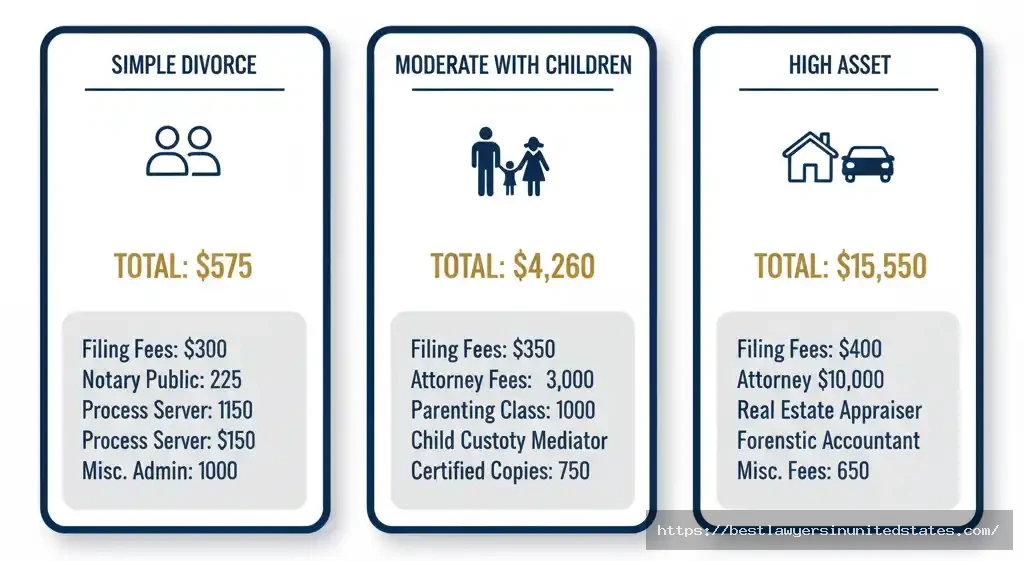
Let’s look at three realistic examples to see what you’d actually pay:
Scenario 1: Simple DIY Divorce
Situation:
- Married 3 years, no children
- Rent apartment (no property)
- Two cars, both owned outright
- Combined debt: $5,000 credit cards
- Bank accounts: $8,000 total
- No retirement accounts
- Both agree on everything
- Both employed
Cost breakdown:
- Filing fee: $300
- Process server: $75
- Notary fees: $30
- Certified copies (2): $20
- Online divorce service: $150
- Total cost: $575
Timeline: 2-3 months
Who should do this: Couples with very simple finances who both agree completely.
Scenario 2: Moderate Complexity with Lawyer
Situation:
- Married 10 years, two children (ages 5 and 8)
- Own home with $100,000 equity
- Two vehicles
- 401(k) accounts totaling $150,000
- Combined debt: $25,000
- Agree on custody (50/50 split)
- Agree on property division
- Need parenting plan drafted
Cost breakdown:
- Filing fee: $335
- Attorney flat fee: $2,800
- QDRO preparation: $800
- Process server: $100
- Parenting class (both): $150
- Notary fees: $45
- Certified copies (3): $30
- Total cost: $4,260
Timeline: 4-5 months
Who should do this: Couples with children and moderate assets who want professional guidance to avoid future problems.
Scenario 3: High-Asset Uncontested Divorce
Situation:
- Married 18 years, three children (ages 14, 12, 9)
- Primary home worth $450,000, mortgage $200,000
- Rental property worth $280,000, mortgage $150,000
- Four vehicles
- Combined 401(k) and IRAs: $650,000
- Stock options: $80,000
- Business valuation needed: $200,000
- Combined debt: $75,000
- Agree on everything but need help structuring complex division
Cost breakdown:
- Filing fee: $410
- Attorney fees (hourly billing, 25 hours): $8,750
- Business valuation: $3,000
- Two QDROs: $1,600
- Property appraisals (2): $900
- Accountant consultation: $500
- Process server: $125
- Parenting class: $150
- Notary fees: $75
- Certified copies (4): $40
- Total cost: $15,550
Timeline: 6-8 months
Who should do this: High-net-worth couples who need professional help structuring complex asset division even though they agree on outcomes.
How to Save Money on Your Uncontested Divorce
Get Organized Before Meeting Your Lawyer
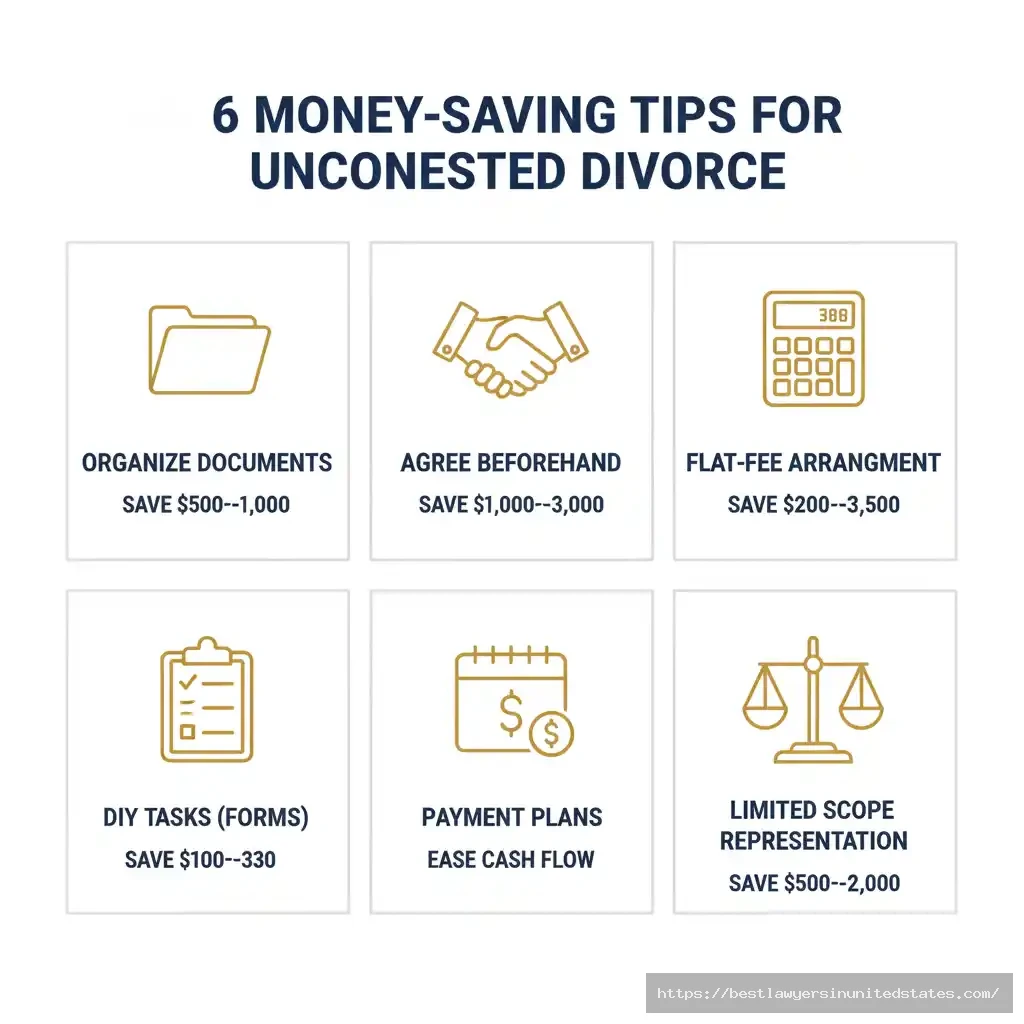
The more prepared you are, the less time (and money) your lawyer spends on basic information gathering.
Documents to prepare in advance:
- List of all bank accounts with current balances
- Retirement account statements (most recent)
- Mortgage statements and property deeds
- Vehicle titles and loan information
- Credit card statements and balances
- Tax returns (last 3 years)
- Pay stubs (both spouses)
- List of personal property to divide
- Timeline of your marriage (date married, separated)
Time saved: 2-5 hours of attorney time = $400-$2,500 savings
Agree on Terms Before Filing
Every issue you and your spouse resolve without lawyer involvement saves you money.
Have these conversations before hiring lawyers:
- Who keeps the house (or do we sell?)
- How do we split retirement accounts?
- What’s the custody schedule?
- Who pays what debts?
- Is spousal support needed?
Draft a simple agreement in writing—even if informal. Your lawyer can formalize it.
Money saved: $1,000-$3,000 in negotiation time
Choose Flat Fee Over Hourly Billing
For truly uncontested divorces, flat fees are almost always cheaper.
Why: Lawyers estimate high when setting hourly budgets. A flat fee incentivizes efficiency.
How to negotiate flat fee:
- Ask: “What would a flat fee be for my simple uncontested case?”
- Get it in writing
- Clarify what’s included
- Ask about cost of revisions
Handle Administrative Tasks Yourself
You don’t need a lawyer for everything.
Tasks you can do yourself:
- Organizing financial documents
- Gathering account statements
- Making photocopies
- Filing documents at courthouse
- Picking up certified copies
Money saved: $300-$800
Use Limited Scope Representation
Don’t pay for full representation if you don’t need it.
Common limited scope options:
- Document review only: $300-$800
- Consultation and strategy: $200-$400
- Settlement agreement drafting: $500-$1,200
- Court appearance only: $500-$1,500
Tell the lawyer: “I’m handling most of this myself but need help with [specific task].”
Ask About Payment Plans
As mentioned earlier, many lawyers allow monthly payments—especially for uncontested divorces with predictable costs.
Don’t let upfront costs deter you. If a lawyer won’t offer a payment plan, find one who will.
Uncontested Divorce Checklist
Before you file, gather everything you need:
Personal Documents:
- Marriage certificate (certified copy)
- Driver’s licenses (both spouses)
- Social Security cards
- Birth certificates (children)
Financial Documents:
- Bank statements (last 3 months)
- Credit card statements
- Loan documents
- Mortgage statements
- Pay stubs (last 3 months)
- Tax returns (last 2-3 years)
- Retirement account statements
- Investment account statements
Property Documents:
- Home deed
- Vehicle titles
- Property appraisals
- Insurance policies
Legal Documents to Complete:
- Divorce petition
- Summons
- Settlement agreement
- Financial affidavits
- Parenting plan (if children)
- Child support worksheet (if children)
Service Requirements:
- Process server hired OR
- Waiver of service signed by spouse
Court Requirements:
- Filing fee paid
- Copies made (usually 3 sets)
- Proof of residency
Frequently Asked Questions About Uncontested Divorce Costs
What is the cheapest way to get divorced?
The cheapest way to get divorced is filing for an uncontested divorce yourself without hiring a lawyer. This DIY approach costs $500-$1,000 total, covering only court filing fees, process server fees, notary costs, and certified copies of your divorce decree.
You’ll need to complete all paperwork yourself using your state’s court forms, agree with your spouse on all terms beforehand, and handle all filing and service requirements. This works best for couples with no children, minimal assets, and no property to divide.
Who pays for divorce fees?
Usually, the person who files for divorce (the petitioner) pays the initial filing fee. However, couples can agree to split all divorce costs including filing fees, lawyer fees, and related expenses. Courts sometimes order one spouse to pay the other’s attorney fees if there’s a significant income disparity or if one spouse caused unnecessary delays or costs. Fee waivers are available for low-income filers.
Can a judge deny an uncontested divorce?
Yes, a judge can deny an uncontested divorce if the settlement agreement is unfair, doesn’t meet state requirements, lacks required financial disclosures, doesn’t properly address child custody and support, or appears to have been signed under duress. Judges have a duty to ensure agreements are fair and legal, especially when children are involved. If denied, you’ll need to revise the agreement and refile.
Is a lawyer necessary for an uncontested divorce?
No, a lawyer is not legally required for an uncontested divorce in any state. However, a lawyer is highly recommended if you have children, own property together, have retirement accounts to divide, or have significant assets. Most people with simple finances and no children can successfully complete an uncontested divorce themselves using court-provided forms.
How quickly can an uncontested divorce take?
An uncontested divorce takes 1-9 months depending on your state’s mandatory waiting period. Some states like Nevada and Alaska have no waiting period, allowing finalization in 1-2 months. Others like California require 6 months, and North Carolina requires a 1-year separation before you can even file. The actual paperwork and court processing adds 2-8 weeks on top of any waiting period.
What is the 70/30 rule in divorce?
The 70/30 rule is a financial guideline suggesting that the lower-earning spouse typically experiences a 30% decline in living standard after divorce, while the higher-earning spouse experiences only a 10-15% decline. It’s not a legal rule for property division but rather an observed outcome in many divorces due to economies of scale being lost when one household becomes two. Courts don’t formally apply this rule but may consider living standard impacts in spousal support decisions.
Can I file for divorce without going to court?
In most states, yes—if your divorce is uncontested and all paperwork is properly completed, many courts approve divorces without requiring a court appearance. You file everything by mail or electronically, and the judge reviews and signs your final decree. However, some states still require a brief final hearing even for uncontested cases. Check your state’s specific requirements.
How much does a lawyer charge for an uncontested divorce?
Lawyers typically charge $1,500-$3,500 as a flat fee for an uncontested divorce, depending on location and case complexity. Urban areas see higher fees ($2,500-$3,500), while rural areas are lower ($1,500-$2,200). Some lawyers charge hourly rates of $200-$500/hour instead, billing 5-10 hours total for straightforward uncontested cases. Limited scope services (like document review only) cost $300-$800.
Do both parties have to be present for an uncontested divorce?
No, both parties typically don’t need to be physically present in court for an uncontested divorce. Most states allow the responding spouse to sign acknowledgment forms instead of attending hearings. If a hearing is required, often only the petitioner (person who filed) needs to attend. Some states allow both parties to sign affidavits avoiding court appearances entirely if everything is agreed upon.
How long will an uncontested divorce take?
An uncontested divorce takes 2-6 months on average, but ranges from 1-15 months depending on state waiting periods. States without waiting periods can finalize in 6-8 weeks. States with mandatory waiting periods add that time (30-180 days) before finalization. The fastest states are Nevada (6 weeks), Alaska (30 days), and Wyoming (60 days). The slowest require long separations: North Carolina (1 year), Virginia (6 months-1 year).
What are the disadvantages of an uncontested divorce?
The main disadvantages are: (1) you might agree to unfair terms without realizing it, especially regarding asset valuation or future support obligations; (2) if you miss assets or debts during division, it’s difficult to go back later; (3) rushed agreements may not account for changing circumstances like job loss or relocation; (4) without a lawyer, you might not understand tax implications of property division; and (5) if your spouse is hiding assets, you may not discover them without formal discovery processes available in contested divorces.
Can I get a divorce if I can’t afford it?
Yes, you can get a divorce even if you can’t afford court costs. Every state offers fee waivers for low-income individuals (typically those at or below 125% of federal poverty level). You can also seek free legal help through legal aid organizations, pro bono programs through your state bar association, or law school legal clinics. Many lawyers offer payment plans for uncontested divorces, allowing you to pay the $1,500-$3,500 fee over 3-6 months.
What questions are asked in an uncontested divorce?
If a court hearing is required for your uncontested divorce, the judge typically asks: (1) Do you understand and agree to all terms in the settlement agreement? (2) Did anyone pressure or force you to sign this agreement? (3) Have you fully disclosed all assets and debts? (4) Is the property division fair? (5) If children are involved: Is this custody arrangement in the children’s best interest? (6) Do you understand child support calculations? (7) Are there any issues you want to raise? (8) Do you want the court to finalize this divorce?
How can I get a divorce if I can’t afford it?
Apply for a court fee waiver using forms available at your county clerk’s office—you’ll need to show income below state guidelines (usually 125% of poverty level). Contact legal aid organizations in your state for free representation or document preparation help. Ask divorce lawyers about payment plans (most offer 3-6 month plans for uncontested cases). Use online divorce services ($139-$299) for document preparation if you qualify for a fee waiver. Check if your state bar association offers pro bono divorce services.
Next Steps: Getting Started with Your Uncontested Divorce
Now that you understand the costs, here’s your action plan:
Step 1: Assess your situation
- Do you and your spouse agree on all major terms?
- What assets and debts do you have?
- Do you have children requiring a parenting plan?
Step 2: Decide on DIY vs. lawyer
- Simple case + tight budget = DIY ($500-$1,000)
- Moderate complexity + some assets = lawyer ($2,000-$3,500)
- Children or significant assets = definitely hire a lawyer
Step 3: Research your state’s requirements
- Visit your state court website’s self-help section
- Check residency and waiting period requirements
- Download forms if going DIY route
Step 4: Gather all financial documents
- Use the checklist above
- Create organized folders
- Make copies of everything
Step 5: Have preliminary discussions with your spouse
- List all assets and debts
- Draft informal agreement on division
- Discuss custody and support if children
Step 6: Consult with 2-3 lawyers (free consultations)
- Compare fees and services
- Ask about payment plans
- Get clarity on your specific situation
Step 7: File your petition
- Pay filing fee (or submit fee waiver)
- Serve your spouse properly
- File proof of service
Step 8: Wait for mandatory period and finalize
- Complete any required classes
- File final paperwork
- Obtain certified copies of decree
Resources for State-Specific Guidance
Each state has unique divorce laws and procedures. For detailed state-specific information:
- California divorce costs and requirements
- Florida divorce filing procedures
- Georgia uncontested divorce guide
- Illinois divorce cost breakdown
- Michigan filing fees and timeline
- New York divorce procedures
- North Carolina separation requirements
- Ohio uncontested divorce guide
- Pennsylvania divorce costs
- Texas filing and timeline
For general divorce cost information across all states, see our comprehensive divorce cost guide.
Use our divorce cost calculator to estimate your specific costs based on your state, assets, and whether you’ll hire a lawyer.
If you need help finding legal representation, browse our directory of family law attorneys by location.
Final Thoughts
Uncontested divorce is the most affordable path to ending your marriage, but costs vary significantly based on your location, assets, and whether you hire help. Most people pay $2,000-$3,500 total when working with a lawyer, or $500-$1,000 for DIY.
The key to keeping costs low: agreement with your spouse on all major terms before you file. Every point of disagreement adds time and money.
Don’t let cost alone drive your decision to go DIY. If you have children or significant assets, spending $2,500 on a lawyer now can save you $10,000+ in mistakes or future modification hearings.
Take your time, gather information, and make the choice that protects both your finances and your future.
