
Your outfit matters in the courtroom. Period.
Before you deliver that opening statement or shake hands with a new client, they’ve already formed an opinion based on what you’re wearing. For female lawyers, getting dressed isn’t just about looking professional—it’s about commanding respect, projecting confidence, and making sure your appearance never becomes the conversation.
But here’s the good news: you don’t have to sacrifice style for authority.
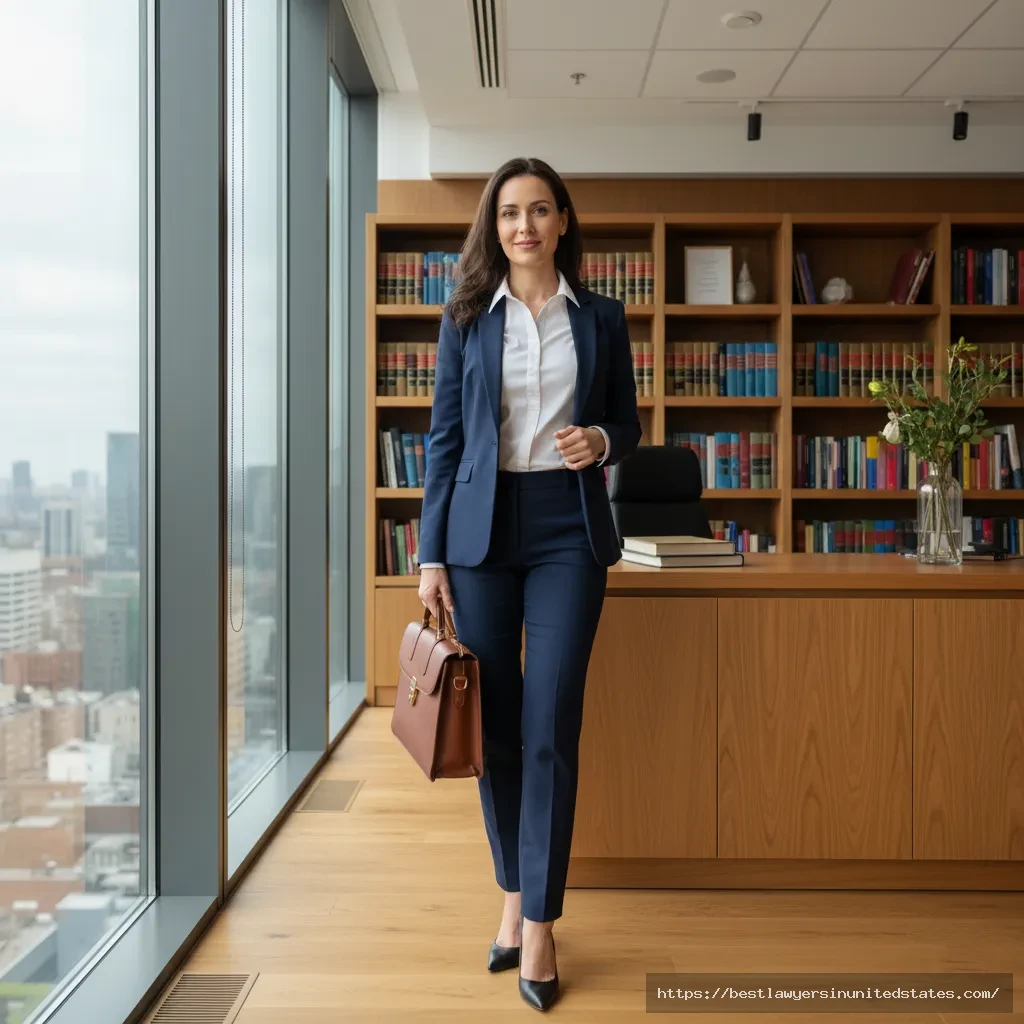
This guide breaks down everything you need to know about building a lawyer wardrobe that works—from the courtroom to client meetings to casual Fridays. We’ll cover the essentials, answer the tough questions (yes, including the pantyhose debate), and give you real outfit formulas you can actually use.
Let’s get into it.
Why Your Outfit Actually Matters in Law
Look, we all wish the legal profession was purely about merit and skill. But the reality? Visual presentation influences how clients, judges, and opposing counsel perceive your competence.
First impressions happen in under 7 seconds. Your tailored suit signals attention to detail. Your polished shoes suggest you take things seriously. Even the way your blazer fits communicates whether you’re organized or scrambling.

In high-stakes litigation, you can’t afford to have your outfit working against you.
The Trust Factor
Clients hire lawyers they trust. Part of that trust comes from looking like someone who has their life together. A wrinkled blouse or scuffed heels might seem minor, but they plant seeds of doubt. If you can’t keep your wardrobe in order, can you handle their case?
Authority vs. Approachability
Here’s the balance every female lawyer walks: looking authoritative without seeming unapproachable.
- In criminal defense or litigation? Structured suits in dark colors project power.
- In family law or mediation? Softer tones and less severe tailoring can put clients at ease.
- Corporate counsel? Sharp, modern cuts that fit a boardroom setting.
Your practice area should inform your style choices.
Understanding Dress Codes: What’s Really Expected
Not all legal settings have the same rules. What flies in a tech startup’s legal department won’t work in federal court. Here’s the breakdown.
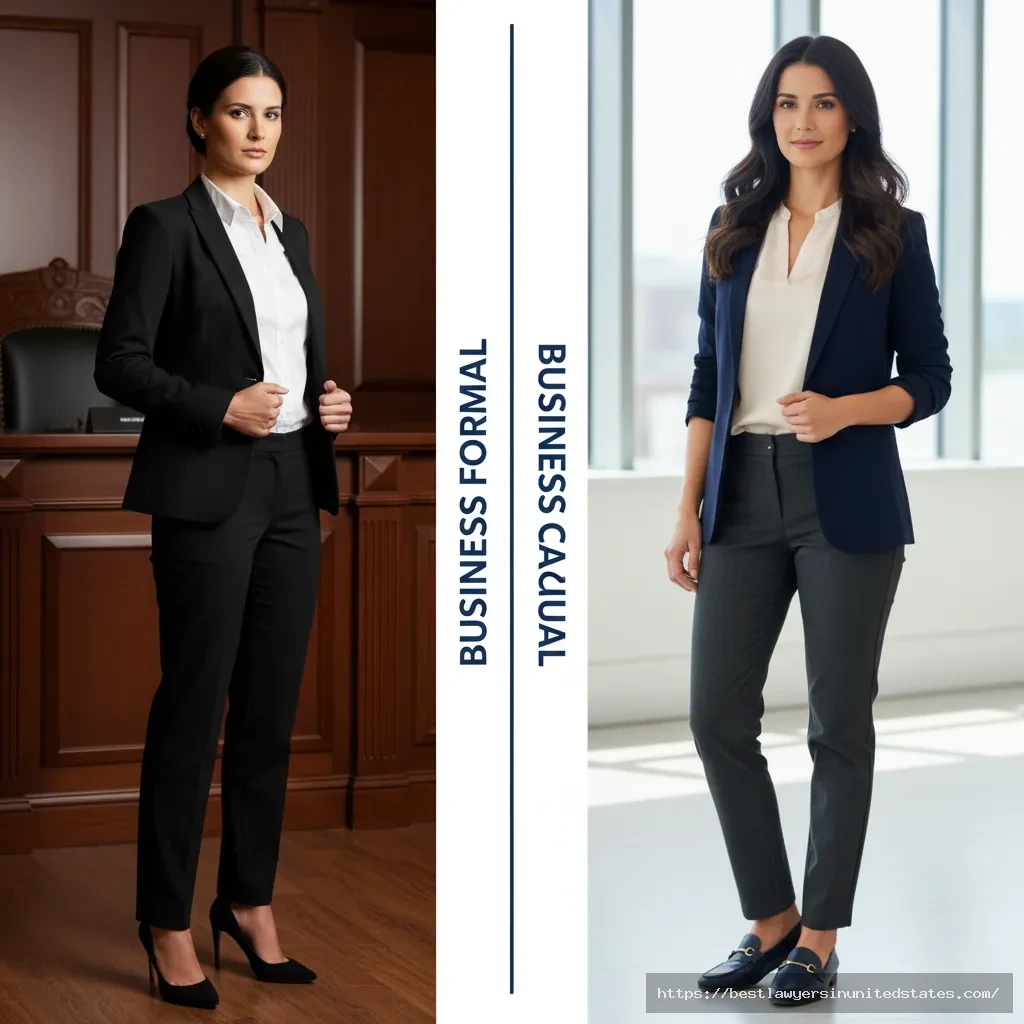
Business Formal (Courtroom Standard)
This is your non-negotiable court uniform:
- Full suit (pantsuit or skirt suit)
- Conservative colors (black, navy, charcoal gray)
- Closed-toe heels or flats (2-3 inch heel max)
- Minimal jewelry (stud earrings, simple watch)
- Professional bag (structured tote or briefcase)
No exceptions. Even if the judge dresses casually, you don’t.
These standards align with the American Bar Association’s courtroom attire guidelines, which emphasize professionalism and respect for the judicial process.
Business Casual (Office Settings)
For non-court days at the firm:
- Blazer + trousers (suit jacket optional)
- Blouse or sweater (collared or crew neck)
- Loafers or low heels
- Slightly more color/pattern allowed
Still polished, just less rigid.
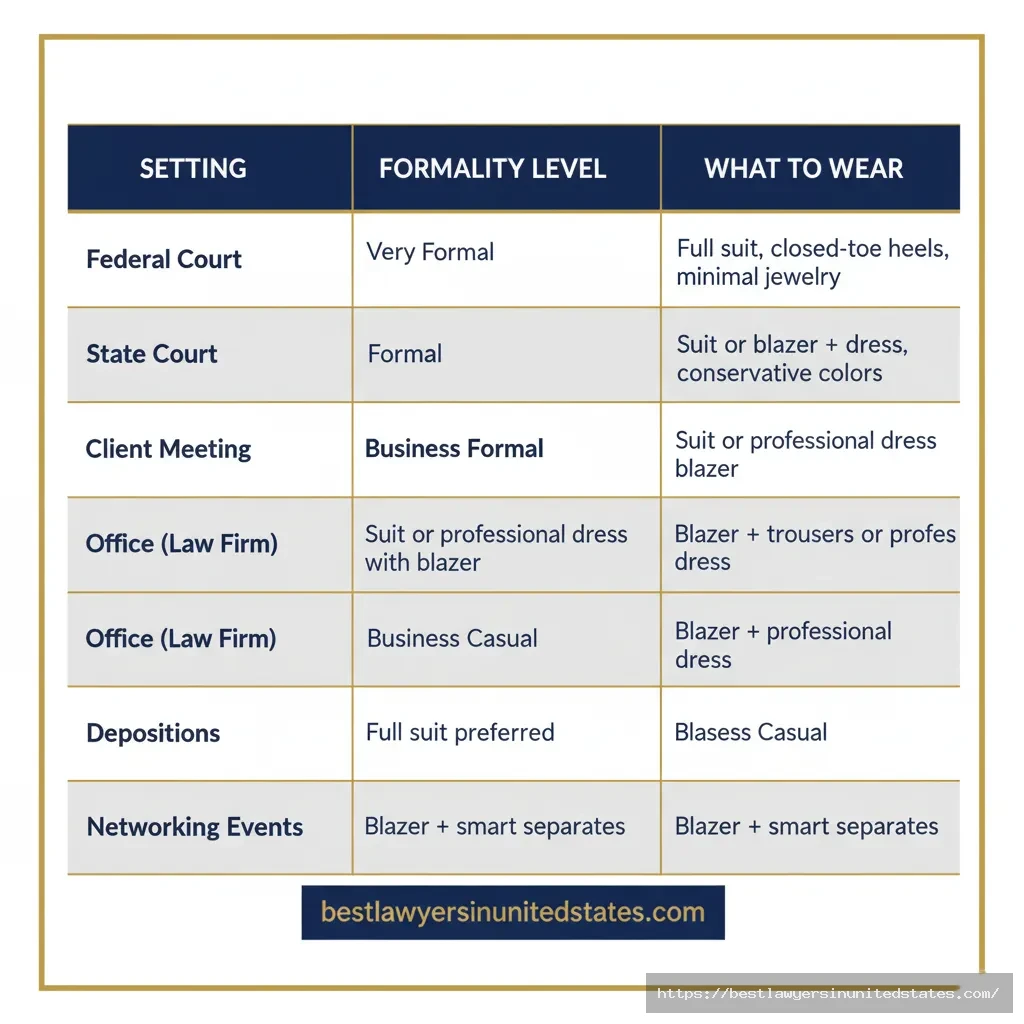
Smart Casual (Internal Meetings Only)
Some modern firms allow this for internal work:
- Dark jeans (if firm culture permits)
- Blazer over a nice top
- Ankle boots or flats
Check your firm’s actual policy before testing this.
For a deeper dive into how first impressions are formed through professional attire, check out our complete lawyer attire guide that covers body language and presentation strategies.
Essential Wardrobe Pieces Every Female Lawyer Needs
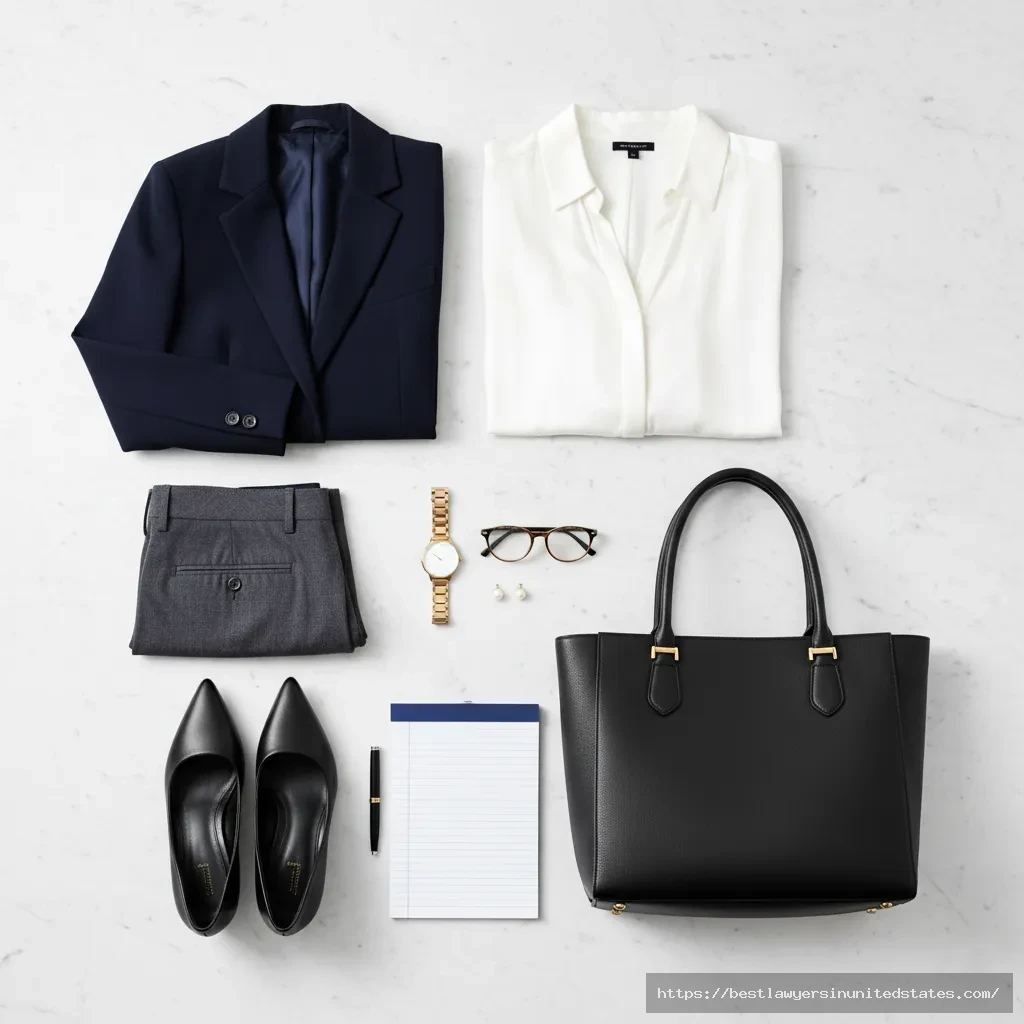
Building a lawyer wardrobe doesn’t mean buying everything at once. It means investing in the right pieces that mix, match, and work across different settings.
Here’s what actually belongs in your closet.
Tailored Suits (The Foundation)
You need at least 3 well-fitted suits to start. Here’s the smart breakdown:
- Navy suit – Your workhorse. Works for court, client meetings, depositions.
- Charcoal gray suit – Slightly softer than black, incredibly versatile.
- Black suit – For trials, formal hearings, or when you need maximum authority.
Pro tip: Get them tailored. Off-the-rack suits rarely fit perfectly, and a $200 suit with $50 tailoring beats a $500 suit that doesn’t fit.
Blazers (Mix-and-Match Heroes)
Blazers let you create different looks without buying full suits. Own these three:
- Classic navy blazer (pairs with everything)
- Modern fit blazer in gray or camel (more contemporary)
- Statement blazer with subtle texture or color (shows personality without breaking rules)
Pair them with dress pants, pencil skirts, or even tailored dresses.
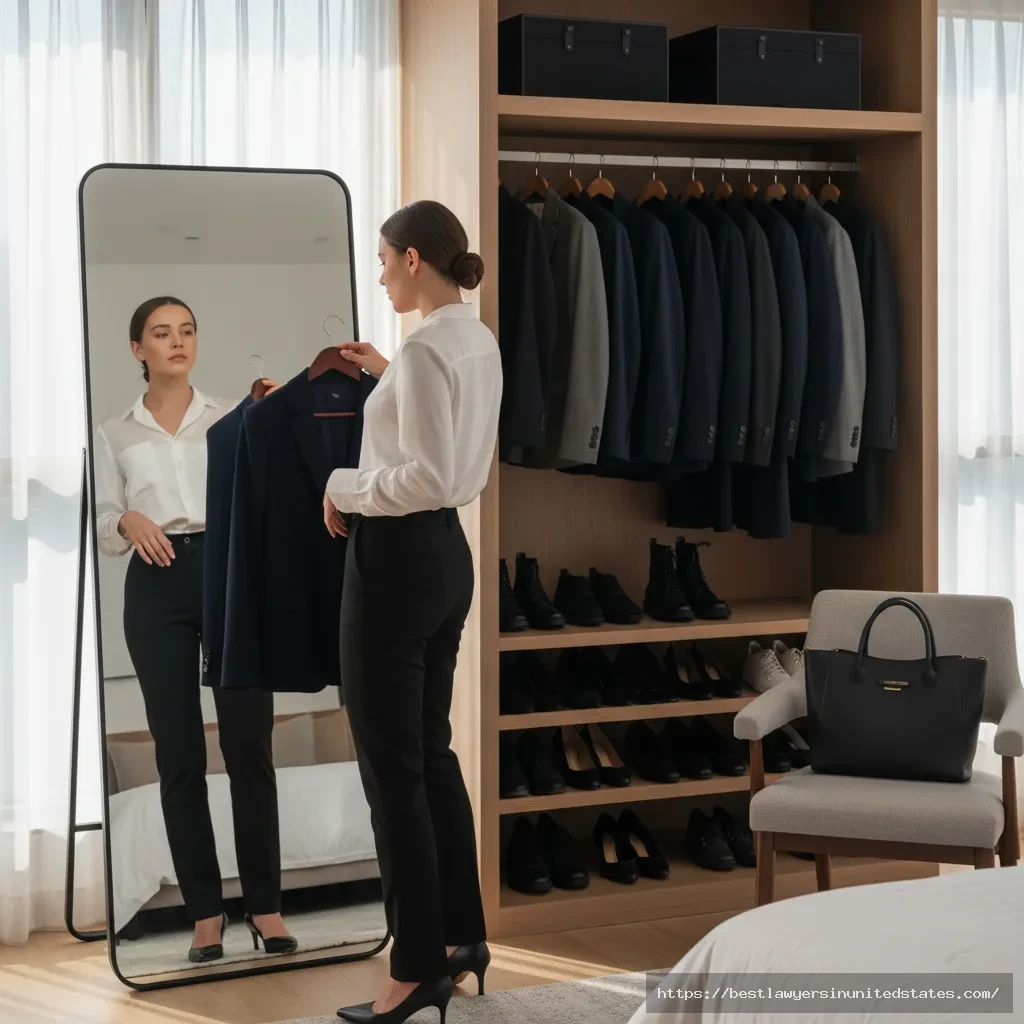
Trousers and Skirts
For trousers:
- Mid to high-waisted (flattering on most body types)
- Straight leg or slightly tapered (not skinny, not wide)
- Wrinkle-resistant fabrics (you’ll thank yourself during trial weeks)
Go for black, navy, gray, and one pair in camel or cream.
For skirts:
- Pencil skirts at or just below the knee
- A-line skirts for variety
- Avoid anything above the knee in court
Professional Dresses
Dresses are your one-and-done solution for busy mornings.
Look for:
- Sheath dresses (structured, professional)
- A-line dresses (flattering, comfortable)
- Knee-length or midi (nothing shorter)
- Solid colors or minimal prints
Add a blazer and you’re courtroom-ready in under 5 minutes.
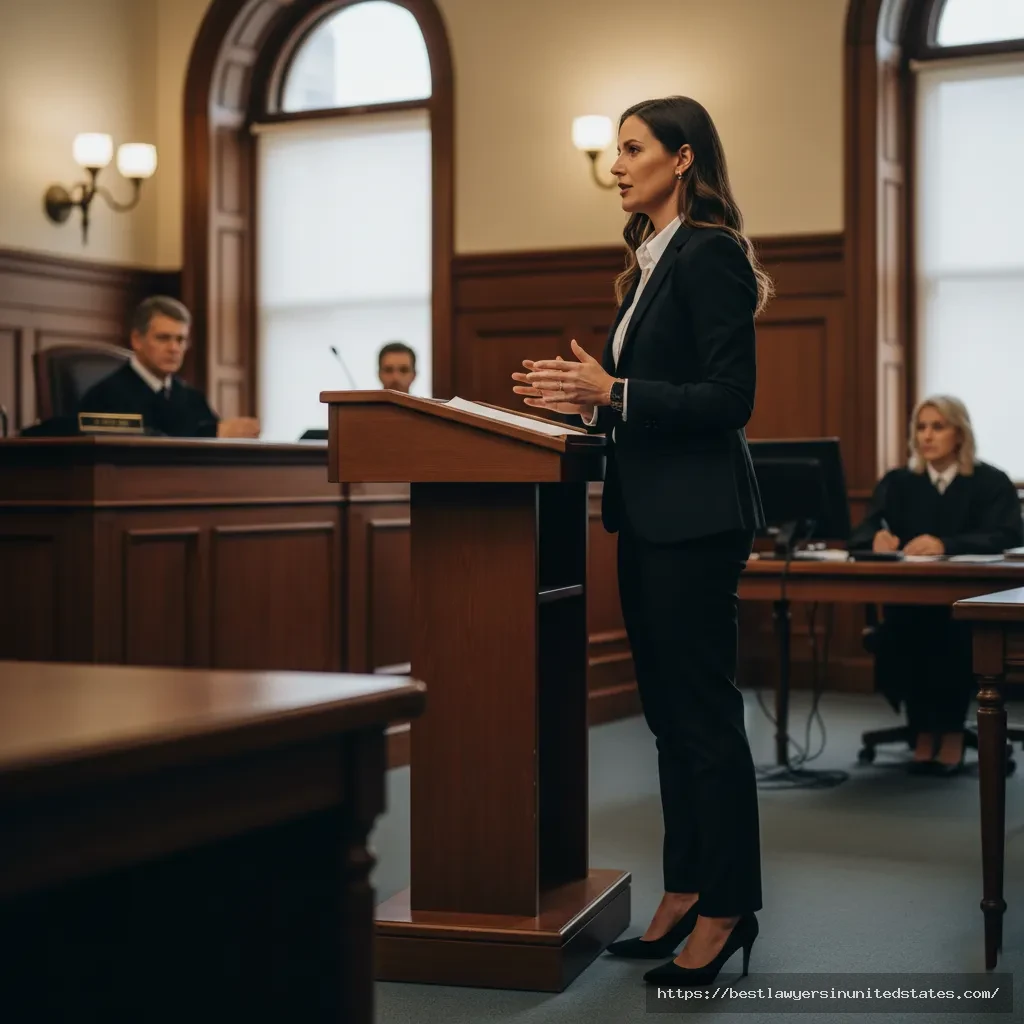
Blouses and Tops
Stock up on these:
- 3-5 white button-downs (crisp, classic, essential)
- 2-3 silk or poly blouses in soft colors (cream, blush, light blue)
- 1-2 shell tops (sleeveless for under blazers)
- 1 turtleneck or mock neck (winter staple)
Avoid anything sheer, low-cut, or sleeveless without a blazer.
The 3-3-3 Wardrobe Rule for Lawyers
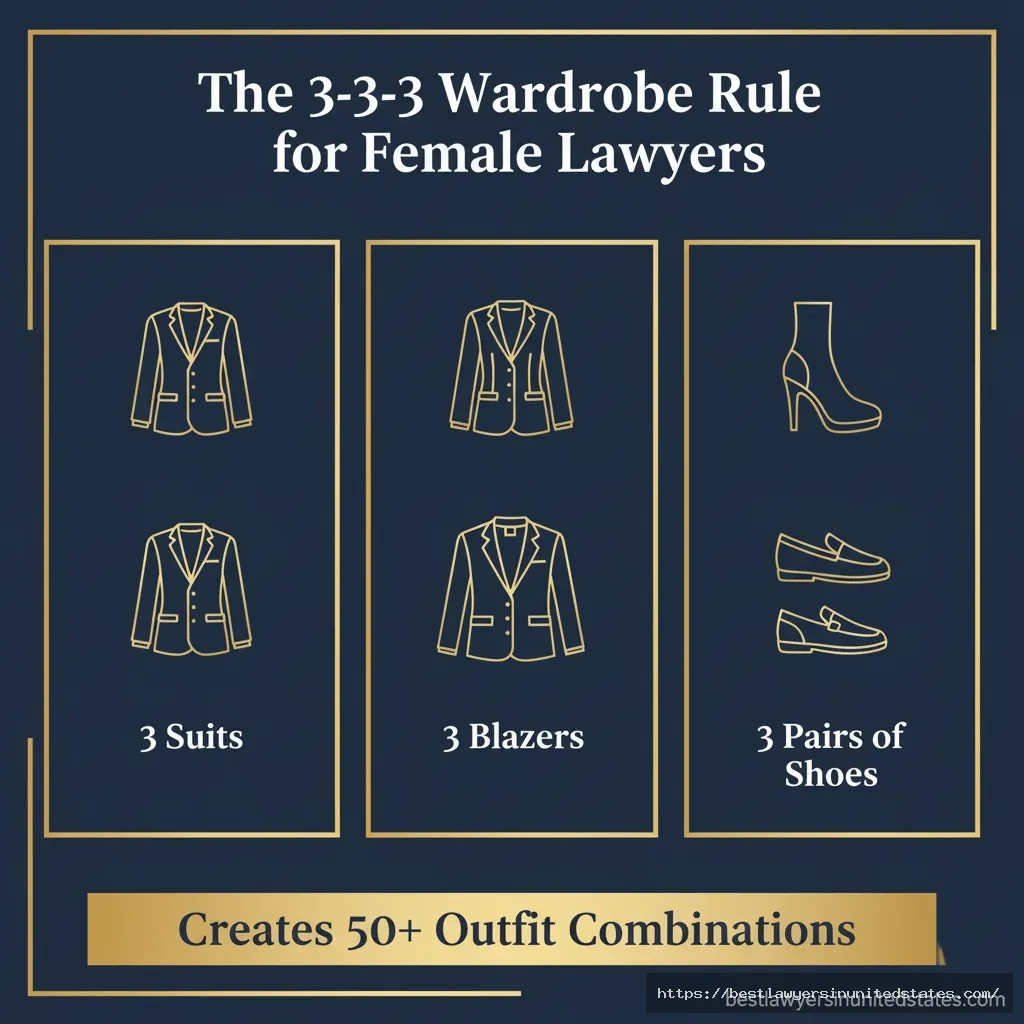
This is a game-changer if you’re overwhelmed by building a professional wardrobe.
The 3-3-3 rule means:
- 3 suits (navy, gray, black)
- 3 blazers (classic, modern, statement)
- 3 pairs of shoes (black pumps, nude heels, professional flats)
From these 9 pieces, you can create dozens of different outfits by rotating blouses, accessories, and styling.
Why This Works
✅ Prevents decision fatigue – Less time choosing outfits
✅ Maximizes versatility – Everything coordinates
✅ Budget-friendly – Quality over quantity
✅ Travel-ready – Pack smart for depositions or conferences
The 70/30 Wardrobe Rule
Here’s another smart framework: 70% classics, 30% current styles.
70% = Timeless pieces that never go out of style (navy suits, white blouses, black pumps)
30% = Modern touches that keep you looking current (updated blazer cuts, on-trend colors, contemporary accessories)
This balance keeps you professional while avoiding the “outdated lawyer” look.
How Many Suits Should a Female Lawyer Own?
Let’s answer this directly because it’s one of the most-searched questions.
Minimum for new lawyers: 3 suits
Comfortable rotation: 5-7 suits
Senior attorneys: 8-10+ suits
Here’s the breakdown:
| Career Stage | Number of Suits | Why |
|---|---|---|
| Law student/intern | 2-3 suits | Enough for interviews, mock trials, career events |
| First-year associate | 4-5 suits | Weekly court appearances, client meetings |
| Mid-level attorney | 6-8 suits | Multiple court days, business travel |
| Partner/senior counsel | 10+ suits | Variety for different clients, practice areas, settings |
Quality beats quantity. Three well-tailored suits will serve you better than seven cheap ones.

Best Colors for Female Lawyer Outfits
Color psychology matters in law. Here’s what different colors communicate.
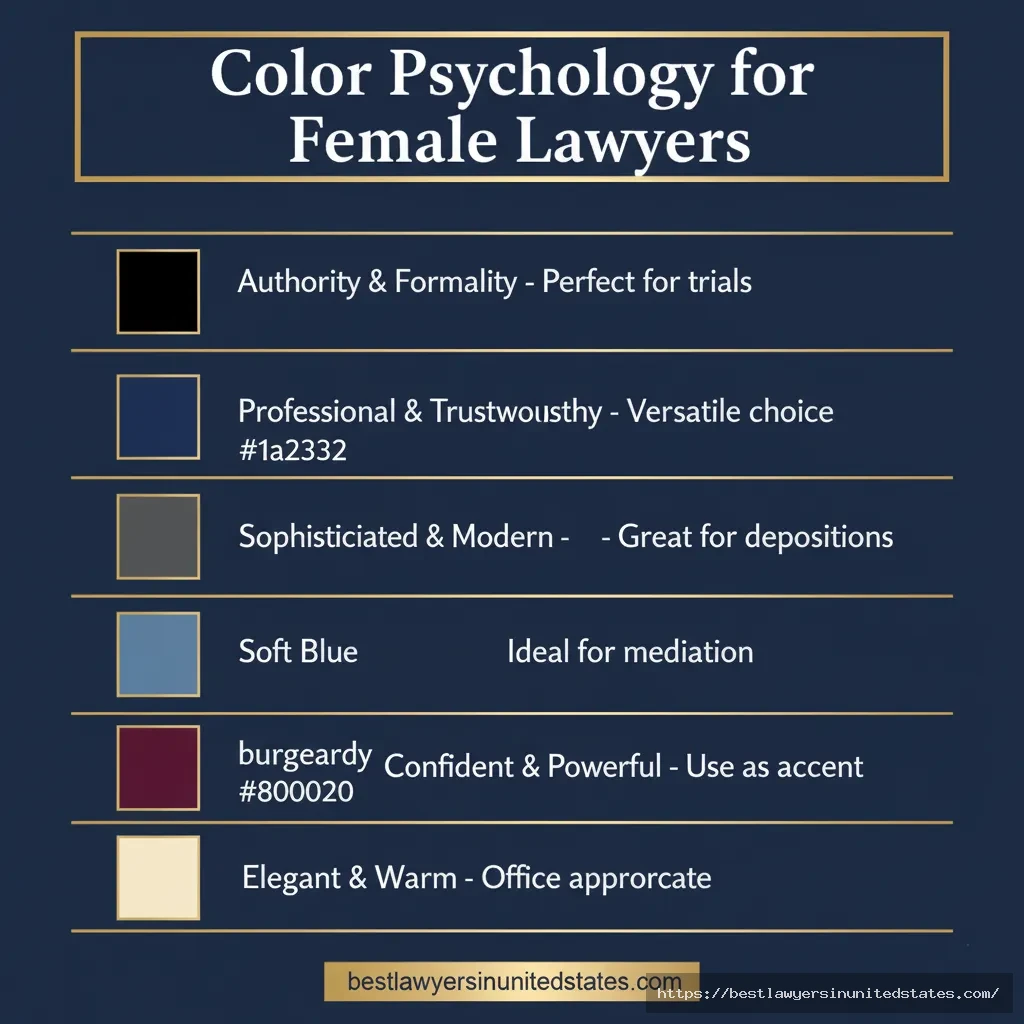
Classic Neutrals (Your Safe Zone)
Black – Maximum authority, seriousness, formality. Perfect for trials and hearings.
Navy – Professional but slightly warmer than black. Works everywhere.
Charcoal gray – Sophisticated and modern. Great for depositions and client meetings.
Beige/Camel – Approachable and polished. Better for office than court.
Soft Colors (When You Want Approachability)
Use these strategically:
- Soft blue – Trustworthy, calming (great for mediation)
- Blush/Dusty rose – Warm but professional
- Cream/Ivory – Elegant, softer than white
These work well for family law, estate planning, or collaborative practice.
Bold Colors (Controlled Confidence)
When you want to stand out:
- Deep burgundy – Rich, powerful
- Emerald green – Confident, memorable
- Royal blue – Strong but not harsh
The rule: Bold color on bottom (skirt/pants) or as an accent. Keep tops and blazers neutral for balance.
What Colors Are NOT Allowed in Court?
Most courts don’t have written color bans, but here’s what legal tradition says to avoid:
❌ Bright red – Can seem aggressive or distracting
❌ Neon or fluorescent anything – Unprofessional
❌ All-white suits – Too casual or attention-seeking
❌ Loud prints or patterns – Distracting to judges and juries
Stick to neutrals and muted tones in courtrooms. Save bolder choices for the office.
Footwear: Heels, Flats, and Everything Between
Your shoes complete the outfit—and they need to survive 10-hour days.
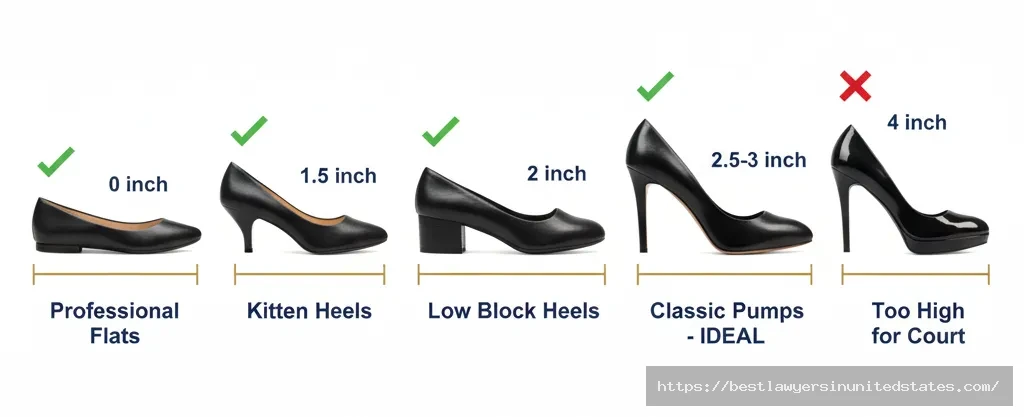
The Heel Debate
Do you need to wear heels as a lawyer?
No. But they do add formality and height (which can project authority).
Best heel heights for court:
- 2-3 inches – Professional without being too high
- Low block heels – Comfortable and stable
- Kitten heels – Classic, easy to walk in
When Flats Work
Modern professional flats are totally acceptable:
✅ Pointed-toe flats (not ballet flats)
✅ Loafers (polished leather, not casual)
✅ Ankle boots with dress pants (office appropriate)
Avoid: Sneakers, sandals, open-toe shoes, overly embellished flats.
Comfort Without Sacrificing Style
Look for:
- Cushioned insoles
- Quality leather (breathes better than synthetics)
- Brands known for comfort: Cole Haan, Naturalizer, Clarks, M.Gemi
Pro tip: Keep a pair of professional flats under your desk for long court days.
The Great Pantyhose Debate: Do You Really Need Them?
This is one of the most controversial questions in legal fashion. Let’s settle it.
The Traditional Rule
Old-school dress codes required pantyhose or stockings with skirts and dresses. Many courts (especially in conservative regions) still expect it.
The Modern Reality
It depends on:
- Geographic region – East Coast and Southern courts tend to be more traditional
- Judge preferences – Some judges notice, some don’t care
- Season – More acceptable to go bare-legged in summer
- Your firm’s culture – Big Law firms lean conservative
When You Should Wear Hosiery
✅ Federal court appearances
✅ Trials with older judges
✅ Conservative jurisdictions
✅ Winter months (practical + professional)
✅ When you’re unsure (better safe than sorry)
When You Can Skip It
✅ Casual office days
✅ Summer weather in progressive cities
✅ Internal meetings only
✅ Your firm explicitly allows it
The safest bet? Bring nude hosiery in your bag. You can always put them on before court if needed.
Accessories That Elevate Your Look
The right accessories add polish without distraction.
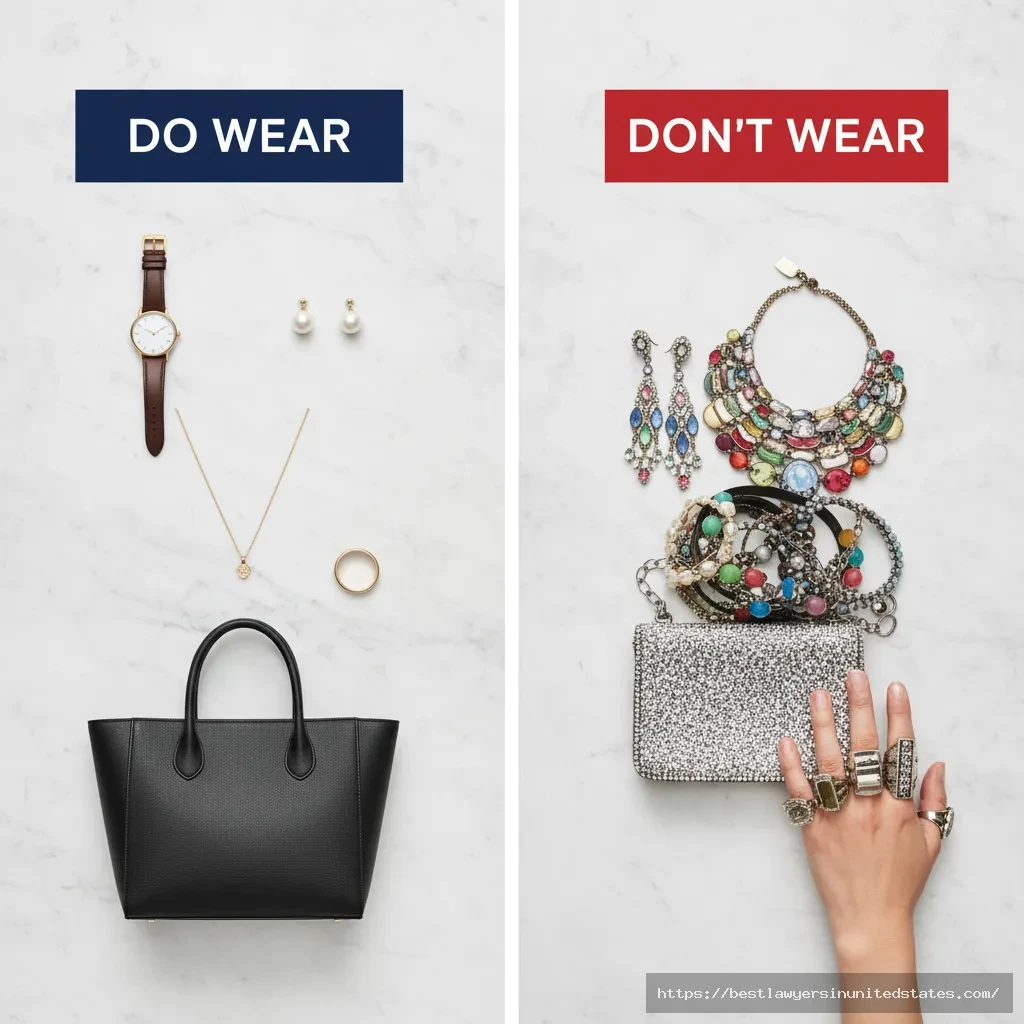
Watches
A classic watch is a power move. Go for:
- Simple leather or metal band
- Minimal face (not oversized or flashy)
- Neutral colors (black, brown, gold, silver)
Avoid smartwatches in court—some judges view them as unprofessional.
Jewelry (The Less-Is-More Rule)
What works:
- Stud earrings (pearl, diamond, gold)
- Small hoops (under 1 inch)
- Simple necklace (delicate chain or pendant)
- One ring per hand (wedding/engagement is fine)
What doesn’t:
- Dangly earrings that move when you talk
- Noisy bracelets that clink
- Statement necklaces that compete with your face
- Multiple rings per finger
Bags
Your bag carries your legal life. Choose wisely:
Best styles:
- Structured tote (professional, spacious)
- Leather briefcase (classic, authoritative)
- Satchel (modern, practical)
Colors: Black, brown, navy, or tan
Must-haves: Laptop compartment, separate section for files, quality hardware.
Hair and Makeup: The Professional Polish
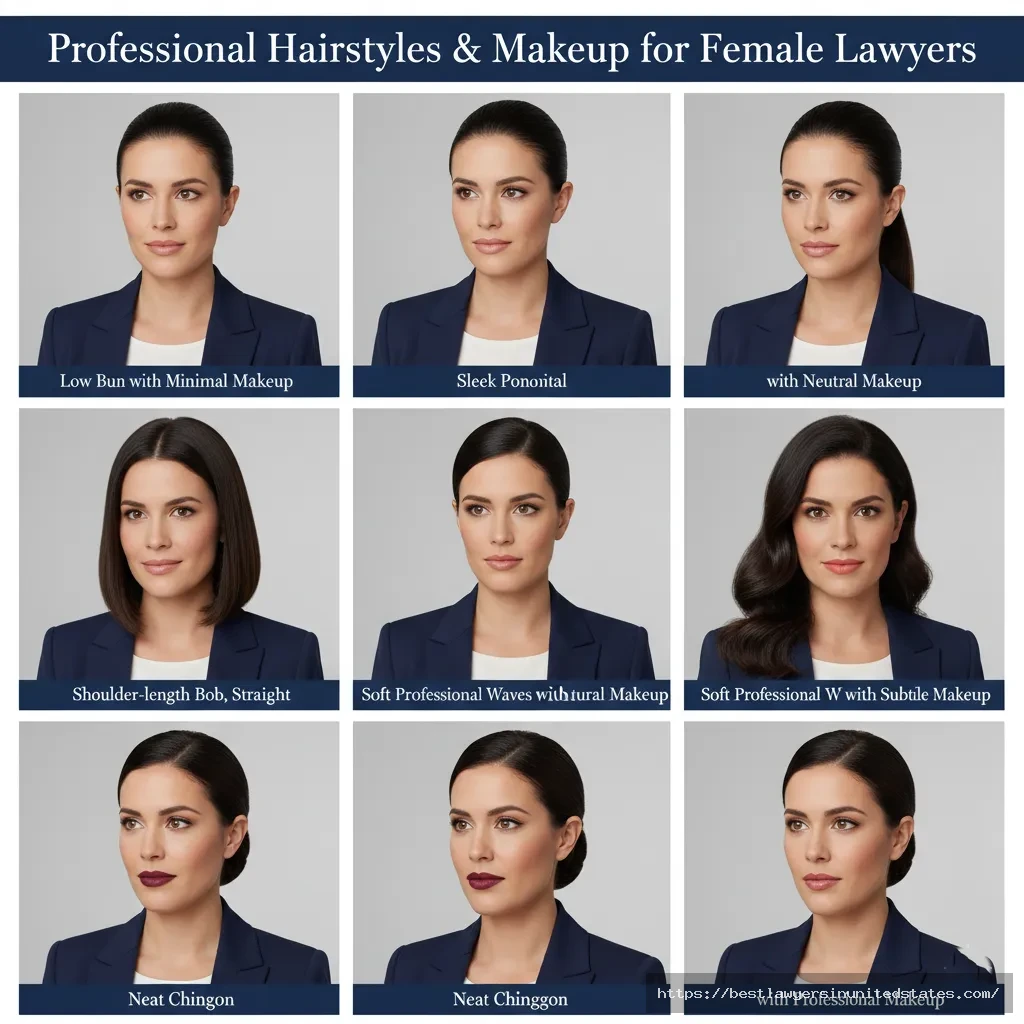
Your grooming matters as much as your outfit.
Professional Hairstyles for Lawyers
What works in court:
✅ Low bun or chignon (polished, stays put)
✅ Sleek ponytail (modern, neat)
✅ Straight and down (if well-maintained)
✅ Soft waves (professional, not too styled)
✅ Bob or lob (classic, easy to manage)
What to avoid:
❌ Messy buns or “I just woke up” hair
❌ Overly trendy styles (like Instagram-worthy braids)
❌ Hair covering your face
❌ Bright or unnatural hair colors (in conservative settings)
Color considerations: Natural tones are safest. If you color your hair, keep roots touched up.
Makeup for Court and Office
The goal: polished and awake, not made-up.
The formula:
- Foundation/BB cream – Even skin tone
- Concealer – Under eyes, blemishes
- Neutral eyeshadow – Browns, taupes, soft grays
- Mascara – Opens eyes
- Brow pencil – Frames face
- Neutral lip – Nude, mauve, soft pink, or classic red (if confident)
Skip: Heavy contouring, dramatic eyeliner, glitter, overly glossy lips.
Pro tip: Your makeup should look the same under fluorescent courtroom lighting as it does in your bathroom.
Seasonal Outfit Strategies
Your wardrobe needs to adapt without losing professionalism.
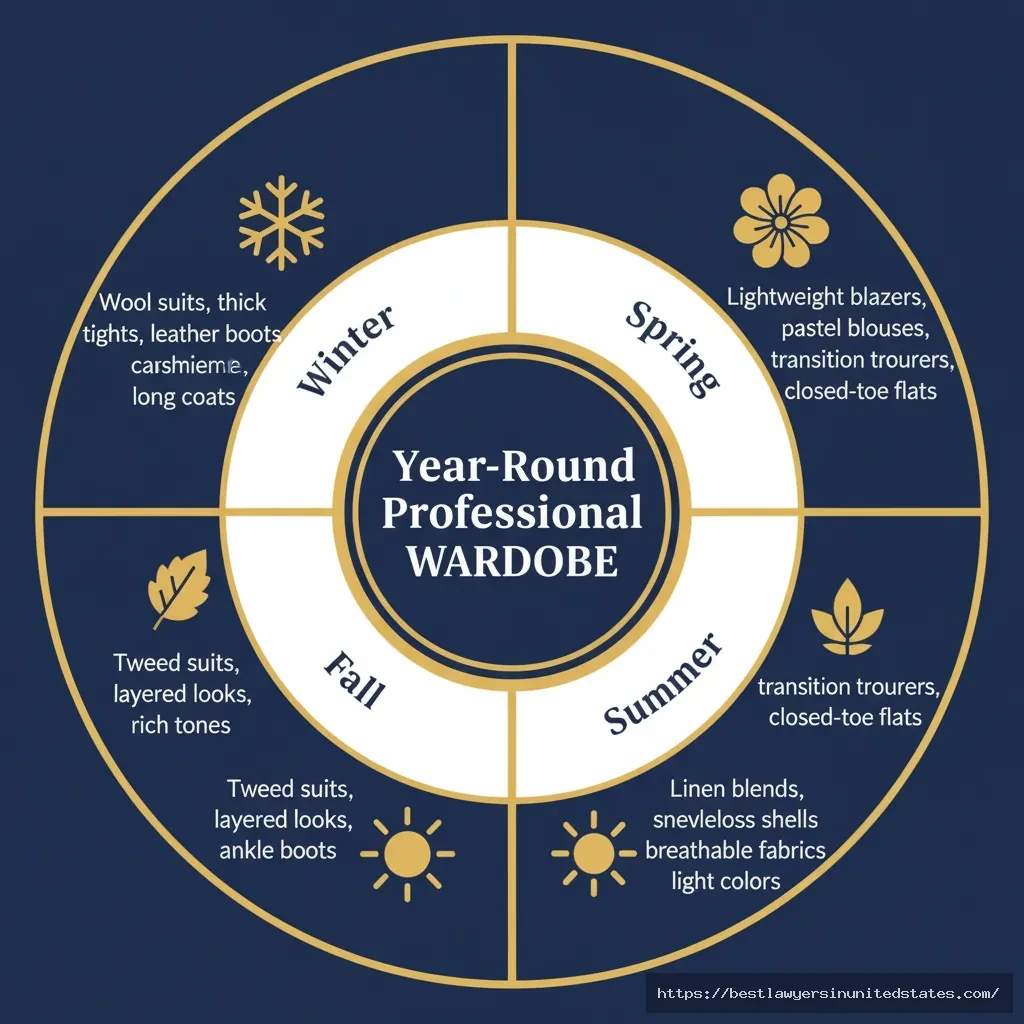
Summer Lawyer Outfits (Stay Cool, Stay Professional)
Fabric choices:
- Lightweight wool (yes, summer wool exists)
- Cotton blends
- Linen (only if it doesn’t wrinkle easily)
- Moisture-wicking blends
Outfit ideas:
Look 1: Light gray suit + sleeveless shell + nude block heels
Look 2: Navy sheath dress + tan blazer + pointed flats
Look 3: Cream trousers + soft blue blouse + navy blazer + sandals (office only)
Summer tips:
- Keep a blazer at the office (AC can be cold)
- Sleeveless is fine UNDER a blazer
- Avoid visible sweat stains—choose breathable fabrics
- Closed-toe shoes still apply in court
Winter Professional Styles (Layer Smart)
Your winter essentials:
- Wool or cashmere coat (knee-length, neutral)
- Thick tights (black or nude, 40+ denier)
- Leather boots (professional ankle or knee boots)
- Turtlenecks (under blazers or alone)
- Cardigans (cashmere or merino wool)
Outfit ideas:
Look 1: Black suit + turtleneck + wool coat + leather boots
Look 2: Charcoal dress + thick tights + blazer + ankle booties
Look 3: Navy trousers + cream sweater + camel coat + heeled boots
Winter tips:
- Layer smartly—you’ll remove your coat indoors
- Keep court shoes at the office; wear boots during commute
- Avoid bulky scarves that wrinkle your suit
Dress Code by Legal Specialty
Different practice areas have slightly different style expectations.
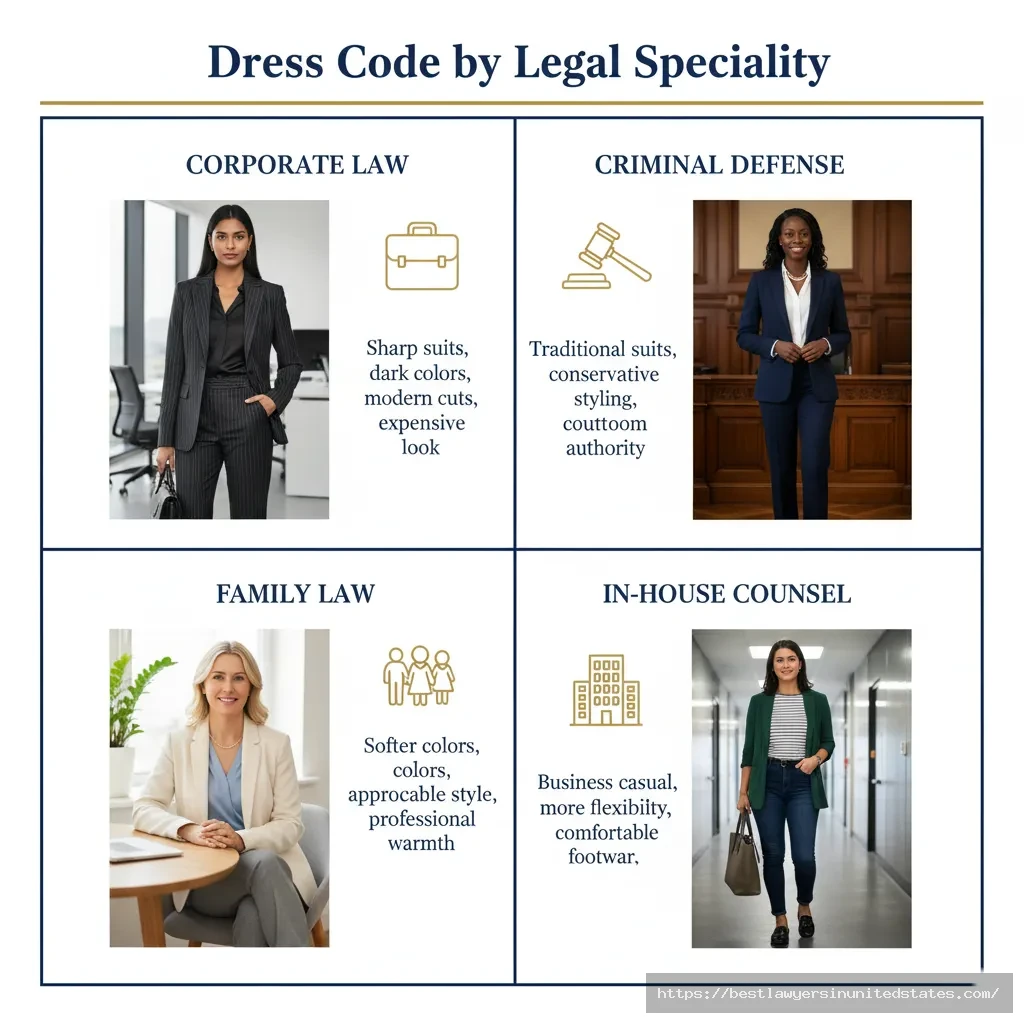
Corporate Law (Boardroom Ready)
The vibe: Sharp, modern, powerful
Go for:
- Tailored pantsuits in dark colors
- Structured blazers with clean lines
- Minimal accessories
- Expensive-looking (even if not expensive)
Brands: Theory, Hugo Boss, Brooks Brothers
Criminal Defense (Courtroom Command)
The vibe: Authoritative, no-nonsense
Go for:
- Traditional suits (navy, black, charcoal)
- Conservative styling
- Closed-toe pumps
- Minimal jewelry
You’re often in front of juries—your clothes shouldn’t distract.
Family Law (Approachable Authority)
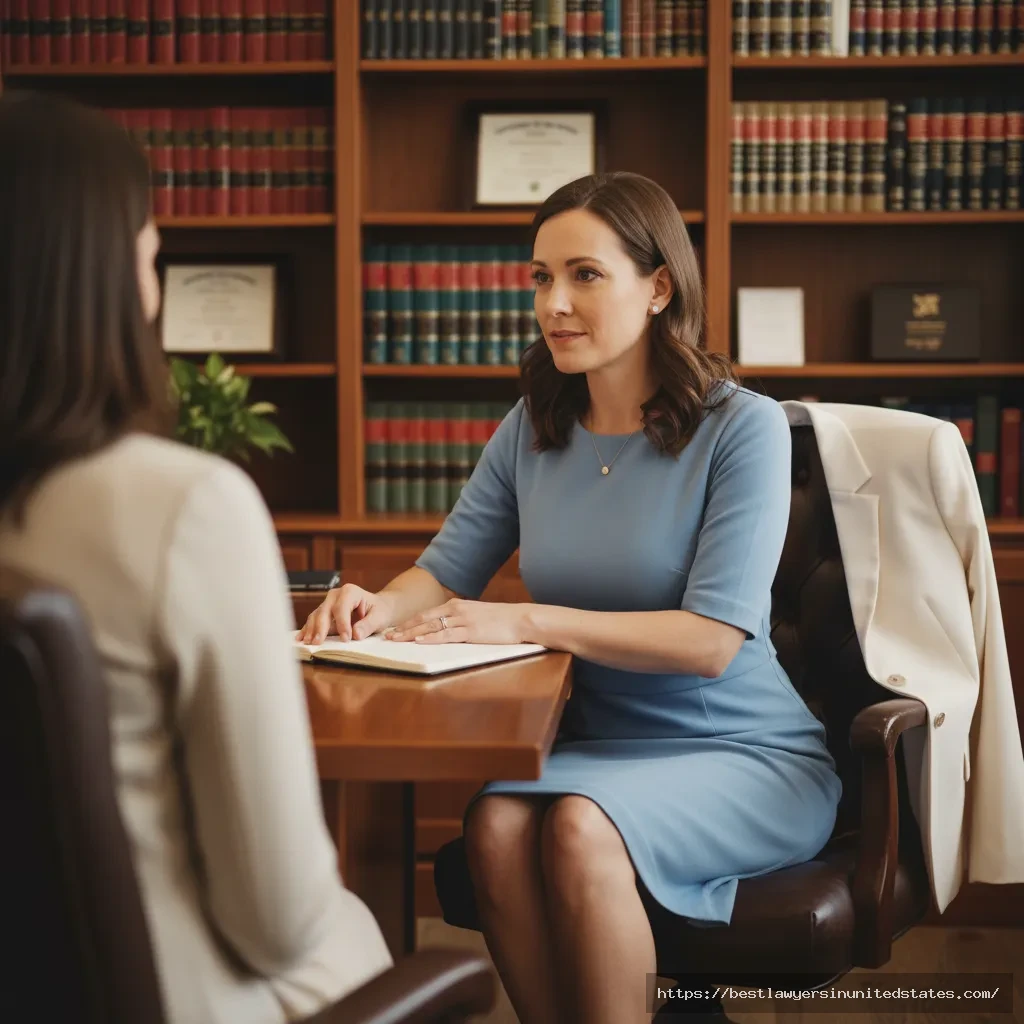
The vibe: Professional but warm
Go for:
- Softer colors (navy, gray, soft blue)
- Less severe tailoring
- Dresses with blazers
- Friendly but polished
Your clients are often emotional—you want to seem accessible.
In-House Counsel (Modern Professional)
The vibe: Polished but less formal
Go for:
- Business casual most days
- Save suits for board meetings
- More color and pattern freedom
- Comfortable shoes (you’re not in court)
Public Interest/Legal Aid (Practical Professional)
The vibe: Professional on a budget
Go for:
- Mix-and-match basics
- Affordable brands (H&M, Uniqlo, Target)
- Comfort over luxury
- Still court-appropriate when needed
Family law attorneys often handle emotionally charged family law cases involving divorce, custody, and mediation—which is why approachable yet authoritative attire works best in this practice area.
Country-Specific Dress Codes for Female Lawyers
Legal dress codes vary dramatically around the world.
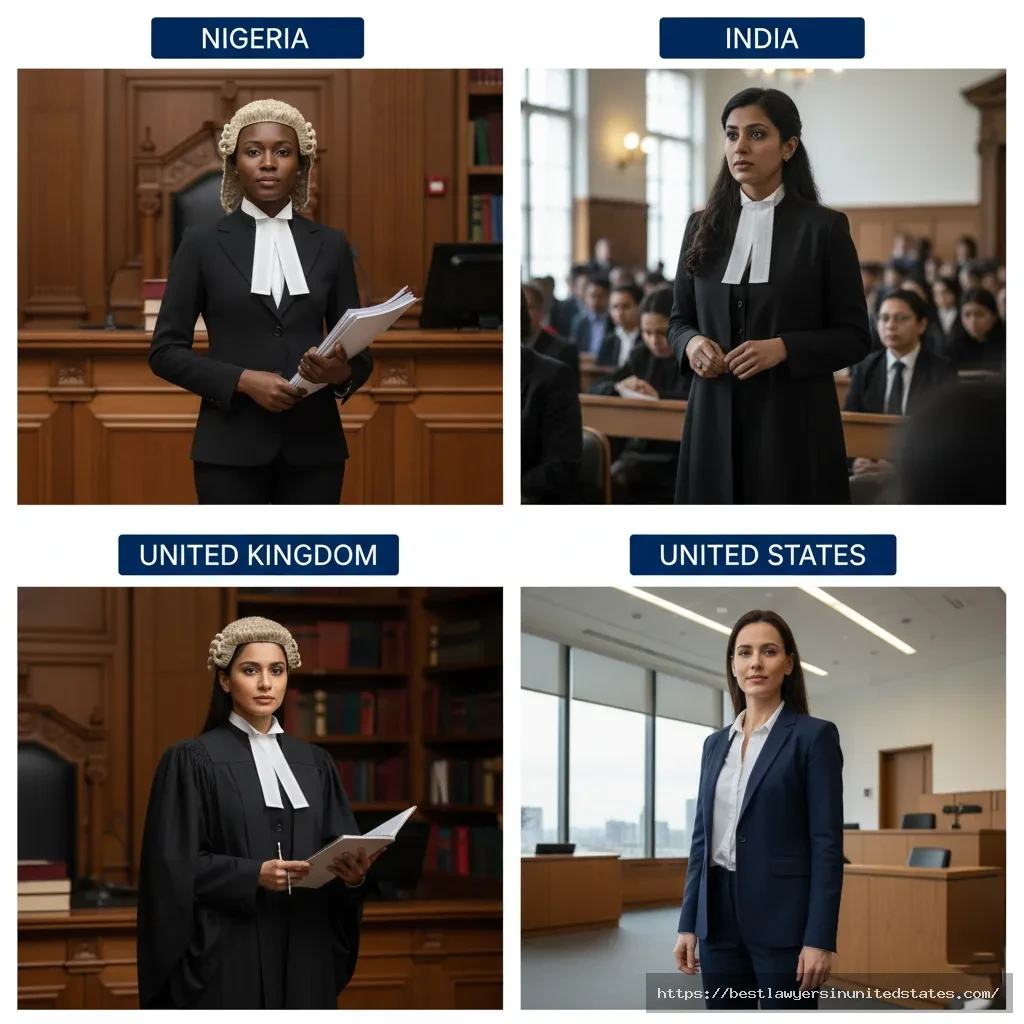
United States
Standard: Business formal in court, business casual in office
Regional differences:
- East Coast – More traditional, conservative
- West Coast – Slightly more relaxed
- Southern states – Very traditional, hosiery often expected
Nigeria (Barrister Requirements)
Court attire:
- Black suit or dress
- White long-sleeved shirt (with collar and cuffs)
- Black shoes (closed-toe)
- Black skirt below the knee
- Barrister’s wig and gown required in court
Office wear: Business formal, conservative colors
India (Advocate Dress Code)
Court attire:
- Black coat (jacket)
- White shirt or blouse with band collar
- Black trousers or black saree (if saree, must be sober-colored)
- Black shoes
- Advocate bands (white strips at collar)
Office wear: Business attire, salwar kameez acceptable at many firms
Pakistan (Female Advocate Dress)
Court attire:
- Black coat
- White shirt
- Black trousers or long skirt
- Dupatta or scarf (modest covering)
- Black closed-toe shoes
Office wear: Modest professional attire, many wear shalwar kameez
United Kingdom (Solicitor vs. Barrister)
Barristers in court:
- Dark suit
- White shirt
- Black court shoes
- Barrister’s wig and gown (in higher courts)
Solicitors:
- Business formal in court
- Business casual in office
South Africa
Court attire:
- Black gown over business attire
- Conservative suit underneath
- Black or dark shoes
Office wear: Standard business attire
Legal dress codes vary dramatically around the world, and understanding female lawyer dress code standards in your jurisdiction is crucial for professional success.
Career Day Lawyer Costume Ideas (For Kids & Students)
Lots of students search for “lawyer outfit for career day.” Here’s how to pull it together.
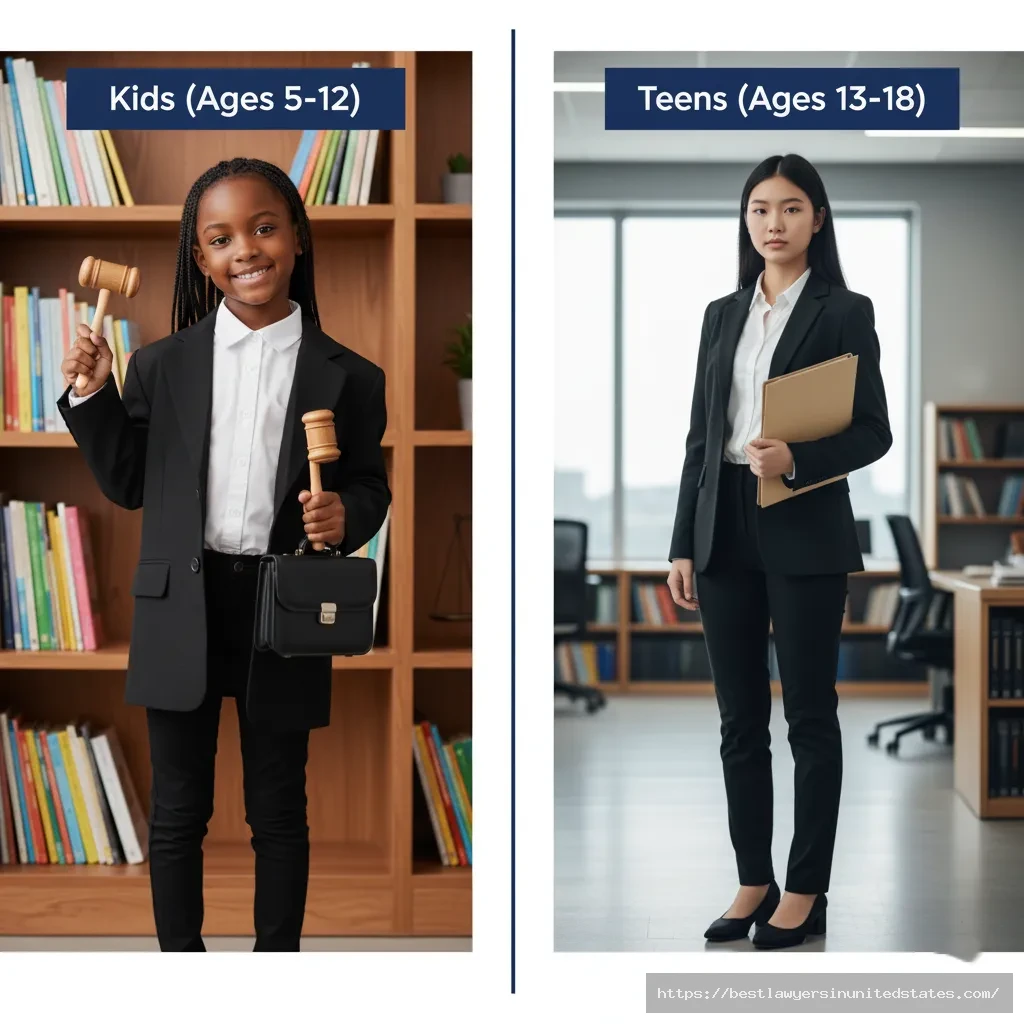
For Kids (Elementary/Middle School)
Basic costume:
- Black pants or skirt (from their regular wardrobe)
- White button-up shirt
- Black blazer (borrow from parent or thrift store)
- Toy briefcase or folder with “legal documents”
- Glasses (even fake ones) for the “smart lawyer” look
Where to find pieces:
- Thrift stores (Goodwill, Salvation Army)
- Amazon (affordable kids’ blazers)
- Target or H&M kids section
For High School/College Students
More authentic look:
- Black or navy suit (can be borrowed)
- Professional blouse
- Closed-toe flats or low heels
- Structured bag or briefcase
- Minimal makeup
Budget tip: Check Poshmark or ThredUp for secondhand professional wear.
15+ Complete Outfit Formulas for Female Lawyers
Stop overthinking your wardrobe. Use these proven combinations.
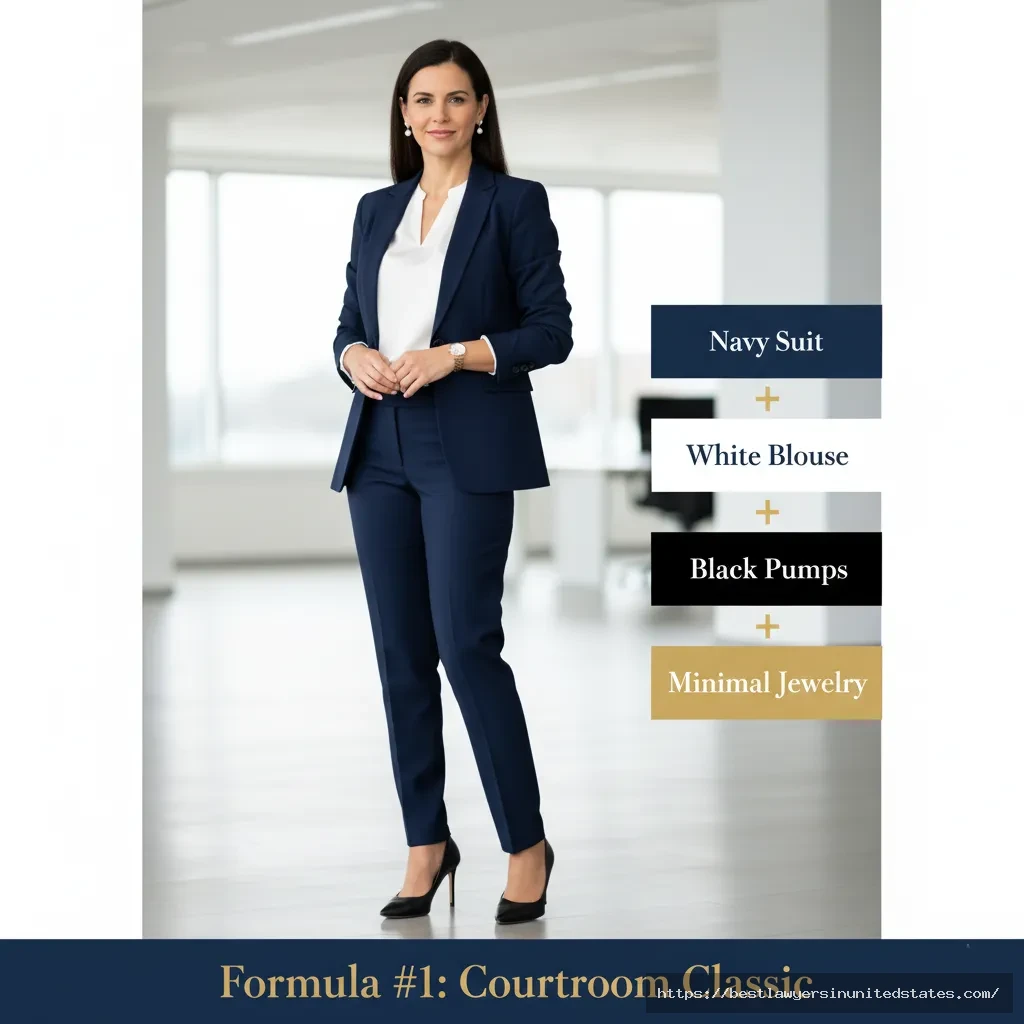
Courtroom Outfits
Formula 1: Navy suit + white blouse + black pumps + stud earrings
Formula 2: Black pantsuit + cream shell + nude heels + simple watch
Formula 3: Charcoal skirt suit + light blue blouse + black heels + pearl studs
Office Outfits
Formula 4: Gray trousers + navy blazer + soft pink blouse + loafers
Formula 5: Black pencil skirt + white button-down + camel blazer + flats
Formula 6: Navy dress + gray cardigan + nude heels + simple necklace
Client Meeting Outfits
Formula 7: Navy suit + silk blouse (cream or blush) + black pumps
Formula 8: Black sheath dress + blazer + professional tote
Formula 9: Gray trousers + structured top + statement blazer + heels
Business Casual (Office Only)

Formula 10: Dark jeans + blazer + blouse + ankle boots
Formula 11: Knit dress + cardigan + flats + minimal jewelry
Formula 12: Trousers + turtleneck + blazer + loafers
Summer Professional
Formula 13: Light suit + sleeveless shell + block heels
Formula 14: Linen-blend trousers + cotton blouse + blazer + flats
Formula 15: Sheath dress + lightweight blazer + sandals (office only)
Winter Layers
Formula 16: Suit + turtleneck + wool coat + boots
Formula 17: Dress + thick tights + blazer + booties
Formula 18: Trousers + sweater + long coat + heeled boots
Shopping Guide: Where to Buy Lawyer Outfits
Let’s talk real recommendations and price points.
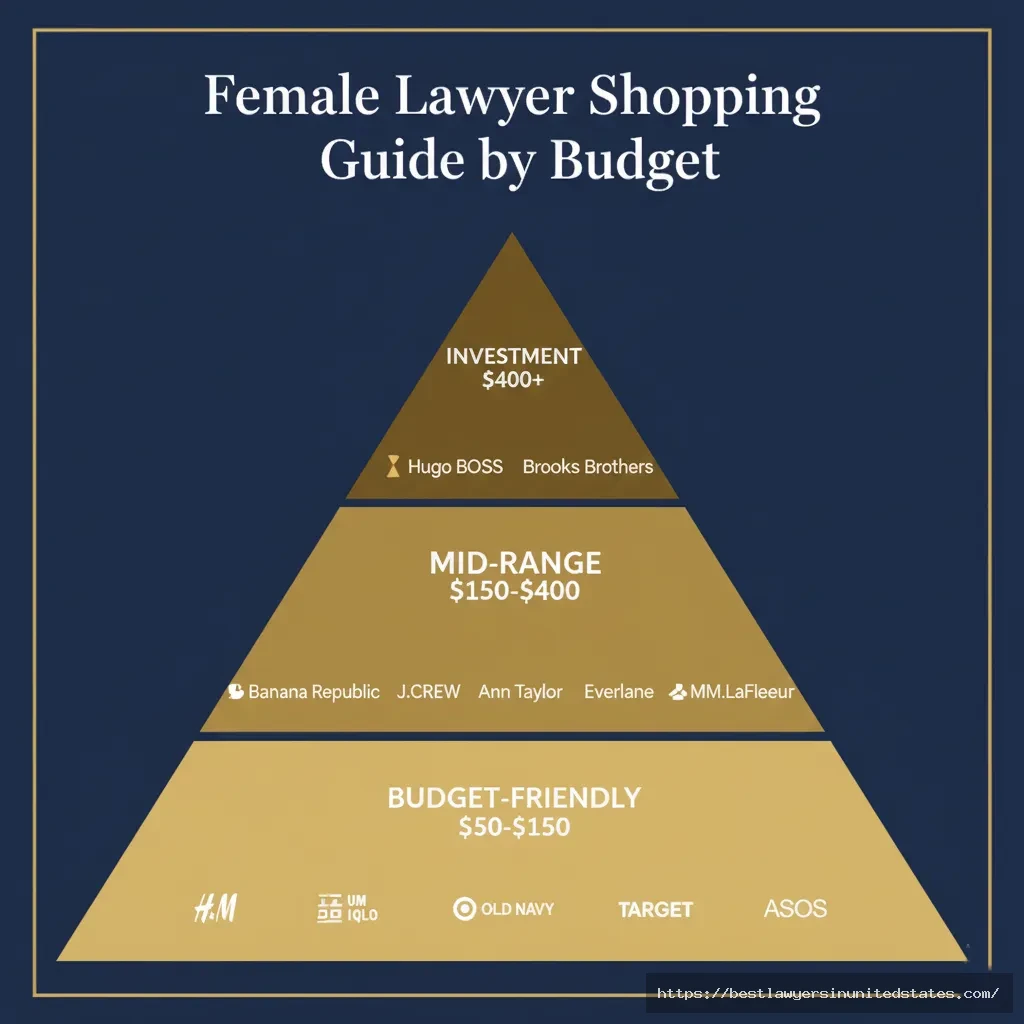
Budget-Friendly ($50-$150 per piece)
Brands:
- H&M – Affordable basics, trendy cuts
- Uniqlo – Quality fabrics, minimalist
- Target (A New Day line) – Surprisingly good workwear
- Old Navy – Budget suits and separates
- ASOS – Online, huge selection
Best for: New lawyers, law students, building your first wardrobe
Mid-Range ($150-$400 per piece)
Brands:
- Banana Republic – Classic workwear staple
- J.Crew – Polished, preppy professional
- Ann Taylor – Traditional office wear
- Everlane – Sustainable, modern basics
- MM.LaFleur – Designed specifically for working women
Best for: Established lawyers, quality investment pieces
Investment/Luxury ($400+ per piece)
Brands:
- Theory – Perfect tailoring, timeless
- Hugo Boss – Sharp, powerful cuts
- Max Mara – Italian craftsmanship
- Brooks Brothers – Classic American professional
- Akris – High-end, impeccable fit
Best for: Partners, senior counsel, special occasions (trials, important hearings)
Plus-Size Options
Brands:
- Eloquii – Modern, stylish workwear
- Universal Standard – Size-inclusive basics
- Lane Bryant – Affordable professional wear
- Marina Rinaldi – High-end plus sizes
Petite Options
Brands:
- Ann Taylor Petite – Full petite line
- Banana Republic Petite – Good selection
- LOFT Petite – Affordable and work-appropriate
Where to Shop Online
✅ Nordstrom – Great return policy, all price points
✅ Bloomingdale’s – Designer options, frequent sales
✅ Saks Off Fifth – Designer discounts
✅ ThredUp – Secondhand professional wear
✅ Poshmark – Gently used designer pieces
Outfit Mistakes to Avoid
Even experienced lawyers make these errors.
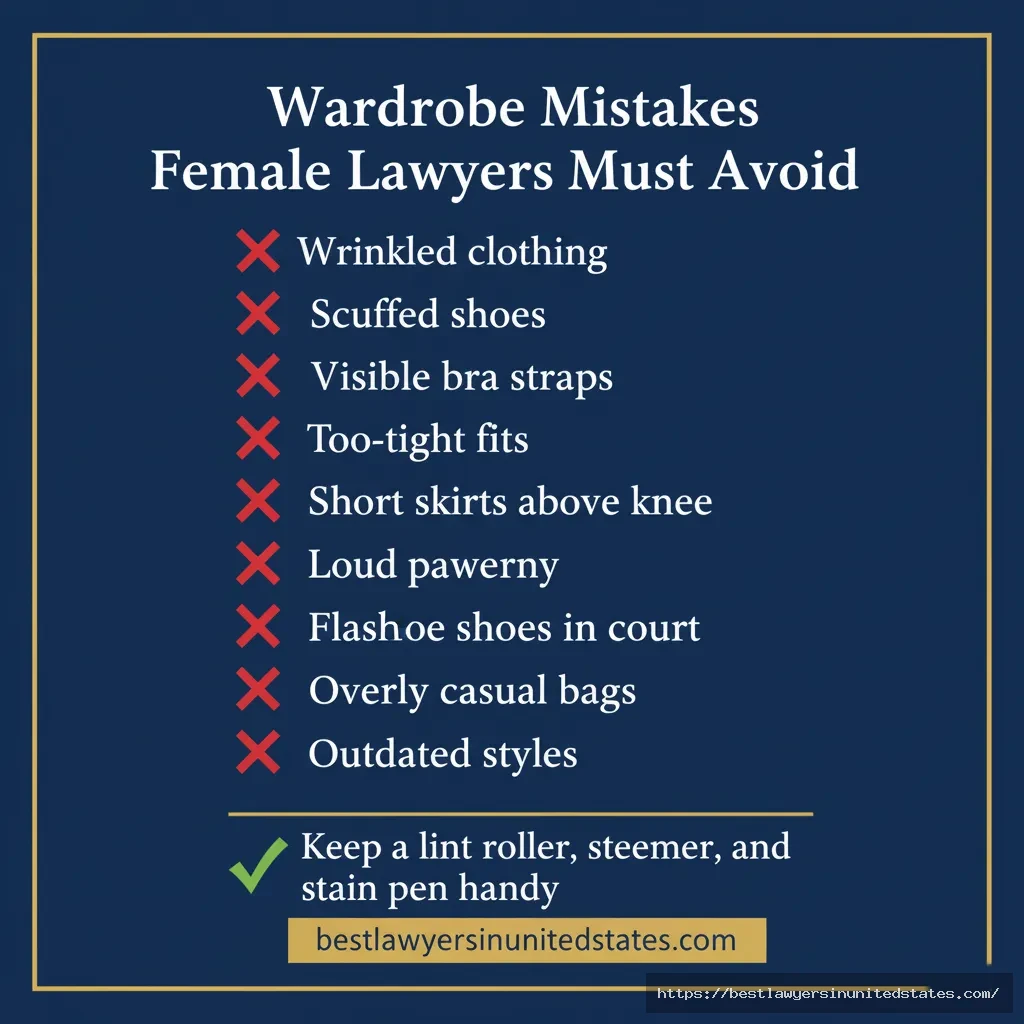
Don’t Do This:
❌ Wearing wrinkled clothes – Invest in a steamer
❌ Showing too much skin – No cleavage, no thigh
❌ Loud patterns – Save the leopard print for weekends
❌ Scuffed or worn-out shoes – Polish or replace them
❌ Over-accessorizing – Pick 2-3 pieces max
❌ Visible bra straps – Ever
❌ Too-tight clothing – If you’re tugging at it, it doesn’t fit
❌ Gym bag as work bag – Get a professional tote
❌ Forgetting to check yourself – Mirrors exist for a reason
Quick Maintenance Checklist
✅ Lint roller in your desk drawer
✅ Stain remover pen in your bag
✅ Safety pins for emergencies
✅ Backup hosiery at the office
✅ Breath mints (not fashion, but important)
✅ Tide stick for coffee spills
Budget Wardrobe Building Plan
You don’t need $10,000 to dress professionally.
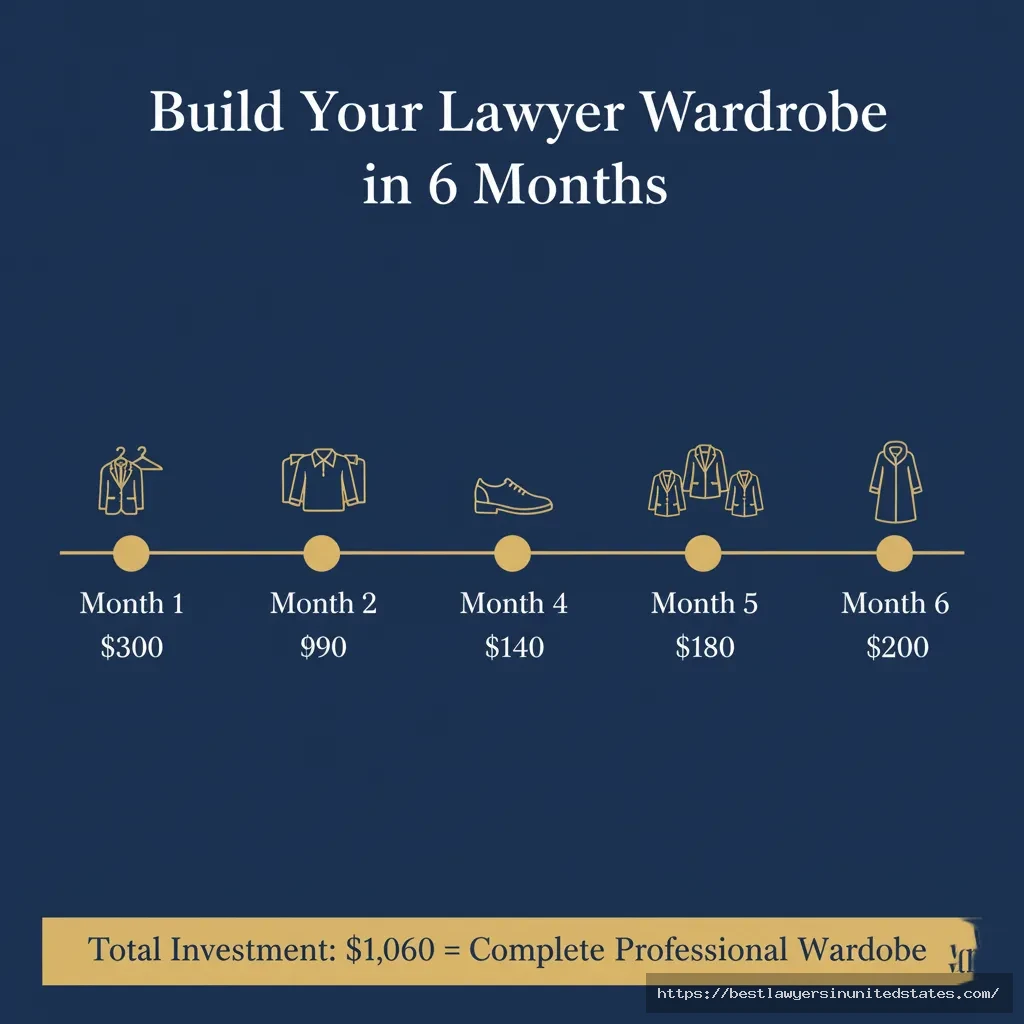
Starter Wardrobe ($500-$700)
Suits: 2 suits at $150 each = $300
Blouses: 3 blouses at $30 each = $90
Shoes: 1 pair of heels ($80) + 1 pair of flats ($60) = $140
Bag: 1 professional tote = $80
Accessories: Watch + basic jewelry = $100
Total: $710
Growing Your Wardrobe (Year 1)
Add one piece per month:
- Month 1: Third suit
- Month 2: Quality blazer
- Month 3: Two more blouses
- Month 4: Professional dress
- Month 5: Second pair of heels
- Month 6: Winter coat
Monthly budget: $100-$150
Quality vs. Quantity Strategy
Invest more in:
- Suits (you’ll wear them constantly)
- Shoes (cheap shoes look cheap)
- Your bag (clients notice)
- Outerwear (lasts years)
Save money on:
- Blouses (trends change)
- Summer pieces (less wear)
- Accessories (affordable options look fine)
Essential Wardrobe Checklist
Use this as your shopping guide:
| Item | Minimum | Ideal | Priority |
|---|---|---|---|
| Suits (full) | 2 | 5 | High |
| Blazers | 2 | 4 | High |
| Dress pants | 3 | 6 | High |
| Pencil skirts | 1 | 3 | Medium |
| Professional dresses | 2 | 4 | Medium |
| Blouses (white) | 2 | 4 | High |
| Blouses (colors) | 2 | 5 | Medium |
| Pumps/heels | 1 | 3 | High |
| Professional flats | 1 | 2 | High |
| Work bag | 1 | 2 | High |
| Winter coat | 1 | 1 | High |
| Cardigans | 1 | 3 | Low |
Final Thoughts: Dress Like You’ve Already Made Partner
Here’s the truth: nobody has their wardrobe perfectly figured out.
Even senior partners sometimes stand in their closet wondering what to wear. The difference is they’ve built systems that work—capsule wardrobes, go-to outfit formulas, and a handful of quality pieces they can rely on.
Your wardrobe is an investment in your career. Not because superficial appearances matter more than your legal skills, but because looking the part removes barriers. When you walk into a courtroom or client meeting dressed with confidence, you’re free to focus on what actually matters: your arguments, your strategy, your advocacy.
Start with the basics. Build slowly. Invest in quality where it counts. And remember—the best outfit is the one that makes you feel like you can take on any case that walks through your door.
Frequently Asked Questions
1. What should a female lawyer wear to court?
A tailored suit in navy, black, or charcoal gray with a conservative blouse, closed-toe heels or professional flats, and minimal jewelry. Avoid anything flashy, too tight, or casual. In some jurisdictions, hosiery is still expected with skirts.
2. Can female lawyers wear dresses?
Yes. Professional sheath or A-line dresses at knee-length are appropriate with a blazer. Choose structured fabrics, modest necklines, and solid colors or minimal prints. Avoid anything too form-fitting or trendy.
3. Are jeans ever acceptable for lawyers?
In modern, casual law firms (like tech startups or some non-profits), dark jeans with a blazer may be acceptable on non-court days. Traditional firms and courtrooms? Absolutely not. When in doubt, don’t.
4. Do female lawyers have to wear pantyhose?
It depends on your region and court. Conservative jurisdictions (especially East Coast and Southern states) often expect hosiery. Progressive West Coast courts are more flexible. Check local customs and when uncertain, wear them.
5. How many suits should a female lawyer own?
Start with 3 suits minimum. A comfortable professional rotation is 5-7 suits. Senior attorneys often have 10+ suits for variety across different settings and practice areas.
6. What colors are best for female lawyer outfits?
Navy, black, charcoal gray, and beige are your foundation. Soft blues, blush, and cream work for approachability. Bold colors like burgundy or emerald can work as accents but should be used sparingly in court.
7. Are blazers essential for female lawyers?
Yes. Blazers add structure, formality, and authority to any outfit. Even with a dress or dress pants and blouse, a blazer completes the professional look. Every lawyer should own at least 3 quality blazers.
8. What is the best hairstyle for female lawyers?
Low buns, sleek ponytails, straight hair, or professional waves work best. Your hair should be neat, off your face, and not distracting. Avoid overly trendy styles or bright colors in conservative settings.
9. Can I wear flats instead of heels as a lawyer?
Absolutely. Professional pointed-toe flats, loafers, or polished ankle boots are completely acceptable. Comfort matters, especially during long court days. Just avoid casual ballet flats or sneakers.
10. How can a law intern dress professionally on a budget?
Focus on basics: 2-3 suits in neutral colors, white blouses, one blazer, and one pair of professional shoes. Shop at H&M, Uniqlo, Target, or thrift stores. Mix and match pieces to create multiple outfits. Quality basics beat cheap trendy pieces.
11. What’s the 3-3-3 wardrobe rule?
Own 3 suits, 3 blazers, and 3 pairs of professional shoes. This creates a versatile foundation that can be mixed and matched with different blouses and accessories to create dozens of outfits.
12. What should I not wear to court as a female lawyer?
Avoid short skirts, sleeveless tops without a blazer, open-toe shoes, loud patterns, flashy jewelry, wrinkled clothes, visible cleavage, anything too tight, sneakers, and overly trendy styles.
Ready to build your perfect lawyer wardrobe? Start with the essentials and build from there. Your confidence starts with how you dress.

Comments