
The Samsung ice maker class action lawsuit involved claims that certain Samsung refrigerator ice makers were defective, causing them to freeze over, leak, and fail. Despite years of complaints, the lawsuit was dismissed in December 2023 after Samsung offered individual settlements to only some consumers. Most people with defective Samsung ice makers never received compensation and were left without a remedy.
Quick Answer: The Samsung ice maker class action lawsuit (Bianchi v. Samsung) was dismissed in December 2023. Samsung settled with only certain individual consumers who were already involved in the case. There is no active settlement fund, no claim deadline, and no payments available through the class action. However, if your Samsung ice maker is still broken in 2026, you have other options including contacting Samsung directly, pursuing individual legal action, or seeking warranty repairs.
⚠️ IMPORTANT UPDATE FOR 2026: Unlike successful refrigerator lawsuits (like the LG compressor settlement that paid up to $3,500), the Samsung ice maker lawsuit ended without compensation for most affected consumers. This guide explains what happened, why the lawsuit failed, and what you can actually do if your Samsung ice maker is defective.
What Is the Samsung Ice Maker Lawsuit About?
Background of the Lawsuit
The Samsung ice maker class action lawsuit centered on a design defect affecting French door refrigerators manufactured between 2014 and 2018. Thousands of consumers reported nearly identical problems: ice makers that froze solid, leaked water onto kitchen floors, made loud grinding noises, and eventually stopped working entirely.
The core issue involved the ice maker compartment’s poor insulation and inadequate air circulation. Warm, moist air from the refrigerator section would enter the ice maker compartment, freeze on contact, and create massive ice buildup. This buildup would jam the ice maker mechanism, damage the fan, and cause water to leak when the ice eventually melted.
What made this particularly frustrating for consumers was that Samsung issued internal service bulletins in 2015 and 2017 acknowledging the problem, yet continued selling refrigerators with the same defective design. Many people paid $2,000 to $4,000 for what they thought were premium refrigerators, only to face repair costs, property damage, and the hassle of dealing with a constantly malfunctioning appliance.
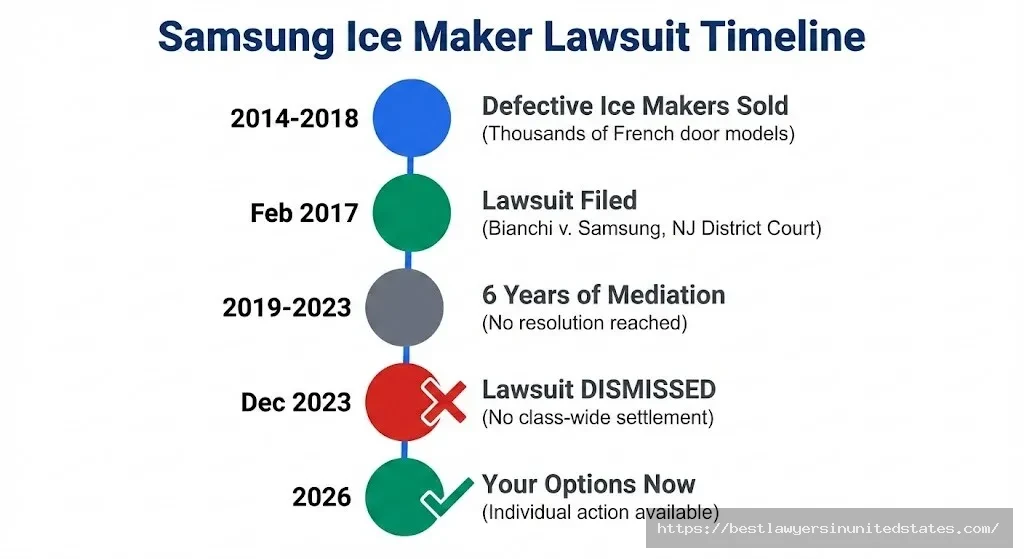
Timeline of Key Events
| Date | Event | Details |
|---|---|---|
| 2014-2018 | Affected refrigerators sold | Samsung sells thousands of French door refrigerators with defective ice makers |
| July 2015 | First service bulletin issued | Samsung acknowledges ice maker problems in internal technical bulletin |
| May 2017 | Second service bulletin | Samsung issues another internal bulletin about French door ice maker issues |
| February 23, 2017 | Class action lawsuit filed | Ronald and Debra Bianchi file complaint in U.S. District Court, New Jersey |
| June 2, 2017 | Amended complaint filed | Additional plaintiffs join; complaint details expand |
| April 24, 2018 | Samsung moves to dismiss | Samsung files motion to have case thrown out |
| May 2019 | Court orders mediation | Judge Claire C. Cecchi orders private mediation |
| June 2019 | Mediation begins | Parties select mediator; talks commence |
| 2020-2023 | Mediation continues | Years of negotiations, delayed by COVID-19 pandemic |
| Late 2023 | Individual settlements offered | Samsung extends settlement offers to select consumers only |
| December 28, 2023 | Lawsuit dismissed | Case dismissed without prejudice; no class-wide settlement reached |
| January 2024 | Settlement payments begin | Only consumers who accepted individual offers receive payments |
| February 2026 | Current status | No active settlement; most consumers received nothing |
Who Filed the Lawsuit?
The lawsuit was filed by Ronald and Debra Bianchi, a Virginia couple who purchased a Samsung French door refrigerator for over $2,500. Within months, they experienced water leaks that damaged their kitchen floor, persistent ice buildup, loud noises, and an ice maker that repeatedly jammed and failed.
After spending money on repairs that didn’t fix the problem and receiving inadequate support from Samsung, the Bianchis became lead plaintiffs in what they hoped would become a nationwide class action. They were joined by additional plaintiffs including Madeline Marino, Richard Bishop, Marie and Francisco Castelo, and John and Laura Mahoney.
The plaintiffs were represented by prominent class action law firms:
- Simmons Hanly Conroy LLC (attorneys Mitchell M. Breit and Paul J. Hanly Jr.)
- Kohn Swift & Graf PC (attorney Jonathan Shub)
- Greg Coleman Law PC (attorneys Gregory Coleman, Mark Silvey, Adam Edwards, and Lisa White)
The case was filed in U.S. District Court for the District of New Jersey (Case No. 2:17-cv-01263) with Judge Claire C. Cecchi presiding.
What Are the Allegations?
The lawsuit made specific claims about Samsung’s knowledge and conduct:
Defective Design and Manufacturing:
- Ice maker compartments lacked proper insulation, allowing warm air infiltration
- Inadequate drainage systems caused water to pool and refreeze
- Faulty fan motors that failed when ice buildup occurred
- Defective control boards that couldn’t properly regulate temperature in the ice maker compartment
Samsung’s Knowledge and Concealment:
- Samsung issued internal service bulletins in 2015 and 2017 acknowledging the problem
- Technicians were instructed on temporary fixes but told not to discuss the design flaw
- Samsung continued manufacturing and selling refrigerators with the same defect even after thousands of complaints
- The company failed to warn consumers or offer recalls despite knowing about widespread failures
Consumer Harm:
- Thousands paid $2,000-$4,000+ for defective refrigerators
- Repair costs often exceeded $500-$1,000 per incident
- Water damage to kitchen floors, cabinets, and surrounding areas
- Food spoilage from temperature fluctuations
- Time wasted dealing with repeated service calls
- Frustration from temporary fixes that failed within months
Breach of Warranty:
- Samsung’s limited warranty didn’t adequately cover the defect
- Repairs often failed because technicians used the same defective parts
- Many consumers were told the ice maker issues were “normal” or caused by their usage
What Happened to the Lawsuit? Why Most Consumers Got Nothing
The Disappointing Outcome
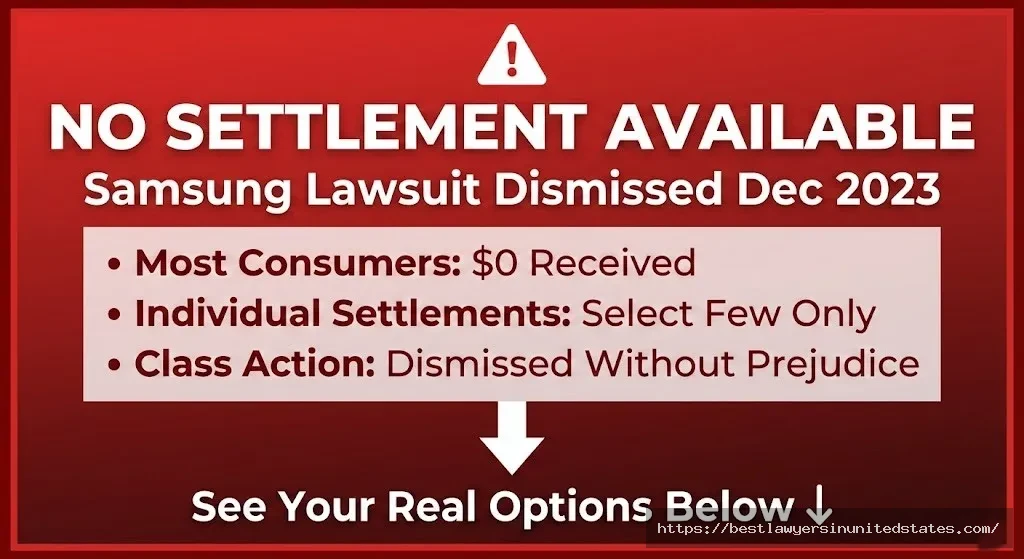
After more than six years of litigation and mediation, the Samsung ice maker lawsuit ended not with a bang, but with a whimper. On December 28, 2023, Judge Cecchi dismissed the case after Samsung offered individual settlement agreements to select consumers.
Here’s what actually happened:
- Samsung did NOT agree to a class-wide settlement
- Samsung did NOT create a settlement fund for all affected consumers
- Samsung did NOT admit any wrongdoing or defect
- Only certain consumers “identified through a deliberate process as potentially part of Plaintiffs’ putative class” received settlement offers
- The vast majority of people with defective Samsung ice makers got nothing
Who Got Paid and Who Didn’t
Consumers Who Received Settlements:
- Original named plaintiffs in the lawsuit
- Consumers who had actively participated in the litigation process
- Select individuals Samsung chose to settle with individually
- People who had documentation of their issues and had contacted Samsung multiple times
Consumers Who Got Nothing:
- The thousands of other Samsung ice maker owners experiencing identical problems
- People who hadn’t formally joined the lawsuit
- Consumers who bought affected models but didn’t know about the class action
- Anyone who didn’t receive a direct settlement offer from Samsung
The dismissal was filed “without prejudice,” meaning consumers who didn’t receive settlement offers can still pursue individual legal action against Samsung. However, this is a hollow consolation for most people, as individual lawsuits are expensive, time-consuming, and impractical for claims worth hundreds or a few thousand dollars.
Why the Lawsuit Failed
The Samsung ice maker lawsuit’s failure highlights several harsh realities about class action litigation:
Samsung’s Deep Pockets and Legal Strategy: Samsung has virtually unlimited resources to fight legal battles. By dragging out mediation for years and offering to settle with only certain individuals, Samsung avoided:
- Admitting the defect publicly
- Paying millions in a class-wide settlement
- Making changes to future refrigerator designs
- Creating legal precedent that could affect other cases
The Pandemic Delay: COVID-19 caused significant delays in court proceedings and mediation sessions. What might have taken 2-3 years stretched to 6+ years, exhausting plaintiffs and allowing Samsung to wait out the clock.
Mediation Doesn’t Guarantee Results: When the court ordered private mediation, many consumers thought this meant a settlement was imminent. In reality, mediation is just facilitated negotiation. If one party (Samsung) doesn’t want to agree to class-wide terms, there’s no settlement.
Individual Settlements Divide the Class: By offering individual settlements to select consumers—including the named plaintiffs who had the most documentation and the strongest claims—Samsung effectively removed the most motivated people from the fight. Once they accepted settlements and were bound by confidentiality agreements, the class action lost momentum.
Who Was Affected by the Samsung Ice Maker Defect?
Eligibility Criteria for the Defective Ice Makers
Even though there’s no active settlement to file claims with, it’s important to understand which refrigerators have the defect. If you own one of these models, you may still have options for getting Samsung to repair or replace your ice maker.
| Requirement | Details | What You Need |
|---|---|---|
| Purchase Timeframe | Refrigerators manufactured between 2014-2018 | Model number and serial number from inside refrigerator door |
| Refrigerator Type | French door models with built-in ice makers | Check model list below |
| Problem Experienced | Ice maker freezing, leaking, noise, or failure | Documentation of issues (photos, repair records, Samsung communications) |
| Purchase Location | Anywhere in the United States | Proof of purchase if available (receipt, credit card statement, delivery invoice) |
Affected Samsung Refrigerator Models
The lawsuit specifically identified these model numbers as having defective ice makers. All color variations of these models are affected:
| Model Number | Common Issues | Years Manufactured |
|---|---|---|
| RF23HCEDB | Ice maker freezing, leaks | 2014-2016 |
| RF23HCEDT | Fan noise, ice buildup | 2014-2016 |
| RFH23HSESB | Water leaks, ice jams | 2014-2016 |
| RF23HTEDB | Ice maker failure, freezing | 2014-2016 |
| RF23J9011 | Leaking, temperature issues | 2015-2017 |
| RF24FSEDB | Ice buildup, fan failure | 2014-2016 |
| RF25HMEDB | Water leaks, ice freezing | 2014-2017 |
| RF263BEAE | Ice maker jamming, noise | 2014-2016 |
| RF263TEAE | Persistent leaking, freezing | 2014-2016 |
| RF26J7500 | Ice buildup, malfunction | 2015-2017 |
| RF28HDEDB | Fan noise, water damage | 2014-2016 |
| RF28HDEDT | Ice freezing, leaking | 2014-2016 |
| RF28HFEDB | Ice maker failure, jamming | 2014-2017 |
| RF28HFEDT | Water leaks, ice buildup | 2014-2017 |
| RF28HFPDB | Freezing, noise problems | 2014-2017 |
| RF30HDEDT | Ice jams, leaking issues | 2014-2016 |
| RF31FMEDB | Persistent ice buildup | 2014-2017 |
| RF31FMESB | Water damage, failure | 2014-2017 |
| RF323TEDB | Ice freezing, jamming | 2014-2016 |
| RF32FMQDB | Leaks, ice maker stops | 2015-2017 |
| RF34H9950 | Ice buildup, fan noise | 2014-2016 |
| RF34H9960 | Water leaks, malfunction | 2014-2016 |
Note: This list includes models specifically named in Samsung’s 2015 and 2017 service bulletins. However, consumer complaints indicate the problem may extend to other French door Samsung models from this period. If you own a Samsung French door refrigerator from 2014-2020 with ice maker problems, you may still qualify for help even if your model isn’t listed.
Common Symptoms of the Defect
You likely have the defective ice maker if you’re experiencing:
Ice Freezing and Buildup:
- Large chunks of ice forming in the ice bucket
- Ice frozen into a solid block
- Ice maker compartment completely iced over
- Frost building up on the inside walls of the ice maker
Water Problems:
- Water leaking from the ice maker onto the freezer floor
- Water dripping down the outside of the refrigerator
- Water pooling under the crisper drawers in the fridge section
- Water damage to kitchen floors or cabinets
Mechanical Failures:
- Ice maker stops producing ice entirely
- Ice dispenser jams or won’t release ice
- Loud grinding, banging, or rattling noises from the ice maker
- Fan makes continuous loud humming or buzzing sounds
Temperature Issues:
- Ice melting then refreezing
- Freezer temperature fluctuating
- Food in freezer developing frost or freezer burn
Who Does NOT Qualify for Help
You’re likely out of luck if:
- You threw away or sold your Samsung refrigerator years ago (Samsung requires you to still own it for warranty claims)
- Your refrigerator is a different style (top freezer, side-by-side, single door)
- Your issues started after 2020 and you bought a newer model
- You never documented your problems or contacted Samsung
- You already received compensation from Samsung through the individual settlements
What Can You Actually Do in 2026? Your Real Options
Since there’s no class action settlement to file claims with, here are the actionable steps you can take if your Samsung ice maker is still causing problems:
Option 1: Contact Samsung Directly (Best First Step)
Why This Works: Even though Samsung won the legal battle, they’re aware of the negative publicity around this issue. Some consumers report getting free repairs or replacements by being persistent with Samsung customer service—even when their refrigerators are out of warranty.
How to Do It:
Step 1: Call Samsung’s Office of the President
- Phone: 1-888-480-5675
- This is the executive escalation line, not regular customer service
- Available Monday-Friday, 9 AM – 6 PM ET
Step 2: Prepare Before You Call
- Have your model number and serial number ready (found on a sticker inside the refrigerator door)
- Have your purchase date and proof of purchase if available
- Document your ice maker problems with photos and videos
- Note all previous repair attempts and dates
- List any damage caused (water damage, spoiled food, etc.)
Step 3: Use This Script “I’m calling about the defective ice maker in my Samsung refrigerator, model [NUMBER]. This is a known design defect that was the subject of a class action lawsuit. My ice maker [describe specific problems]. This is not a warranty issue—this is a design defect that Samsung acknowledged in service bulletins. I expect Samsung to repair or replace the defective ice maker at no cost to me.”
Step 4: Be Persistent and Escalate
- If the first representative says no, ask to speak to a supervisor
- Reference the class action lawsuit: Bianchi v. Samsung
- Mention Samsung’s 2015 and 2017 service bulletins
- If you get a flat refusal, call back the next day and try a different representative
- Some consumers report success after 3-5 calls
What to Ask For:
- Free ice maker replacement or repair
- Compensation for past repair costs (keep all receipts)
- Reimbursement for water damage
- Extended warranty on the replacement parts
- If the ice maker can’t be fixed: partial refund or replacement refrigerator
Option 2: Check Your Warranty Status
Samsung’s Current Warranty Offers (2026):
| Warranty Type | Coverage | Ice Maker Coverage |
|---|---|---|
| Standard Warranty | 1 year parts and labor | Covered if defect occurred within 1 year |
| 2026 Extended Promotion | 2 years parts and labor (ends July 8, 2026) | Eligible if you bought between Jan-July 2026 and register |
| Sealed System Warranty | 5 years parts, 5 years labor | Does not typically cover ice maker |
| Samsung Care+ | 2, 3, 5, or 7 year plans | Covers ice maker repairs (if purchased) |
How to Check Your Warranty:
- Go to Samsung’s warranty check page: samsung.com/us/support/warranty
- Enter your model and serial number
- Register your product if not already registered
- Request warranty service if still covered
Important Note: The defect affects refrigerators from 2014-2018, so standard warranties have long expired for these models. However, if you purchased Samsung Care+ or if your state has longer implied warranty periods, you may still have coverage.
Option 3: Know Your State’s Implied Warranty Laws
Some states give you more protection than Samsung’s written warranty:
States with Stronger Consumer Protection:
| State | Implied Warranty Period | What This Means for You |
|---|---|---|
| California | 4-7 years from purchase | You can demand repair/refund up to 7 years after buying |
| Indiana | 7 years from warranty expiration | You can demand repair/refund up to 8 years after purchase |
| Massachusetts | “Reasonable period” for major appliances | Typically 4-7 years considered reasonable |
| Connecticut | 4 years minimum | Strong lemon laws for defective appliances |
| Vermont | “Reasonable period” | Courts have ruled 5+ years reasonable for refrigerators |
How to Use This:
- Research your state’s implied warranty laws (Google “[your state] implied warranty appliances”)
- When contacting Samsung, reference your state’s implied warranty statute
- Explain that the defect means the refrigerator was “not fit for its intended purpose” at the time of sale
- Demand repair, replacement, or refund based on your state law rights
Option 4: Document Everything for Potential Individual Legal Action
What to Document:
| Document Type | Why You Need It | Where to Find It |
|---|---|---|
| Proof of Purchase | Proves you bought the refrigerator and when | Receipt, credit card statement, delivery invoice, store records |
| Model/Serial Number Photo | Proves you own an affected model | Take clear photo of sticker inside refrigerator door |
| Problem Documentation | Proves the defect exists and when it started | Photos/videos of ice buildup, leaks, error messages; dated entries |
| Repair Records | Proves failed repair attempts | Service tickets, invoices, receipts from technicians |
| Samsung Communications | Proves you tried to resolve with Samsung | Save emails, note phone call dates/times/names, letters |
| Damage Documentation | Proves financial harm beyond the refrigerator | Photos of water damage, receipts for spoiled food, hotel stays if needed |
| Financial Records | Proves your out-of-pocket costs | Repair receipts, replacement ice, eating out costs, new refrigerator purchase |
How This Helps:
- If you decide to pursue individual legal action, you’ll have everything ready
- If Samsung does offer to settle individually, you can prove the full extent of your damages
- If a new class action forms, you’ll be prepared to participate
Option 5: Consider Small Claims Court (for Damages Under $5,000-$10,000)
When This Makes Sense:
- You’ve spent less than your state’s small claims limit on repairs and damages
- Samsung refuses to help after you’ve tried Steps 1-4
- You still own the defective refrigerator
- You have good documentation
Small Claims Court Limits by State:
- Most states: $5,000-$10,000 maximum
- California: $10,000
- Tennessee: $25,000
- Some states: $2,500-$3,000
How It Works:
- File a small claims lawsuit against Samsung Electronics America
- No lawyer needed (you represent yourself)
- Filing fee typically $30-$100
- Present your case to a judge
- If you win, judge orders Samsung to pay
What You Can Sue For:
- Cost of refrigerator
- Repair costs
- Water damage to property
- Spoiled food
- Increased electricity costs
- Time and inconvenience
Pros:
- Relatively quick (2-4 months)
- Inexpensive
- No lawyer needed
- Samsung may settle before court date to avoid hassle
Cons:
- You must handle everything yourself
- Samsung will send a lawyer
- You might lose
- Can only recover limited damages
Option 6: Hire a Consumer Protection Attorney
When This Makes Sense:
- Your damages exceed small claims limits
- You have strong documentation
- Samsung’s refusal is particularly egregious
- You suffered significant property damage
What an Attorney Can Do:
- Send a demand letter (often prompts settlement)
- File a lawsuit in regular court (not small claims)
- Pursue claims under state consumer protection laws
- Seek attorney’s fees and punitive damages
- Potentially negotiate better settlement than you could alone
How to Find the Right Attorney:
- Look for consumer protection or product liability specialists
- Many offer free consultations
- Some work on contingency (you pay only if you win)
- Contact the lawyers who handled the original class action (firms listed earlier)
Free Legal Consultation:
- Contact attorneys from the original lawsuit for referrals
- Email: [email protected] for attorney referrals
- Your state bar association often has lawyer referral services
Option 7: DIY Repairs and Workarounds (Last Resort)
Temporary Solutions: Some consumers have had limited success with these fixes:
Ice Maker Compartment Sealing:
- Purchase a Samsung-approved ice maker sealing kit
- Improves insulation around ice maker compartment
- Cost: $20-$50
- Effectiveness: Helps some, not a permanent fix
Manual Defrosting:
- Unplug refrigerator monthly
- Allow complete ice maker defrost (4-6 hours)
- Effectiveness: Buys time but doesn’t fix root cause
Professional Repair (Not Samsung):
- Third-party appliance repair technicians
- May install aftermarket improved parts
- Cost: $200-$600
- Effectiveness: Better parts may last longer, but design flaw remains
⚠️ Warning: DIY electrical or refrigerant work can be dangerous and may void any remaining warranty. Samsung has argued that unauthorized repairs void your rights to claim under warranty or implied warranty laws.
How the Samsung Lawsuit Compares to Similar Refrigerator Cases
Samsung Ice Maker vs. LG Compressor Lawsuit – What a Real Settlement Looks Like
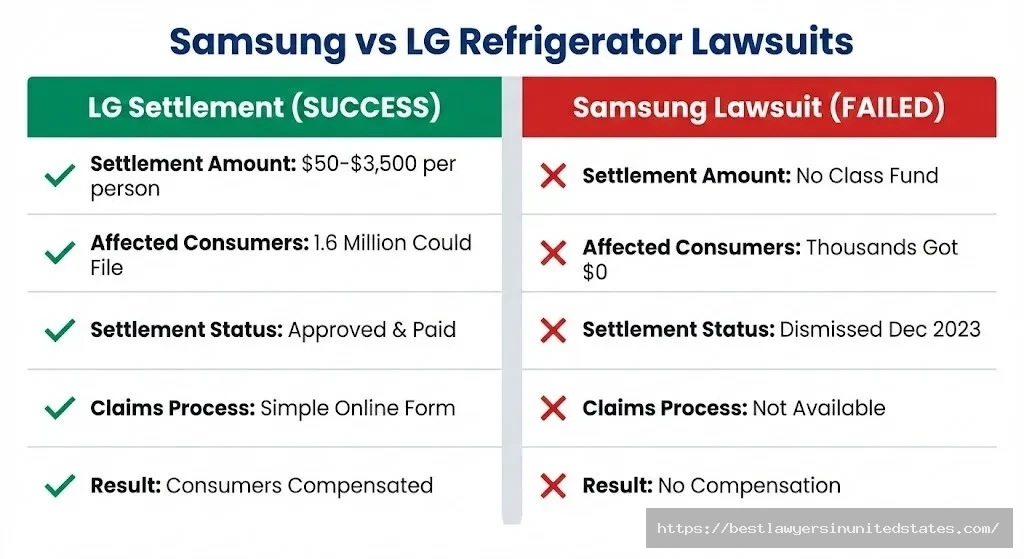
The contrast between Samsung’s outcome and LG’s refrigerator lawsuit shows what affected consumers missed out on:
| Aspect | LG Compressor Settlement (Successful) | Samsung Ice Maker Lawsuit (Failed) |
|---|---|---|
| Settlement Amount | No fixed cap; payments ranged $50-$3,500+ | No class-wide settlement; select individuals only |
| Affected Consumers | 1.6 million LG refrigerator owners | Thousands of Samsung owners, most got nothing |
| Payout Range | $50 base payment<br>Up to $450 with receipts<br>Up to $3,500 for replacement costs | Only individual settlements to select consumers<br>Amounts confidential |
| Filing Deadline | February 5, 2021 | No deadline (no settlement to file with) |
| Extended Warranty | 5 years from purchase date | None provided |
| Claim Process | Simple online form at LGFridgeSettlement.com | Not applicable – no claims accepted |
| Documentation Required | Minimal for $50 payment<br>Receipts for higher amounts | N/A |
| Final Approval | Approved December 15, 2020 | Dismissed December 28, 2023 |
| Payment Status | Payments distributed 2021 | Only individual settlements (confidential) |
| Manufacturer Response | LG settled to avoid litigation costs | Samsung fought for 6+ years, never admitted fault |
Why LG Settled and Samsung Didn’t
LG’s Motivation to Settle:
- Faced overwhelming evidence of widespread compressor failures
- Consumer Reports and independent testing confirmed defect rates
- Multiple state attorneys general investigating
- Negative publicity damaging brand reputation
- Settlement cheaper than years of litigation
Samsung’s Strategy:
- Deep pockets to sustain long legal fight
- Individual settlements cheaper than class-wide payment
- No admission of defect protects against future lawsuits
- Mediation allowed delay without court-imposed deadlines
- Named plaintiffs settled and stopped pushing case forward
Other Major Refrigerator Lawsuits and Settlements
| Manufacturer | Issue | Settlement Amount | Status (2026) |
|---|---|---|---|
| LG (2020) | Linear compressor failures | $50-$3,500 per claimant | Paid in full |
| LG (2024) Canada | Compressor failures | Up to $150 default, more with proof | Claims closed Oct 2024 |
| LG (2025) New | Continued compressor issues (post-2018 models) | Pending litigation | Active lawsuit |
| Whirlpool | Ice maker failures (various models) | No class action settlement | Individual complaints |
| Samsung | Ice makers (THIS CASE) | No class settlement | Dismissed 2023 |
| GE Profile | Ice maker and motherboard failures | No class action | Individual warranty claims |
| Frigidaire | Ice maker failures | No class action settlement | Ongoing complaints |
What This Shows:
- Refrigerator manufacturers commonly have design defects
- Not all defects result in settlements
- LG is the rare exception that actually paid consumers
- Most brands (like Samsung) fight until lawsuits collapse
FAQs About the Samsung Ice Maker Lawsuit
Is there a Samsung ice maker class action settlement I can file a claim with?
Quick Answer: No. The class action lawsuit was dismissed in December 2023 without creating a settlement fund for consumers to file claims. Samsung offered individual settlements only to select people already involved in the litigation.
The dismissal means there’s no website to file claims, no deadline to meet, and no administrator processing payments. Unlike the LG refrigerator settlement that allowed 1.6 million consumers to submit claims online, the Samsung case ended without that option.
Can I still get money from Samsung for my defective ice maker?
Quick Answer: Possibly, but not through a class action settlement. You can try contacting Samsung directly for a free repair, file an individual lawsuit in small claims or regular court, or hire an attorney for larger claims.
Your best chance is calling Samsung’s Office of the President at 1-888-480-5675 and being persistent. Some consumers report getting free repairs or partial refunds by referencing the lawsuit and being firm that this is a known design defect, not a warranty issue.
What Samsung refrigerator models have defective ice makers?
Quick Answer: Models manufactured between 2014-2018, particularly French door refrigerators with model numbers starting with RF, were most affected. The lawsuit specifically named 22 models including RF28HFEDB, RF23J9011, and RF263TEAE, among others.
Check the complete model list in the “Affected Samsung Refrigerator Models” section above. Your model number is on a sticker inside your refrigerator door, usually on the left or right side panel.
Why was the Samsung ice maker lawsuit dismissed?
Quick Answer: The lawsuit was dismissed on December 28, 2023, after Samsung offered individual settlements to select consumers rather than agreeing to a class-wide settlement. Once the named plaintiffs and some other participants accepted individual offers, the class action lost momentum and was dismissed without prejudice.
“Without prejudice” means consumers who didn’t get settlement offers can still file individual lawsuits against Samsung, but the class action itself is over.
How much did people get from the Samsung ice maker lawsuit?
Quick Answer: Only consumers who received individual settlement offers know the amounts, and those settlements typically include confidentiality clauses preventing them from disclosing payment details. The vast majority of Samsung ice maker owners received nothing.
This is dramatically different from the LG refrigerator settlement, which publicly offered $50 to $3,500 to eligible claimants based on clear, published criteria.
What was the deadline to file a Samsung ice maker lawsuit claim?
Quick Answer: There was never a claim deadline because no class-wide settlement was established. Individual settlement offers from Samsung had their own deadlines known only to the recipients.
If you’re asking because you want to file a claim, unfortunately, there’s no settlement claim process available.
Can I still sue Samsung individually for my defective ice maker?
Quick Answer: Yes. The lawsuit was dismissed “without prejudice,” meaning consumers who weren’t part of the individual settlements can still pursue their own legal action against Samsung in small claims court or through an attorney.
However, individual lawsuits have challenges:
- Expensive if you hire a lawyer for regular court
- Time-consuming (6+ months to years)
- Samsung has far more legal resources than individual consumers
- Your claim may be worth less than it costs to pursue
Small claims court (for damages under $5,000-$10,000 depending on your state) is often the most practical option.
Do I need proof of purchase to get help from Samsung?
Quick Answer: Ideally yes, but if you don’t have a receipt, Samsung can sometimes verify your purchase through their warranty registration system, or you can provide alternatives like credit card statements, delivery invoices, or store purchase records.
Even a photo of the model and serial number sticker inside your refrigerator door helps prove you own an affected model. Some consumers have succeeded by explaining they bought the refrigerator years ago and no longer have the receipt.
What if I already threw away or sold my broken Samsung refrigerator?
Quick Answer: You’re likely out of luck for warranty claims or repairs, since Samsung requires you to still own the refrigerator. However, you could potentially still sue in small claims court for past damages like repair costs, water damage, and spoiled food—if you have good documentation.
Some states (California, Indiana) have laws requiring manufacturers to refund defective appliances within certain timeframes, but these often require you to have the appliance in your possession.
Will Samsung recall the defective ice maker refrigerators?
Quick Answer: No. There is no official recall of Samsung refrigerators with defective ice makers as of 2026. Samsung has not admitted the ice makers are defective and has not issued a voluntary recall.
The Consumer Product Safety Commission (CPSC) has not ordered a mandatory recall either, despite thousands of consumer complaints. Recalls typically only happen when there’s a safety hazard like fire or injury risk—malfunction and inconvenience generally don’t trigger recalls.
Is my Samsung ice maker problem covered under warranty?
Quick Answer: Only if your refrigerator is less than 1-2 years old (depending on whether you registered for Samsung’s 2026 extended warranty promotion) or if you purchased Samsung Care+ extended warranty coverage.
Refrigerators from 2014-2018 with the defect are now 6-12 years old, far beyond standard warranty coverage. However, some state implied warranty laws may still give you rights—see the “State Implied Warranty Laws” section above.
What’s the difference between the Samsung lawsuit and the LG compressor lawsuit?
Quick Answer: The LG lawsuit resulted in a successful settlement that paid out millions to 1.6 million consumers ($50 to $3,500+ each). The Samsung lawsuit was dismissed after 6 years with no class-wide settlement. Most Samsung ice maker owners got nothing while LG owners could easily file claims online.
LG admitted no wrongdoing but agreed to pay to avoid further litigation costs. Samsung never admitted fault and successfully avoided paying most affected consumers by offering individual settlements to select people only.
Can I get a refund or replacement refrigerator from Samsung?
Quick Answer: Not automatically, but you can request one when you contact Samsung directly. Some consumers report success getting full or partial refunds or replacement refrigerators by being extremely persistent with Samsung’s Office of the President escalation line.
Your state’s consumer protection laws may also give you refund rights. California and Indiana specifically have “Song-Beverly Act” and “Indiana Lemon Law” provisions that can force Samsung to refund defective appliances within certain timeframes.
What should I do if Samsung refuses to help me?
Quick Answer: Document Samsung’s refusal, then pursue one or more of these options: (1) File a complaint with your state attorney general’s consumer protection division, (2) File a small claims lawsuit, (3) Hire a consumer protection attorney, (4) Leave detailed reviews warning other consumers, (5) Contact local consumer protection reporters.
The more pressure Samsung faces from multiple sources, the more likely they may reconsider. Some consumers report that filing complaints with the Better Business Bureau, state AG, and posting on social media prompted Samsung to reach out with settlement offers.
Are newer Samsung refrigerators still having ice maker problems?
Quick Answer: Yes. Consumer complaints about Samsung ice maker failures continue through 2025-2026, indicating the design problems persist in newer models. Samsung has not publicly acknowledged fixing the ice maker design flaw.
Online forums, consumer complaint sites, and social media are filled with reports from people who bought Samsung refrigerators in 2020, 2021, 2022, and later years experiencing identical ice maker freezing and leaking problems.
How can I prevent my Samsung ice maker from freezing up?
Quick Answer: You can’t truly prevent it because the problem is a design flaw, but you can slow it down by: (1) Manually defrosting the ice maker monthly, (2) Reducing the frequency of opening the refrigerator door, (3) Not overfilling the ice bucket, and (4) Keeping the refrigerator temperature at recommended settings.
Some consumers report that purchasing Samsung’s ice maker sealing kit (around $20-50) provides temporary improvement. However, these are Band-Aid solutions—the fundamental design defect remains.
What if Samsung customer service says my issue isn’t covered?
Quick Answer: Ask to speak to a supervisor, then escalate to the Office of the President line (1-888-480-5675). Specifically tell them this is a “design defect, not a warranty issue” and reference the Bianchi v. Samsung lawsuit and Samsung’s 2015/2017 service bulletins acknowledging the problem.
If still refused, call back and speak to a different representative. Consumers report success rates increase after 3-5 calls with different Samsung reps. Persistence matters.
Can I join a new Samsung ice maker class action lawsuit?
Quick Answer: As of February 2026, there is no new active class action lawsuit against Samsung for ice maker defects. The original lawsuit was dismissed, and no new class action has been filed to replace it.
If a new class action is filed in the future, you typically don’t need to “join” it proactively—if you own an affected model, you’re automatically part of the class unless you opt out. However, you would need to file a claim when a settlement is reached to receive payment.
Where can I report my Samsung ice maker problems?
Quick Answer: Report to multiple places for maximum impact: (1) Consumer Product Safety Commission at SaferProducts.gov, (2) Your state attorney general’s consumer protection division, (3) Better Business Bureau, (4) Samsung directly, and (5) Consumer review sites like ConsumerAffairs.com.
Widespread reporting can trigger government investigations and increase pressure on Samsung to address the problem. Federal agencies track complaint patterns and may launch investigations if thousands of identical complaints are filed.
How long do Samsung ice makers typically last before failing?
Quick Answer: Based on consumer reports, defective Samsung ice makers typically fail within 6 months to 3 years of purchase. Some last slightly longer but rarely make it past 4-5 years without significant problems requiring repair or replacement.
This is well below the expected 8-12 year lifespan of a quality refrigerator ice maker and far short of the overall refrigerator’s expected 10-15 year lifespan.
Final Thoughts: What the Samsung Lawsuit Teaches Consumers
The Samsung ice maker class action lawsuit’s disappointing outcome offers important lessons for anyone dealing with defective products:
Lesson 1: Class Actions Don’t Always Work Despite years of litigation, thousands of affected consumers, and clear evidence of a defect (Samsung’s own service bulletins), Samsung successfully avoided paying most customers. Class actions are powerful tools, but they’re not guarantees.
Lesson 2: Manufacturers With Deep Pockets Can Wait You Out Samsung’s strategy was simple: drag out mediation for years, then cherry-pick who to settle with individually. Most consumers can’t sustain a legal fight for 6+ years. Time favors the company with unlimited resources.
Lesson 3: Document Everything Immediately The consumers who received individual settlements were those with extensive documentation. From day one of experiencing problems, take photos, save emails, keep receipts, and note every interaction with the company.
Lesson 4: Don’t Count on Future Settlements If you’re having problems now, don’t wait for a settlement to fix things. Pursue your individual options aggressively while you still own the defective product and have time to gather evidence.
Lesson 5: Your State Laws May Be Your Best Protection Federal product liability law is often weaker than state consumer protection statutes. Research your state’s implied warranty laws, lemon laws, and consumer fraud protections—they may give you rights that federal law doesn’t.
Lesson 6: Persistence With the Company Directly Can Work Before spending money on lawyers or filing lawsuits, exhaust your options with Samsung directly. The squeaky wheel gets the grease, and companies often pay to make persistent customers go away.
Lesson 7: Avoid Samsung (or Any Manufacturer With This Track Record) When buying your next refrigerator, research the company’s lawsuit history and consumer complaint patterns. Samsung’s refusal to admit the defect or compensate most consumers speaks volumes about their commitment to customer satisfaction.
Need Legal Help?
If you’re dealing with a defective Samsung ice maker and Samsung refuses to help, consider consulting with a consumer protection attorney. Many offer free initial consultations and work on contingency (you pay only if you win).
For attorney referrals: [email protected]
Your Rights Matter. Don’t let a multi-billion dollar corporation ignore your defective product claims. Even though the class action failed, individual consumers can still hold Samsung accountable through persistence, state consumer protection laws, and small claims court action.
This article is for informational purposes only and does not constitute legal advice. Consult with a licensed attorney in your state for advice about your specific situation.
Last Updated: February 2026

Comments