
If you used Roundup weed killer and later developed cancer, you might be able to get money from one of the largest product liability settlements in U.S. history. Bayer has already paid out $11 billion to settle around 100,000 claims from people who say Roundup caused their non-Hodgkin lymphoma and other cancers. But about 60,000 lawsuits are still pending, and new cases are being filed every week as people continue to be diagnosed. hawthorne residential partners lawsuit
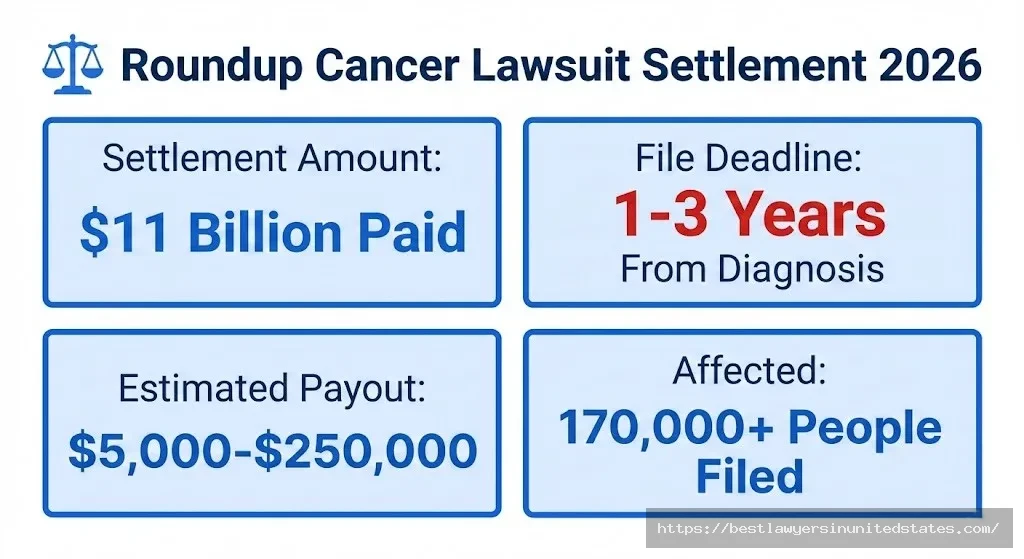
Quick Answer: Bayer settled approximately 100,000 Roundup cancer lawsuits for nearly $11 billion. Settlement payouts typically ranged from $100,000 to $160,000 per person in the first round, with estimates now ranging from $5,000 to $250,000 depending on case strength. Around 60,000 claims remain active as of February 2026. You can still file a claim if you used Roundup and were diagnosed with non-Hodgkin lymphoma or related cancer, but state deadlines (typically 1-3 years from diagnosis) apply.
The lawsuits claim that Roundup’s active ingredient, glyphosate, causes cancer — particularly non-Hodgkin lymphoma. Plaintiffs say Monsanto (now owned by Bayer) knew about the cancer risks but failed to warn consumers. If you or someone you love developed cancer after using Roundup, you might qualify for compensation. This guide explains everything you need to know about filing a claim in 2026.
What Is the Roundup Cancer Lawsuit About?
Background of the Lawsuit
Roundup is the world’s most widely used weed killer. Farmers, landscapers, groundskeepers, and homeowners have relied on it since Monsanto introduced it in the 1970s. The product’s active ingredient, glyphosate, kills weeds by blocking a key enzyme plants need to grow.
For decades, Monsanto marketed Roundup as safe for humans and the environment — even claiming it was “safer than table salt.” But mounting scientific evidence suggests otherwise. In 2015, the International Agency for Research on Cancer (IARC), part of the World Health Organization, classified glyphosate as “probably carcinogenic to humans.” Multiple studies have since linked glyphosate exposure to non-Hodgkin lymphoma, a cancer of the lymphatic system.
The lawsuits argue that Monsanto knew about these cancer risks but actively concealed them from the public. Internal company documents revealed during litigation — known as the “Monsanto Papers” — showed the company ghostwrote scientific articles claiming Roundup was safe, tried to discredit independent researchers, and worked to manipulate regulatory findings.
Timeline of Key Events
| Date | Event | Details |
|---|---|---|
| 1973 | Roundup introduced | Monsanto brings glyphosate-based Roundup to market |
| 2015 | IARC classification | World Health Organization’s cancer agency labels glyphosate “probably carcinogenic to humans” |
| August 2018 | First major verdict | California jury awards Dewayne Johnson $289 million (later reduced to $78 million) |
| 2018 | Bayer acquires Monsanto | German pharmaceutical giant buys Monsanto for $63 billion |
| March 2019 | Second major verdict | Jury awards Edwin Hardeman $80 million in federal case |
| June 2020 | Initial settlement announced | Bayer agrees to $10.9 billion settlement covering about 100,000 claims |
| 2021 | Future claims fund rejected | Federal judge rejects Bayer’s $2 billion plan for future cancer claims |
| November 2023 | Massive jury verdict | Missouri jury awards $1.56 billion to three plaintiffs (later reduced to $611 million) |
| January 2026 | Supreme Court review | U.S. Supreme Court agrees to hear key preemption case, decision expected by June 2026 |
| February 2026 | Current status | About 3,902 cases pending in federal MDL; over 60,000 total claims still active |
| End of 2026 | Bayer’s target | Company aims to “significantly contain” litigation by year-end |
Who Filed the Lawsuit?
The first landmark case was filed by Dewayne “Lee” Johnson, a California school groundskeeper who developed terminal non-Hodgkin lymphoma after regularly using Roundup as part of his job. His 2018 trial victory opened the floodgates for thousands of similar lawsuits.
Since then, approximately 170,000 people have filed Roundup cancer claims. These include farmers, agricultural workers, landscapers, nursery employees, groundskeepers, and homeowners who used the product in their yards. Many law firms across the country represent plaintiffs, with cases consolidated in both federal multidistrict litigation (MDL 2741) in the Northern District of California and in various state courts, particularly in Missouri.
The defendant is Bayer AG, the German pharmaceutical and chemical company that acquired Monsanto in 2018 for $63 billion. Since the acquisition, Bayer’s stock has dropped more than 70%, largely due to the ongoing Roundup litigation.
What Are the Allegations?
The lawsuits make several key claims against Bayer and Monsanto:
- Failure to warn: Monsanto knew or should have known that glyphosate could cause cancer but failed to put adequate warnings on Roundup labels
- Defective product: Roundup is unreasonably dangerous when used as intended, especially given the availability of safer alternatives
- Fraudulent concealment: The company actively hid evidence of cancer risks and manipulated scientific research to support claims that Roundup was safe
- Negligence: Monsanto failed to properly test Roundup’s cancer-causing potential and ignored mounting scientific evidence of harm
Internal documents revealed that Monsanto:
- Ghostwrote scientific articles promoting Roundup’s safety and had them published under independent researchers’ names
- Built networks of scientists to work “behind the scenes” to defend glyphosate
- Worked to influence the Environmental Protection Agency (EPA) and discredit the IARC’s findings
- Never actually tested whether Roundup’s full formulation (not just glyphosate alone) causes cancer in humans
Who Qualifies for the Roundup Lawsuit Settlement?
Quick Answer: You may qualify if you used Roundup regularly (typically at least 40-50 hours total) and were later diagnosed with non-Hodgkin lymphoma or related cancer. You’ll need medical records showing your diagnosis and evidence of Roundup use (receipts, employment records, or witness statements). State deadlines vary but are typically 1-3 years from your diagnosis, so you need to act quickly.
Eligibility Requirements
| Requirement | Details | Documentation Needed |
|---|---|---|
| Cancer diagnosis | Non-Hodgkin lymphoma, B-cell lymphoma, T-cell lymphoma, chronic lymphocytic leukemia (CLL), or related blood cancer | Medical records, pathology reports, biopsy results, diagnosis documents |
| Roundup exposure | Regular use of Roundup or glyphosate-based products (typically minimum 40-50 hours total exposure) | Purchase receipts, employment records, witness statements, photos of product use |
| Timing | Diagnosis must be at least 2 years after initial exposure and within your state’s statute of limitations | Date of diagnosis from medical records |
| Causation link | Reasonable connection showing Roundup exposure likely contributed to your cancer | Timeline showing exposure before diagnosis, medical expert opinion (your attorney will help with this) |
| No prior settlement | You haven’t already accepted money from a previous Roundup settlement and signed a release | N/A |
You don’t need to prove with 100% certainty that Roundup caused your cancer — you just need to show it was a substantial contributing factor. Your attorney will work with medical experts to establish this connection.
Who Most Commonly Qualifies
People at highest risk for qualifying claims include:
Occupational users:
- Farmers and agricultural workers
- Landscaping professionals
- Groundskeepers and golf course maintenance workers
- Nursery and garden center employees
- Parks and recreation workers
- Highway and railroad maintenance crews
Residential users:
- Homeowners who regularly used Roundup on lawns and gardens
- Hobby farmers with small properties
- People who lived near agricultural areas where Roundup was heavily sprayed
The key is regular, repeated exposure over time. One-time use typically isn’t enough to establish a strong claim, but if you used Roundup multiple times per year for several years, you likely meet the exposure threshold.
Eligible Cancer Types
The most common cancer in Roundup lawsuits is non-Hodgkin lymphoma (NHL), but other related blood cancers may also qualify:
| Cancer Type | Description | Qualifies? |
|---|---|---|
| Non-Hodgkin Lymphoma (NHL) | Cancer affecting the lymphatic system; most common Roundup-related cancer | Yes – Primary cancer in most cases |
| B-Cell Lymphomas | About 85% of NHL cases; affects B lymphocytes | Yes |
| – Diffuse Large B-Cell Lymphoma (DLBCL) | Most common NHL subtype (33% of cases) | Yes |
| – Follicular Lymphoma | Second most common NHL subtype | Yes |
| – Marginal Zone Lymphoma (MALT) | Affects mucosa-associated lymphoid tissue | Yes |
| – Burkitt Lymphoma | Rare, aggressive B-cell cancer | Yes |
| – Mantle Cell Lymphoma | Affects mantle zone of lymph nodes | Yes |
| T-Cell Lymphomas | Less common; affects T lymphocytes | Yes – About 15% of NHL cases |
| Chronic Lymphocytic Leukemia (CLL) | Often classified as a subtype of NHL; affects blood and bone marrow | Yes |
| Multiple Myeloma | Cancer of plasma cells in bone marrow | Possibly – Some cases accepted, less common |
| Acute Myeloid Leukemia (AML) | Aggressive blood cancer | Possibly – Emerging evidence |
| Hairy Cell Leukemia | Rare chronic leukemia | Possibly – Related to CLL |
The strongest cases involve non-Hodgkin lymphoma and its subtypes, as these have the most scientific evidence linking them to glyphosate exposure. If you have a different type of cancer and believe it’s related to Roundup use, consult an attorney — eligibility criteria continue to evolve as new research emerges.
Who Does NOT Qualify?
You are not eligible if:
❌ You never personally used or were directly exposed to Roundup (just living in an area where it was used isn’t enough without documented direct exposure)
❌ You’ve already accepted a settlement payment in the original Bayer settlement and signed a release waiving future claims
❌ Your cancer diagnosis has no plausible connection to Roundup exposure (for example, you were diagnosed before you ever used the product)
❌ You’ve exceeded your state’s statute of limitations deadline (typically 1-3 years from diagnosis or discovery of the link to Roundup)
❌ Your only exposure was minimal or one-time use (a few applications over a lifetime typically isn’t sufficient)
How to Prove Your Claim
| Document Type | Why It’s Needed | Where to Find It | Alternatives |
|---|---|---|---|
| Medical records | Prove your cancer diagnosis, type, stage, and treatment | Your oncologist, hospital, cancer treatment center | Contact medical records departments; your attorney can help obtain these |
| Purchase receipts | Show you bought and used Roundup products | Old receipts, credit card statements, store purchase history | Product containers, photos of you using Roundup, store loyalty card records |
| Employment records | Document workplace exposure to Roundup | Former employers, pay stubs showing landscaping/farming work | Coworker testimony, job descriptions, photos of work duties |
| Witness statements | Corroborate your Roundup use | Family members, neighbors, coworkers who saw you use it | Personal diary entries, social media posts showing lawn care activities |
| Product containers | Physical evidence of the specific products you used | Your garage, shed, or storage areas | Photos of containers before disposal, product purchase history |
Don’t panic if you don’t have receipts. Many people used Roundup years ago and no longer have documentation. Your attorney can help build your case through:
- Witness testimony from family, friends, or coworkers
- Employment records showing you worked in agriculture or landscaping
- Medical records showing exposure history discussed with doctors
- Your own detailed written timeline of when and how you used Roundup
How Much Money Can You Get from the Settlement?
Quick Answer: Settlement payouts range from $5,000 to $250,000 per person, with the average being around $150,000. The total settlement fund is approximately $11 billion. Your specific payout depends on your cancer type and stage, age, level of Roundup exposure, and impact on your life. Trial verdicts have been much higher — ranging from millions to over a billion dollars — but settlements typically resolve faster and avoid the risk of losing at trial.
Settlement Fund Breakdown
| Category | Amount | Purpose |
|---|---|---|
| Total Paid to Date | ~$11 billion | Resolved approximately 100,000 claims |
| Additional Provisions (2025) | $1.37 billion | Set aside by Bayer for ongoing and future claims |
| Attorney Fees | Varies by case | Typically 33-40% of your settlement (only if you win) |
| Claims Administration | Included | Processing and distributing payments |
| Net Available to Current Claimants | Unknown exact amount | Depends on number and strength of pending claims |
Bayer has paid out more than $11 billion so far and set aside an additional $1.37 billion in September 2025 for the remaining 60,000+ pending claims. The company aims to largely resolve all litigation by the end of 2026.
Payout Tiers and Amounts
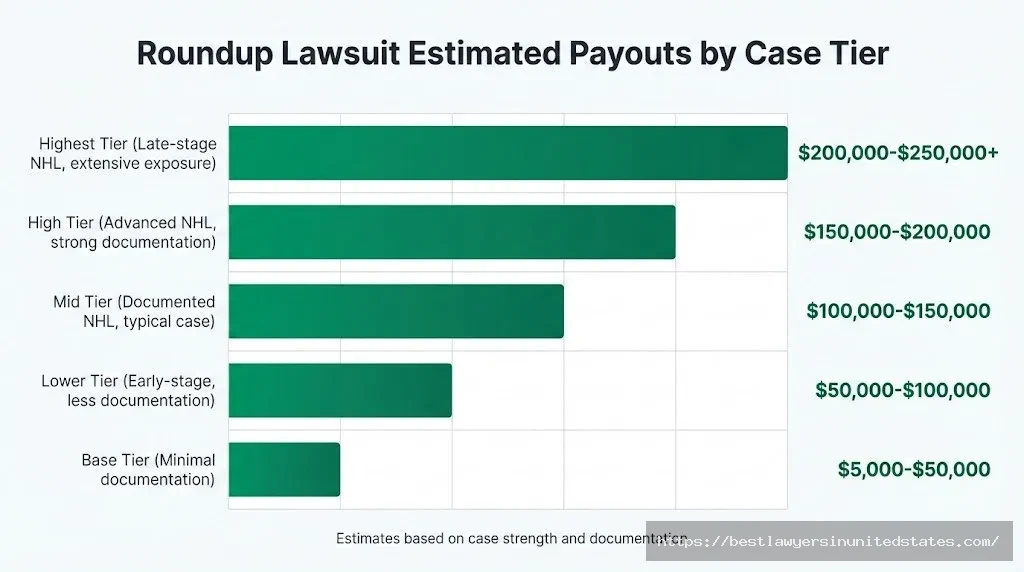
Roundup settlements use a point-based system to determine how much each person receives. Cases are scored based on multiple factors, then placed into settlement tiers. Higher-tier cases get significantly more money.
| Tier Category | Estimated Payout Range | Qualifying Factors | Payment Timeline |
|---|---|---|---|
| Highest Tier | $200,000 – $250,000+ | Late-stage aggressive NHL, young age at diagnosis, extensive documented exposure, severe impact on life/work, strong evidence | 1-2 months after settlement approval and claim review |
| High Tier | $150,000 – $200,000 | Advanced NHL, significant exposure history, clear causation, moderate to severe impact | 1-2 months after settlement approval and claim review |
| Mid Tier | $100,000 – $150,000 | Diagnosed NHL with documented exposure, typical case strength | 2-3 months after settlement approval and claim review |
| Lower Tier | $50,000 – $100,000 | Earlier-stage cancer, less extensive exposure documentation, older age at diagnosis | 2-3 months after settlement approval and claim review |
| Base Tier | $5,000 – $50,000 | Minimal documentation, weaker causation link, less severe cases | 2-4 months after settlement approval and claim review |
Important note: These are estimates based on the first round of settlements and legal expert opinions. Individual results vary significantly. Trial verdicts can be much higher (some have exceeded $100 million), but they take longer and carry the risk of losing.
Factors That Affect Your Payout
Your compensation depends on several key factors:
1. Type and stage of cancer – Aggressive, late-stage non-Hodgkin lymphoma cases receive higher payouts than earlier-stage or less severe diagnoses. Diagnosis of rare, aggressive subtypes like Burkitt lymphoma may score higher points.
2. Age at diagnosis – Younger people who develop cancer typically receive more because they face more years of living with the disease and its long-term effects. Someone diagnosed at 35 generally gets more than someone diagnosed at 75.
3. Level and duration of exposure – More extensive, longer-term Roundup use leads to higher payouts. Someone who used Roundup professionally for 20 years will likely receive more than a homeowner who used it occasionally for 3 years.
4. Impact on life and earning capacity – Cases where cancer caused job loss, permanent disability, or severe ongoing health problems score higher. If you can no longer work in your chosen field due to cancer, that increases your compensation.
5. Treatment intensity and outcome – Extensive treatments (multiple rounds of chemotherapy, radiation, stem cell transplants) and poor treatment outcomes warrant higher compensation. Ongoing treatment needs also increase awards.
6. Strength of evidence – Strong documentation of both your cancer diagnosis and Roundup exposure leads to better settlements. Good medical records and clear proof of product use help maximize your payout.
7. Legal representation quality – Experienced Roundup attorneys who understand the settlement matrix can position your case for a higher tier. They know which evidence matters most and how to present your case effectively.
Major Trial Verdicts (For Comparison)
While most cases settle, some have gone to trial with massive jury awards:
| Date | Plaintiff(s) | Verdict Amount | Final Amount After Appeal |
|---|---|---|---|
| August 2018 | Dewayne Johnson | $289 million | Reduced to $78 million |
| March 2019 | Edwin Hardeman | $80 million | Reduced to $25 million |
| May 2019 | Alva & Alberta Pilliod | $2.055 billion | Reduced to $87 million |
| November 2023 | Three Missouri plaintiffs | $1.56 billion | Reduced to $611 million ($5.6M-$38M each plus punitive damages) |
| October 2023 | Ernest Caranci (Pennsylvania) | $175 million | Upheld on appeal September 2025 |
| October 2025 | William Melissen (Philadelphia) | $78 million | Appeal pending |
| January 2025 | Georgia plaintiff | $2.25 billion | Settled November 2025 (amount confidential) |
Trial verdicts are often dramatically reduced on appeal, but they still tend to be much higher than settlement offers. However, trials take years, and there’s always a risk the jury could rule in favor of Bayer.
When Will You Receive Payment?
| Stage | Timeframe | What Happens |
|---|---|---|
| Claim Submission | ASAP – Before statute of limitations expires | You and your attorney file your claim |
| Case Evaluation | 1-3 months | Settlement administrator reviews your documentation and assigns point score |
| Settlement Negotiation | Ongoing | Your attorney negotiates with Bayer based on your case tier |
| Settlement Agreement | Varies | You accept or reject the settlement offer |
| Payment Processing | 30-60 days after acceptance | Check or wire transfer issued |
| Receipt of Funds | 1-2 weeks after processing | Money arrives in your account |
Typical total timeline: 2-6 months from filing your claim to receiving money, assuming you have strong documentation and accept the settlement offer.
If your case goes to trial instead of settling, expect 1-3 years or more before resolution. Trials offer the possibility of much higher awards but take significantly longer.
Important: After you receive your settlement, you may have to repay medical liens from Medicare, Medicaid, or private health insurance companies that covered your cancer treatment. These liens must be paid first, which can reduce your net payout by thousands of dollars. Your attorney will handle this, but it’s important to set realistic expectations.
How to File Your Roundup Lawsuit Claim – Step by Step

⚠️ CRITICAL DEADLINE WARNING: You MUST file your Roundup lawsuit within your state’s statute of limitations, which is typically 1 to 3 years from your cancer diagnosis or from when you discovered the link between Roundup and your cancer. Once this deadline passes, you permanently lose your right to seek compensation. State deadlines vary:
- 1-year states: Kentucky, Louisiana, Tennessee (very strict – file immediately)
- 2-year states: California, Florida, Georgia, Illinois, Missouri, New Jersey, Ohio, Pennsylvania, Texas, and many others
- 3-year states: Connecticut, Massachusetts, Michigan, New York, and several others
Don’t wait. Even if you think you have time, start the process now. Building your case takes time, and you don’t want to risk missing your deadline.
Complete Filing Process
Step 1: Contact a Roundup Lawsuit Attorney
Your first move should be calling an experienced Roundup attorney for a free case evaluation. Most law firms handling these cases work on contingency, meaning you pay nothing unless you win.
During your initial consultation (usually 15-30 minutes), the attorney will ask about:
- Your cancer diagnosis (type, stage, when diagnosed)
- Your Roundup use (how often, how long, in what capacity)
- Available documentation (medical records, proof of use)
- Your state’s statute of limitations deadline
The attorney will tell you honestly whether you likely have a qualifying case. If you do, they’ll explain next steps. If you don’t, they’ll tell you that too — it costs nothing to find out.
Attorney fees: Most Roundup attorneys work on contingency, taking 33-40% of any settlement or verdict you receive. You pay nothing upfront and nothing if your case doesn’t win.
Step 2: Gather Your Documentation
If you decide to move forward, start collecting evidence:
Medical documentation:
- Cancer diagnosis reports (pathology, biopsy results)
- Oncology records and treatment summaries
- Hospital admission and discharge papers
- Prescription records for cancer medications
- Imaging reports (CT scans, PET scans, X-rays)
- Physician notes documenting your diagnosis and prognosis
Exposure evidence:
- Product purchase receipts or credit card statements
- Photos of you using Roundup or of product containers
- Employment records showing work in agriculture/landscaping
- Coworker or supervisor statements about your job duties
- Personal calendars or journals noting lawn care activities
- Product containers (even empty ones) from your garage or shed
Financial records:
- Medical bills and explanation of benefits (EOB) from insurance
- Pay stubs showing lost wages due to illness
- Tax returns showing income before and after diagnosis
- Records of out-of-pocket expenses for treatment
Don’t worry if you’re missing some items. Your attorney can help obtain medical records directly from providers and can work with investigators to track down other evidence. Missing receipts is common — many people used Roundup years ago. Witness statements and employment records can fill gaps.
Step 3: Complete the Legal Intake Process
Your attorney will have you fill out detailed intake forms covering:
- Personal information (name, address, contact details)
- Detailed medical history and current health status
- Complete timeline of Roundup use (when, where, how often, which products)
- Employment history, especially any ag/landscaping work
- Family medical history (helps rule out genetic factors)
- Current medications and treatments
- Financial impact of your illness
Be thorough and honest. Inaccuracies can hurt your case later. If you don’t remember exact dates or details, estimate as best you can and say so.
Step 4: Medical Records Authorization
You’ll sign releases allowing your attorney to obtain your medical records directly from hospitals, doctors, and treatment centers. This ensures complete records and saves you the hassle of requesting them yourself.
Your attorney may also have you see an independent medical expert who will review your case and potentially provide an opinion linking your cancer to Roundup exposure. This examination is typically free — the expert is paid by your attorney.
Step 5: Case Filing
Your attorney will prepare and file your lawsuit. This may involve:
- Filing in your state court where you live or were exposed
- Joining the federal multidistrict litigation (MDL 2741) in California
- Filing in a state with particularly favorable laws for plaintiffs
You don’t need to do anything during this step. Your attorney handles all the legal paperwork, court filings, and procedural requirements. You’ll receive copies of filed documents for your records.
Step 6: Discovery and Case Development
After filing, your case enters the discovery phase where both sides exchange information:
What you may need to do:
- Provide additional documents if requested
- Answer written questions (interrogatories) about your diagnosis and exposure
- Give a deposition (recorded interview under oath about your case)
- Attend an independent medical examination if Bayer requests one
What your attorney does:
- Obtain documents from Bayer/Monsanto through discovery requests
- Depose Bayer witnesses and experts
- Work with medical and scientific experts to build causation evidence
- Develop your case presentation
This phase can take 6-18 months. Your attorney will guide you through each step and prepare you for any depositions or examinations.
Step 7: Settlement Negotiations or Trial Preparation
Most Roundup cases settle rather than going to trial. Your attorney will:
For settlement track:
- Present your case to the settlement administrator using the point-based matrix
- Negotiate the best possible tier placement and payout
- Review settlement offers with you and explain your options
- Handle all paperwork if you accept a settlement
For trial track (if settlement isn’t reached):
- Prepare for trial with expert witnesses and evidence
- File pretrial motions to strengthen your case
- Prepare you to potentially testify
- Present your case to a jury
You have final say on whether to accept a settlement offer or proceed to trial. Your attorney will give you their professional recommendation, but the decision is yours.
Step 8: Receive Your Compensation
If you settle:
- Your attorney receives the settlement check
- Medical liens (Medicare, Medicaid, private insurance) are paid first
- Attorney fees and case costs are deducted (typically 33-40%)
- You receive the remaining net proceeds via check or wire transfer
Example settlement breakdown:
- Gross settlement: $150,000
- Medical liens paid: -$20,000
- Attorney fee (35%): -$52,500
- Case costs: -$3,000
- Your net payment: $74,500
If you win at trial:
- Similar process, but amount is determined by jury verdict
- Appeals may delay payment by months or years
- Higher potential payout but also higher risk
Most people receive their net settlement payment within 30-60 days after agreeing to terms.
Filing Deadlines – Don’t Miss These Dates
Remember, deadlines vary by state. Here are statutes of limitations for key states where many Roundup claims have been filed:
| State | Deadline from Diagnosis | Notes |
|---|---|---|
| California | 2 years | Discovery rule may extend; consult attorney immediately |
| Missouri | 2 years | Very active Roundup litigation; some extensions during MDL |
| Florida | 2 years | Strict enforcement; limited exceptions |
| Texas | 2 years | May be extended if under 18 at diagnosis |
| Pennsylvania | 2 years | Discovery rule applies |
| Illinois | 2 years | Strict; few exceptions |
| New York | 3 years | One of the longer deadlines |
| Louisiana | 1 year | Shortest deadline – extremely urgent |
| Tennessee | 1 year | Very short window – consult attorney immediately |
| Ohio | 2 years | Discovery rule may apply |
Discovery rule: In some states, the deadline doesn’t start until you knew or should have known that Roundup caused your cancer. But don’t rely on this — start your claim as soon as possible.
Pending litigation pause: In some jurisdictions, statute of limitations deadlines may be paused while MDL proceedings are ongoing. But this is complex and varies by location. Never assume you have extra time — consult an attorney right away.
Common Filing Mistakes to Avoid
❌ Waiting until the last minute – File early to avoid technical issues, missing documents, or unexpected complications. Some law firms stop taking cases 6 months before the deadline to ensure they have time to file properly.
❌ Incomplete medical documentation – Make sure all cancer diagnosis records, pathology reports, and treatment summaries are included. Missing key medical records is a common reason claims get delayed or undervalued.
❌ Insufficient exposure evidence – Don’t just say you used Roundup — provide receipts, photos, employment records, or witness statements. The stronger your proof of use, the better your settlement tier.
❌ Using the wrong attorney – Choose a lawyer experienced specifically with Roundup litigation, not just any personal injury attorney. Roundup cases have unique medical and scientific complexity.
❌ Not saving your claim confirmation – Always keep copies of all documents you submit and any confirmation numbers or receipts. You’ll need these to track your claim and prove you filed on time.
❌ Accepting the first offer without negotiation – Settlement offers are often negotiable. An experienced attorney knows when an offer is too low and will fight for better compensation.
❌ Missing important deadlines – Beyond the statute of limitations, there may be discovery deadlines, deposition schedules, and other time-sensitive requirements. Your attorney will track these, but stay responsive when they need information from you.
Current Lawsuit Status & Latest Updates
Settlement and Trial Activity (as of February 2026)
Roundup litigation is extremely active in early 2026. Here’s where things stand:
Cases resolved: Approximately 100,000 claims have been settled for nearly $11 billion total
Active federal MDL cases: 3,902 lawsuits pending in MDL 2741 (Northern District of California) as of February 2026
Total pending claims: An estimated 60,000-61,000 claims remain unresolved across federal and state courts
New filings: Lawsuits continue to be filed every week as people are newly diagnosed with cancer
Recent trial activity: Several major trial wins for plaintiffs in 2025, including:
- September 2025: Pennsylvania court upholds $175 million Caranci verdict
- November 2025: Bayer settles $2 billion Georgia case (amount confidential)
- Multiple 2025 verdicts totaling over $2 billion
Bayer has stated it plans to “significantly contain” the Roundup litigation by the end of 2026 through continued settlements and the pending Supreme Court decision.
Recent Developments
January 16, 2026 – U.S. Supreme Court Agrees to Hear Key Case
The Supreme Court announced it will review Monsanto Company v. Durnell, a case that could dramatically impact all remaining Roundup lawsuits. At issue is federal preemption — whether EPA approval of Roundup’s label prevents plaintiffs from suing under state failure-to-warn laws.
The case background: John Durnell won $1.25 million from a Missouri jury after developing non-Hodgkin lymphoma. Bayer appealed, arguing that because the EPA approved Roundup’s label without a cancer warning, state law can’t require a different warning. Lower courts have split on this issue:
- 3rd Circuit (Pennsylvania): Ruled FOR Bayer – federal law preempts state lawsuits
- 9th Circuit (California), 11th Circuit (Georgia), Missouri courts: Ruled AGAINST Bayer – plaintiffs can sue despite EPA approval
U.S. Government position: In December 2025, Solicitor General John Sauer filed a brief supporting Bayer’s position that federal law should preempt state lawsuits.
Expected decision: The Supreme Court will hear oral arguments in spring 2026 and issue a ruling by June 2026.
What this means for you: A ruling in Bayer’s favor could dismiss many pending lawsuits and make new claims much harder to file. A ruling against Bayer would allow litigation to continue. Either way, the decision will be a major turning point.
Should you wait for the Supreme Court decision? NO. File your claim now if you’re eligible. If the Supreme Court rules for Bayer, cases filed before the decision may still proceed. If you wait and the Court rules for Bayer, you might lose your chance entirely.
September 2025 – Bayer Sets Aside $1.37 Billion for Additional Settlements
Bayer announced provisions of $1.37 billion to resolve ongoing Roundup claims, signaling continued settlement negotiations. The company stated it has resolved approximately 131,000 of the 192,000 total claims filed.
August 2025 – Settlement Discussions with Missouri State Court Cases
Reports indicate Bayer is pursuing another round of settlements, particularly targeting thousands of cases pending in Missouri state courts. Settlement frameworks are reportedly being negotiated.
Court Activity – Cases Moving Toward Trial
Several individual cases are progressing toward trial dates:
- Joslyn Ethel Kooi’s case recommended for transfer back to Washington state for trial
- Multiple Missouri and California cases set for trial dates in 2026
- Federal MDL judge has noted that plaintiffs who declined earlier settlement offers “may wish to reconsider” given the pending Supreme Court review
What Happens Next?
Expected upcoming events:
Spring 2026 – Supreme Court oral arguments in Monsanto v. Durnell case
June 2026 – Supreme Court decision expected (could come sooner or slightly later)
Throughout 2026 – Continued settlement negotiations and individual trial dates
End of 2026 – Bayer’s target date to largely resolve litigation
2027 and beyond – New cases may continue to be filed as people are diagnosed, depending on Supreme Court ruling
Roundup Lawsuit vs. Similar Product Liability Cases
How This Settlement Compares
| Lawsuit | Settlement/Verdicts | Affected Parties | Average Payout Range | Status |
|---|---|---|---|---|
| Roundup | $11+ billion | ~170,000 filed; ~100,000 settled | $100,000-$160,000 | Ongoing; ~60,000 pending |
| Talcum Powder (J&J) | $700+ million | Thousands | $25,000-$500,000+ | Ongoing |
| Risperdal (J&J) | $800+ million | Thousands | Varies widely | Mostly resolved |
| Zantac | Ongoing | Tens of thousands | TBD | Active litigation |
| 3M Earplugs | $6+ billion | ~300,000 | ~$20,000 average | Ongoing |
| Hernia Mesh | $4+ billion | Hundreds of thousands | $25,000-$100,000 | Ongoing |
| Camp Lejeune Water | $21 billion fund | Estimated 1 million+ | $50,000-$550,000 estimated | Active filing period |
The Roundup settlement is one of the largest in product liability history. Only the Camp Lejeune water contamination settlement (a government program) and asbestos settlements (spanning decades) are larger.
What Makes the Roundup Lawsuit Unique?
1. Sheer scale of exposure: Roundup is the most widely used herbicide in the world. Unlike drugs taken by limited patient populations, Roundup was available to anyone at any hardware store. Millions of people were potentially exposed.
2. Strong scientific debate: The conflict between the IARC classification (“probably carcinogenic”) and EPA’s stance (“not likely carcinogenic”) creates unusual legal complexity. Most product liability cases don’t have this level of regulatory disagreement.
3. Internal company documents: The “Monsanto Papers” revealed exceptionally damning evidence of corporate manipulation of science and regulators. These documents have been crucial in winning jury sympathy.
4. Supreme Court intervention: It’s rare for product liability litigation to reach the Supreme Court, but the federal preemption issue in Roundup cases raises fundamental questions about state vs. federal regulatory authority.
5. Impact on agricultural industry: Roundup is central to modern farming practices, particularly for genetically modified “Roundup Ready” crops. A ban or severe restrictions would disrupt agricultural production nationwide.
Do You Need a Lawyer to File a Claim?
Quick Answer: While you’re not legally required to have a lawyer, attempting to file a Roundup lawsuit on your own is extremely difficult and not recommended. Roundup cases involve complex medical causation issues, scientific evidence, corporate document review, and sophisticated legal arguments that require specialized expertise. Virtually all successful Roundup claims have been handled by experienced attorneys. Most Roundup lawyers work on contingency (you pay nothing unless you win), so there’s no financial barrier to getting professional help.
Why Self-Filing Isn’t Practical for Roundup Cases
Unlike some straightforward class action settlements where you just fill out a form and submit documentation, Roundup lawsuits require:
Complex medical causation analysis: You need medical experts to testify that glyphosate caused your specific cancer. Finding, hiring, and coordinating these experts requires legal resources most individuals don’t have.
Discovery and document review: Obtaining internal Monsanto documents, deposing company witnesses, and reviewing thousands of pages of scientific studies requires legal expertise and court authority.
Expert witness coordination: Roundup cases typically require multiple expert witnesses — oncologists, toxicologists, epidemiologists — who charge $400-$800 per hour. Law firms advance these costs and only recover them if you win.
Trial presentation: If your case goes to trial, you’ll face Bayer’s team of elite corporate defense attorneys. Going up against them without legal training would be nearly impossible.
Settlement negotiation: Understanding the point-based settlement matrix and negotiating the best tier placement requires familiarity with how the settlement program works.
When Legal Help Is Essential
You absolutely need an attorney for Roundup cases. The only exception might be if you were part of the original 2020 settlement and are just submitting documentation for a claim you already established — and even then, attorney guidance helps.
Consider that:
- Bayer employs dozens of attorneys from top law firms nationwide
- The science linking glyphosate to cancer is complex and contested
- Settlement tier placement can mean the difference between $50,000 and $200,000
- Mistakes in filing or documentation can result in claim denial
- State statutes of limitations are strictly enforced — miss your deadline and you’re done
Free Legal Consultation
Most attorneys handling Roundup lawsuits offer:
Free case evaluations: A 15-30 minute phone consultation to review your situation and determine if you likely have a qualifying case. No cost, no obligation.
Contingency fee arrangements: You pay nothing upfront. The attorney only gets paid if you win a settlement or verdict. Typical fees are 33-40% of your recovery, plus case costs (expert fees, filing fees, etc.).
No out-of-pocket costs: The law firm advances all case expenses — medical record retrieval, expert witnesses, court fees — and only recoups them if your case is successful.
Case management: Your attorney handles everything: gathering evidence, filing paperwork, coordinating with experts, negotiating with Bayer, and representing you in court if needed.
To find an experienced Roundup attorney:
- Contact national law firms that have handled hundreds of Roundup cases (like those mentioned in your web searches)
- Ask about their specific Roundup experience: How many cases have they handled? What settlements have they achieved?
- Verify they work on contingency with no upfront costs
- Make sure they have medical and scientific experts already lined up
You can also contact [email protected] for attorney referrals to qualified Roundup litigation attorneys in your state.
Frequently Asked Questions
What is the Roundup cancer lawsuit?
Quick Answer: The Roundup cancer lawsuit involves thousands of individual claims alleging that Monsanto’s Roundup weed killer causes non-Hodgkin lymphoma and other blood cancers through exposure to its active ingredient, glyphosate.
The lawsuits claim that Monsanto (now owned by Bayer) knew about the cancer risks but failed to warn users and actively worked to hide the dangers. Internal company documents revealed Monsanto ghostwrote studies claiming Roundup was safe and attempted to influence regulators. Bayer has paid about $11 billion to settle approximately 100,000 claims, with around 60,000 lawsuits still pending as of February 2026.
Who is eligible for the Roundup settlement?
Quick Answer: You may be eligible if you used Roundup regularly (typically at least 40-50 hours total), were later diagnosed with non-Hodgkin lymphoma or a related blood cancer, can provide documentation of your diagnosis and exposure, and are within your state’s filing deadline (usually 1-3 years from diagnosis).
Farmers, landscapers, groundskeepers, nursery workers, and homeowners who regularly used Roundup in their yards most commonly qualify. You’ll need medical records proving your cancer diagnosis and evidence showing you used Roundup (receipts, employment records, witness statements, or photos). The key is establishing that you had significant exposure to the product before developing cancer.
How much money will I receive from the Roundup settlement?
Quick Answer: Individual settlement amounts typically range from $5,000 to $250,000, with the average being around $150,000. Your specific payout depends on your cancer type and stage, age, level of Roundup exposure, strength of evidence, and impact on your life and earning capacity.
Bayer uses a point-based system to evaluate cases and assign them to settlement tiers. People with aggressive, late-stage non-Hodgkin lymphoma who are younger and have extensive documented Roundup exposure receive the highest settlements (often $200,000+). Cases with weaker documentation or less severe cancer may receive $50,000-$100,000. Trial verdicts have been much higher — some exceeding $100 million — but settlements provide faster, more certain compensation.
Is there a deadline to file a Roundup lawsuit claim?
Quick Answer: Yes. Each state has its own statute of limitations, typically 1-3 years from your cancer diagnosis or from when you discovered the link to Roundup. Louisiana and Tennessee have 1-year deadlines. Most states including California, Florida, Missouri, and Texas have 2-year deadlines. A few states like New York have 3-year deadlines.
Once your state’s deadline passes, you permanently lose your right to file. Don’t wait — start the process immediately. Even if you think you have time, gathering evidence and building your case takes months. Some law firms stop accepting cases 6 months before the deadline to ensure adequate time for filing. Contact an attorney right away for a free case evaluation to determine your specific deadline.
How do I file a Roundup lawsuit claim?
Quick Answer: Contact an experienced Roundup lawsuit attorney for a free case evaluation. They’ll review your diagnosis and exposure history, help gather necessary medical records and evidence of Roundup use, file your lawsuit in the appropriate court, and handle all negotiations or trial proceedings on your behalf.
The process typically involves: (1) Free attorney consultation, (2) Signing a retainer agreement (contingency — no upfront costs), (3) Gathering medical records and exposure evidence, (4) Filing the lawsuit, (5) Discovery and case development, (6) Settlement negotiations or trial, and (7) Receiving compensation. Your attorney does the heavy lifting — you just need to provide information and documentation. The entire process from filing to settlement payment typically takes 2-6 months if you settle, or 1-3+ years if you go to trial.
Do I need a lawyer to file a Roundup claim?
Quick Answer: While not legally required, you absolutely should use an attorney for Roundup cases. These lawsuits involve complex medical causation, scientific evidence, and sophisticated legal arguments that are nearly impossible to handle alone.
Roundup cases require medical and scientific experts to link your cancer to glyphosate exposure, extensive discovery of Monsanto’s internal documents, and negotiation with Bayer’s experienced legal team. Virtually all successful Roundup claims have been handled by specialized attorneys. Most work on contingency (taking 33-40% of your settlement), so you pay nothing unless you win. The cost of hiring experts and managing litigation would be prohibitive for an individual, but law firms advance these costs. Trying to go it alone would almost certainly result in a denied claim or severely reduced compensation.
What documents do I need to file a Roundup lawsuit?
Quick Answer: You need medical records proving your cancer diagnosis (pathology reports, biopsy results, oncology records) and evidence of Roundup use (purchase receipts, employment records showing agricultural/landscaping work, witness statements, or photos of you using the product).
Key medical documentation includes: cancer diagnosis reports, treatment summaries, physician notes, and prescription records. For exposure proof: product purchase receipts or credit card statements, employment records from farming or landscaping jobs, coworker or supervisor statements, photos of Roundup containers or you using the product, and detailed written timelines of your use. Don’t panic if you’re missing some items — your attorney can help obtain medical records and find alternative evidence like witness testimony.
What if I don’t have receipts showing I bought Roundup?
Quick Answer: Don’t worry — most people don’t have receipts from years ago. Your attorney can establish your Roundup use through employment records (if you worked in agriculture or landscaping), witness statements from family, friends, or coworkers who saw you use it, photos of you doing yard work or of old Roundup containers, and your own detailed written timeline of when and how you used the product.
Many successful Roundup claims have been won without purchase receipts. If you worked professionally with Roundup, employment records and coworker testimony often provide strong evidence. For residential users, neighbors or family members can attest to seeing you use the product regularly. Your attorney knows how to build a case even with incomplete documentation.
When will I receive my Roundup settlement payment?
Quick Answer: If you settle your case (rather than going to trial), you typically receive payment 30-60 days after accepting the settlement offer. The entire process from filing your claim to receiving money usually takes 2-6 months.
The timeline is: File claim → Case evaluation (1-3 months) → Settlement negotiation (varies) → Accept settlement → Payment processing (30-60 days) → Receive funds. After the settlement check arrives, your attorney pays any medical liens first (Medicare, Medicaid, private insurance), deducts their fee (typically 33-40%) and case costs, then sends you the net proceeds. If your case goes to trial, expect 1-3 years or more before final payment, though verdicts are often higher.
How will I receive my Roundup settlement payment?
Quick Answer: You’ll receive your net settlement proceeds via check or direct deposit/wire transfer from your attorney’s trust account after medical liens and attorney fees are deducted.
Here’s how it works: Bayer sends the gross settlement to your attorney’s trust account → Medical liens are paid (Medicare, Medicaid, private insurance) → Attorney fees (typically 33-40%) and case costs are deducted → You receive the remaining balance by check or electronic transfer. For example, a $150,000 settlement might result in a net payment of $70,000-$90,000 to you after all deductions. Your attorney will provide a detailed accounting showing exactly how the settlement was distributed.
What is the total Roundup settlement amount?
Quick Answer: Bayer has paid approximately $11 billion to settle around 100,000 Roundup cancer claims as of February 2026. In September 2025, the company set aside an additional $1.37 billion to resolve ongoing cases.
The original 2020 settlement was $10.9 billion, covering the bulk of the initial claims. Since then, Bayer has continued settling individual cases and recently allocated more funds for the estimated 60,000 remaining claims. This does not include additional jury verdicts totaling over $8 billion that have been awarded to plaintiffs who went to trial (though many verdict amounts were reduced on appeal). The total financial impact on Bayer exceeds $11 billion and continues to grow.
Has the Roundup settlement been approved?
Quick Answer: The original 2020 settlement of $10.9 billion was approved and money has been distributed to approximately 100,000 claimants. Individual settlements continue to be negotiated and approved on a case-by-case basis.
Unlike a traditional class action with a single settlement approval, Roundup cases involve individual settlements between plaintiffs and Bayer. The 2020 settlement framework established a point-based system for evaluating claims, which was approved by Judge Vince Chhabria. However, Bayer’s 2021 proposal for a $2 billion future claims settlement was rejected by the court. Currently, cases are being settled individually or in groups through ongoing negotiations.
Can I opt out of the Roundup settlement?
Quick Answer: If you have an individual Roundup lawsuit, you’re not part of a class action settlement — you can accept or reject settlement offers as you choose. If you reject a settlement offer, you can continue pursuing your case through trial.
Roundup litigation is not a traditional class action settlement where you need to “opt out.” Instead, each plaintiff has an individual case. You can choose to accept a settlement offer from Bayer or reject it and proceed to trial for a potentially higher (but riskier) award. Your attorney will explain your options and provide a recommendation, but the final decision whether to settle is always yours.
What if I already threw away my Roundup container?
Quick Answer: That’s fine — most people no longer have the product containers. You can still prove your use through purchase receipts, employment records, witness statements from people who saw you use Roundup, photos showing you doing yard work, or your own detailed written timeline of use.
Physical product containers can be helpful evidence but aren’t required. Many successful Roundup lawsuits have been won without the actual container. Your attorney can establish exposure through other means: credit card statements showing Roundup purchases, photos of you working in your yard or at landscaping jobs, coworker testimony if you used it professionally, family members who remember seeing you use it, or even social media posts about lawn care. The key is having multiple pieces of evidence that corroborate your claim.
Will I have to give up my right to sue Bayer separately if I join the lawsuit?
Quick Answer: If you accept a Roundup settlement, yes — you’ll sign a release waiving your right to sue Bayer again for the same cancer diagnosis. However, you won’t be barred from suing for different future health problems unrelated to your current claim.
When you settle your Roundup lawsuit, you’ll sign a settlement agreement that releases Bayer from liability for your non-Hodgkin lymphoma or blood cancer caused by Roundup. This is standard in all settlements. However, the release is specific to your current claim. If you later develop a different health issue unrelated to your current cancer diagnosis, you would still have legal rights regarding that separate injury. Your attorney will explain exactly what you’re agreeing to before you sign.
What happens if I miss the filing deadline?
Quick Answer: If you miss your state’s statute of limitations deadline, you permanently lose your right to file a lawsuit and cannot recover compensation through Roundup litigation. There are very few exceptions to these deadlines.
Statutes of limitations are strictly enforced. Once the deadline passes — typically 1-3 years from your diagnosis — courts will dismiss your case without even considering the merits. Very limited exceptions exist (such as being a minor at the time of diagnosis, or in rare cases where fraud concealed the cause of injury until later). Don’t risk losing your claim. Contact an attorney immediately upon diagnosis to protect your rights. Even if you’re not sure you want to pursue a lawsuit, at least consult with an attorney while you’re still within the filing window.
How can I check the status of my Roundup claim?
Quick Answer: Contact your attorney — they’re your primary source for claim status updates. They’ll tell you where your case stands in settlement negotiations, what documents are still needed, and when to expect the next steps.
Your lawyer should provide regular updates as your case progresses. Typical milestones they’ll update you about: case filed, discovery in progress, settlement evaluation completed, offer received, settlement accepted, medical liens being resolved, payment processed. If you haven’t heard from your attorney in a while, it’s perfectly acceptable to call or email for a status update. Most firms have case managers who can provide quick updates without needing to speak directly to the attorney.
What if my Roundup claim is denied?
Quick Answer: If Bayer rejects your settlement claim or offers an unreasonably low amount, you have options: your attorney can negotiate for better terms, provide additional evidence to strengthen your case, or take your case to trial where a jury (not Bayer) decides the outcome.
Claim denials or low-ball offers can happen if documentation is insufficient, causation links are weak, or your case has other issues. Work with your attorney to understand why the claim was denied and whether additional evidence could overcome the denial. Sometimes claims are initially denied but later accepted after more documentation is provided. If settlement truly isn’t possible, you can pursue a jury trial. While riskier, trials have resulted in verdicts far exceeding typical settlement amounts.
Will my Roundup settlement affect my taxes?
Quick Answer: Compensation for physical illness (like cancer) is generally not taxable under federal law. However, portions of your settlement allocated to lost wages or punitive damages may be taxable. Consult a tax professional for advice specific to your situation.
Under current federal tax law, settlements for physical injury or sickness are typically excluded from taxable income. This means the portion of your Roundup settlement compensating you for cancer, medical expenses, and pain and suffering related to your illness is usually tax-free. However, if part of your settlement compensates for lost wages, that portion may be taxable as income. Punitive damages (meant to punish Bayer) are also taxable. Your settlement agreement should specify how the payment is allocated among these categories. Consult a tax advisor or CPA to understand your specific tax obligations.
Where can I find the official Roundup claim form?
Quick Answer: Roundup lawsuits are individual legal cases filed by attorneys, not a class action settlement with a simple claim form. To file a Roundup lawsuit, contact an experienced Roundup attorney who will handle all paperwork and filing on your behalf.
Unlike some class action settlements where you can just download a form and mail it in, Roundup cases require full legal representation and court filings. There is no “official claim form” you can complete yourself. Your attorney will gather your information, prepare legal documents, file your lawsuit in the appropriate court, and handle all aspects of your case. The intake forms your attorney gives you are for their internal case management — the actual legal filings are complex court documents they’ll prepare.
Can I still file a Roundup lawsuit if I have non-Hodgkin lymphoma but also have other risk factors?
Quick Answer: Yes, you can still file even if you have other risk factors for cancer. You don’t need to prove Roundup was the only cause — just that it was a substantial contributing factor.
Many people with non-Hodgkin lymphoma have multiple potential risk factors: family history, other chemical exposures, immune system disorders, etc. This doesn’t automatically disqualify you. The legal standard is whether Roundup was a “substantial contributing factor” to your cancer, not whether it was the sole cause. Your attorney and medical experts will analyze your overall health history and develop evidence showing Roundup played a significant role. Cases with competing risk factors can still succeed, though they may receive lower settlement offers than cases with clear, direct causation.
What is the difference between the Roundup lawsuit and a class action?
Quick Answer: Roundup lawsuits are individual personal injury claims, not a traditional class action. Each plaintiff has their own lawsuit with unique facts, though many cases are coordinated in a multidistrict litigation (MDL) for efficiency.
In a class action, one case represents many people with identical claims, and the settlement is usually distributed equally or through a simple formula. Roundup litigation is different — each person has an individual case evaluated on its specific merits. Your cancer stage, exposure level, and documentation affect your individual settlement amount. Cases are grouped in an MDL for pretrial efficiency (joint discovery, shared experts), but each case remains separate. This means your settlement depends on the strength of your specific case, not just membership in a group.
Can family members file a Roundup lawsuit if their loved one died from cancer?
Quick Answer: Yes. If your spouse, parent, or family member died from non-Hodgkin lymphoma or related cancer after Roundup exposure, eligible family members or estate representatives can file a wrongful death lawsuit seeking compensation for their death.
Wrongful death Roundup lawsuits can be filed by: surviving spouses, children, parents (if the deceased had no spouse/children), or estate administrators/executors. These cases seek compensation for: the deceased’s medical bills and pain and suffering before death, funeral and burial expenses, loss of financial support the deceased would have provided, and loss of companionship and guidance. You’ll need the deceased’s medical records showing cancer diagnosis and death, evidence of their Roundup use, and a death certificate listing cancer as cause of death. Contact an attorney experienced in wrongful death Roundup cases.
Will the Supreme Court decision affect my ability to file a Roundup lawsuit?
Quick Answer: The Supreme Court’s decision in Monsanto v. Durnell (expected by June 2026) could significantly impact future Roundup lawsuits. If the Court rules for Bayer, new lawsuits may become much harder or impossible to file. If it rules against Bayer, litigation can continue. File your claim NOW if you’re eligible — don’t wait for the decision.
A favorable ruling for Bayer would establish that federal EPA approval of Roundup’s label preempts state failure-to-warn lawsuits. This could dismiss many pending cases and prevent new ones from being filed. Cases already filed before the decision may still proceed (legal experts disagree on this), so the safest approach is to file as soon as possible if you qualify. Waiting to see what the Supreme Court decides could cost you your right to compensation entirely. File now to protect your rights regardless of how the Court rules.
Take Action on Your Roundup Lawsuit Claim Today
If you or a loved one developed non-Hodgkin lymphoma or related cancer after using Roundup weed killer, you may be entitled to significant compensation. With approximately $11 billion already paid to cancer victims and settlement negotiations ongoing, now is the time to explore your legal options.
Don’t wait: State filing deadlines are strict (typically 1-3 years from diagnosis), and the pending Supreme Court decision could impact future claims. The sooner you contact an attorney, the more time they have to build a strong case.
Remember: Most Roundup attorneys work on contingency — you pay nothing unless you win. Free case evaluations are available with no obligation.
Contact an experienced Roundup lawsuit attorney today to find out if you qualify for compensation. Your initial consultation is free, and if you have a qualifying case, your attorney will handle everything while you focus on your health and family.
This article is for informational purposes only and does not constitute legal or medical advice. Consult with a qualified attorney about your specific situation. Case outcomes vary, and past results don’t guarantee future success.

Comments