
Hawthorne Residential Partners faces multiple lawsuits involving tenant rights violations, unsafe living conditions, and discriminatory practices at properties across the southeastern United States. The company settled one major class action lawsuit in North Carolina in 2023 for $500,000 cash plus $2.7 million in debt cancellation, while additional lawsuits in Georgia, Florida, and South Carolina remain active as of February 2026. If you lived in a Hawthorne-managed property and experienced maintenance neglect, discrimination, unfair fees, or unsafe conditions, you may qualify to file a claim or join ongoing litigation.
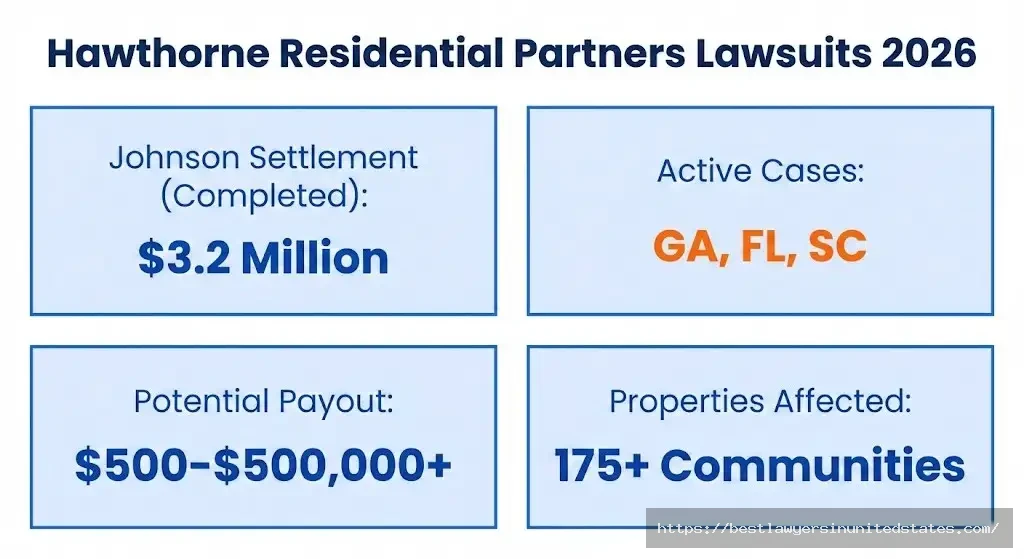
Quick Answer: Hawthorne Residential Partners, a property management company managing 60,000+ units across the Southeast, has faced multiple lawsuits since 2019 for alleged maintenance failures, Fair Housing Act violations, unlawful eviction fees, and unsafe living conditions. One class action settled in 2023 for $3.2 million total compensation. Several active lawsuits continue in 2026, with tenants alleging disability discrimination, civil rights violations, and personal injury from negligent property maintenance.
What Is the Hawthorne Residential Partners Lawsuit About?
Background of the Lawsuit
The Hawthorne Residential Partners lawsuit refers to multiple legal actions filed against the Greensboro, North Carolina-based property management company since 2019. Tenants across multiple states have alleged systematic failures in property maintenance, discriminatory housing practices, and illegal fee assessments. These cases involve properties in North Carolina, South Carolina, Georgia, Tennessee, Virginia, and Florida.
Founded in 2009, Hawthorne Residential Partners manages over 175 apartment communities with approximately 60,000 residential units. The company markets itself as providing “modern living with a sense of community” featuring fitness centers, pools, and pet amenities. However, hundreds of tenants have reported a different reality: mold infestations, broken HVAC systems, pest problems, discriminatory treatment, and excessive fees.
The lawsuits allege violations of the Fair Housing Act, state landlord-tenant laws, breach of contract, and negligence resulting in personal injury. Some cases have settled, while others continue through federal and state court systems as of February 2026.
Timeline of Key Events
Table: Hawthorne Residential Partners Lawsuit Timeline
| Date | Event | Details |
|---|---|---|
| 2018-2021 | Complaint patterns emerge | Online forums and tenant advocacy groups report increasing complaints about rent hikes, maintenance delays, security deposit disputes |
| 2022 | Legal aid organizations document issues | North Carolina and Tennessee tenant advocacy organizations observe surge in complaints against Hawthorne properties |
| May 20, 2019 | Davis v. Hawthorne filed | Labor standards lawsuit filed in U.S. District Court, Georgia Middle District (Case 3:19-cv-00051) |
| 2023 | Lawyers consolidate cases | Multiple attorneys begin collecting evidence of discriminatory practices across states |
| May 16, 2023 | Johnson settlement executed | Keosha Johnson class action settlement agreement signed – $500,000 cash + $2.7 million debt cancellation |
| August 10, 2023 | Johnson settlement approved | Wake County Superior Court approves final settlement in North Carolina eviction fees class action |
| September 11, 2024 | Watts v. Rivarel filed | Personal injury lawsuit filed in South Carolina for tenant fall due to defective stairs |
| October 16, 2024 | Noronha v. Hawthorne filed | Civil rights and breach of contract lawsuit filed in U.S. District Court, Florida Southern District (Case 0:24-cv-61922) |
| January 24, 2025 | Jehramyus v. Hawthorne filed | Fair Housing Act disability discrimination lawsuit filed in U.S. District Court, Georgia Northern District (Case 1:2025cv00304) |
| 2025-2026 | Class action certification pending | Courts consider certification of consolidated class action potentially covering thousands of tenants |
| December 8, 2025 | Noronha jury trial scheduled | Florida case set for trial in Fort Lauderdale Division |
| February 2026 | Multiple cases ongoing | Georgia, Florida, and South Carolina cases proceed through discovery and litigation |
Who Filed the Lawsuits?
Multiple individual tenants and groups have filed lawsuits against Hawthorne Residential Partners:
Keosha Johnson – Lead plaintiff in the North Carolina class action regarding unlawful eviction fees. Represented tenants at Hawthorne at the Trace in Wake County who were automatically charged three fees when facing eviction for non-payment of rent.
D’Jai Okolo Jehramyus – Plaintiff in the 2025 Georgia case alleging the company failed to provide reasonable accommodations for disability needs, violating the Fair Housing Act.
Juliana Noronha – Plaintiff in the October 2024 Florida case alleging civil rights violations and breach of contract. The case is proceeding through mediation with a jury trial scheduled for December 2025.
Charlotte, NC Tenants – A group of tenants from a Hawthorne-managed property in Charlotte have become the face of maintenance neglect allegations, presenting photographs, maintenance logs, and testimony about prolonged mold exposure.
Law firms representing class members include tenant rights advocates and consumer protection attorneys across multiple states. The Johnson settlement was approved by Wake County Superior Court after determining the settlement was fair, reasonable, and adequate.
What Are the Allegations?
Key allegations against Hawthorne Residential Partners include:
Unlawful Eviction Fees:
- Automatically assessing three separate fees when filing eviction lawsuits
- Charging fees without proper legal authorization under North Carolina General Statutes §§ 42-46 and 75-50
- Collecting fees even when eviction proceedings were dropped or settled
Fair Housing Act Violations:
- Refusing to make reasonable accommodations for tenants with disabilities
- Discriminatory treatment based on protected characteristics
- Failure to provide accessible housing modifications when legally required
- Systemic policies that disproportionately impact protected classes
Maintenance Negligence:
- Ignoring reported mold growth for months or years
- Failing to repair HVAC systems during extreme weather
- Allowing plumbing leaks to cause property damage
- Inadequate pest control despite repeated tenant complaints
- Violating implied warranty of habitability
Unsafe Living Conditions:
- Defective stairs causing tenant injuries
- Structural issues creating health hazards
- Exposure to toxic mold causing respiratory problems
- Broken security features endangering tenant safety
Breach of Contract:
- Failing to maintain properties as promised in lease agreements
- Not providing advertised amenities
- Wrongfully withholding security deposits
- Unjustified rent increases violating lease terms
Deceptive Practices:
- Unclear fee structures not properly disclosed
- Sudden rent increases without adequate notice
- Misrepresentation of property conditions before move-in
Who Qualifies for the Hawthorne Residential Partners Lawsuit?
Quick Answer: Current and former tenants of Hawthorne-managed properties who experienced unlawful fees, maintenance neglect, discrimination, unsafe conditions, or wrongful eviction may qualify. For the settled Johnson case, affected tenants received compensation automatically if they were charged the unlawful fees. For ongoing cases, eligibility depends on the specific property, dates of residency, and type of harm experienced.
Eligibility Requirements
Table: Eligibility Checklist by Case Type
| Case Type | Who Qualifies | Time Period | Documentation Needed |
|---|---|---|---|
| Johnson Settlement (Closed) | Tenants charged unlawful eviction fees at Hawthorne at the Trace | Fees charged before August 2023 | Fee statements, eviction notices, lease agreements |
| Fair Housing/Disability Claims | Tenants denied reasonable accommodations for disabilities | Any time at Hawthorne property | Medical documentation, accommodation requests, denial correspondence |
| Maintenance Negligence | Tenants who lived in unsafe/uninhabitable conditions | Active cases: 2019-present | Photos, maintenance requests, medical records, emails |
| Personal Injury | Tenants injured due to property defects | Varies by state statute of limitations | Medical records, incident reports, photos, witness statements |
| Security Deposit Disputes | Tenants whose deposits were wrongfully withheld | Within state-specific timeframes | Lease agreement, move-in/out inspection reports, deposit receipts |
| Unlawful Eviction | Tenants evicted without proper notice or valid cause | Varies by state law | Eviction notices, court documents, lease agreements, payment records |
You may qualify for compensation if you experienced any of the following while renting from a Hawthorne Residential Partners property:
Maintenance Issues:
- Reported mold growth that was ignored or inadequately addressed
- HVAC failures during extreme temperatures without timely repair
- Plumbing problems causing water damage or unsanitary conditions
- Pest infestations despite requests for extermination
- Structural defects creating safety hazards
Discriminatory Treatment:
- Requests for disability accommodations that were denied
- Disparate treatment based on race, religion, gender, familial status, or national origin
- Harassment or retaliation after fair housing complaints
Illegal Fees:
- Charged eviction-related fees beyond what North Carolina law allows
- Hidden fees not disclosed in original lease agreements
- Fees charged after resolving payment disputes
Eligible Properties and Locations
Table: States and Communities Where Lawsuits Have Been Filed
| State | Hawthorne Properties | Known Lawsuit Locations | Number of Communities |
|---|---|---|---|
| North Carolina | 50+ communities | Wake County (Hawthorne at the Trace), Charlotte, Greensboro, Asheville (Hawthorne Northside) | Statewide – 50+ |
| Georgia | 30+ communities | Atlanta metro area, Northern District | 30+ |
| South Carolina | 25+ communities | Upstate region, personal injury cases filed | 25+ |
| Florida | 20+ communities | Fort Lauderdale area (Southern District) | 20+ |
| Tennessee | 15+ communities | Nashville, Memphis metro areas | 15+ |
| Virginia | 15+ communities | Multiple locations | 15+ |
| Texas | 10+ communities | Various locations | 10+ |
Hawthorne Residential Partners manages approximately 175 communities across these states. If you lived in any Hawthorne-managed property during the relevant time periods and experienced the issues described, you may qualify.
Who Does NOT Qualify?
You are NOT eligible if:
- You never lived in a Hawthorne Residential Partners property
- Your tenancy ended before the company began managing the property
- You experienced normal wear and tear or minor maintenance delays that didn’t violate habitability standards
- Your eviction was lawful and fees were properly authorized under state law
- You failed to pay rent and did not have valid defenses
- You already received full compensation in the Johnson settlement and have no additional claims
- Your claim falls outside your state’s statute of limitations
How to Prove Your Claim
Table: Required Documentation
| Document Type | Why It’s Needed | Where to Find It | Alternatives If You Don’t Have It |
|---|---|---|---|
| Lease Agreement | Proves residency and terms | Your records, property manager | Request from Hawthorne, contact attorney for discovery |
| Rent Payment Records | Shows payment history, unjustified charges | Bank statements, cancelled checks, receipts | Bank can provide statements going back 7 years |
| Maintenance Requests | Documents reported issues and response times | Email records, written requests, online portal | Testimony, witness statements, photos |
| Photos/Videos | Visual evidence of conditions | Your phone, cloud storage | Witness affidavits, medical records showing related illness |
| Medical Records | Links health issues to property conditions | Healthcare providers | Doctor’s notes, prescription records for mold-related illness |
| Correspondence with Management | Shows company knew about problems | Email, text messages, letters | Certified mail receipts, phone records |
| Fee Statements | Proves unlawful charges | Billing statements, lease addendums | Court eviction records, attorney subpoenas |
| Eviction Notices | Shows improper eviction practices | Court documents, certified mail | Public court records, housing court clerk |
Tips for Strengthening Your Claim:
- Organize chronologically – Create a timeline of events with dates
- Keep duplicates – Store copies of all documents in multiple locations
- Document everything – Take photos with date stamps enabled
- Save digital communications – Download and backup all emails and texts
- Get witness contact information – Neighbors who experienced similar issues can corroborate your claims
How Much Money Can You Get from the Settlement?
Quick Answer: The Keosha Johnson class action settlement totaled $3.2 million ($500,000 cash fund + $2.7 million debt cancellation). Individual payouts from that case depended on fees charged. For ongoing lawsuits, settlements in similar property management cases have ranged from $5,000 to $500,000 per claimant depending on severity of harm, with personal injury and discrimination cases typically receiving higher compensation.
Johnson Settlement Fund Breakdown (Completed)
Table: Johnson Class Action Settlement Allocation
| Category | Amount | Purpose |
|---|---|---|
| Cash Settlement Fund | $500,000 | Direct payments to affected class members |
| Debt Cancellation | $2,700,000 | Forgiveness of fees wrongfully charged |
| Total Tenant Benefit | $3,200,000 | Total value to class members |
| Attorney Fees | Court-approved amount | Legal representation costs (separate from settlement fund) |
| Administration Costs | Court-approved amount | Processing claims and distributions |
This settlement compensated tenants at Hawthorne at the Trace in Wake County, North Carolina who were automatically assessed three fees when eviction lawsuits were filed against them for failure to pay rent. The fees violated North Carolina General Statutes.
Potential Compensation for Ongoing Cases
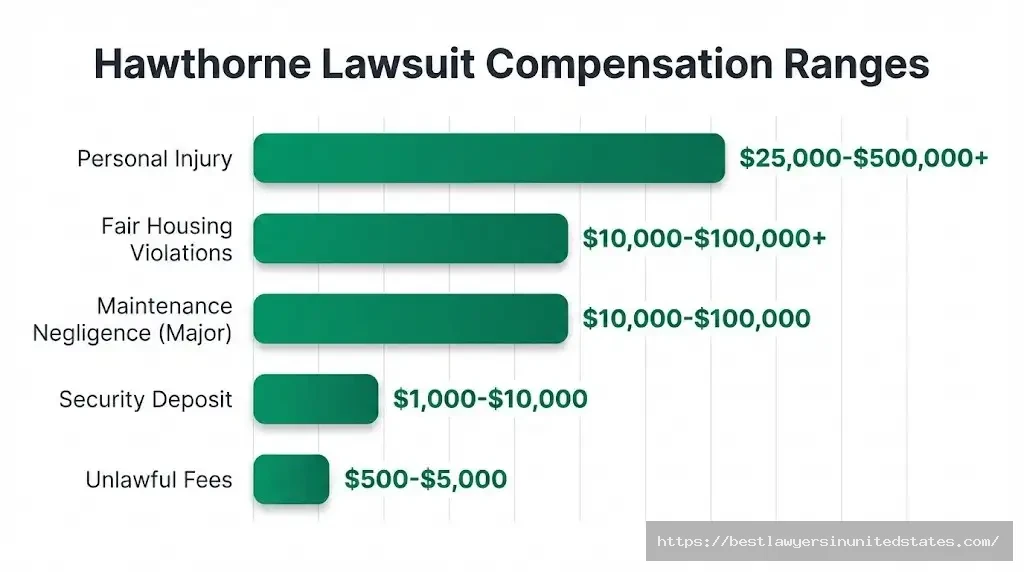
Table: Estimated Compensation by Claim Type
| Claim Category | Estimated Range | What Qualifies You | Factors Affecting Amount |
|---|---|---|---|
| Unlawful Fees (Individual) | $500 – $5,000 | Charged unauthorized eviction or late fees | Number of instances, fee amounts, state law violations |
| Security Deposit Violations | $1,000 – $10,000 | Wrongfully withheld deposit | Deposit amount, statutory penalties (often 2-3x deposit), bad faith |
| Maintenance Negligence (Minor) | $2,000 – $15,000 | Temporary inconvenience, no lasting harm | Duration of issue, impact on living conditions |
| Maintenance Negligence (Major) | $10,000 – $100,000 | Health issues, property damage, uninhabitable conditions | Medical bills, severity of illness, property loss |
| Personal Injury | $25,000 – $500,000+ | Physical injury from property defect | Medical expenses, lost wages, permanent disability, pain and suffering |
| Fair Housing Violations | $10,000 – $100,000+ | Discrimination, denied accommodations | Severity, emotional distress, punitive damages |
| Rent Refunds | Months of rent paid | Lived in uninhabitable conditions | Duration, severity of violations, breach of implied warranty |
Comparison with Similar Cases:
Similar property management lawsuits provide context for potential compensation:
- Elmington Property Management settlements: $25,000 – $500,000 depending on severity
- General property management class actions: Individual payouts typically $2,000 – $50,000
- Mold-related health claims: Often $50,000 – $200,000 when serious respiratory illness documented
- Fair Housing discrimination: Federal penalties up to $100,000+ first violation, higher for repeat violations
Factors That Affect Your Payout
Your compensation depends on several key factors:
- Severity and Duration of Harm – Minor inconveniences receive lower compensation than serious health impacts or prolonged uninhabitable conditions.
- Documentation Quality – Strong evidence (photos, medical records, written communication) significantly increases settlement value.
- Economic Losses – Medical bills, property damage, moving costs, and lost wages from health issues increase compensation.
- State Law Penalties – Some states impose statutory penalties (2-3x damages for security deposit violations, treble damages for Fair Housing Act violations).
- Punitive Damages – Intentional or reckless conduct may warrant punitive damages to punish the defendant.
- Number of Class Members – In class actions, larger class sizes may reduce individual payouts as settlement funds are divided.
When Will You Receive Payment?
Table: Payment Timeline for Different Case Types
| Case Status | Expected Timeline | Next Steps |
|---|---|---|
| Johnson Settlement (Completed) | Payments distributed 2023-2024 | If you qualified but didn’t receive payment, contact settlement administrator |
| Jehramyus v. Hawthorne (Georgia) | 18-36 months from filing (filed Jan 2025) | Case in early stages, discovery ongoing |
| Noronha v. Hawthorne (Florida) | 12-24 months (trial Dec 2025) | Mediation ongoing, potential settlement or trial verdict |
| Future Class Actions | 2-4 years typical | Depends on class certification, settlement negotiations |
| Individual Lawsuits | 1-3 years | Varies by complexity, court schedule |
General Timeline for Active Cases:
- Discovery Phase: 6-12 months – Both sides exchange evidence
- Motion Practice: 3-6 months – Legal arguments on key issues
- Settlement Negotiations: Ongoing – Many cases settle before trial
- Trial (if no settlement): 1-2 weeks, then verdict
- Payment After Settlement/Verdict: 60-180 days – Time to process and distribute funds
How to File Your Claim – Step by Step
⚠️ IMPORTANT: The Keosha Johnson class action settlement has closed. If you were part of that case and didn’t receive payment, contact a tenant rights attorney immediately. For ongoing cases and future claims, follow the process below.
Complete Filing Process
Step 1: Determine Which Case Applies to You
Review the lawsuits and allegations to identify which situation matches your experience:
- Fair Housing/Disability Issues → Jehramyus case in Georgia may be relevant if similar claims
- Civil Rights/Contract Breach → Noronha case in Florida if similar situation
- Personal Injury → Individual lawsuit may be necessary
- General Tenant Rights → May qualify for future class actions under consideration
Step 2: Gather Your Documentation
Collect all relevant evidence before contacting an attorney:
- Lease agreement and all addendums
- Rent payment history and receipts
- Maintenance request records (emails, written requests, portal submissions)
- Photos and videos of property conditions with dates
- Medical records if health was affected
- Correspondence with property management
- Eviction notices or fee statements
- Security deposit documentation
- Move-in and move-out inspection reports
Step 3: Check Your State’s Statute of Limitations
Table: Statutes of Limitations by State and Claim Type
| State | Personal Injury | Property Damage | Contract Breach | Fair Housing | Security Deposit |
|---|---|---|---|---|---|
| North Carolina | 3 years | 3 years | 3 years | 1 year (HUD complaint), 3 years (lawsuit) | 60 days (must sue within this time after wrongful withholding) |
| Georgia | 2 years | 4 years | 4-6 years | 1 year (HUD), 2 years (lawsuit) | 1 month (must sue after written demand) |
| South Carolina | 3 years | 3 years | 3 years | 1 year (HUD), 3 years (lawsuit) | 30 days (written notice required) |
| Florida | 4 years | 4 years | 5 years | 1 year (HUD), 4 years (lawsuit) | 30 days (must provide forwarding address) |
| Tennessee | 1 year | 3 years | 6 years | 1 year (HUD), 1 year (lawsuit) | 60 days (required timeframe for return or explanation) |
| Virginia | 2 years | 5 years | 5 years | 1 year (HUD), 2 years (lawsuit) | 45 days (must provide itemization) |
Critical: Missing these deadlines can permanently bar your claim. If you’re close to the deadline, contact an attorney immediately.
Step 4: Contact a Tenant Rights Attorney
For the best chance of success, consult with an attorney who specializes in:
- Landlord-tenant law
- Fair Housing Act violations
- Property management litigation
- Class action lawsuits
Many tenant rights attorneys offer free initial consultations and work on contingency (no fee unless you win).
Step 5: File Your Claim
Your attorney will:
- Evaluate your case’s strength
- Determine the appropriate legal venue
- Draft and file your complaint or join you to an existing class action
- Serve the complaint on Hawthorne Residential Partners
- Begin the discovery process
Step 6: Participate in Discovery
You may need to:
- Provide testimony in a deposition
- Answer written questions (interrogatories)
- Submit additional documentation
- Undergo medical examinations (for personal injury claims)
Step 7: Negotiate or Go to Trial
Most cases settle, but your attorney will:
- Negotiate with Hawthorne’s legal team
- Mediate if ordered by the court
- Prepare for trial if settlement isn’t reached
- Advise you on settlement offers
Step 8: Receive Your Payment
After settlement or verdict:
- Settlement administrator processes payments (class actions)
- Checks or direct deposits issued
- Typical timeframe: 60-180 days after settlement approval
- Attorney fees deducted per agreement (usually 30-40% in contingency cases)
Filing Deadlines – Don’t Miss These Dates
Table: Critical Deadlines for Active Cases
| Case | Current Status | Key Dates | Action Required |
|---|---|---|---|
| Jehramyus v. Hawthorne (Georgia) | Discovery | No public claim deadline yet | Monitor for class certification; consult attorney if you have similar disability accommodation claims |
| Noronha v. Hawthorne (Florida) | Mediation/Trial Prep | Trial: December 8, 2025 | If you have similar civil rights claims in Florida, contact plaintiff’s attorney immediately |
| Potential Class Actions | Certification Pending | Unknown – could be announced 2026 | Watch for public notices; register with tenant advocacy groups for updates |
Where to Find Updates:
- Federal court dockets: PACER system (pacer.gov)
- Tenant rights organizations in your state
- Legal news websites covering class action lawsuits
- BestLawyersInUnitedStates.com lawsuit updates section
Common Filing Mistakes to Avoid
- Waiting Until the Last Minute – Statutes of limitations are strict. Evidence gets lost, witnesses move away, and memories fade. Act quickly.
- Throwing Away Documentation – Never discard lease agreements, photos, emails, or receipts even after moving out. Keep for at least 5 years.
- Not Reporting Issues in Writing – Verbal complaints don’t create a paper trail. Always submit maintenance requests via email or written notice.
- Accepting Settlements Too Quickly – Don’t settle without consulting an attorney. Initial offers are often far below case value.
- Missing Court Deadlines – If you join a lawsuit, respond to all court-ordered requests promptly. Missing deadlines can get your claim dismissed.
- Failing to Document New Issues – Continue documenting problems even after filing. Ongoing issues strengthen your case.
- Not Reading Settlement Terms – Understand what rights you’re giving up. Some settlements include broad release clauses.
Current Lawsuit Status & Latest Updates
Settlement Approval Status (as of February 2026)
Keosha Johnson v. Hawthorne Residential Partners (North Carolina) – COMPLETED:
This class action reached final approval on August 10, 2023 in Wake County Superior Court. The settlement provided $500,000 in cash compensation plus $2.7 million in debt forgiveness to tenants who were wrongfully charged eviction fees. Class members who submitted valid claims have already received their payments. This case is now closed.
Jehramyus v. Hawthorne Residential Partners (Georgia) – ACTIVE:
Filed January 24, 2025 in U.S. District Court for the Northern District of Georgia (Case 1:2025cv00304), this Fair Housing Act case alleges Hawthorne refused to make reasonable accommodations for a tenant with disabilities. Judge Victoria M. Calvert is presiding. The case is in early discovery stages, with potential for class certification if similar claims emerge from other disabled tenants. This case could result in both monetary damages and injunctive relief forcing policy changes.
Noronha v. Hawthorne Residential Partners (Florida) – ACTIVE:
Filed October 16, 2024 in U.S. District Court for the Southern District of Florida (Case 0:24-cv-61922), this case involves allegations of civil rights violations and breach of contract. Judges William P. Dimitrouleas and Patrick M. Hunt are overseeing the case. The parties are currently in court-ordered mediation with mediator Alvin M. Capp. A jury trial is scheduled for December 8, 2025 in Fort Lauderdale. If mediation fails, this case will proceed to trial, potentially creating significant precedent.
Watts v. Rivarel LLC (South Carolina) – PENDING:
This personal injury lawsuit filed September 11, 2024 involves a tenant who allegedly fell due to defective stairs at a Hawthorne-managed property. Rivarel LLC is connected to Hawthorne Residential Partners. The case was initially filed in federal court but has been remanded to state court, where property managers may face personal liability. Discovery is ongoing.
Recent Developments
Recent updates affecting the Hawthorne Residential Partners litigation include:
January 24, 2025 – Jehramyus disability discrimination case filed in federal court in Georgia, marking the most recent federal lawsuit against the company. This case focuses specifically on Fair Housing Act violations regarding reasonable accommodations.
December 2024 – Noronha case in Florida enters mediation phase, with both parties attempting to reach settlement before the scheduled December 2025 trial.
September 2024 – South Carolina personal injury case filed, expanding the geographic scope of litigation against Hawthorne properties.
2025-2026 – Multiple law firms are reviewing additional tenant complaints and considering consolidated class actions. Courts are evaluating whether to certify class actions that could include thousands of current and former tenants across multiple states.
RealPage Connection – In August 2024, North Carolina joined a national antitrust lawsuit against RealPage Inc., a software company whose rent-pricing algorithm is used by Hawthorne Residential Partners. This separate litigation alleges RealPage helped landlords artificially inflate rents by sharing confidential pricing data. While this is a distinct case, it has increased scrutiny on Hawthorne’s rental pricing practices.
What Happens Next?
Expected upcoming events in the Hawthorne litigation:
- 2026 Q1-Q2 – Discovery continues in Georgia and Florida cases. Depositions of company executives and property managers likely.
- 2026 Q2-Q3 – Potential class certification hearings if additional tenants join the Georgia or Florida cases with similar claims.
- December 8, 2025 – Noronha trial scheduled in Fort Lauderdale unless parties reach settlement in mediation.
- 2026 – Possible announcement of new consolidated class actions if courts certify classes. Public notice would be required, allowing additional tenants to opt in.
- 2026-2027 – Resolution of South Carolina personal injury case through settlement or state court trial.
Impact of Pending Litigation
These lawsuits have already affected Hawthorne Residential Partners operations:
Operational Changes:
- Increased scrutiny from local housing inspectors
- Independent inspections of Hawthorne properties in some jurisdictions
- Enhanced maintenance protocols (according to company statements)
- Updated staff training programs
Reputational Impact:
- Over 100 complaints filed with Better Business Bureau
- Negative reviews on apartment rating websites
- Prospective tenants increasingly researching lawsuit history
- Some properties experiencing higher vacancy rates
Policy Implications:
- Potential industry-wide changes in property management practices
- Increased enforcement of Fair Housing Act requirements
- Greater attention to fee transparency and lawful eviction procedures
- Possible legislative reforms in affected states
Hawthorne Residential Partners Lawsuit vs. Similar Cases
How This Settlement Compares
Table: Comparison with Similar Property Management Lawsuits
| Lawsuit | Company | Settlement Amount | Affected Parties | Payout Range | Primary Issues | Status |
|---|---|---|---|---|---|---|
| Johnson v. Hawthorne | Hawthorne Residential Partners | $3.2 million | Class members at Wake County property | $500K cash + $2.7M debt | Unlawful eviction fees | Settled 2023 |
| Elmington Class Action | Elmington Property Management | $25M – $500K range | Multiple properties, multiple states | $25,000 – $500,000 individual | Maintenance, fees, discrimination | Various settlements |
| Greystar Fair Housing | Greystar Real Estate | $1.8 million | California properties | Varies | Disability discrimination | Settled 2020 |
| Lincoln Property Mold | Lincoln Property Company | Confidential | Texas apartment complex | Estimated $50K – $200K per claimant | Toxic mold, health issues | Settled 2019 |
| MAA Tenant Class Action | Mid-America Apartments | $4.5 million | Southeast properties | Average $2,500 per claimant | Illegal fees, deposit retention | Settled 2021 |
| Pinnacle Tenant Rights | Pinnacle Property Management | $750,000 | Arizona properties | $1,000 – $10,000 | Security deposits, unlawful charges | Settled 2022 |
What Makes the Hawthorne Lawsuits Unique?
Several factors distinguish the Hawthorne Residential Partners litigation from similar cases:
Geographic Scope: The lawsuits span seven states (North Carolina, Georgia, South Carolina, Florida, Tennessee, Virginia, Texas), suggesting potential systemic issues rather than isolated property problems. This multi-state pattern has attracted attention from federal regulators and tenant advocacy organizations.
Variety of Claims: Unlike many property management lawsuits focusing on a single issue, Hawthorne faces allegations across multiple areas: Fair Housing violations, unlawful fees, maintenance negligence, personal injury, and civil rights violations. This breadth suggests widespread management failures.
Fair Housing Focus: The Jehramyus case specifically targets disability accommodation failures under the Fair Housing Act. These cases often result in both monetary damages and court-ordered policy changes, potentially affecting how Hawthorne handles all disability-related requests going forward.
Debt Cancellation Component: The Johnson settlement’s $2.7 million debt forgiveness is noteworthy. Rather than just cash payments, the settlement eliminated alleged illegal fees that tenants “owed,” providing relief to those facing collections or damaged credit.
Ongoing Nature: With multiple active cases in 2026 and potential class certifications pending, the Hawthorne litigation is far from over. This distinguishes it from single-settlement cases that resolved completely.
Industry Impact
The Hawthorne cases contribute to broader trends in rental housing litigation:
Increased Accountability: Large property management companies face growing legal and regulatory scrutiny. Tenant rights organizations are better coordinating across states to identify patterns.
Technology Scrutiny: The connection to RealPage’s rent-pricing software highlights how technology affects rental markets. The parallel RealPage antitrust litigation may reveal how algorithms influence Hawthorne’s pricing decisions.
Fair Housing Enforcement: Federal and state agencies are prioritizing Fair Housing Act enforcement, particularly regarding disability accommodations. The Jehramyus case aligns with this enforcement trend.
Class Action Viability: These cases demonstrate that property management class actions can succeed when documentation shows systematic violations affecting numerous tenants similarly.
Do You Need a Lawyer to File a Claim?
Quick Answer: You do NOT need a lawyer to file a complaint with HUD or state housing agencies, which can be done for free. However, for lawsuits seeking monetary damages (especially class actions or complex cases), legal representation significantly increases your chances of success and maximizes compensation. Most tenant rights attorneys offer free consultations and work on contingency (no upfront costs).
Filing Without a Lawyer
You can handle certain actions on your own:
HUD Complaints (Fair Housing Issues): The U.S. Department of Housing and Urban Development accepts complaints without requiring an attorney. You can file online at hud.gov or call 1-800-669-9777. HUD will investigate and may pursue action against the landlord on your behalf.
State Housing Agency Complaints: Each state has agencies that handle landlord-tenant disputes. North Carolina, for example, has tenant advocacy programs through Legal Aid. These agencies can mediate disputes, order repairs, or assess penalties.
Small Claims Court: For security deposit disputes or small fee refunds (typically under $5,000-$10,000 depending on state), you can file in small claims court without an attorney. The process is designed for self-representation.
When You Can Handle It Yourself:
- Simple security deposit disputes with clear documentation
- Minor fee refunds with obvious overcharges
- HUD discrimination complaints
- Requesting repairs through housing inspectors
When Legal Help Is Essential
You should consult an attorney when:
Your Case Involves:
- Personal injury from property defects
- Serious health issues from mold, pests, or toxic conditions
- Fair Housing Act violations requiring federal lawsuit
- Joining or initiating a class action
- Complex eviction defenses
- Significant damages (over $10,000)
- Retaliation by landlord after complaints
Your Documentation Is:
- Incomplete or missing key evidence
- Contradictory or hard to interpret
- Primarily verbal rather than written
- Requires expert testimony (medical, engineering)
You Face:
- Aggressive opposition from landlord’s attorneys
- Statute of limitations concerns
- Counterclaims from the landlord
- Multiple legal issues simultaneously
Advantages of Legal Representation:
- Better Outcomes: Studies show represented tenants receive 3-5x higher settlements on average
- No Upfront Costs: Contingency fee arrangements mean no payment unless you win
- Evidence Discovery: Attorneys can subpoena documents you can’t access on your own
- Negotiation Power: Landlords take attorney representation more seriously
- Legal Strategy: Understanding which claims to pursue and in which venue
- Court Procedures: Navigating complex filing deadlines and procedural requirements
Free Legal Consultation
National Resources:
Legal Services Corporation – Connects low-income tenants with free legal aid
- Website: lsc.gov/find-legal-aid
- Phone: 202-295-1500
National Fair Housing Alliance – Assists with discrimination claims
- Website: nationalfairhousing.org
- Phone: 202-898-1661
State-Specific Tenant Rights Organizations:
North Carolina:
- Legal Aid of North Carolina: legalaidnc.org | 1-866-219-5262
- North Carolina Justice Center: ncjustice.org
Georgia:
- Atlanta Legal Aid: atlantalegalaid.org | 404-524-5811
- Georgia Legal Services: glsp.org
South Carolina:
- South Carolina Legal Services: sclegal.org | 1-888-346-5592
Florida:
- Florida Legal Services: floridalegal.org
- Community Legal Services of Mid-Florida: clsmf.org | 1-800-405-1417
Tennessee:
- Legal Aid Society of Middle Tennessee: las.org | 615-780-7123
Virginia:
- Virginia Legal Aid: vlas.org | 1-866-534-5243
Finding Private Attorneys:
If you don’t qualify for free legal aid based on income, consider:
- Local bar association referral services (often free or low-cost initial consultations)
- Tenant rights attorneys who work on contingency (no fee unless you win)
- Law school clinics offering supervised student representation
Contact BestLawyersInUnitedStates.com: For referrals to experienced tenant rights and property management litigation attorneys in your state, email [email protected]. We can connect you with attorneys handling Hawthorne cases or similar landlord-tenant disputes.
Frequently Asked Questions
What is the Hawthorne Residential Partners lawsuit about?
Quick Answer: Multiple lawsuits allege Hawthorne Residential Partners violated tenant rights through unlawful fees, maintenance negligence, Fair Housing Act discrimination, unsafe living conditions, and breach of contract at properties across seven states.
The litigation includes a settled 2023 North Carolina class action over illegal eviction fees ($3.2 million settlement), plus active 2024-2026 cases in Georgia, Florida, and South Carolina involving disability discrimination, civil rights violations, and personal injury from property defects.
Who is eligible to file a claim?
Quick Answer: Current and former tenants of Hawthorne-managed properties who experienced unlawful fees, discrimination, maintenance failures, unsafe conditions, or wrongful eviction may qualify depending on dates, location, and claim type.
Eligibility varies by case. The Johnson settlement (closed) covered tenants charged specific fees at Hawthorne at the Trace in Wake County, NC. For ongoing cases, you may qualify if you rented from Hawthorne and experienced similar issues to those alleged in active lawsuits. Consult a tenant rights attorney to evaluate your specific situation.
How much money will I receive?
Quick Answer: The Johnson settlement provided $500,000 cash plus $2.7 million debt cancellation divided among class members. Future payouts depend on claim type and severity, potentially ranging from $500 (fee violations) to $500,000+ (serious injury or discrimination).
Compensation varies significantly. Security deposit cases may recover 2-3x the deposit. Maintenance negligence causing health issues can reach $50,000-$200,000. Personal injury settlements average $25,000-$500,000+. Fair Housing violations may include punitive damages. Your attorney can estimate value based on your specific damages and documentation.
Is there a deadline to file a claim?
Quick Answer: Deadlines vary by state and claim type. Statutes of limitations range from 1-6 years. The Johnson settlement has closed, but ongoing cases and future class actions may have upcoming deadlines announced through public notice.
State-specific deadlines:
- Personal injury: 1-4 years from incident
- Contract breach: 3-6 years from violation
- Fair Housing: 1 year for HUD complaint, 2-4 years for lawsuit
- Security deposits: 30-60 days after improper withholding to demand return
Check your state’s statute of limitations immediately and consult an attorney if you’re approaching a deadline.
How do I file a claim?
Quick Answer: Contact a tenant rights attorney who will evaluate your case, gather evidence, and file the appropriate legal action (individual lawsuit, join class action, or HUD complaint). For simple matters, you can file HUD complaints or small claims court actions yourself.
The process typically involves: (1) documenting your experience, (2) consulting an attorney, (3) filing a complaint or lawsuit, (4) participating in discovery, (5) negotiating settlement or going to trial. Most tenant cases settle before trial through negotiation or mediation.
Do I need a lawyer to file?
Quick Answer: No for HUD complaints or small claims court, but YES for serious claims involving significant damages, class actions, personal injury, or complex legal issues. Most tenant rights attorneys work on contingency (no fee unless you win).
While simple security deposit or fee disputes can be handled in small claims court without an attorney, complex cases benefit enormously from legal representation. Attorneys access evidence through discovery, understand procedural requirements, negotiate better settlements, and can pursue class certification for widespread violations.
What documents do I need?
Quick Answer: Essential documents include your lease agreement, rent payment records, maintenance requests, photos/videos of conditions, medical records (if health affected), correspondence with management, and any fee statements or eviction notices.
The strength of your case depends on documentation. Always request repairs in writing (email creates a time-stamped record). Take photos with dates enabled. Keep all bills and receipts. Download and save emails before leaving the property. Medical records linking health issues to property conditions are particularly valuable in negligence claims.
What if I don’t have receipts or documentation?
Quick Answer: You can still pursue claims using bank statements (showing rent payments), testimony, witness statements, property inspection reports, court records, or medical documentation. Your attorney can also obtain records through legal discovery processes.
Lack of perfect documentation doesn’t destroy your case. Bank statements prove rent payments. Neighbors can testify about shared conditions. Medical records show health impacts. Property inspection reports from housing authorities provide official evidence. Your attorney can subpoena Hawthorne’s maintenance records showing reported issues and delayed responses.
When will I receive my payment?
Quick Answer: The Johnson settlement distributed payments in 2023-2024 (now complete). For ongoing lawsuits, expect 1-4 years from filing to resolution, with payment typically 60-180 days after settlement or verdict.
Lawsuit timelines vary. Cases settling early (within 1 year) are fastest. Class actions typically take 2-4 years through certification, discovery, and approval. Trial cases can extend 3-5 years with appeals. Once a settlement is approved or verdict rendered, administrators process payments within 2-6 months.
How will I receive payment?
Quick Answer: Payments typically arrive via check mailed to your address on file, though some settlements offer direct deposit or electronic payment options. Class action settlements require you to cash the check within a specified period (usually 90-180 days) or the funds revert to the settlement pool.
Settlement administrators handle distribution. You’ll receive notice explaining payment method, amount, and any required actions. Update your address with the settlement administrator if you’ve moved. Some settlements issue initial partial payments followed by additional distributions after attorney fees and administrative costs are finalized.
What is the total settlement amount for Hawthorne cases?
Quick Answer: The Keosha Johnson North Carolina class action settled for $3.2 million total ($500,000 cash + $2.7 million debt cancellation). Other cases remain active with unknown settlement values.
Only the Johnson case has publicly disclosed settlement terms. The Georgia, Florida, and South Carolina cases are ongoing, so settlement amounts (if they settle) won’t be known until agreements are reached. If additional class actions are certified, those settlement funds could range from hundreds of thousands to millions depending on the number of affected tenants.
Has the settlement been approved by the court?
Quick Answer: Yes, the Johnson settlement received final court approval on August 10, 2023 in Wake County Superior Court. The Georgia, Florida, and South Carolina cases are still in litigation, so no settlements have been proposed or approved in those matters yet.
Court approval is required for class action settlements to ensure they’re fair, reasonable, and adequate. The Johnson settlement underwent preliminary approval, notice to class members, a fairness hearing, and final approval before payments were distributed. Future settlements in ongoing cases will follow similar processes.
Can I opt out of the settlement?
Quick Answer: For the Johnson settlement (now closed), the opt-out period has passed. If future class actions are certified in the Georgia or Florida cases, you’ll receive notice with instructions on opting out, typically requiring written notification within 30-60 days.
Opting out allows you to pursue an individual lawsuit instead of participating in the class action. This makes sense if your damages are significantly higher than the class settlement offers, but you lose the collective power of the class and must hire your own attorney. Most tenants choose to remain in class actions.
What if I already moved out or threw away the product?
Quick Answer: You can still file claims for issues that occurred during your tenancy. Moving out doesn’t eliminate your rights to compensation for past violations. However, physical evidence (items thrown away) makes cases harder to prove, though other documentation can substitute.
Tenant lawsuits are about past wrongs, not current residency. If you experienced discriminatory treatment, unlawful fees, or unsafe conditions while living there, you have claims even after moving. Your lease, emails, photos taken while there, and medical records from that period serve as evidence even without current access to the property.
Do I have to give up my right to sue separately?
Quick Answer: Class action settlements typically require releasing all related claims against the defendant. If you opt out of the class, you retain the right to sue individually. Read settlement terms carefully before accepting payment – cashing a settlement check often constitutes agreement to the release.
Settlement releases usually cover only claims related to the specific issues in the lawsuit. For example, the Johnson settlement released eviction fee claims but wouldn’t prevent a separate mold exposure lawsuit. However, releases can be broad. Your attorney should review any settlement terms before you accept to ensure you understand what rights you’re giving up.
What if I missed the deadline?
Quick Answer: Missing a statute of limitations deadline typically bars your claim permanently. However, tolling exceptions (pauses in the deadline) exist for certain circumstances like ongoing concealment, minority, or disability. Consult an attorney immediately to determine if any exceptions apply.
Some deadlines have exceptions. If the landlord actively concealed the problem, the statute of limitations might not start until you discovered the issue. If you were a minor when violations occurred, the deadline may be extended. Class action filings can sometimes toll individual deadlines. Don’t assume your claim is dead – speak with an attorney who can evaluate tolling arguments.
How do I check my claim status?
Quick Answer: For the Johnson settlement (closed), contact the settlement administrator listed in your notice. For ongoing cases where you’ve filed, check with your attorney for updates. Public court documents are available through PACER (pacer.gov) for federal cases or state court websites.
If you filed a HUD complaint, check status at hud.gov or call 1-800-669-9777. For individual lawsuits, your attorney provides updates. Class action members receive periodic notices about case progress. Federal court dockets are public records accessible through PACER, though access fees apply.
What if my claim is denied?
Quick Answer: You can appeal denials in lawsuits through the court system. For HUD complaints, you have rights to request reconsideration or file a federal lawsuit. Settlement claim denials can sometimes be contested with additional documentation.
Denials in settlement claims usually stem from incomplete documentation or ineligibility. Submit additional proof if you have it. For lawsuit dismissals, you can appeal to higher courts, though success requires showing legal errors in the lower court’s decision. Your attorney will advise on appeal viability and deadlines.
Will this affect my taxes?
Quick Answer: Settlement compensation for actual damages (medical bills, property loss, rent refunds) is generally tax-free. Emotional distress and punitive damages are usually taxable income. Consult a tax professional about your specific settlement, as tax treatment varies by claim type.
The IRS requires reporting of settlement income, but not all settlement money is taxable. Compensation for physical illness or injury is tax-exempt. Reimbursement for economic losses (rent refunds, repair costs) isn’t taxed since it restores what you lost. However, interest on settlements and punitive damages are taxable. Settlement administrators provide IRS Form 1099 for reportable amounts.
Where can I find the official claim form?
Quick Answer: For the Johnson settlement, the claim period has ended. For active cases, claim forms will be created if settlements are reached or class actions are certified. Monitor federal court dockets, settlement administration websites announced in court notices, or contact attorneys representing plaintiffs.
Class action settlement websites are created when settlements are approved and provide claim forms, deadlines, and instructions. These sites are announced through legal notices in newspapers, direct mail to known class members, and sometimes media campaigns. Watch for notices from the courts in the Georgia (Jehramyus) and Florida (Noronha) cases.
Can I join an existing lawsuit?
Quick Answer: If a class action is certified, you’re automatically included if you meet the class definition unless you opt out. For the Georgia and Florida cases not yet certified as class actions, contact the plaintiffs’ attorneys to discuss whether your situation qualifies for joining or requires separate filing.
Class certification allows anyone meeting the criteria to automatically participate. Individual lawsuits may be consolidated if they involve similar claims. Contact tenant rights organizations or the attorneys listed in court filings for ongoing cases to inquire about joining. Your participation may help strengthen the case for class certification.
What happens if Hawthorne Residential Partners goes bankrupt?
Quick Answer: Bankruptcy complicates but doesn’t eliminate recovery. Your claims become part of the bankruptcy estate, potentially resulting in partial payment. However, liability insurance often covers settlements, providing a source of payment even if the company reorganizes or liquidates.
Bankruptcy triggers an automatic stay on litigation, pausing cases while the bankruptcy court allocates assets. As a creditor with legal claims, you file proofs of claim in the bankruptcy proceeding. Priority depends on claim type – some tenant claims receive priority status. Insurance policies usually survive bankruptcy, providing recovery sources. Your attorney can pursue insurance coverage directly.
How does this compare to other property management lawsuits?
Quick Answer: Hawthorne lawsuits are similar to other major property management litigation involving companies like Elmington, Greystar, and Lincoln Property. Settlement amounts range from thousands (fee disputes) to hundreds of thousands (personal injury, discrimination), depending on claim severity and number of affected tenants.
Property management lawsuits have increased industry-wide as tenants become more aware of rights and documentation methods improve. Hawthorne’s multi-state, multi-issue litigation reflects broader patterns: maintenance failures, unlawful fees, Fair Housing violations, and personal injury. The $3.2 million Johnson settlement is mid-range compared to larger settlements ($10-50 million) involving major national management companies.
What should I do if I’m currently experiencing similar issues?
Quick Answer: Document everything immediately with photos, written maintenance requests, and saved emails. Report issues to local housing authorities. Consult a tenant rights attorney to understand your legal options. Consider filing HUD complaints for discrimination or joining ongoing litigation if applicable.
Don’t wait for legal action to conclude – protect yourself now:
- Document all issues with dated photos and videos
- Submit all maintenance requests in writing (email creates records)
- Report serious violations to city/county housing inspectors
- Keep all correspondence and payment records
- Don’t sign anything without attorney review
- Consult tenant rights organizations in your state
- Contact attorneys handling Hawthorne cases to evaluate your claims
- Consider joining future class actions if certified
If conditions are uninhabitable, you may have the right to withhold rent, repair and deduct, or terminate the lease. Consult an attorney before taking these actions, as state laws vary and improper procedures can hurt your position.
Internal Resources
Understanding your tenant rights is crucial when facing property management issues. If you’re dealing with housing disputes, our comprehensive guides on tenant rights and landlord-tenant law can provide additional context for your situation. Many property management lawsuits involve violations of state-specific housing regulations, so reviewing your local tenant protections is essential.
For tenants facing eviction proceedings, our resources on eviction defense strategies explain your legal options and how to challenge unlawful eviction practices. The Hawthorne cases demonstrate that illegal fee assessments during eviction are unfortunately common – knowing your rights can prevent exploitation.
Property maintenance negligence often overlaps with premises liability law. If you suffered injury due to defective property conditions, our premises liability guide explains how landlords can be held responsible for dangerous conditions they knew about or should have discovered.
Fair Housing Act violations, like those alleged in the Jehramyus case, represent serious civil rights issues. Our discrimination in housing resources detail protected characteristics and what constitutes illegal discrimination in rental housing. Understanding these protections empowers tenants to recognize and report violations.
Security deposit disputes are among the most common landlord-tenant conflicts. Our security deposit rights guide explains state-specific laws governing deposit returns, allowable deductions, and penalties for wrongful withholding – information directly relevant to several Hawthorne allegations.
Class action lawsuits provide a powerful tool for tenants to collectively address systematic violations. Our guide to class action procedures explains how these cases work, how to determine if you qualify, and what to expect if you participate as a class member.
For general consumer protection issues beyond housing, our consumer rights section covers unfair business practices, deceptive trade, and remedies available to consumers who have been harmed by corporate misconduct.
Legal representation significantly improves tenant outcomes in housing disputes. Our attorney directory can connect you with qualified landlord-tenant lawyers in your state who have experience handling property management litigation and tenant rights cases.
If you have questions about your legal options or need help understanding whether you qualify for compensation in the Hawthorne cases or similar situations, contact our legal information service at [email protected] for guidance and attorney referrals.
Disclaimer: This article provides general information about the Hawthorne Residential Partners lawsuits and is not legal advice. Specific legal rights vary by state and individual circumstances. Consult a licensed attorney in your jurisdiction for advice about your particular situation. BestLawyersInUnitedStates.com is an informational resource and does not represent any parties in these lawsuits.

Comments