
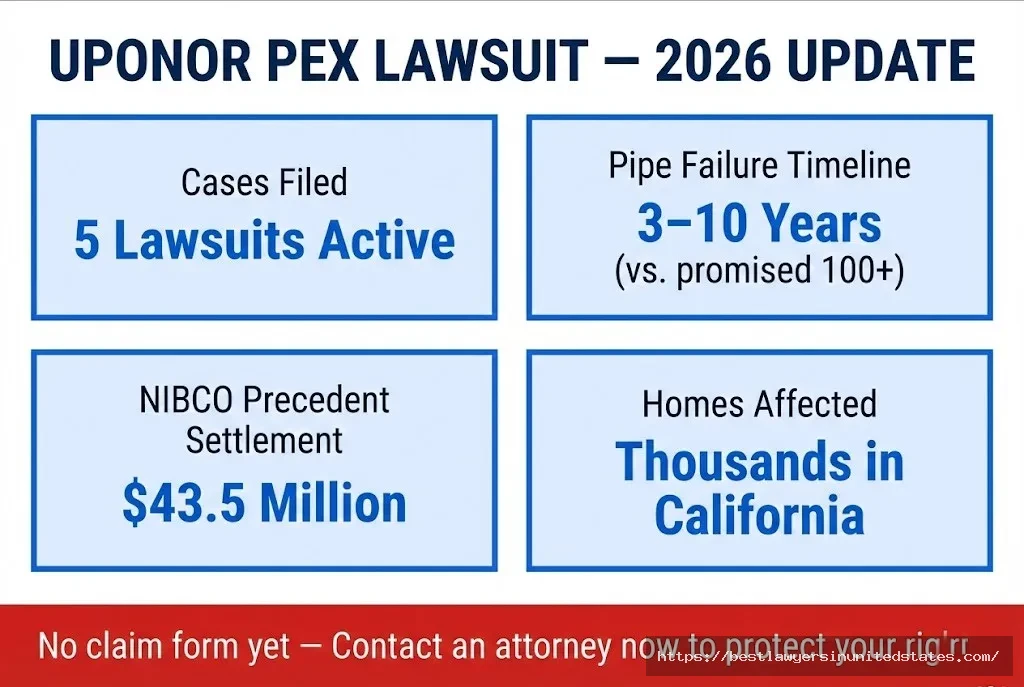
Multiple class action lawsuits allege that Uponor’s AquaPEX red, white, and blue plumbing pipes are defective — failing within 3 to 10 years despite being advertised to last 50 to 100 years. As of early 2026, several active cases are working through federal courts in California and Minnesota, with attorneys across the country actively recruiting affected homeowners. There is no open public claim form yet, but if you have Uponor PEX pipe in your home and have experienced leaks or water damage, the actions you take right now could determine whether you receive compensation later. ogx lawsuit
Quick Answer: The Uponor PEX lawsuits claim that red, white, and blue AquaPEX pipes manufactured from 2010 to 2021 suffer from a manufacturing defect that causes premature cracking and leaks. Multiple class actions are pending in California federal courts. No public settlement claim form exists yet — but homeowners can contact attorneys now at no cost to preserve their rights. Attorneys expect these cases could result in multi-million dollar settlements similar to comparable PEX pipe cases that paid out $43.5 million.
What Is the Uponor PEX Lawsuit About?
Background of the Lawsuit
Uponor, Inc. is one of the world’s largest manufacturers of cross-linked polyethylene (PEX) plumbing pipe. For years, the company marketed its AquaPEX product line as a superior, long-lasting alternative to copper and PVC piping, touting a life expectancy of “well over 100 years.” Tens of thousands of California homes — and properties across the country — were built or repiped using Uponor’s red, white, and blue AquaPEX pipes between 2010 and 2021. The Vet Life Lawsuit Outcome
The problem? Multiple lawsuits allege the pipes are failing catastrophically within just 3 to 10 years of installation. Homeowners across California have reported repeated leaks, interior flooding, destroyed drywall and flooring, and repair bills running into the tens of thousands of dollars. Some have had to repipe their entire homes. The lawsuits claim Uponor knew about the defects for years — based on internal testing and consumer complaints — and chose to say nothing.
The red and blue versions of the pipe were quietly discontinued in 2021. Uponor called it a product “suspension.” Plaintiffs’ attorneys call it an admission. The white pipe remains on the market. Now, multiple law firms have filed class action lawsuits seeking to hold Uponor accountable and get California homeowners compensated.
Timeline of Key Events
| Date | Event | Details |
|---|---|---|
| 2010–2021 | Uponor AquaPEX manufactured and sold | Red, white, and blue pipe installed in thousands of California homes |
| 2021 | Uponor discontinues red and blue pipe | Company calls it a “suspension”; plaintiffs call it a concealment of defects |
| July 2021 | First major class action filed | Colorado homeowners case filed in U.S. District Court |
| May 6, 2024 | Colorado case settles privately | Parties reach private (undisclosed) settlement |
| October 10–15, 2024 | Colorado case dismissed | Dismissed with prejudice; non-class members dismissed without prejudice, preserving right to sue |
| May 20, 2025 | Clifford v. Uponor filed | New California class action filed in U.S. District Court, S.D. California (Case No. 3:25-cv-01286) |
| July 2025 | Uponor files motion to compel arbitration | Uponor attempts to force case out of court |
| August 26, 2025 | Sauder Schelkopf files separate California case | Filed in U.S. District Court, Northern District of California |
| November 7, 2025 | Fitzpatrick v. Uponor filed | Birka-White Law and co-counsel file in U.S. District Court, District of Minnesota (Case No. 0:25-cv-04268) |
| Late 2025–Early 2026 | Multiple cases active; MDL consolidation possible | Courts weighing whether to consolidate cases into single Multi-District Litigation |
| TBD | Settlement or trial | Cases are ongoing; no settlement reached in new California cases as of February 2026 |
Who Filed the Lawsuit?
Multiple law firms have stepped up to represent affected homeowners. The primary cases currently active include:
Clifford v. Uponor, Inc. — Filed May 2025 in the Southern District of California. This 77-page complaint is one of the most detailed, laying out the specific manufacturing defects and naming California homeowner Edward Clifford as lead plaintiff.
Sauder Schelkopf case — Filed August 26, 2025, in the Northern District of California. Sauder Schelkopf is a nationally recognized plaintiff firm that previously won a $43.5 million settlement in an almost identical case against NIBCO’s PEX pipes.
Fitzpatrick and McKenzie v. Uponor, Inc. — Filed November 7, 2025, in the District of Minnesota. Brought by Birka-White Law Offices, Gustafson Gluek PLLC, Girard Sharp LLP, and Levin Sedran & Berman.
The defendants are Uponor, Inc. and Uponor North America, Inc., both subsidiaries of Finland-based Uponor Corporation.
What Are the Allegations?
The lawsuits paint a detailed picture of a company that knew its product was failing and kept selling it anyway. The core allegations against Uponor include:
- Defective antioxidant distribution: The manufacturing process (called the “Engel method”) allegedly fails to evenly distribute antioxidants throughout the polyethylene pipe. This means some sections of every pipe have almost no protection against oxidation — and no one can tell which sections those are just by looking.
- Flame treatment destroys pipe protection: To get the red and blue color coating to stick, Uponor runs the pipe through a furnace. This heat treatment destroys the antioxidant stabilizers on the outer surface of the pipe, leaving it brittle and prone to microcracks — especially when expanded during installation.
- Defective fittings and rings: The fitting installation system creates additional stress at the edges of the reinforcement rings, accelerating cracking at the connection points where leaks are most likely to cause serious damage.
- Fraudulent concealment: Uponor allegedly knew about the defects through internal testing and thousands of consumer complaints, yet continued to market the pipes as lasting “over 100 years” without disclosure.
- Denial of valid warranty claims: When homeowners reported leaks and requested reimbursement, Uponor allegedly denied claims by falsely blaming installation errors or water pressure — even when measurements showed the system operated within code.
California courts have already ruled in at least one related dispute that Uponor’s warranty provisions cannot force California consumers into private arbitration, giving plaintiffs a stronger path to pursue these cases in open court.
Who Qualifies for the Uponor PEX Lawsuit?
Quick Answer: You may qualify if you own a home, condo, or multi-unit property in California (and potentially other states) that contains Uponor AquaPEX red, white, or blue pipe installed between 2010 and the present — especially if you’ve experienced leaks, cracking, flooding, or costly repairs. Homeowners in other states should also contact an attorney, as investigations are ongoing nationally.
Eligibility Requirements
| Requirement | Details | Documentation Needed |
|---|---|---|
| Property location | California homeowners are the primary focus of current cases; national cases may follow | Proof of address, deed or mortgage documents |
| Uponor PEX installed | Your property contains Uponor AquaPEX red, white, or blue piping | Home inspection report, plumber’s assessment, builder records |
| Installation timeframe | Pipe manufactured and/or installed between 2010 and present (2021 for red/blue; white still sold) | Purchase receipts, contractor invoices, building permits |
| Harm suffered | Experienced leaks, cracking, flooding, water damage, or repair/repiping costs — OR pipe is still in home and at risk | Repair receipts, contractor invoices, photos, insurance claims |
| Ownership status | You own the property; HOA members with common-area pipe failures may also qualify | Deed, HOA documentation |
How to Identify Uponor PEX Pipe in Your Home
This is one of the most important questions — and one that competitors’ articles often skip entirely. Here’s how to check:
If your home was built or repiped in the last 15 years, you may have PEX plumbing without knowing the brand. Check these places: Look at exposed pipes under sinks, in your basement, crawl space, or utility room. Uponor AquaPEX pipes are stamped with “UPONOR” or “WIRSBO” (an earlier brand name) directly on the pipe. The red pipe is for hot water, blue for cold, and white can be used for either. If you’re unsure, hire a licensed plumber or home inspector to verify — a single visit can confirm whether you have Uponor pipe. You can also check your original home inspection report, your builder’s spec sheet, or any plumbing invoices you have.
Eligible Products
| Product | Colors | Years Manufactured | Common Uses |
|---|---|---|---|
| Uponor AquaPEX | Red, Blue | Approx. 2010–2021 (discontinued) | Hot/cold water distribution, fire protection |
| Uponor AquaPEX | White | 2010–present (still sold) | Hot/cold water, radiant heating |
| Uponor WIRSBO PEX | Various | Pre-2010 to 2010+ | Earlier brand name, same product |
The lawsuits focus primarily on pipe manufactured and installed from 2010 onward, but if your pipe is labeled WIRSBO or another earlier Uponor brand and you’ve had failures, contact an attorney to discuss your specific situation. Security Negligence Lawsuit
Who Does NOT Currently Qualify?
The class definition is still being finalized in ongoing litigation, but based on current filings, you’re less likely to qualify if:
- Your property is outside California (though national cases are being investigated and could change this)
- Your pipe was installed before 2010
- Your pipe is from a different manufacturer entirely (NIBCO, Rehau, SharkBite, etc.)
- You already received full compensation from Uponor directly for your damages
- Your property is purely commercial (current cases focus on residential properties)
How to Prove Your Claim
| Document Type | Why It’s Needed | Where to Find It | If You Don’t Have It |
|---|---|---|---|
| Home inspection report | Identifies pipe brand and condition | From your real estate transaction files | Request from your home inspector; some keep records for years |
| Plumbing receipts or invoices | Proves Uponor pipe was installed | From your contractor or repipe company | Check bank/credit card statements; contractor may have records |
| Repair receipts | Documents the cost of damage from leaks | From plumbers, restoration companies | Insurance claim files may have this |
| Photos/videos of leaks or damage | Shows physical evidence of failure | Your own files, photos app | Take them now if you haven’t already |
| Insurance claim records | Corroborates property damage | From your homeowner’s insurance company | Request a copy of any filed claims |
| Plumber’s written assessment | Expert opinion on cause of failure | From a licensed plumber | Get one now — critical for your claim |
Don’t panic if you don’t have all of this. Attorneys handling these cases will help you identify what you have and what else you can obtain. The important thing is to start collecting and preserving what you can right now.
How Much Money Could You Get?
Quick Answer: No public settlement has been reached in the active 2025 California cases yet, so exact payout amounts aren’t available. However, a nearly identical PEX pipe case against NIBCO settled for $43.5 million nationwide, providing compensation for repairs, repiping, and property damage. Individual homeowners in similar cases have recovered thousands to tens of thousands of dollars depending on the extent of their damages.
What Compensation Could Look Like
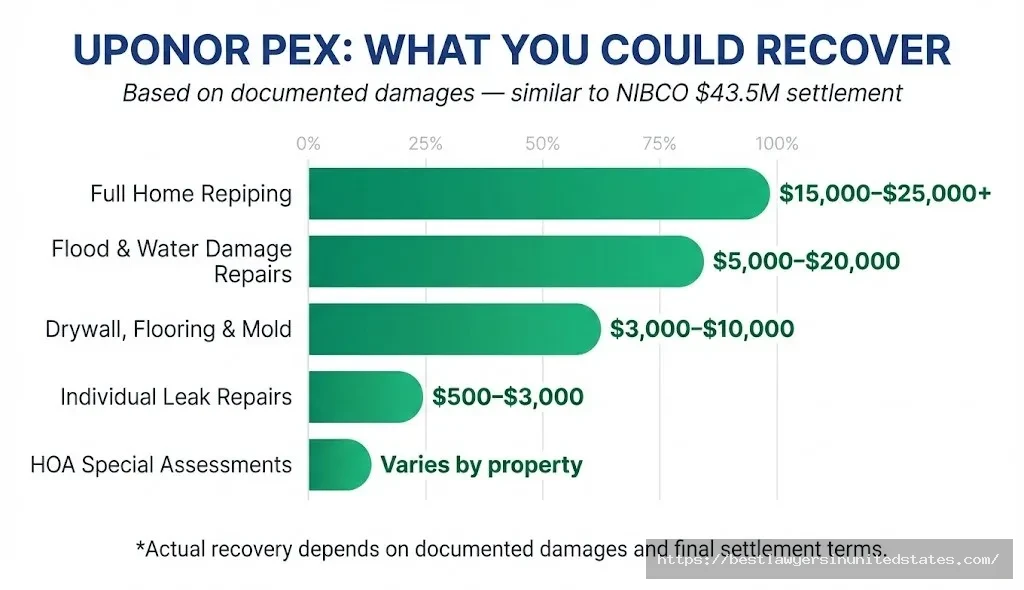
Based on the NIBCO PEX settlement and similar product defect cases, compensation in a future Uponor settlement could cover:
| Damage Category | What It Covers | Potential Recovery |
|---|---|---|
| Leak repair costs | Plumbing labor, materials to fix individual leaks | Several hundred to several thousand dollars |
| Property damage | Drywall, flooring, insulation, mold remediation | Thousands of dollars depending on extent |
| Full repiping/replumbing | Cost to replace all Uponor pipe in the home | $5,000–$25,000+ depending on home size |
| HOA special assessments | Costs levied on residents for common-area repairs | Varies by HOA and property |
| Out-of-pocket costs | Hotel stays, temporary fixes, emergency plumbing calls | Documented costs |
The NIBCO Comparison: A Roadmap for What’s Possible
The NIBCO PEX case is the closest legal precedent to what’s happening with Uponor — same defect type, same class of plaintiffs, same law firm (Sauder Schelkopf) involved. That case settled for $43.5 million and provided homeowners with options including cash reimbursement for documented repairs and the option to have their homes fully repiped.
Uponor’s pipe is installed in potentially thousands more California homes than NIBCO’s was, and the California lawsuits are filed on behalf of a single state — which courts have found easier to certify and resolve. A future Uponor settlement could be comparable in size or larger.
What Affects Your Potential Recovery
How much you ultimately receive will depend on:
- The extent of documented damage — more documented leaks and more expensive repairs mean stronger claims
- Whether you’ve already been repiped — documented repiping costs are among the clearest recoverable damages
- Number of class members — the more homeowners who join the class, the larger the total fund needs to be, but individual shares depend on total claims filed
- Whether your case settles or goes to trial — trials can result in higher or lower verdicts
- HOA vs. individual homeowner status — HOAs managing multiple units may recover for a broader set of damages
What Is the Current Status of the Lawsuits?
Active Cases as of February 2026
This is where the Uponor PEX situation stands right now, and it’s important to understand the full picture rather than oversimplified summaries.
The California cases are active and in early litigation stages. Three separate complaints are currently working through federal courts: the Clifford case in the Southern District of California (filed May 2025), the Sauder Schelkopf case in the Northern District (filed August 2025), and the Fitzpatrick case in Minnesota (filed November 2025). All three are seeking class certification — the court’s official approval to treat the case as a class action representing all similarly situated homeowners.
Uponor is fighting hard. In the Clifford case, Uponor filed a motion to compel arbitration in July 2025 — a common defense tactic that tries to push cases out of open court and into private proceedings where terms stay secret and class treatment is impossible. California courts have previously blocked this move in related Uponor disputes, which gives plaintiffs reason for optimism. That motion is still being litigated.
Consolidation is likely coming. With multiple lawsuits filed in overlapping jurisdictions, legal experts and the attorneys involved expect these cases to be consolidated — either into a Multi-District Litigation (MDL) proceeding or a single consolidated class action in one California court. As of late 2025, motions for coordination were actively being considered by the Judicial Panel on Multidistrict Litigation.
The Colorado case settled privately in 2024 but didn’t benefit the broader class. The earlier Colorado case settled on private terms — the amount was never made public — and was dismissed in October 2024. Critically, non-class members were dismissed without prejudice, meaning homeowners outside that case can still sue. This is why the new 2025 cases matter.
What Happens Next?
Expect the following milestones over the coming months and years:
| Milestone | Expected Timeframe | What It Means |
|---|---|---|
| Resolution of arbitration motions | Mid-2026 | Determines whether cases proceed in open court |
| Class certification motions | Late 2026 to 2027 | Court officially designates cases as class actions |
| Discovery phase | 2026–2027 | Both sides exchange evidence, internal documents |
| MDL consolidation decision | 2026 | All cases may be combined under one judge |
| Settlement negotiations | 2027+ (if they happen) | Attorneys negotiate a deal |
| Potential settlement approval | 2027–2028 | Court approves any settlement; claim process opens |
| Trial (if no settlement) | 2028+ | Cases go before a jury |
Class action lawsuits involving product defects of this complexity typically take 2 to 4 years to resolve. That’s why acting now — connecting with attorneys and preserving your documentation — matters so much.
How to Get Involved Right Now

Since there is no open claim form yet, the process looks different than a settled class action. Here’s exactly what to do.
⚠️ Important: There are no deadlines to file a claim form right now because no settlement has been reached. However, statutes of limitations do apply. In California, product liability claims generally must be filed within 2 to 3 years of when you discovered — or reasonably should have discovered — the damage. If your leaks happened years ago, don’t wait to speak with an attorney.
Step-by-Step: What to Do Right Now
Step 1: Check whether you have Uponor pipe. Look at exposed plumbing under sinks, in your basement, or in your garage. Look for “UPONOR,” “WIRSBO,” or “AQUAPEX” stamped on the pipe. If you’re unsure, have a licensed plumber confirm during a free inspection or service call.
Step 2: Document everything, starting today. Take photos and videos of all visible Uponor pipe in your home. Photograph any leaks, water stains, damaged drywall, or repaired areas. Write down a timeline of any leaks you’ve experienced: when they occurred, what was damaged, and who repaired it. Gather all plumbing invoices, repair bills, and insurance claim records you have.
Step 3: Contact a class action attorney for a free consultation. Multiple law firms are actively signing up affected homeowners at no cost. These cases are taken on contingency — meaning you pay nothing unless the attorneys recover money for you. Reach out to:
- Birka-White Law Offices — email: [email protected] (handling cases for California and other states)
- Sauder Schelkopf — form available at sauderschelkopf.com (California homeowners)
- Audet & Partners, LLP — phone: (800) 965-1461 (California homeowners and HOAs)
- Burg Simpson — phone: (888) 895-2080 (national inquiries)
- ClassAction.org investigation form — classaction.org/uponor-pex-class-action
Step 4: Don’t repair and throw away evidence. If you’re having active leaks, you obviously need to fix them for safety. But save the damaged pipe sections if possible, photograph the failed area before repairs begin, and keep the invoice from your plumber. These are evidence.
Step 5: Register with the law firm representing your interests. Once you connect with a law firm, they will add you to their records. When a settlement is eventually reached, you’ll be notified about the claim process. If you’re not registered with anyone, you may miss out even if you’d otherwise qualify.
Step 6: Monitor for settlement announcements. Sign up for email updates from ClassAction.org, Birka-White, or another firm tracking the case. When a settlement is reached and a claim form becomes available, you’ll want to be the first to know.
Common Mistakes Homeowners Make
The attorneys handling these cases see the same mistakes over and over:
- Waiting too long — statutes of limitations are real. If you noticed leaks several years ago and haven’t spoken to an attorney, do it this week.
- Throwing away evidence — old invoices, damaged pipe sections, and photos of water damage are all valuable. Don’t discard them.
- Assuming it was installation error — Uponor often blames installation problems when denying claims. The lawsuits specifically allege that perfect installation cannot prevent these defects. Don’t accept that framing without speaking to an attorney.
- Not telling your HOA — if you’re in an HOA-managed community, the association itself may have a claim for common-area pipe failures. Tell your board and encourage them to consult an attorney.
- Signing releases without legal advice — if Uponor offers you direct compensation and asks you to sign a release, talk to an attorney first. You may be signing away much more than you’re receiving. Sierra Mist Lawsuit Girl
Uponor PEX Lawsuit vs. Similar PEX Pipe Cases
The Uponor lawsuits don’t exist in a vacuum. Several similar defective PEX pipe cases have already been resolved, giving attorneys and homeowners a clear picture of what’s possible.
Comparison with Similar PEX Pipe Lawsuits
| Lawsuit | Settlement | Affected Parties | Type of Relief | Status |
|---|---|---|---|---|
| Uponor PEX (California, 2025) | TBD — pending | Thousands of CA homeowners | TBD | Active litigation |
| Uponor PEX (Colorado, 2021) | Private — undisclosed | Colorado homeowners only | Private terms | Settled Oct. 2024 |
| NIBCO PEX | $43.5 million | National homeowners | Repairs + replumbing option | Settled 2018 |
| Defective water connectors (Nebraska) | $14 million | Nebraska homeowners | Cash compensation | Settled (Sauder Schelkopf) |
| Defective toilet connectors | $16.5 million | National homeowners | Cash compensation | Settled (Sauder Schelkopf) |
What Makes the Uponor Case Unique
A few things set the Uponor PEX lawsuits apart from the competition’s cases:
California courts are homeowner-friendly. California has strong consumer protection laws, and courts there have already rejected Uponor’s attempt to force homeowners into private arbitration in related disputes. This makes California a favorable battlefield for plaintiffs.
The defect is progressive. Unlike a one-time product failure, Uponor PEX gets worse over time. Homeowners who had one leak will likely have more. This makes the case for full repiping — not just patching — far more compelling to courts and juries.
Uponor quietly discontinued the product. The 2021 discontinuation of red and blue pipe, framed as a “suspension,” is evidence the lawsuits use to argue Uponor acknowledged the problem internally while concealing it publicly.
The same firm that won $43.5M from NIBCO is involved. Sauder Schelkopf’s involvement is significant. They know this type of case, they know the defense playbook, and they’ve already won a landmark result in an almost identical situation.
Do You Need a Lawyer to Get Involved?
Quick Answer: You don’t need to hire a lawyer on your own to participate. Class action attorneys take these cases for free upfront — they only collect fees if they win. However, speaking with an attorney now (rather than waiting) can significantly protect your rights and ensure you’re included when a settlement happens.
Why Connecting with an Attorney Now Matters
In a typical settled class action, you’d wait for a notice in the mail and file a simple claim form online. This case is different — it’s still being litigated. That means the class hasn’t been formally certified, and there’s no guarantee every affected homeowner will automatically receive notice when a settlement eventually happens.
By contacting one of the law firms now, you ensure you’re in the loop. The attorneys will document your situation, include you in their client records, and notify you directly when there are developments. If you wait until a settlement is announced and announced publicly, it may take months to find you — if they find you at all.
When You Especially Should Talk to an Attorney
Consider reaching out as soon as possible if:
- You’ve had multiple leaks from Uponor pipe over the years
- You’ve already paid for a full repipe and want reimbursement
- Uponor denied a warranty claim you made
- Your HOA has levied special assessments due to PEX failures
- You’re not sure whether your damage falls within California’s statute of limitations
Free Consultation Options
All of the following firms handle Uponor PEX cases on a contingency basis — no fees unless they recover money for you:
| Law Firm | Contact |
|---|---|
| Birka-White Law Offices | [email protected] |
| Audet & Partners, LLP | (800) 965-1461 |
| Burg Simpson | (888) 895-2080 |
| Sauder Schelkopf | sauderschelkopf.com (form) |
| ClassAction.org investigation | classaction.org/uponor-pex-class-action |
Frequently Asked Questions
What is the Uponor PEX lawsuit about?
Multiple class action lawsuits claim that Uponor’s AquaPEX red, white, and blue plumbing pipes — sold from roughly 2010 to 2021 — are defective. The pipes allegedly suffer from a manufacturing flaw that causes premature oxidative degradation, leading to cracking, leaks, and significant water damage in California homes. The lawsuits claim Uponor knew about the problem and concealed it.
Is there a settlement I can file a claim for right now?
No. As of February 2026, the active California lawsuits filed in 2025 have not reached a settlement. There is no open claim form. The Colorado case did reach a private settlement in October 2024, but that settlement was not public and did not provide a claim form for the general public. If a new settlement is reached, affected homeowners will be notified.
Who qualifies to join the lawsuit?
Currently, the lawsuits are focused on California homeowners, condo owners, and HOA members whose properties contain Uponor AquaPEX piping manufactured and installed from 2010 to the present. You don’t need to have had a leak yet — the defect exists in the pipe itself. However, having documented damage strengthens your claim considerably.
How much money could I get?
No settlement amount has been announced. A comparable case against NIBCO for nearly identical PEX pipe defects settled for $43.5 million, with individual homeowners receiving money for documented repairs and repiping costs. In that case, some homeowners received full repiping of their homes as part of the settlement. Any future Uponor settlement amount will depend on the number of claimants and the total documented damages.
When is the deadline to join?
There is no single filing deadline right now because no settlement has been reached. However, California’s statute of limitations for product liability claims is generally 2 to 3 years from when you discovered the damage. If you had leaks years ago and haven’t spoken to an attorney, contact one soon to make sure your rights haven’t expired.
What if I’ve already had my home repiped?
You may still have a claim. The cost of your repiping is exactly the kind of documented damage the lawsuits seek to compensate. Save all invoices, contracts, and records from the repiping job. If you paid $10,000 to $25,000 or more to repipe because of Uponor failures, that’s significant evidence of harm.
Do I need to have a lawyer to participate?
You don’t need to hire a private lawyer at your own expense. Class action attorneys take these cases for free upfront on contingency. But you should contact an attorney now — before a settlement is announced — to make sure you’re documented and included.
What if Uponor already denied my warranty claim?
This is actually common and doesn’t disqualify you. The lawsuits specifically allege that Uponor wrongly blamed installation errors and water pressure when denying legitimate warranty claims. A denial from Uponor doesn’t mean you’re out of options — it may actually strengthen your case.
How do I know if I have Uponor pipe?
Look at exposed pipes under sinks, in your basement, crawl space, or garage. Uponor pipe is stamped with “UPONOR,” “WIRSBO,” or “AQUAPEX” on the side. The red pipe is for hot water, blue for cold, white for either. If you’re unsure, have a licensed plumber check.
My home is in Colorado, Texas, or another state — am I excluded?
Current active class actions are focused on California. However, ClassAction.org and other firms are investigating a broader national case. Even if you’re outside California, contact an attorney to discuss your options — your state’s statute of limitations may be running.
What if I’m part of an HOA?
HOAs with Uponor PEX in common areas may have separate, potentially larger claims than individual homeowners. Audet & Partners specifically represents HOAs in these cases. If you’re a board member or resident, encourage your HOA to consult a lawyer independently of any individual homeowner claims.
Will Uponor be forced to recall the pipes?
The lawsuits seek injunctive relief in addition to monetary damages, meaning they ask the court to require Uponor to take corrective action — which could include a recall or replacement program. No recall has been issued as of early 2026, and Uponor has made no public statement about the alleged defects.
What causes the pipe to fail?
The complaints point to three overlapping manufacturing defects: uneven distribution of antioxidants in the pipe material, heat treatment during color coating that destroys antioxidant protection on the pipe’s outer surface, and fitting installation design that concentrates stress at pipe connections. These defects cause oxidative degradation — essentially the pipe breaks down chemically from the inside and outside — leading to microcracks that spread over time.
Is the Uponor white pipe also defective?
The white pipe is included in the lawsuits. While red and blue pipe has additional defects from the flame treatment process used to apply their colors, white pipe still suffers from the uneven antioxidant distribution and fitting-related defects. White pipe is still sold today, which is one reason attorneys are eager to get the word out.
What documents should I gather right now?
Start with: photos of all Uponor pipe visible in your home, any invoices from plumbing repairs or repiping jobs, your home inspection report, any correspondence with Uponor or your insurance company about leaks, and photos of water damage. Even if you’ve already repaired everything, gather what you have — attorneys can work with partial documentation.
How long will the lawsuit take?
Complex product defect class actions typically take 2 to 5 years to fully resolve. Given that major new filings only began in mid-2025, a realistic timeline for any settlement or trial verdict would be 2027 to 2029. That’s why acting now — preserving evidence and connecting with attorneys — matters so much.
What is the Engel method, and why does it matter?
The Engel method is a manufacturing process used to make cross-linked polyethylene (PEX-a) pipe. The lawsuits allege that Uponor’s use of this method fails to uniformly blend antioxidants into the pipe material. Because antioxidants protect polyethylene from oxidation (chemical breakdown), uneven distribution means some sections of the pipe are largely unprotected — and there’s no way for consumers or installers to identify which sections those are.
If the pipe hasn’t failed yet, can I still have a claim?
Potentially, yes. The lawsuits seek to represent all California homeowners with Uponor pipe installed — not just those who have experienced leaks. The argument is that the defect exists in all the pipe, making all affected homes less valuable and all homeowners exposed to future damage. Courts will ultimately decide whether this theory supports class certification for homeowners who haven’t yet had failures.
Will I have to pay taxes on any settlement money I receive?
Generally, compensation for property damage and repair costs in a lawsuit settlement is not taxable. However, tax law is complicated and depends on your specific circumstances. Ask a tax professional once a settlement is announced and you know the nature and amount of any compensation you receive.
What to Do This Week
If you’ve read this far, you probably own a home with Uponor pipe or know someone who does. Here’s a simple checklist to protect yourself right now:
- Confirm whether you have Uponor AquaPEX pipe (check exposed pipes for the brand name)
- Take photos of all visible Uponor pipe — do this today
- Gather any invoices, receipts, or records of plumbing repairs or leaks
- Contact one of the law firms listed above for a free consultation — it costs nothing and takes 15 minutes
- Set a calendar reminder to check back on case developments every 3 months
- If you’re in an HOA, tell your board about the lawsuits
These cases are still in early stages, but the attorneys involved have a strong track record in nearly identical cases. The steps you take now could mean the difference between being fully compensated and being left out entirely.
This article is for informational purposes only and does not constitute legal advice. Laws and case statuses change. If you believe you have a claim, consult a qualified attorney to evaluate your specific situation.
Last updated: February 2026
