
A security negligence lawsuit holds property owners legally responsible when their failure to provide adequate safety measures allows a preventable crime to happen — and you get hurt because of it. These cases fall under premises liability law, meaning the property and whoever controls it can be on the hook for your injuries.
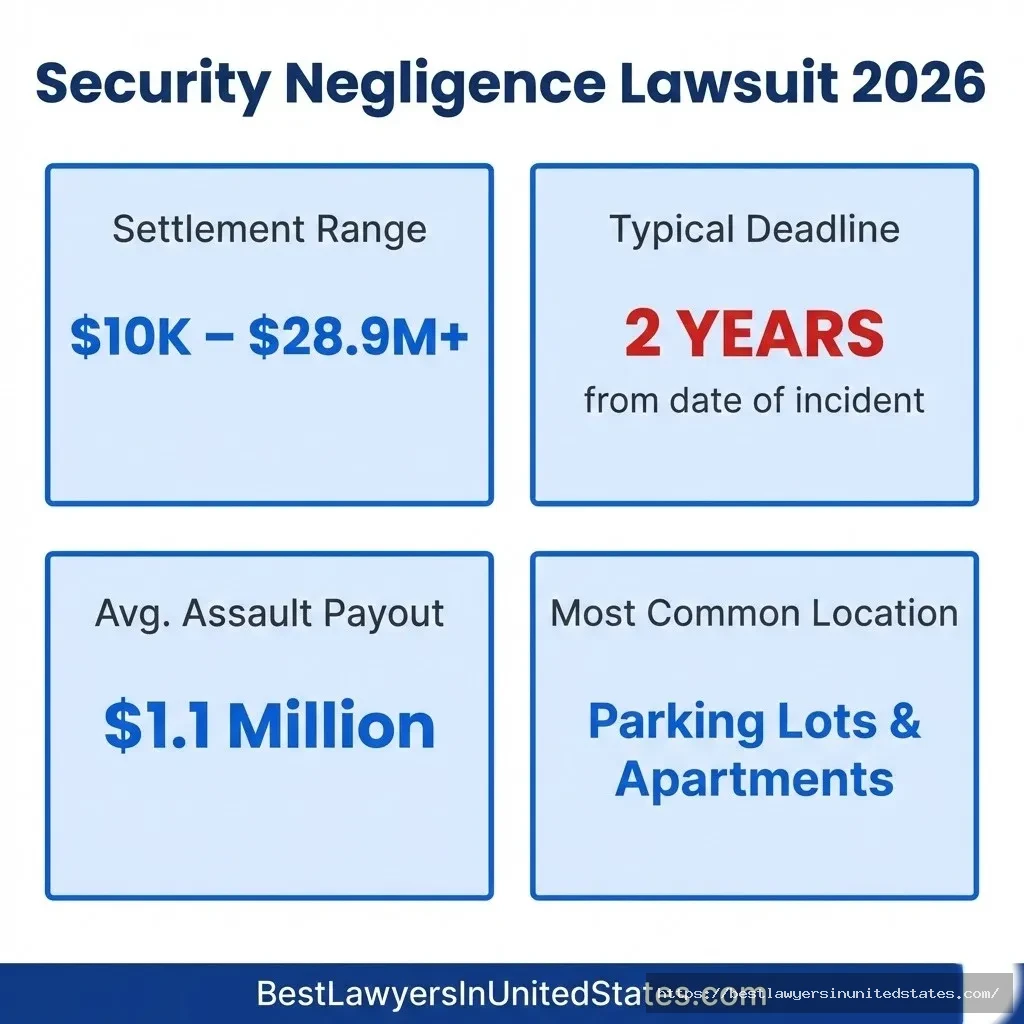
Settlement amounts in negligent security cases range anywhere from $10,000 to over $1,000,000 depending on the circumstances, the strength of the evidence, and the extent of the harm — and catastrophic injury cases have produced settlements far exceeding that range.
Quick Answer: A security negligence lawsuit lets you seek compensation from a property owner when crime on their premises injures you and better security could have stopped it. You don’t need to catch or sue the criminal — you sue the owner who failed to protect you. The deadline to file varies by state, ranging from 1 to 6 years from the date of the incident, with most states giving you 2 years. ogx lawsuit
⚠️ TIME-SENSITIVE WARNING: The clock starts on the day of your incident. In most states, you have 2 years or less to file. If you’re suing a government entity, you may have as little as 6 months to file a required notice of claim. Missing these deadlines permanently eliminates your right to compensation — no exceptions.
This guide covers everything you need to know in 2026: what negligent security means legally, who qualifies, how much you can get, how to build your case, and exactly what to do next. Sierra Mist Lawsuit Girl
What Is a Security Negligence Lawsuit?
The Legal Foundation
A security negligence lawsuit is a type of premises liability claim. It holds property owners accountable when their failure to provide a safe environment leads to a visitor being harmed by a crime. As a type of premises liability claim, it’s based on the owner’s duty to ensure their property is reasonably safe for legal visitors, whether it’s a store, apartment complex, or parking garage.
Here’s the key distinction people often miss: these cases are not about blaming the property owner for the criminal’s choices. They’re about whether the crime was foreseeable and whether basic security precautions could have stopped it. A hotel that ignores a pattern of room break-ins and doesn’t fix broken door locks is very different from a hotel that gets hit by a random, unprecedented attack. Courts focus on foreseeability.
While the criminal justice system punishes the perpetrator, it doesn’t compensate the victim. Criminals often lack the funds to pay for damages, which is why a claim against the property owner — who usually has liability insurance — is often the most practical path to financial recovery.
How This Differs from Other Personal Injury Cases
In a typical premises liability claim, the injured person is seeking damages from the property owner due to some dangerous condition that existed on the property. In a negligent security action, the injured person is seeking damages from the property owner for the criminal acts of an independent third party, such as a robber or mass shooter. Courts have developed a specific legal framework for these cases because they involve the independent actions of a third person. That framework centers on foreseeability: if a reasonable property owner should have known that crime was a risk on their property, they had a duty to address it.
Security Negligence Lawsuit: Overview Table
| Element | Details |
|---|---|
| Legal Category | Premises Liability / Negligent Security |
| Who You Sue | Property owner, business operator, security company |
| Typical Deadline | 1–6 years from incident (2 years in most states) |
| Government Entity Deadline | As little as 6 months to file notice of claim |
| Settlement Range | $10,000 to $28.9+ million |
| Average Settlement (Assault/Battery) | ~$1.1 million |
| Average Settlement (Sexual Assault) | ~$1.2 million |
| Average Settlement (Wrongful Death) | ~$2.8 million |
| Cost to Start | Most attorneys work on contingency (no upfront cost) |
| Most Common Locations | Parking lots, apartment complexes, hotels, bars, retail stores |
Who Qualifies to File a Security Negligence Lawsuit?
Quick Answer: You may qualify if you were lawfully on someone else’s property, were harmed by a crime that was reasonably foreseeable, and that crime could have been prevented or reduced by adequate security measures. You do not need to have identified or prosecuted the criminal to file a claim.
The Four Core Eligibility Requirements
To bring a successful negligent security lawsuit, a plaintiff needs to prove: Duty — that the business or property owner had a legal obligation to provide reasonable security features on the premises; Breach — that the property owner was somehow negligent in failing to ensure or maintain reasonable security; and Injury/Causation — that they were physically harmed and that their injuries were a direct result of the defendant’s negligent failure to provide reasonable security. The Lashify Lawsuit Explained
Courts also consistently require a fourth element:
Foreseeability — Courts often look at whether similar crimes had happened on or near the property. If there were many robberies in a parking lot, it’s easier to argue that another robbery was foreseeable. Police reports and internal security logs can be used to establish this.
Eligibility Checklist
| Requirement | What It Means | How You Prove It |
|---|---|---|
| Lawful presence on property | You had permission to be there | Lease, receipt, invitation, guest log |
| Foreseeable crime | Owner should have known crime was a risk | Prior police reports, crime statistics, incident records |
| Security failure | Owner didn’t take reasonable steps | Photos, expert testimony, security standards |
| Causation | Better security would have changed the outcome | Expert witness, security consultant |
| Actual damages | You suffered real physical or financial harm | Medical records, bills, pay stubs, therapy records |
Common Locations for Negligent Security Cases
The most frequent location for negligent security cases was a parking lot — 289 cases in one comprehensive study took place in a parking lot. Apartment buildings were second with 211 cases. Other frequent locations included stores, exterior common areas, bars, and schools.
| Location | Notes |
|---|---|
| Parking lots/garages | Most common setting; lighting and surveillance issues are typical |
| Apartment complexes | Second most common; broken entry systems, inadequate lighting |
| Retail stores & malls | Robbery-related; failure to hire guards or maintain cameras |
| Hotels & motels | Broken room locks, inadequate lobby security |
| Bars & nightclubs | Fight-related incidents; failure to control access or hire bouncers |
| Schools & universities | Campus security failures |
| Hospitals & clinics | Patient and visitor safety failures |
| Office buildings | Access control failures |
Common Types of Security Failures
Inadequate locks, inadequate lighting, and a lack of video cameras are among the most common grounds for negligent security claims. Darkness invites criminal activity, so ensuring the premises is well lit is often a basic element of security expected on all types of properties and businesses. This is a frequent claim in negligent security cases because property owners and businesses often neglect to maintain lighting systems in outdoor areas, such as parking lots.
Other common failures include: failure to hire or post security personnel in high-risk areas, broken or missing access control systems at apartment complexes and hotels, ignoring prior complaints from tenants or customers about safety, and failure to patrol common areas with a history of criminal activity.
Who Does NOT Qualify
You likely cannot bring a successful negligent security claim if:
- You were trespassing on the property at the time of the incident
- The crime was a completely unforeseeable, random act with no warning signs whatsoever
- The property owner had reasonable, industry-standard security in place
- You’ve missed the statute of limitations deadline for your state
- You were substantially responsible for provoking the criminal incident (though comparative fault only reduces recovery in most states — it doesn’t eliminate it)
- Your claim involves a government entity and you missed the early notice of claim deadline
How Much Money Can You Get from a Security Negligence Lawsuit?
Quick Answer: There’s no guaranteed number — each case is different. Settlements typically range from $10,000 for minor incidents to over $28 million for catastrophic cases. The type of crime, severity of injury, and quality of evidence all heavily influence how much you can recover.

Settlement Ranges by Case Type
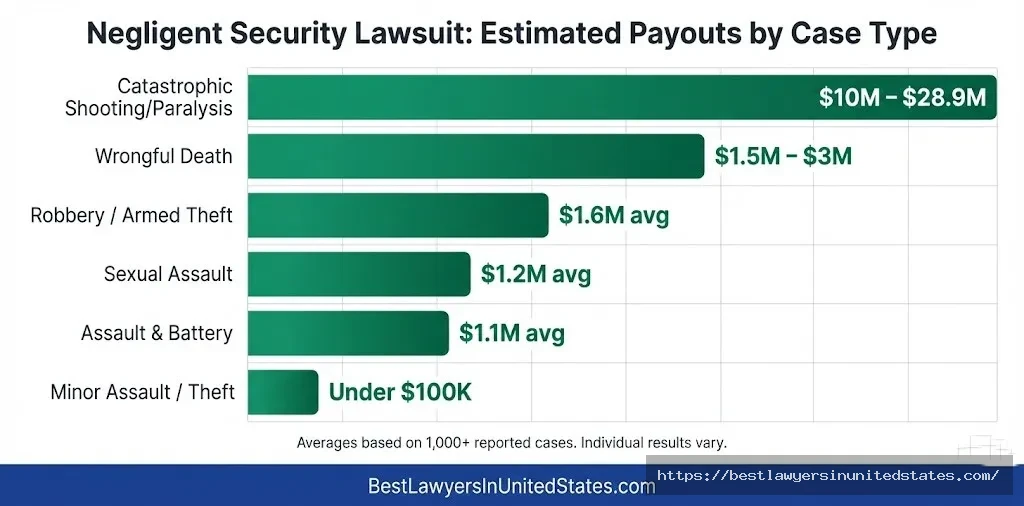
Wrongful death averaged the most significant jury verdicts at $2.8 million. Second were robberies with a median jury verdict of $1,900,000 and a median settlement of $1.6 million. Inadequate security rape lawsuits resulted in an average of $1.5 million in jury verdicts and settled on average for $1.2 million. Assault and battery cases saw average jury verdicts of $1,200,000 and median pretrial settlements of $1.1 million.
| Incident Type | Average Jury Verdict | Typical Settlement | Notes |
|---|---|---|---|
| Wrongful Death | $2.8 million | $1.5–$3 million | Highest average outcome |
| Robbery/Armed Theft | $1.9 million | $1.6 million median | High evidence value |
| Sexual Assault/Rape | $1.5 million | $1.2 million average | Severe psychological damages |
| Assault & Battery | $1.2 million | $1.1 million median | 42% of all negligent security cases |
| Shooting (catastrophic) | $10M–$28.9M | Varies widely | Paralysis, permanent disability |
| Minor Assault | $50,000–$250,000 | Often under $100K | Minor injuries, limited evidence |
Settlement Ranges by Property Type
In inadequate security lawsuits, hotels paid out an average of $1 million in jury verdicts and $632,000 in pretrial settlements. Restaurants paid an average of $600,000 in jury verdict awards and settled on average for $2.8 million. Apartment complexes, which owe residents a higher duty of care due to the landlord-tenant relationship, paid a median of $1.5 million in jury awards and $1.7 million in settlements.
| Property Type | Median Jury Award | Average Settlement |
|---|---|---|
| Apartment complexes | $1.5 million | $1.7 million |
| Retail stores | $1.7 million | $1.2 million |
| Hotels/motels | $1.0 million | $632,000 |
| Restaurants/bars | $600,000 | $2.8 million |
Real Cases: What Settlements Look Like
A $28.9 million settlement was awarded in a shooting where a teenager was rendered quadriplegic due to inadequate security at an apartment complex — achieved even after recent tort reform. A $10 million settlement involved a 26-year-old man who became a paraplegic after being shot in his apartment complex with “wholly inadequate” security despite a history of violent crimes. A $7 million settlement resolved a nightclub shooting lawsuit where a female plaintiff was paralyzed in a parking lot shooting.
Factors That Affect Your Payout
| Factor | Impact on Compensation |
|---|---|
| Severity of injury | More serious injuries = significantly higher compensation |
| Foreseeability of crime | Clear warning signs of prior crime = much stronger case |
| Degree of owner negligence | Blatant failures (broken lights for months, ignored complaints) = higher damages |
| Your comparative fault | If you contributed to the incident, your payout may be reduced |
| State laws | Some states cap damages or apply contributory negligence rules |
| Insurance coverage | Defendant’s policy limits can affect actual recovery |
| Availability of evidence | Stronger documentation = better settlement position |
| Lost income | High earners or long recovery periods = higher economic damages |
What Damages Can You Recover?
In general, plaintiffs can recover economic damages — monetary losses that result from your injuries, such as medical expenses, lost wages, and property damage — and noneconomic damages — non-monetary losses such as physical pain and suffering and emotional distress. Punitive damages are reserved for cases where a property owner was grossly negligent or showed intentional recklessness, and they are not available in every case or every state.
How to File a Security Negligence Lawsuit: Step by Step
⚠️ DEADLINE WARNING: Your filing clock starts on the day of your incident. In most states, you have 2 years. Some states give only 1 year. If a government entity is involved, you may have only 6 months. Act now.
Step 1: Get Immediate Medical Attention
Go to the hospital or urgent care as soon as possible — even if your injuries feel minor. Delayed medical care gives property owners and insurers a powerful argument that your injuries weren’t caused by the incident. Your medical records are the backbone of your case.
Step 2: Call the Police and File a Report
Always report the incident to law enforcement regardless of whether you plan to sue. The police report creates an official record of the crime, the scene conditions, and the initial facts. It’s one of the most important pieces of evidence in any negligent security case.
Step 3: Document the Scene
Call the police — they will investigate the scene, document evidence, and gather witness testimonies. Go to the hospital to seek immediate medical attention, which prevents claims that injuries aren’t related to what happened. Speak to an attorney — a lawyer will guide you in what to say and do to protect your interests in the future. Don’t speak to the defendant or their representatives — avoid discussions as they might use what you say against you in court.
Before anything changes at the scene, document in photos and video: poor or broken lighting, broken or malfunctioning locks, missing or damaged security cameras, lack of security personnel, and any signage advertising safety features that weren’t in place.
If there’s surveillance footage on the property, send a written preservation request to the property owner immediately. Footage is frequently overwritten within 24–72 hours.
Step 4: Consult a Negligent Security Attorney
Most negligent security attorneys offer free consultations and work on a contingency fee basis — meaning they only get paid if you win. There’s no upfront cost. An experienced attorney will evaluate your case, identify all liable parties, investigate the property’s crime history, hire expert witnesses, and negotiate with the property owner’s insurance company.
Don’t accept any settlement offer or sign anything before consulting an attorney. Initial insurance offers are almost always significantly below what your case is worth.
Step 5: Conduct a Full Investigation
Law firms frequently hire ex-police officers, private detectives, and others with extensive investigation experience. They know where to look, how to ask questions, and ways to conduct interviews to get critical information for your case. Your legal team will also pull crime statistics for the area, review the property’s internal security logs and incident reports, and hire a security expert to evaluate whether the property met reasonable standards.
Step 6: File Your Claim and Negotiate
The legal process following a crime generally follows a clear path: filing a claim, a thorough investigation and evidence gathering, settlement negotiations, and, if necessary, a trial. The vast majority of personal injury claims, including negligent security lawsuits, are resolved through a settlement rather than a trial. Homestead Rescue Lawsuit
Required Documentation Checklist
| Document | Why It Matters | Where to Get It | If You Don’t Have It |
|---|---|---|---|
| Police report | Official record of the crime and scene | Police department, records division | File a report now |
| Medical records | Proves nature and extent of injuries | Hospital, doctor’s office | Request immediately in writing |
| Photos/video of scene | Shows security failures visually | Take them yourself ASAP | Attorney can document; some evidence may remain |
| Witness statements | Supports foreseeability and conditions | Gather contact info now | Attorney can track down witnesses |
| Surveillance footage | Shows the incident and security gaps | Written request to property owner immediately | Subpoena through attorney if denied |
| Property incident logs | Shows prior crimes and owner awareness | Request from management | Attorney can obtain through discovery |
| Pay stubs/tax returns | Proves lost income | Employer, IRS records | W-2s, bank statements can substitute |
| Therapy/psych records | Supports emotional distress damages | Therapist, counselor | Begin treatment and document going forward |
Filing Deadlines: Don’t Lose Your Right to Compensation
This is the most critical section of this guide. Missing your state’s deadline means no compensation — courts won’t grant exceptions based on the seriousness of your injuries or the clarity of the negligence.
State Statute of Limitations Reference
Some states, such as Kentucky, Tennessee, and Louisiana, give plaintiffs only one year to file a personal injury lawsuit. In Maine, victims of a negligent security incident have a full six years to file their lawsuit. The California personal injury statute of limitations is generally two years from your injury date.
| State | Personal Injury Deadline | Government Entity Notice | Notes |
|---|---|---|---|
| California | 2 years | 6 months to file notice | Discovery rule may apply |
| New York | 3 years | 90 days for notice of claim | Government claims are strict |
| Florida | 2 years | Varies | HB 837 created safe harbors for compliant landlords |
| Texas | 2 years | 6 months for notice | |
| Nevada | 2 years | 1 year for some govt | |
| Illinois | 2 years | 1 year for local govt | |
| Georgia | 2 years | Varies | |
| Tennessee | 1 year | Very short — consult attorney | |
| Kentucky | 1 year | Very short — consult attorney | |
| Louisiana | 1 year | Short — consult attorney | |
| Maine | 6 years | Varies | Longest deadline in the US |
| Most other states | 2 years | Varies; often 6 months | Confirm your exact deadline |
⚠️ These are general guidelines. Your state may have exceptions, tolling provisions, or different timelines depending on who you’re suing. Always confirm your exact deadline with an attorney.
Special Deadline Situations
| Situation | How Deadline Is Affected |
|---|---|
| Victim is a minor (under 18) | Deadline is typically paused (“tolled”) until they turn 18 |
| Victim is mentally incapacitated | Deadline may be tolled during incapacity |
| Suing a government entity | Dramatically shorter — often 6 months for a notice of claim |
| Injury discovered later | “Discovery rule” may start clock at discovery, not date of incident |
| Defendant fraudulently concealed info | May extend deadline in some states |
Current Landscape of Security Negligence Lawsuits in 2026
What’s Changing Right Now
Security negligence litigation continues to grow in volume and complexity. The value of the 10 highest class-action settlements in 2025 exceeded $70 billion for the first time ever. Plaintiffs filed more than 13,000 class-action lawsuits in federal courts alone — more than 36 new class-action filings every day. Negligent security cases are riding this wave, with plaintiffs’ attorneys pursuing apartment complexes, hotel chains, and large retail operators more aggressively than ever.
Florida’s Tort Reform (HB 837): Florida created a legal “presumption against liability” for multi-family residential property owners who implement specific security measures — camera systems, adequate lighting, and proper locks. If the property owner implements these specific security measures such as camera systems, adequate lighting, and proper locks, they may benefit from a presumption against liability in negligent security cases. If your landlord ignored these measures entirely, however, it strengthens your position.
Rising Jury Awards: Despite tort reform in some states, when plaintiffs win at trial the awards are getting larger. A $38 million verdict in Nevada and a $28.9 million settlement in a shooting case illustrate the upper ceiling of what juries award in catastrophic cases.
Digital Negligent Security: Data breach negligent security is an emerging area following the same legal framework as physical security cases — foreseeability, failure to implement reasonable protections, and resulting harm. Discord faces a data breach class action filed in October 2025 alleging Discord failed to properly secure personally identifiable information, with approximately 70,000 users having government IDs, IP addresses, billing information, emails, and account details compromised.
Comparison with Similar Case Types
| Lawsuit Type | Typical Settlement Range | Key Distinguishing Factors |
|---|---|---|
| Negligent security (catastrophic injury) | $10M–$28.9M | Paralysis/death, clear prior crime history |
| Negligent security (serious injury) | $500K–$5M | Significant injury, documented security failure |
| Negligent security (moderate injury) | $100K–$500K | Medical treatment required, some evidence of failure |
| Data breach negligent security | $50–$7,500 per person | Large class, documented losses |
| Premises liability (slip/fall) | $30K–$500K+ | Physical injury, property defect |
Do You Need a Lawyer to File a Security Negligence Lawsuit?
Quick Answer: You don’t legally need one, but you almost certainly should get one. These cases are complex, involve expert witnesses, require investigation into the property’s crime history, and pit you against well-funded insurance companies with experienced defense lawyers. Most negligent security attorneys offer free consultations and charge nothing upfront.
What an Experienced Attorney Does for You
Pursuing negligent security claims takes time. Moreover, they’re more complex than many other types of personal injury lawsuits because they usually require expert witnesses, investigation, cooperation with law enforcement and prosecutors, dealing with perpetrators and a criminal case, and establishing industry and property standards for practical security measures.
A skilled negligent security attorney investigates the full history of crime at the property, identifies every potentially liable party (property owner, management company, security firm), hires qualified expert witnesses on security standards, preserves evidence before it disappears, calculates the full value of your claim including future medical costs and lost earning capacity, and takes your case to trial if the insurance company lowballs you.
When You Need Legal Help Most
Don’t try to handle the case yourself if your injuries are serious, permanent, or disabling; if a loved one died because of the incident; if the property owner is denying all liability; if a government entity is involved; or if the statute of limitations deadline is approaching.
Finding Legal Help
Most negligent security attorneys work on contingency — you pay nothing until they win your case, and their fee comes out of the settlement. Free case evaluations are standard. You can also contact [email protected] for attorney referrals if you’re unsure where to start.
Frequently Asked Questions
What is a security negligence lawsuit?
Quick Answer: A legal claim against a property owner for failing to provide adequate security, allowing a foreseeable crime to injure you.
A negligent security lawsuit is a legal claim against property owners who failed to provide adequate security measures, resulting in harm to visitors from preventable crimes. These cases fall under premises liability law and allow victims to seek compensation when property owners breach their duty of care.
Who can file a security negligence lawsuit?
Quick Answer: Anyone who was lawfully on a property, harmed by a foreseeable crime, where adequate security would have prevented or reduced the harm.
You don’t need to be a tenant or paying customer. Most plaintiffs (70%) were customers or guests of the business. Employees of the defendant made up 17% of plaintiffs. The key is that you had a right to be on the property.
How much money can I get from a negligent security case?
Quick Answer: Settlements typically range from $10,000 to over $28 million depending on how serious your injuries are and how clear the negligence was.
Negligent security lawsuit settlement amounts may range from anywhere between $10,000 to over $1,000,000 depending on the circumstances, the strength of the evidence, and the extent of the harm. Tier 1 negligent security settlements typically range from $500,000 to over $1,000,000 when the plaintiff suffered life-altering harm and the evidence shows the risk was not a surprise.
What is the deadline to file a security negligence lawsuit?
Quick Answer: Most states give you 2 years from the date of the incident, but some give only 1 year, and suing a government entity can require action in as little as 6 months.
Regardless of the time available to file your negligent security claim, acting quickly can help you collect evidence before it disappears. Important evidence could disappear over the years, making a lawsuit more challenging. If there are witnesses to the crime, they may not remember all the details after years have passed, or they may have moved far away.
Do I need a police report to file a claim?
Quick Answer: You don’t legally need one, but not having one significantly weakens your case.
A police report creates an official record of the crime, the scene, and the conditions at the time. It’s one of the most powerful pieces of evidence in your case. If you haven’t filed a report yet, do it now — most departments allow reports to be filed after the fact.
What if the criminal was never caught?
Quick Answer: You can still sue the property owner. Your case is against the owner, not the attacker.
You can still pursue a negligent security claim against the property owner, regardless of the perpetrator’s identification or prosecution. The case focuses entirely on whether the property owner failed their duty — not on finding the criminal.
What if I was partly at fault for the incident?
Quick Answer: In most states, you can still recover compensation — it just reduces your award proportionally.
Most states use “comparative negligence” rules. Under the doctrine of comparative fault, your own actions can reduce the amount of money you receive in a settlement or judgment. For example, if you were assaulted in a hotel room after leaving the door unlocked, a court might find that you contributed to the cause of the incident and lower your payout accordingly.
What evidence do I need for a negligent security claim?
Quick Answer: Police reports, medical records, photos or video of the scene, witness contact information, and documentation of prior crimes at the property.
The key evidence includes police reports, medical records, photos and videos of the scene showing inadequate security such as poor lighting or broken locks, and witness statements from people who saw the incident or knew about the security conditions or prior crimes on the property.
Can I sue an apartment complex for being attacked?
Quick Answer: Yes — apartment complexes are the second most common defendant in negligent security lawsuits.
Apartment complexes have a heavy responsibility for resident safety, having paid a median of $1.5 million in jury awards and $1.7 million in settlements in negligent security cases. Courts consistently hold that apartment owners must take meaningful steps to protect residents from foreseeable crime.
Can I sue a hotel for negligent security?
Quick Answer: Yes — hotels owe guests a high duty of care and are frequently defendants in negligent security cases.
A hotel failing to repair broken room locks, allowing a break-in, is a classic example of negligent security. Hotels are expected to provide working locks on all guest rooms, adequate lighting in parking areas and hallways, surveillance systems in common areas, and security personnel when the risk level warrants it.
How long does a security negligence lawsuit take?
Quick Answer: Most cases settle within 1 to 3 years; cases that go to trial can take 3 to 5 years or longer.
The timeline for a negligent security lawsuit can range from several months to a few years. The duration is influenced by case complexity, evidence gathering, the defendant’s cooperation, court schedules, and whether the case settles or goes to trial. Cases that settle are resolved much faster than those that go to trial.
What is “foreseeability” and why does it matter?
Quick Answer: Foreseeability is the legal test for whether a crime was predictable enough that the property owner should have prepared for it.
A central element in every negligent security case is foreseeability — could the property owner have reasonably known that a crime like this was likely to happen? To determine if a crime was predictable, courts often look at whether similar crimes had happened on or near the property.
What happens if the property owner says their security was adequate?
Quick Answer: That’s exactly what they’ll argue — and your attorney’s job is to prove them wrong.
Even if you have a strong case, the property owner’s lawyers will defend their client vigorously. Common defenses include claiming the crime was a random, unpredictable event; arguing their security was good enough; claiming the criminal is the only one to blame; or arguing you were also careless. An experienced attorney anticipates all of these arguments and builds evidence to counter each one.
Can I file a negligent security lawsuit against a government entity?
Quick Answer: Yes, but with significantly tighter deadlines and special procedural requirements.
Claims against government entities have much shorter deadlines, sometimes as little as six months to file a formal “notice of claim.” Missing this first step can prevent you from filing a lawsuit. Don’t assume your regular statute of limitations applies — if a government entity is involved, consult an attorney immediately.
What if the security company hired by the property owner was the one that failed?
Quick Answer: You may be able to sue both the property owner and the security company as separate defendants.
Parties that may be held liable in a negligent security lawsuit include property owners, security companies that were hired but failed to perform their duties reasonably, and business operators or managers who had control over the premises’ safety protocols. Multiple defendants typically means more total insurance coverage and more settlement leverage.
Will my settlement be taxed?
Quick Answer: Most compensation for physical injuries and related medical expenses is not taxable, but punitive damages and emotional distress damages may be.
The IRS generally doesn’t tax compensation for physical injuries or medical expenses. However, punitive damages, emotional distress damages not directly tied to physical injury, and interest on settlements are typically taxable. Consult a tax professional before or after settling your case.
What if I can’t afford a lawyer?
Quick Answer: You almost certainly can get legal help at no upfront cost — most negligent security attorneys work on contingency fees only.
The vast majority of personal injury claims, including negligent security lawsuits, are resolved through a settlement rather than a trial. Because trials can be costly and unpredictable, insurers often prefer to settle. Attorneys who take these cases on contingency only get paid when you win — their fee (typically 33%–40%) comes out of your settlement.
What should I do immediately after a negligent security incident?
Quick Answer: Call 911, get medical attention, document the scene, and contact a negligent security attorney as soon as possible.
The steps you take in the first 24–72 hours are critical. Surveillance footage gets overwritten, witnesses forget details, and scene conditions change. The moment harm occurs due to negligent security, the legal deadline to take action begins, and to protect your rights and preserve vital evidence, it’s essential to act well before the statute of limitations expires.
Can a waiver I signed prevent me from filing?
Quick Answer: Waivers often don’t hold up in negligent security cases — courts frequently find them unenforceable when gross negligence is involved.
Property owners sometimes include liability waivers in lease agreements or entry forms. These are frequently unenforceable when the harm involved serious criminal conduct or gross negligence. Don’t assume a waiver kills your case — consult an attorney first.
Can multiple people file claims for the same incident?
Quick Answer: Yes — every person injured in the same incident can file their own separate claim.
If multiple people were harmed by the same security failure, each person files their own individual claim with their own damages. These aren’t class actions in the traditional sense; each victim’s medical bills, lost income, and pain and suffering are separate and individual.
What to Do Right Now
If you’ve been injured because of inadequate security on someone else’s property, time is your most critical resource. Here’s what matters most in the days immediately following the incident:
Step 1: Get medical attention if you haven’t already. Your health comes first, and your medical records are the foundation of your claim.
Step 2: File a police report if you haven’t done so. Do it now, not later.
Step 3: Take photos and video of the scene, focusing on security failures — lighting, locks, cameras, lack of security personnel.
Step 4: Write down everything you remember about the incident while it’s fresh — exact location, time, what happened, conditions you observed, anyone you spoke to.
Step 5: Get contact information from any witnesses.
Step 6: Send a written request to the property owner or management company asking them to preserve all surveillance footage. Do this in writing so there’s a record.
Step 7: Contact a negligent security attorney for a free consultation. Most handle these cases on contingency and can evaluate your claim at no cost to you.
Don’t speak with the property owner’s representatives, their insurance company, or any defense attorneys without consulting your own lawyer first. Anything you say can and will be used to reduce or deny your compensation.
