
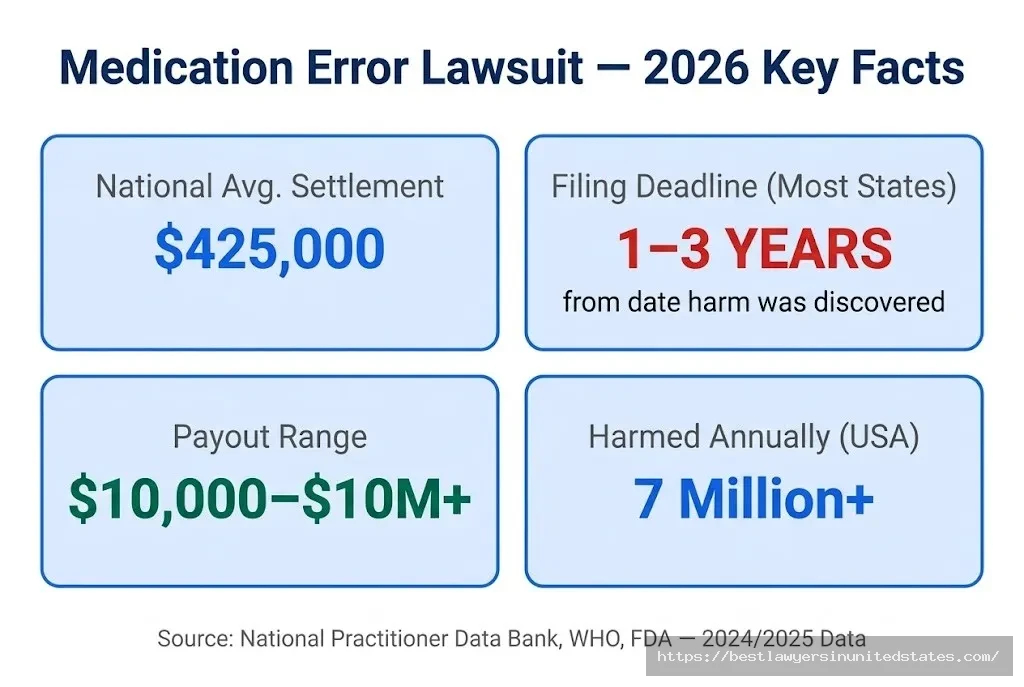
Every year, more than 7 million patients in the United States are harmed by preventable medication errors. These are not minor slip-ups — they kill between 44,000 and 98,000 people annually, and the financial and emotional cost to victims and families is devastating. If a doctor, nurse, pharmacist, or hospital gave you the wrong drug, the wrong dose, or failed to catch a dangerous drug interaction, you have the right to sue and recover real money.
This guide explains everything you need to know about filing a medication error lawsuit in 2026 — from proving negligence and understanding what your case is worth, to the filing deadlines you absolutely cannot miss and what documents to gather starting today.
Quick Answer: A medication error lawsuit is a medical malpractice claim filed against a healthcare provider — doctor, nurse, pharmacist, or hospital — who harmed you through a preventable drug-related mistake. Settlements and verdicts range from $100,000 to over $10 million, depending on how seriously you were hurt. In most states, you have 2 to 3 years from the date you discovered the harm to file your lawsuit. Miss that window, and your case is gone.
What Is a Medication Error Lawsuit?
Background: The Problem Is Bigger Than Most People Know
Medication errors are one of the most serious and underreported problems in American healthcare. According to the National Coordinating Council for Medication Error Reporting and Prevention, more people die from medication errors every year than from workplace injuries nationwide. The FDA receives over 100,000 medication error reports annually — and those are only the ones that actually get reported.
The World Health Organization estimates global medication error costs at $42 billion per year. In the U.S. alone, these errors add $38 to $50 billion in extra healthcare costs, lost productivity, and disability. When you factor in pain, suffering, and the lives permanently changed, the real cost is far higher.
A medication error lawsuit is a type of medical malpractice claim. You’re not suing because a treatment didn’t work. You’re suing because a healthcare professional made a preventable mistake with your medication that caused you real, documented harm. Nike Lawsuit 2026
What Counts as a Medication Error?
Not every adverse drug reaction is a lawsuit. For a medication error to form the basis of a legal claim, a healthcare provider must have deviated from the accepted standard of care — meaning they did something a reasonable, competent provider would not have done under similar circumstances.
Common types of medication errors that lead to lawsuits:
- Wrong medication — dispensing or administering the incorrect drug entirely
- Wrong dose — giving too much or too little of a prescribed medication
- Wrong route of administration — giving oral medication intravenously or vice versa
- Wrong patient — administering one patient’s medication to another
- Drug interaction failure — prescribing a drug that dangerously interacts with another medication the patient already takes
- Failure to monitor — not checking blood levels or patient response after administration
- Omission errors — failing to give a medication that was prescribed and needed
- Prescribing contraindicated drugs — ordering a medication that is specifically dangerous for that patient’s condition
Nearly 50% of all medication errors happen during the prescribing or ordering stage. But errors at the dispensing and administration stages are just as deadly and just as actionable legally.
Who Can Be Sued?
Anyone in the chain of medication management who was negligent can be named as a defendant in your lawsuit:
- Physicians and doctors who prescribe incorrectly or fail to account for a patient’s medical history
- Nurses who administer the wrong drug, wrong dose, or wrong patient
- Pharmacists who dispense the incorrect medication or miss a dangerous interaction
- Hospitals as institutions for systemic failures, understaffing, or inadequate safety protocols
- Nursing homes and long-term care facilities for resident medication management failures
- Anesthesiologists for errors during surgical anesthesia administration
Key Medication Error Lawsuit Timeline
| Stage | Typical Timeframe | What Happens |
|---|---|---|
| Error occurs | Day 0 | Medication mistake takes place |
| Harm becomes apparent | Days to months later | Patient experiences adverse effects |
| Discovery of negligence | Weeks to years later | Patient or doctor identifies the error |
| Statute of limitations begins | From discovery date | Filing clock starts ticking |
| Consulting an attorney | As soon as possible | Attorney evaluates your claim |
| Pre-lawsuit filing steps | 1–6 months | Medical review, expert affidavits, notice letters |
| Lawsuit filed | Within SOL deadline | Formal complaint filed in court |
| Discovery and depositions | 6–18 months | Both sides gather evidence |
| Settlement negotiations | Ongoing | Most cases settle before trial |
| Trial (if no settlement) | 12–36 months after filing | Jury hears case and renders verdict |
| Payment received | After settlement or verdict | Compensation paid to plaintiff |
Who Qualifies to File a Medication Error Lawsuit?
Quick Answer: You may have a valid claim if a healthcare provider gave you the wrong drug, wrong dose, or failed to catch a dangerous drug interaction — AND you suffered real, documented harm as a result. You need medical records, evidence of the error, and expert testimony confirming negligence. Your state’s filing deadline (statute of limitations) must not have expired.
The Four Elements You Must Prove
To win a medication error lawsuit, you need to establish all four of the following:
| Element | What It Means | How You Prove It |
|---|---|---|
| Duty of Care | A doctor-patient or pharmacist-patient relationship existed | Medical records, prescriptions, treatment records |
| Breach of Duty | The provider deviated from accepted standard of care | Expert medical testimony confirming the error |
| Causation | The breach directly caused your harm | Medical evidence linking the error to your injury |
| Damages | You suffered real, measurable losses | Medical bills, income records, pain documentation |
All four elements must be present. If a pharmacist made a mistake but you weren’t harmed, there’s no viable lawsuit. If you were harmed but can’t establish it was caused by negligence, the claim won’t hold up.
Eligibility Checklist
| Requirement | Details | Documentation Needed |
|---|---|---|
| A medication error occurred | Wrong drug, dose, route, or interaction failure | Medical records, pharmacy dispensing logs |
| Proven harm resulted | Physical injury, illness, hospitalization, death | Hospital records, diagnostic results, physician notes |
| Provider was negligent | Error wouldn’t have occurred under proper care | Expert medical opinion (required in most states) |
| Filing deadline not expired | Within your state’s statute of limitations | Date of error or discovery of harm |
| Provider-patient relationship | You were a patient under their care | Medical records, prescriptions, treatment history |
Who Does NOT Qualify?
Not every bad outcome from medication means you have a case. You are unlikely to qualify if:
❌ You experienced a known, disclosed side effect of a properly prescribed medication ❌ The drug simply didn’t work, without any error in administration ❌ Your injury cannot be linked to the error by medical evidence ❌ The statute of limitations in your state has expired (this is more common than people realize) ❌ The harm you suffered was minor and temporary with no lasting effects ❌ You were non-compliant with instructions and caused your own harm Greenies Lawsuit
Required Documentation Checklist
| Document Type | Why You Need It | Where to Get It | If You Don’t Have It |
|---|---|---|---|
| Medical records | Show diagnosis, treatment, and the error | Hospital, clinic, or doctor’s office — request in writing | File a formal records request; they are legally required to provide them |
| Pharmacy dispensing records | Confirm what was actually dispensed vs. prescribed | Pharmacy directly | Request your prescription history; pharmacies keep records for years |
| Prescription records | Show what was originally ordered | Prescribing physician’s office | Your insurance company may have records of filled prescriptions |
| Bills and invoices | Document financial damages | Your own records and insurance EOBs | Request itemized bills from all providers involved |
| Witness statements | Support your account of events | Family, caregivers present at the time | Affidavits from people who witnessed the error or its effects |
| Expert medical opinion | Required in most states to prove negligence | Hired by your attorney | Your attorney will find and retain the appropriate expert |
| Income documentation | Prove lost wages | Employer records, pay stubs, tax returns | W-2s, bank deposits, employer letters |
How Much Is a Medication Error Lawsuit Worth?
Quick Answer: Medication error settlements and verdicts typically range from $100,000 to over $3 million, depending on injury severity, your state’s laws, and the strength of your evidence. According to the National Practitioner Data Bank, the national average medical malpractice settlement reached approximately $425,000 in 2024, with some catastrophic injury cases exceeding $10 million.
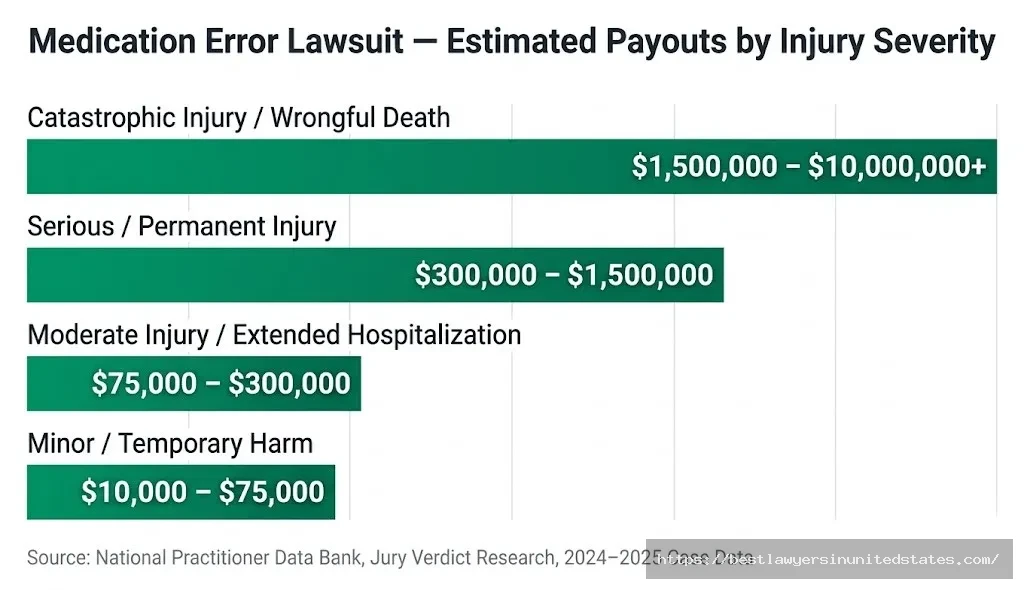
Settlement and Verdict Ranges by Injury Severity
| Case Type | Typical Payout Range | What It Usually Involves |
|---|---|---|
| Minor/temporary harm | $10,000 – $75,000 | Short-term illness, recoverable effects |
| Moderate injury | $75,000 – $300,000 | Extended hospitalization, significant health impact |
| Serious/permanent injury | $300,000 – $1.5 million | Permanent disability, long-term care needs |
| Catastrophic injury | $1.5 million – $10 million+ | Brain damage, paralysis, major organ failure |
| Wrongful death | $500,000 – $10 million+ | Death from medication error, surviving family claim |
Real Medication Error Verdicts and Settlements
These are actual case outcomes showing what courts and juries have awarded:
| Year | State | Amount | What Happened |
|---|---|---|---|
| 2024 | Utah | $1,407,000 | Nurse administered another patient’s morphine, causing fatal allergic reaction |
| 2023 | Virginia | $800,000 | Wrong anesthesia drug caused cardiac arrest and anoxic brain injury |
| 2022 | Maryland | $10,000,000 | Wrong medication prescribed without awareness of known risks; patient died |
| 2021 | Various | $760,000 | Excessive epinephrine concentration given pre-surgery caused cardiac arrest, mild brain injury |
| 2020 | Pennsylvania | $1,150,000 | Wrong medication given to substance abuse patient without reviewing medical history; patient died |
| 2020 | Illinois | $600,906 | Contraindicated antibiotic prescribed alongside existing medication, causing statin toxicity |
| 2019 | Pennsylvania | $900,000 | Deadly combination of opioids administered; patient died |
| 2019 | Texas | $684,000 | Medication switch done without proper lab work; patient had stroke and died |
What Damages Can You Recover?
Your total compensation is made up of up to three categories of damages:
Economic Damages (calculable financial losses): These have no cap in most states and include:
- All medical bills related to treating the harm caused by the error
- Future medical costs if you need ongoing care
- Lost wages from time you couldn’t work
- Lost earning capacity if you can no longer work in your previous role
- Rehabilitation and therapy costs
Non-Economic Damages (harder to quantify): These are often the largest part of a medication error case and include:
- Physical pain and suffering
- Emotional distress and psychological trauma
- Loss of enjoyment of life
- Disfigurement or permanent disability
Many states cap non-economic damages. For example, Maryland caps them at $890,000 in 2025 (increasing $15,000 each year). California has a $350,000 cap. But states like New York, Illinois, and Pennsylvania have no cap at all — which is why some of the largest verdicts come from those states.
Punitive Damages: These are rare and only awarded when a provider’s conduct was especially reckless or intentional. If awarded, they can dramatically increase your total recovery.
Factors That Determine Your Specific Payout
Your case value depends on:
- Severity of harm — permanent injuries pay more than temporary ones
- Your age and income — younger, higher-earning plaintiffs often recover more in lost wages
- Clarity of negligence — the clearer the error, the stronger your negotiating position
- State laws — damage caps and statutes of limitations vary widely
- Quality of your attorney — experienced malpractice lawyers typically secure far higher settlements
- Whether you go to trial — jury verdicts can be higher but also unpredictable
Filing Deadlines: The Statute of Limitations You Cannot Ignore
⚠️ CRITICAL DEADLINE WARNING: Filing deadlines for medication error lawsuits vary by state and are strictly enforced. Miss your deadline and your case is permanently dismissed — no matter how strong it is.

Statute of Limitations by State (Selected States, 2026)
| State | Time Limit | Notes |
|---|---|---|
| California | 3 years from injury / 1 year from discovery | Whichever comes first; must give 90-day notice before filing |
| New York | 2.5 years (30 months) | Discovery rule for cancer cases; Lavern’s Law applies |
| Texas | 2 years from discovery | Expert report must be filed within 120 days of lawsuit |
| Florida | 2 years from discovery | Maximum 4-year statute of repose |
| Illinois | 2 years from discovery | No non-economic damages cap |
| Pennsylvania | 2 years | Certificate of merit required |
| North Carolina | 3 years from injury | 4-year cap even with discovery rule |
| Ohio | 1 year from discovery | One of the shorter deadlines in the country |
| Georgia | 2 years | Ante litem notice required before suing government entities |
| Massachusetts | 3 years | Discovery rule applies; certificate of merit needed |
Important: These are general guidelines. Your specific situation — including when you discovered the error, your age, and whether fraud was involved — can change the deadline. Talk to an attorney immediately to confirm your deadline.
What Is the Discovery Rule?
Most states recognize the “discovery rule,” which means the filing clock doesn’t always start on the date the error happened. It starts when you knew, or reasonably should have known, that you were harmed by negligence.
This matters because some medication errors take months or years to manifest. If a pharmacy gave you the wrong drug and you took it for four months before discovering the error and developing serious side effects, your deadline likely starts from when you connected your symptoms to the mistake — not the date it was first dispensed.
However, most states also have a “statute of repose” — an absolute deadline beyond which no lawsuit can be filed, regardless of when you discovered the harm. North Carolina’s is 4 years. Massachusetts is 7 years.
Special Deadline Exceptions
The clock can be paused (legally “tolled”) in certain situations:
- Minors — in most states, the deadline doesn’t begin until the child turns 18
- Mental incapacity — if the patient was unable to manage their own affairs
- Fraudulent concealment — if the provider actively hid the error from you
- Continuing treatment — in some states, the clock starts when treatment for the negligent condition ends
How to File a Medication Error Lawsuit: Step by Step
Filing a medication error lawsuit is more complex than most other personal injury claims. Here’s exactly what the process looks like in 2026. Roundup Lawsuit Statute of Limitations
Step 1: Seek Medical Attention and Document Everything
Before anything else, get treated and get documentation. Every physician visit, hospital stay, prescription change, or diagnostic result related to your harm needs to be in writing. This becomes the foundation of your case.
Keep a personal log. Write down dates, symptoms, what you were told, and what happened. Even your handwritten notes can help refresh memory later during a deposition.
Step 2: Get Your Medical Records
You have a legal right to your complete medical records. Request them in writing from every provider involved — the prescribing physician, the dispensing pharmacy, and any hospital where treatment occurred.
Do this quickly. You want records before there’s any reason for anyone to review, alter, or “lose” relevant documents. Records requests typically take 30 days.
Step 3: Consult a Medication Error Attorney Immediately
Do not wait. Many people make the mistake of trying to handle this themselves or waiting to see if they recover. Medication error cases require expert medical witnesses, complex evidence gathering, and specific legal filings that vary by state.
Most medication error attorneys work on contingency — meaning you pay nothing unless they win your case. Get consultations from multiple attorneys before choosing one.
At your consultation, bring:
- All medical records you have
- Prescription bottles and packaging
- A written timeline of events
- Your list of damages — bills, missed work, pain
Step 4: Attorney Files Pre-Lawsuit Requirements
Many states require specific steps before a formal lawsuit can be filed:
- Certificate of merit — a sworn statement from a qualified medical expert saying your claim has validity (required in PA, TX, MA, and many others)
- Notice of intent to sue — some states (like California) require you to notify the defendant 90 days before filing
- Medical review panel — a few states require the case to be reviewed before going to court
Your attorney handles these. But they can’t do it if you come to them one week before your deadline.
Step 5: The Lawsuit Is Filed
Your attorney files a formal complaint in the appropriate court. The complaint names the defendants, describes the negligent acts, and states the damages you’re seeking. The defendants receive notice and have time to respond.
Step 6: Discovery Phase
Both sides gather evidence. This includes:
- Written questions (interrogatories) each side must answer under oath
- Depositions — recorded testimony from you, the providers, witnesses, and experts
- Document exchange — medical records, internal hospital protocols, training records
- Expert witness reports — both sides hire medical experts to testify about the standard of care
This phase typically takes 6 to 18 months.
Step 7: Settlement Negotiations
Most medication error cases settle before trial. Once both sides understand the evidence and the risks, serious negotiation begins. Your attorney will advise whether a settlement offer is fair based on your specific damages.
You are never required to accept a settlement offer. If the offer is too low, your attorney can reject it and proceed toward trial.
Step 8: Trial (If No Settlement)
If the case doesn’t settle, it goes to a judge or jury. Both sides present evidence and expert testimony. The fact-finder decides whether negligence occurred and, if so, what damages to award.
Only about 28% of medication error plaintiffs who go to trial win their cases outright. This is one reason most cases settle — but it’s also why having the best possible attorney matters enormously.
Complete Filing Deadlines Summary
| Deadline Type | When It Applies | What Happens If Missed |
|---|---|---|
| Statute of limitations | State-specific (1–3 years typical) | Case permanently dismissed |
| Statute of repose | Absolute deadline (4–10 years from error) | No exceptions allowed |
| Pre-filing notice | 90 days before filing (California and others) | Case may be dismissed for procedural failure |
| Certificate of merit | Often 60–90 days after filing | Case dismissed in states requiring it |
| Expert report deadline | Within 120 days in Texas | Dismissal with prejudice |
Current Landscape: Medication Error Lawsuits in 2026
What’s Changed Recently
Medication error litigation has grown significantly in recent years. A few notable 2026 developments affecting these cases:
AI-Related Errors Are Rising: A 2025 study reported approximately a 14% increase in medical malpractice claims involving misdiagnosis or medication errors attributable to AI diagnostic tools. As hospitals rely more heavily on automated drug dispensing and electronic prescribing systems, new types of errors are emerging — and courts are still figuring out who is liable when an algorithm makes the mistake.
Nursing Home Cases Are Increasing: Studies show around 42% of elderly adults in care facilities receive incorrect medications at some point. Nursing home medication error lawsuits are increasingly common, though the facilities rarely admit fault and insurance carriers fight these claims aggressively.
New York Law Updates (2026): As of early 2026, New York still does not cap non-economic damages in medical malpractice cases, making it one of the most favorable states for plaintiffs. The average New York malpractice payout is among the highest nationally. Legislative discussions about damage caps continue, but no cap has been enacted.
National Average Settlement Rising: According to the National Practitioner Data Bank, the estimated average medical malpractice settlement rose to approximately $423,000–$425,000 in 2026, up from $358,000 in 2018.
How Medication Error Cases Compare to Other Malpractice Types
| Case Type | Typical Average Settlement | Difficulty Level | Common Defendants |
|---|---|---|---|
| Medication errors | $100,000 – $3 million+ | High | Hospitals, pharmacists, physicians |
| Surgical errors | $200,000 – $2 million+ | High | Surgeons, hospitals |
| Birth injuries | $1 million – $5 million+ | Very high | OBGYNs, hospitals |
| Misdiagnosis/delayed diagnosis | $150,000 – $1.5 million | High | Physicians, radiologists |
| Anesthesia errors | $500,000 – $5 million+ | Very high | Anesthesiologists, CRNAs |
| Nursing home errors | $100,000 – $2 million | Moderate–High | Nursing homes, staff |
| Pharmacy misfill | $50,000 – $1 million | Moderate | Pharmacists, pharmacy chains |
Do You Need a Lawyer for a Medication Error Lawsuit?
Quick Answer: Yes — unlike class action settlements where you file a simple claim form, a medication error lawsuit is an individual medical malpractice claim that almost always requires an attorney. These cases require medical expert witnesses, complex legal filings, and negotiation against hospital insurance companies with large legal teams. Attempting this alone is rarely successful.
Why These Cases Require Legal Representation
Medication error lawsuits are among the most technically demanding cases in civil law. Here’s why going without an attorney almost never works:
Expert witnesses are mandatory. Most states require a sworn statement from a qualified medical expert before you can even file. Finding, retaining, and working with these experts is something only experienced attorneys do routinely.
Defendants fight hard. Hospitals and pharmacies are insured by large malpractice carriers with full-time legal teams. They know every procedural trick, and they will use them.
Evidence disappears. Medication records, surveillance footage, staffing logs, and witness memories all degrade over time. An attorney moves quickly to preserve this evidence.
Causation is genuinely complex. If you had a pre-existing condition, defendants will argue your injury had nothing to do with their error. Attorneys know how to address causation arguments with expert support.
When to Contact an Attorney
Contact a medication error attorney as soon as you suspect an error caused your harm. Do not wait for:
- A second opinion to confirm the error
- A hospital investigation to conclude
- Insurance to deny your claim
- The statute of limitations to get close
All of those situations make your case harder and your timeline tighter.
What It Costs
Medication error attorneys almost universally work on a contingency fee basis. That means:
- No upfront cost to you
- No fee if you don’t win
- Attorney takes a percentage (typically 33%–40%) of your settlement or verdict if you do win
This structure means any qualified attorney only takes your case if they believe it has real merit.
Frequently Asked Questions
What is a medication error lawsuit?
Quick Answer: It’s a medical malpractice claim against a healthcare provider who made a preventable drug-related mistake — such as giving you the wrong medication, wrong dose, or failing to catch a dangerous interaction — and that mistake caused you real harm.
It falls under the category of medical negligence law. Unlike a class action, it is your individual claim based on your specific injuries. The settlement or verdict amount depends entirely on your case.
Who can I sue for a medication error?
Quick Answer: You can sue any healthcare provider who was negligent, including physicians, nurses, pharmacists, anesthesiologists, and hospitals or nursing homes as institutions.
Multiple parties can be named in a single lawsuit. If the pharmacy dispensed the wrong drug but the doctor also failed to check your allergy history, both may be liable for your damages.
How much money can I get from a medication error lawsuit?
Quick Answer: Settlements range widely from around $75,000 for minor injuries to well over $3 million for deaths or permanent disability. The national average across all medical malpractice claims was approximately $425,000 in 2024.
Your specific case value depends on how severely you were hurt, whether you can work, how much your medical treatment cost, the strength of your negligence evidence, and the state where you file.
What is the deadline to file a medication error lawsuit?
Quick Answer: It depends on your state. Most states give you 2 to 3 years from the date you discovered — or should have discovered — the harm. Some states give you as little as 1 year. This is not a soft deadline. Miss it and your case is gone permanently.
Your attorney can tell you your exact deadline at a free consultation. Don’t delay.
What documents do I need to file?
Quick Answer: Medical records, pharmacy dispensing records, prescriptions, all bills and financial records related to your injury, income documentation for lost wages, and a personal log of your symptoms and treatment.
Your attorney will tell you exactly what to gather based on your state and the specifics of your claim.
What if I don’t have all my medical records?
You are legally entitled to your complete medical records under HIPAA. Submit a written records request to each provider and they must comply within 30 days. If they don’t, your attorney can compel them.
You don’t need everything in hand before speaking to an attorney. Start the records request process and consult simultaneously.
Do I need to prove the provider intended to make a mistake?
Quick Answer: No. Medication error lawsuits are based on negligence, not intent. You just need to show that the provider failed to meet the accepted standard of care — what a competent professional would have done in the same situation.
Negligence does not require malice. An exhausted nurse who grabbed the wrong medication from a poorly organized cabinet may still be legally liable for the harm caused.
What is the “standard of care” in a medication error case?
The standard of care is the level of care, skill, and treatment that a reasonably competent healthcare provider in the same specialty would provide under similar circumstances. Expert witnesses define this standard and testify whether the defendant met it or fell short.
Can I file if my loved one died from a medication error?
Quick Answer: Yes. In that case, the claim is filed as a wrongful death lawsuit, typically by surviving spouses, children, or parents. Wrongful death claims often result in higher damages, since they account for the full financial and emotional loss to the family.
Every state has its own wrongful death statute with its own rules about who can sue, what damages are available, and when the deadline runs. Speak with an attorney as soon as possible after a loved one’s death from a suspected medication error.
What if I was partly responsible for the medication error?
Quick Answer: It depends on your state’s comparative negligence laws. In most states, you can still recover damages even if you were partially at fault — but your compensation will be reduced by your percentage of responsibility.
For example, if you are found 20% responsible (perhaps because you didn’t disclose another medication you were taking), your $500,000 recovery would be reduced to $400,000 in most states.
Will my case go to trial?
Quick Answer: Probably not. The vast majority of medication error lawsuits settle before trial — often 80% or more. However, having a strong case and a skilled trial attorney puts you in a much better negotiating position, even if you never step into a courtroom.
How long does a medication error lawsuit take?
Most cases take 1 to 3 years from filing to resolution. Complex cases involving catastrophic injuries, multiple defendants, or disputed liability can take longer. Cases that go to trial take the most time.
What if the hospital says it was a “known complication” and not their fault?
This is one of the most common defenses. Hospitals and insurance companies routinely argue that adverse drug reactions are known risks, not errors. Your attorney and medical expert will counter this by showing that the specific mistake — wrong drug, wrong dose, missed interaction — went beyond any known complication and resulted from a breach of care.
Are medication error lawsuit settlements taxable?
Quick Answer: Generally, compensation for physical injuries is not taxable under federal law. However, portions covering lost wages or any punitive damages may be taxable. Talk to a tax professional about your specific settlement.
What if the statute of limitations already passed?
This is a serious problem, but not always fatal. Certain exceptions — the discovery rule, fraudulent concealment, incapacity, or cases involving minors — can extend the deadline in your favor. Even if you think you’re too late, consult an attorney before giving up. They may identify an exception that saves your claim.
Can I file a lawsuit against a major pharmacy chain like CVS or Walgreens?
Quick Answer: Yes. Pharmacy chains face medication error lawsuits regularly, typically for dispensing the wrong drug or wrong dose. Large pharmacy corporations have been sued successfully in numerous cases and have paid substantial settlements.
A pharmacy error claim is often simpler to prove than a hospital negligence claim, because dispensing records clearly show what was supposed to be given versus what actually was.
How do I find a medication error attorney?
Look for attorneys who specialize specifically in medical malpractice — not just general personal injury lawyers. Check their track record with medication and pharmaceutical error cases. Most offer free initial consultations with no obligation. You can also contact [email protected] for a referral to attorneys experienced in handling medication error claims across multiple states.
Can I file if the medication error happened years ago?
Maybe. It depends on when the harm became apparent, whether the discovery rule applies, and what state you’re in. If the error was concealed from you or took years to cause obvious symptoms, the clock may have started later than you think. Don’t assume you’re out of time — get a professional evaluation first.
What’s the difference between a medication error lawsuit and a class action?
Quick Answer: A medication error lawsuit is your individual claim for your specific injuries. A class action groups many people with similar claims against the same defendant (often a drug manufacturer). Individual lawsuits for medication errors almost always result in larger, more personalized compensation.
Class actions are common in defective drug cases where the same product harmed thousands of people. Individual medication error lawsuits are more appropriate when the harm resulted from a specific act of negligence by a particular provider.
What happens if my doctor or pharmacist no longer works at that facility?
The institution (hospital, clinic, pharmacy chain) can still be held liable for the actions of employees who worked for them at the time of the error. Provider employment records, hiring protocols, and training records all become relevant. The fact that someone moved on from a job doesn’t shield the organization from liability.
Your Next Steps
If you or someone you love was harmed by a medication error, here is exactly what to do right now:
This week:
- Request your complete medical records from every provider involved
- Write a detailed timeline of what happened, when, and what the effects have been
- Gather all prescription bottles, packaging, and pharmacy receipts you can find
- Document your financial damages — bills, missed work, expenses
Within the next 30 days:
- Consult a medical malpractice attorney who handles medication error cases
- Ask at the consultation about your specific state’s filing deadline
- Do not give recorded statements to the hospital or their insurance company without legal advice
Do not wait. Every day that passes makes evidence harder to gather, memories less reliable, and deadlines closer. Medical malpractice law is unforgiving about timing — courts will throw out even the strongest case if you miss the statute of limitations.
The healthcare system made a mistake that hurt you. You don’t have to absorb that cost alone. Medication error lawsuits exist specifically to hold negligent providers accountable and get you the compensation you deserve.
