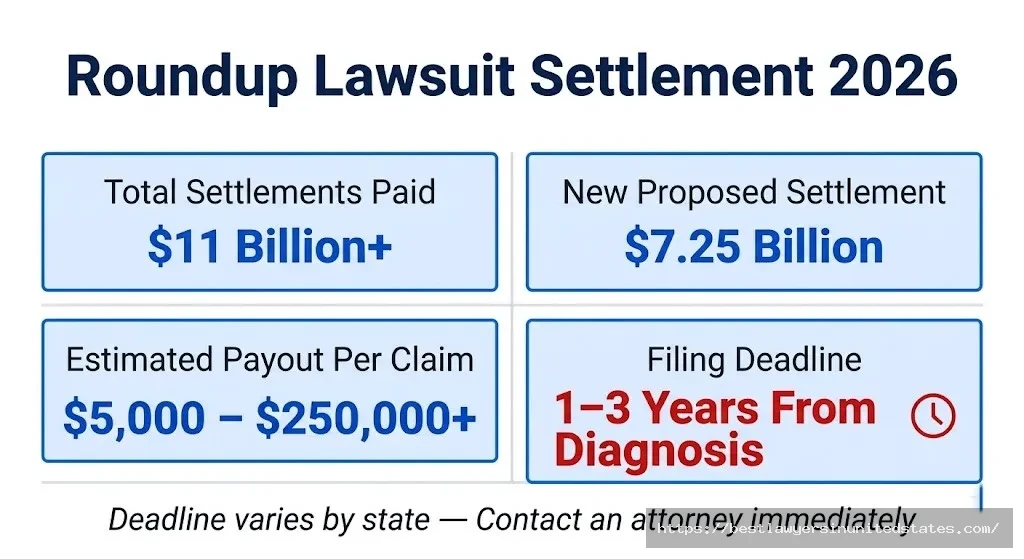
The Roundup lawsuit is one of the largest mass tort cases in American history, with claims that Monsanto’s popular weed killer causes non-Hodgkin lymphoma (NHL) and other cancers due to its active ingredient, glyphosate. Bayer, which acquired Monsanto in 2018, has already paid out nearly $11 billion to settle close to 100,000 Roundup claims. In February 2026, Bayer announced a new $7.25 billion proposed settlement that, if finalized, could pay up to $165,000 per qualifying victim. But none of that matters if you’ve already missed your filing deadline.
The Roundup lawsuit statute of limitations varies by state and typically gives you just one to three years from the date of your cancer diagnosis — or from the date you learned that Roundup may have caused it — to take legal action. Once that window closes, it closes permanently.
This guide explains exactly how the statute of limitations works in Roundup cases, what the discovery rule means for your deadline, how your state’s specific time limit might affect your case, and what steps to take right now to protect your right to compensation. Native Hair Care Lawsuit
Quick Answer: The Roundup lawsuit statute of limitations is typically 1 to 3 years from the date of your cancer diagnosis or the date you discovered the link between Roundup exposure and your illness. Every state has a different deadline. The clock may start later under the “discovery rule” if you weren’t immediately aware of the Roundup-cancer connection. With a new $7.25 billion proposed settlement receiving preliminary approval in March 2026, time is critical. Contact a Roundup attorney immediately to find out where your deadline stands.
What Is the Roundup Lawsuit About?
Background of the Lawsuit
Roundup is a glyphosate-based herbicide manufactured by Monsanto and now sold by Bayer. First introduced in 1974, Roundup became the world’s most widely used weed killer, popular among farmers, landscapers, golf course workers, and backyard gardeners alike.
The lawsuits began gaining traction after 2015, when the International Agency for Research on Cancer (IARC) classified glyphosate as “probably carcinogenic to humans.” Plaintiffs allege that Monsanto knew about the cancer risks for years and deliberately concealed them from the public — a claim supported by internal company documents that became known as the “Monsanto Papers.”
Those internal documents, made public through litigation, revealed that Monsanto ghostwrote articles in scientific journals claiming Roundup was safe, worked to discredit independent researchers who found otherwise, and built a network of scientists to promote the safety of glyphosate behind the scenes. Despite multiple billion-dollar jury verdicts, Bayer continues to deny that Roundup causes cancer.
Timeline of Key Events
| Date | Event | Details |
|---|---|---|
| 1974 | Roundup first introduced | Monsanto launches glyphosate-based herbicide |
| 2015 | IARC classifies glyphosate | Labeled “probably carcinogenic to humans” |
| July 2018 | Johnson v. Monsanto verdict | $289 million awarded to a California groundskeeper |
| March 2019 | Hardeman v. Monsanto verdict | $80 million federal jury verdict |
| June 2020 | Global Settlement reached | Bayer agrees to pay $11.6 billion to resolve ~100,000 claims |
| October 2024 | Pennsylvania jury verdict | $78 million awarded after 28 years of Roundup use |
| March 2025 | Barnes v. Monsanto verdict | Georgia jury awards $2.1 billion |
| November 2025 | California court upholds $28M verdict | Appeals court affirms Mike Dennis case |
| February 17, 2026 | New $7.25B settlement proposed | Bayer files proposal in St. Louis, Missouri |
| March 2026 | Preliminary approval granted | Judge gives initial OK to $7.25 billion settlement |
| Ongoing | ~61,000 active lawsuits remain | Cases in state courts and federal MDL |
Who Filed the Lawsuits?
The lawsuits were originally filed by individual plaintiffs — farmers, landscapers, golf course workers, and home users — who developed non-Hodgkin lymphoma after years of Roundup use. Thousands of federal cases have been consolidated into Multidistrict Litigation (MDL 2741) in the U.S. District Court for the Northern District of California. Tens of thousands more are pending in state courts, with heavy concentrations in Missouri, California, and Georgia.
As of March 2026, approximately 170,000 Roundup lawsuits have been filed against Bayer and Monsanto. Around 61,000 cases remain active, with new cases still being filed regularly.
Key Allegations
The central claims against Monsanto and Bayer include:
✅ Glyphosate, the active ingredient in Roundup, causes or contributes to non-Hodgkin lymphoma ✅ Monsanto knew or should have known about the cancer risk and failed to warn users ✅ Monsanto actively suppressed, manipulated, or ghostwrote scientific research to hide the dangers ✅ Product labels never included adequate cancer warnings despite growing scientific evidence ✅ Monsanto engaged in a deliberate campaign to discredit independent scientists who found glyphosate harmful
Understanding the Roundup Lawsuit Statute of Limitations
What Is a Statute of Limitations?
A statute of limitations is a legal deadline. In the context of Roundup lawsuits, it’s the window of time you have to file a lawsuit after being harmed. If you miss your state’s deadline, you lose the right to sue — permanently. No exceptions.
⚠️ CRITICAL WARNING: The statute of limitations for Roundup lawsuits can be as short as ONE year in some states. If you’ve been diagnosed with non-Hodgkin lymphoma and used Roundup, do not wait another day to speak with an attorney.
Roundup lawsuits aren’t like typical personal injury claims. If you’re hurt in a car crash, you know it happened and why. Cancer caused by a chemical you used years ago is different — symptoms may not appear until long after exposure, and many people don’t immediately connect their illness to Roundup.
How the Discovery Rule Changes Your Deadline
The “discovery rule” is one of the most important concepts in Roundup cases — and most competitors’ articles either gloss over it or miss it entirely. Here’s how it works:
In most states, the statute of limitations doesn’t start ticking from the date you were last exposed to Roundup. Instead, it starts from the date you discovered (or reasonably should have discovered) that:
- You have been diagnosed with non-Hodgkin lymphoma or another qualifying cancer, AND
- That cancer may be linked to your Roundup exposure
This is significant because many Roundup users were exposed decades ago but only diagnosed with cancer in recent years. Under the discovery rule, someone who used Roundup in the 1990s but wasn’t diagnosed with NHL until 2022 may still have a viable case — as long as they file within their state’s deadline from that 2022 diagnosis.
When the clock starts in Roundup cases:
- The date of your cancer diagnosis
- The date you learned or reasonably should have learned about the Roundup-cancer link
- In wrongful death cases: the date of your loved one’s death or the date you connected the death to Roundup
Statute of Limitations by State
Every state sets its own deadline. The range across the country is one to six years, though the vast majority of states fall within a two-to-three-year window.
| State | Statute of Limitations | Notes |
|---|---|---|
| California | 2 years | From diagnosis or discovery |
| Texas | 2 years | Personal injury / product liability |
| Florida | 4 years | Product liability; recent law changes may affect future cases |
| New York | 3 years | Product liability |
| Illinois | 2 years | From diagnosis or discovery of Roundup link |
| Pennsylvania | 2 years | Personal injury |
| North Carolina | 3 years | From diagnosis / injury |
| Georgia | 2 years | Note: Georgia now has a shield law limiting future failure-to-warn claims |
| Ohio | 2 years | Personal injury |
| Michigan | 3 years | Product liability |
| Missouri | 5 years | Product liability (state where major settlement was filed) |
| North Dakota | 6 years | Product liability; state also passed shield law |
| Arizona | 2 years | Personal injury |
| Colorado | 2 years | Personal injury |
| Washington | 3 years | Personal injury |
Important: This table is for general reference only. State laws change, and specific facts in your case — like when you first learned of the cancer link — can shift your exact deadline. Only an attorney can give you a definitive answer for your situation.
Statute of Repose: The Hidden Deadline
There’s a second type of deadline many people don’t know about: the statute of repose. Unlike the statute of limitations (which can shift based on the discovery rule), a statute of repose sets an absolute outer limit on how long after initial exposure you can file suit — regardless of when you were diagnosed.
If a state’s statute of repose has expired for your case, your claim may be barred even if you only recently discovered the cancer-Roundup connection. This is another reason why acting quickly matters so much.
What Can Pause (or “Toll”) the Statute of Limitations?
In some circumstances, the deadline can be paused or extended:
- MDL consolidation: Some courts have tolled the statute of limitations during periods of mass tort consolidation to give victims time to come forward
- Minor plaintiffs: If the affected person is a minor, the clock may not start until they turn 18
- Mental incapacity: The deadline may be extended if the claimant was legally incapacitated
- Fraudulent concealment: If Monsanto’s concealment of the cancer risk prevented you from discovering your claim, the clock may be tolled during the period of concealment
Who Qualifies to File a Roundup Lawsuit?
Quick Answer: You may qualify if you used Roundup for at least 40 hours total over at least two years, were diagnosed with non-Hodgkin lymphoma or a related cancer, and your case is still within your state’s statute of limitations. You’ll need medical records confirming your diagnosis and evidence of Roundup exposure.
Eligibility Requirements
| Requirement | Details | Documentation Needed |
|---|---|---|
| Roundup Use | Used Roundup or a glyphosate product | Purchase receipts, employment records, photos, witness statements |
| Exposure Duration | At least 40+ lifetime hours; at least 2-3 years of use | Work logs, personal statements, corroborating witnesses |
| Diagnosis | Non-Hodgkin lymphoma or qualifying cancer subtype | Medical records, pathology reports, oncologist letters |
| Timing | Diagnosis at least 2 years after first exposure | Medical and employment records showing timeline |
| Statute of Limitations | Must be within your state’s filing window | Attorney review of your specific state’s rules |
To qualify for the Roundup lawsuit, you generally need to show all of the following:
- You used Roundup or another glyphosate-based product
- Your total lifetime exposure was at least 40 hours (more exposure strengthens your case)
- You used Roundup for at least two to three years
- You were diagnosed with non-Hodgkin lymphoma (NHL) or a related blood cancer
- Your case is still within your state’s statute of limitations
The most common claimants include farmers and agricultural workers, commercial landscapers and groundskeepers, golf course maintenance workers, nursery and garden center employees, and residential users who applied Roundup at home for years.
Qualifying Cancer Types
The primary cancer linked to Roundup exposure in successful lawsuits is non-Hodgkin lymphoma (NHL). This broad category includes several subtypes:
- Diffuse large B-cell lymphoma (DLBCL)
- Follicular lymphoma
- Mantle cell lymphoma
- Marginal zone lymphoma
- Small lymphocytic lymphoma/chronic lymphocytic leukemia (SLL/CLL)
- Hairy cell leukemia
- T-cell lymphoma variants
Who Does NOT Qualify?
You are likely NOT eligible if:
❌ You never used Roundup or a glyphosate-containing product ❌ You used Roundup only once or a handful of times (insufficient exposure) ❌ Your cancer diagnosis is unrelated to NHL or the qualifying cancer types ❌ Your state’s statute of limitations has already expired ❌ Your claim is based solely on fear of future illness without a current cancer diagnosis ❌ You used only the newer residential Roundup formulations that replaced glyphosate (after Bayer phased glyphosate out of consumer products in 2023)
How Much Can You Get from a Roundup Settlement?
Quick Answer: Individual Roundup settlement payouts have ranged from $5,000 to $250,000 or more, depending on the severity of your cancer, how long and intensely you used Roundup, your age, and other factors. The average payout from the first round of settlements was approximately $150,000. The new $7.25 billion proposed settlement offers up to $165,000 per claim.
Settlement Fund Overview
| Category | Amount | Notes |
|---|---|---|
| Original Global Settlement (2020) | ~$11 billion | Resolved ~100,000 claims |
| Average payout (Round 1) | ~$150,000 | Per plaintiff after fees |
| New proposed settlement (2026) | $7.25 billion | Paid over 21 years; pending final approval |
| Max payout under new settlement | Up to $165,000 | Based on scoring system |
| Active cases still pending | ~61,000 | As of March 2026 |
How Roundup Settlement Tiers Work
The Roundup settlement program uses a point-based scoring system, not a flat payout. Your total score determines which tier you fall into, and your tier determines how much you receive. The scoring evaluates several factors:
| Factor | How It Affects Your Score |
|---|---|
| Cancer type and subtype | More aggressive subtypes score higher |
| Stage at diagnosis | Advanced stage increases points |
| Age at diagnosis | Younger claimants may score higher for long-term loss |
| Duration of Roundup exposure | Longer use = more points |
| Intensity of exposure | Professional use (daily/weekly) scores more than occasional home use |
| Treatment required | Chemotherapy, bone marrow transplants add points |
| Functional impairment | Permanent disability from cancer or treatment |
| Medical expenses | Total documented costs of treatment |
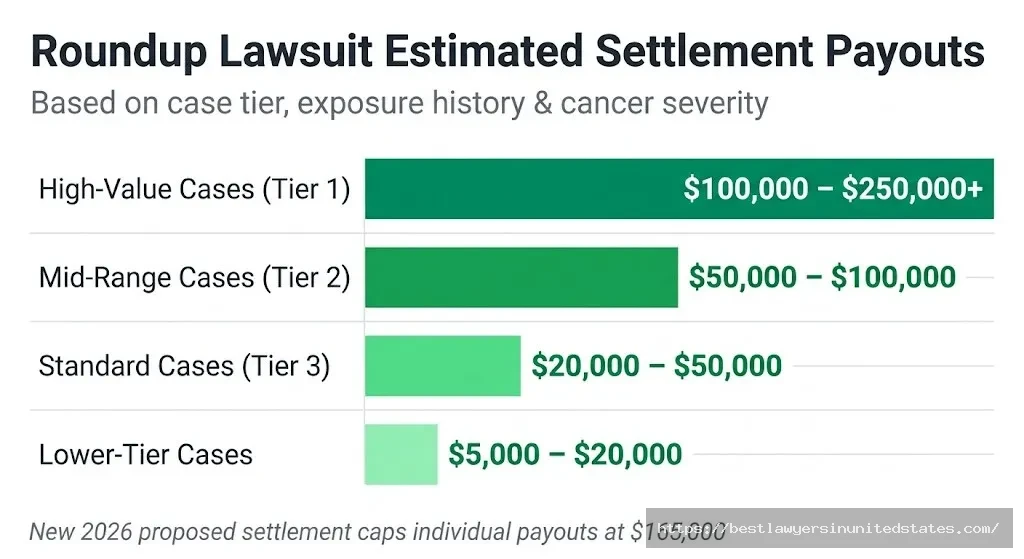
Estimated Payout Ranges by Case Tier
| Case Category | Estimated Range | Key Factors |
|---|---|---|
| High-value cases (Tier 1) | $100,000 – $250,000+ | Severe NHL, aggressive treatment, long documented exposure, younger age |
| Mid-range cases (Tier 2) | $50,000 – $100,000 | Moderate NHL, clear exposure history, adequate documentation |
| Standard cases (Tier 3) | $20,000 – $50,000 | NHL confirmed, moderate exposure, standard documentation |
| Lower-tier cases | $5,000 – $20,000 | Limited documentation, shorter exposure history, less severe illness |
What Affects Your Payout
Several variables can push your compensation higher or lower:
- Strength of your exposure evidence — documented professional use worth more than estimated home use
- Medical records quality — comprehensive oncology records, treatment history, and follow-up care documentation
- Age at diagnosis — younger victims may receive more to account for future lost earnings
- State law — some states allow broader damages claims than others
- Which settlement round — newer claimants in the 2026 settlement may receive different amounts than those in the 2020 wave
How to File a Roundup Lawsuit: Step by Step
⚠️ DEADLINE ALERT: There is no single universal deadline for Roundup lawsuits. Your deadline depends on your state and your diagnosis date. In some states, the window may already be closed for older diagnoses. Contact a Roundup attorney today — not next week. Lugano Diamonds Lawsuit
Step 1: Confirm You Have a Qualifying Diagnosis
Get a copy of your medical records confirming your NHL diagnosis. If you haven’t been formally diagnosed but have symptoms, see an oncologist immediately. You can’t file without a confirmed cancer diagnosis.
Step 2: Document Your Roundup Exposure
Pull together anything that shows you used Roundup. This includes purchase receipts and store records, employment documents from farms, landscaping companies, or golf courses, photos or videos of you using Roundup, payroll stubs or work logs showing your job duties, witness statements from coworkers or neighbors who saw you apply it, and HOA or property records if you maintained a yard or commercial property.
Don’t panic if you don’t have receipts. Courts accept personal testimony, work records, and corroborating witnesses as proof of exposure.
Step 3: Calculate Your State’s Statute of Limitations
Do this with an attorney, not on your own. They’ll look at your diagnosis date, when you first suspected the Roundup-cancer link, your state’s specific rules, and whether any tolling provisions apply. A case that seems time-barred may still be viable under the discovery rule.
Step 4: Contact a Roundup Attorney
This is the single most important step. Roundup lawsuits are complex personal injury claims against one of the world’s largest corporations. Most Roundup attorneys work on contingency — they don’t get paid unless you win. There are no upfront costs to start a case. You can contact [email protected] for a free attorney referral.
Step 5: Your Attorney Files the Complaint
Your attorney will prepare and file a legal complaint in the appropriate court — either the federal MDL in California or your state’s court system — and will make sure it’s filed before your statute of limitations expires. From there, your case enters the pretrial process.
Step 6: Discovery and Settlement Negotiations
After filing, both sides exchange evidence, take depositions, and bring in expert witnesses. Many cases settle before reaching trial. Your attorney will negotiate on your behalf and advise you on whether to accept any settlement offer or pursue a trial.
Step 7: Receive Compensation
If your case settles or you win at trial, you’ll receive payment minus attorney fees (typically 33–40% in contingency arrangements). Settlement payments from the new $7.25 billion proposal would be structured over 21 years under the proposed terms.
Required Documentation Checklist
| Document | Why You Need It | Where to Get It | If You Don’t Have It |
|---|---|---|---|
| Medical records (diagnosis) | Proves you have qualifying cancer | Your oncologist or hospital | Request directly from provider |
| Pathology reports | Confirms NHL subtype | Hospital or cancer center | Can be ordered years after diagnosis |
| Treatment history | Establishes severity of illness | Oncologist, hospital | Medical providers keep these on file |
| Proof of Roundup use | Links you to the product | Receipts, employment records | Personal testimony + witnesses acceptable |
| Employment records | Shows occupational exposure | Former employers, payroll records | Union records, tax filings can help |
| Witness statements | Corroborates use | Coworkers, neighbors, family | Attorney can help gather these |
2026 Settlement Status & Latest Updates
The $7.25 Billion Proposed Settlement
On February 17, 2026, Bayer filed a proposed class action settlement in the 22nd Judicial Circuit Court of the City of St. Louis, Missouri. Under this proposal, Bayer would pay up to $7.25 billion over 21 years to resolve both current Roundup lawsuits and future claims from people who may be diagnosed with non-Hodgkin lymphoma after previous Roundup exposure.
A judge granted preliminary approval to the settlement in March 2026. However, the deal is not final. Lawyers representing approximately 20,000 plaintiffs across 14 firms have asked the court to slow down the approval process, arguing the settlement was negotiated without adequate input from all parties and that its complexity deserves more thorough review.
⚠️ What This Means for Your Case: If the $7.25 billion settlement is finalized, it will create its own deadlines for class members to decide whether to participate or opt out. These deadlines will be separate from, and could potentially be shorter than, your state’s statute of limitations. Anyone with a potential Roundup claim needs to have an attorney monitoring this settlement’s progress.
Recent Verdicts Shaping the Litigation
| Date | Case | Verdict | Outcome |
|---|---|---|---|
| July 2018 | Johnson v. Monsanto | $289 million | Plaintiff win; later reduced on appeal |
| March 2019 | Hardeman v. Monsanto | $80 million | First federal jury verdict |
| March 2025 | Barnes v. Monsanto | $2.1 billion | Georgia farmer wins; Bayer appealing |
| October 2024 | Philadelphia case | $78 million | Jury finds Roundup caused NHL after 28 years of use |
| November 2025 | Dennis v. Monsanto | $28 million | California appeals court upholds verdict |
The Supreme Court Wild Card
The U.S. Supreme Court is weighing whether to take up Durnell v. Monsanto, a case at the heart of the “federal preemption” debate. Bayer argues that because the EPA approved Roundup’s labels without cancer warnings, states can’t allow failure-to-warn lawsuits. Two federal appeals courts have rejected this argument; one has accepted it. If the Supreme Court agrees to hear the case and rules in Bayer’s favor, it could eliminate the legal basis for most remaining Roundup lawsuits. A ruling against Bayer would protect plaintiffs’ rights to continue suing under state law.
State Shield Laws: A Growing Threat
Georgia and North Dakota have already passed laws protecting pesticide manufacturers from failure-to-warn lawsuits when their products complied with federal label requirements. Iowa is considering similar legislation. These laws could permanently bar new Roundup lawsuits in those states — another reason why filing sooner rather than later matters enormously.
Roundup vs. Similar Mass Tort Lawsuits
How This Litigation Compares
| Lawsuit | Settlement Amount | Affected Parties | Avg. Payout | Status |
|---|---|---|---|---|
| Roundup (Bayer/Monsanto) | $11B+ paid; $7.25B proposed | 170,000+ filed | ~$150,000 | Active; proposed 2026 settlement pending |
| 3M Earplugs | $6 billion | ~260,000 veterans | ~$18,000 | Settlement reached (2023) |
| Talcum Powder (J&J) | $8.9 billion | ~60,000 | ~$150,000 | Ongoing (multiple attempts) |
| Paraquat (Parkinson’s) | No global settlement yet | 5,000+ | Varies | Active litigation |
| PFAS/Camp Lejeune Water | $15+ billion authorized | Hundreds of thousands | Varies | Ongoing |
What Makes Roundup Cases Unique
Several features set the Roundup litigation apart from other mass torts:
The scientific evidence is unusually strong — a major independent health agency (IARC) classified glyphosate as “probably carcinogenic,” and multiple U.S. juries have found in plaintiffs’ favor after hearing weeks of expert testimony. The corporate misconduct evidence is equally powerful — the Monsanto Papers show internal deliberate suppression of safety concerns. And despite paying $11 billion already, Bayer continues to sell Roundup in the U.S. market with glyphosate still in commercial formulations, meaning new cases keep arising.
Do You Need a Lawyer to File a Roundup Lawsuit?
Quick Answer: Unlike simple class action settlement claims, Roundup lawsuits are individual personal injury cases that require an attorney. You cannot file a Roundup lawsuit on your own and expect to succeed against Bayer’s legal team without experienced legal representation.
Why Roundup Cases Require an Attorney
Roundup lawsuits aren’t like filing a product recall form online. These are full personal injury lawsuits against one of the world’s largest corporations, filed in either federal or state court. They require gathering and analyzing medical records and expert testimony, navigating complex MDL procedures, negotiating with Bayer’s large defense legal team, and understanding which court to file in and by when.
The good news: virtually every Roundup attorney works on a contingency fee basis. That means zero upfront costs. They only get paid a percentage of your settlement or verdict if you win. If you recover nothing, you owe nothing.
Free Legal Consultation
Contact [email protected] for a free referral to a Roundup attorney in your state. You can also reach out to national mass tort firms that currently handle Roundup cases — most offer free, no-obligation case reviews by phone within 24 hours.
Frequently Asked Questions About the Roundup Lawsuit Statute of Limitations
What is the Roundup lawsuit statute of limitations?
Quick Answer: It’s the legal deadline to file a Roundup lawsuit, typically 1 to 3 years from your cancer diagnosis, varying by state.
Every state sets its own deadline. Most fall between one and three years, though some states allow up to four to six years. The clock usually starts from the date of your NHL diagnosis or the date you learned Roundup may have caused it — whichever is later under the discovery rule.
How do I know when my statute of limitations started?
Quick Answer: It typically starts on the date of your cancer diagnosis or when you first connected your illness to Roundup — whichever comes later under your state’s discovery rule.
This is one of the most fact-specific questions in any Roundup case. If you were diagnosed years ago but only recently learned about the Roundup-cancer link, your clock may have started later than you think. An attorney can help pin down your exact start date.
Can I still file if my cancer was diagnosed several years ago?
Quick Answer: Possibly, but time is critical and depends on your state and when you discovered the Roundup connection.
Some states have longer limitation periods. The discovery rule may also push your start date later if you weren’t aware of the Roundup connection at diagnosis. Cases diagnosed many years ago are harder to pursue, but still worth reviewing with an attorney immediately.
What happens if I miss the statute of limitations?
Quick Answer: Your lawsuit will almost certainly be dismissed, and you permanently lose your right to seek compensation from Bayer or Monsanto. Defective Product Lawsuit
There are very limited exceptions — fraudulent concealment, tolling during MDL consolidation — but they’re narrow. Missing the deadline is generally irreversible. An attorney confirmed a strong case was recently dismissed in Philadelphia solely because the statute had expired.
Does the $7.25 billion settlement create its own deadline?
Quick Answer: Yes. If the proposed settlement is approved, it will create separate opt-in and opt-out deadlines for class members.
These settlement-specific deadlines could arrive before your state’s statute of limitations expires — or they could overlap. An attorney monitoring the settlement’s progress is the best way to make sure you don’t miss either deadline.
What is the “discovery rule” in Roundup lawsuits?
Quick Answer: The discovery rule means your filing deadline starts when you learned (or reasonably should have learned) that your cancer was linked to Roundup — not when you were first exposed.
This matters enormously for longtime Roundup users who only recently got a cancer diagnosis or who weren’t immediately aware of the glyphosate-cancer controversy.
Do I qualify if I only used Roundup at home?
Quick Answer: Yes, homeowners qualify. Professional or occupational use is stronger evidence, but home use of 40+ hours over multiple years can still meet the exposure threshold.
Many successful claimants were residential users who applied Roundup regularly in their yards and gardens over many years. You don’t have to be a farmer or landscaper.
What if I don’t have receipts proving I bought Roundup?
Quick Answer: Receipts aren’t required. Personal testimony, witness statements, employment records, and other corroborating evidence can establish exposure.
Courts understand that most people don’t keep receipts for weed killer purchases made years ago. Neighbors who saw you spray your yard, coworkers at a landscaping job, or photos of your garden can all support your claim.
Can family members file a wrongful death lawsuit if a loved one died from Roundup-related cancer?
Quick Answer: Yes. Family members may file wrongful death claims, subject to their state’s wrongful death statute of limitations.
Wrongful death deadlines are often shorter than personal injury deadlines — sometimes as short as one year. If your loved one passed away from NHL potentially linked to Roundup, speak with an attorney immediately.
What cancers qualify for the Roundup lawsuit?
Quick Answer: Non-Hodgkin lymphoma (NHL) and its subtypes are the primary qualifying cancers. Some leukemia subtypes may also qualify.
The most established link is between glyphosate and NHL. This includes diffuse large B-cell lymphoma, follicular lymphoma, mantle cell lymphoma, and several other NHL subtypes. If you have a different cancer, it’s still worth a free consultation to discuss whether it may qualify.
How much does it cost to hire a Roundup attorney?
Quick Answer: Nothing upfront. Roundup attorneys work on contingency — they only get paid if you win, typically 33–40% of your settlement.
There are no hourly fees, no retainers, and no out-of-pocket costs to get a case evaluation or file a lawsuit. If your case doesn’t settle or win, you owe nothing.
Will the new $7.25 billion settlement pay more or less than the original?
Quick Answer: Individual payouts under the new settlement may be lower on average than the first round, but the maximum remains up to $165,000 per qualifying claimant.
The 2020 settlement averaged about $150,000 per claim. The 2026 proposed settlement caps payments at $165,000 and would be paid out over 21 years. Bayer’s financial situation has also weakened since 2020, which affects the overall settlement economics.
What does the Supreme Court case mean for Roundup lawsuits?
Quick Answer: The Supreme Court may decide whether federal law (FIFRA) blocks state-level failure-to-warn lawsuits — a ruling in Bayer’s favor could eliminate most remaining Roundup claims.
The court is weighing Durnell v. Monsanto, which centers on whether Bayer’s compliance with EPA label rules shields it from state lawsuits. If the Supreme Court rules for Bayer, it could effectively end the litigation. This is another major reason to file now, while state court avenues remain clearly open.
Are Georgia and North Dakota residents still able to file Roundup lawsuits?
Quick Answer: With limitations. Both states passed laws shielding pesticide manufacturers from failure-to-warn claims when products met federal label requirements.
If you’re in Georgia or North Dakota and haven’t yet filed, consult an attorney immediately about how these state shield laws may affect your specific case. Cases already filed before the laws took effect may proceed under different rules.
How long does it take to receive a Roundup settlement payment?
Quick Answer: From filing to payment typically takes 1 to 3 years, depending on settlement negotiations, court approval, and claims processing.
Individual cases that settle directly may resolve faster. Cases tied to the larger $7.25 billion settlement proposal would depend on court approval timelines and may take longer given the 21-year payment structure proposed.
What is MDL 2741?
Quick Answer: MDL 2741 is the federal court case in the Northern District of California where thousands of Roundup lawsuits are consolidated for pretrial proceedings.
Multidistrict litigation groups similar cases together to avoid duplicative discovery and pretrial work, while still allowing each plaintiff to pursue their own individual claims. As of March 2026, approximately 3,887 to 4,500 cases remain in the federal MDL, while the majority are in state courts.
What should I do right now if I think I have a Roundup claim?
The answer is simple: contact a Roundup attorney today. Don’t wait until you’ve gathered every document. Don’t wait until your next doctor’s appointment. The single biggest mistake Roundup victims make is waiting — and finding out later that their statute of limitations already expired. A free consultation costs you nothing and takes less than an hour. It could be worth hundreds of thousands of dollars.
Contact [email protected] for a free Roundup attorney referral, or reach out to a mass tort law firm in your state today.