
The Lugano Diamonds lawsuit is one of the most dramatic fraud and bankruptcy cases to hit the luxury jewelry world in years. Former CEO and co-founder Mordechai “Moti” Ferder stands accused of orchestrating an alleged scheme involving fabricated invoices, empty-box diamond shipments, and unauthorized investment contracts that bilked more than 60 high-net-worth investors out of what may be hundreds of millions of dollars.
The fallout drove Newport Beach-based Lugano Diamonds & Jewelry Inc. into Chapter 11 bankruptcy on November 16, 2025, and as of early 2026, the FBI is actively investigating, the company has been sold to Gordon Brothers’ affiliate Enhanced Retail Funding, and multiple civil lawsuits remain ongoing.
Quick Answer: The Lugano Diamonds lawsuit refers to a web of civil lawsuits filed by defrauded investors against former CEO Moti Ferder, Lugano Diamonds itself, and related parties, following the discovery of an alleged fraud scheme in April 2025. There is no consumer class action settlement with a standard filing deadline. If you are one of the investors who lost money in Ferder’s alleged diamond co-investment contracts, you are a creditor in the bankruptcy case (Case No. 25-12055, U.S. Bankruptcy Court, District of Delaware) or a plaintiff in one of the separate civil suits. The situation is ongoing as of March 2026.
If you think you may have a claim, read every section of this guide. This is not a standard product-defect class action — it is a complex fraud and bankruptcy case with multiple legal tracks running simultaneously. Defective Product Lawsuit
Lugano Diamonds Lawsuit Overview: Key Facts at a Glance
| Detail | Information |
|---|---|
| Company | Lugano Diamonds & Jewelry Inc. |
| Headquarters | Newport Beach, California |
| Founded | 2004 by Mordechai “Moti” Ferder and wife Idit Ferder |
| Parent Company (Pre-Bankruptcy) | Compass Diversified (CODI), 60% stake acquired 2021 |
| CODI’s Purchase Price | $256 million (September 2021) |
| Alleged Total CODI Exposure | Approximately $718 million |
| Investors Claiming Harm | 60+ individuals and entities |
| Bankruptcy Filed | November 16, 2025 |
| Bankruptcy Court | U.S. Bankruptcy Court, District of Delaware |
| Case Number | 25-12055 |
| New Owner | Enhanced Retail Funding (division of Gordon Brothers) |
| Sale Finalized | December 2025 |
| Criminal Investigation | FBI — Los Angeles Complex Financial Crimes Squad |
| Ferder’s Current Status | Resigned May 2025; reported to be residing in Israel |
What Is the Lugano Diamonds Lawsuit About?
Background of the Alleged Fraud
Lugano Diamonds was founded in 2004 in Newport Beach, California, by Mordechai “Moti” Ferder and his wife, Idit Ferder. The brand built its identity around exclusivity — appointment-only salon showings, bespoke jewelry, and a heavy emphasis on philanthropic partnerships and equestrian events to reach ultra-wealthy clients. For nearly two decades, it looked like a remarkable success story.
The company reported unaudited 2024 revenues of approximately $470 million and operating income of roughly $180 million. Compass Diversified (CODI), the private equity firm that purchased a 60% controlling interest in Lugano for $256 million in 2021, considered Lugano its star performer. Ferder retained a 40% stake and stayed on as CEO.
Then everything unraveled.
In April 2025, CODI launched an internal investigation into what it initially called “irregularities” in Lugano’s financing, accounting, and inventory practices. What investigators found, according to court filings and lawsuits, was an alleged scheme in which Ferder had been approaching Lugano’s own wealthy clients with a side deal: co-invest in a specific diamond, and split the profits when it sold. The pitch sounded credible — these clients trusted Ferder personally and had spent enormous sums in his salons. But according to the allegations, the diamonds either didn’t exist or were never actually purchased with investor funds. Fabricated invoices documented fake transactions. Empty boxes were shipped while billing for valuable diamond contents. Funds were falsely recorded as Lugano revenue. The whole operation allegedly inflated the company’s financials while Ferder collected investor money outside the company’s normal books.
Timeline of Key Events
| Date | Event | Details |
|---|---|---|
| 2004 | Lugano Diamonds founded | Newport Beach, CA, by Moti and Idit Ferder |
| September 2021 | Compass Diversified acquires majority stake | $256 million for 60%; Ferder retains 40% and stays as CEO |
| Early 2024 | Professional management added | Josh Gaynor named President; Christoph Pachler as CFO |
| Late 2024 | Alleged scheme intensifies | Lawsuits allege Ferder aggressively pushed co-investment deals |
| April 2025 | CODI launches internal investigation | Accounting, financing, and inventory irregularities discovered |
| May 7, 2025 | Ferder resigns as CEO | No severance; CODI files 8-K disclosing investigation |
| May–June 2025 | ~60 investors come forward | Claims relating to unauthorized co-investment agreements |
| June 2025 | Lugano sues Ferder in California | Alleges concealment, fraud, breach of fiduciary duty, $100M+ in liabilities |
| June 2025 | Investors begin filing civil lawsuits | Multiple suits filed in state and federal court |
| July 16, 2025 | Special Committee formed | Retained Barnes & Thornburg LLP to investigate claims |
| Summer 2025 | ~12+ lawsuits filed | Against Lugano, Ferder, and related parties |
| September 2025 | Ferder reported to have relocated to Israel | Court filings confirm he is no longer in the U.S. |
| November 14, 2025 | Ferder files response | Denies allegations; calls the lawsuit an attempt to scapegoat him |
| November 16, 2025 | Lugano files Chapter 11 bankruptcy | U.S. Bankruptcy Court, District of Delaware; Case No. 25-12055 |
| November 20, 2025 | Court enters interim order | Approves agency agreement with Enhanced Retail Funding |
| December 2025 | FBI investigation confirmed | Agents interviewing investors; CODI confirms cooperation |
| December 2025 | Auction cancelled | Enhanced Retail Funding named successful bidder |
| December 31, 2025 | Sale to Enhanced Retail Funding finalized | Gordon Brothers division takes ownership |
| January 2026 | New ownership operational | Josh Gaynor stays on as CEO |
| March 2026 | Civil lawsuits and FBI investigation ongoing | No criminal charges filed as of this writing |
Who Founded Lugano and Who Is Accused?
Moti Ferder co-founded Lugano with his wife Idit Ferder in 2004. A second-generation diamond dealer who moved to the United States from Israel in 2005, Ferder built Lugano into a prominent luxury brand over two decades. He became a well-known philanthropist in Orange County, donating $2.5 million to the Orange County Museum of Art, sitting on the board of Segerstrom Center for the Arts, and supporting Irvine public schools and the Lupus Foundation.
The primary defendant across the various lawsuits is Ferder personally. The lawsuits also name the Haim Family Trust, Simba IL Holdings, and other entities connected to Ferder. Lugano Diamonds the company is also named in several investor suits, with some plaintiffs arguing the company itself bears responsibility. CODI, as the majority owner, is named as a potential counterclaim target by Ferder’s legal team.
What Are the Core Allegations?
The lawsuits and court filings allege the following:
- Fabricated invoices: Ferder allegedly created fake documentation to make investment transactions look like legitimate diamond purchases
- Empty-box shipments: Investors and company records were allegedly deceived by shipments of empty boxes presented as containing valuable diamonds
- Off-book investment contracts: Ferder allegedly entered into co-investment deals with wealthy clients without Lugano’s authorization, outside normal company channels
- Revenue inflation: Funds from investor contracts were allegedly recorded as Lugano revenue, massively overstating company performance
- Fraudulent concealment: Ferder allegedly hid the payment obligations arising from these deals from Lugano’s official books
- Possible misappropriation: Some lawsuits allege investor funds were diverted toward personal real estate purchases, including a luxury home in Aspen, Colorado
- Ponzi-like structure: Certain pleadings allege the scheme required continuously bringing in new investor money to keep it going
Ferder, through his attorney Jeffrey Reeves of Reeves & Weiss LLP, has denied all allegations. Ferder’s defense argues that proceeds from the investment contracts went directly to Lugano, that company management and CODI were fully aware of the arrangements, and that the lawsuit against him is “a clear effort to misdirect accountability.”
Who Has Filed Lawsuits — and Who Can Still File?
Types of Legal Claims in Play
This case involves several overlapping legal tracks. You should understand which one applies to your situation.
| Legal Track | Who It Involves | Court | Status |
|---|---|---|---|
| Lugano v. Ferder (civil fraud) | Lugano suing its founder | Originally Orange County Superior Court; transferred to federal court | Active |
| Investor civil lawsuits vs. Ferder | Individual and institutional investors | State and federal courts in California | Multiple active cases |
| Aspen investor lawsuits | Colorado-based investors | Pitkin County District Court | Stayed (paused) due to bankruptcy |
| Bankruptcy creditor claims | All creditors owed money | U.S. Bankruptcy Court, Delaware, Case No. 25-12055 | Active — creditor claims process ongoing |
| FBI criminal investigation | Ferder; possibly others | FBI Los Angeles field office | Active — no charges filed as of March 2026 |
| CODI securities class actions | Investors in CODI stock | Federal court | Filed following CODI’s stock drop |
Who Are the Known Plaintiffs?
One publicly identified investor, Kristoffer Winters, filed a federal suit alleging that he entered a written agreement to invest $3,075,000 in specific diamonds to be held by Lugano, with profits to be split equally. Winters never received his diamonds or returns.
A lawsuit filed by Woodland Hills-based Avina and Global Innovations alleges that 40 creditors collectively lost “hundreds of millions of dollars.” Individual investor lawsuits in court records cite specific losses of $7.9 million and $6.4 million. Aspen-area investors are referenced in court filings as having made investments ranging from $150,000 to $500,000, with promises of returns of at least 35% within a year. California-based investors signed guaranteed co-ownership agreements with personal guarantees from Ferder, the Haim Family Trust, and Simba IL Holdings. Pet Screening Lawsuit
Who Qualifies to Pursue a Claim?
You may have a viable legal claim if:
- You entered a verbal or written co-investment or joint-investment agreement with Moti Ferder related to diamonds, whether through Lugano boutiques or directly with Ferder
- You wired money or transferred funds to Lugano, Ferder, the Haim Family Trust, Simba IL Holdings, or related entities as part of an investment arrangement
- You were promised returns, guaranteed profits, or the right to purchase specific diamonds, and those promises were not honored
- You purchased jewelry or diamonds and later discovered the transaction involved irregularities in documentation
- You are a supplier or vendor owed money by Lugano Diamonds at the time of the bankruptcy filing (you are an unsecured creditor)
- You are a CODI shareholder who suffered losses when CODI’s stock dropped after the fraud disclosure
You are less likely to have a direct claim if:
- You simply purchased jewelry at retail from a Lugano boutique as a normal consumer transaction
- You had no financial dealings with Ferder outside of standard retail purchases
- You are a CODI shareholder looking at a standard retail purchase complaint
Required Documentation for Potential Claimants
| Document Type | Why It Matters | Where to Find It | If You Don’t Have It |
|---|---|---|---|
| Written investment or co-investment agreement | Core proof of the arrangement | Your personal files or attorney | Verbal agreements may still support claims — consult an attorney |
| Wire transfer records or bank statements | Shows money was transferred | Your bank | Bank can provide statements going back several years |
| Emails or texts with Ferder or Lugano staff | Documents promises and representations made | Your email account or phone | Screenshots, forwarded messages, or recovered records |
| Any invoices or documentation received from Lugano | Shows what you were told you were buying | Personal files | Lugano’s own records may be subpoenaed in litigation |
| Proof of demand for repayment | Shows you attempted to recover funds | Copies of letters or emails | Reconstruct the timeline in writing now |
| Correspondence related to the diamonds | Identifies specific diamonds claimed | Your files | Lugano’s books and court records may corroborate |
How Much Money Is at Stake?
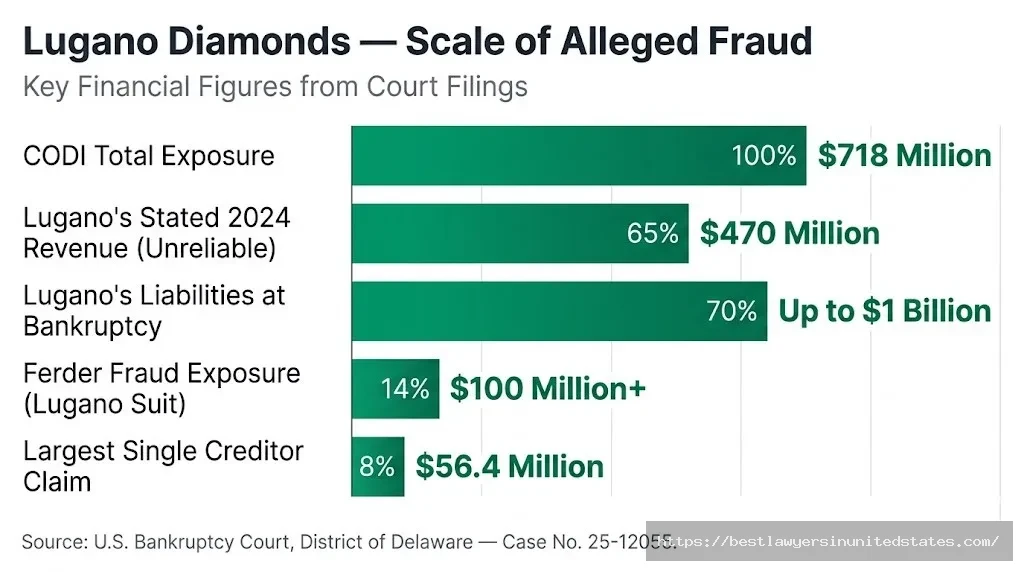
The Scale of the Alleged Fraud
This is not a small claims situation. The alleged fraud is one of the largest in the luxury jewelry industry’s history.
| Financial Metric | Amount | Source |
|---|---|---|
| CODI’s total exposure | ~$718 million | Court filings |
| CODI’s original purchase price for 60% of Lugano | $256 million | SEC filings |
| Lugano’s stated 2024 revenues (later deemed unreliable) | ~$470 million | CODI annual report |
| Lugano’s stated 2024 operating income (later deemed unreliable) | ~$180 million | CODI annual report |
| Alleged liabilities from Ferder’s scheme | $100 million+ | Lugano v. Ferder complaint |
| Estimated total losses claimed by investors | “Hundreds of millions” | Avina/Global Innovations lawsuit |
| Lugano’s estimated assets at bankruptcy filing | $100M–$500 million | Bankruptcy court documents |
| Lugano’s estimated liabilities at bankruptcy filing | $500M–$1 billion | Bankruptcy court documents |
| Number of creditors | 200–999 | Bankruptcy filing |
| Largest single unsecured claim | $56.4 million | Champion Force Industrial, Hong Kong |
| Smallest listed unsecured claims | $1.5 million | Various creditors |
| Debtor-in-possession financing secured | $12 million ($10M new liquidity) | Bankruptcy court motion |
What Creditors and Claimants Can Realistically Expect
This is where the reality of bankruptcy law creates hard limits. With liabilities estimated between $500 million and $1 billion, and assets estimated between $100 million and $500 million, the math suggests a significant shortfall. In Chapter 11 bankruptcy proceedings, secured creditors get paid first, then administrative costs, then unsecured creditors. Most investors who entered co-investment contracts with Ferder are likely classified as unsecured creditors unless their agreements provided specific collateral or security interests.
Individual payout amounts will depend on the total value recovered through the bankruptcy sale and any separate litigation recoveries against Ferder personally, the Haim Family Trust, Simba IL Holdings, and other defendants. There is no guarantee of any recovery. Investors with strong documentary evidence and large claim amounts who act quickly to register as creditors and retain experienced bankruptcy and fraud attorneys will be best positioned.
The Bankruptcy Case: What You Need to Know

Chapter 11 Filing Details
Lugano Diamonds & Jewelry Inc. and certain affiliates voluntarily filed for Chapter 11 protection on November 16, 2025, in the U.S. Bankruptcy Court for the District of Delaware. The case is being jointly administered under Case Number 25-12055 before the Honorable Brendan Linehan Shannon.
Chapter 11 allows a company to continue operating while restructuring or selling its assets under court supervision. In Lugano’s case, it was always intended as a sale process rather than a reorganization — the company was too damaged by the alleged fraud to restructure and survive independently.
The Stalking Horse Bid and Sale
From the moment of filing, Enhanced Retail Funding — a division of Boston-based Gordon Brothers — was named the stalking horse bidder. A stalking horse bid sets a minimum floor price that other potential buyers must beat. Other bids were solicited, but according to court filings, the one competing bid received did not significantly improve on Enhanced Retail Funding’s offer. The auction was ultimately cancelled, and Enhanced Retail Funding was designated the successful bidder. A federal judge approved the acquisition. The sale was finalized by December 31, 2025.
Gordon Brothers, founded in 1903, is a firm known primarily for retail asset management, lending, and restructuring. It has worked on distressed situations involving brands like Brooks Brothers, Polaroid, American Apparel, and various jewelry retailers including Hyde Park Jewelers and Lux Bond & Green.
What Happened to Lugano’s Stores
| Location | Status |
|---|---|
| Newport Beach, California (flagship) | Remained open through bankruptcy |
| Aspen, Colorado | Remained open |
| Palm Beach, Florida | Remained open |
| Houston, Texas | Remained open |
| Chicago, Illinois (Gold Coast) | Remained open |
| Other U.S. boutiques | Remained open |
| Greenwich, Connecticut | Closing/closed |
| Washington, D.C. | Closing/closed |
| London, U.K. | Already closed before bankruptcy |
The company went into bankruptcy with roughly eight boutiques in the United States and had peaked at ten locations including the closed London store.
Creditor Information and How to Register
The official bankruptcy case information line is:
- Phone (U.S. & Canada toll free): 888-902-1791
- Phone (International): 747-226-5603
- Email: [email protected]
- Case administrator website: Omni Agent Solutions (the court-appointed administrator)
If you believe you are owed money by Lugano Diamonds, you need to file a formal proof of claim in the bankruptcy proceeding. Missing the court-set bar date for filing claims could eliminate your right to any recovery from the bankruptcy estate. Consult a bankruptcy attorney immediately if you have not already done so.
The FBI Investigation and Criminal Exposure
What the FBI Is Looking At
The FBI’s involvement elevates this from a civil dispute to a potential criminal matter. FBI agents assigned to the complex financial crimes squad at the Los Angeles field office have been interviewing individuals who entered into diamond investment deals with Ferder. CODI confirmed it is cooperating with the investigation. Lugano’s interim CEO Josh Gaynor, in a June 2025 email to one investor who sued Ferder, indicated that those with interest in parallel criminal investigations may wish to contact the assigned FBI agent.
In a December 8, 2025 SEC filing, CODI went further than before, stating its investigation found that Ferder “deliberately engaged in fraudulent activity by, among other things, entering into off-balance sheet financing arrangements with third parties in violation of company policies, misrepresenting the existence and valuation of inventory, and causing the recording of fictitious sales.” Alex Palou Lawsuit
Ferder’s Whereabouts and Legal Position
Ferder is reportedly residing in Israel as of the time of the bankruptcy filing and subsequent proceedings. He is engaging with U.S. legal proceedings through his counsel. His attorney, Jeffrey Reeves of Reeves & Weiss LLP, has stated that Ferder denies the allegations, maintains his innocence of any criminal wrongdoing, and has not been contacted by the FBI or the Department of Justice. Ferder’s legal team says the evidence will show proceeds went directly to Lugano and that company management and CODI were aware of the transactions. Ferder intends to file counterclaims against Compass Diversified, Lugano, and others.
No criminal charges have been filed against Ferder as of March 2026.
How the Alleged Scheme Worked: A Step-by-Step Breakdown
Understanding the mechanics of the alleged fraud helps investors and potential claimants recognize whether they were targeted.
Step 1 — Target selection. Ferder allegedly focused on Lugano’s own high-net-worth clients — people who already trusted him and had demonstrated willingness to spend large sums on jewelry.
Step 2 — The pitch. He would present a specific diamond opportunity, often referencing a unique identification number to make the deal sound concrete and verifiable. The pitch promised the investor either a profit share when the diamond sold or a guaranteed above-market return if they wanted their money back instead.
Step 3 — The paperwork. Written co-investment or joint-investment agreements were drawn up, sometimes with personal guarantees from Ferder, the Haim Family Trust, or Simba IL Holdings.
Step 4 — The money transfer. Investors wired funds. Those funds were allegedly not used to purchase the promised diamonds.
Step 5 — The concealment. Funds were recorded as Lugano revenue on the company’s books, hiding the liability. Ferder allegedly told Lugano’s own staff that the transactions were normal sales.
Step 6 — The stall. When investors asked for their returns or the actual diamonds, they were told Lugano was experiencing strong growth and needed to fund expansion, or were given other reasons for delays.
Step 7 — The collapse. When CODI’s investigation began in April 2025 and Ferder resigned in May, investors who demanded repayment received nothing. Lugano admitted it did not possess the diamonds Ferder had allegedly promised.
Comparison: Lugano Diamonds vs. Other Major Investment Fraud Cases
| Case | Alleged Fraud Amount | Victims | Resolution | Criminal Outcome |
|---|---|---|---|---|
| Lugano Diamonds / Moti Ferder | $100M–$718M exposure | 60+ investors | Chapter 11 bankruptcy; sold to Gordon Brothers (Dec 2025) | FBI investigation active; no charges as of March 2026 |
| Bernie Madoff Ponzi Scheme | ~$65 billion | Thousands | Bankruptcy; victims compensation fund | 150-year federal prison sentence |
| Elizabeth Holmes / Theranos | ~$700 million | Investors | Bankruptcy; sold assets | 11.25-year federal prison sentence |
| Allen Stanford Ponzi Scheme | ~$7 billion | ~21,000 investors | Receivership | 110-year federal prison sentence |
| Trevor Milton / Nikola | ~$200 million securities fraud | Investors | Company survived; Milton convicted | 4-year federal prison sentence |
The Lugano case is still in its early stages compared to these resolved matters. Criminal proceedings, if any charges are filed, typically lag civil and bankruptcy proceedings by months or years.
What Ferder’s Defense Says
Ferder has not stayed silent. His attorney Jeffrey Reeves has consistently pushed back on the narrative. The defense argues:
- The proceeds from the investment contracts went directly to Lugano, not to Ferder personally
- Compass Diversified and Lugano’s management were fully aware of the investment contract activities and “knowingly accepted the financial benefits from them”
- The lawsuit against Ferder is “a clear effort to misdirect accountability for the company’s action, performance, and ultimate failure, which occurred after Mr. Ferder’s departure from leadership”
- Ferder intends to file counterclaims against CODI, Lugano, and others
- Ferder is “confident that the judicial process will bring the full truth to light” and that he will be vindicated
On November 14, 2025 — just two days before the bankruptcy filing — Ferder’s legal team filed a formal response in California court calling the lawsuit an attempt to “scapegoat” him and “divert attention from Lugano’s own culpability.”
This defense, if successful, could significantly affect who is ultimately held liable and what recovery is available for investors.
Current Status as of March 2026
Where Things Stand Right Now
| Legal/Business Track | Current Status |
|---|---|
| Lugano Diamonds bankruptcy | Chapter 11 sale completed; company now owned by Enhanced Retail Funding (Gordon Brothers) |
| Lugano v. Ferder (civil fraud) | Active; transferred to federal court |
| Investor civil lawsuits vs. Ferder | Multiple active cases in California state and federal courts |
| Aspen investor lawsuits | Stayed (frozen) as a result of the bankruptcy; awaiting lift of automatic stay |
| FBI criminal investigation | Active; FBI Los Angeles complex financial crimes squad |
| CODI securities class actions | Filed; ongoing |
| Ferder’s location | Reportedly in Israel; engaging through U.S. legal counsel |
| Criminal charges against Ferder | None filed as of March 2026 |
| Lugano retail operations | Continuing under new ownership; some store closures |
What to Watch For in 2026
The next major developments likely to shape this case include potential criminal charges against Ferder, the outcome of extradition discussions if charges are filed (given that Ferder is in Israel), resolution of the stayed investor lawsuits as the bankruptcy automatic stay is potentially lifted, and the progress of CODI’s own securities class actions. Any civil settlements between the bankruptcy estate and investor-plaintiffs will also be subject to court approval.
Do You Need a Lawyer?
Quick Answer: If you invested money in any diamond co-investment deal connected to Moti Ferder or Lugano, yes — you need an attorney. This is not a DIY situation.
Unlike a standard consumer class action where you fill out a form on a website, the Lugano Diamonds lawsuit involves bankruptcy creditor claims, civil fraud litigation, and a potential criminal investigation all running at the same time. Your rights in each track are different, deadlines matter enormously, and the money at stake is almost certainly significant.
You need an attorney if:
- You entered any written or verbal co-investment agreement with Ferder related to diamonds
- You wired money to Lugano or related entities as part of an investment
- You have been contacted by the FBI or any law enforcement regarding your dealings with Ferder
- You are a creditor owed money by Lugano and have not yet filed a proof of claim in the bankruptcy
Free consultations are typically available from plaintiff-side fraud and bankruptcy attorneys. If you need a referral, you can contact: [email protected]
Frequently Asked Questions
What is the Lugano Diamonds lawsuit?
Quick Answer: It is a series of civil lawsuits filed by investors who claim they were defrauded by Lugano Diamonds CEO Moti Ferder through fake diamond co-investment contracts, combined with a Chapter 11 bankruptcy filing by the company itself.
The lawsuits are not a single class action with a settlement fund. They are individual and group civil suits filed in California state and federal courts, running alongside a bankruptcy proceeding and an FBI criminal investigation.
Is there a class action settlement I can file a claim in?
Quick Answer: No — as of March 2026, there is no approved class action settlement with a consumer claim form.
This is frequently misunderstood. The Lugano Diamonds matter involves investor lawsuits and a bankruptcy proceeding, not a consumer product defect class action. There is no settlement website where you submit a simple claim form.
Who is Moti Ferder?
Quick Answer: Moti Ferder is the co-founder and former CEO of Lugano Diamonds, who resigned in May 2025 amid allegations he orchestrated a multimillion-dollar investment fraud scheme against the company’s wealthy clients.
Ferder built Lugano from a Newport Beach appointment-only jeweler into a nine-location luxury brand. He was a prominent philanthropist in Orange County before the allegations surfaced. He currently resides in Israel and denies all wrongdoing through his U.S. legal counsel.
How much money was allegedly stolen?
Quick Answer: Estimates range from $100 million (Lugano’s own lawsuit figure) to hundreds of millions of dollars across all investor claims, with CODI’s total exposure stated at approximately $718 million.
Individual investor losses in specific lawsuits range from $150,000 on the low end to $7.9 million for a single claimant. The Avina/Global Innovations lawsuit alleges 40 creditors collectively lost “hundreds of millions.”
Is the FBI really investigating?
Quick Answer: Yes. FBI agents from the Los Angeles field office’s complex financial crimes squad have been interviewing individuals involved in diamond investment deals with Ferder. CODI has confirmed it is cooperating.
No criminal charges have been announced as of March 2026. Ferder’s attorney has said Ferder has not been contacted by the FBI and maintains his innocence of any criminal wrongdoing.
What happened to Lugano Diamonds as a company?
Quick Answer: Lugano filed for Chapter 11 bankruptcy on November 16, 2025, and was sold to Enhanced Retail Funding — a division of Gordon Brothers — by December 31, 2025. The company continues to operate under new ownership.
The sale closed the bankruptcy sale process but does not resolve the investor lawsuits or the criminal investigation. Stores in Greenwich, CT and Washington, D.C. are closing or have closed. The London boutique closed before the bankruptcy.
Can I still file a creditor claim in the bankruptcy?
Quick Answer: Potentially yes, but the window for filing proofs of claim is subject to court-set deadlines. Contact the bankruptcy administrator immediately.
The case administrator is Omni Agent Solutions. Contact them at 888-902-1791 (toll-free U.S./Canada), 747-226-5603 (international), or [email protected]. Hire a bankruptcy attorney to assist — missing the claim bar date typically eliminates your right to any recovery from the estate.
What is a “stalking horse bidder” and why does it matter?
Quick Answer: A stalking horse bidder sets the minimum acceptable price in a bankruptcy auction. Enhanced Retail Funding served as the stalking horse for Lugano and ultimately became the successful buyer when no better bids came in.
This matters to creditors because the sale price directly affects how much money is available to pay claims. With Lugano’s liabilities ranging up to $1 billion and assets up to $500 million, creditors will likely receive less than full recovery.
What are the Aspen investor lawsuits about?
Quick Answer: Several Aspen, Colorado-based investors entered co-investment agreements with Ferder through Lugano’s Aspen boutique, were promised returns of at least 35%, never received repayment, and filed suit in Pitkin County District Court.
Those lawsuits are currently stayed — meaning frozen — as a result of the automatic stay that takes effect when a company files for bankruptcy. When the bankruptcy proceedings advance further, investors may be able to lift the stay and proceed with their individual claims.
Why did CODI’s stock drop?
Quick Answer: When Compass Diversified disclosed the investigation into Lugano’s financials in May 2025, its stock dropped approximately 60% in a single trading day.
Investors in CODI stock who suffered losses have filed securities class action lawsuits arguing they were harmed by the disclosure of what they allege was a preventable fraud at a portfolio company.
What is Ferder’s defense?
Quick Answer: Ferder denies all allegations, argues Lugano and CODI knew about the investment contracts and accepted the financial benefits, and plans to file counterclaims against both.
His legal team argues the lawsuits against him are an attempt to scapegoat him for the company’s own failures and that the full evidence will vindicate him.
Where is Ferder now?
Quick Answer: According to court filings, Ferder is currently residing in Israel. He is engaging with U.S. civil proceedings through his attorneys but is no longer in the United States.
This raises potential extradition questions if criminal charges are ever filed. Israel and the United States have an extradition treaty, though extradition proceedings can be lengthy and complex.
What was the “empty box” scheme?
Quick Answer: According to court filings and lawsuits, Ferder allegedly shipped empty boxes to investors and company records while representing the boxes as containing valuable diamonds.
This is one of the most vivid alleged details in the fraud: investors who thought they were co-investing in real, identifiable diamonds may have been receiving documentation for shipments that contained nothing of value.
What is the Haim Family Trust and Simba IL Holdings?
Quick Answer: These are entities connected to Moti Ferder that are named in certain investor lawsuits as having received investor funds or having provided personal guarantees on investment agreements.
Several California investors signed co-ownership agreements backed by personal guarantees from Ferder, the Haim Family Trust, and Simba IL Holdings. These entities may be separate targets for recovery in litigation.
Did Lugano’s management or CODI know about the scheme?
Quick Answer: Lugano and CODI say no — they claim to have discovered it only through an internal investigation. Ferder says yes — his defense argues management and CODI were fully aware and accepted the benefits.
This factual dispute is central to the litigation. If Ferder’s version is proven, it could significantly expand the liability of the company and CODI to investors.
What happened to Lugano’s reported revenues?
Quick Answer: Lugano’s previously reported 2024 revenues of approximately $470 million and operating income of $180 million were determined to be materially overstated. CODI ultimately stated that its 2022, 2023, and 2024 financial statements were all unreliable and should not be relied upon.
This financial restatement wiped out Lugano’s apparent value practically overnight, triggered loan defaults, and accelerated the bankruptcy filing.
How does this compare to a Ponzi scheme?
Quick Answer: Some lawsuits use Ponzi-like language to describe the alleged scheme, though that characterization is disputed. The structure — using new investor money to pay earlier investors — is a feature commonly associated with Ponzi schemes.
Ferder’s attorneys strongly dispute this characterization. Whether any criminal charges eventually use Ponzi-related statutes will depend on the FBI investigation and any subsequent Department of Justice action.
What should I do right now if I invested with Ferder?
Quick Answer: Preserve all documentation immediately, consult a fraud and bankruptcy attorney as soon as possible, and contact the bankruptcy administrator to inquire about filing a proof of claim.
Do not wait to see how the case develops. Bankruptcy claim deadlines are strict and missing them can permanently bar your right to any recovery from the estate. Attorney consultations are generally free for this type of case.
Can Ferder be extradited from Israel?
Quick Answer: Potentially yes — the U.S. and Israel have an extradition treaty — but only if criminal charges are formally filed and extradition proceedings are initiated. No charges have been filed as of March 2026.
Extradition proceedings, if pursued, can take years and involve their own legal battles in the host country’s courts.
Summary: What the Lugano Diamonds Lawsuit Means for Investors
The Lugano Diamonds lawsuit is not a finished story. As of March 2026, the bankruptcy sale is complete, the stores are open under new ownership, but the investor lawsuits are grinding through courts, the FBI investigation is active, Ferder is abroad, and no criminal charges have been filed. The gap between what was owed and what is available to pay creditors means most investors face a difficult road to full recovery.
If you lost money in connection with Moti Ferder’s investment contracts, the most important thing you can do right now is act — preserve every piece of documentation, consult a qualified fraud or bankruptcy attorney, and register your claim in the bankruptcy proceeding before any court-imposed deadlines expire.
For those watching from the outside, this case stands as a stark reminder that even in a world of ultra-luxury and old-money trust, due diligence matters. A brand’s reputation and its founder’s charisma are not substitutes for verified financials and independent audits.
