
Every year, millions of Americans are hurt by products that never should have made it to store shelves. If a faulty product injured you, caused property damage, or cost you money, you have the legal right to hold the manufacturer — and others in the supply chain — financially responsible. A defective product lawsuit (also called a product liability claim) is how you do that.
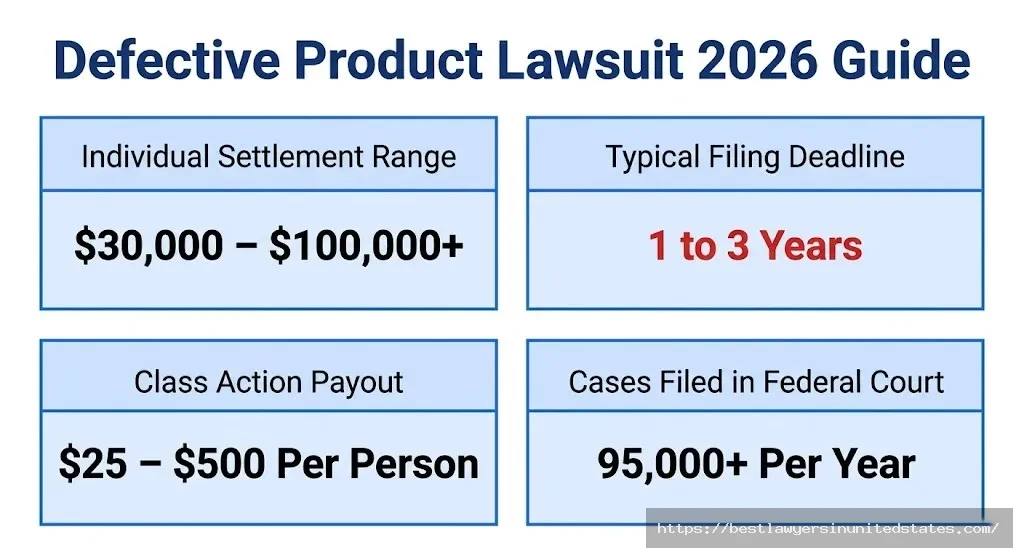
Your filing deadline, called the statute of limitations, is typically 2 to 4 years from the date of your injury, but it can be as short as 1 year in certain states. Missing that deadline means losing your right to compensation permanently.
This guide tells you exactly what you need to know: what counts as a defective product, who qualifies to sue, how much you can realistically recover, and what steps to take right now.
Quick Answer: A defective product lawsuit allows you to seek compensation from a manufacturer, distributor, or retailer whose product hurt you or cost you money. Compensation ranges from a few thousand dollars in class action settlements to millions in individual injury cases. The clock is already ticking on your deadline — most states give you just 2 to 3 years to act. Pet Screening Lawsuit
What Is a Defective Product Lawsuit?
Understanding Product Liability Law
Product liability is the area of law that holds companies accountable when their products cause harm. When you buy something — a power tool, a medication, a car, a household appliance — you have a reasonable expectation that it works safely as intended. When it doesn’t, and you get hurt or lose money because of it, the legal system gives you a path to recover what you lost.
A defective product lawsuit is a civil claim you bring against any party in the chain that brought that product to you. That chain can include the original manufacturer, a parts supplier, a distributor, a wholesaler, and even the retailer that sold it to you. In many cases, your attorney will name more than one defendant.
What’s especially important to understand is that you don’t have to be the person who bought the product to file a claim. If you were injured by someone else’s defective product — as a family member, a bystander, or even a friend borrowing an item — you may still have a valid case.
Product liability cases have grown dramatically over the decades. Federal court filings alone jumped from fewer than 2,000 in 1974 to nearly 95,000 by 2012-2013 — that’s roughly one in every six civil cases filed in federal court. The average product liability jury award has exceeded $5 million, making this one of the highest-compensation areas of personal injury law.
The Lawsuit at a Glance
| Category | Details |
|---|---|
| Legal area | Product liability / personal injury |
| Who you can sue | Manufacturer, distributor, wholesaler, retailer, or any combination |
| Who can file | Anyone injured by the product, not just the original buyer |
| Filing deadline | 1 to 6 years depending on your state (most commonly 2 to 3 years) |
| Burden of proof | Strict liability in most states (no need to prove negligence) |
| Typical case outcome | Out-of-court settlement (majority of cases) |
| Average settlement range | $30,000 to $100,000+ for individual claims; varies widely by severity |
| Attorney fees | Usually contingency-based — no upfront cost |
The Three Types of Defective Product Claims
Your entire case is built around proving one or more of three types of product defects. Understanding which type applies to your situation is the first step in building a strong claim.
1. Design Defects
A design defect means the product was dangerous before a single unit was ever manufactured. The flaw lives in the blueprint itself. Every item made from that same design carries the same risk, which is why design defects so often lead to mass recalls and large class action lawsuits.
A well-known historical example is certain car airbags that used ammonium nitrate — a volatile compound — in their inflators. The design was flawed from the start, meaning tens of millions of vehicles carried the same risk. The resulting recall and litigation involved billions of dollars in settlements.
If you were hurt by a design defect, every other person who owns that same product model could have the same claim. That’s what makes these cases so powerful and so frequently pursued as class actions.
2. Manufacturing Defects
A manufacturing defect happens when something goes wrong during production, and a particular unit doesn’t come out the way it was designed to. The product design itself might be perfectly safe — but this specific item, due to a bad weld, wrong materials, or a factory error, became dangerous.
A bicycle helmet assembled with substandard foam padding instead of impact-grade material is one example. The helmet’s design was fine. But the one that reached you was defective. Manufacturing defect claims tend to be more individual in nature because not every unit has the same flaw.
3. Failure to Warn (Marketing Defects)
Some products are dangerous in ways that aren’t immediately obvious to users. When a manufacturer knows about a risk and doesn’t label it clearly, they can be held responsible for any harm that results. This is called a failure to warn, or a marketing defect.
Cleaning chemicals that become toxic when mixed with other common products are a classic example. If the label doesn’t warn you, and you mix them without knowing the danger, that manufacturer has a problem.
Failure to warn cases are increasingly common with medications and medical devices, where companies are expected to disclose known side effects and usage risks in full.
Defect Type Comparison Table
| Defect Type | What It Means | Who It Affects | Common Examples |
|---|---|---|---|
| Design defect | Flaw in the original blueprint | All units of that model | Car airbags, unsafe children’s products |
| Manufacturing defect | Error during production of a specific unit | Affected units only | Faulty welds, wrong materials used |
| Failure to warn | Inadequate safety labels or instructions | All users of that product | Medications, chemicals, power tools |
Who Qualifies to File a Defective Product Lawsuit?
Basic Eligibility Requirements
You don’t need to pass a test to qualify for a defective product lawsuit — but your case does need to meet certain legal standards. Courts look at four core elements.
You suffered actual harm. A product being defective or simply disappointing isn’t enough by itself. You need to have suffered a real injury (physical harm, illness, property damage) or financial loss tied directly to that defect. Frustration about a product not working doesn’t, on its own, create a liability claim.
The product was defective. You need to show that a design flaw, manufacturing error, or missing warning made the product unreasonably dangerous.
The defect caused your harm. There has to be a clear, direct link between the specific defect and your specific injury. If you cut yourself with a perfectly functional knife because you were distracted, that’s not the knife’s fault. But if the knife’s handle was defective and broke during normal use, causing the cut — that’s a different story.
You were using the product as intended. Courts look at whether you were using the product in a normal, foreseeable way when the injury occurred. If you were misusing the product, that can weaken or eliminate your claim.
Eligibility Checklist
| Requirement | What It Means | How to Show It |
|---|---|---|
| Actual injury or loss | Physical harm, illness, property damage, or financial loss | Medical records, repair bills, documented expenses |
| Product had a defect | Design flaw, manufacturing error, or inadequate warning | Expert testimony, product testing, recall notices |
| Defect caused the harm | Direct connection between the defect and your specific injury | Medical opinion, accident reports, product analysis |
| Normal use of product | You were using it as intended or in a foreseeable way | Your own account, witness statements |
| Within statute of limitations | Filed within your state’s deadline | Date of injury vs. filing date |
Who Else Can File
You don’t have to be the buyer to file. Family members hurt by a product in the home, bystanders injured by someone else’s defective item, and people who received a product as a gift all have legal standing to pursue a claim. If a defective product caused someone’s death, their immediate family may be able to file a wrongful death lawsuit.
Who Does NOT Qualify
You likely don’t have a valid claim if:
- You misused the product in a way the manufacturer couldn’t reasonably have anticipated
- Your injury had no connection to any product defect
- The statute of limitations in your state has expired
- You signed a valid arbitration agreement waiving your right to sue (common with some medical devices and consumer electronics)
- The product worked exactly as designed and labeled — you just didn’t like the result
How Much Compensation Can You Get?
What You Can Recover
Product liability cases can cover three broad categories of damages.
Economic damages cover your actual out-of-pocket losses: medical bills (current and future), lost wages, lost earning capacity if you can no longer work, and property damage. These are the most straightforward to calculate because there are real numbers behind them.
Non-economic damages cover losses that don’t come with a receipt — physical pain, emotional suffering, loss of enjoyment of life, and permanent disability or disfigurement. These are harder to put a dollar figure on, which is why attorneys use multipliers and comparable case values to argue for fair amounts.
Punitive damages are reserved for the most egregious situations — cases where a company knowingly sold a dangerous product, hid evidence of defects, or acted with deliberate disregard for consumer safety. Punitive awards are meant to punish and deter, not just compensate. They can multiply the final verdict significantly.
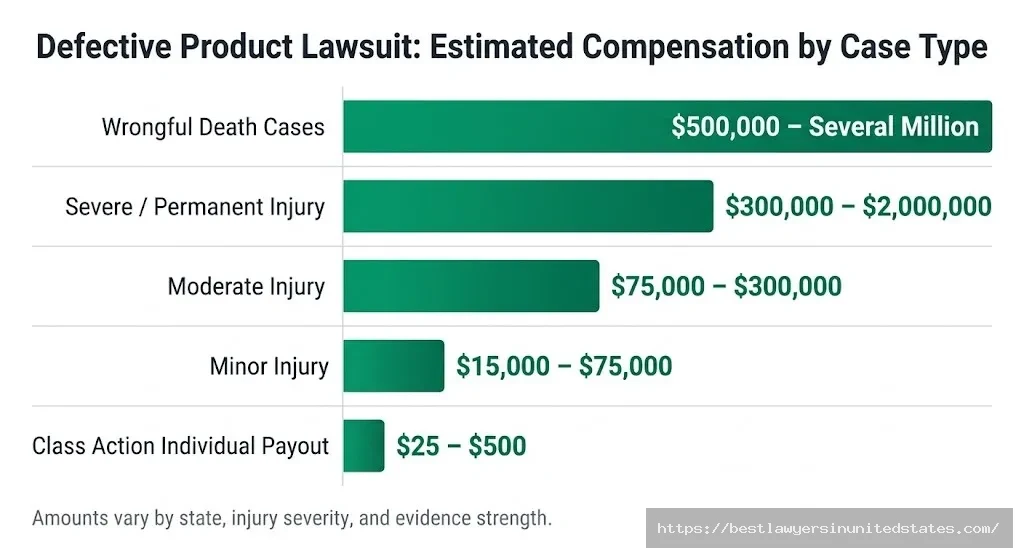
Compensation by Case Type
| Case Type | Typical Compensation Range | Notes |
|---|---|---|
| Minor injury, clear defect | $15,000 – $75,000 | Faster resolution, often class action |
| Moderate injury (surgery, extended recovery) | $75,000 – $300,000 | Depends heavily on lost wages |
| Severe or permanent injury | $300,000 – $2 million+ | Long-term medical costs factor in heavily |
| Wrongful death | $500,000 – several million | Includes funeral, lost income, grief damages |
| Class action individual payout | $25 – $500 per person | Large fund divided among many claimants |
| Mass tort individual payout | $50,000 – $500,000+ | Each case valued individually |
What Affects Your Payout
Several factors push settlement values higher or lower:
Severity of your injury — permanent disabilities, cancer diagnoses, and injuries requiring multiple surgeries get higher values than minor or temporary harm.
Strength of evidence — clear, documented proof of the defect and your injury gives your attorney more leverage in negotiations.
Company knowledge — if the manufacturer knew about the defect before your injury and did nothing, your case becomes much stronger, especially for punitive damages.
Comparative negligence — if you share some of the blame (for example, you ignored a safety warning), your compensation may be reduced by your percentage of fault in many states.
Number of plaintiffs — in class actions, a large settlement fund gets split many ways, meaning individual payouts can be small even when the total settlement is large. Alex Palou Lawsuit
Notable Product Liability Settlements for Reference
| Case | Approximate Settlement | Product Type |
|---|---|---|
| Takata airbag litigation | $1 billion+ | Automotive safety components |
| Volkswagen emissions scandal | $14.7 billion | Vehicles |
| Vioxx (Merck) | $4.85 billion fund | Prescription medication |
| Roundup (Monsanto/Bayer) | Billions ongoing | Weed killer / herbicide |
| Ford Super Duty roof defect (2025) | $30.5 million jury award | Automotive |
| Bestway pool design (2025) | $25 million jury award | Consumer product |
| Hyundai/Kia airbag class action (open) | $62.1 million | Automotive |
Filing Deadlines: The Statute of Limitations

Why the Deadline Matters More Than Anything Else
The single most important thing to know about a defective product lawsuit is this: there is a hard deadline to file, and if you miss it, you lose your right to any compensation — no matter how strong your case is. Courts don’t make exceptions for people who waited too long.
The filing deadline is called the statute of limitations. Each state sets its own deadline, and they vary quite a bit.
Statute of Limitations by State (Common Examples)
| State | Deadline for Product Liability Claims |
|---|---|
| California | 2 years from injury (3 years for property damage) |
| Texas | 2 years from injury |
| New York | 3 years from injury |
| Florida | 2 years from injury (updated 2023) |
| Illinois | 2 years from injury |
| Pennsylvania | 2 years from injury |
| Ohio | 2 years from injury |
| Georgia | 2 years from injury |
| Arizona | 2 years (with 12-year statute of repose) |
| New Jersey | 2 years from injury |
| Michigan | 3 years from injury |
| Colorado | 2 years from injury |
| Louisiana | 1 year from injury |
| Kentucky | 1 year from injury |
| Tennessee | 1 year from injury |
Important note: These deadlines represent general rules. Exceptions exist — including the “discovery rule” and exceptions for minors — which can change when the clock starts or extend the deadline. Always verify your specific deadline with an attorney in your state.
The Discovery Rule: When the Clock Actually Starts
Most states follow what’s called the discovery rule. Under this rule, the statute of limitations doesn’t start running from the date of the accident — it starts from the date you discovered (or reasonably should have discovered) that a defect caused your harm.
This matters a lot in cases involving toxic chemicals, medications, and medical devices. If you used a product for years before realizing it caused your illness, you may still be within your filing window even if years have passed since the initial exposure.
For example: If you used a product with undisclosed toxic ingredients throughout the early 2020s, and were only diagnosed with a related illness in 2025, your two-year clock may have started in 2025 — not when you first used the product.
When the Clock Can Be Paused (Tolling)
Certain circumstances can pause or “toll” the statute of limitations:
- You were under 18 at the time of injury (clock often starts on your 18th birthday)
- You were mentally incapacitated
- The manufacturer deliberately concealed the defect to prevent you from learning about it
- The defendant left the state or took steps to avoid being served
How to File a Defective Product Lawsuit: Step by Step
Step 1: Document Everything Immediately
The moment you realize a product may have caused your injury, start building your record. This evidence can make or break your case.
What to collect and preserve:
- The defective product itself (don’t repair it, don’t throw it away)
- Original packaging, labels, and any written instructions
- Receipt or proof of purchase
- Photos and videos of the product, the defect, and your injuries
- Medical records and bills related to the injury
- Any communications with the manufacturer or retailer
- Names and contact information of any witnesses
The physical product is your most important piece of evidence. Courts and expert witnesses need to examine the actual item. Once you throw it away, that evidence is gone forever.
Step 2: Seek Medical Attention and Document Your Injuries
Get treatment right away, even if your injuries seem minor at first. Medical records create an official, dated record connecting your injury to the incident. Follow-up appointments matter too — gaps in treatment can be used against you to argue the injury wasn’t serious.
Make sure your medical providers document the cause of your injuries in your records, not just the injuries themselves. A note that says “burn injury from product malfunction” is far more useful than one that simply says “burn injury.”
Step 3: Report the Defect
Report the defective product to the Consumer Product Safety Commission (CPSC). This creates an official record, protects other consumers, and can support your legal case. If the product is a medical device, report it to the FDA’s MedWatch system. If it’s a vehicle, report it to the NHTSA.
Checking whether a recall already exists for your product is also worth doing at this stage. An existing recall confirms that the manufacturer knew about the defect — which significantly strengthens your claim.
Step 4: Contact a Product Liability Attorney
Don’t try to handle a defective product claim on your own. These cases involve complex technical evidence, aggressive corporate defense teams, and multi-party liability chains. An experienced product liability attorney will:
- Evaluate whether you have a valid case (usually free of charge)
- Identify all potentially liable parties
- Hire expert witnesses to analyze the defect
- Calculate your full damages (including future losses)
- Negotiate with insurance companies and defense attorneys
- File in court if a fair settlement isn’t offered
The vast majority of product liability attorneys work on contingency — meaning they only get paid if you win. You don’t pay anything out of pocket to get started.
Step 5: Gather Documentation
Your attorney will guide you through this, but start pulling together:
Required Documentation Table
| Document Type | Why It’s Needed | Where to Find It | If You Don’t Have It |
|---|---|---|---|
| Proof of purchase | Proves you owned the product | Receipts, bank statements, emails | Credit card records, retailer purchase history |
| The defective product | Physical evidence of the flaw | Keep it stored safely | Photographs may substitute in some cases |
| Medical records | Documents injury and connects it to the product | Your doctors, hospitals | Request copies directly from providers |
| Medical bills | Establishes economic damages | Healthcare providers, insurance | Request itemized bills |
| Income records | Proves lost wages | Pay stubs, employer letters, tax returns | W-2s, employer verification |
| Accident/incident report | Official record of the event | Police, employer, workplace records | Create your own written account with dates |
| Photographs/video | Visual evidence of the defect and injuries | Your phone, security footage | Reconstruct via expert testimony if needed |
Step 6: Your Attorney Files the Complaint
Your attorney drafts and files a legal complaint in the appropriate court. The complaint identifies the defendants, describes the defect, explains how it caused your harm, and states what you’re seeking in compensation.
The defendant(s) are then served and given time to respond. Their defense team will investigate the claim, request evidence, and attempt to minimize their liability.
Step 7: Discovery Phase
Both sides exchange evidence. Your attorney may depose company employees and executives, obtain internal emails and product testing records, and hire independent experts to analyze the defect. This is often where the strongest cases are built — internal documents sometimes reveal that a company knew about a defect long before your injury occurred.
Step 8: Settlement or Trial
Most defective product cases settle before reaching trial. Your attorney will negotiate on your behalf. If a fair settlement is reached, you receive your compensation without going to court. If the other side won’t offer a reasonable amount, your attorney takes the case to trial.
Filing Process Timeline
| Stage | Typical Timeframe | What Happens |
|---|---|---|
| Initial consultation | Day 1 | Attorney evaluates your case for free |
| Evidence gathering | Weeks 1–8 | Documents, medical records, product analysis |
| Complaint filed | Within a few months | Legal claim officially begins |
| Discovery phase | 6–18 months | Both sides exchange evidence |
| Settlement negotiations | Ongoing throughout | Most cases resolve here |
| Trial (if needed) | 1–3 years after filing | Case argued before judge or jury |
| Compensation received | After settlement or verdict | Typically 4–8 weeks after settlement |
Class Action vs. Individual Lawsuit: Which Path Is Right for You?
Class Action Lawsuits
A class action lawsuit groups together many people who were harmed by the same product defect. One or a few “lead plaintiffs” represent the entire group, and any resulting settlement is shared among all class members.
Class actions make sense when the harm is widespread but each individual’s loss is relatively modest — for example, a consumer product that was defective and overpriced, causing financial loss to thousands of buyers. The combined weight of all those claims gives the lawsuit leverage it wouldn’t have if filed individually.
The trade-off is that individual payouts in class actions are often small. A $60 million settlement split among 500,000 claimants results in about $120 per person before legal fees and administration costs.
Mass Tort Litigation / MDL
When a defective product injures many people in significantly different ways — as is common with medications and medical devices — courts use a structure called Multidistrict Litigation (MDL). Cases are consolidated before a single judge for efficiency during the discovery phase, but each plaintiff still has their own case with individually calculated damages.
MDLs produce far higher individual payouts than class actions because each person’s compensation reflects their actual, specific losses — not a share of a common fund.
Comparison Table: Class Action vs. Individual Lawsuit vs. Mass Tort
| Feature | Class Action | Individual Lawsuit | Mass Tort (MDL) |
|---|---|---|---|
| Best for | Small, widespread economic harm | Single serious injury | Many victims with varying injuries |
| Individual payout | Low ($25–$500 typically) | High (your actual losses) | Moderate to high |
| Your involvement | Minimal | Significant | Moderate |
| Attorney fees | Shared across class | Contingency on your case | Contingency on your case |
| Timeline | 1–4 years | 1–5 years | 2–6 years |
| Court approval needed | Yes — judge must approve | No | Varies |
Do You Need a Lawyer?
For Class Action Claims
If there’s already an open class action settlement involving your product, you generally don’t need a lawyer to file a claim. The settlement administrator handles the process, and you simply submit your claim form through the official settlement website before the deadline.
For Individual Injury Claims
Yes — absolutely hire an attorney for any serious individual product liability claim. These cases involve:
- Technical product analysis requiring expert witnesses
- Multiple corporate defendants and their insurance teams
- Complex damage calculations covering future medical costs and lost earning capacity
- Aggressive defense strategies designed to minimize or eliminate your payout
Attempting to go up against a manufacturer’s legal team without representation almost always results in a far lower outcome, or no recovery at all. Product liability attorneys take these cases on contingency, meaning you pay nothing unless you win.
When to Contact an Attorney Immediately
- Your injury is serious (hospitalization, surgery, permanent disability, lost time from work)
- You don’t know who the at-fault parties are
- The manufacturer has denied responsibility or stopped responding
- You’re approaching your state’s filing deadline
- The product was recalled — this confirms the defect existed and strengthens your case
- Someone died as a result of the defective product
Current Landscape of Defective Product Lawsuits in 2026
Active and Recent Cases to Know About
The defective product litigation landscape in 2026 remains highly active across several product categories.
Automotive defects continue to generate some of the largest settlements. Hyundai and Kia recently agreed to a $62.1 million settlement to resolve claims that certain vehicles contained defective airbag control units that could fail during a collision. The claim deadline extends into 2027 for qualifying vehicle owners.
Water heater components are also under scrutiny. Rheem Manufacturing and Melet Plastics recently faced a class action settlement over allegations that round poly drain valves used in certain water heaters are prone to leaking and failure, which can cause significant property damage. The settlement offers affected homeowners up to $1,500 for documented losses, plus warranty extensions.
Bicycle components saw a 2026 settlement from Shimano over allegations that certain Hallowtech II cranksets manufactured before 2019 are defective, with a claim deadline of August 4, 2026.
Consumer products across categories — from food products to electronics to appliances — continue to generate both individual claims and class actions throughout 2026.
Medical devices and pharmaceuticals remain the highest-stakes product liability litigation. The Depo-Provera lawsuit continues to grow, with individuals who received the injection and were later diagnosed with meningioma (a type of brain tumor) exploring legal action. KerryGold Butter Lawsuit
2026 Product Liability Trends
| Trend | What It Means for Claimants |
|---|---|
| Rising settlement amounts | Average jury awards continue to increase year over year |
| More MDL consolidations | Federal courts grouping related cases for efficiency |
| Faster class action approvals | Courts streamlining consumer class action processes |
| Greater CPSC enforcement | More official recalls creating stronger evidence for claimants |
| Increased pharmaceutical litigation | Drug and device claims remain the highest-value category |
Frequently Asked Questions About Defective Product Lawsuits
What exactly is a defective product lawsuit?
Quick Answer: A defective product lawsuit is a legal claim against the manufacturer, distributor, or retailer of a product that caused harm due to a design flaw, manufacturing error, or missing safety warning.
It’s the legal system’s way of holding companies accountable when the products they profit from hurt people. These lawsuits can be filed individually or as part of a class action, depending on how many people were affected and how seriously each person was hurt.
Who can file a defective product lawsuit?
Quick Answer: Anyone physically injured by a defective product can file — not just the original buyer.
Family members, bystanders, friends who borrowed the product, and even bystanders injured by someone else’s defective item may have standing to file. If a defective product caused a death, surviving family members may file a wrongful death claim.
Do I need to prove the company was negligent?
Quick Answer: In most states, no. Most product liability cases use “strict liability,” which means you only need to prove the product was defective and caused your harm — not that the company acted carelessly.
This is actually one of the most consumer-friendly aspects of product liability law. You don’t have to show that the manufacturer knew about the problem or deliberately ignored it (though if they did, that can increase your damages significantly).
How long do I have to file a defective product lawsuit?
Quick Answer: Most states give you 2 to 3 years from the date of injury, but it ranges from 1 to 6 years depending on your state. Some states use the “discovery rule,” which starts the clock when you first discovered the defect caused your harm.
Do not assume you know your deadline without checking. Several states have shorter windows, and some have “statutes of repose” — absolute cutoffs based on when the product was manufactured or sold — that can end your right to sue regardless of when you were injured.
How much will I receive in a defective product settlement?
Quick Answer: It varies widely. Individual serious injury cases commonly settle between $30,000 and $100,000, but severe cases involving permanent disability or death can reach millions. Class action payouts are often just $25 to $500 per person.
Your compensation depends on the severity of your injury, how much work you missed, your future medical needs, the strength of your evidence, and whether the manufacturer acted knowingly and recklessly.
What if I don’t have the receipt or proof of purchase?
Quick Answer: You can still file. Receipts help, but they’re not the only way to prove you owned the product.
Credit card statements, bank records, online order history, gift records, and even photographs of you using the product before the injury can serve as evidence. Your attorney can also work with retailers to pull purchase records.
What if I threw away the defective product?
Quick Answer: Your case becomes harder, but it may not be over.
If the product model was recalled or is known to be defective, expert witnesses can potentially testify about the defect without examining your specific unit. Photographs taken before disposal can also help. Tell your attorney immediately if you no longer have the product — they’ll assess what options remain.
Do I have to give up my right to sue separately if I join a class action?
Quick Answer: Yes. If you participate in a class action settlement, you typically release your right to file your own individual lawsuit over the same claim.
This is why it’s worth consulting an attorney before joining a class action if your injuries are serious. A class action payout of $50 to $200 might be far less than what you could recover in an individual lawsuit for significant medical bills and lost wages.
What is the difference between a class action and a mass tort?
Quick Answer: In a class action, everyone shares a single outcome. In a mass tort, each person has their own case with individually calculated damages — which usually results in much higher individual payouts.
Mass torts are common in pharmaceutical and medical device cases because the harm people suffer tends to be very different from person to person. One person might have a mild reaction while another faces life-threatening complications — a single payout amount wouldn’t be fair to either.
Can I file a lawsuit if the product was recalled?
Quick Answer: Yes — and a recall actually helps your case.
A recall is an official acknowledgment that the product was defective. It makes it much harder for the manufacturer to deny there was a problem. If you were injured by a recalled product, contact a product liability attorney right away, as your case may already have significant momentum.
What if I was partially at fault for my injury?
Quick Answer: You may still recover compensation in most states, but your payout could be reduced.
Most states use “comparative negligence” rules, which reduce your compensation by your percentage of fault. For example, if you were 20% at fault, you’d receive 80% of the damages awarded. A few states use “contributory negligence,” which can bar recovery entirely if you share any blame — making it especially important to speak with an attorney in those states.
What does it cost to hire a product liability attorney?
Quick Answer: Nothing upfront. Product liability attorneys work on contingency, meaning they only get paid if you win.
The typical contingency fee ranges from 25% to 40% of your recovery, depending on whether the case settles or goes to trial. You pay no hourly rates, no retainers, and no out-of-pocket costs. If your case doesn’t result in compensation, you owe nothing.
Will a defective product lawsuit affect my taxes?
Quick Answer: Compensation for physical injuries and medical expenses is generally not taxable. Punitive damages and compensation for emotional distress unrelated to physical injury may be taxable.
Tax rules on lawsuit settlements are complex. Once your case resolves, consult a tax professional to understand exactly how your specific recovery will be treated.
What if the company went out of business?
Quick Answer: You may still have options. Other parties in the product’s supply chain — distributors, retailers, component manufacturers — may still be liable.
Additionally, some companies in bankruptcy establish settlement trusts specifically to handle ongoing product liability claims. An attorney can help you identify whether any remaining avenues exist.
What is a statute of repose, and how is it different from the statute of limitations?
Quick Answer: The statute of limitations starts running when you were injured (or discovered the injury). The statute of repose starts running from when the product was manufactured or sold — and can cut off your right to sue even if you haven’t been injured yet.
For example, a state might have a 12-year statute of repose. That means if a product was sold in 2010 and you’re still using it in 2026 and get hurt, your right to sue may have already expired under that state’s rules, even if you’re within the two-year statute of limitations. Not every state has a statute of repose — but many do.
What if the product hurt my child?
Quick Answer: In most states, the clock doesn’t start on your child’s case until they turn 18.
Most states toll (pause) the statute of limitations for minors. That means an injury that happened to a 10-year-old in 2020 might still be actionable when they turn 18 in 2028. However, you should still consult an attorney now — preserving evidence early is critical, and acting sooner gives you more options.
What happens if I miss the filing deadline?
Quick Answer: In almost all cases, you permanently lose your right to sue and can no longer recover any compensation.
This is not a soft deadline. Courts routinely dismiss cases filed even one day late. The only way to protect yourself is to act quickly. If you think your deadline may have already passed, talk to an attorney anyway — there may be exceptions that apply to your situation.
How to Protect Your Rights Starting Today
If a defective product hurt you or someone in your family, the most important thing you can do right now is not wait. Evidence disappears. Witnesses forget details. And your filing deadline is counting down whether you’re thinking about it or not.
Here’s your action checklist for the next 48 hours:
Preserve the product. Don’t throw it away, repair it, or let anyone else handle it. Store it somewhere safe exactly as it was when the incident occurred.
Document your injuries. Take photos. Get medical treatment. Make sure your doctor records the cause of your injury, not just the injury itself.
Write down everything you remember. Dates, times, how the injury happened, what warnings (if any) were on the product, and any conversations you’ve had with the manufacturer or retailer.
Check for recalls. Search the product name and model on the CPSC website to see if a recall already exists.
Contact a product liability attorney. The consultation is free. An attorney can tell you exactly how much time you have, what your case is worth, and what to do next. Because they work on contingency, it costs you nothing to find out where you stand.
You trusted a product to be safe. When it wasn’t, and you were the one who paid the price, the law is on your side. The companies that make and sell dangerous products have legal teams protecting their interests around the clock. You deserve the same protection.
