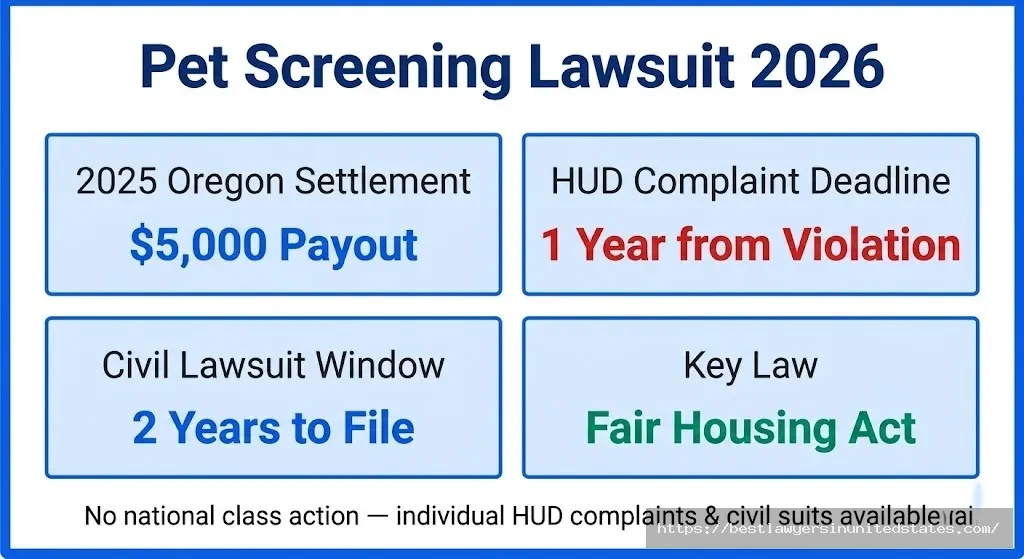
Quick Answer: Pet screening lawsuits involve legal claims against landlords and property managers who require tenants — especially those with disabilities and emotional support animals — to use third-party services like PetScreening.com in ways that violate the Fair Housing Act. A 2025 settlement in Oregon resulted in a $5,000 payout to an affected tenant. A separate data privacy case involving PetScreening.com is currently moving through the Fourth Circuit Court of Appeals. There is no single national class action settlement with a claim filing deadline as of March 2026, but individual tenants can pursue legal action through HUD complaints, state fair housing agencies, and civil litigation.
What Is the Pet Screening Lawsuit About?
Pet screening lawsuits have become one of the most talked-about legal battles in tenant rights law, and for good reason. Thousands of renters across the country — many of them people with disabilities — are finding out the hard way that what their landlord calls a “routine screening process” may actually be a violation of federal fair housing law.
At the center of this debate is PetScreening.com, a North Carolina-based company founded by John Bradford that markets its software to landlords as a way to “outsource their pet risk assessment.” The platform assigns animals a “FIDO score” (a play on the FICO credit score) ranging from 1 to 5, uses that score to adjust pet deposit amounts, and has been widely adopted by apartment communities nationwide.
The legal trouble started when housing providers began requiring tenants with emotional support animals (ESAs) and other assistance animals to use PetScreening.com as the mandatory pathway for verifying their disability-related accommodation requests. Under the Fair Housing Act, that requirement can cross a serious legal line.
This guide covers everything you need to know — the cases, your rights, how to document your situation, and what steps to take if you think your landlord has violated the law. Alex Palou Lawsuit
Pet Screening Lawsuit Overview
| Detail | Information |
|---|---|
| Company at Center of Disputes | PetScreening, Inc. (PetScreening.com) |
| Headquartered | Mooresville, North Carolina |
| Type of Legal Issues | Fair Housing Act violations, data privacy, undue burden on disabled tenants |
| Key Federal Law | Fair Housing Act (42 U.S.C. § 3604); 24 CFR 100.7(2)(b) |
| Regulatory Body | U.S. Dept. of Housing and Urban Development (HUD) |
| Notable 2025 Settlement | Fair Housing Council of Oregon case — $5,000 payout to tenant |
| Active Appellate Case | Fourth Circuit Court of Appeals — data privacy/disability discrimination |
| HUD Guidance Status | HUD has warned against mandatory reliance on third-party ESA verifiers |
| PetScreening’s Own ToS | States service use is “elective and optional” for tenants |
Background of the Lawsuit
PetScreening.com launched with a straightforward premise: give landlords a digital tool to manage pet policies, collect pet profiles, and assign a standardized “risk score” to animals living in rental properties. For regular household pets, this raises few legal concerns — landlords can generally set their own pet policies.
The legal problem arises when landlords apply the same mandatory process to assistance animals. Under federal fair housing law, assistance animals — including trained service animals, emotional support animals (ESAs), and companion animals — are not pets. They are considered medically necessary accommodations for people with disabilities, similar in legal standing to a wheelchair ramp or accessible bathroom.
When a landlord tells a tenant with a disability that they must use PetScreening.com to get their ESA approved — and won’t accept a valid letter from a licensed mental health professional — that landlord may be creating an “undue burden” on a protected class. That is a textbook Fair Housing Act violation.
The situation became even more complicated when it emerged that PetScreening.com’s profile creation process requires users to agree to terms that include sharing personal data with third parties for advertising purposes. For tenants without disabilities who simply register a household pet, this is a consumer annoyance. For tenants with disabilities who are forced to go through this process to access a legally protected accommodation, it raises a distinct civil rights concern.
Timeline of Key Pet Screening Legal Events
| Date | Event | Details |
|---|---|---|
| Pre-2020 | PetScreening.com launches | John Bradford’s software marketed to landlords nationwide |
| 2021 onward | Tenant complaints begin emerging | Legal forums fill with questions about ESA denials via PetScreening |
| 2023 | North Carolina legislative controversy | WHQR reports HB 551 may benefit Bradford’s PetScreening business; advocates raise concerns |
| 2024 | HUD reaffirms guidance | HUD warns housing providers not to rely solely on third-party ESA verification services |
| Summer 2025 | Oregon Fair Housing settlement | FHCO successfully settles case against landlord; ~$5,000 payout to disabled tenant |
| September 2025 | PetScreening Review site publishes detailed tenant case | Documents specific denial practices and PetScreening’s dismissive response to tenants |
| Late 2025/2026 | Fourth Circuit case active | Data privacy case involving PetScreening’s third-party data sharing moves through appeals court |
| March 2026 | FHCO publishes formal warning | Fair Housing Council of Oregon issues public guidance warning landlords about PetScreening liability risks |
Who Is Involved?
PetScreening, Inc. was founded by John Bradford, who also sponsored North Carolina House Bill 551, a piece of legislation that critics said was written to benefit his company. The bill created legal expectations around ESA and service animal certifications that, according to PetScreening.com, his software is designed to evaluate.
The Fair Housing Council of Oregon (FHCO) has been among the most active organizations bringing pet screening issues into legal focus. Their Legal Director, Steven Crawford, has given public guidance that landlords should “never require tenants to request their assistance animal through a web portal.” Their Investigations and Intake manager, Mario Anguiano, has reinforced the same message.
The plaintiffs in these cases are primarily tenants with disabilities — people who have legitimate ESA letters from licensed mental health professionals and who have been put through an unauthorized gauntlet of extra demands, data disclosures, and denials.
What Are the Core Allegations?
The legal complaints against landlords who misuse PetScreening.com — and the broader legal challenges involving PetScreening itself — center on several key allegations:
✅ Requiring disabled tenants to use a specific third-party website as the only way to verify an assistance animal violates the Fair Housing Act by creating an undue burden on a protected class.
✅ Demanding excessive medical information — such as frequency of therapy sessions, release of records, or detailed provider-patient communications logs — goes beyond what HUD permits landlords to request.
✅ Charging fees to process ESA verification is illegal, since assistance animals cannot be subject to pet fees or deposits under the Fair Housing Act.
✅ Sharing the sensitive personal and disability-related data of tenants with third-party advertisers — when tenants are effectively compelled to use the platform — creates a discriminatory barrier not imposed on non-disabled tenants.
✅ Landlords who use PetScreening as their agent remain vicariously liable for any discriminatory outcomes, per 24 CFR 100.7(2)(b), regardless of whether they personally handled the denial.
✅ PetScreening’s practice of rejecting valid ESA letters from licensed clinicians — on grounds that letters appear “identical to templates online” — substitutes an algorithm’s judgment for that of a licensed healthcare professional, which has no legal basis under HUD guidance.
Who Qualifies to Pursue Legal Action?
Quick Answer: You may have grounds to file a fair housing complaint or pursue legal action if a landlord required you to use PetScreening.com to verify your ESA or assistance animal, your valid ESA documentation was rejected, you were charged fees related to your assistance animal, or you were denied housing because of your disability-related animal.
Eligibility Checklist
| Factor | Details | Documentation You’ll Need |
|---|---|---|
| You have a disability | A physical or mental condition that substantially limits a major life activity | Medical records, therapist letter, doctor’s statement |
| You have or requested an ESA/assistance animal | You have an ESA letter from a licensed professional | Original ESA letter, date it was issued, provider’s license info |
| Landlord required mandatory PetScreening use | You were told you must use PetScreening.com — not given it as an option | Written communications, emails, lease provisions, verbal instruction logs |
| Your valid documentation was rejected | PetScreening or your landlord rejected a legitimate ESA letter | Denial notice, your original letter, any PetScreening communications |
| You were charged fees for ESA verification | You paid fees related to running your assistance animal through PetScreening | Payment receipts, charge records, correspondence |
| Harm resulted | You lost housing, were denied accommodation, faced undue delay, or suffered financial harm | Timeline of events, any eviction notices, financial records |
Who Does NOT Qualify?
❌ Tenants who only registered a regular household pet through PetScreening (not an assistance animal) and had no disability-related accommodation request.
❌ Landlords or property managers — the legal protections here run in favor of tenants with disabilities, not the housing providers.
❌ Tenants who voluntarily used PetScreening.com without any landlord requirement and had no issues.
❌ Situations where a landlord offered PetScreening as one option among many, and the tenant was free to submit documentation directly.
How to Prove Your Claim
| Document Type | Why You Need It | Where to Find It | Alternative If Unavailable |
|---|---|---|---|
| ESA letter from licensed professional | Proves you had valid documentation | From your therapist, psychiatrist, or doctor | Ask your provider for a duplicate; note date of issuance |
| Landlord/PetScreening communications | Shows mandatory requirement or wrongful denial | Your email inbox, PetScreening platform messages | Written summary of verbal communications, signed and dated |
| Lease agreement or addendum | Shows language about pet/animal screening requirements | Your copy of the signed lease | Request copy from landlord in writing |
| Denial notice from PetScreening | Documents rejection of valid documentation | PetScreening platform or email | Screenshots of platform messages |
| Proof of fees charged | Shows illegal pet-style charges applied to ESA | Bank statements, payment receipts | Credit card records, receipts |
| Correspondence requesting direct accommodation | Shows you tried to bypass PetScreening and were denied | Your sent emails to landlord | Written reconstruction with dates |
The 2025 Oregon Fair Housing Settlement — The Landmark Case
This is the clearest court-validated example of how pet screening practices can go legally wrong.
In the summer of 2025, the Fair Housing Council of Oregon successfully settled a fair housing case against a landlord whose use of PetScreening.com had created an unlawful undue burden on a tenant with a disability. The case involved a woman who had requested permission for an assistance animal for her disabled son when the family moved in. The housing provider initially approved the request through traditional methods — the way HUD says it should be done. The problem came later.
During an unrelated dispute, the landlord revoked the family’s permission to have the assistance animal and then insisted the animal needed to be re-approved — this time through PetScreening.com. The tenant, who had already gone through the legally correct verification process, was suddenly faced with a completely new set of digital hoops to jump through for an accommodation that had already been granted.
The case was settled in the tenant’s favor. The landlord was required to make a combined payout of approximately $5,000 to the tenant and the Fair Housing Council of Oregon. The basis was clear: by revoking an approved accommodation and forcing a disabled tenant through a mandatory third-party platform, the landlord imposed an undue burden that impeded equal access to housing.
This is the exact scenario that fair housing experts have been warning about. FHCO Legal Director Steven Crawford’s advice, now made public, is blunt: never require tenants to request their assistance animal accommodation through a web portal. KerryGold Butter Lawsuit
The Fourth Circuit Data Privacy Case
A separate but equally significant legal battle is working its way through the U.S. Court of Appeals for the Fourth Circuit, and it targets PetScreening.com’s data practices directly.
To create a profile on PetScreening.com, every user must agree to terms and conditions that include sharing personal data with third parties for advertising purposes. For tenants who have pets and no disability-related needs, this is a consumer choice issue. For tenants with disabilities who are compelled to use the platform in order to receive a legally protected accommodation, it is something else entirely.
The case argues that requiring tenants with disabilities to share their personal and medical-adjacent data with unknown third parties — simply to access housing rights that non-disabled tenants access freely — creates a discriminatory barrier under the Fair Housing Act. Tenants without disabilities who register a “no pet” profile are not required to surrender the same level of personal information. The differential treatment is the legal crux.
The Fourth Circuit case had not yet been decided as of March 2026. It represents one of the first federal appellate-level challenges to the data practices of third-party tenant screening platforms specifically as a disability discrimination issue.
What the Law Says: Your Rights Under the Fair Housing Act
Understanding your legal baseline is the most powerful tool you have in any pet screening dispute.
| Legal Requirement | What It Means for You |
|---|---|
| Landlords must accept reasonable accommodation requests | If you have a disability and need an assistance animal, your landlord must genuinely consider your request |
| No mandatory use of specific platforms | Landlords cannot force you to use PetScreening.com or any specific website as the only way to submit your ESA request |
| No extra fees for assistance animals | Landlords cannot charge pet deposits, pet rent, or third-party verification fees for ESAs or service animals |
| Vicarious liability applies | Even if PetScreening wrongfully denies your request, your landlord is legally responsible for that outcome |
| Interactive process is required | Landlords and their agents must engage with you in good faith, not issue a “take it or leave it” ultimatum |
| Documentation standards are set by HUD | A letter from a licensed mental health professional is sufficient. Landlords cannot demand provider-patient communication logs, “release of information” forms, or re-evaluation by an online algorithm |
| PetScreening use for ESAs is risky, not protective | Landlords who use PetScreening to verify assistance animals are NOT shielded from liability by doing so |
How Much Money Could You Recover?
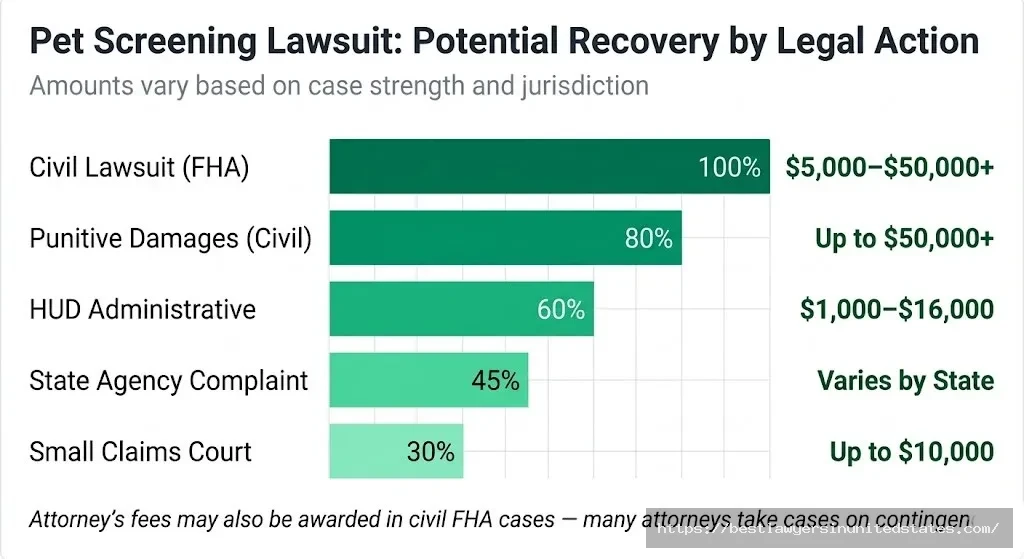
There is no single national class action fund to claim from as of March 2026. However, individual legal actions can result in meaningful compensation.
| Type of Legal Action | Potential Recovery | Notes |
|---|---|---|
| HUD complaint (administrative) | Actual damages, injunctive relief, civil penalties | Free to file; HUD investigates on your behalf |
| State fair housing agency complaint | Varies by state; often includes damages and attorney fees | Many states have protections beyond federal law |
| Individual civil lawsuit under FHA | Actual damages, punitive damages, attorney’s fees | You can sue both the landlord and, potentially, PetScreening as their agent |
| Small claims court | Up to your state’s limit (often $5,000–$10,000) | Good option if your financial damages are modest and documented |
| Settlement (as seen in Oregon case) | $5,000 in the 2025 FHCO case | Settlements often happen before trial |
Note: Under the Fair Housing Act, if you win, the court can award attorney’s fees to your side. This means many fair housing attorneys will take strong cases on contingency.
The PetScreening Business Model — What You Should Know
PetScreening.com functions as a subscription-based platform. Here is what their system actually does, and why it creates legal tension:
The platform assigns every animal a “FIDO score” from 1 to 5 — a proprietary risk rating. Landlords can use this score to set pet deposit amounts. A high-scoring dog (lower risk) might mean a lower deposit; a low-scoring dog (higher risk) can mean a higher deposit or rejection.
For regular pets, this is arguably a landlord’s prerogative. But the system applies the same algorithmic risk rating logic to assistance animals — animals that are not legally pets and cannot be treated as such. When a landlord uses a “FIDO score” to adjust the accommodation terms for a disabled tenant’s ESA, they may be discriminating on the basis of disability.
PetScreening also offers what it calls “Fair Housing compliance” features, pitching landlords on the idea that using the platform shields them from liability. The Fair Housing Council of Oregon’s FHCO Legal Director has publicly challenged this claim. Per 24 CFR 100.7(2)(b), a housing provider is vicariously liable for discriminatory acts by their agent — and PetScreening, when acting on a landlord’s behalf, is their agent.
One particularly egregious pattern documented by the Pet Screening Review site involves PetScreening rejecting valid ESA letters by claiming they look “nearly identical to other templates available online.” When tenants push back, some have received responses from PetScreening’s “Director of Fair Housing Compliance” stating that “PetScreening’s review is complete and we will not accept further communications on this matter.” That is not an interactive process. That is a door being slammed shut on a disabled person’s federal housing rights.
How to File a Complaint — Step by Step

If you believe your rights have been violated, here is exactly what to do.
Step 1: Document Everything Before you do anything else, write down a detailed timeline of every interaction. What was said, by whom, and when. Print or screenshot every email, platform message, denial notice, and lease provision. If a verbal demand was made, write a detailed summary and note the date.
Step 2: Send Your ESA Letter Directly to Your Landlord If you haven’t already done so, send your valid ESA letter directly to your landlord or property manager via email or certified mail. This creates a paper trail showing you attempted to work within the proper accommodation process. Ask in writing for a response, and if they refer you back to PetScreening, ask them in writing to explain the legal basis for that requirement.
Step 3: File a Complaint with HUD Go to hud.gov and file a Fair Housing Act complaint. You have one year from the date of the discriminatory act to file. HUD’s investigation is free to you. If they find cause, they can pursue the case on your behalf. You can also call HUD at 1-800-669-9777.
Step 4: Contact Your State or Local Fair Housing Agency Many states and cities have their own fair housing agencies with broader protections than federal law. If you’re in Oregon, the Fair Housing Council of Oregon (fhco.org) is especially active on these issues. Contact them at 503-223-8197 ext. 2.
Step 5: Consult a Fair Housing Attorney Many fair housing attorneys take cases on contingency, meaning you don’t pay unless you win. Because the FHA allows courts to award attorney’s fees to prevailing plaintiffs, attorneys are often willing to take strong cases at no upfront cost.
Step 6: File with Your State Attorney General Some state AGs have consumer protection and civil rights divisions that handle housing discrimination. Filing there adds another layer of institutional pressure on your landlord.
Step 7: Preserve the Evidence Do not delete any emails or platform messages. Keep your original ESA letter and any copies. Save bank records showing any fees charged. This documentation is the foundation of any legal action.
Step 8: Know Your Deadline For HUD complaints, you have one year from the date of the discriminatory act. For civil lawsuits under the Fair Housing Act, you have two years. Don’t wait.
Critical Deadlines for Legal Action
| Action | Deadline | Notes |
|---|---|---|
| HUD Fair Housing Complaint | 1 year from discriminatory act | File at hud.gov or call 1-800-669-9777 |
| Civil lawsuit under FHA | 2 years from discriminatory act | File in federal or state court |
| State fair housing complaint | Varies by state (often 1 year) | Check your state agency’s rules |
| Small claims court | Varies by state (often 2–4 years) | For straightforward financial damages |
Common Mistakes to Avoid
Don’t agree to PetScreening’s demands for extra documentation without knowing you don’t have to — PetScreening’s own Terms of Service say use of the platform is “elective and optional” for tenants. Most tenants are never told this.
Don’t ignore a denial or escalate aggressively without first creating a clean paper trail. You want a written record of you doing everything right.
Don’t sign anything waiving your fair housing rights in exchange for “resolving” the matter informally without consulting an attorney.
Don’t assume your landlord is acting in good faith if PetScreening is doing the denying — legally, your landlord is responsible for PetScreening’s conduct as their agent.
Don’t wait. Statute of limitations clocks start running from the date of the violation, not when you found out about your legal options. Carvana Lawsuit
Pet Screening Lawsuit vs. Similar Fair Housing Cases
| Case | Outcome | Key Issue | Relevance |
|---|---|---|---|
| FHCO v. Oregon Landlord (2025) | ~$5,000 settlement for tenant | Mandatory PetScreening use as undue burden | Direct precedent for current cases |
| Fourth Circuit PetScreening Data Case (Ongoing) | Pending appellate ruling | Data sharing as discriminatory barrier for disabled tenants | Could set national precedent |
| HUD v. Landlords Using Breed Restrictions for ESAs | HUD guidance issued | Insurance-based breed restrictions for assistance animals | Shows HUD’s broad reading of accommodation rights |
| Multiple State Fair Housing Cases | Mixed outcomes | Denial of ESAs via algorithmic screening | Pattern of liability for landlords using automated systems |
Do You Need a Lawyer?
Quick Answer: You don’t need a lawyer to file a HUD complaint — that process is free and designed for individuals. But if your case involves significant financial harm, housing loss, or a pattern of deliberate violations, a fair housing attorney can dramatically increase your recovery.
Filing with HUD or your state agency yourself is a legitimate and often effective route. HUD has enforcement power, and a finding of cause can result in a conciliation agreement that compensates you without ever going to court.
When you should strongly consider an attorney: your housing was terminated or threatened because of your ESA; you’ve faced a pattern of harassment or retaliation; you were charged significant fees; or you have strong documentation but PetScreening and your landlord are stonewalling you. Many fair housing attorneys work on contingency for FHA cases because the fee-shifting provisions make these cases financially viable for them to take.
For attorney referrals, you can contact: [email protected], or reach out to the Fair Housing Council of Oregon at fhco.org/report-housing-discrimination if you’re in the Pacific Northwest.
Latest Updates — March 2026
The Fair Housing Council of Oregon published a comprehensive public warning about PetScreening.com on March 6, 2026 — one of the most authoritative and detailed statements from a fair housing organization on this issue to date. The piece, written by FHCO Education Coordinator Gina Rizk and reviewed by FHCO Legal Director Steven Crawford, explicitly warns housing providers that requiring tenants to use PetScreening for assistance animal verification exposes them to liability, not protection.
The Fourth Circuit data privacy case involving PetScreening.com’s third-party data sharing practices was still working through the appellate process as of this writing. A ruling could establish significant precedent about whether compelling disabled tenants to share their data through a mandatory third-party platform constitutes an additional discriminatory barrier under the Fair Housing Act.
HUD’s guidance on assistance animals — which clearly states that landlords cannot require tenants to use specific third-party verification services — remains in effect and has not been updated to give PetScreening-style platforms any formal carve-out.
On the BBB complaint front, Pet Screening, Inc. has accumulated a notable volume of unresolved tenant complaints, with many involving ESA denials, billing disputes for services tenants didn’t knowingly subscribe to, and difficulty reaching customer service. As of 2026, the company’s Terms of Service continued to contain mandatory arbitration clauses barring class actions, making individual complaints and HUD filings the primary avenues for affected tenants.
Frequently Asked Questions
What is the pet screening lawsuit? Quick Answer: “Pet screening lawsuit” refers to legal claims — mostly individual fair housing complaints and cases — brought by tenants whose landlords required them to use PetScreening.com to verify emotional support animals or assistance animals, allegedly in violation of the Fair Housing Act.
There is no single national class action settlement to file a claim with. Instead, affected tenants pursue relief through HUD complaints, state fair housing agencies, or individual civil lawsuits. The 2025 FHCO Oregon case and the ongoing Fourth Circuit appellate case are the most significant legal developments to date.
Is PetScreening.com illegal? Quick Answer: Using PetScreening.com for regular household pets is not illegal. Requiring tenants with disabilities to use it as the mandatory way to verify an assistance animal likely is illegal under the Fair Housing Act.
The Fair Housing Council of Oregon and HUD guidance both make clear that housing providers cannot impose a third-party online verification requirement as the only path to an ESA accommodation. Whether landlords face liability depends on how they use the platform, not the platform’s mere existence.
My landlord says I must use PetScreening for my ESA. Do I have to? Quick Answer: No. PetScreening’s own Terms of Service state that tenant use of the platform is “elective and optional.”
You have the right to submit your ESA letter directly to your landlord. If your landlord refuses to accept direct documentation and insists you go through PetScreening, they may be violating the Fair Housing Act. Put your objection in writing, submit your ESA letter directly, and contact HUD or a fair housing attorney if you face denial.
Can a landlord charge me a fee to run my ESA through PetScreening? Quick Answer: No. Charging fees in connection with an ESA accommodation — whether framed as a “pet fee” or a “third-party verification fee” — is illegal under the Fair Housing Act.
Landlords cannot charge pet deposits, pet rent, or verification fees for assistance animals. If you’ve been charged, document it and include it in any fair housing complaint.
PetScreening rejected my valid ESA letter. What do I do? Quick Answer: Don’t comply with their demands for more documentation. Submit your ESA letter directly to your landlord and file a fair housing complaint if they won’t accept it.
PetScreening has been documented telling tenants their letters “look like templates” and demanding information about how often they speak to their therapist. None of this is legally required. A letter from a licensed mental health professional confirming your disability-related need for an assistance animal is sufficient under HUD guidance.
What is the FIDO score, and is it legal to use for ESAs? Quick Answer: The FIDO score is PetScreening’s proprietary 1-5 animal risk rating. Using it to adjust accommodation terms for a disabled tenant’s ESA raises serious Fair Housing Act concerns.
Landlords can use FIDO scores for regular household pets. But because ESAs are not pets under federal law, applying an algorithmic risk score to adjust the terms of a disability accommodation — or to deny one — may constitute discrimination on the basis of disability.
What is the Fourth Circuit PetScreening case about? Quick Answer: The case argues that requiring disabled tenants to share personal data with advertisers, as a condition of accessing housing rights that non-disabled tenants access freely, is a form of disability discrimination under the Fair Housing Act.
The case is still pending as of March 2026. If the Fourth Circuit rules for the plaintiff, it could create a binding legal standard covering federal courts in Maryland, Virginia, West Virginia, North Carolina, and South Carolina — precisely the region where PetScreening is headquartered.
How do I file a fair housing complaint? Quick Answer: File at hud.gov or call 1-800-669-9777. You have one year from the date of the discriminatory act.
You can file online, by mail, or by phone. HUD will investigate your complaint, and if they find cause, they’ll pursue the matter. It costs you nothing to file. You can also contact your state or local fair housing agency at the same time.
Do I need a receipt or proof of fees paid to file a complaint? Quick Answer: Not necessarily. You can file a fair housing complaint based on the denial of your accommodation request even without documented financial losses.
Financial harm strengthens your case, but the fundamental violation — being denied a legally protected accommodation or being forced through an unlawful process — is itself actionable. Gather whatever documentation you have and file.
Can my landlord retaliate against me for filing a complaint? Quick Answer: Retaliation for asserting your fair housing rights is itself a violation of the Fair Housing Act. Document any retaliation immediately and report it to HUD or your attorney.
Retaliation can include threats of eviction, sudden lease non-renewal, harassment, sudden “lease violations,” or increased scrutiny after you filed a complaint. All of this creates additional legal exposure for your landlord.
What if my ESA is a breed that the landlord says is “dangerous”? Quick Answer: Breed restrictions generally do not apply to assistance animals under the Fair Housing Act, even if your landlord’s insurance carrier objects.
HUD has specifically addressed this scenario. Landlords must evaluate each ESA accommodation request on a case-by-case basis. Insurance-based breed restrictions are not a valid blanket defense for denying an assistance animal, though they can be weighed as one factor in a direct threat analysis.
Does the Fair Housing Act cover me if I live in a condo or HOA? Quick Answer: Yes. The Fair Housing Act covers most residential housing, including condos and HOA communities. The same rules about assistance animals and mandatory screening processes apply.
Some owner-occupied small buildings (with fewer than 4 units where the owner lives on-site) may have limited FHA coverage. But most rental housing, condos, and HOAs are covered.
What if my state has stronger fair housing protections than federal law? Quick Answer: Many states — including California, Oregon, New York, and Illinois — have fair housing laws that are more expansive than the federal standard. You may have additional rights.
Check with your state fair housing agency or a local fair housing attorney to understand what additional protections might apply in your situation.
Can I sue both my landlord and PetScreening? Quick Answer: Potentially yes. PetScreening acts as the landlord’s agent when deployed to verify assistance animal requests, and the landlord bears vicarious liability for PetScreening’s conduct. PetScreening may also face direct claims depending on the specific acts involved.
This is a complex area and you should consult a fair housing attorney if you want to pursue direct claims against PetScreening itself.
What if I’ve already been evicted? Quick Answer: You may still be able to file. The Fair Housing Act gives you two years for a civil lawsuit and one year for a HUD complaint from the date of the discriminatory act — not the date of eviction.
Document your eviction paperwork carefully, particularly any language connecting the eviction to your ESA or accommodation request. Consult a fair housing attorney promptly.
Where can I find more help? Quick Answer: Start with HUD at hud.gov, your state fair housing agency, or a local fair housing organization. If you’re in Oregon, the Fair Housing Council of Oregon (fhco.org) is a top resource for pet screening-related issues specifically.
For attorney referrals, reach out to [email protected]. Many fair housing attorneys offer free consultations and take qualifying cases on contingency.
The Bottom Line
Pet screening lawsuits are not about landlords wanting to know what animals live on their property. That’s a legitimate business interest. They’re about what happens when a landlord uses a mandatory algorithmic platform to gatekeep a federal civil right — and calls it compliance.
If you’ve been required to use PetScreening.com for your emotional support animal, had your valid ESA letter rejected, been charged fees tied to your assistance animal, or been threatened with housing loss over this issue, you may have a winnable case. The Oregon settlement proved it. The Fourth Circuit case is testing the boundaries further. And HUD has been clear: your doctor’s letter is enough.
The law is on your side. Use it.