
The Carvana lawsuit landscape involves multiple active legal cases against the popular online used-car retailer, covering consumer fraud, title and registration failures, investor securities fraud, and wage theft. Across several states, Carvana has already reached settlements totaling millions of dollars — and new investigations launched in early 2026 could lead to even more. Whether you bought a car from Carvana, invested in its stock, or worked there, you may have a right to compensation.
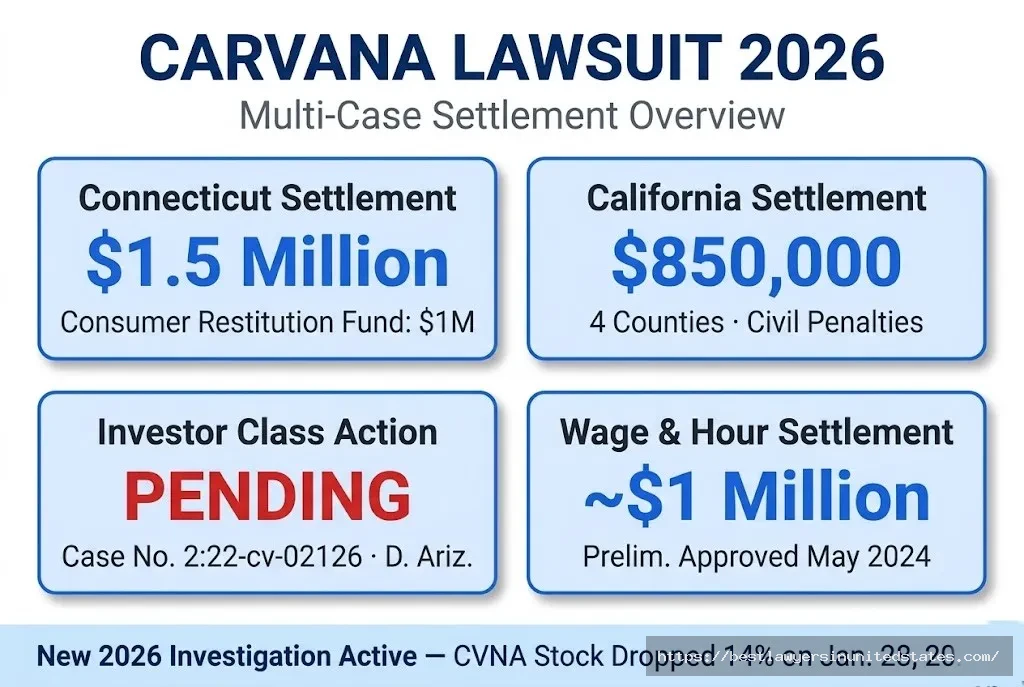
Quick Answer: Carvana has settled multiple lawsuits — including a $1.5 million settlement with the Connecticut Attorney General (January 2025), an $850,000 settlement with California counties, and a ~$1 million wage and hour class action settlement. A separate securities fraud investor class action (Case No. 2:22-cv-02126, U.S. District Court for the District of Arizona) is currently in the discovery phase heading toward trial, and fresh investigations triggered by a January 2026 short-seller report could result in a new investor lawsuit. Read on for everything you need to know about each case, who qualifies, and what to do next. The Stepping Stones Group Lawsuit
What Is the Carvana Lawsuit About?
Carvana — headquartered in Tempe, Arizona — is the second-largest used-car retailer in the U.S., known for its flashy vending-machine dealerships and fully online car-buying experience. But behind the slick marketing, the company has faced a cascade of legal problems involving three main areas: failing to transfer vehicle titles and registrations on time, misleading investors about its financial health and compliance record, and underpaying hourly workers.
These are not isolated complaints. Multiple state attorneys general, federal courts, and pension fund investors have taken action, with cases stretching from Pennsylvania to California to Arizona federal court.
Overview of Active Carvana Lawsuits
| Lawsuit Type | Jurisdiction | Status (March 2026) | Settlement/Amount |
|---|---|---|---|
| Consumer — Title & Registration (Connecticut) | Hartford Superior Court | Settled (Jan. 2025) | $1.5 million ($1M restitution + $500K penalty) |
| Consumer — Title & Registration (California) | Los Angeles, Santa Clara, San Diego, Ventura Counties | Settled (2021) | $850,000 |
| Consumer — Title & Registration (Illinois) | Illinois Secretary of State | Settled | $250,000 bond forfeited |
| Consumer — Title & Registration (Pennsylvania) | U.S. District Court, E.D. Pa. (Case No. 2:21-cv-05400) | Active class action | Not yet settled |
| Securities Fraud — Investor Class Action | U.S. District Court, D. Ariz. (Case No. 2:22-cv-02126) | In discovery, heading toward trial | Not yet settled |
| New Securities Investigation (Gotham City Report) | Under investigation, multiple law firms | Investigation stage (Jan. 2026) | Not yet filed |
| Wage & Hour (California) | U.S. District Court, N.D. Cal. | Prelim. approval (May 2024) | ~$1 million |
Timeline of Key Events
| Date | Event | Details |
|---|---|---|
| May 6, 2020 | Start of investor class period | Carvana begins alleged misleading statements to investors |
| 2021 | California counties settlement | $850K settlement over title and registration issues |
| Dec. 10, 2021 | Pennsylvania class action filed | Jennings et al. v. Carvana, LLC, Case No. 2:21-cv-05400 |
| Feb. 2022 | Illinois investigation launched | Secretary of State investigates after 100+ complaints |
| June 24, 2022 | End of investor class period | Carvana stock crash; 2,500+ workers laid off |
| Aug. 2022 | Securities class action filed | Case No. 2:22-cv-02126, D. Ariz. |
| Jan. 2022 | Connecticut investigation begins | Hundreds of consumer complaints filed |
| Jan. 2023 | Illinois settlement | Carvana admits violations, forfeits $250K bond |
| Oct. 2022 | Wage & hour class action filed | Claims workers not paid for off-the-clock time |
| 2024 | Motions to dismiss defeated | Arizona federal judge lets securities claims proceed |
| May 2024 | Wage & hour prelim. approval | ~$1 million settlement preliminarily approved |
| Jan. 14, 2025 | Connecticut AG settlement announced | $1.5M settlement, $1M consumer restitution fund |
| Feb. 3, 2025 | Securities case clears reconsideration motion | Case advances to discovery phase |
| Jan. 28, 2026 | Gotham City Research short-seller report | CVNA stock drops ~14% in one day |
| Feb. 2026 | New securities investigations launched | Multiple law firms announce investigations |
| March 2026 | Securities case in active discovery | Proceeding toward potential trial |
Who Filed the Lawsuits?
The legal actions span both government enforcement and private litigation:
- Consumer cases: Connecticut Attorney General William Tong, the California counties of Los Angeles, Santa Clara, San Diego, and Ventura, and the Illinois Secretary of State’s office have all pursued enforcement actions.
- Investor securities class action: Lead plaintiffs are the United Association National Pension Fund and Saskatchewan Healthcare Employees’ Pension Plan, represented by Robbins Geller Rudman & Dowd LLP. The named defendants include Carvana Co., founder Ernie Garcia III, other executives, and underwriters Citigroup and J.P. Morgan Securities LLC.
- Pennsylvania consumer class action: Filed by Dana Jennings and Joseph A. Furlong on behalf of a nationwide class of buyers east of the Mississippi River.
- New 2026 investigation: Multiple law firms — including Bleichmar Fonti & Auld LLP, Block & Leviton, and Kirby McInerney LLP — have launched investigations following the Gotham City Research report.
What Are the Allegations?
The claims against Carvana fall into four main categories:
Consumer Protection (Title & Registration):
- Carvana failed to transfer vehicle titles within the legally required timeframe, sometimes taking months or over a year
- The company issued repeated out-of-state temporary registration tags instead of permanent plates, violating state laws
- Customers couldn’t legally drive, insure, or sell their vehicles due to missing titles
- Carvana misrepresented vehicle conditions, features, and specifications at time of sale
- The company delayed payments and loan payoffs when purchasing or trading in vehicles
Securities Fraud (Investor Class Action):
- Carvana and its executives allegedly misled investors about the sustainability of its retail sales growth
- The company allegedly hid that it was violating title and registration laws across multiple states
- Executives are accused of failing to disclose regulatory actions, license suspensions, and business restrictions in Arizona, Illinois, Pennsylvania, Michigan, and North Carolina
- Founder Ernie Garcia III’s father, Ernest Garcia II, allegedly sold $3.6 billion in Carvana stock while prices were artificially inflated
New 2026 Accounting Allegations:
- The January 2026 Gotham City Research report alleges Carvana’s reported profits relied on undisclosed related-party transactions with DriveTime and Bridgecrest (both connected to Ernest Garcia II)
- DriveTime allegedly burned over $1 billion in cash to subsidize Carvana’s earnings
- Bridgecrest allegedly marked down billions in loans while Carvana recognized gains on loan sales
Wage & Hour:
- Carvana allegedly failed to pay hourly and non-exempt employees for all hours worked, including off-the-clock preparation time and unpaid breaks at security posts
Who Qualifies for Each Carvana Lawsuit or Settlement?
Your eligibility depends entirely on which type of case applies to your situation. Here’s a breakdown by case category.
Connecticut Consumer Settlement (Settled — January 2025)
Quick Answer: You may qualify if you bought a used vehicle from Carvana in Connecticut after January 1, 2019, and suffered losses due to delayed title transfers, delayed loan payoffs, or misrepresented vehicle conditions. Submit your claim to: [email protected]
Connecticut Eligibility Checklist
| Requirement | Details | Documentation Needed |
|---|---|---|
| Purchased from Carvana in CT | Must be a Connecticut-based purchase | Purchase agreement or order confirmation |
| Purchase date | After January 1, 2019 | Bill of sale or financing agreement |
| Suffered a qualifying harm | Title/registration delay, delayed loan payoff, or misrepresented vehicle | See below |
| Out-of-pocket losses | Fines, tickets, towing, extra payments | Receipts, citations, bank statements |
Qualifying harms include:
- Fines or penalties from driving with expired temporary tags
- Tickets for unregistered vehicle
- Additional loan payments made on a vehicle you traded in or sold to Carvana before Carvana paid off your existing loan
- Costs tied to inaccurate vehicle descriptions (repairs, inspections)
The $1 million restitution fund is administered by Carvana, with the claim contact being [email protected]. The Connecticut settlement also carries a $500,000 state penalty — $250,000 of which is suspended pending Carvana’s compliance going forward. ASAP Tickets Lawsuit 2026
Pennsylvania Consumer Class Action (Active)
The Pennsylvania class action (Jennings et al. v. Carvana, LLC, Case No. 2:21-cv-05400, U.S. District Court for the Eastern District of Pennsylvania) targets buyers nationwide — particularly those east of the Mississippi River — who experienced delayed title and registration transfers. This case is still active, and no settlement has been announced yet.
You may be part of the class if:
- You purchased a vehicle from Carvana anywhere in the U.S.
- Carvana failed to timely transfer your title or register your vehicle
- You received multiple temporary out-of-state tags instead of permanent registration
- You suffered damages — tickets, inability to drive, inability to insure the vehicle
Because this is still an active class action, you generally don’t need to take action to be included. If a settlement is reached, class members will receive notice by mail or email.
Securities Fraud Investor Class Action (Active — In Discovery)
Quick Answer: You may qualify if you purchased Carvana (NYSE: CVNA) stock between May 6, 2020 and June 24, 2022 and suffered losses when the stock dropped.
Investor Eligibility Checklist
| Requirement | Details | Documentation Needed |
|---|---|---|
| Purchased CVNA stock | Bought Carvana shares during the class period | Brokerage statements |
| Class period | May 6, 2020 – June 24, 2022 | Trade confirmations |
| Suffered a net loss | Stock value declined after purchase | Net loss calculation from brokerage |
| U.S. or foreign investor | Open to institutional and individual investors | Identity verification |
The case is represented by Robbins Geller Rudman & Dowd LLP. Contact them at [email protected] or (619) 338-3821 if you believe you have a claim.
New 2026 Securities Investigation
For the new investigation triggered by the January 28, 2026 Gotham City Research report, no lawsuit has yet been formally filed (as of March 2026). However, multiple law firms have opened investigations.
You may be affected if:
- You purchased CVNA stock and suffered losses tied to the January 28, 2026 stock drop (from approximately $477.72 to $410.04 per share — a decline of about 14.2%)
- Or if you held shares when the stock dropped
If a new class action is filed, the class period and eligibility dates will be formally defined in court filings. You can contact BFA Law at [email protected] or (212) 789-3619 to register your interest.
Wage & Hour Class Action (~$1 Million Settlement)
Quick Answer: You may qualify if you were a current or former hourly or non-exempt Carvana employee, particularly in California. The case received preliminary approval in May 2024.
| Requirement | Details |
|---|---|
| Employment status | Hourly or non-exempt Carvana employee |
| Type of harm | Unpaid off-the-clock work (shift prep, unpaid breaks) |
| Timeframe | During the applicable class period (review settlement notice for exact dates) |
Class members will be notified directly about this settlement. If you worked for Carvana in an hourly capacity and haven’t received a notice, contact the settlement administrator listed in your notice or search for updates on the PACER federal court system.
How Much Money Can You Get?
Compensation varies significantly depending on which case applies to you and what harm you experienced.
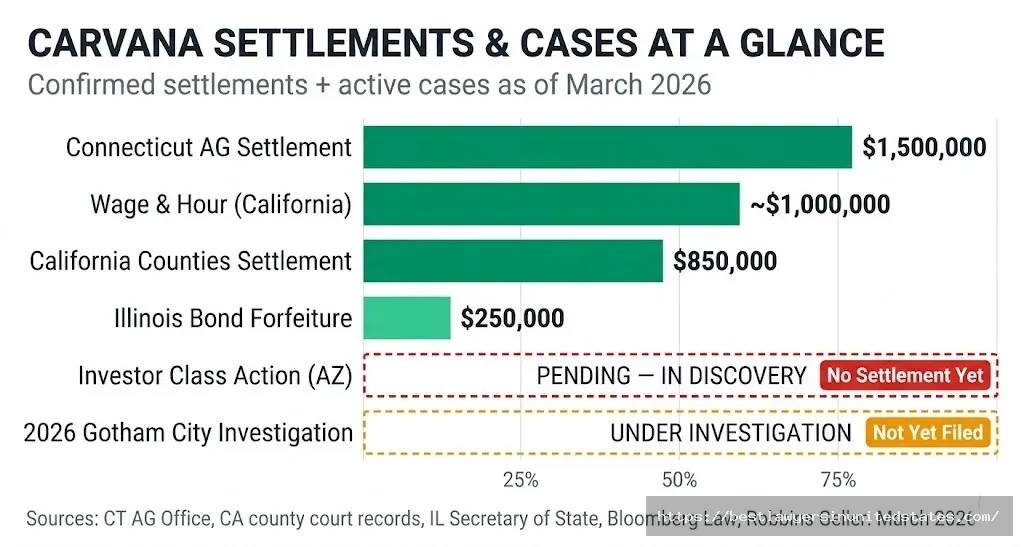
Settlement Fund Breakdown by Case
| Case | Total Settlement | Consumer/Investor Fund | State Penalties |
|---|---|---|---|
| Connecticut AG Settlement | $1.5 million | $1 million restitution fund | $500,000 ($250K suspended) |
| California Counties Settlement | $850,000 | $250,000 restitution + admin | $600,000 civil penalties |
| Illinois Settlement | ~$250,000 bond | N/A | $250,000 bond forfeited |
| Wage & Hour (California) | ~$1 million | Class member distributions | N/A |
| Pennsylvania Class Action | Pending | Pending | N/A |
| Investor Securities Class Action | Pending | Pending | N/A |
Estimated Consumer Payouts
How much you get from the Connecticut or similar consumer settlements depends on what actually happened to you. There are no fixed tiers published by the court — your reimbursement reflects documented out-of-pocket losses.
| Type of Loss | What You May Recover | Documentation Required |
|---|---|---|
| Traffic citations for expired tags | Full citation amount | Court records or ticket copy |
| Towing/impound fees | Full towing and storage costs | Receipts |
| Extra loan payments (vehicle you sold) | Payments made after Carvana picked up vehicle | Loan statements |
| Undisclosed vehicle defects/damage | Repair costs or cost difference | Repair invoices, inspection reports |
| Administrative fees (re-registration) | Filing and DMV fees | DMV receipts |
For the investor class action, your recovery — if and when the case settles or goes to trial — would be based on your documented losses from buying CVNA stock during the class period. Securities class action recoveries typically pay out cents on the dollar of total losses, depending on the settlement fund size.
How to File Your Claim — Step by Step
The right steps depend on which case you’re pursuing.
For the Connecticut Consumer Settlement
Step 1: Determine you qualify. You purchased a Carvana vehicle in Connecticut after January 1, 2019, and experienced a qualifying harm.
Step 2: Gather your documents. You’ll need your purchase agreement, any traffic citations, DMV correspondence, loan statements, and receipts for out-of-pocket costs.
Step 3: Write your claim. Draft a written summary of your experience and the losses you suffered. Be specific — include dates, dollar amounts, and reference any documentation you’re attaching.
Step 4: Submit your claim. Email your claim to: [email protected] — this is the official restitution contact designated in the Connecticut Attorney General’s settlement agreement.
Step 5: Keep a copy. Save your email and any reply from Carvana. Note the date you submitted.
Step 6: Follow up. If you don’t hear back within a reasonable period (30–60 days), contact the Connecticut Attorney General’s office for assistance.
For the Pennsylvania or Other Active Class Actions
In most class actions, you don’t need to file anything to be included — you’re automatically part of the class if you meet the eligibility criteria. However, you do need to act if:
- You want to opt out (preserve your right to sue individually)
- You want to object to a settlement you think is inadequate
- A settlement is reached and you need to submit a claim form (you’ll be notified by mail or email)
Watch your mail. Settlement notices are sent to last-known addresses — keep your contact information current with your lender or DMV, as those records are often used to identify class members.
For the Investor Securities Class Action
Step 1: Pull your brokerage records. Locate all records of CVNA purchases between May 6, 2020 and June 24, 2022.
Step 2: Calculate your net loss. Your net loss accounts for purchases, sales, and the timing of each. A securities attorney can help you calculate this accurately.
Step 3: Contact lead counsel. Reach out to Robbins Geller Rudman & Dowd LLP, the lead counsel in this case, at [email protected] or (619) 338-3821.
Step 4: Monitor the case. The case is in discovery as of early 2026. No settlement has been announced. Stay informed at the court’s PACER portal or through your attorney.
Critical Deadlines Table
| Deadline | Case | What It Means |
|---|---|---|
| Ongoing | Connecticut consumer restitution | Submit to [email protected] — no fixed public deadline announced, but act promptly |
| Pending announcement | Pennsylvania class action | Watch for settlement notice; opt-out deadlines will be stated in the notice |
| Pending announcement | Investor securities class action | No trial date set; case is in discovery |
| Pending announcement | New 2026 CVNA investigation | Investigation phase — no lawsuit yet filed as of March 2026 |
| Already passed | California counties settlement | 2021 settlement; claim period closed |
| Check your notice | Wage & hour class action | Settlement approved May 2024 — class member notices should have been sent |
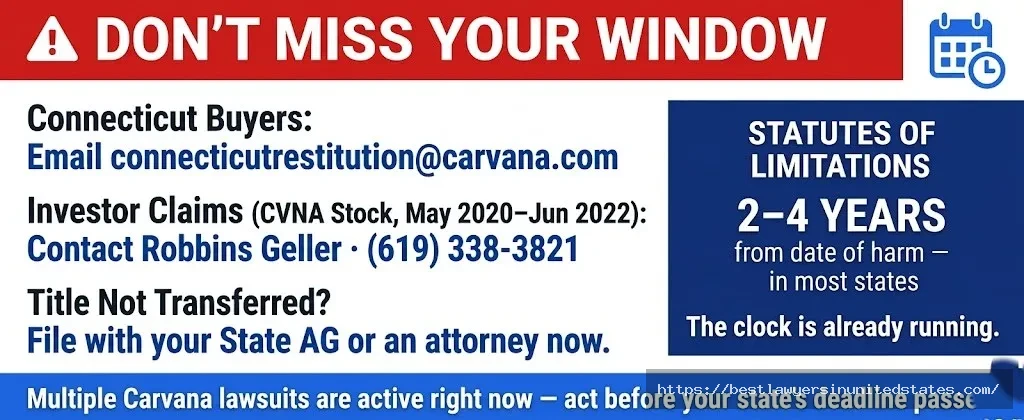
Don’t wait. Consumer protection claims can be subject to statutes of limitations — in most states, you have between 2 and 4 years from the date of harm to bring a legal claim. If your experience was several years ago, act quickly.
Current Lawsuit Status & Latest Updates (March 2026)
Connecticut AG Settlement
The Connecticut Attorney General’s $1.5 million settlement was announced on January 14, 2025 and filed in Hartford Superior Court for approval. The settlement was the result of a three-year investigation that began in January 2022. The $1 million restitution fund is now active for Connecticut consumers, with claims submitted to [email protected].
Pennsylvania Class Action — Still Active
The Pennsylvania case (Jennings et al. v. Carvana, LLC, Case No. 2:21-cv-05400) continues to move through federal court. A judge previously denied Carvana’s motion to dismiss or compel arbitration, which means the case is proceeding on the merits. No settlement has been reached as of March 2026.
Investor Securities Class Action — Heading Toward Trial
This is the most significant ongoing Carvana legal battle for investors. On February 3, 2025, Robbins Geller defeated Carvana’s motion for reconsideration — meaning the court will not revisit its earlier decision to let the case proceed. The case is now in the discovery phase, with plaintiffs seeking documents related to Carvana’s operations, compliance failures, and the alleged $3.6 billion in insider stock sales by Ernest Garcia II during the class period.
Plaintiffs allege that Carvana and Ernie Garcia III artificially inflated the stock price, enabling Garcia II to cash out billions before the bubble burst in May 2022, when the stock crashed and Carvana laid off more than 2,500 workers.
New 2026 Investigation (Gotham City Research Report)
On January 28, 2026, short-seller research firm Gotham City Research published a report titled “Carvana: Bridgecrest and the Undisclosed Transactions and Debts.” The report alleged that Carvana’s reported profitability is deeply tied to a network of related-party entities controlled by Ernest Garcia II — including DriveTime, Bridgecrest, and GoFi. Specifically, the report claims DriveTime burned over $1 billion in cash to subsidize Carvana’s earnings, and that Bridgecrest marked down billions in auto loans while Carvana simultaneously recognized gains on those same loan sales.
On the day the report was published, CVNA stock dropped from approximately $477.72 to $410.04 — a decline of about $67.68 per share, or roughly 14.2%. Multiple securities law firms immediately launched investigations. As of March 2026, no new lawsuit has been formally filed, but the investigation is active.
What Happens Next?
- Spring–Summer 2026: Discovery in the existing investor class action continues; possible deposition of key executives
- 2026: Pennsylvania consumer class action may move toward summary judgment or settlement discussions
- 2026: New securities investigations may result in a formal class action filing related to the Gotham City report
- Ongoing: Connecticut consumer restitution claims are processed
Carvana Lawsuits vs. Similar Used-Car Industry Cases
To understand the scale of Carvana’s legal troubles, it helps to see how they compare to other major used-car and auto-dealer lawsuits. Is Instant Dream Home Fake?
How This Compares to Similar Cases
| Company/Case | Settlement Amount | Key Issue | Status |
|---|---|---|---|
| Carvana (CT AG Settlement) | $1.5 million | Title delays, consumer fraud | Settled (2025) |
| Carvana (CA Counties) | $850,000 | Title/registration violations | Settled (2021) |
| Carvana (Investor Class Action) | Pending | Securities fraud, stock inflation | In discovery |
| CarMax consumer settlements | Varied by state | Vehicle condition disclosures | Multiple settled |
| AutoNation (various) | Varied | Consumer and financing issues | Various |
| Vroom Inc. (title/reg) | $3.5 million (TX AG, 2022) | Same title/registration issues | Settled |
Carvana and Vroom faced almost identical complaints about title and registration failures — both companies grew rapidly during the pandemic and struggled to keep pace with processing demand. The difference is that Carvana’s legal exposure is larger, spanning more states and a parallel securities fraud case of significant scale.
What Makes the Carvana Case Unique?
Three things set Carvana’s lawsuits apart from typical used-car dealer disputes:
First, the scale. The title and registration failures weren’t isolated — they affected buyers across at least a dozen states simultaneously, generating hundreds of complaints per state in some cases.
Second, the insider trading dimension. The investor class action doesn’t just allege garden-variety stock inflation. It specifically targets the alleged coordination between Carvana’s leadership (Ernie Garcia III) and its largest shareholder (his father, Ernest Garcia II), who allegedly sold $3.6 billion in stock before the crash. That father-son dynamic makes this a particularly complex and legally novel case.
Third, the fresh 2026 accounting allegations. Even as the original investor case works through discovery, entirely new potential fraud allegations have surfaced — suggesting that the legal exposure for Carvana investors may not be fully known yet.
Do You Need a Lawyer to File a Claim?
Quick Answer: For the Connecticut consumer restitution fund, no — you can submit your claim directly to Carvana by email. For the active class actions, you’re typically included automatically and only need a lawyer if you want to take specific legal action. For the investor case, consulting a securities attorney is strongly recommended.
When You Can Handle It Yourself
If your situation is straightforward — you bought a car from Carvana, experienced a specific, documentable harm, and you’re submitting a claim to a consumer restitution fund — you can handle that on your own. The Connecticut restitution process is a direct email submission, not a formal court proceeding.
Similarly, if you’re a class member in the Pennsylvania or wage/hour cases, you’ll automatically receive a notice with instructions when and if a settlement is reached. Filing a claim response is typically a simple online form.
When Legal Help Is Worth It
Consider talking to an attorney if:
- Your damages are significant (thousands of dollars in losses)
- Carvana is ignoring your requests for your title or registration right now
- You want to pursue an individual arbitration claim rather than waiting for a class settlement
- You’re an investor with substantial CVNA losses during the class periods
- Carvana denied your restitution claim and you believe you’re entitled to compensation
One important note: Many consumer protection law firms take Carvana title cases on contingency — meaning you pay nothing unless they win. The same is true for securities class action firms.
Where to Get Help
- Connecticut restitution: [email protected]
- Pennsylvania consumer class action: Contact plaintiffs’ counsel or monitor the docket at PACER (Case No. 2:21-cv-05400)
- Investor class action: Robbins Geller Rudman & Dowd LLP — (619) 338-3821 or [email protected]
- New 2026 investigation: BFA Law — [email protected] or (212) 789-3619
- Title/registration issues in any state: Kneupper & Covey PC handles consumer arbitrations nationwide; firms in your state may also take these cases on contingency
Frequently Asked Questions
What is the Carvana lawsuit about?
Quick Answer: There are multiple lawsuits — the main ones involve Carvana failing to transfer vehicle titles on time (consumer fraud), misleading investors about the company’s finances and compliance (securities fraud), and underpaying hourly workers (wage theft).
There’s no single “Carvana lawsuit.” Several different cases are active or recently settled, covering consumers in multiple states, stock investors, and former employees. The most significant ongoing cases are the federal securities fraud class action in Arizona and the Pennsylvania consumer class action.
Who is eligible for the Connecticut settlement?
Quick Answer: Anyone who bought a used car from Carvana in Connecticut after January 1, 2019, and suffered losses due to title/registration delays, delayed loan payoffs, or misrepresented vehicle conditions.
Submit your claim in writing to [email protected]. Include a description of what happened and documentation of any out-of-pocket costs.
How much money will I get?
Quick Answer: For Connecticut consumers, it depends on your documented losses — there are no fixed payment tiers. The total fund is $1 million. For investors, no settlement has been reached yet in the main securities case.
There’s no set payment per claim in the consumer cases. Recoveries are based on what you can document and prove. If you were fined $200 in traffic tickets because Carvana didn’t get you your registration, you’d claim that $200. Larger losses produce larger potential claims.
Is there a deadline to file a Carvana consumer claim?
Quick Answer: No hard public deadline has been published for the Connecticut consumer restitution fund, but you should act promptly — consumer protection statutes of limitations still apply, and funds are finite.
For active class actions (Pennsylvania), don’t file anything yet — wait for a formal settlement notice with specific deadlines.
How do I file a claim for title and registration issues?
Quick Answer: For Connecticut, email [email protected] with a written description of your harm and supporting documents. For other states, you may need to consult a consumer protection attorney.
If you’re in a state without a specific restitution fund, your options may include a direct arbitration claim against Carvana, a complaint to your state’s Attorney General, or joining a class action if one covers your state.
Do I need a lawyer?
Quick Answer: No, not for the Connecticut consumer restitution process. But for individual arbitration claims, investor cases, or complex situations, having one significantly improves your chances of recovery.
Most consumer protection attorneys take these cases on contingency, so there’s often no upfront cost.
What documents do I need to file a consumer claim?
Quick Answer: You’ll generally need your purchase agreement, any correspondence with Carvana, traffic citations or registration rejections, and receipts for any money you lost.
| Document | Why You Need It | Where to Find It |
|---|---|---|
| Vehicle purchase agreement | Proves you bought from Carvana and when | Carvana account or email confirmation |
| Temporary tag copies | Shows pattern of delays | Carvana communications or your vehicle |
| Traffic citations | Documents out-of-pocket harm | Court records or your files |
| Bank statements | Shows loan payments made on a traded-in vehicle | Your bank |
| DMV rejection or delay notices | Proves title/registration failure | DMV correspondence |
| Repair invoices | Documents undisclosed defects | Your mechanic |
What if I don’t have my paperwork anymore?
Quick Answer: You may still be able to file. DMV records, court records for citations, and bank statements can often be retrieved even years later.
Contact your state DMV for registration records, your bank for historical statements, and your county court for any citation history. Carvana itself may also have records of your purchase accessible through your online account.
When will I receive payment?
For the Connecticut restitution fund, there’s no publicly announced timeline for disbursements. Reach out to [email protected] after submitting your claim to ask about processing time.
For the pending class actions, no payments will be made until a court approves a settlement and a claims process is set up — which typically takes 12–24 months after a settlement is announced.
What is the securities fraud class action about specifically?
Quick Answer: Investors allege that Carvana and its leadership misled stockholders about the company’s growth and regulatory compliance between May 2020 and June 2022, while insiders allegedly sold billions in stock before the price collapsed.
The case (Case No. 2:22-cv-02126, U.S. District Court for the District of Arizona) claims that Carvana issued false and misleading financial statements, hid regulatory troubles in multiple states, and artificially inflated its stock price — while founder Ernie Garcia III’s father sold approximately $3.6 billion in shares at those inflated prices.
What happened in Illinois?
Carvana admitted to violating Illinois state law when it failed to transfer vehicle titles in a timely manner and issued out-of-state temporary registration tags — also a violation. As part of a settlement with the Illinois Secretary of State, Carvana forfeited a $250,000 bond it had previously posted with the state. Carvana’s Vice President and General Counsel at the time, Paul Breaux, faced more than 80 criminal charges in DuPage County related to the violations.
What is the Gotham City Research report about?
Quick Answer: It’s a January 2026 short-seller report alleging that Carvana’s profits are propped up by undisclosed transactions with related companies controlled by Ernest Garcia II — which, if true, would mean Carvana’s financial results are misleading.
The report caused CVNA stock to drop about 14% in a single day, triggering fresh securities fraud investigations by multiple law firms. No formal lawsuit has been filed on this theory as of March 2026, but investigations are ongoing.
Can I opt out of a class action?
Yes. If you receive a class action settlement notice, it will include instructions for opting out if you’d prefer to pursue your own individual lawsuit. Opting out makes sense only if you believe your individual damages are large enough to justify separate litigation — which typically requires a lawyer.
What if Carvana still hasn’t given me my title?
This is an active problem for some buyers even today. If Carvana has not transferred your title and registration, you have several options: (1) File a complaint with your state’s Attorney General or DMV; (2) File an arbitration claim through a consumer protection attorney; (3) Contact your state’s DMV directly to investigate whether a lien release or title transfer is stuck. Many consumer protection attorneys take these cases on contingency.
Will my settlement payment be taxable?
In most cases, compensation that reimburses you for actual out-of-pocket expenses (fines, tickets, fees) is not taxable income. However, if any portion of a payment represents punitive damages or interest, that portion may be taxable. Consult a tax professional if you receive a significant payment.
How do I check the status of an active Carvana case?
You can monitor federal case filings at PACER (pacer.gov) using the case numbers listed in this article. For the Connecticut consumer settlement, contact the AG’s office or Carvana directly at [email protected]. For the investor class action, Robbins Geller posts updates at rgrdlaw.com.
Where is the official claim form?
For the Connecticut consumer restitution, there is no formal claim form — the process is a written email submission to [email protected]. For other class actions, official claim forms are sent directly to class members by mail or email when a settlement is approved by the court.
This article is for informational purposes only and does not constitute legal advice. Laws and case statuses change. Consult a licensed attorney for guidance specific to your situation. Information current as of March 13, 2026.
