
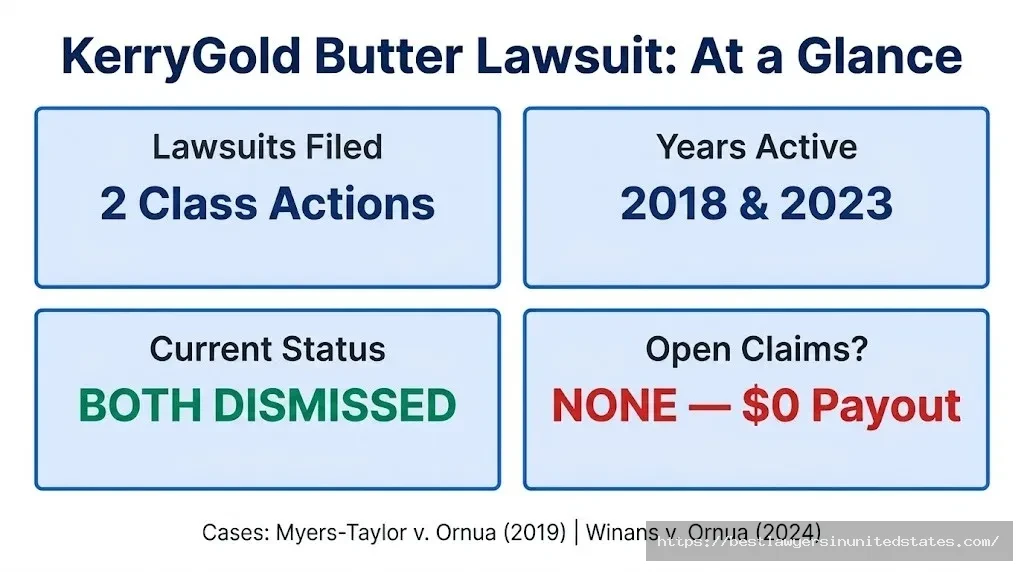
The KerryGold butter lawsuit refers to two separate class action lawsuits filed against Ornua Foods North America — the company behind KerryGold — alleging false and misleading product labeling.
The first, filed in 2018, challenged the brand’s “grass-fed” claims. The second, filed in 2023, alleged that KerryGold’s “Pure Irish Butter” packaging contained toxic PFAS “forever chemicals” that contaminated the product itself.
Both cases have since been resolved — the 2018 case was dismissed in early 2019, and the 2023 PFAS case was dismissed in August 2024.
Quick Answer: There is currently no open KerryGold butter class action settlement where consumers can file claims for money. Both lawsuits ended without any public settlement fund or compensation payout to buyers. However, these cases forced KerryGold to update its packaging and raised serious questions about food labeling transparency that every consumer deserves to understand.
This guide covers everything — what happened in both lawsuits, who filed them, why the courts ruled as they did, and what it all means for you as a KerryGold customer today. Carvana Lawsuit
What Is the KerryGold Butter Lawsuit About?
Background of the Lawsuits
KerryGold is one of the most recognizable butter brands in the United States. It’s the second-best-selling butter in the country, with a loyal customer base built almost entirely on the promise of purity and premium grass-fed dairy. That reputation is exactly what attracted legal scrutiny.
Two separate class action lawsuits challenged KerryGold’s marketing at different times and on different grounds. The first targeted the brand’s “grass-fed cows” claim, arguing that Irish dairy cows eat supplemental grain and are not exclusively grass-fed. The second focused on the foil packaging itself, arguing that PFAS chemicals — synthetic substances linked to serious health risks — migrated from the wrapper into the butter.
Neither lawsuit resulted in a public monetary settlement that consumers could claim. But both cases had real consequences for how KerryGold labels and packages its products, and together they sparked a broader conversation about food marketing honesty in the U.S. dairy industry.
Timeline of Key Events
| Date | Event | Details |
|---|---|---|
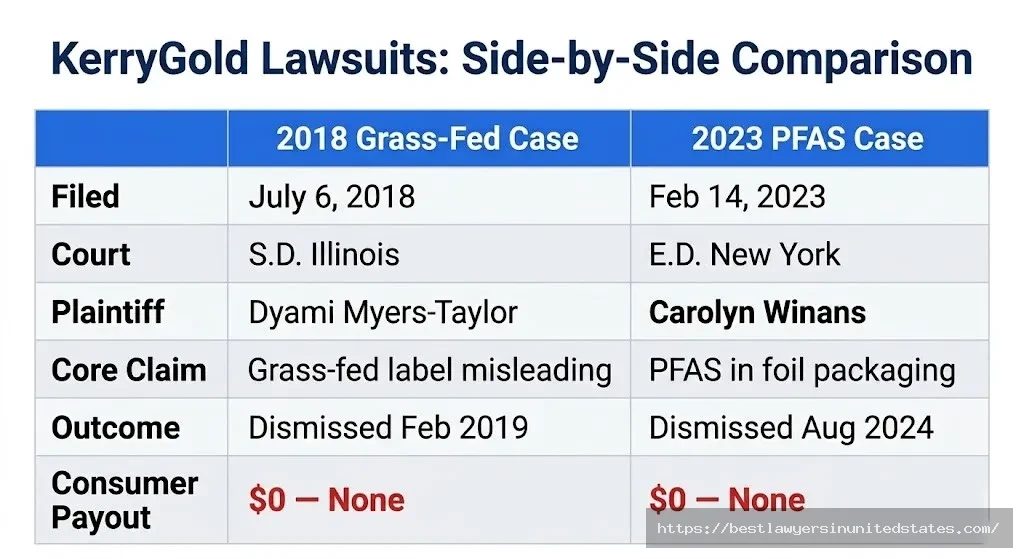
| July 6, 2018 | Grass-fed class action filed | Myers-Taylor v. Ornua Foods N.A., No. 18-1538, S.D. Cal. |
| February 4, 2019 | Grass-fed case dismissed | Judge Huff found plaintiff failed to state a valid claim |
| March 5, 2019 | Plaintiff voluntarily withdraws | Dismissed without prejudice; plaintiff chose not to amend |
| February 14, 2023 | PFAS class action filed | Winans v. Ornua Foods N.A., Case No. 2:23-cv-01198, E.D.N.Y. |
| 2023 | New York PFAS packaging ban enacted | State law banned PFAS in all food packaging |
| 2023–2024 | KerryGold recalls packaging | Product pulled from shelves in NY and CA; packaging reformulated |
| April 23, 2024 | Court partially trims PFAS case | Some claims allowed to proceed; others dismissed |
| August 14, 2024 | PFAS case dismissed with prejudice | Joint filing by both parties; Judge Block signed dismissal |
| 2025–2026 | KerryGold back on shelves | Updated packaging now complies with state regulations |
Who Filed the Lawsuits?
Grass-fed lawsuit (2018): A San Diego-based real estate executive named Dyami Myers-Taylor filed the case in California federal court against Ornua Foods North America — the U.S. arm of Ornua Co-operative Limited, the Irish co-operative that owns the KerryGold brand.
PFAS lawsuit (2023): Plaintiff Carolyn Winans filed the class action against Ornua Foods North America Inc. on February 14, 2023, in the U.S. District Court for the Eastern District of New York, alleging violations of state and federal consumer protection laws. She was represented by The Sultzer Law Group PC and Milberg Coleman Bryson Phillips Grossman PLLC.
What Were the Allegations?
In the grass-fed lawsuit, the key claims were:
- ✅ KerryGold misrepresented its products as made from “milk from grass-fed cows”
- ✅ The cows were actually fed soy, corn, and other grains, including GMO varieties
- ✅ KerryGold used supplemental grain feeding as a cost-saving measure while charging consumers a health-food premium
- ✅ Labels stating “All Natural” and “100% Pure and Natural” were false and misleading
- ✅ The marketing deliberately targeted health-conscious consumers who pay more for grass-fed products
In the PFAS lawsuit, the key claims were:
- ✅ KerryGold’s foil packaging contained per- and polyfluoroalkyl substances (PFAS), known as “forever chemicals”
- ✅ PFAS from the packaging migrated into the butter itself
- ✅ Calling the product “Pure Irish Butter” was false and misleading given this chemical contamination
- ✅ PFAS have been linked to thyroid disorders, immunotoxicity, hormone disruption, reproductive problems, and various cancers
- ✅ KerryGold violated New York state consumer protection laws by selling a product labeled “pure” that allegedly contained synthetic chemical contaminants
The Grass-Fed Lawsuit: Full Breakdown
The Core Claim
The 37-page complaint in the 2018 case argued that KerryGold systematically misled American consumers about how its cows were raised. The lawsuit claimed that while KerryGold’s labels and advertising prominently featured “grass-fed” language, the reality on Irish dairy farms was different. Irish cows — particularly during winter months or periods of bad weather when pasture grass is scarce — are routinely fed supplemental soy, corn, and grain-based feed, including feed derived from genetically modified crops.
The plaintiff argued that KerryGold knew consumers associated “grass-fed” with higher nutritional value and a superior product, and that the company exploited that perception to charge premium prices. Butter from grass-fed cows is believed by many consumers to contain higher levels of omega-3 fatty acids, conjugated linoleic acid (CLA), and vitamins A and K2 compared to butter from conventionally fed cows. The lawsuit said buyers were paying for benefits they weren’t actually getting.
How the Judge Ruled
The case didn’t survive its first significant court challenge. U.S. District Judge Marilyn L. Huff dismissed the complaint in February 2019, finding that the plaintiff failed to state a claim upon which relief could be granted.
The judge’s reasoning matters. She pointed out that KerryGold’s actual product packaging never claimed its cows were fed 100% grass — and that the company’s own website stated cows are fed between 85 and 90 percent grass. She concluded that a reasonable consumer would not be led to believe the butter came from cows fed exclusively on grass based on how the label was worded.
In other words, the court found that “grass-fed” doesn’t legally mean “only grass, ever, 100% of the time” — and that KerryGold’s label, read carefully, didn’t actually make that absolute claim. The plaintiff chose not to amend the complaint and voluntarily dismissed the case on March 5, 2019. No settlement was reached. No consumers received compensation.
Grass-Fed Lawsuit Overview Table
| Item | Details |
|---|---|
| Case Name | Myers-Taylor v. Ornua Foods North America, Inc. |
| Case Number | No. 18-1538 |
| Court | U.S. District Court, Southern District of California |
| Filed | July 6, 2018 |
| Lead Plaintiff | Dyami Myers-Taylor |
| Defendant | Ornua Foods North America, Inc. & Ornua Co-operative Limited |
| Core Claims | False advertising, breach of warranty, fraud, negligent misrepresentation |
| Dismissed | February 4, 2019 (by court); March 5, 2019 (voluntarily by plaintiff) |
| Settlement | None |
| Consumer Payout | None |
The PFAS “Forever Chemicals” Lawsuit: Full Breakdown
What Are PFAS and Why Does It Matter for Butter?
PFAS — per- and polyfluoroalkyl substances — are a group of thousands of synthetic chemicals used widely in food packaging, cookware, clothing, and firefighting foam because of their water-resistant and non-stick properties. The problem is that these chemicals don’t break down in the environment or in the human body. They accumulate over time.
Scientists have linked PFAS exposure to thyroid disorders, hormone disruption, immunotoxicity, various cancers, reproductive problems, and developmental issues in children. Because they persist in the body even at very low levels, health experts consider them one of the most serious chemical contamination concerns in modern food safety.
For a butter brand built on the word “pure,” the allegation that PFAS were migrating from the foil wrapper into the product was a major problem — both legally and reputationally.
How the 2023 Lawsuit Was Filed
Carolyn Winans filed the 35-page complaint in February 2023 in New York federal court. She alleged that KerryGold salted and unsalted butter sticks were falsely advertised as “Pure Irish Butter” because the foil packaging contained PFAS that leached into the butter itself. The proposed class covered all U.S. consumers who purchased KerryGold butter sticks for personal use during the longest period allowed by law.
Winans asserted five causes of action: deceptive business acts or practices, false advertising, selling adulterated or misbranded food, negligence per se, and unjust enrichment. She sought both money damages and injunctive relief.
Court’s April 2024 Ruling
The case partially survived an early motion to dismiss. In an April 23, 2024 ruling, the court allowed the core claim to proceed — specifically, that marketing and labeling KerryGold butter as “pure” was false or misleading if PFAS had in fact migrated from the packaging into the product. Some other claims were trimmed out, but the central false-advertising theory was green-lit to move forward.
The August 2024 Dismissal
The case never made it to trial. On August 14, 2024, U.S. District Judge Frederic Block dismissed the lawsuit with prejudice after both parties filed a joint request to end the case. The filing did not explicitly mention a settlement agreement, and both sides agreed to pay their own attorney fees.
What does that mean? A dismissal with prejudice means the case cannot be refiled. The joint nature of the dismissal — where both the plaintiff and defendant agreed to drop it — strongly suggests some private resolution occurred, but the terms were never made public. There is no confirmed settlement amount, no open claims process, and no compensation fund for consumers.
PFAS Lawsuit Overview Table
| Item | Details |
|---|---|
| Case Name | Winans v. Ornua Foods North America, Inc. |
| Case Number | 2:23-cv-01198-FB-RML |
| Court | U.S. District Court, Eastern District of New York |
| Filed | February 14, 2023 |
| Lead Plaintiff | Carolyn Winans |
| Defendant | Ornua Foods North America, Inc. |
| Core Claims | Deceptive practices, false advertising, selling adulterated food, negligence per se, unjust enrichment |
| Partial Survival | April 23, 2024 (core false advertising claim allowed to proceed) |
| Dismissed | August 14, 2024 (with prejudice, joint filing) |
| Public Settlement | None confirmed |
| Consumer Payout | None — no claims process was ever opened |
Can You Still File a Claim? (2026 Status)
⚠️ No. There is no open KerryGold butter settlement claim process in 2026. Both lawsuits have been fully resolved. There is no settlement administrator, no claims website, no deadline to file, and no compensation fund.
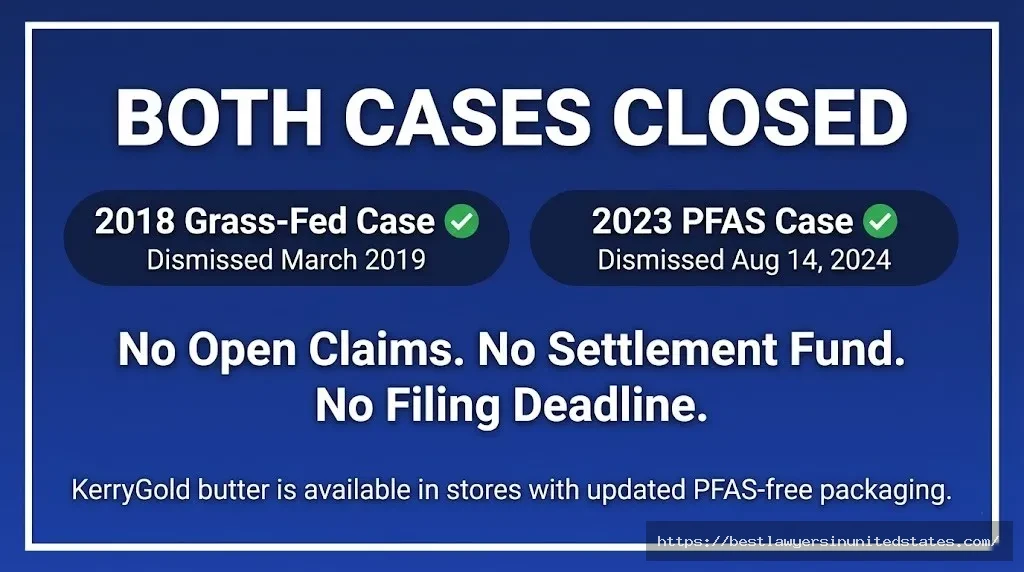
If you are seeing websites claiming you can file a KerryGold butter claim for cash, treat that information with serious skepticism. As of March 2026, no active settlement exists. Court records confirm both cases ended — one in 2019 and one in August 2024 — without any public consumer payout structure.
| Lawsuit | Status | Claims Process | Consumer Compensation |
|---|---|---|---|
| 2018 Grass-Fed Lawsuit | Dismissed (2019) | Never opened | None |
| 2023 PFAS Lawsuit | Dismissed with prejudice (Aug. 2024) | Never opened | None confirmed |
| Any active 2026 settlement | Does not exist | N/A | N/A |
If a new KerryGold lawsuit is filed in the future, this guide will be updated. For now, there is nothing to file.
What Changed Because of These Lawsuits?
Even without consumer payouts, the KerryGold lawsuits had real-world consequences.
Packaging Changes
After New York enacted a statewide ban on PFAS in food packaging in 2023, KerryGold recalled its butter products in New York and California. The company reformulated its foil packaging to remove PFAS-containing materials. KerryGold has since returned to shelves in both states with updated packaging that complies with current state regulations.
Labeling Transparency
The legal scrutiny pushed KerryGold and the broader dairy industry to be more precise about what “grass-fed” actually means. A label saying “grass-fed” doesn’t legally mean 100% grass-fed in all circumstances — a distinction that the 2019 court ruling made very clear. After both lawsuits, more food brands began specifying whether they mean “100% grass-fed” or using certifications from independent organizations to back up their claims.
Industry-Wide Impact
The KerryGold cases became reference points for how U.S. courts interpret food labeling claims made by international brands operating under different standards. EU agricultural practices don’t always align with what American consumers expect — and the gap between “grass-fed by Irish standards” and “exclusively grass-fed all year” is real and meaningful to health-conscious buyers.
Other butter and dairy brands began reviewing their own labels more carefully after these cases drew media attention. Regulatory agencies and consumer advocates pointed to these lawsuits when pushing for tighter oversight of PFAS levels in food packaging and more precise standards for “natural” and “grass-fed” claims.
Who Does This Affect? Understanding Your Rights as a Butter Buyer
If You Bought KerryGold Before 2024
You bought the product in good faith based on its labeling. The courts have weighed in on whether that labeling was legally actionable — and both cases ended without judgments against KerryGold or findings that the company violated the law.
That said, your concerns as a consumer are valid. Courts dismissing a lawsuit doesn’t mean the underlying questions about labeling honesty aren’t worth asking.
If You’re Buying KerryGold Now
The packaging has changed. KerryGold’s foil wrappers no longer contain PFAS materials — the company reformulated after the New York law took effect. The product on shelves today in 2026 reflects those updates.
On the grass-fed question, KerryGold’s position has always been that Irish cows graze on pasture for roughly 85–90% of their diet, with supplemental feeding during winter months. Whether that meets your personal standard for “grass-fed” is something you can now make an informed decision about.
Eligibility for Any Future Case
If a new class action related to KerryGold butter is filed, typical eligibility for food mislabeling cases usually requires:
| Factor | Typical Requirement |
|---|---|
| Purchase location | United States (sometimes limited to specific states) |
| Purchase type | Personal use, not for resale |
| Product type | The specific product named in the complaint |
| Time frame | Within the statute of limitations (varies by state, usually 3–4 years) |
| Documentation | Proof of purchase helpful but often not required at claim stage |
Again — no such case is currently open as of March 2026.
KerryGold Lawsuit vs. Similar Food Labeling Cases
The KerryGold litigation fits a well-established pattern of class action lawsuits targeting food brands over “natural,” “pure,” and “grass-fed” claims. Here’s how it compares:
| Lawsuit | Core Allegation | Outcome | Consumer Payout |
|---|---|---|---|
| KerryGold 2018 (Grass-Fed) | “Grass-fed” label misleading | Dismissed — plaintiff failed to state a claim | None |
| KerryGold 2023 (PFAS) | “Pure” label misleading due to PFAS in packaging | Dismissed with prejudice — joint filing | None confirmed |
| Kashi “All Natural” Lawsuit | “All Natural” label misleading due to synthetic ingredients | Settled — class members received vouchers | Small vouchers |
| Dannon Oikos Greek Yogurt Lawsuit | “All Natural” labeling with artificial ingredients | Settled for $45 million | Up to $10/household |
| Trader Joe’s “All Natural” Lawsuit | “All Natural” claim with synthetic ingredients | Settled | Small cash payments |
| Chobani “Natural” Lawsuit | Similar “all natural” claims challenged | Dismissed | None |
The KerryGold cases stand out because neither resulted in a consumer payout. In most food labeling class actions, companies settle to avoid prolonged litigation costs. KerryGold’s parent company, Ornua, successfully defended the grass-fed case outright and quietly resolved the PFAS case without any public settlement terms.
What Makes These Cases Unique
The KerryGold lawsuits are particularly notable for two reasons. First, they put an international brand in the crosshairs of American consumer protection law — raising questions about whether EU farming standards satisfy the expectations of U.S. buyers. Second, the PFAS case highlighted an issue that had nothing to do with what’s inside the butter but rather with the packaging itself. That’s a category of food safety litigation that’s growing rapidly across the industry.
Do You Need a Lawyer?
Quick Answer: Since there’s no open KerryGold settlement to file a claim in, there’s nothing to file without an attorney’s involvement. If you believe you have a personal injury claim related to PFAS exposure from food products generally, that’s a different matter — and yes, you’d want legal counsel.
When Legal Help Could Apply to Your Situation
Consider speaking with a consumer protection attorney if:
- You have specific documentation of health issues you believe are linked to PFAS exposure from food packaging
- You purchased KerryGold in large quantities over many years and are concerned about cumulative exposure
- You want to understand your rights if a new class action is filed in the future
- You’re a business that purchased KerryGold products for resale and want to understand liability questions
Free Consultation Option
Many consumer protection and class action law firms offer free consultations. You can also contact [email protected] for attorney referrals related to food safety and consumer protection matters. The Stepping Stones Group Lawsuit
Current Status: 2026 Update
As of March 2026, here is where everything stands:
| Issue | Current Status |
|---|---|
| 2018 Grass-Fed Lawsuit | Fully closed since March 2019 |
| 2023 PFAS Lawsuit | Fully closed since August 2024 |
| Open consumer claims process | None |
| KerryGold packaging | Updated; PFAS-containing foil removed |
| KerryGold product availability | Available in all U.S. states with updated packaging |
| New KerryGold lawsuit filed in 2025–2026 | None confirmed as of this writing |
The legal chapters involving KerryGold are closed for now. The product remains widely available. What changed is that you, as a consumer, now have more context about what the “grass-fed” and “pure” labels mean — and the limits of what those words legally guarantee.
Frequently Asked Questions
What is the KerryGold butter lawsuit?
Quick Answer: There were two KerryGold lawsuits — one in 2018 over “grass-fed” labeling claims, and one in 2023 over PFAS “forever chemicals” allegedly found in the butter’s packaging.
The 2018 lawsuit was filed in California and argued that KerryGold’s “grass-fed” label was misleading because the company’s cows are also fed soy, corn, and grain during parts of the year. That case was dismissed in early 2019 after a federal judge found a reasonable consumer would not interpret “grass-fed” as meaning exclusively grass. The 2023 lawsuit was filed in New York and alleged that PFAS chemicals in the foil packaging migrated into the butter, making the “Pure Irish Butter” label false. That case was dismissed in August 2024 via a joint filing by both parties.
Is there a KerryGold butter settlement I can file a claim for?
Quick Answer: No. There is no open KerryGold settlement fund or consumer claims process as of 2026.
Both lawsuits ended without any public settlement that consumers could file claims against. There is no official claims website, no settlement administrator, and no deadline to submit paperwork. If you see a site suggesting otherwise, verify it against official court records before submitting any personal information.
Who is Ornua Foods North America?
Quick Answer: Ornua Foods North America is the U.S. subsidiary of Ornua Co-operative Limited, the Irish dairy co-operative that owns the KerryGold brand.
Ornua (formerly known as the Irish Dairy Board) is the organization responsible for marketing and distributing Irish dairy products internationally. In the United States, Ornua Foods North America handles KerryGold’s U.S. operations and was named as the defendant in both class action lawsuits. All legal proceedings described in this article were brought against Ornua, not against individual Irish dairy farmers.
Did KerryGold do anything wrong?
Quick Answer: No court ever ruled that KerryGold violated the law. Both cases ended without findings of liability.
In the 2018 case, the judge specifically found that KerryGold’s “grass-fed” claims were not legally misleading to a reasonable consumer. In the 2023 case, the dismissal was reached by mutual agreement before a final ruling on the merits. KerryGold has consistently maintained that its products comply with all applicable laws and regulations.
What are PFAS and why were they a concern in KerryGold packaging?
Quick Answer: PFAS are synthetic chemicals used in food packaging for their water and grease resistance. They were found in KerryGold’s foil wrapper and alleged to have migrated into the butter.
PFAS (per- and polyfluoroalkyl substances) are a group of thousands of man-made chemicals used in a wide range of products including food packaging, non-stick cookware, and waterproof clothing. They are called “forever chemicals” because they don’t break down in the environment or in the human body over time. Health researchers have linked PFAS accumulation to thyroid disease, hormone disruption, immune system problems, various cancers, and developmental issues in children. The 2023 lawsuit alleged that KerryGold’s foil packaging — the same material the company used for decades — contained PFAS that leached into the butter. After New York banned PFAS in food packaging, KerryGold reformulated its wrapper.
Did KerryGold really pull its butter from store shelves?
Quick Answer: Yes. After New York passed a law banning PFAS in food packaging in 2023, KerryGold recalled and reformulated its packaging in New York and California.
The product was temporarily unavailable in those states while the packaging was updated. Once KerryGold’s new PFAS-free foil wrapper was introduced, the product returned to store shelves in all states. KerryGold butter is currently available at major retailers across the U.S. with updated packaging.
What does “grass-fed” actually mean on a butter label?
Quick Answer: In the U.S., “grass-fed” is not tightly regulated, and the court in the 2019 KerryGold ruling confirmed it does not legally mean 100% grass-only diet.
The 2019 ruling is actually useful consumer education. Judge Huff found that KerryGold’s website disclosed that its cows eat between 85 and 90 percent grass, with supplemental grain feeding during winter or periods when pasture isn’t available. The court concluded a reasonable consumer couldn’t assume “grass-fed” meant exclusively grass under those circumstances. If you want a guarantee of 100% grass-fed dairy, look for products certified by independent organizations like the American Grassfed Association, which sets stricter standards than the general marketing term.
Is KerryGold butter still grass-fed?
Quick Answer: KerryGold’s position is that Irish dairy cows graze on pasture for approximately 85–90% of their diet. Supplemental grain feeding does occur during winter months.
Nothing about KerryGold’s sourcing has changed as a result of the lawsuits. Irish dairy cows are indeed pastured for much of the year — Ireland’s climate supports year-round grazing to a greater degree than most of the U.S. — but they do receive supplemental feed. Whether that meets your personal definition of “grass-fed” is a judgment call you can now make with full information.
Are there any health risks from KerryGold butter sold today?
Quick Answer: KerryGold’s packaging no longer contains PFAS, following the 2023 New York law and the product recall. No court ever found KerryGold butter itself to be unsafe.
The product currently sold in stores uses updated packaging that complies with state regulations banning PFAS in food wrappers. The lawsuits raised legitimate questions about packaging safety, and those questions prompted real changes. If you have specific health concerns related to PFAS exposure, speaking with your doctor is the best course of action.
Can I sue KerryGold on my own?
Quick Answer: You can always consult a personal injury or consumer protection attorney about individual claims, but individual food labeling suits are unusual and typically proceed as class actions.
Individual lawsuits over food labeling would generally be impractical because the potential damages per person are small. Class actions work by aggregating thousands of individual claims into one case. Since both KerryGold class actions have ended, bringing a new one would require a new legal theory or new evidence not already addressed by the courts. An attorney specializing in consumer protection or food safety law can advise you based on your specific situation.
What happened to the plaintiffs in the KerryGold lawsuits?
Quick Answer: Dyami Myers-Taylor (2018 grass-fed case) and Carolyn Winans (2023 PFAS case) both walked away without court-ordered compensation. The cases ended without monetary judgments in their favor.
In the 2018 case, Myers-Taylor chose to voluntarily dismiss after the court ruled against him rather than try to amend the complaint. In the 2023 case, Winans and Ornua filed a joint request to dismiss — suggesting some form of private resolution — but the terms were never disclosed. Both sides in the 2023 case agreed to pay their own attorney fees, which is somewhat unusual for a settlement but can indicate a private arrangement whose details were kept confidential.
Will there be a new KerryGold lawsuit in 2026?
Quick Answer: None has been confirmed or reported as of March 2026.
No new class action has been filed against KerryGold as of this writing. The packaging changes and the resolution of both prior cases appear to have cleared the most active legal risk for now. However, consumer protection litigation is ongoing across the food industry, and any significant new product safety concern could trigger future legal action. This article will be updated if that changes.
What brands are similar to KerryGold if I’m concerned?
Quick Answer: If the “grass-fed” or “pure” labeling concerns bother you, look for butter certified by organizations with defined standards — such as the American Grassfed Association (AGA) certification.
AGA certification, for example, requires animals to be fed only grass and forage for their entire lives. Other options include small-batch domestic butter brands that use certified pasture-raised dairy. The lawsuits against KerryGold did highlight a real consumer education point: premium terms like “grass-fed,” “pure,” and “all natural” are used differently by different brands and are not uniformly regulated by the FDA for dairy products.
What is the case number for the KerryGold PFAS lawsuit?
Quick Answer: The case is Carolyn Winans v. Ornua Foods North America Inc., Case No. 2:23-cv-01198-FB-RML, filed in the U.S. District Court for the Eastern District of New York.
Judge Frederic Block presided over the case. Court documents are publicly available through the PACER federal court records system if you want to review the original filings, the April 2024 partial dismissal ruling, and the August 2024 final dismissal order.
What is the case number for the KerryGold grass-fed lawsuit?
Quick Answer: The case is Myers-Taylor v. Ornua Foods North America, Inc. and Ornua Co-operative Limited, Case No. 18-1538, filed in the U.S. District Court for the Southern District of California.
Judge Marilyn L. Huff handled the case. Her February 4, 2019 dismissal order contains the court’s full reasoning on why the “grass-fed” claim did not constitute legally actionable false advertising under the circumstances.
Final Takeaway
The KerryGold butter lawsuits tell a story about a brand that built its identity on words like “pure,” “natural,” and “grass-fed” — and what happens when consumers and courts start asking exactly what those words mean.
Both cases are closed. No money was ever distributed to consumers. But the lawsuits achieved something real: KerryGold’s packaging is now PFAS-free, the industry’s use of “grass-fed” labeling is under more scrutiny than ever, and buyers today are far more informed about what they’re actually getting when they pick up that gold foil wrapper at the grocery store.
If you’re looking for an open settlement to file a claim against, this isn’t it. But if you want to understand the full story of what happened — and make smarter buying decisions going forward — you now have everything you need. ASAP Tickets Lawsuit 2026
Last updated: March 2026. This article is for informational purposes only and does not constitute legal advice. If you have specific legal questions about food safety, consumer protection rights, or class action eligibility, consult a licensed attorney in your state.
