
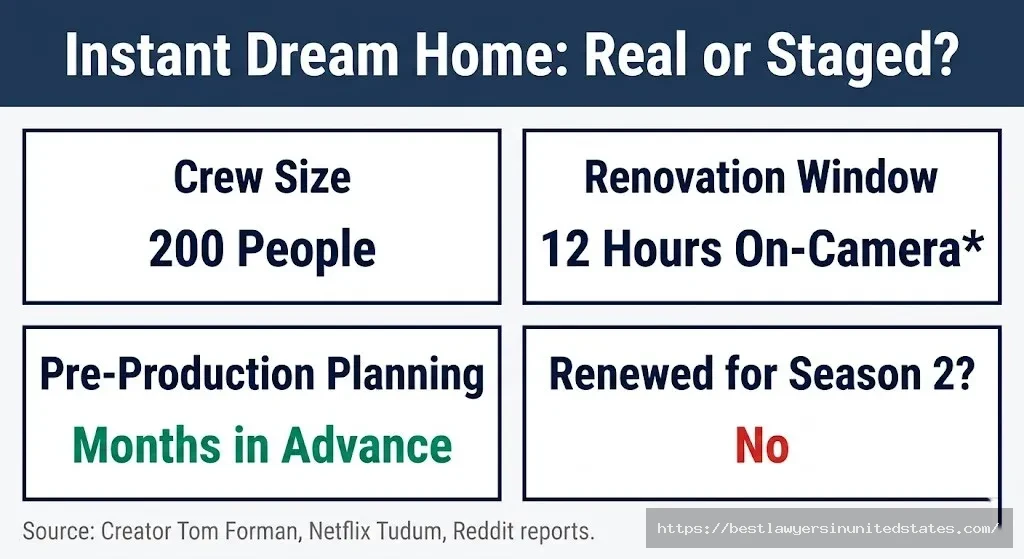
Quick Answer: Netflix’s Instant Dream Home (2022) is a home makeover show in which a 200-person crew renovates a family’s home in 12 hours while the owners are taken away for the day.
The show is largely authentic in execution, but not without staging: drama scenes were manufactured, at least one crew member publicly disputed the 12-hour timeline, and certain logistical realities — permits, HOA approvals, drying times — were never explained on-camera. The show ran one season and has not been renewed.
When Instant Dream Home dropped on Netflix in August 2022, it shot straight to the platform’s Top 10. The premise was irresistible: a crew of specialists descends on a deserving family’s home and rebuilds it top-to-bottom in a single 12-hour day, while the unsuspecting owners are whisked away by an accomplice.
Host Danielle Brooks, best known from Orange Is the New Black, presided over the chaos.
But almost as fast as it climbed the charts, it attracted a wave of skepticism. Viewers went to Reddit, Twitter, and TikTok with the same essential question: Is any of this actually real? The debates got heated enough that cast members broke character to defend themselves publicly. So what’s the actual truth? Let’s go through it, claim by claim. West Capital Lending Lawsuit
The Show’s Premise — and Why It Immediately Raised Red Flags
The format is simple on the surface. Each episode follows a different Atlanta-area family. A friend or family member nominates them and helps keep the homeowners away for the day. The expert team — interior designer Adair Curtis, landscape architect Nick Cutsumpas, carpenter Erik Curtis, and special projects lead Paige Mobley — rolls in and rebuilds the home. Danielle Brooks manages logistics and sometimes grabs a tool herself when things get tight.
What makes the premise feel suspect isn’t the ambition, it’s the math. Twelve hours to gut and rebuild a home. Real contractors know that paint needs 2–4 hours to dry between coats, concrete takes 24–48 hours to cure, and structural work requires inspections. Combine that with permits, HOA approvals, and coordinating a family’s entire belongings — and the skepticism makes sense.
A Reddit thread titled “Can we talk about how fake Instant Dream House is?” became the central hub of the debate almost immediately after the show premiered. One early commenter put the core objection plainly: the structural and exterior changes being made would require planning permission, permits, and HOA approvals that couldn’t happen without the homeowner being aware. The thread went viral and was picked up by entertainment media within days.
What the Show’s Creator Actually Said
Creator Tom Forman — the man behind Extreme Makeover: Home Edition — acknowledged from the start that the concept was borderline impossible. Speaking to Netflix’s own Tudum podcast, he recalled pitching the idea to Netflix executives, who asked if it could really be done. He walked out, turned to his colleagues, and said something to the effect of: “Oh my god, what have we just done?”
The answer to how they pulled it off was relentless pre-planning. The crew didn’t show up on the day with a rough sketch. Each project was mapped out over months in advance, with detailed schematics, practice runs, mock-ups, and minute-by-minute scheduling. Forman described the process as planning a heist.
That framing matters. The show never claimed the 12-hour crew was figuring things out on the fly. The 200-person team — carpenters, electricians, landscapers, decorators — already knew exactly what they were doing before a single camera rolled on the actual shoot day.
The Cast’s Defense
After the Reddit threads gained traction, cast members took to social media to push back.
Landscape architect Nick Cutsumpas posted an Instagram video lightheartedly referencing viewer doubts, standing behind the show’s timeline. Carpenter Erik Curtis posted two separate Instagram tributes to his teammates — crediting Paige Mobley with conceiving designs for a glass balcony, a schoolhouse build, and a bathroom addition, and crediting Adair Curtis with organizing the team so precisely that everyone could execute under the time pressure. The tone was proud, not defensive, which read to some fans as more credible than a straight denial.
Interior designer Adair spoke to Architectural Digest and explained that all planning was rooted in detailed homeowner surveys — videos and photos submitted in advance — which is how the team knew what to build and buy months before the shoot day. She acknowledged this created some problems, since a few designs were based on assumptions that didn’t quite match what they found on arrival.
The Crew Member Who Disputed the 12-Hour Claim
The most damaging blow to the show’s premise came from someone who said they worked on it. Under a Reddit thread questioning the timeline, user Shot_Permit7834 wrote that they were part of the green basement remodeling crew and stated that none of the houses were completed in 12 hours — that the projects actually took three to four days.
This claim was never verified, and Netflix never responded to it directly. It’s possible the commenter was referring to pre-work done before the shoot day rather than the formal on-camera window. But it spread widely and became the most-cited piece of evidence for those who believed the show’s framing was misleading.
The honest read: “12 hours” likely described the on-camera shoot window, with significant prep work, possible finishing touches after cameras stopped rolling, and months of off-screen planning already baked in. Whether that meets the show’s own standard of authenticity is something viewers had to decide for themselves.
The Staged Drama Problem
Separate from the timeline debate, viewers caught what looked like manufactured crisis moments — the kind of “oh no, something broke” scenes every renovation show uses to create tension.
The most-cited example came from Episode 7. A kitchen counter was shown breaking while being unloaded from a truck. A replacement counter arrived just in time — but was visibly half the size of the original. Viewers noted the sequence looked staged, pointing to what appeared to be a prop plywood box being dropped rather than the real countertop, which was then swapped in. In Episode 2, the production showed a trailer being craned over a hill for logistical reasons — then later revealed the same scene with multiple full trailers and box trucks that had apparently just driven in without any issue.
This kind of manufactured drama is not unique to Instant Dream Home — it’s a staple of the genre. But the show’s specific promise of authentic, real-time renovation made the staging feel more dishonest than it might have on a more openly theatrical show.
The Logistics Questions Nobody Answered On-Screen
Beyond the timeline, several practical questions were raised that the show never addressed:
Building permits and HOA approvals. Structural changes and exterior modifications typically require permits that take days or weeks to obtain — and homeowner signature. The show never explained how this was handled.
Drying and curing times. Concrete, grout, adhesive, and paint all have mandatory wait times. For a renovation completed in 12 hours to be safe and functional, crews would need fast-cure products and extremely precise sequencing — which is possible, but was never shown or explained.
Unpacking. The crew packed up every family’s belongings at the start of the day and moved them into storage. The show ended at the reveal, with no indication of who unpacked everything afterward — almost certainly not the renovation crew.
Material waste. Viewers noticed large dumpsters on-site, suggesting significant amounts of removed materials and fixtures were discarded rather than donated. This drew criticism from environmentally conscious viewers.
How Real Were the Homeowners’ Reactions?
The homeowners had applied for a makeover — they knew a show was potentially coming — they just didn’t know they’d been selected or when. That means the surprise element was genuine, but the families had prior awareness of the process, which may have softened what would otherwise be total shock.
One viewer framed a fair point the show never really engaged with: if a crew redesigned your entire home in 12 hours without your input, and you didn’t love every choice, you’d have no recourse. The makeover was fundamentally one-sided in a way that standard renovation shows — where homeowners are involved in design decisions — are not. Honda Battery Drain Lawsuit
What the Evidence Actually Supports
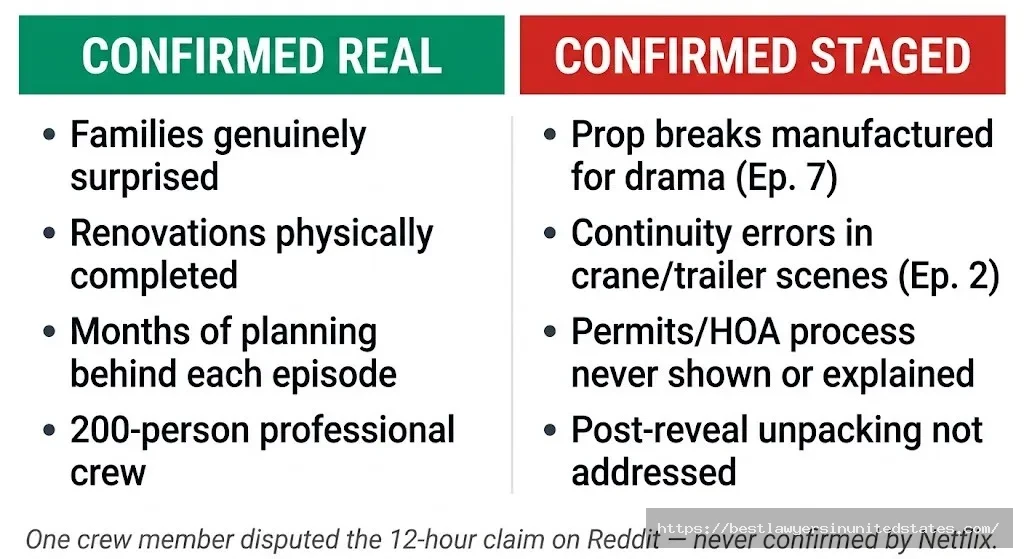
| Claim | Verdict | Evidence |
|---|---|---|
| Renovations completed in 12 hours on shoot day | Likely mostly true, disputed by one crew member | Creator confirmed; one Reddit user with alleged inside knowledge said 3–4 days |
| Months of pre-planning before shoot day | Confirmed true | Creator Tom Forman and designer Adair both confirmed this explicitly |
| Some dramatic moments were staged | Confirmed true | Viewers identified specific prop breaks across multiple episodes |
| Permits and HOA approvals handled legitimately | Unknown — never addressed on-camera | No official explanation given |
| Families genuinely did not know renovation was happening | Appears true | Families had applied but were not told when or if selected |
| Work quality built to last | Disputed — no follow-up footage released | Multiple viewers predicted failures; no update episodes produced |
Why Netflix Never Renewed It
Despite hitting the Top 10, Instant Dream Home was not renewed for a second season. Netflix never gave a public reason. Cast members have been asked about Season 2 on social media, with vague non-answers suggesting it wasn’t going to happen.
Renewal decisions at Netflix are driven by completion rates, subscriber impact, and production cost — not just chart position. A show requiring months of pre-production, 200 crew members per episode, and the logistical complexity of a real home renovation is expensive to produce. If the cost-per-view math didn’t work, that’s a sufficient explanation on its own.
That said, the persistent bad press — the viral “it’s fake” threads, the disputed crew member claim — likely didn’t help the case for a second cycle.
How It Compares to Other Renovation Shows
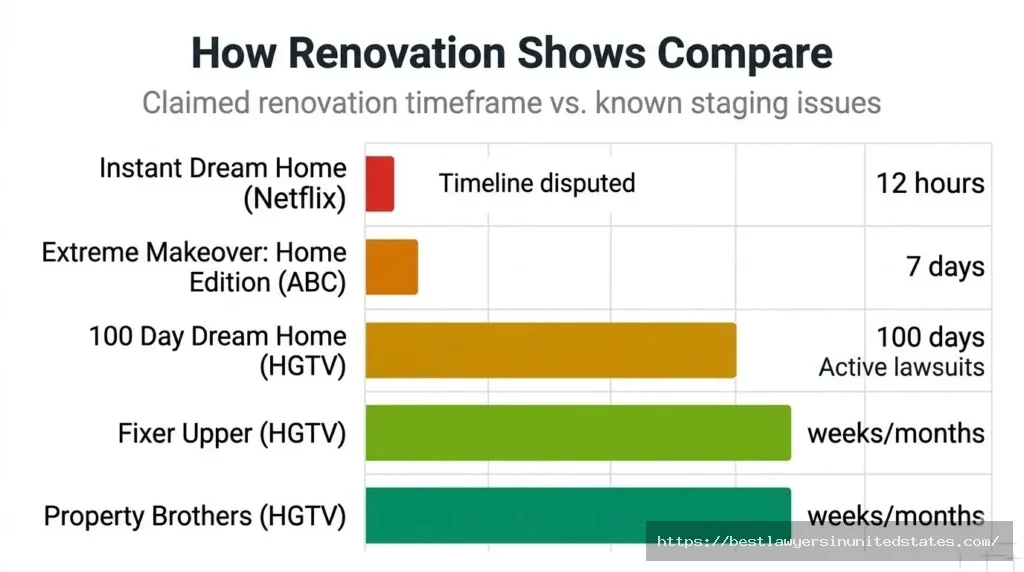
| Show | Network | Claimed Timeframe | Known Issues |
|---|---|---|---|
| Instant Dream Home | Netflix | 12 hours | Timeline disputed; staged drama moments |
| 100 Day Dream Home | HGTV | 100 days | Subject of civil lawsuits over construction defects |
| Extreme Makeover: Home Edition | ABC | 7 days | Several families lost homes to foreclosure after renovation costs |
| Fixer Upper | HGTV | Weeks to months | Some buyers reported completing unfinished work post-shoot |
| Property Brothers | HGTV | Weeks to months | Buyers reported budget overruns and incomplete builds |
In context, Instant Dream Home is not uniquely problematic in the genre. Almost every major renovation show has faced authenticity questions. The 12-hour hook made the staging more visible — but the underlying practices weren’t unusual.
The Bottom Line
Instant Dream Home was not a fraud. The renovations happened. The families were genuinely surprised. The crew genuinely built what you saw on screen — deploying months of preparation to hit a very aggressive timeline.
What the show obscured is how much of the “12-hour” magic was really the result of months of off-screen work: permits pulled, materials pre-ordered, designs finalized, practice runs completed. Some dramatic moments were staged for television. Questions about code compliance and long-term build quality were never addressed.
Whether that’s “fake” depends on what you were expecting. If you expected a crew to walk in cold and rebuild a house in half a day, that’s not what this was. If you accept that every renovation show involves pre-planning, editing, and manufactured moments, then Instant Dream Home was no more dishonest than anything else in the genre — and considerably more spectacular. What Proof Do You Need for a Roundup Lawsuit
Was Instant Dream Home really done in 12 hours? The on-camera shoot day appears to have been 12 hours, but each project required months of off-screen preparation. One person claiming to be a crew member said projects took 3–4 days total; this was never confirmed or denied by Netflix.
Is there an Instant Dream Home Season 2? No. Netflix did not renew the show after its August 2022 run. No official reason was given.
Did any families have problems with their renovations afterward? No follow-up episodes or news reports have documented specific issues. The show ended without any check-in segments, so the long-term quality of the builds remains unknown.
