
Quick Answer
- What this is: Thousands of individual lawsuits against Novo Nordisk, consolidated into two federal MDLs in Pennsylvania, alleging Wegovy caused severe gastrointestinal injuries and permanent vision loss without adequate warning.
- Who qualifies: Patients who took Wegovy and were diagnosed with gastroparesis, bowel obstruction, ileus, or NAION (sudden vision loss), typically with documented medical evidence including a gastric emptying study.
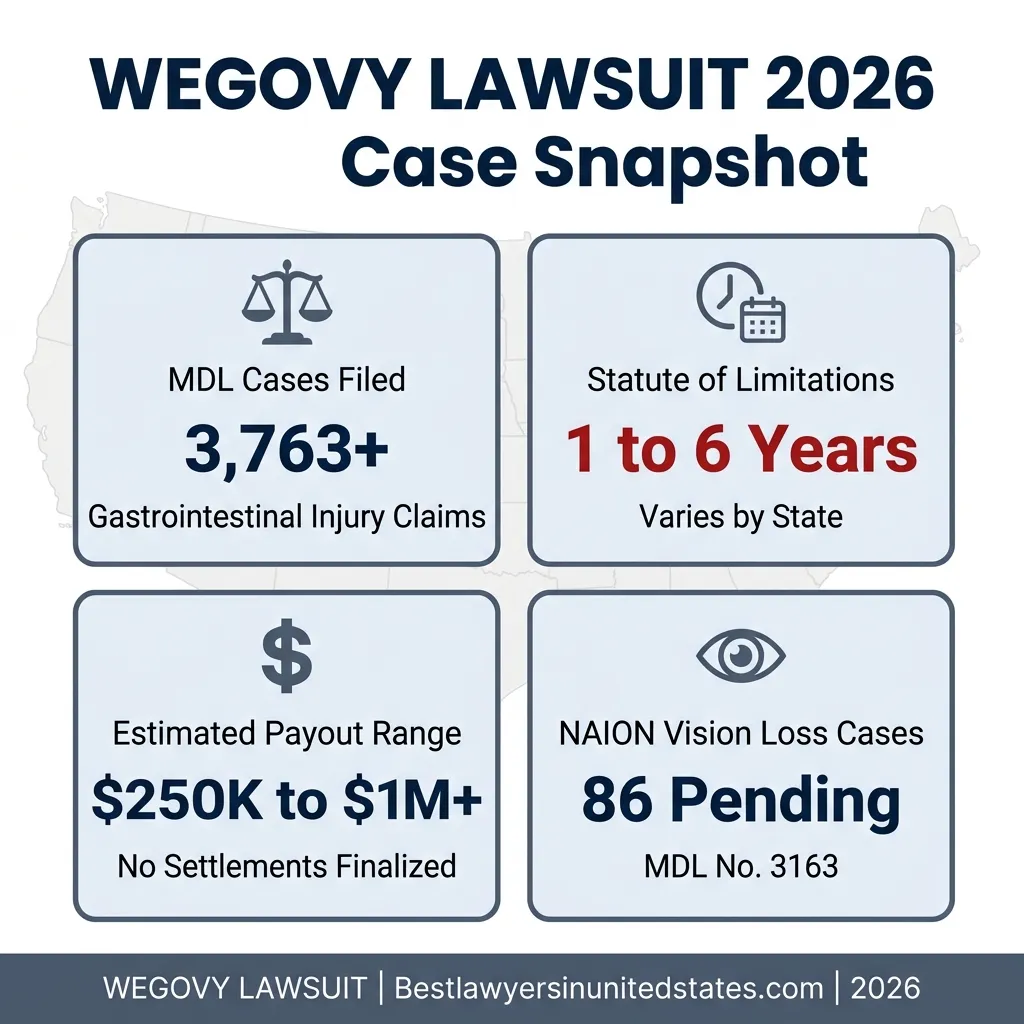
- What it’s worth: No global settlement exists as of June 2026. Legal analysts estimate future individual recoveries could range from 250,000toover250,000toover1,000,000 for the most serious injury categories, though no figures are guaranteed.
Case Snapshot
| Detail | Info |
|---|---|
| Court | U.S. District Court, Eastern District of Pennsylvania |
| GI Injuries MDL Number | MDL No. 3094 |
| Vision Loss MDL Number | MDL No. 3163 |
| MDL 3094 Established | February 2024 |
| Presiding Judge | Judge Karen Spencer Marston |
| Cases Pending (MDL 3094) | 3,763 as of June 2026 |
| Cases Pending (MDL 3163) | 86 as of June 2026 |
| Current Status | Active pretrial discovery and motion practice |
| Global Settlement | None as of June 2026 |
| Defendant | Novo Nordisk A/S |
Thousands of Americans who took Wegovy to manage obesity have filed personal injury claims against Novo Nordisk, the Danish pharmaceutical company that manufactures the drug. The central allegation is consistent across thousands of filings: the company knew, or should have known, about the risk of severe gastrointestinal harm and vision loss, and failed to warn patients or their physicians adequately.
The litigation is not a single class action. It is two separate federal multidistrict litigations, both operating under the supervision of Judge Karen Spencer Marston in the Eastern District of Pennsylvania. As of June 2026, 3,763 cases sit in MDL No. 3094 (gastrointestinal injuries) and 86 cases in the newer MDL No. 3163 (NAION vision loss). No trial has concluded. No global settlement has been reached.
The scale and complexity of these proceedings make the Wegovy litigation one of the most consequential pharmaceutical mass torts currently active in federal court.
What Is the Wegovy Lawsuit?
The Wegovy lawsuit refers to consolidated federal litigation against Novo Nordisk over injuries allegedly caused by Wegovy (semaglutide 2.4 mg), the FDA-approved injectable weight-loss medication.
Plaintiffs across the country allege that Novo Nordisk failed to adequately warn users about documented risks of serious side effects. Those injuries range from chronic stomach paralysis to sudden, permanent vision loss.
The legal theory at the core of each case is product liability based on failure to warn. Plaintiffs are not arguing that Wegovy does not work. They are arguing that the company withheld or understated material safety information that, if disclosed, would have altered prescribing decisions.
| Core Legal Theory | Allegation |
|---|---|
| Failure to Warn | Novo Nordisk inadequately disclosed risks of gastroparesis, ileus, and NAION on product labeling |
| Defective Product | Drug’s design posed unreasonable risks not reflected in approved warnings |
| Negligence | Company failed its duty of care to disclose known adverse event data |
Attorney Insight: Attorneys handling these claims note that the failure-to-warn theory in pharmaceutical litigation is exceptionally difficult for defendants to defeat once internal company communications surface in discovery, particularly if those communications predate FDA label updates.
Is the Wegovy Case a Class Action Lawsuit?
The Wegovy case is not a class action lawsuit, despite widespread public use of that term. The distinction has real legal consequences for every claimant.
A class action consolidates thousands of plaintiffs into a single legal entity with one shared outcome. The Wegovy litigation instead operates as a multidistrict litigation (MDL), which preserves each plaintiff’s individual claim while centralizing pretrial proceedings in one court.
In practical terms, this means each case is evaluated on its own medical and factual record. One claimant with a severe, documented gastroparesis hospitalization does not share a settlement outcome with another who experienced milder symptoms.
| Feature | Class Action | MDL (Wegovy Structure) |
|---|---|---|
| Each case evaluated individually? | No | Yes |
| Single settlement binds all? | Yes | No |
| Claimant receives individual recovery? | No (shares fund) | Yes (individual amount) |
| Bellwether trials used? | Rarely | Yes, standard practice |
Attorney Insight: Attorneys in mass tort pharmaceutical cases consistently advise plaintiffs that the MDL structure, while slower, tends to produce higher individual recoveries for serious injuries than a class action settlement formula would.
Wegovy Lawsuit Update 2026: Where the Cases Stand Now
The litigation crossed a procedural threshold in mid-2026 that signals the cases are moving, not stalled.
Judge Karen Spencer Marston, who assumed oversight of MDL 3094 after the death of Judge Gene E.K. Pratter in May 2024, has been managing the docket through monthly, in-person status conferences with plaintiffs’ and defense leadership counsel. Discovery is active.
Key 2026 developments include:
- May 2026: Court filings reveal active disputes over the scope of Novo Nordisk’s preemption defense, specifically whether it applies only to core GI injuries or also to pancreatitis and malnutrition claims.
- March 2026: The FDA issued a warning letter to Novo Nordisk regarding misleading advertising for a new pill form of Wegovy, alleging the company overstated weight-loss efficacy. This regulatory action has drawn attention from plaintiffs’ counsel as evidence of the company’s pattern of incomplete disclosure.
- Bellwether schedule: A formal bellwether trial date has not been set as of June 2026. The court is working through “cross-cutting” issues including diagnostic requirements for gastroparesis claimants and general causation questions.
Attorney Insight: Attorneys monitoring MDL 3094 point to the May 2026 preemption dispute as a signal for the litigation’s overall trajectory. If the court narrows Novo Nordisk’s preemption shield, the path to trial opens significantly wider.
Litigation Watch: Both MDLs remain in active pretrial proceedings as of June 2026, with no trial date set and no global settlement reached, making the timing of individual case resolution uncertain.
What Is Wegovy MDL? Understanding the Court Structure
An MDL is a federal procedural mechanism that transfers related lawsuits from courts across the country into one district court for coordinated pretrial proceedings.
The Judicial Panel on Multidistrict Litigation (JPML) created MDL No. 3094 in February 2024 to consolidate GLP-1 receptor agonist cases involving gastrointestinal injuries. The panel later created MDL No. 3163 in late 2025 to separately manage NAION vision loss claims.
Both MDLs are assigned to the U.S. District Court for the Eastern District of Pennsylvania, under Judge Karen Spencer Marston.
| MDL | Injury Type | Cases (June 2026) | Established |
|---|---|---|---|
| MDL No. 3094 | Gastroparesis, ileus, bowel obstruction | 3,763 | February 2024 |
| MDL No. 3163 | NAION (vision loss) | 86 | Late 2025 |
Attorney Insight: Attorneys practicing in federal MDL courts emphasize that a case placed in an MDL does not stay there permanently. After bellwether trials, individual cases are typically remanded to their original district courts for trial or negotiated resolution.
MDL 3094 GLP-1: The Gastrointestinal Injury Docket Explained
MDL No. 3094 is the larger of the two Wegovy-related MDLs, carrying more than 3,700 active cases as of June 2026.
The full caption is In re: Glucagon-Like Peptide-1 Receptor Agonists (GLP-1 RAs) Products Liability Litigation. The MDL covers multiple GLP-1 drugs: Wegovy, Ozempic, and Rybelsus (Novo Nordisk), as well as Mounjaro, Zepbound, and Trulicity (Eli Lilly). Both companies are primary defendants.
Judge Marston has issued case management orders requiring that plaintiffs alleging gastroparesis provide documented evidence of a gastric emptying study to proceed. This threshold requirement is a substantive gating mechanism, not a clerical formality.
Key procedural facts in MDL 3094 as of June 2026:
- General causation discovery is ongoing
- Expert witness deadlines are managed on a rolling schedule
- Defense Daubert motions challenging plaintiffs’ causation experts are pending
- Cross-cutting preemption motions filed by Novo Nordisk are under active briefing as of May 2026
Attorney Insight: Attorneys filing into MDL 3094 report that the gastric emptying study requirement is becoming a de facto qualification hurdle. Claimants without that documented test face procedural challenges, which underscores the importance of preserving all medical records promptly.
Litigation Watch: The MDL 3094 docket grew by hundreds of cases through early 2026, reflecting continued attorney activity and ongoing broad use of GLP-1 medications nationwide.
Wegovy Gastroparesis Lawsuit: The Core Injury Claim
Gastroparesis, commonly referred to as stomach paralysis, is the primary injury alleged in MDL 3094.
The condition occurs when the stomach cannot empty itself normally. Patients experience chronic nausea, vomiting, severe abdominal pain, and inability to tolerate food. In the most serious cases, hospitalization and surgical intervention are required.
Plaintiffs allege Novo Nordisk knew its GLP-1 drug significantly slowed gastric motility, yet its labeling stated only that Wegovy was “not recommended” for patients who already had gastroparesis, without disclosing that the drug itself could cause the condition in otherwise healthy patients.
Qualifying gastrointestinal injuries in MDL 3094:
- Gastroparesis confirmed via gastric emptying study
- Ileus (intestinal immobility requiring hospitalization)
- Intestinal obstruction or bowel obstruction
- Severe nausea and vomiting requiring documented medical intervention
- Pancreatitis (currently under dispute as of May 2026 preemption motions)
Attorney Insight: Attorneys representing gastroparesis claimants frequently note that the September 2023 FDA label update adding ileus warnings, while not a formal enforcement action, functions as an implicit acknowledgment that earlier warnings were insufficient.
Wegovy Vision Loss Lawsuit: NAION Claims in MDL 3163
A second category of Wegovy lawsuits targets a fundamentally different injury: sudden, permanent vision loss caused by NAION (non-arteritic anterior ischemic optic neuropathy).
NAION occurs when blood flow to the optic nerve is interrupted. It can cause permanent vision impairment in one or both eyes, often without any recovery. The link between GLP-1 medications and NAION was first flagged in peer-reviewed medical literature in 2024, prompting a separate wave of lawsuits.
The JPML created MDL No. 3163 in late 2025 to manage these cases separately. As of June 2026, 86 cases are pending.
| Injury | MDL | Cases Pending | Estimated Recovery Range |
|---|---|---|---|
| Gastroparesis / GI Injuries | MDL 3094 | 3,763 | 250,000to700,000 |
| NAION Vision Loss | MDL 3163 | 86 | 500,000to1,000,000+ |
Figures above are analytical estimates. No verdicts or settlements have been finalized as of June 2026.
Attorney Insight: Attorneys handling NAION claims point to the lower case count as a strategic factor. Fewer cases in an MDL can mean slower development of legal precedent, but also potentially stronger individual negotiating positions once causation science is established by expert testimony.
Litigation Watch: MDL 3163’s small current docket is expected to expand significantly as awareness of NAION’s link to GLP-1 medications grows among neurologists and ophthalmologists treating affected patients.
Wegovy Bowel Obstruction Lawsuit: Additional GI Claims
Beyond gastroparesis, bowel obstruction represents a distinct and serious injury category within MDL 3094.
Intestinal obstruction occurs when the small or large intestine is physically blocked, preventing normal digestion and potentially leading to tissue death. Unlike gastroparesis, which involves impaired motility, bowel obstruction can require emergency surgery and carries risk of sepsis.
Plaintiffs alleging bowel obstruction argue that Novo Nordisk’s labeling, even following the September 2023 ileus update, failed to address the risk of full intestinal obstruction requiring surgical intervention.
Key characteristics of bowel obstruction claims:
- Emergency hospitalization with documented records is typically required
- Surgical intervention creates a strong evidentiary record for damages
- Cases with post-surgical complications carry higher damage potential
- Claims are often accompanied by malnutrition and extended recovery allegations
Attorney Insight: Attorneys litigating bowel obstruction claims note these cases often carry stronger damages profiles than gastroparesis cases because they involve emergency procedures, longer hospitalizations, and more objective medical documentation with clear causation timelines.
Who Qualifies for the Wegovy Lawsuit?
Qualification for the Wegovy MDL litigation requires satisfying several evidentiary thresholds. Taking Wegovy and experiencing discomfort is not sufficient.
Attorneys evaluating these cases consistently apply the following baseline criteria:
Primary eligibility factors:
- Documented Wegovy use: Prescription records or pharmacy receipts confirming the patient was prescribed semaglutide 2.4 mg (Wegovy specifically, not compounded semaglutide from a telehealth provider)
- Qualifying diagnosis: A confirmed medical diagnosis of gastroparesis, ileus, intestinal obstruction, or NAION linked temporally to Wegovy use
- Medical evidence: For gastroparesis, a gastric emptying study confirming delayed gastric emptying, consistent with Judge Marston’s case management orders
- Hospitalization or significant medical intervention: Cases without documented hospital stays face harder causation arguments
- Causal timeline: Symptoms arose during or within a reasonable period after Wegovy use
| Eligibility Factor | Required? |
|---|---|
| Prescription record for Wegovy | Yes |
| Qualifying injury diagnosis | Yes |
| Gastric emptying study (gastroparesis claims) | Yes, per CMO |
| Documented hospitalization | Strongly preferred |
| Pre-existing gastroparesis diagnosis | Evaluated case by case |
Attorney Insight: Attorneys reviewing intake cases report that claimants who also took other GLP-1 medications such as Ozempic or Mounjaro may qualify even if Wegovy was not the only drug used, since MDL 3094 covers all GLP-1 receptor agonist products.
Wegovy Lawsuit Eligibility: What the Courts Are Looking For
Eligibility and qualification are related but distinct concepts in MDL litigation.
Eligibility refers to whether a plaintiff can be part of the MDL at all. The court’s case management orders set minimum proof standards that function as qualification thresholds. Meeting basic eligibility does not guarantee recovery. It only allows the case to proceed.
Courts in pharmaceutical MDLs increasingly require “plaintiff fact sheets” (PFS), standardized questionnaires covering medical history, drug usage, injury description, and treatment history. In MDL 3094, Judge Marston has required these documents along with supporting medical records from all active plaintiffs.
Documentation claimants should gather now:
- All prescription records for Wegovy and any other GLP-1 drug used
- Emergency room and hospital admission records
- Gastric emptying study results (the single most important document for GI claims)
- Gastroenterology consultation notes and imaging records
- Ophthalmology records for NAION claims
- Employment and wage records if lost income is a damages component
Attorney Insight: Attorneys conducting case reviews consistently identify incomplete medical records as the single most common reason a facially valid claim stalls in the MDL. The earlier records are requested, the lower the risk that a healthcare provider destroys them under its routine retention schedule.
Litigation Watch: Judge Marston’s plaintiff fact sheet requirements and the gastric emptying study mandate are the most consequential procedural rulings for case viability in MDL 3094 as of mid-2026.
Wegovy Lawsuit Filing Deadline: Statute of Limitations by State
There is no single national filing deadline for the Wegovy litigation. Each plaintiff’s deadline is set by the state law of the jurisdiction where the injury occurred.
State statutes of limitations for pharmaceutical personal injury claims range from one year to six years. Most states fall within a two-to-three-year window measured from the date of injury discovery, not the first date of drug use.
The discovery rule is the pivotal doctrine. In most states, the clock does not begin running from the date a person first took Wegovy. It begins running from the date the person knew, or reasonably should have known, that their injury was caused by the drug.
| State | Statute of Limitations (General Personal Injury) |
|---|---|
| California | 2 years |
| Texas | 2 years |
| New York | 3 years |
| Florida | 2 years |
| Illinois | 2 years |
| Pennsylvania | 2 years |
| Ohio | 2 years |
| Georgia | 2 years |
General figures for personal injury. Pharmaceutical product liability claims may involve different limits or tolling provisions under each state’s specific law.
Attorney Insight: Attorneys emphasize that an MDL does not toll statutes of limitations automatically. Each plaintiff must file a complaint before the applicable state deadline expires, regardless of how many other cases are already pending in the MDL.
Wegovy Lawsuit Settlement Amount: What the Numbers Look Like
No global settlement has been reached in either MDL as of June 2026. The cases are still in active pretrial discovery.
Settlement projections in pharmaceutical litigation are driven by bellwether trial outcomes. When a bellwether case goes to trial and produces a verdict, that figure anchors subsequent settlement negotiations across the full docket. No Wegovy-related bellwether has been tried to verdict.
Current analytical estimates from legal observers:
| Injury Category | Estimated Settlement Range |
|---|---|
| Gastroparesis, medically managed, moderate severity | 150,000to350,000 |
| Gastroparesis, severe, with documented hospitalization | 350,000to700,000 |
| Bowel obstruction requiring surgical intervention | 400,000to800,000 |
| NAION with partial, permanent vision loss | 500,000to850,000 |
| NAION with permanent bilateral vision loss | $1,000,000 or above |
These figures are estimates from pharmaceutical litigation analysts and represent no guarantee of individual case outcome.
Attorney Insight: Attorneys with mass tort experience consistently note that early projections are frequently revised as bellwether data emerges. In the Vioxx litigation, individual verdicts ranged from zero to 253millionbeforeMercksettledtheentiredocketfor253millionbeforeMercksettledtheentiredocketfor4.85 billion. The Wegovy litigation has not reached that stage.
Wegovy Lawsuit Payout: Factors That Drive Individual Case Value
Even within the same injury category, individual Wegovy cases will resolve at substantially different amounts.
Factors that increase case value:
- Permanent injury with no clinical recovery
- Multiple hospitalizations over an extended period
- Surgical intervention with documented complications
- Young plaintiff with demonstrable lifetime wage loss
- Pre-litigation evidence of Novo Nordisk’s internal knowledge of the risk
Factors that reduce case value:
- Pre-existing gastrointestinal condition before Wegovy use
- Short duration of Wegovy use before injury onset
- Incomplete or missing medical records
- Use of multiple GLP-1 medications simultaneously (complicates causal attribution)
- Significant delay in seeking medical care after symptom onset
Attorney Insight: Attorneys in pharmaceutical mass torts note that the damages calculation extends well beyond medical bills. Future care costs, loss of enjoyment of life, and loss of consortium claimed by a spouse are all recoverable under most state tort frameworks and can substantially increase total case value.
How to Join the Wegovy Lawsuit
Joining the Wegovy litigation means filing an individual lawsuit that will be transferred into MDL 3094 or MDL 3163, depending on the injury type.
There is no opt-in form or MDL registration portal. The process begins with retaining a pharmaceutical litigation attorney who evaluates the claim and, if viable, files a complaint in the appropriate federal district court. That complaint is then transferred by the JPML to the Eastern District of Pennsylvania.
Steps in the litigation intake process:
- Document your full prescription history for Wegovy and any other GLP-1 drug taken
- Gather all medical records related to your injury, including hospitalization records and imaging
- Obtain your gastric emptying study results if gastroparesis is the claimed injury
- Consult a mass tort or pharmaceutical litigation attorney for a formal case evaluation
- Attorney files a short-form or long-form complaint in federal district court
- JPML transfers the complaint to MDL 3094 or MDL 3163 in the Eastern District of Pennsylvania
- Plaintiff fact sheet and all supporting documentation submitted per Judge Marston’s case management orders
Attorney Insight: Attorneys handling GLP-1 intake cases note that most firms working on these claims accept them on a contingency basis. The claimant pays no legal fees unless and until the case resolves favorably, making access to counsel a financial barrier for very few eligible plaintiffs.
Novo Nordisk Lawsuit: How the Defendant Is Fighting Back
Novo Nordisk is actively contesting these claims on multiple fronts. Understanding its defense strategy is part of understanding the litigation’s timeline.
The company’s primary legal defense is federal preemption. Under this doctrine, Novo Nordisk argues that because the FDA approved Wegovy’s labeling, state-law failure-to-warn claims are preempted by federal law. If the preemption defense succeeds broadly, it could defeat claims across the docket without individual trials.
As of May 2026, active motions in MDL 3094 address exactly this issue: whether preemption bars not only core GI injury claims but also pancreatitis and malnutrition-related claims.
Novo Nordisk defense strategies in MDL 3094:
- Federal preemption: FDA-approved label controls over state tort failure-to-warn claims
- Causation challenges: The company disputes that Wegovy causes, rather than merely exacerbates, gastroparesis
- Expert witness exclusion: Daubert motions targeting plaintiffs’ general causation experts
- Comparative fault: Arguments that pre-existing conditions or other medications caused the claimed injuries
Attorney Insight: Attorneys tracking Novo Nordisk’s litigation posture note that the company’s preemption arguments face a difficult factual backdrop, particularly given that the FDA issued a warning letter in March 2026 questioning the completeness of Novo Nordisk’s own drug disclosures.
Wegovy Lawsuit Statute of Limitations: State-by-State Risk Assessment
The statute of limitations is the most time-sensitive element in any Wegovy lawsuit. Missing the deadline forfeits the right to recover, regardless of how strong the underlying claim is.
Beyond general state-by-state windows, several legal doctrines affect when the clock starts and whether it can be paused.
Key legal doctrines affecting filing deadlines:
- Discovery rule: Clock starts when the plaintiff knew or should have known the injury was drug-related
- Tolling for minors: Statute may be tolled until the individual reaches majority if a minor was prescribed Wegovy
- Fraudulent concealment: Plaintiffs may argue for equitable tolling if Novo Nordisk concealed material safety information
- Accrual disputes: Some jurisdictions disagree on when a pharmaceutical injury “accrues” for limitations purposes
| Risk Level | Situation |
|---|---|
| High | Injury occurred more than 18 months ago with no attorney consultation |
| Elevated | Injury occurred 12 to 18 months ago; medical records not yet gathered |
| Moderate | Injury occurred within the past 12 months; attorney being consulted now |
| Lower | Injury occurred recently and records are being preserved proactively |
Attorney Insight: Attorneys in pharmaceutical mass torts see otherwise strong cases lost because plaintiffs waited too long to seek counsel. The statute of limitations is an absolute legal bar. No court in MDL 3094 has the authority to override it.
Frequently Asked Questions
Is there a class action lawsuit against Wegovy?
There is no traditional class action lawsuit against Wegovy. The litigation is structured as two separate federal multidistrict litigations, MDL 3094 for gastrointestinal injuries and MDL 3163 for NAION vision loss, both pending in the Eastern District of Pennsylvania. Each claimant retains an individual case evaluated on its own facts, separate from all other plaintiffs.
What injuries qualify for the Wegovy lawsuit?
Qualifying injuries include gastroparesis confirmed by a gastric emptying study, severe ileus, intestinal or bowel obstruction requiring hospitalization, and NAION, which causes sudden permanent vision loss. Pancreatitis and malnutrition claims are under active procedural dispute as of May 2026 motions in MDL 3094. All claimants must have documented medical evidence linking the injury temporally to their use of Wegovy.
How much is the Wegovy lawsuit worth?
No global settlement exists as of June 2026, and no officially confirmed payout amounts are available. Legal analysts estimate individual recoveries for serious gastroparesis cases at 250,000to700,000, and NAION vision loss cases at 500,000toover1,000,000, depending on injury severity and permanence. Final case values will be shaped significantly by bellwether trial outcomes, which have not yet occurred.
How do I join the Wegovy lawsuit?
You join by consulting a pharmaceutical litigation attorney who evaluates your medical history, prescription records, and injury documentation. If the case qualifies, the attorney files a complaint in federal court and the JPML transfers it to MDL 3094 or MDL 3163 in the Eastern District of Pennsylvania. There is no direct opt-in or online registration. Filing must go through retained counsel.
What is the filing deadline for the Wegovy lawsuit?
There is no single federal deadline. Each state’s statute of limitations governs individual claimants. Most states allow two to three years from the date a plaintiff knew or reasonably should have known that Wegovy caused the injury, not from the first day the drug was taken. Consulting an attorney promptly is essential because statutes of limitations are absolute legal bars once expired.
Has Novo Nordisk settled the Wegovy lawsuit?
Novo Nordisk has not settled the Wegovy litigation as of June 2026. The company is actively contesting claims through preemption defenses, Daubert challenges to causation experts, and factual disputes about comparative fault. Settlement discussions in mass torts typically begin in earnest only after bellwether verdicts inform both sides of jury risk, a phase that MDL 3094 has not yet reached.
Closing
The Wegovy litigation now represents one of the most significant active pharmaceutical mass torts in federal court. Two MDLs, nearly 3,850 combined pending cases, one presiding judge, and no settlement in sight define the legal picture as of June 2026.
For any person who took Wegovy and later suffered hospitalization for gastroparesis, bowel obstruction, or sudden vision loss, the legal window is open but not indefinitely. Statutes of limitations are hard legal deadlines that no court can waive retroactively.
The appropriate next step is a direct consultation with an attorney who practices mass tort pharmaceutical litigation. These cases require documented medical evidence, full prescription history, and for gastroparesis claims specifically, a gastric emptying study. The earlier that record is assembled, the stronger the claim.
