
The Honda battery drain lawsuit involves allegations that American Honda Motor Company sold more than two million vehicles with a defect that causes car batteries to die without warning — even when the car is completely turned off. Multiple class action lawsuits have been filed covering 2016–2019 Honda Accords and 2017–2019 Honda CR-Vs, and litigation is actively continuing in federal court. Honda has not yet settled these consumer claims, but affected owners have legal options available right now.
Quick Answer: If your 2016–2019 Honda Accord or 2017–2019 Honda CR-V keeps dying, stalling, or draining its battery, you may be a victim of the “parasitic draw” defect that is the subject of ongoing class action litigation. No open claim form exists yet for the main lawsuit — but you can document your losses, pursue lemon law remedies, and connect with attorneys handling the case. A separate Acura HandsFreeLink battery drain settlement was fully approved in May 2025 and may affect some Acura owners. What Proof Do You Need for a Roundup Lawsuit
What Is the Honda Battery Drain Lawsuit About?
Background of the Defect
Picture this: you park your Honda overnight, and by morning it won’t start. No headlights left on. No accessories running. The battery just died on its own. This is the “parasitic draw” defect that has left hundreds of thousands of Honda owners stranded — and sparked multiple federal lawsuits against American Honda Motor Company.
The defect is known technically as parasitic battery drain, which means the car’s electrical components keep pulling power from the 12-volt battery after you turn the key off and walk away. Under normal circumstances, a modern car draws only a tiny trickle of current when parked — just enough to maintain memory functions. But in affected Honda Accords and CR-Vs, the draw is far larger, and it kills the battery in a matter of days.
What makes this worse is what follows a dead battery. When the battery can’t power the car, headlights fail, emergency hazard lights go dark, the engine can stall mid-drive, and critical safety systems stop working. Several owners have reported their CR-V or Accord dying at highway speeds — a genuine safety emergency, not just an inconvenience.
Who Filed the Lawsuits?
These are not one single class action, but a series of related federal cases targeting the same defect:
The first major filing came in February 2021, when plaintiffs filed in the U.S. District Court for the Central District of California (Mastrangelo et al. v. American Honda Motor Co., Inc.), alleging Honda’s Accord and CR-V batteries were undersized and suffered from parasitic draw. Attorneys Migliaccio & Rathod LLP, Levin Sedran & Berman, and Baird Law Firm represented the plaintiffs.
In May 2021, FeganScott LLC — a Chicago-based national consumer rights firm — filed a separate case on behalf of Honda CR-V owner George Jones in Iowa federal court (Jones et al. v. American Honda Motor Co., Inc., Case No. 4:21-cv-00148-JAJ-CFB, U.S. District Court for the Southern District of Iowa). That lawsuit covers all U.S. owners and lessees of 2017–2019 Honda CR-Vs and 2016–2019 Honda Accords.
A June 2021 Florida federal case (Cruz et al. v. American Honda Motor Company, Inc., Case No. 0:21-cv-61130, U.S. District Court for the Southern District of Florida) was filed by Robbins Geller Rudman & Dowd LLP but was voluntarily dismissed by the plaintiff in August 2021.
In September 2022, a new California federal case was filed. It was dismissed by Judge Haywood S. Gilliam, Jr. later that month — but the judge specifically allowed the plaintiffs to revise and refile their complaint. They did, now pinpointing the F-CAN (Fast-Controller Area Network) as the defective system. In October 2023, Judge Gilliam largely denied Honda’s second motion to dismiss, finding the plaintiffs had adequately alleged a defect and that Honda had knowledge of it before selling the vehicles. Consumer fraud claims are now moving forward.
A completely separate Acura lawsuit — the Aberin et al. v. American Honda Motor Company HandsFreeLink battery drain case — received final approval in May 2025. That case applies to certain Acura models and has its own claims process.
The Timeline of Key Events
| Date | Event | Details |
|---|---|---|
| February 2017 | Honda files internal investigation | Honda filed an Engineering Request for Investigation over battery issues in some Accord models |
| 2017 | TSB 17-032 issued | Honda alerts dealers about VSA software bug causing parasitic drain |
| 2018–2019 | Honda battery collection programs | Honda began quietly collecting batteries from certain 2017–2019 CR-V and 2016–2019 Accord models |
| March 2019 | Second TSB issued to dealers | Additional guidance on battery replacements without fixing root cause |
| February 2021 | First class action filed (California) | Mastrangelo et al. filed alleging undersized batteries and parasitic draw |
| May 2021 | Iowa class action filed | Jones v. American Honda filed by FeganScott for 2M+ affected vehicles |
| June 2021 | Florida class action filed | Cruz et al. filed by Robbins Geller; later dismissed August 2021 |
| September 2022 | California case dismissed — refiling permitted | Judge dismissed but let plaintiffs pinpoint specific defective component |
| October 2023 | Judge denies Honda motion to dismiss | Court rules F-CAN defect adequately alleged; consumer fraud claims proceed |
| May 2025 | Acura HandsFreeLink settlement finalized | Separate Acura battery drain case receives final court approval |
| 2026 | CR-V/Accord case active in court | Main consumer litigation ongoing; no settlement announced yet |
What Are the Core Allegations?
The lawsuits allege Honda violated federal warranty laws, state consumer protection statutes, committed fraud, and was unjustly enriched by:
- Selling vehicles with a known F-CAN electrical defect that causes batteries to drain when the car is off
- Knowing about the defect as early as 2017 through internal investigations and Technical Service Bulletins (TSBs)
- Issuing secret TSBs to dealers while keeping car buyers in the dark
- Offering only “band-aid” fixes — software updates and battery replacements — while knowing these wouldn’t fix the underlying problem
- Selling more than two million affected vehicles without disclosing the defect or issuing a recall
- Causing owners to spend hundreds to thousands of dollars on repeated battery replacements and alternator repairs that didn’t solve the problem
Who Is Affected by the Honda Battery Drain Defect?
Covered Vehicle Models
If you own or lease any of the vehicles listed below and have experienced unexplained battery drain, dead batteries, repeated jump-starts, or stalling, you may be affected by the defect at the center of this litigation.
| Vehicle | Model Years | Engine | Known Issue |
|---|---|---|---|
| Honda CR-V | 2017, 2018, 2019 | 1.5L Turbocharged | VSA software bug, F-CAN parasitic draw |
| Honda Accord | 2016, 2017, 2018, 2019 | 1.5L / 2.0L | PCM/F-CAN parasitic draw |
| Honda Accord | 2016–2018 | Various | Battery collection program vehicles |
| Honda CR-V | 2017–2018 | 1.5L | Battery collection program vehicles |
| Honda Pilot Touring/Elite | 2016–2018 | 3.5L | Also included in battery collection programs |
Note: The Pilot was included in Honda’s internal battery collection programs but is not a named model in all current lawsuits. If you own a 2016–2018 Pilot Touring or Elite and have battery problems, document everything and consult an attorney.
Signs Your Honda Has the Parasitic Drain Defect
You’re not just dealing with a regular old battery going bad. Here’s what separates this defect from normal battery aging:
Dead battery with no obvious cause. You didn’t leave lights on. Nothing was plugged in. The car just won’t start.
Battery dies repeatedly. You replace the battery — or the dealer replaces it — and within months the same problem comes back. Owners report going through two, three, even four batteries.
Car stalls without warning. Some drivers report their CR-V or Accord simply shutting down while driving. One owner reported her CR-V “completely stalled out” on a 60-mph highway with no warning lights beforehand.
Headlights and safety systems fail. With a drained battery, emergency hazard lights, headlights, power steering, and other safety functions can stop working.
Dealer says nothing is wrong. Honda dealers have repeatedly told owners the battery “checks out fine” — only for the battery to die again within weeks.
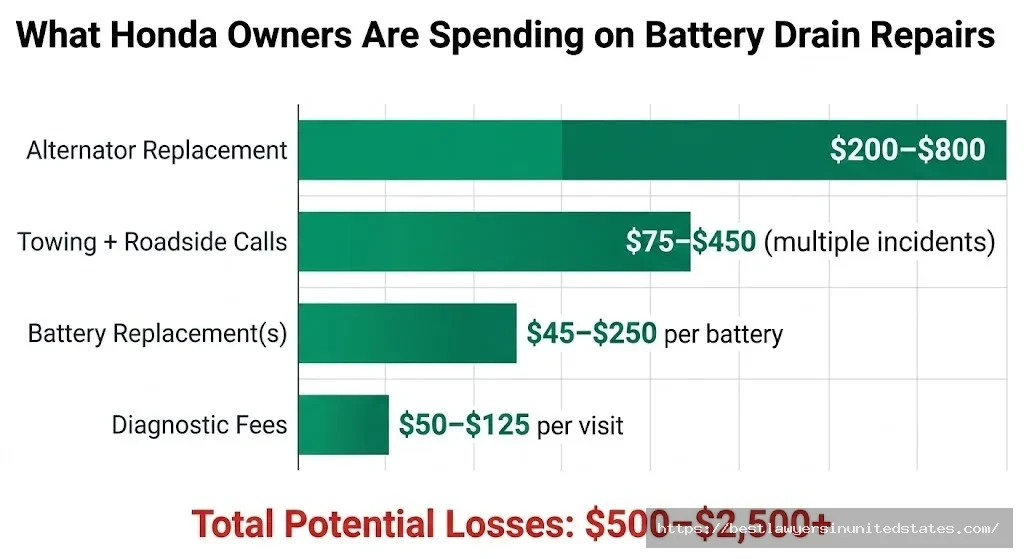
The problem affects alternators too. Because the battery repeatedly goes from fully charged to completely dead, the alternator works overtime trying to compensate. This wears it out prematurely, leading to a $200–$800 repair bill on top of repeated battery costs ($45–$250 each).
What Caused This? The Technical Explanation
The lawsuits pinpoint several components and systems that can cause the parasitic drain:
The F-CAN (Fast-Controller Area Network) is identified in the refiled California case as the primary defective system. The F-CAN is an internal communication network between electronic modules in the vehicle. When it fails to shut down properly, it keeps drawing current from the battery indefinitely.
A software bug in the Vehicle Stability Assist (VSA) system was confirmed by Honda itself in TSB 17-032. The VSA module can stay active after the ignition is turned off, draining the battery.
The Powertrain Control Module (PCM) and a related system called the FI-ECU (Fuel Injection Electronic Control Unit) have also been cited in Honda’s own internal service bulletins as potential sources of improper battery draw.
In some older CR-V generations, a faulty A/C relay can get stuck in the open position after shutdown, creating a drain through the multiplexing system.
What makes this especially egregious is that Honda issued TSBs to dealers describing all of these issues — while never notifying consumers or issuing a recall.
What the Lawsuits Are Seeking
Because there is no finalized settlement yet in the main consumer litigation, there are no specific dollar amounts or payout tiers to report. Here’s what the lawsuits are asking the court to award Honda CR-V and Accord owners:
| What Plaintiffs Are Seeking | Description |
|---|---|
| Compensatory damages | Reimbursement for battery replacements, alternator repairs, towing, rental cars, and other out-of-pocket costs caused by the defect |
| Extended warranties | A warranty extension requiring Honda to fix the underlying defect free of charge |
| Injunctive relief | A court order requiring Honda to notify all affected owners about the defect and issue TSBs proactively |
| Statutory penalties | Additional damages permitted under state consumer protection laws, which can multiply actual damages in some states |
| Attorney fees and costs | Legal costs covered by Honda if plaintiffs prevail |
| Jury trial | Plaintiffs have demanded a jury trial on all applicable claims |
The out-of-pocket losses for individual owners have been substantial. A single battery runs $45–$250. Alternator replacement adds $200–$800. Factor in towing ($75–$150 per incident), rental cars, missed work, and emergency roadside assistance, and many affected owners have spent $500 to $2,500 or more chasing a problem Honda hasn’t fixed.
The Acura HandsFreeLink Settlement — What’s Already Resolved
If you own an Acura (not a Honda CR-V or Accord), a separate related case may directly benefit you right now.
The Aberin et al. v. American Honda Motor Company lawsuit targeted the HandsFreeLink (HFL) Bluetooth system in post-2004 Acura vehicles. The HFL was supposed to disconnect when the car turned off. Instead, it stayed “on,” creating a parasitic drain that killed batteries and burned out alternators — the same basic problem, different component.
Final approval was granted in May 2025. Here’s what the settlement provides:
| Benefit Type | Eligibility | Amount |
|---|---|---|
| HFL Replacement Reimbursement | Paid out-of-pocket to replace HFL unit due to confirmed excessive parasitic drain before vehicle reached 10 years or 120,000 miles | Up to $500 per replacement |
| HFL Disconnection Payment | Evidence of excessive parasitic drain in the HFL prior to vehicle reaching 10 years or 120,000 miles | $350 payment |
Important limitation: The settlement is currently accepting claims from residents of California, Kansas, New York, and Washington only, per the Seeger Weiss settlement website. If you’re in a different state and have an affected Acura, consult an attorney about your options.
The settlement was handled by Seeger Weiss LLP and Carella Byrne Cecchi Brody & Agnello, P.C. To check your eligibility or file a claim, visit the case website managed by Seeger Weiss. Affordable Dentures Lawsuit
What Honda CR-V and Accord Owners Can Do Right Now
Because there’s no open settlement claim form yet for the main CR-V and Accord litigation, your best move is to build the strongest possible record and explore your legal options today.
Step 1: Document Every Battery Problem Thoroughly
Start a log — a simple notes document on your phone works — and record:
- The date every time your battery dies or the car fails to start
- The mileage at the time
- What the weather was (cold weather accelerates symptoms)
- Whether you’d left anything plugged in or running (to rule out user error)
- Every dealer visit, including what was done and what the technician said
- All repair receipts, including battery replacements and alternator work
This documentation is exactly what attorneys and courts look for when evaluating claims. The more specific you are — dates, amounts spent, what Honda told you — the stronger your position.
Step 2: Get Every Dealer Visit in Writing
When you bring your Honda in for battery issues, insist on a written repair order that:
- Describes the problem you reported
- Lists what the technician inspected
- Shows any TSBs the dealer applied (TSB 17-032, for example)
- Shows the outcome — even if the dealer says “no problem found”
“No problem found” documentation actually helps your case. Courts have looked at Honda owners who brought their vehicles in multiple times and were told there was no defect, only for the problem to continue. That pattern supports the allegation that Honda’s fixes don’t work.
Step 3: Save All Your Receipts
Keep every receipt for:
- Battery purchases (at dealers and auto parts stores)
- Alternator repairs or replacements
- Towing or roadside assistance charges
- Rental cars necessitated by the breakdown
- Any diagnostic fees
These are your provable out-of-pocket losses, which form the basis of your damage claim.
Step 4: File a Complaint with NHTSA
You can report your battery drain issues to the National Highway Traffic Safety Administration (NHTSA) at safercar.gov. NHTSA complaints are public record and are referenced in class action lawsuits — the Honda cases already cite over 120 NHTSA complaints from affected owners. Your complaint adds to the record that could push Honda toward a recall or settlement.
Step 5: Contact an Attorney
The firms currently handling this litigation include:
- FeganScott LLC — [email protected] | Chicago-based, filed the Iowa federal case
- Robbins Geller Rudman & Dowd LLP — handled the Florida case
- Migliaccio & Rathod LLP — filed in California
Initial consultations are free. Attorneys in class action cases typically work on contingency — meaning you pay nothing unless there’s a recovery. You can also contact [email protected] for referrals to attorneys handling Honda battery claims in your area.
Step 6: Check Your Lemon Law Rights
If your Honda has required substantial repair attempts for the same battery problem without being fixed, you may qualify for a lemon law buyback or replacement under your state’s laws — separate from the class action.
| State | General Lemon Law Standard |
|---|---|
| California | 2+ unsuccessful repair attempts for a serious safety defect, or 4+ attempts for any defect, within 18 months/18,000 miles |
| Florida | 3+ unsuccessful repair attempts, or 15+ calendar days out of service, within 24 months/24,000 miles |
| Texas | 4+ repair attempts for same defect, or 30+ total days out of service |
| New York | 4+ repair attempts, or 30+ days out of service, within 2 years/18,000 miles |
| All Other States | Varies — typically 3–4 repair attempts for the same defect within warranty period |
Lemon law claims move on their own track, independent of class action litigation. A lemon law attorney can pursue Honda for a refund or replacement vehicle right now, even while the class action proceeds through court. California’s lemon law is particularly strong for Honda owners given that a key case is pending in California federal court.
Current Status of the Honda Battery Drain Lawsuit (2026)
Where Things Stand
The main class action covering Honda CR-V (2017–2019) and Honda Accord (2016–2019) owners is active litigation in federal court. Here’s the current picture:
As of the most recent court update in late 2023, Judge Haywood S. Gilliam, Jr. of the Northern District of California denied Honda’s motion to dismiss in the refiled California case. The court’s October 2023 ruling was significant: the judge found that the plaintiffs had adequately alleged that a defect exists within the F-CAN system of affected vehicles, and that Honda had knowledge of the defect before the cars were sold. This green light means consumer fraud claims against Honda can proceed.
The Iowa federal case (Jones v. American Honda) filed by FeganScott in 2021 has also been progressing. That case covers all U.S. purchasers and lessees of 2017–2019 CR-Vs and 2016–2019 Accords.
No settlement has been announced for the main CR-V/Accord consumer litigation as of the publication of this article. There is no open claim portal, no settlement fund, and no deadline for consumers to file claims in connection with the main lawsuit at this time.
What Comes Next
Litigation of this scale typically follows this path before a settlement becomes available:
| Phase | What Happens |
|---|---|
| Discovery | Attorneys gather Honda’s internal documents, emails, engineering reports, and TSBs proving Honda’s knowledge of the defect |
| Class Certification | Court formally certifies the lawsuit as a class action, defining who is a class member |
| Summary Judgment | Honda may challenge specific claims; court rules on whether the case goes to trial |
| Settlement Negotiations | Parties may enter settlement talks at any point — often accelerates as trial approaches |
| Trial (if no settlement) | Case goes before a jury |
| Claims Period Opens | Once a settlement is reached and court-approved, affected owners file claims |
Given the October 2023 ruling allowing claims to move forward, the case is now firmly in the discovery and class certification phase. This process typically takes one to three years from that point before a settlement or trial.
Honda’s Response to the Allegations
Honda has consistently denied the allegations in all battery drain lawsuits. The company’s legal position, as stated in court filings, is that:
The plaintiffs failed to adequately identify which specific component caused the alleged drain (this argument was rejected by the court in the 2022 dismissal but addressed in the refiled complaint). Honda has argued the batteries in these vehicles are not defective, and that battery problems are caused by factors outside Honda’s control. The automaker has maintained that its TSBs and software updates represent appropriate responses to identified issues.
Honda did not admit wrongdoing in the Acura HandsFreeLink settlement, and the court has not ruled that Honda violated any law in the CR-V/Accord cases. The October 2023 ruling allowing claims to proceed is not a finding of liability — it only means the case can move forward.
Honda Battery Drain vs. Similar Defect Lawsuits
For context, here’s how the Honda battery drain litigation compares to other major automotive battery defect cases:
| Lawsuit | Vehicles | Alleged Defect | Status | Payout Range |
|---|---|---|---|---|
| Honda CR-V/Accord Battery Drain | 2M+ vehicles (2016–2019) | F-CAN/VSA parasitic drain | Active litigation — no settlement yet | TBD |
| Acura HandsFreeLink Settlement | Post-2004 Acura models | HFL Bluetooth system drain | Final approval May 2025 | Up to $500 reimbursement |
| Honda Idle Stop Settlement | 2015–2021 Acura TLX, MDX; Honda Pilot, Passport, Ridgeline | Idle Stop system starter failure | Preliminary approval 2025 | $7,500 per plaintiff; warranty extension |
| Kia/Hyundai Battery/Fire | Millions of vehicles | Engine fire and battery defect | Multiple settlements ongoing | Varies by claim type |
| GM Chevrolet Bolt Battery | Bolt EV (2017–2022) | Battery fire and range loss | Settled | Up to $1,400 + software fixes |
What stands out about the Honda CR-V/Accord case is the sheer scale — over two million vehicles — and the safety dimension. Unlike a vehicle that stalls in a parking lot, the battery drain has left some drivers stranded at highway speed, and Honda’s own documents show the company knew about it years before the lawsuits were filed.
Do You Need a Lawyer?
Quick Answer: You don’t need a lawyer to document your issues, file an NHTSA complaint, or request repairs at a Honda dealer. But if you want to pursue a lemon law claim, join the class action, or seek full compensation, an attorney is your best move — and initial consultations are free.
When You Can Handle It Yourself
Filing NHTSA complaints and documenting your repair history are things you can do today without any legal help. If you’ve had only one or two battery issues and the dealer has replaced the battery under warranty, you may want to wait and watch how the class action develops. Once a settlement is reached, class members typically join automatically — no attorney required. NetCredit Lawsuit
When Legal Help Is Worth It
Talk to an attorney if:
- Your car has stalled while driving, or you’ve been stranded in a dangerous situation
- You’ve spent several hundred dollars or more on batteries and repairs Honda won’t cover
- The dealer keeps replacing the battery but won’t address the root cause
- Your vehicle may qualify as a lemon under your state’s law (multiple repair attempts for the same problem within warranty)
- You bought your Honda recently and weren’t told about known battery issues — this may support a fraud or non-disclosure claim
How to Connect with Attorneys
The attorneys handling the Honda battery drain cases are:
- FeganScott LLC: [email protected] | www.feganscott.com
- Migliaccio & Rathod LLP: Contact via their website
- Robbins Geller Rudman & Dowd LLP: Contact via their website
Or reach out to [email protected] for a referral to a Honda lemon law or class action attorney in your state.
Frequently Asked Questions
What is the Honda battery drain lawsuit?
It’s a series of federal class action lawsuits against American Honda Motor Company alleging that 2016–2019 Honda Accords and 2017–2019 Honda CR-Vs have a defect that causes batteries to drain even when the car is turned off. Multiple suits have been filed since 2021; the main case is active in California federal court.
How many vehicles are affected?
Honda has sold more than two million affected vehicles — the 2016–2019 Accord and 2017–2019 CR-V. This makes it one of the larger automotive defect cases currently in litigation.
Can I file a claim right now?
Not yet for the main CR-V/Accord lawsuit. There is no settlement, no claim form, and no deadline at this time. What you can do now is document your losses and contact an attorney. The Acura HandsFreeLink settlement (different case) may have an active claims period for California, Kansas, New York, and Washington residents — check with Seeger Weiss LLP for current status.
What is “parasitic drain”?
Parasitic drain — also called parasitic draw — is when a car’s electrical components continue pulling power from the battery after the vehicle is turned off. A small amount of draw is normal; the defect in these Hondas causes excessive drain that kills the battery in days.
What causes the defect in Honda CR-Vs and Accords?
The refiled California lawsuit identifies the F-CAN (Fast-Controller Area Network) as the defective system. Honda’s own Technical Service Bulletins have also cited a software bug in the Vehicle Stability Assist (VSA) system and issues with the PCM (Powertrain Control Module) and FI-ECU. In some cases, an A/C relay stuck in the open position can cause similar symptoms.
Will replacing the battery fix the problem?
No — and that’s central to the lawsuit. Replacing the battery doesn’t fix the underlying drain. The new battery will face the same excessive draw and fail prematurely. Honda’s own documents acknowledge that battery replacements are not a permanent solution.
What should I do if my Honda battery keeps dying?
Document every incident and repair visit in writing, keep all receipts, insist on written repair orders from the dealer, file an NHTSA complaint at safercar.gov, and consult a lemon law or class action attorney for a free evaluation of your specific situation.
What if my Honda stalled while I was driving?
This is a serious safety incident. Document it immediately — date, location, speed, what happened. Report it to NHTSA. This type of incident strengthens a legal claim significantly, and you should contact an attorney right away.
Does this affect Acura vehicles too?
Yes, but through a separate case. The Acura HandsFreeLink (HFL) battery drain settlement received final court approval in May 2025 and covers different vehicles and a different defective component. It’s a separate settlement from the CR-V/Accord cases.
Do I need to opt in to the class action?
Not at this stage. Class members in federal class actions are generally included automatically and don’t need to take action until a settlement is announced and a claims period opens. You will want to preserve your records in the meantime.
What if I already sold or traded in my affected Honda?
You may still be part of the class depending on how the class definition is written when the court certifies the case. Past owners who suffered losses while they owned the vehicle are often included. An attorney can advise you based on your specific situation.
What if my Honda is outside the 2016–2019 range?
Earlier CR-V and Accord models have separate technical service bulletins for related battery issues (Honda issued TSBs as far back as 2012 and 2014 for PCM-related battery drain). Those older vehicles are not in the current class action, but individual lemon law claims may still be available if your vehicle is within warranty period.
What if the dealer told me nothing is wrong?
This is extremely common in these cases and actually helps your claim. Document the date of the visit, who you spoke with, and what they told you. Owners repeatedly told “no defect found” while the battery continued dying are exactly who the lawsuits are designed to protect.
How much could I get from a settlement?
No settlement amount has been negotiated yet. When a settlement is reached, compensation will depend on the total fund, the number of claimants, and your specific documented losses. Based on the Acura case and similar automotive defect settlements, individual payouts typically range from a few hundred dollars for standard claimants to significantly more for owners who can document high out-of-pocket costs or safety incidents.
Is Honda facing a recall?
Honda has issued Technical Service Bulletins to dealers, but no recall has been issued for the main battery drain defect in 2016–2019 Accords and 2017–2019 CR-Vs as of this writing. Filing an NHTSA complaint (safercar.gov) helps pressure NHTSA to investigate whether a recall is warranted.
What is the difference between a TSB and a recall?
A Technical Service Bulletin (TSB) is internal guidance Honda sends to its dealers describing a known issue and how to address it. A TSB is not a public recall — Honda isn’t required to notify you, and you may never know a TSB exists for your vehicle unless you ask. A recall is mandatory and requires Honda to notify all affected owners and fix the problem for free. The battery drain issue has only TSBs, not a recall.
How long do class action lawsuits take?
Class actions of this complexity typically take three to seven years from filing to final settlement approval. The Honda CR-V/Accord cases were filed in 2021 and are currently in the active litigation phase. A settlement could be announced at any time if Honda chooses to negotiate.
Where can I get the official claim form when a settlement is announced?
When a settlement is reached and approved by the court, a settlement administrator will create an official website with the claim form. It will be announced through court records, news reports, and direct mail to affected owners. To make sure you hear about it, keep your Honda registration up to date, file an NHTSA complaint with your contact info, and monitor classaction.org or topclassactions.com for updates.
What if I have questions an attorney can answer?
Contact FeganScott at [email protected], or reach out to [email protected] for a free referral.
The Bottom Line for Honda Owners
If your 2016–2019 Accord or 2017–2019 CR-V keeps killing batteries, you’re not alone — and Honda’s own documents show the company has known about this problem for years. The class action litigation is alive and progressing in federal court. A favorable ruling in October 2023 means the case is moving forward.
Right now, the most important things you can do are document every battery failure and repair visit, save all your receipts, file an NHTSA complaint, and talk to an attorney for a free assessment of your situation. You have nothing to lose in a free consultation, and you could have significant out-of-pocket losses to recover once a settlement is reached.
The Acura HandsFreeLink settlement is already finalized for those with eligible Acura vehicles. For Honda CR-V and Accord owners, the fight is still ongoing — and building a strong record now puts you in the best position when it concludes.
This article is for informational purposes only and does not constitute legal advice. For advice specific to your situation, consult a licensed attorney in your state.
