
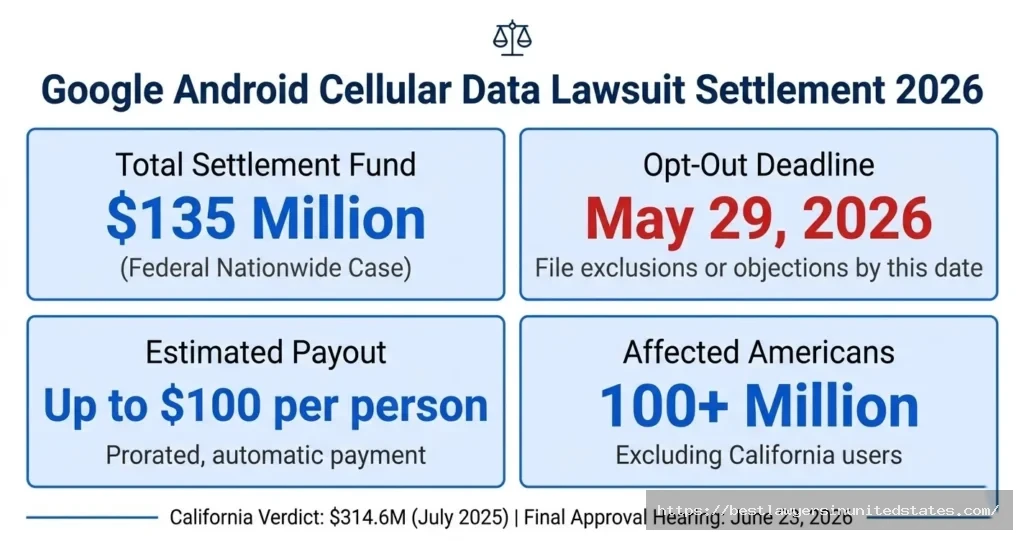
Google has agreed to pay $135 million to settle a nationwide class action over secret cellular data collection by the Android operating system. If you used an Android phone on a cellular data plan anytime since November 12, 2017, you may be entitled to a cash payment of up to $100, delivered automatically with no claim form required.
This is not a small dispute. Over 100 million Americans are covered by the federal settlement alone. California residents are handled under a separate state-level case worth $314.6 million.
In this guide, you’ll learn exactly what the google android cellular data lawsuit is about, who qualifies, what the payout looks like, and what the critical 2026 deadlines mean for your money.
What Is the Google Android Data Lawsuit About?
The Google Android cellular data lawsuit is a legal action accusing Google of programming its Android operating system to secretly consume users’ paid cellular data for its own purposes, without their knowledge or consent.
The core allegation is blunt: while your phone sat idle on your nightstand, your cellular data was being transferred to Google’s servers. This happened even when apps were closed, location services were off, and your screen was locked.
Plaintiffs argued Google used that data to power its product development and targeted advertising business. Since cellular data comes from plans users pay for out of their own pockets, the lawsuit framed this as a theft of personal property, not just a privacy violation. Pete and Gerry’s Eggs Lawsuit
| Key Detail | Info |
|---|---|
| What Google is accused of | Secretly transferring cellular data from idle Android devices |
| When it started | November 12, 2017 (class period start date) |
| Who filed the federal case | Joseph Taylor, Mick Cleary, Jennifer Nelson |
| Google’s position | Denies wrongdoing; calls transfers standard system behavior |
| Settlement amount | $135 million (nationwide) + $314.6 million (California) |
Google’s defense throughout has been that background data transfers are standard, necessary system functions, like security checks and software syncs. Users allegedly consented through the device’s terms of service and settings. The courts disagreed.
Google Android Class Action Lawsuit 2026: The Full Picture
This is not one lawsuit. It’s two parallel legal battles that developed on separate tracks, covering different groups of users, tried in different courts, and reaching different financial outcomes.
The California state case, filed in 2019 as Attila Csupo et al. v. Google LLC (Case No. 19CV352557), targeted roughly 14 million California Android users. A Santa Clara County jury returned a $314.6 million verdict in July 2025. That case covered a class period beginning August 9, 2016.
The federal nationwide case, Taylor et al. v. Google LLC, was filed in November 2020 in the U.S. District Court for the Northern District of California. After years of litigation, including a trip to the Ninth Circuit Court of Appeals, the parties reached a $135 million settlement agreement filed on January 27, 2026.
| Case | Jurisdiction | Class | Settlement |
|---|---|---|---|
| Csupo v. Google LLC | Santa Clara County Superior Court | ~14M California users | $314.6 million |
| Taylor v. Google LLC | U.S. District Court, N.D. California | 100M+ nationwide users | $135 million |
The federal case covers all U.S. Android users except those in California, who are already covered by the state verdict.
Key Takeaway: Two separate lawsuits cover the Google Android cellular data issue. California users fall under the $314.6M state case. Everyone else falls under the $135M federal settlement.
Google Android Background Data Lawsuit Explained
The heart of this case is background data. This is data your phone sends and receives when you’re not actively using it.
Android devices, according to plaintiffs, were programmed to periodically “phone home” to Google’s servers. These transfers happened over cellular networks, not just Wi-Fi, meaning they came directly out of users’ paid monthly data plans.
Think of it like a water meter that keeps ticking even when no one is home and all the faucets are off. You’re paying for water you never consciously used, and someone else is benefiting from it.
The transfers included things like telemetry data, system logs, and signals that fed into Google’s advertising targeting. Plaintiffs alleged this was not a bug. It was a feature, and a profitable one.
- Transfers occurred when devices were idle
- Transfers continued even with location services disabled
- Transfers happened even when all apps were closed
- Data was routed through cellular networks, not Wi-Fi
- Google allegedly benefited through targeted advertising revenue
This detail matters legally. The data wasn’t just collected; it was consumed from a resource the user paid for.
Google Android Data Conversion Lawsuit: The Legal Theory
The legal theory that made this case viable is called conversion. Understanding it explains why this lawsuit worked where others failed.
Conversion is a property tort, not a privacy claim. It means one party wrongfully takes or uses another person’s property without authorization. Plaintiffs argued that your monthly cellular data allowance is your property, just like the money you spend to buy it.
When Google caused your phone to use that data for its own purposes, plaintiffs said it wrongfully took something that belonged to you. A California jury agreed. The Ninth Circuit Court of Appeals also ruled that Android users had adequately alleged a property interest in their cellular data plans.
This was legally significant. Most data privacy cases rely on statutes that are hard to prove and often result in dismissal. Framing the harm as a property theft opened a direct path to damages. Glen Summers, lead attorney for plaintiffs at Bartlit Beck LLP, stated the $135 million federal settlement is the largest ever reached in a conversion case.
The quantum meruit claim, a separate legal theory seeking restitution for unjust enrichment, was ultimately dismissed by the Ninth Circuit. Only the conversion claim survived to settlement.
The $135 Million Google Android Settlement
The $135 million federal settlement was filed on January 27, 2026, and granted preliminary approval on March 5, 2026, by U.S. Magistrate Judge Virginia K. DeMarchi.
The fund is structured as nonreversionary, meaning any money not distributed to class members does not revert back to Google. It goes to the class.
Settlement administrator Angeion Group will manage the distribution. Payments will be sent electronically via PayPal, Venmo, or Zelle, linked to the email addresses and phone numbers in Google’s own systems.
| Settlement Detail | Amount / Date |
|---|---|
| Total settlement fund | $135,000,000 |
| Max attorneys’ fees sought | $39,800,000 |
| Estimated payout per person | Up to $100 (prorated) |
| Preliminary approval date | March 5, 2026 |
| Opt-out / objection deadline | May 29, 2026 |
| Final approval hearing | June 23, 2026 |
Plaintiffs’ counsel told the court they do not expect the $100 cap per person to be reached given the size of the fund relative to expected claim volume.
California Google Android Lawsuit: The $314.6 Million Verdict
California users have their own, separate outcome with a much larger figure attached.
In July 2025, a Santa Clara County jury found Google liable and awarded $314.6 million to the California class, covering approximately 14 million Android users in the state. The class period for California users begins August 9, 2016, earlier than the federal case.
The legal standard in California consumer law allowed the jury to apply the conversion theory more aggressively. The verdict came after the jury sided with plaintiffs on both the factual finding (that Google transferred data as described) and the legal theory (that this caused compensable harm).
As plaintiff counsel noted during trial: phone users were unknowingly subsidizing the same advertising business that earns over $200 billion annually. Medication Error Lawsuit
| California Case Detail | Info |
|---|---|
| Case name | Attila Csupo et al. v. Google LLC |
| Case number | 19CV352557 |
| Court | Santa Clara County Superior Court |
| Verdict date | July 2025 |
| Verdict amount | $314,600,000 |
| Users covered | ~14 million California Android users |
| Class period start | August 9, 2016 |
California users are excluded from the federal $135 million settlement entirely.
Key Takeaway: California users got a larger verdict through the state courts. If you’re in California, your case and your money come from a completely separate $314.6 million pool.
Google Android Cellular Data Lawsuit Payout: What to Expect
The federal settlement payout is prorated, up to a maximum of $100 per class member. The final amount each person receives depends on how many total eligible members submit or are identified as part of the class.
Because the fund is $135 million and over 100 million Americans are potentially eligible, the per-person math works like this: before deductions for attorneys’ fees (up to $39.8 million), administration costs, and lead plaintiff incentive awards, the net fund available for distribution is estimated at roughly $90 to $95 million.
If all 100 million eligible users participate, individual amounts drop well below $1. However, class action settlements of this type typically see much lower actual participation rates. Plaintiffs’ attorneys stated they do not expect the $100 cap to be hit, suggesting expected payouts could land somewhere in a meaningful range for active recipients.
| Payout Scenario | Estimated Amount |
|---|---|
| If cap is not reached (expected) | $1 to $100 per person (prorated) |
| Maximum possible | $100 per class member |
| Payment method | PayPal, Venmo, or Zelle |
| Claim form required | No, payments are automatic |
The exact payout will only be confirmed after the final approval hearing on June 23, 2026.
How Much Will I Get from the Google Android Settlement?
Most eligible class members can expect a prorated share of the net fund, capped at $100 per person. Plaintiffs’ counsel does not expect the cap to be reached.
The actual per-person amount depends on total participation. Lower participation means a higher individual payout. High participation spreads the fund thinner.
The settlement is non-reversionary. Whatever remains in the fund after costs goes to class members, not back to Google. That is a meaningful structural protection for claimants.
For the California case, individual payouts from the $314.6 million verdict have not yet been publicly announced on a per-person basis. That distribution is proceeding separately through Santa Clara County Superior Court.
- Federal settlement covers: 100+ million Android users outside California
- California settlement covers: ~14 million California users
- Payment delivery: Automatic, no paperwork for federal class members
- Payments arrive: After final court approval and resolution of any appeals
Who Qualifies for the Google Android Settlement?
You qualify for the federal $135 million settlement if you meet all three of the following criteria.
First, you must be a U.S. resident. Second, you must not be a California resident (California users fall under the separate state case). Third, you must have used a mobile device running the Android operating system to access the internet on a cellular data network operated by a mobile carrier at any point between November 12, 2017 and the date of the court’s final approval order.
| Eligibility Criteria | Requirement |
|---|---|
| Location | United States, excluding California |
| Device | Android-powered smartphone |
| Data usage | Used cellular data (not just Wi-Fi) on Android |
| Class period | November 12, 2017 through final court approval |
| Claim form needed | No |
California residents who used Android on a cellular data plan anytime between August 9, 2016 and the present may qualify for the state-level settlement instead.
Simply owning an Android phone is likely sufficient. The class is broad. Google’s own account records will be used to identify eligible users.
Key Takeaway: Almost every Android user in America who has been on a cellular data plan since late 2017 qualifies. You do not need to prove you were harmed individually.
Android Data Tracking Settlement Eligibility: Edge Cases
Some situations require a closer look at whether eligibility applies.
If you lived in California during part of the class period but moved out of state, your eligibility depends on your location at the time of the alleged data transfers. The official settlement website, once live from Angeion Group, will clarify this.
If you used both personal and business Android devices, each separate user account could potentially qualify. Google account data is used to identify class members. Multiple accounts mean multiple potential notifications.
Users who previously participated in any settlement release related to the same claims may be excluded. This is standard in class action practice.
- Moved states during class period: Eligibility may be partial, pending official guidance
- Multiple Android devices: Each Google account is potentially eligible
- Business Android users: Likely covered if using personal cellular data plans
- Users who opted out of the California case: May or may not qualify for federal case, depending on the specific release signed
If your situation is unusual, wait for the official Angeion settlement website. That site will be the authoritative source once launched.
How to File a Claim for the Google Android Settlement
You do not need to file a paper claim form for the $135 million federal settlement. This is a significant departure from most class action processes.
Payments will be sent automatically to eligible class members via PayPal, Venmo, or Zelle, using the email addresses and phone numbers associated with your Google accounts. The settlement administrator, Angeion Group, will handle the outreach.
What you should do now:
- Make sure your Google account has a current, active email address and phone number on file
- Link a PayPal, Venmo, or Zelle account to that email or phone number
- Watch for a notification from Angeion Group once the settlement website goes live
- Do nothing if you want to be included; no form submission is required
If you want to update your payment preferences or adjust your account details, the official settlement website will provide a mechanism to do so once launched. The site was expected to go live in the weeks following preliminary approval on March 5, 2026.
Google Android Lawsuit Claim Deadline 2026
The critical date for the federal settlement is May 29, 2026. That is the deadline for class members to submit any requests, including exclusions (opting out) or formal objections to the settlement terms.
This is not the date payments arrive. Payments will only be sent after final court approval and resolution of any appeals, which could extend well into late 2026 or beyond.
| Date | Event |
|---|---|
| January 27, 2026 | Settlement agreement filed in federal court |
| March 5, 2026 | Preliminary approval granted by Judge DeMarchi |
| May 29, 2026 | Deadline for opt-outs and objections |
| June 23, 2026 | Final approval hearing scheduled |
| Post-June 2026 | Payments issued after final approval and appeals |
Mark May 29, 2026 in your calendar. If you miss this deadline and want to opt out to pursue your own legal action, you lose that right.
Android Data Lawsuit Opt Out: What It Means and When to Do It
Opting out means you are excluding yourself from the class settlement. You give up your right to receive a payout from this settlement but retain the right to sue Google independently.
For most people, opting out makes no practical sense. Individual lawsuits against Google are expensive, time-consuming, and far less certain than a guaranteed prorated share of $135 million.
Opting out is potentially worth considering only if you believe you have suffered documented, provable damages far exceeding $100 and you have the resources to pursue independent litigation. Nike Lawsuit 2026
| Option | What It Means |
|---|---|
| Do nothing | You stay in the class, receive automatic payment |
| Opt out | Excluded from payout, can sue Google independently |
| Object | Remain in class but formally challenge settlement terms |
| Deadline | May 29, 2026 for both opt-outs and objections |
Objecting is different from opting out. You can object to the settlement terms while still remaining in the class. Objections go to Judge DeMarchi and become part of the court record reviewed at the June 23 hearing.
Key Takeaway: For most Android users, the smart move is to do nothing, stay in the class, and wait for your automatic payment. Only opt out if you have a specific reason and legal resources to back it up.
Google Android Settlement Payment Method: How You Get Paid
Payments in the federal settlement will be delivered electronically through PayPal, Venmo, or Zelle. No check will be mailed. No paper form needs to be submitted.
The settlement administrator, Angeion Group, will use the email addresses and phone numbers tied to your Google account to route payments. This is the system Google already has on file for you.
If you do not have a PayPal, Venmo, or Zelle account linked to your Google account email or phone number, you may need to create one before payments are distributed. The official settlement website will clarify whether alternative delivery methods are available.
- PayPal: Link to the email associated with your Google account
- Venmo: Link to the phone number associated with your Google account
- Zelle: Available through most major U.S. bank apps, linked to email or phone
- Timing: Payments sent after final approval (post-June 2026) and any appeals are resolved
Set up or verify your payment accounts now. Don’t wait until the settlement website is live and everyone else is scrambling to update their information at the same time.
Taylor v. Google LLC Settlement Case Details
The federal case is formally captioned Taylor et al. v. Google LLC, filed in November 2020 in the U.S. District Court for the Northern District of California (San Jose Division).
Named plaintiffs are Joseph Taylor, Mick Cleary, and Jennifer Nelson. Lead counsel for the plaintiffs is Glen Summers of Bartlit Beck LLP, supported by attorneys from Korein Tillery LLC and other firms.
The case had a notable procedural journey. A district court judge initially granted Google’s motion to dismiss. The Ninth Circuit Court of Appeals reversed the dismissal of the conversion claim, finding that plaintiffs had adequately alleged a property interest in their cellular data. The quantum meruit claim was dismissed by the Ninth Circuit and did not survive.
| Case Detail | Information |
|---|---|
| Case name | Taylor et al. v. Google LLC |
| Court | U.S. District Court, Northern District of California |
| Filed | November 2020 |
| Lead plaintiffs | Joseph Taylor, Mick Cleary, Jennifer Nelson |
| Lead plaintiff counsel | Glen Summers, Bartlit Beck LLP |
| Settlement administrator | Angeion Group |
| Presiding judge | U.S. Magistrate Judge Virginia K. DeMarchi |
| Claims that survived | Conversion |
| Claims dismissed | Quantum meruit |
The Ninth Circuit’s ruling was pivotal. Without it, the lawsuit dies at dismissal and no settlement exists.
Google Android Settlement Final Approval Date 2026
The final approval hearing for the $135 million federal settlement is currently scheduled for June 23, 2026, before Judge Virginia K. DeMarchi.
At that hearing, the judge will review any objections filed before May 29, assess whether the settlement is fair, reasonable, and adequate, and determine whether to grant final approval. If approved, the order becomes effective and the payment process begins.
However, final approval does not mean instant payment. Any class member who objects can appeal the final approval order. If appealed, the payment process is paused until the appellate court rules. In complex class actions, this can add months or years.
| Stage | Date |
|---|---|
| Preliminary approval | March 5, 2026 |
| Settlement website launch | Weeks after March 5, 2026 |
| Opt-out / objection deadline | May 29, 2026 |
| Final approval hearing | June 23, 2026 |
| Payments begin | After final approval, post-June 2026 |
| Potential delay | If appealed, timeline extends further |
The conservative expectation: if no serious appeals emerge, payments could begin in late 2026. If appeals drag on, it could be 2027 or later.
Frequently Asked Questions
Do I need to file a claim for the Google Android settlement?
No, you do not need to file a claim form for the federal $135 million settlement. Payments will be sent automatically via PayPal, Venmo, or Zelle to eligible class members using contact information Google already has on file. Make sure your Google account has a current email and phone number to avoid missing your payment.
How much money will I get from the Google Android cellular data lawsuit?
Most eligible class members can expect up to $100, paid as a prorated share of the net settlement fund. The exact amount depends on total participation; plaintiffs’ counsel does not expect the $100 cap to be reached. Payments will be sent after final court approval, which is scheduled for June 23, 2026.
Who qualifies for the Google Android settlement?
You qualify if you are a U.S. resident (outside California) who used an Android device on a cellular data plan anytime between November 12, 2017 and the date of final court approval. California residents are covered by the separate $314.6 million state-level verdict from July 2025. No individual proof of harm is required; class membership is based on Android usage with a cellular data plan.
What is the deadline to opt out of the Google Android class action?
The deadline to opt out of or object to the federal settlement is May 29, 2026. If you miss this date, you lose your right to exclude yourself and cannot pursue an independent lawsuit against Google over these claims. Most class members have no practical reason to opt out given the automatic payment structure.
When will Google Android settlement payments be sent out?
Payments will be sent after the final approval hearing on June 23, 2026 and after any appeals are resolved. If no appeals are filed, payments could begin in late 2026. If the settlement faces an appeal, distribution could be delayed into 2027 or beyond.
What Happens Next
The Google Android cellular data lawsuit has already delivered real results. A $314.6 million California verdict in July 2025. A $135 million federal settlement approved preliminarily in March 2026.
The next step is the June 23, 2026 final approval hearing. If approved, Angeion Group will begin sending automatic payments.
Mark May 29, 2026 as your action date. That is the last day to opt out or object. After that, you are in the class and waiting for your money.
Update your Google account’s email and phone number. Link your PayPal, Venmo, or Zelle account now. Then wait for the official settlement notification to arrive.
