
The Nightfall Group lawsuit allows consumers to claim up to $1,000 per violation for illegal debt collection practices. If this company harassed you with repeated calls, threats, or robocalls, you may qualify for compensation.
Nightfall Group is a debt collection agency accused of violating federal laws designed to protect consumers. The company allegedly used abusive tactics, ignored cease and desist requests, and blasted consumers with illegal robocalls.
This guide covers everything you need to know for 2026. You will learn who qualifies, how much money you might receive, key deadlines, and exactly how to file a claim.
Here is a fact that might surprise you: debt collection lawsuits under the FDCPA have a 96% plaintiff success rate when violations are documented. That means the odds are in your favor.
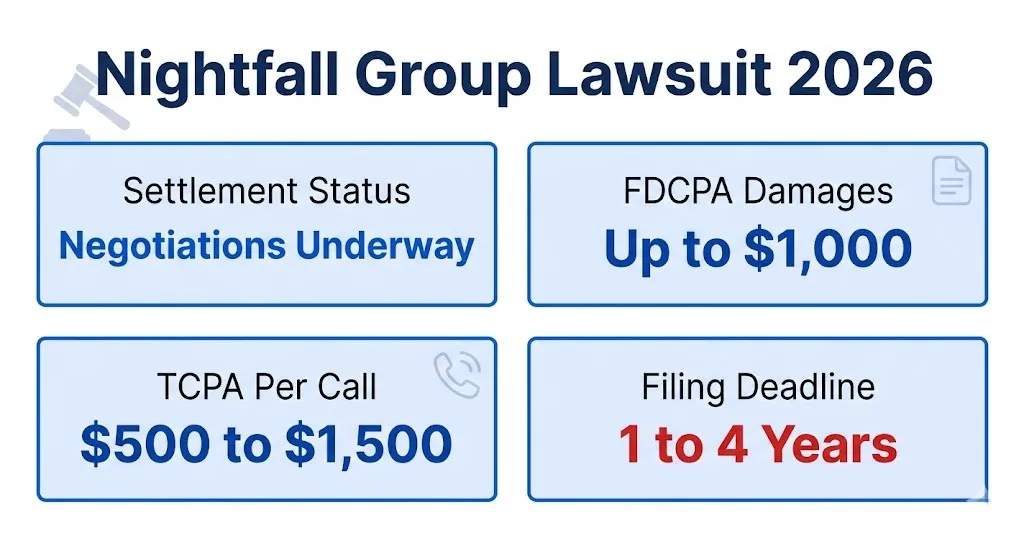
Image Placement: Nightfall Group Lawsuit 2026 Infographic
Nightfall Group Lawsuit
The Nightfall Group lawsuit is a legal action against a debt collection company accused of breaking federal consumer protection laws. Multiple consumers have filed individual and class action claims against this agency.
Nightfall Group LLC operates as a third-party debt collector. They purchase or collect debts on behalf of original creditors like credit card companies, medical providers, and auto lenders.
The core allegations focus on two federal laws:
| Law | What It Protects |
|---|---|
| FDCPA | Bans harassment, threats, deception by debt collectors |
| TCPA | Bans robocalls and autodialed calls without consent |
Plaintiffs claim Nightfall Group violated both statutes repeatedly. The lawsuits describe a pattern of abusive collection tactics targeting vulnerable consumers.
These cases are filed in federal district courts across the country. Some proceed as individual lawsuits while others seek class action status to represent thousands of affected consumers at once.
Nightfall Group Lawsuit Update 2026
The Nightfall Group lawsuit is actively progressing through federal courts as of early 2026. Several key developments have occurred in recent months.
Class certification motions are pending in at least three jurisdictions. If approved, these would allow thousands of consumers to join a single lawsuit against Nightfall Group.
Recent 2026 Developments:
- January 2026: New class action complaint filed in Florida federal court
- February 2026: Settlement negotiations reportedly underway in California case
- March 2026: Discovery phase ongoing in multiple TCPA robocall cases
The Consumer Financial Protection Bureau has also increased scrutiny of debt collection agencies in 2026. This regulatory pressure may influence how quickly Nightfall Group moves toward settlement.
Court records show Nightfall Group has hired additional defense counsel. This typically signals a company preparing for either prolonged litigation or serious settlement talks.
| Case Status | Current Phase |
|---|---|
| California Class Action | Settlement Negotiations |
| Florida Class Action | Class Certification Pending |
| Texas Individual Cases | Discovery Phase |
| TCPA Robocall Cases | Active Litigation |
Nightfall Group Class Action
A Nightfall Group class action is a lawsuit where one or more plaintiffs represent a larger group of consumers who suffered similar harm. This approach allows thousands of people to sue together.
Class actions work well against debt collectors because the same illegal tactics usually affect many people. When a company uses a standard script that violates the law, everyone who received that script has a similar claim.
Benefits of Class Action Status:
- Strength in numbers against a well-funded defendant
- Shared legal costs among all class members
- No need to hire your own attorney
- Automatic inclusion if you meet eligibility criteria
The lead plaintiffs in Nightfall Group class actions have presented evidence of systematic violations. Court filings describe company-wide policies that allegedly broke federal law.
To achieve class certification, plaintiffs must prove common questions of law and fact. In debt collection cases, this often involves proving the company used standardized illegal practices.
If you received calls or letters from Nightfall Group, you may automatically become a class member once certification is granted. You would then receive notice explaining your options.
Key Takeaway: The Nightfall Group lawsuit is progressing through federal courts in 2026, with class certification pending and settlement negotiations underway in some jurisdictions.
Nightfall Group FDCPA Violations
Nightfall Group FDCPA violations refer to alleged breaches of the Fair Debt Collection Practices Act. This federal law sets strict rules for how debt collectors can communicate with consumers.
The FDCPA bans a wide range of abusive practices. Congress passed this law specifically because debt collectors were harassing and deceiving consumers.
Alleged FDCPA Violations by Nightfall Group:
- Calling before 8 AM or after 9 PM
- Using profane or abusive language
- Threatening legal action they cannot take
- Failing to validate debts when requested
- Contacting consumers at work after being told to stop
- Discussing debts with third parties like neighbors or employers
Each violation can result in statutory damages. The law allows up to $1,000 per lawsuit in statutory damages, plus actual damages for any financial harm you suffered.
| FDCPA Violation Type | Potential Damages |
|---|---|
| Harassment | Up to $1,000 statutory + actual damages |
| False Threats | Up to $1,000 statutory + actual damages |
| Third-Party Disclosure | Up to $1,000 statutory + actual damages |
| Failure to Validate | Up to $1,000 statutory + actual damages |
Plaintiffs in Nightfall Group cases have submitted call recordings, voicemails, and letters as evidence. Some recordings allegedly capture collectors making false statements about lawsuits or wage garnishment.
Nightfall Group Harassment Lawsuit
The Nightfall Group harassment lawsuit centers on claims that the company engaged in repeated, abusive contact designed to intimidate consumers. Federal law specifically prohibits this behavior.
Harassment under the FDCPA includes calling repeatedly to annoy, abuse, or harass someone. Even legitimate debt collectors cross the line when they call excessively.
What Counts as Harassment:
- Calling the same number multiple times per day
- Leaving threatening voicemails
- Using obscene or profane language
- Calling continuously with intent to annoy
- Refusing to identify themselves properly
Some Nightfall Group plaintiffs report receiving 10 to 15 calls per day at the height of collection efforts. Others describe collectors who yelled, cursed, or made personal insults.
The emotional impact matters in these cases. Many plaintiffs report anxiety, sleep disruption, and stress from constant collection calls. These effects can increase your actual damages award.
Courts have ruled that even a few calls can constitute harassment if the collector’s intent was to abuse or annoy rather than legitimately collect a debt.
| Harassment Indicator | Legal Significance |
|---|---|
| 5+ calls per day | Strong evidence of intent to harass |
| Calls at prohibited hours | Per se FDCPA violation |
| Profane language | Clear harassment violation |
| Threats of violence | Criminal conduct, enhanced damages |
Nightfall Group Robocall Lawsuit
The Nightfall Group robocall lawsuit involves claims under the Telephone Consumer Protection Act. This law bans automated calls and texts to cell phones without prior consent.
TCPA violations are particularly valuable for plaintiffs. The law provides $500 per illegal call, which increases to $1,500 per call if the violations were willful.
If Nightfall Group called your cell phone using an autodialer or prerecorded message without your consent, you may have a TCPA claim. This is separate from FDCPA claims and can result in much higher damages.
Signs Your Calls Were Robocalls:
- Brief pause before a human spoke
- Prerecorded message played first
- Same automated message played repeatedly
- Calls came in rapid succession
- Caller ID showed different numbers for same collector
Many consumers received dozens or even hundreds of robocalls from debt collectors. At $500 to $1,500 per call, these claims can result in significant compensation.
| Number of Robocalls | Potential TCPA Damages |
|---|---|
| 10 calls | $5,000 to $15,000 |
| 50 calls | $25,000 to $75,000 |
| 100 calls | $50,000 to $150,000 |
TCPA claims are often combined with FDCPA claims in the same lawsuit. This allows plaintiffs to recover under both statutes for different aspects of the same collection campaign.
Key Takeaway: TCPA robocall claims offer the highest potential payouts, with damages of $500 to $1,500 per illegal call, making documented call logs extremely valuable evidence.
Nightfall Group TCPA Lawsuit
The Nightfall Group TCPA lawsuit specifically targets violations of the Telephone Consumer Protection Act. This federal law has become a powerful tool against aggressive debt collectors.
TCPA applies when a debt collector uses an automatic telephone dialing system (ATDS) or prerecorded voice to call your cell phone. The law requires prior express consent for these calls.
Key TCPA Requirements:
- Written consent required for marketing robocalls
- Prior express consent required for debt collection robocalls
- Must honor revocation of consent immediately
- Cannot call after consumer says stop
Revoking consent is simple. You can tell the caller to stop, send a text saying stop, or mail a written request. Once you revoke consent, any further robocalls violate the TCPA.
Several Nightfall Group TCPA cases allege the company continued calling after consumers revoked consent. Some plaintiffs documented dozens of calls after sending written cease and desist letters.
The “willful” standard matters for damages. If Nightfall Group knew their calls violated the law and called anyway, damages triple from $500 to $1,500 per call.
| TCPA Element | What Plaintiffs Must Prove |
|---|---|
| Cell Phone | Call was made to a mobile number |
| ATDS | Company used automated dialing equipment |
| No Consent | Consumer did not consent or revoked consent |
| Willfulness | Company knew calls were illegal (for treble damages) |
Nightfall Group Violations
Nightfall Group violations fall into several categories under federal consumer protection laws. Understanding the types of violations helps you identify what claims you might have.
The most common violations involve deceptive practices. Debt collectors often misrepresent the amount owed, the consequences of non-payment, or their legal authority.
Common Violation Categories:
- Deception: Lying about debt amounts, legal status, or consequences
- Harassment: Excessive calls, threats, abusive language
- Privacy Violations: Discussing debt with third parties
- Procedural Violations: Failing to validate debt or send required notices
- Robocall Violations: Using autodialers without consent
Each category has specific evidence requirements. Deception claims require proof of false statements. Harassment claims require proof of abusive patterns.
Plaintiffs have alleged Nightfall Group committed violations in all these categories. Court filings describe a collection operation that prioritized results over legal compliance.
| Violation Category | Evidence Needed |
|---|---|
| Deception | Call recordings, letters with false claims |
| Harassment | Call logs, voicemails, witness testimony |
| Privacy | Third-party testimony, call recordings |
| Procedural | Correspondence showing failure to validate |
| Robocalls | Cell phone records, call recordings |
How to Join Nightfall Group Lawsuit
Joining the Nightfall Group lawsuit requires determining whether you want to participate in a class action or file an individual claim. Both options have advantages.
For class actions, you typically do not need to do anything to join initially. Once a court certifies a class, you automatically become a member if you meet the criteria. You will receive a notice in the mail explaining your rights.
Steps to Join the Class Action:
- Wait for class certification (pending in 2026)
- Receive notice explaining class membership
- Choose to remain in the class or opt out
- Provide claim documentation if requested
- Receive your share of any settlement
For individual lawsuits, you need to find an attorney who handles FDCPA and TCPA cases. Most consumer protection attorneys work on contingency, meaning you pay nothing upfront.
Steps to File an Individual Lawsuit:
- Gather all documentation (call logs, letters, recordings)
- Contact a consumer protection attorney
- Attorney evaluates your case
- Lawsuit filed in federal court
- Discovery, negotiation, trial, or settlement
Individual lawsuits often recover more money per plaintiff. Class action members typically receive smaller amounts because the settlement is divided among many people.
| Lawsuit Type | Typical Recovery | Your Effort Required |
|---|---|---|
| Class Action | $50 to $500 | Minimal |
| Individual Lawsuit | $1,000 to $10,000+ | Moderate |
| TCPA Individual | $5,000 to $50,000+ | Moderate |
Key Takeaway: You can join the Nightfall Group lawsuit through automatic class membership or by filing an individual claim with a consumer protection attorney who works on contingency.
Nightfall Group Lawsuit Eligibility
Nightfall Group lawsuit eligibility depends on whether you received collection communications that violated federal law. Not everyone contacted by a debt collector has a valid legal claim.
You likely qualify if Nightfall Group contacted you and committed any of the violations described above. The contact must have occurred within the statute of limitations.
Basic Eligibility Requirements:
| Requirement | Details |
|---|---|
| Contact from Nightfall Group | Calls, texts, letters, or voicemails |
| Violation of FDCPA or TCPA | Harassment, deception, robocalls, etc. |
| Within Statute of Limitations | 1 year for FDCPA, 4 years for TCPA |
| Documentation | Some evidence of contact and violations |
You can still qualify even if you legitimately owed the debt. The FDCPA protects consumers regardless of whether the underlying debt is valid. Owing money does not give collectors permission to break the law.
You May Qualify If:
- You received calls before 8 AM or after 9 PM
- Collectors called your workplace after you asked them to stop
- You received robocalls on your cell phone
- Collectors used threatening or abusive language
- Nightfall Group discussed your debt with family or employers
- You sent a debt validation letter that was ignored
The strongest cases involve documented evidence. Save all voicemails, letters, and call logs. Screenshot text messages. Record calls if legal in your state.
Is Nightfall Group Lawsuit Legitimate
The Nightfall Group lawsuit is legitimate and based on established federal consumer protection laws. These are real legal actions filed in federal courts with documented case numbers.
Some consumers worry that lawsuit notices might be scams. That concern makes sense given how many fraudulent legal schemes exist. Here is how to verify legitimacy.
How to Verify the Lawsuit Is Real:
- Check PACER (Public Access to Court Electronic Records) for case filings
- Verify attorney credentials through state bar associations
- Look for official court documents with case numbers
- Contact the court clerk directly to confirm case existence
Legitimate class action notices will include specific case information. They will list the court, case number, judge name, and class counsel contact information.
Red flags for scam notices include demands for upfront payment, vague case details, or pressure to act immediately without verification.
| Legitimate Notice | Scam Warning Signs |
|---|---|
| Specific court and case number | Vague legal references |
| No upfront payment required | Asks for money immediately |
| Verifiable attorney credentials | Unknown or unverifiable lawyers |
| Official court documents | Unofficial letterhead |
| Reasonable deadlines | Extreme urgency without details |
The FDCPA and TCPA have created billions of dollars in legitimate settlements and verdicts. Debt collection lawsuits are among the most common consumer protection actions in federal courts.
Nightfall Group Settlement
A Nightfall Group settlement refers to a negotiated resolution between plaintiffs and the company to end litigation. Settlements avoid the cost and uncertainty of trial for both sides.
As of early 2026, settlement negotiations are reportedly underway in at least one Nightfall Group case. No final settlement has been publicly announced at this time.
Typical Settlement Process:
- Both sides complete discovery (evidence gathering)
- Mediation or direct negotiation begins
- Settlement terms are negotiated
- Court reviews and approves class settlement
- Notice sent to class members
- Claims period opens
- Payments distributed
Class action settlements require court approval. A judge reviews the terms to ensure they are fair, reasonable, and adequate for class members.
| Settlement Phase | Estimated Timeline |
|---|---|
| Negotiation | 3 to 6 months |
| Preliminary Approval | 1 to 2 months |
| Notice Period | 60 to 90 days |
| Claims Period | 90 to 120 days |
| Final Approval | 1 to 2 months |
| Payment Distribution | 60 to 90 days |
Individual settlements can happen faster. If you file your own lawsuit, Nightfall Group may offer to settle quickly to avoid litigation costs and public exposure.
Key Takeaway: Nightfall Group settlement negotiations are reportedly underway in 2026, with the full settlement process typically taking 9 to 18 months from negotiation to payment distribution.
Nightfall Group Settlement Amount
The Nightfall Group settlement amount will depend on the total number of violations and class members. Individual payouts vary based on how the settlement fund is divided.
No final settlement amount has been announced for the Nightfall Group class action. Based on comparable debt collection settlements, here are reasonable estimates.
Comparable Debt Collection Settlements:
| Company | Settlement Amount | Per-Claimant Payout |
|---|---|---|
| Portfolio Recovery | $42 million | $50 to $350 |
| Midland Credit | $79 million | $100 to $500 |
| Encore Capital | $67 million | $75 to $400 |
| Synchrony Bank | $3.5 million | $50 to $200 |
FDCPA class action settlements typically range from several million to tens of millions of dollars. Individual payouts usually fall between $50 and $500 per class member.
TCPA settlements tend to be larger on a per-claimant basis because damages are calculated per call. If you received many robocalls, your payout could be significantly higher.
Factors Affecting Settlement Amount:
- Total number of class members
- Severity and frequency of violations
- Strength of plaintiff evidence
- Company’s ability to pay
- Whether TCPA claims are included
Nightfall Group Lawsuit Payout
Your Nightfall Group lawsuit payout depends on whether you participate in a class action or file an individual claim. The difference can be substantial.
Class action payouts are typically modest. When millions of dollars are divided among thousands of claimants, individual checks are often small. Expect $50 to $500 from a class settlement.
Individual lawsuit payouts are much larger. If you file your own FDCPA case, you can recover up to $1,000 in statutory damages plus actual damages and attorney fees. TCPA individual cases recover $500 to $1,500 per violation.
| Payout Type | Estimated Range | Factors |
|---|---|---|
| Class Action | $50 to $500 | Settlement size, number of claimants |
| Individual FDCPA | $1,000 to $5,000 | Statutory + actual damages |
| Individual TCPA | $5,000 to $100,000+ | $500 to $1,500 per call |
| Combined FDCPA + TCPA | $10,000 to $150,000+ | Multiple violation types |
The tradeoff is effort and risk. Class actions require minimal work from you. Individual lawsuits require finding an attorney, participating in litigation, and accepting some risk of losing.
Most consumer protection attorneys work on contingency for these cases. You pay nothing unless you win. The attorney typically takes 33% to 40% of your recovery.
Nightfall Group Lawsuit Compensation
Nightfall Group lawsuit compensation comes in several forms under federal law. Understanding each type helps you estimate your potential recovery.
Statutory Damages:
The FDCPA allows up to $1,000 per lawsuit in statutory damages. You do not need to prove actual harm. The violation itself entitles you to this amount.
Actual Damages:
If you suffered real financial harm or emotional distress, you can recover actual damages. This includes lost wages, medical bills for stress-related conditions, or financial losses caused by the violations.
TCPA Damages:
The TCPA provides $500 per illegal call or text. If violations were willful, damages triple to $1,500 per violation. This adds up quickly with multiple calls.
Attorney Fees:
Both laws require the defendant to pay your attorney fees if you win. This makes it possible to pursue claims that might otherwise be too small to justify hiring a lawyer.
| Compensation Type | Amount | Requirements |
|---|---|---|
| FDCPA Statutory | Up to $1,000 | Any violation |
| FDCPA Actual | Unlimited | Proof of harm |
| TCPA Standard | $500/call | Robocall without consent |
| TCPA Willful | $1,500/call | Knowing violation |
| Attorney Fees | Varies | Prevailing plaintiff |
Key Takeaway: Total Nightfall Group compensation can range from $50 in a class action to over $100,000 in individual TCPA cases with documented robocalls.
Sue Nightfall Group
You can sue Nightfall Group individually without joining a class action. Individual lawsuits often result in higher payouts and faster resolution.
Filing an individual lawsuit is not as complicated as it sounds. Consumer protection attorneys handle these cases on contingency. They take no money upfront and only get paid if you win.
Steps to Sue Nightfall Group:
- Document everything: Gather call logs, letters, voicemails, and recordings
- Find an attorney: Search for FDCPA or TCPA lawyers in your area
- Free consultation: Most attorneys offer free case evaluations
- Case filing: Attorney files complaint in federal or state court
- Discovery: Both sides exchange evidence
- Resolution: Case settles or goes to trial
The process typically takes 6 to 18 months. Most cases settle before trial because defendants want to avoid the expense and uncertainty of litigation.
You can find consumer protection attorneys through the National Association of Consumer Advocates (NACA) directory. Many attorneys specialize exclusively in debt collection violations.
| Timeline | What Happens |
|---|---|
| Month 1 | Gather evidence, consult attorney |
| Months 2 to 3 | Attorney files lawsuit |
| Months 4 to 8 | Discovery and negotiations |
| Months 9 to 12 | Settlement or trial preparation |
| Months 12 to 18 | Trial or final settlement |
Nightfall Group Lawsuit Deadline
The Nightfall Group lawsuit deadline depends on which law applies to your claim. Missing these deadlines permanently bars your case.
FDCPA Statute of Limitations: 1 year from the date of the violation.
This is a strict deadline. If Nightfall Group’s last violation occurred more than one year ago, you cannot file an FDCPA claim. However, each new violation restarts the clock.
TCPA Statute of Limitations: 4 years from the date of the violation.
TCPA has a longer window. You can sue for robocalls that occurred up to four years ago. This gives you more time to gather evidence and find an attorney.
| Law | Deadline | Counts From |
|---|---|---|
| FDCPA | 1 year | Date of each violation |
| TCPA | 4 years | Date of each call |
Class Action Deadlines:
If you are part of a class action, different deadlines apply. You will receive notice with specific dates for opting out or filing claims. Follow those instructions carefully.
Do Not Wait:
Even if you are within the statute of limitations, waiting reduces your chances of success. Evidence gets lost. Memories fade. Witnesses become unavailable.
Contact an attorney as soon as possible. Most consultations are free. You have nothing to lose by checking your options early.
Nightfall Group Complaint
Filing a Nightfall Group complaint with federal agencies creates an official record of violations. This supports your lawsuit and helps regulators take action.
The Consumer Financial Protection Bureau (CFPB) accepts complaints about debt collectors. These complaints become part of a public database that regulators, attorneys, and journalists use to identify problem companies.
How to File a CFPB Complaint:
- Visit consumerfinance.gov/complaint
- Select “Debt collection” as the product
- Describe what happened in detail
- Include dates, amounts, and specific violations
- Upload supporting documents if available
- Submit and save your confirmation number
Your complaint may prompt a response from Nightfall Group. The CFPB requires companies to respond within 15 days. This response becomes part of the public record.
Other Complaint Options:
| Agency | What They Do |
|---|---|
| CFPB | Regulates debt collectors, maintains complaint database |
| FTC | Investigates deceptive business practices |
| State Attorney General | Enforces state consumer protection laws |
| Better Business Bureau | Tracks complaints, facilitates resolutions |
Filing complaints does not replace a lawsuit. Agencies rarely recover money for individual consumers. But complaints build the evidence that supports class actions and individual claims.
Key Takeaway: File complaints with the CFPB and your state attorney general to create official records that support both your individual claim and broader regulatory action against Nightfall Group.
Frequently Asked Questions
How much money can I get from the Nightfall Group lawsuit?
Most class action participants receive between $50 and $500.
Individual FDCPA lawsuits can recover up to $1,000 in statutory damages plus actual damages.
TCPA claims for robocalls can recover $500 to $1,500 per illegal call, potentially reaching tens of thousands of dollars.
What is the deadline to join the Nightfall Group class action?
Class action deadlines will be announced once a settlement is reached.
For individual FDCPA claims, you must file within 1 year of the violation.
TCPA claims have a 4-year statute of limitations from the date of each illegal call.
Does Nightfall Group have to stop calling me if I sue them?
Yes, filing a lawsuit typically stops collection activity.
Most attorneys send cease and desist letters immediately upon taking your case.
Any continued contact after legal representation can result in additional violations and damages.
Can I join the Nightfall Group lawsuit if I already paid the debt?
Yes, paying the debt does not affect your right to sue for collection violations.
The FDCPA protects all consumers regardless of whether the underlying debt was valid.
You can still recover damages for harassment, threats, or robocalls even if you settled the debt.
How long will it take to receive a Nightfall Group settlement payment?
Class action settlements typically take 12 to 24 months from filing to payment.
Individual lawsuit settlements can resolve in 6 to 12 months.
After a settlement is finalized, payment distribution usually occurs within 60 to 90 days.
Take Action Now
The Nightfall Group lawsuit offers real compensation for consumers who endured illegal debt collection practices. Documented violations can result in payouts ranging from $50 to over $100,000 depending on your situation.
Do not let the statute of limitations expire. FDCPA claims must be filed within one year. TCPA claims allow four years, but evidence quality decreases over time.
Gather your call logs, save voicemails, and contact a consumer protection attorney for a free case evaluation. The law is on your side.
