
The AT&T class action lawsuit affects over 73 million customers whose personal data was exposed in massive breaches. If you had AT&T service between 2019 and 2024, you might be owed money.
This guide breaks down everything happening with AT&T lawsuits in 2026. You will learn who qualifies, how much you could receive, and exactly how to file your claim.
Some claimants may receive up to $7,500 depending on their losses. Others will get smaller payments ranging from $50 to $300.
The clock is ticking on several deadlines. Missing them means losing your right to compensation forever.
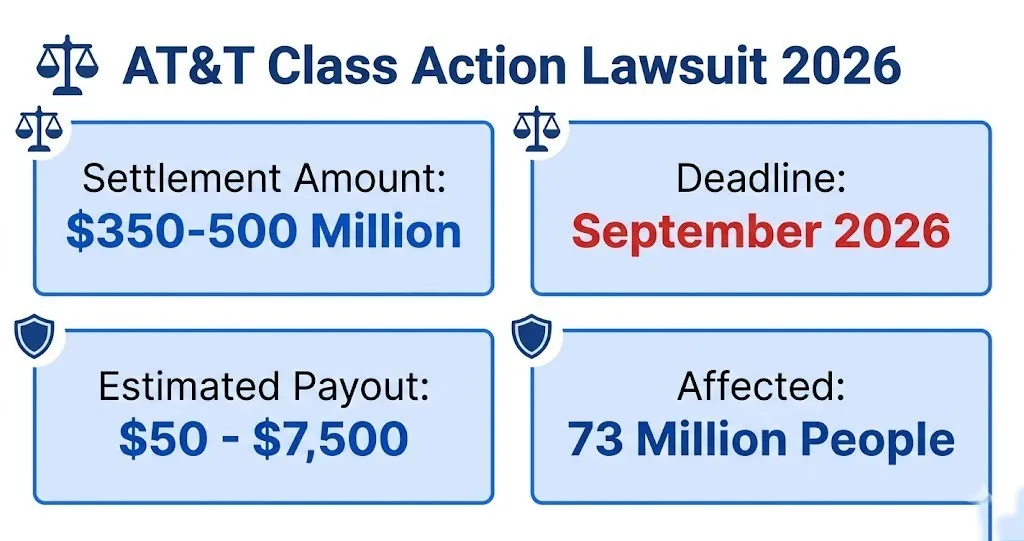
AT&T Class Action Lawsuit
The AT&T class action lawsuit is a legal case where thousands of customers join together to sue the company for harm caused by data breaches, billing errors, or service failures. Rather than filing individual lawsuits, affected customers combine their claims into one powerful case.
AT&T currently faces multiple class action lawsuits across the country. The largest involves the 2024 data breach that exposed sensitive information for 73 million people.
These lawsuits claim AT&T failed to protect customer data. They also allege the company waited too long to notify affected customers.
| Lawsuit Type | Affected Customers | Status in 2026 |
|---|---|---|
| Data Breach (2024) | 73 million | Settlement pending |
| Data Breach (2023) | 9 million | Claims open |
| Billing Disputes | 2.4 million | Active litigation |
| Service Outages | 1.2 million | Preliminary stages |
Class action lawsuits work like strength in numbers. One person suing AT&T has little power. Millions of customers together can force real accountability.
The company has already set aside hundreds of millions for potential payouts. Settlement negotiations continue through 2026.
Joining costs nothing out of pocket. Lawyers work on contingency, meaning they only get paid if you win.
AT&T Lawsuit 2026 Overview
The AT&T lawsuit situation in 2026 involves several active cases at different stages of the legal process. Some are in settlement negotiations while others move toward trial.
The most significant case stems from the April 2024 data breach. Hackers accessed call and text records for nearly all AT&T wireless customers.
Another major case involves the March 2024 disclosure. AT&T revealed that data from 73 million accounts had been leaked onto the dark web.
Quick Facts Box:
- Total Affected: 73+ million customers
- Data Exposed: Social Security numbers, account info, passcodes
- Lawsuits Filed: 40+ federal cases consolidated
- Settlement Status: Preliminary discussions ongoing
Courts have consolidated many individual lawsuits into Multi-District Litigation. This MDL is being handled in the Northern District of Texas.
The consolidation speeds up the process. Instead of 40 separate trials, one judge oversees everything.
AT&T has not admitted wrongdoing. The company maintains its security practices met industry standards.
But plaintiffs argue differently. Their evidence suggests AT&T knew about vulnerabilities and did nothing.
AT&T Data Breach Lawsuit 2026
The AT&T data breach lawsuit in 2026 centers on two massive security failures that exposed customer data to hackers. These breaches rank among the largest in telecommunications history.
The first breach came to light in March 2024. Data from 73 million current and former customers appeared on the dark web.
This data included Social Security numbers, account numbers, and passcodes. Some records dated back to 2019.
The second breach occurred through a third-party cloud platform called Snowflake. Hackers accessed call and text metadata for 109 million accounts.
| Breach | Date Disclosed | Records Exposed | Data Types |
|---|---|---|---|
| Dark Web Leak | March 2024 | 73 million | SSN, account info, passcodes |
| Snowflake Breach | July 2024 | 109 million | Call/text metadata, location |
Lawsuits allege AT&T violated multiple laws. These include the California Consumer Privacy Act and various state data protection statutes.
Plaintiffs seek compensation for:
- Identity theft costs
- Credit monitoring expenses
- Time spent dealing with fraud
- Emotional distress
- Increased risk of future harm
The hacking group ShinyHunters claimed responsibility for the Snowflake breach. They reportedly demanded ransom from AT&T.
AT&T allegedly paid $373,000 to prevent wider data release. This payment came to light through cryptocurrency tracking.
Key Takeaway: AT&T faces lawsuits covering two separate data breaches affecting over 100 million customers, with settlement negotiations expected to intensify throughout 2026.
AT&T Lawsuit Eligibility
AT&T lawsuit eligibility depends on your customer status during specific time periods and what data was compromised. Not everyone affected will qualify for every lawsuit.
The basic requirement is simple. You must have been an AT&T customer when the breach occurred.
For the 73 million breach, you qualify if you had AT&T service between 2019 and March 2024. Both current and former customers are included.
For the Snowflake breach, eligibility covers customers with wireless service in 2022. This includes business and personal accounts.
Eligibility Checklist:
- Had AT&T wireless or landline service during breach periods
- Received a breach notification letter from AT&T
- Your data appeared in known breach databases
- You experienced identity theft or fraud after the breach
- You paid for credit monitoring due to the breach
You do not need to prove you suffered financial loss to join. The exposure of your data alone creates legal standing.
However, proving actual damages can increase your payout. Keep records of any fraud or identity theft.
AT&T sent notification letters to affected customers. Check your mail and email from 2024.
If you never received notification, you might still qualify. Many customers changed addresses or email accounts.
You can check your eligibility through the settlement website once claims open. The administrator will verify your status against AT&T records.
Who Qualifies for AT&T Lawsuit
Who qualifies for the AT&T lawsuit includes current subscribers, former customers, and even people who never directly signed up for service. The reach extends further than most people realize.
Obvious qualifiers include anyone who had AT&T wireless service. This covers individual plans, family plans, and business accounts.
Former customers also qualify even if they left AT&T years ago. The breached data included records dating back to 2019.
Here is the surprising part. You might qualify even without an AT&T account.
| Customer Type | Qualification Status | Notes |
|---|---|---|
| Current Wireless Customer | Qualifies | All plans included |
| Former Wireless Customer (2019-2024) | Qualifies | Includes canceled accounts |
| Landline/Internet Customer | May Qualify | Depends on breach scope |
| Cricket Wireless Customer | Qualifies | AT&T subsidiary |
| Non-Customer (contacted AT&T user) | May Qualify | Metadata exposure |
Cricket Wireless is owned by AT&T. If you had Cricket service, you are included.
People who called or texted AT&T customers may qualify for the metadata breach. Their phone numbers appeared in the stolen records.
Business customers are also included. Companies that used AT&T services can file claims.
Minors on family plans qualify too. Parents or guardians can file on their behalf.
The settlement administrator will verify eligibility using AT&T’s own customer records. You do not need to prove you were a customer yourself.
AT&T Lawsuit Claim
An AT&T lawsuit claim is your formal request for compensation from the settlement fund. Filing a claim tells the administrator you want money.
You cannot get paid without filing a claim. This is the most important step.
Many people assume they will automatically receive a check. That is not how class action settlements work.
You must actively submit a claim form. The form asks for basic information about your AT&T account.
Claim Information Required:
- Full legal name
- Current mailing address
- Email address
- Phone number associated with AT&T account
- AT&T account number (if known)
- Dates of service
- Description of any losses or harm
The claim form is available online once settlements receive final approval. Paper forms will also be available.
You can submit your claim electronically. This is the fastest method.
Paper claims must be postmarked by the deadline. Electronic claims must be submitted by 11:59 PM on the final day.
Keep a copy of your submitted claim. Screenshot the confirmation page if filing online.
The administrator assigns each claim a unique ID number. Use this number for all follow-up questions.
Processing takes several months. You will receive confirmation once your claim is reviewed.
Key Takeaway: Filing a claim is mandatory to receive payment. You will not automatically get a check just because you were affected by the breach.
How to File AT&T Lawsuit Claim
How to file an AT&T lawsuit claim involves a straightforward online process that takes about 10 minutes. Here is exactly what to do step by step.
Step 1: Verify Your Eligibility
Visit the official settlement website. Enter your phone number or account number to check if you qualify.
The system will confirm whether your information was in the breach. You will see a message indicating your eligibility status.
Step 2: Gather Your Documentation
Collect any proof of your AT&T service. This can include bills, emails, or account statements.
If you experienced fraud or identity theft, gather that evidence too. Bank statements, police reports, and credit monitoring alerts help.
Step 3: Complete the Claim Form
| Form Section | What to Enter |
|---|---|
| Personal Information | Name, address, email, phone |
| Account Details | AT&T account number, service dates |
| Harm Statement | Description of losses (optional but increases payout) |
| Documentation | Upload supporting files |
| Signature | Electronic signature confirming accuracy |
Step 4: Submit and Save Confirmation
Click the submit button. The page will display a confirmation number.
Screenshot this confirmation. Print it if possible.
You will receive an email confirmation within 24 hours. Check your spam folder if it does not arrive.
Step 5: Wait for Processing
The administrator reviews all claims after the deadline. This process takes 90 to 180 days.
You will receive updates via email. The final step is receiving your payment.
AT&T Lawsuit Deadline 2026
The AT&T lawsuit deadline in 2026 is projected to fall in the second or third quarter, depending on when courts grant final settlement approval. Missing this deadline means forfeiting your right to payment.
Settlement deadlines are absolutely firm. Courts do not grant extensions for individual claimants.
The exact deadline will be announced after preliminary approval. Check the settlement website for updates.
Based on the current case timeline, expect the claims deadline around June to September 2026. This could shift based on court schedules.
Critical Dates to Watch:
| Event | Expected Timeline |
|---|---|
| Preliminary Approval | Q1 2026 |
| Notice Period Begins | 30 days after approval |
| Claims Period Opens | 45 days after notice |
| Claims Deadline | 90-120 days after opening |
| Objection Deadline | 60 days before final hearing |
| Final Approval Hearing | Q3-Q4 2026 |
Do not wait until the last minute. Website crashes and technical issues happen on deadline days.
File your claim as soon as the period opens. Early filers often receive payments faster.
Set calendar reminders now. Enter the projected deadline range and check for updates monthly.
The settlement administrator will send reminder emails. Make sure your email address is current.
If you miss the deadline, you cannot join the settlement. Your only option would be an individual lawsuit, which is expensive and difficult.
AT&T Settlement Payout
The AT&T settlement payout varies widely based on your claim type and documented losses. Base payments start around $50 while documented fraud victims could receive thousands.
Settlement funds distribute money using a tiered system. The more harm you prove, the more money you receive.
Basic claims require no proof of loss. You simply confirm you were affected by the breach.
Enhanced claims require documentation. These pay significantly more but need evidence.
| Claim Tier | Payment Range | Requirements |
|---|---|---|
| Basic | $50 – $100 | Confirmation of eligibility only |
| Standard | $100 – $300 | Proof of AT&T service |
| Enhanced | $300 – $1,500 | Documentation of time spent |
| Documented Loss | $1,500 – $7,500 | Receipts, fraud reports, expenses |
The total settlement fund size determines final amounts. If more people file claims, individual payments decrease.
This is called pro rata distribution. Everyone shares the available pool.
Based on similar telecom settlements, expect the fund to range from $350 million to $500 million. This covers the combined breaches.
Payment methods include direct deposit and mailed checks. Direct deposit is faster and more secure.
You choose your preferred method on the claim form. Provide accurate banking information.
Payments typically arrive 6 to 12 months after the claims deadline. The exact timing depends on any appeals.
Key Takeaway: Settlement payouts range from $50 for basic claims up to $7,500 for victims with documented identity theft or fraud losses.
AT&T Class Action Settlement Amount
The AT&T class action settlement amount is expected to reach between $350 million and $500 million based on similar telecom data breach cases. Final numbers depend on ongoing negotiations.
This figure comes from analyzing comparable settlements. T-Mobile paid $350 million for its 2021 breach affecting 76 million people.
AT&T’s breach affected similar numbers. Legal experts predict a comparable or larger settlement.
Comparable Settlement Analysis:
| Company | Breach Size | Settlement Amount | Per-Person Average |
|---|---|---|---|
| T-Mobile (2021) | 76 million | $350 million | $25 – $7,500 |
| Equifax (2017) | 147 million | $700 million | $125 – $20,000 |
| Yahoo (2016) | 3 billion | $117.5 million | $25 – $358 |
| AT&T (Projected) | 73+ million | $350-500 million | $50 – $7,500 |
The settlement amount must cover all claimants. It also pays attorney fees and administrative costs.
Attorney fees typically take 25% to 33% of the total. This is standard in class action cases.
Administrative costs cover the claim review process. This usually runs 3% to 5%.
The remaining money goes to claimants. Your individual share depends on how many people file.
If 10 million people file claims on a $400 million fund, average payments would be around $40 each. If only 2 million file, averages jump to $200.
Early estimates suggest 20% to 30% of eligible claimants will file. This is typical for data breach settlements.
AT&T Lawsuit How Much Will I Get
How much you will get from the AT&T lawsuit depends entirely on your claim type and documentation. The range spans from $50 to $7,500.
Most claimants will receive the lower end. This includes people who simply confirm their eligibility without documenting specific losses.
Getting the maximum requires proof. You need receipts, bank statements, and police reports.
Here is a realistic breakdown of what to expect:
Basic Claim (No Documentation):
You confirm you were an AT&T customer during the breach. You do not claim any specific financial losses.
Expected payment: $50 to $100
Standard Claim (Service Verification):
You provide proof of AT&T service. You may note time spent dealing with the breach.
Expected payment: $100 to $300
Time-Spent Claim:
You document hours spent monitoring credit, making calls, or dealing with the breach. The rate is typically $25 per hour.
Expected payment: $300 to $750 (up to 30 hours)
Documented Loss Claim:
You submit proof of actual expenses or fraud losses. This includes credit monitoring purchases, fraud charges, and professional fees.
Expected payment: $1,500 to $7,500
| Loss Type | Reimbursement Cap |
|---|---|
| Credit Monitoring | $300/year |
| Identity Theft Losses | $7,500 |
| Professional Fees | $500 |
| Out-of-Pocket Expenses | $2,500 |
The $7,500 cap applies to documented identity theft. You need police reports and fraud resolution documentation.
Most people will realistically receive between $50 and $150. That is the honest truth based on similar settlements.
AT&T Data Breach Compensation
AT&T data breach compensation covers multiple categories of harm beyond just direct financial losses. You can claim for time, stress, and future risk.
The settlement typically offers these compensation categories:
Direct Financial Losses:
Any money you lost due to fraud stemming from the breach. This requires bank statements or credit card records.
Out-of-Pocket Expenses:
Costs you paid to protect yourself. Examples include credit monitoring services, credit freezes, and identity theft protection.
Time Spent:
Hours you spent dealing with the breach aftermath. This includes calling banks, monitoring accounts, and fixing credit reports.
Identity Monitoring Services:
Many settlements provide free credit monitoring for 2 to 4 years. This has a value of $200 to $400 annually.
| Compensation Type | Maximum Amount | Documentation Needed |
|---|---|---|
| Cash Payment | $7,500 | Varies by tier |
| Credit Monitoring | 4 years free | None |
| Identity Restoration | Full coverage | If needed |
| Reimbursement | $2,500 | Receipts |
Identity restoration services help if your identity is stolen after the breach. These services work to fix your credit and accounts.
Some claimants experienced emotional distress. This is harder to document but can be included in your harm statement.
Future harm is also compensable. The breach increased your lifetime risk of identity theft.
You do not need to wait for fraud to happen. The exposure itself caused compensable harm.
Key Takeaway: Compensation covers direct losses, expenses, time spent, and free credit monitoring services, with the highest payouts going to documented identity theft victims.
AT&T Billing Dispute Lawsuit
The AT&T billing dispute lawsuit is a separate case from the data breach lawsuits. It involves customers who were overcharged or billed for services they never received.
This lawsuit alleges AT&T engaged in deceptive billing practices. Customers were charged for services they did not authorize.
Common billing issues in the lawsuit include:
- Unauthorized premium text message charges
- Services added without customer consent
- Incorrect early termination fees
- Hidden administrative fees
- Charges continuing after account cancellation
The billing lawsuit affects approximately 2.4 million customers. It covers billing from 2018 through 2023.
| Billing Issue | Estimated Victims | Potential Refund |
|---|---|---|
| Unauthorized Charges | 1.8 million | $50 – $200 |
| Hidden Fees | 1.2 million | $75 – $150 |
| Post-Cancellation Charges | 400,000 | $100 – $500 |
This case is separate from the data breach settlement. You may qualify for both.
If you experienced both data exposure AND billing issues, file claims for each lawsuit. They have different deadlines and processes.
Review your old AT&T bills if possible. Look for charges you do not recognize.
The FTC previously fined AT&T $105 million for cramming. This is the practice of adding unauthorized charges.
Current lawsuits build on that enforcement action. They seek additional compensation for affected customers.
AT&T Service Issues Lawsuit
The AT&T service issues lawsuit addresses widespread outages and service failures that left customers without working phones. This became a major legal issue after the February 2024 nationwide outage.
On February 22, 2024, AT&T’s network went down for approximately 12 hours. Over 70,000 customers reported disruptions.
The outage affected emergency 911 services in some areas. This created potential safety hazards.
Lawsuits claim AT&T failed to maintain reliable infrastructure. Customers paid for service they did not receive.
February 2024 Outage Details:
| Aspect | Detail |
|---|---|
| Duration | Approximately 12 hours |
| Affected Customers | 70,000+ reported |
| Geographic Scope | Nationwide |
| Services Impacted | Voice, text, data, 911 |
| Cause | Configuration error |
Customers in the service lawsuit may receive bill credits or cash payments. The amounts are smaller than data breach payouts.
Typical service failure compensation ranges from $5 to $50. The amount depends on outage duration and impact.
If you documented a specific harm from the outage, you may receive more. Examples include missed business calls or emergency situations.
This lawsuit is in earlier stages than the data breach cases. Claims are not yet open.
AT&T offered some customers automatic credits after the outage. These credits do not prevent you from joining the lawsuit.
The service lawsuit and data breach lawsuit are completely separate. You can participate in both if eligible.
AT&T Lawsuit Proof Requirements
AT&T lawsuit proof requirements depend on how much compensation you are seeking. Basic claims need almost nothing while enhanced claims require specific documentation.
For the minimum payout, you only need to confirm your identity. The settlement administrator verifies your eligibility against AT&T records.
Higher payouts require more evidence. Gather documentation now before filing.
Proof Requirements by Claim Type:
| Claim Level | Required Proof |
|---|---|
| Basic | Valid ID, confirmation of eligibility |
| Standard | AT&T bills or account statements |
| Time Claim | Self-certification (no receipts needed) |
| Expense Claim | Receipts for credit monitoring, fees paid |
| Fraud Claim | Police reports, bank statements, credit reports |
The strongest claims include these documents:
- AT&T bills from the breach period
- Breach notification letter from AT&T
- Credit monitoring service receipts
- Bank or credit card fraud alerts
- Police report for identity theft
- Credit bureau dispute letters
- Screenshots of fraudulent accounts
You do not need all of these. Include whatever you have.
Digital copies are acceptable. Take photos of paper documents.
The claim form allows file uploads. Most accept PDF, JPG, and PNG formats.
Keep original documents in a safe place. You may need them if your claim is questioned.
The administrator may request additional information. Respond promptly to avoid delays.
Key Takeaway: Basic claims need minimal proof, but documenting your losses with receipts, police reports, and bank statements significantly increases your potential payout.
AT&T Lawsuit Payment Timeline
The AT&T lawsuit payment timeline stretches over several months after you file your claim. Understanding the process helps set realistic expectations.
Filing your claim is just the first step. Several more phases must complete before checks arrive.
Expected Timeline:
| Phase | Estimated Date |
|---|---|
| Claims Period Opens | Q1-Q2 2026 |
| Claims Deadline | Q2-Q3 2026 |
| Claim Review Period | 90-180 days after deadline |
| Final Approval Hearing | Q4 2026 |
| Appeals Period | 60 days after final approval |
| Payment Distribution | Q1-Q2 2027 |
After the claims deadline, administrators review every submission. They verify eligibility and calculate payment amounts.
This review process typically takes 3 to 6 months. Complex claims take longer.
The court must grant final approval before any payments. A hearing addresses any objections to the settlement.
Objectors can appeal the settlement terms. This adds 60 to 90 days to the timeline.
Once appeals resolve, payment processing begins. The administrator prepares checks and direct deposits.
Direct deposit payments arrive first. They typically process within 2 to 4 weeks.
Paper checks mail afterward. Add 1 to 2 weeks for delivery.
If your check does not arrive within the expected window, contact the administrator. Use your claim ID number for reference.
Some claimants receive payments in batches. The administrator may prioritize smaller claims for faster processing.
The entire process from filing to payment usually takes 12 to 18 months. Plan accordingly.
Frequently Asked Questions
How much money will I get from the AT&T class action lawsuit?
Most claimants will receive between $50 and $300 for basic claims.
If you have documented identity theft or fraud losses, payouts can reach $7,500.
The exact amount depends on how many people file claims and your level of proof.
What is the deadline to file an AT&T lawsuit claim in 2026?
The claims deadline is expected to fall between June and September 2026.
The exact date will be announced after the court grants preliminary settlement approval.
File early to avoid website crashes and last-minute technical problems.
How do I know if I qualify for the AT&T data breach settlement?
You qualify if you were an AT&T wireless customer between 2019 and 2024.
Check if you received a breach notification letter from AT&T via mail or email.
The settlement website will verify your eligibility when claims open.
Do I need a lawyer to join the AT&T class action lawsuit?
No, you do not need your own lawyer to file a claim.
Class action attorneys already represent all eligible claimants at no upfront cost.
You simply file a claim form online and wait for payment.
When will AT&T settlement payments be sent out?
Payments are expected to begin in early to mid 2027.
The timeline depends on final court approval and any appeals.
Direct deposit recipients will receive money before paper check recipients.
Take Action on Your AT&T Claim
The AT&T class action lawsuit represents a real opportunity to recover money for the exposure of your personal data. Over 73 million customers are potentially affected.
Your window to file is limited. Once the deadline passes, you lose all rights to compensation.
Start gathering your documentation now. Check for old AT&T bills, breach notification letters, and any fraud records.
Visit the official settlement website when claims open in 2026. File your claim early to ensure your spot and faster processing.
