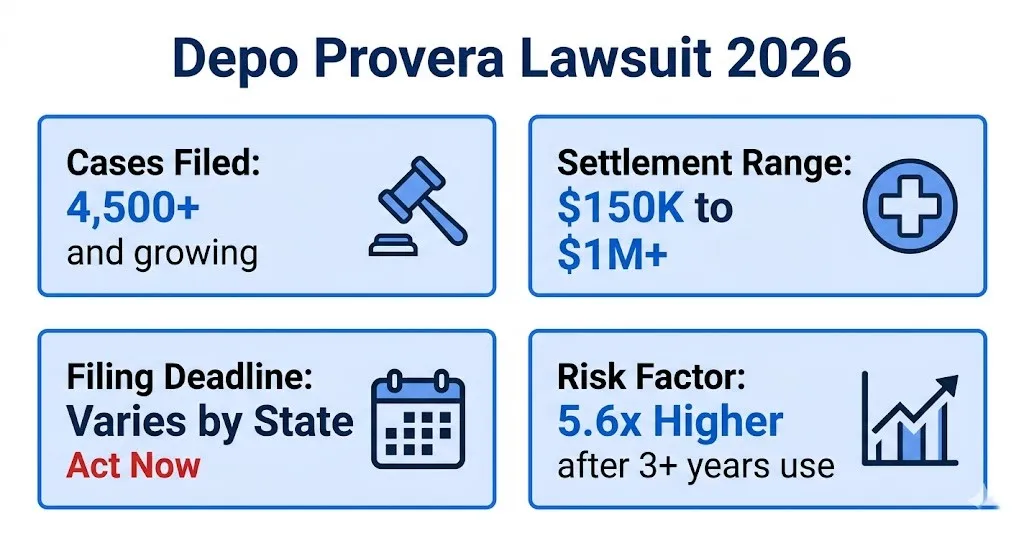
The Depo Provera lawsuit centers on claims that Pfizer failed to warn women about the risk of developing meningioma brain tumors from long-term use of this birth control injection. Thousands of women across the United States have filed claims in 2026, and the litigation is gaining momentum.
If you used Depo Provera for a year or longer and developed a brain tumor, you may qualify for significant compensation. Settlement projections for individual cases range from $150,000 to over $1 million depending on tumor severity and required treatments.
This article covers everything you need to know: who qualifies, how much money you might receive, filing deadlines, and how to avoid predatory legal marketing. One key fact worth knowing: research shows women who used Depo Provera for more than three years face a 5.6 times higher risk of meningioma compared to non-users.
What Is the Depo Provera Lawsuit
The Depo Provera lawsuit is a mass tort litigation against Pfizer, the pharmaceutical company that manufactures this injectable birth control. Women claim Pfizer knew about the meningioma brain tumor risk but failed to include adequate warnings on the product label.
Depo Provera contains medroxyprogesterone acetate, a synthetic progestin hormone. The drug was approved by the FDA in 1992 for contraception. Women receive an injection every three months to prevent pregnancy.
The lawsuits argue that Pfizer had access to studies linking progestin to brain tumor growth for decades. Despite this evidence, the company allegedly chose profits over patient safety.
| Key Lawsuit Facts | Details |
|---|---|
| Defendant | Pfizer Inc. |
| Drug Name | Depo-Provera, Depo-SubQ Provera 104 |
| Active Ingredient | Medroxyprogesterone acetate |
| Primary Injury | Meningioma brain tumors |
| Lawsuit Type | Mass tort litigation |
| First Cases Filed | 2024 |
Most cases focus on failure to warn claims. This legal theory holds that drug manufacturers must inform patients and doctors about known risks. When they hide or downplay dangers, injured patients can sue for damages.
The litigation is not limited to one state. Women from California to Florida have filed claims in both state and federal courts.
Depo Provera Lawsuit 2026 Updates
The Depo Provera lawsuit entered a critical phase in 2026 with major developments in federal court. The Judicial Panel on Multidistrict Litigation consolidated federal cases into a single MDL for more efficient handling.
As of early 2026, over 4,500 cases have been filed against Pfizer. That number grows weekly as more women connect their meningioma diagnoses to Depo Provera use.
Bellwether trials are scheduled to begin in late 2026 or early 2027. These test cases will help both sides gauge how juries respond to the evidence. Their outcomes often shape settlement negotiations.
| 2026 Timeline | Status |
|---|---|
| Cases Filed | 4,500+ and growing |
| MDL Consolidation | Completed |
| Discovery Phase | Ongoing |
| Bellwether Selection | In progress |
| First Trial Date | Late 2026 to early 2027 |
| Settlement Talks | Preliminary stages |
Pfizer has denied liability in court filings. The company maintains that Depo Provera is safe when used as directed and that warnings were adequate.
However, internal documents obtained during discovery may tell a different story. Plaintiffs’ attorneys claim these records show Pfizer knew about tumor risks earlier than publicly acknowledged.
The 2026 litigation pace suggests settlements could begin in 2027. Attorneys on both sides have experience resolving mass tort cases before lengthy trials conclude.
Depo Provera Class Action Lawsuit Explained
The Depo Provera lawsuit is not technically a class action. It is a mass tort, which is an important distinction for anyone considering a claim.
In a class action, one lawsuit represents all affected people. Everyone gets the same settlement amount regardless of individual circumstances. The group shares one outcome.
Mass torts work differently. Each plaintiff files an individual lawsuit. Your compensation depends on your specific injuries, medical bills, and damages. This approach often results in higher payouts for seriously injured claimants.
| Class Action vs Mass Tort | Class Action | Mass Tort |
|---|---|---|
| Individual Filing | No | Yes |
| Personalized Compensation | No | Yes |
| Your Own Attorney | Shared | Yes |
| Outcome Based on Your Case | No | Yes |
| Average Payout Potential | Lower | Higher |
The Depo Provera litigation uses the mass tort structure because brain tumor injuries vary dramatically. Some women required single surgeries. Others faced multiple operations, radiation, or permanent disabilities.
A woman who had one small tumor removed will receive different compensation than someone who suffered paralysis or cognitive damage from a large meningioma.
This structure benefits plaintiffs with severe injuries. You are not limited to an average payout calculated across thousands of claimants.
Key Takeaway: The Depo Provera lawsuit is a mass tort, not a class action, meaning your individual injuries determine your compensation amount rather than receiving a one-size-fits-all settlement.
Pfizer Depo Provera Lawsuit Details
Pfizer faces thousands of lawsuits alleging the company prioritized sales over patient safety. Plaintiffs argue Pfizer knew about meningioma risks but buried the evidence.
The company acquired Depo Provera through its 2009 merger with Wyeth Pharmaceuticals. Wyeth originally developed and marketed the drug. Pfizer inherited both the product and its liability history.
Studies from Europe raised red flags years before U.S. litigation began. French researchers published findings in 2024 showing a clear link between long-term Depo Provera use and meningioma.
- French ANSM study found 5.6x increased risk after 3+ years of use
- British Medical Journal published supporting research
- European regulators added stronger warnings before the U.S. did
Pfizer’s U.S. label did not include a meningioma warning until mid-2024. Plaintiffs argue this delay caused preventable harm to thousands of women.
The company’s defense strategy focuses on several arguments:
- Meningiomas are common tumors that occur naturally
- Many factors contribute to brain tumor development
- FDA approved the drug and its labeling
- Individual causation is difficult to prove
Despite these defenses, plaintiffs have strong ammunition. Internal company communications, scientific studies, and expert testimony support their claims.
Pfizer has significant financial resources to fight these cases. But the company also has experience settling mass torts when evidence mounts. The outcome depends on bellwether trial results.
Depo Provera Brain Tumor Lawsuit Connection
The Depo Provera brain tumor lawsuit exists because scientific evidence links the drug to meningioma growth. This connection is the foundation of every case filed against Pfizer.
Meningiomas are tumors that grow in the meninges, the protective membranes surrounding your brain and spinal cord. Most meningiomas are benign, meaning non-cancerous. But benign does not mean harmless.
These tumors can cause serious problems as they grow. They press against brain tissue, nerves, and blood vessels. Many require surgical removal. Some return even after surgery.
| Brain Tumor Facts | Information |
|---|---|
| Tumor Type | Meningioma |
| Location | Brain/spinal membrane |
| Usually Cancerous | No (benign) |
| Can Still Be Dangerous | Yes |
| Treatment | Surgery, radiation, monitoring |
| Recurrence Risk | 10-20% within 10 years |
Why does Depo Provera cause these tumors? The answer lies in hormone receptors.
Meningiomas often have progesterone receptors on their surface. When exposed to progestins like the one in Depo Provera, these receptors can trigger tumor growth.
Think of it like watering a plant. The progestin acts as fertilizer for cells that might otherwise stay dormant. With repeated exposure over months or years, small tumors can grow large enough to cause symptoms.
The longer you used Depo Provera, the higher your risk. Women who received injections for more than three years face the greatest danger.
Depo Provera Meningioma Lawsuit Claims
Depo Provera meningioma lawsuit claims focus specifically on this type of brain tumor. Meningioma is the centerpiece injury driving the litigation.
Plaintiffs must prove their meningioma resulted from Depo Provera use, not other factors. This requires medical records, expert testimony, and a clear timeline connecting the drug to the diagnosis.
Common claims in these lawsuits include:
- Failure to warn: Pfizer did not adequately disclose meningioma risk
- Negligence: The company failed to exercise reasonable care
- Strict liability: The product was unreasonably dangerous
- Fraud: Pfizer allegedly concealed known risks
Each claim type has different legal requirements. Most plaintiffs file multiple claims to strengthen their case.
| Claim Type | What You Must Prove |
|---|---|
| Failure to Warn | Inadequate labeling about tumor risk |
| Negligence | Pfizer breached duty of care |
| Strict Liability | Product was defective as designed |
| Fraud | Intentional concealment of dangers |
Meningioma location matters for your case value. Tumors in certain brain areas cause more severe symptoms and require more complex surgeries.
A tumor pressing on your optic nerve might cause vision loss. One affecting motor areas could result in paralysis. These outcomes dramatically increase compensation amounts.
Medical records from your diagnosis and treatment become crucial evidence. Keep copies of all imaging scans, surgical reports, pathology results, and follow-up care documentation.
Key Takeaway: Meningioma brain tumors are the primary injury in Depo Provera lawsuits, and proving the connection between your drug use and your specific tumor is essential for compensation.
Depo Provera Lawsuit Symptoms That Qualify
Depo Provera lawsuit symptoms that qualify for compensation primarily relate to meningioma brain tumors. Not every side effect from the drug makes you eligible for the lawsuit.
The litigation focuses on women who developed intracranial tumors, not general birth control side effects. You need a meningioma diagnosis confirmed by imaging and often pathology.
Symptoms that often lead to meningioma diagnosis include:
- Persistent headaches that worsen over time
- Vision changes or loss of peripheral vision
- Hearing loss or ringing in ears
- Seizures with no prior history
- Weakness on one side of body
- Memory problems or confusion
- Personality changes
- Balance difficulties
- Speech problems
| Symptom | How It Relates to Meningioma |
|---|---|
| Headaches | Tumor pressure on brain tissue |
| Vision issues | Tumor near optic nerve |
| Seizures | Brain irritation from tumor |
| Weakness | Motor cortex compression |
| Cognitive changes | Frontal lobe involvement |
Many women used Depo Provera for years before noticing symptoms. Meningiomas grow slowly. Some take a decade to become large enough for detection.
If you experienced these symptoms and received a meningioma diagnosis, document when symptoms started. This timeline helps establish causation.
Your medical records should show the progression from symptoms to diagnosis. An MRI or CT scan revealing the tumor becomes key evidence in your case.
Women currently using Depo Provera should watch for these warning signs. Early detection leads to better treatment outcomes regardless of whether you file a lawsuit.
Depo Provera Lawsuit Side Effects You Need to Know
Depo Provera lawsuit side effects worth knowing extend beyond meningioma to other hormone-related concerns. While the current litigation focuses on brain tumors, understanding the full picture helps you assess your situation.
The drug carries FDA warnings for several serious side effects:
- Significant bone density loss (osteoporosis risk)
- Increased breast cancer risk with prolonged use
- Blood clots in legs or lungs
- Ectopic pregnancy risk
- Depression and mood changes
- Weight gain averaging 5-10 pounds annually
| Side Effect | FDA Warning Level | Litigation Status |
|---|---|---|
| Meningioma | Recent addition (2024) | Active lawsuits |
| Bone loss | Black box warning | Past litigation |
| Blood clots | Standard warning | Limited cases |
| Depression | Standard warning | Not primary focus |
The meningioma risk stands out because it represents a newer discovery. Other side effects have been documented since the drug launched.
Bone loss received a black box warning in 2004. The FDA’s strongest warning type. This came after studies showed significant skeletal damage in long-term users.
However, the current lawsuit wave centers on meningioma because Pfizer allegedly knew about this risk and failed to warn. The failure to update labels despite available evidence forms the legal basis for claims.
If you have meningioma plus other side effects, your case may be worth more. Multiple injuries increase damages calculations.
Who Can File a Lawsuit for Depo Provera
Who can file a lawsuit for Depo Provera depends on meeting specific eligibility criteria. Not everyone who used the drug qualifies.
The primary eligibility requirements include:
- You used Depo Provera or Depo-SubQ Provera 104
- You received injections for at least one year (12 months minimum)
- You developed a meningioma brain tumor
- Your diagnosis came after starting Depo Provera
- Your state’s statute of limitations has not expired
| Eligibility Factor | Requirement |
|---|---|
| Drug Used | Depo Provera or Depo-SubQ Provera 104 |
| Minimum Duration | 12+ months of use |
| Injury Required | Meningioma diagnosis |
| Timing | Tumor diagnosed after starting drug |
| Filing Window | Within statute of limitations |
Duration of use matters significantly. Women who received Depo Provera for three years or more have the strongest cases. The risk multiplier increases with longer exposure.
You need medical records proving both your Depo Provera prescription history and your meningioma diagnosis. Pharmacy records, doctor visit notes, and imaging results all serve as evidence.
Some women developed meningiomas years after stopping Depo Provera. You may still qualify. The tumor could have begun growing during your active use period.
Family members of deceased patients can also file wrongful death claims. If your loved one died from meningioma complications after using Depo Provera, you may have legal options.
Key Takeaway: To qualify for the Depo Provera lawsuit, you need documented use of at least one year and a confirmed meningioma diagnosis that occurred after you started the drug.
How to Join the Depo Provera Lawsuit
How to join the Depo Provera lawsuit involves several steps, but the process is more straightforward than many people expect. You do not need to pay anything upfront.
Step 1: Gather Your Records
Collect medical documentation showing your Depo Provera prescription history. Pharmacy records, insurance claims, and doctor’s notes all work.
Obtain records of your meningioma diagnosis. MRI or CT scan reports, surgical records, and pathology results matter most.
Step 2: Consult an Attorney
Mass tort attorneys handle these cases on contingency. They charge nothing unless you win. Fees typically range from 33% to 40% of your settlement.
Look for firms with experience in pharmaceutical litigation. Ask about their track record with similar cases.
Step 3: File Your Claim
Your attorney prepares and files the lawsuit. You sign documents but do not attend court in most cases.
Federal cases go to the MDL. State cases follow local procedures.
| Filing Step | What Happens | Your Role |
|---|---|---|
| Initial consult | Attorney reviews eligibility | Provide basic info |
| Record collection | Legal team gathers evidence | Sign release forms |
| Case evaluation | Attorneys assess claim value | Answer questions |
| Filing | Lawsuit submitted to court | Review and sign |
| Discovery | Evidence exchanged | Possible deposition |
| Resolution | Settlement or trial | Accept or reject offer |
Step 4: Wait for Resolution
Mass tort cases take time. Expect 2 to 4 years from filing to settlement. Bellwether trials help speed negotiations.
You may need to provide a deposition. This is recorded testimony where defense attorneys ask about your medical history and drug use.
Depo Provera Lawsuit Settlement Amounts
Depo Provera lawsuit settlement amounts remain estimated since no global settlement has occurred yet. However, attorneys project individual case values based on similar pharmaceutical litigation.
Settlement projections vary based on injury severity:
| Injury Level | Estimated Settlement Range |
|---|---|
| Tier 1: Surgery with full recovery | $150,000 to $300,000 |
| Tier 2: Multiple surgeries needed | $300,000 to $600,000 |
| Tier 3: Permanent complications | $600,000 to $1,000,000 |
| Tier 4: Severe disability or death | $1,000,000+ |
These estimates come from analyzing similar mass tort outcomes. The Risperdal litigation, which also involved hormone-related tumors, saw verdicts ranging from $1.75 million to $8 billion (later reduced on appeal).
Factors that increase your settlement value:
- Tumor size and location
- Number of surgeries required
- Permanent neurological damage
- Lost income and future earning capacity
- Medical expenses incurred
- Duration of Depo Provera use
- Age at diagnosis
Factors that might reduce your value:
- Pre-existing conditions
- Limited medical documentation
- Short duration of drug use
- Full recovery after treatment
No settlement fund exists yet. Pfizer has not agreed to resolve cases globally. Bellwether trial outcomes will heavily influence any future settlement structure.
Attorneys stress that these numbers are projections, not guarantees. Each case depends on individual circumstances and evidence strength.
Depo Provera Lawsuit Deadline and Statute of Limitations
The Depo Provera lawsuit deadline depends on your state’s statute of limitations for personal injury claims. Missing this deadline means losing your right to sue forever.
Most states set a 2 to 3 year limit from when you discovered (or should have discovered) your injury was caused by Depo Provera. This is called the discovery rule.
| State | Statute of Limitations | Discovery Rule |
|---|---|---|
| California | 2 years | Yes |
| Texas | 2 years | Yes |
| Florida | 4 years (changed 2023) | Yes |
| New York | 3 years | Yes |
| Pennsylvania | 2 years | Yes |
| Illinois | 2 years | Yes |
The discovery rule matters because many women did not connect Depo Provera to their tumors until recent publicity. Courts recognize you cannot sue over something you did not know caused harm.
Your clock likely started when:
- News reports linked Depo Provera to meningioma
- Your doctor mentioned the possible connection
- FDA added the meningioma warning (2024)
Some states also toll (pause) limitations during certain circumstances:
- Minor plaintiffs (until age 18)
- Mental incapacity
- Defendant’s fraudulent concealment of evidence
Do not assume you have missed the deadline. Consult an attorney for case-specific analysis. Many women who believe they waited too long actually qualify under discovery rule calculations.
Filing sooner protects your rights. Evidence gets harder to obtain over time. Medical records may be destroyed. Witnesses forget details.
Key Takeaway: Statutes of limitations vary by state and typically run 2 to 3 years from when you discovered the connection between Depo Provera and your meningioma, so act quickly to protect your legal rights.
Depo Provera MDL Status and Court Updates
The Depo Provera MDL status shows active litigation with growing case numbers. Federal cases have been consolidated for pretrial proceedings.
MDL stands for Multidistrict Litigation. This federal court procedure groups similar lawsuits before one judge. It promotes efficiency without merging cases into a single class action.
Current MDL details:
| MDL Information | Status |
|---|---|
| MDL Number | Pending assignment |
| Court Location | Under determination |
| Presiding Judge | To be appointed |
| Cases Consolidated | 4,500+ |
| Phase | Discovery and bellwether selection |
The MDL process follows predictable stages:
Discovery Phase (Current)
Both sides exchange documents and evidence. Plaintiffs obtain internal Pfizer communications. Depositions of company executives occur.
Bellwether Selection
Courts choose representative cases for early trials. These cases test legal theories and jury responses.
Bellwether Trials
First trials expected late 2026 or early 2027. Outcomes guide settlement negotiations.
Settlement Negotiations
If plaintiffs win bellwethers, Pfizer faces pressure to settle remaining cases globally.
Resolution
Cases either settle individually, through global agreement, or proceed to trial.
State court cases follow separate tracks. Some may reach trial before federal bellwethers.
Attorneys update clients regularly on MDL progress. Major developments make legal news within days of occurring.
Depo Provera Lawsuit Legal Marketing: What to Know
Depo Provera lawsuit legal marketing has exploded since 2024, and understanding it helps you avoid scams. Not every ad you see comes from a legitimate law firm.
Legal marketing for mass torts is a billion-dollar industry. Companies buy advertising to generate leads, then sell those leads to attorneys. This middleman approach can work, but it creates problems.
Red flags in legal marketing:
- Promises of specific settlement amounts
- Pressure to sign immediately
- Requests for upfront payment
- Unclear about who actually represents you
- No attorney name provided
- Generic 800 numbers with no firm identification
| Marketing Type | Legitimacy | Concerns |
|---|---|---|
| Law firm direct ads | Usually legitimate | Verify firm credentials |
| Lead generation companies | Variable | May sell your info |
| Social media ads | Often sketchy | Many not attorney-run |
| TV commercials | Usually legitimate | Still verify |
| Text messages | Often questionable | Likely lead gen |
Legitimate law firms clearly identify themselves. They explain their experience with pharmaceutical litigation. They do not promise specific dollar amounts.
Lead generation companies sometimes pose as law firms. They collect your information, then auction it to multiple attorneys. Your phone may ring for weeks.
The safest approach involves researching attorneys independently. Look for firms that have handled Risperdal, Essure, or other pharmaceutical mass torts. Check state bar records for disciplinary history.
Depo Provera Lawsuit Marketing Campaigns Explained
Depo Provera lawsuit marketing campaigns use various tactics to reach potential plaintiffs. Knowing how these campaigns work helps you evaluate what you see.
TV commercials remain the most common approach. Law firms buy local and national airtime asking “Have you used Depo Provera?” These ads create awareness but often lack nuance.
Digital marketing has grown significantly:
- Paid search ads: Appear when you Google lawsuit terms
- Facebook/Instagram ads: Target women of reproductive age
- YouTube pre-roll: Video ads before health content
- Display ads: Banner ads on news and health websites
- Email campaigns: Purchased lists or lead forms
| Campaign Channel | Reach | Credibility | Cost to Advertiser |
|---|---|---|---|
| TV commercials | High | Moderate | $10,000+ per spot |
| Google search ads | Targeted | Variable | $50-200 per click |
| Social media ads | High | Low | $5-50 per lead |
| Radio spots | Local | Moderate | $500-5,000 per week |
| Direct mail | Targeted | Moderate | $1-3 per piece |
Campaigns often partner with medical record retrieval services. They help potential clients gather documentation quickly, speeding up the evaluation process.
Some campaigns use patient testimonials. Real plaintiffs share their stories to encourage others to come forward. This approach builds trust but raises privacy considerations.
The most aggressive campaigns start within weeks of major news. When FDA updated the Depo Provera label in 2024, marketing exploded. The same will happen with significant 2026 court rulings.
Key Takeaway: Lawsuit marketing campaigns vary in legitimacy from established law firms to sketchy lead generators, so always verify who you are dealing with before sharing personal medical information.
Depo Provera Lawsuit Mass Tort Case Leads
Depo Provera lawsuit mass tort case leads represent a behind-the-scenes industry that most plaintiffs never see. Understanding it explains why you receive so many solicitations.
Case leads are contact information for potential plaintiffs. Companies generate these leads through advertising, then sell them to law firms. It is legal but ethically complex.
How the lead industry works:
- Marketing company runs Depo Provera ads
- Interested people fill out online forms
- Company verifies basic eligibility
- Lead gets sold to one or multiple law firms
- Attorneys contact you to evaluate your case
| Lead Type | What It Means | Typical Price |
|---|---|---|
| Raw lead | Filled out a form only | $50-150 |
| Qualified lead | Basic criteria confirmed | $200-500 |
| Retainer-ready | Verified medical records | $1,000-3,000 |
| Signed case | Client retained | $3,000-10,000 |
Firms pay more for better-qualified leads. Someone with documented three-year Depo Provera use and confirmed meningioma commands premium prices.
The economics create incentives for aggressive marketing. Companies earn more by generating more leads. Quality control sometimes suffers.
Some lead generators engage in questionable practices:
- Exaggerating settlement possibilities
- Failing to disclose they are not attorneys
- Selling your information to multiple buyers
- Using scare tactics about deadlines
Reputable firms avoid purchased leads or carefully vet lead sources. They prefer clients who contact them directly after research.
If you contact an attorney through any channel, ask directly: “Are you the attorney who will handle my case, or will you refer me to another firm?”
Depo Provera Lawsuit Reddit: What Real People Are Saying
Depo Provera lawsuit Reddit discussions reveal what actual patients and plaintiffs think about the litigation. These conversations provide insights that polished legal websites do not offer.
Reddit communities discussing the lawsuit include:
- r/DepoProvera
- r/birthcontrol
- r/TwoXChromosomes
- r/legaladvice
- r/meningioma
Common themes in Reddit discussions:
Fear and Uncertainty
Many users express anxiety about potential tumors. They share screening experiences and symptom concerns.
Attorney Selection Questions
People ask how to find good lawyers. They share positive and negative experiences with specific firms.
Timeline Frustrations
Plaintiffs complain about slow case progress. Mass tort timelines test patience.
| Reddit Concern | Common Response |
|---|---|
| “Should I get screened?” | Yes, discuss with doctor |
| “How long until settlement?” | 2-4 years typical |
| “Are the TV lawyers legit?” | Research before signing |
| “My case seems stuck” | Mass torts move slowly |
| “How much will I really get?” | No guarantees, varies by case |
Real Patient Experiences
Women describe their diagnoses, surgeries, and recoveries. These stories help others understand what to expect.
Marketing Complaints
Users warn each other about aggressive solicitations. They share tips for identifying legitimate firms.
Reddit offers unfiltered perspectives. Unlike law firm websites, users have no financial incentive to oversell outcomes. The cynicism can be helpful.
However, Reddit advice is not legal advice. Anonymous users may misunderstand law or share outdated information. Use these discussions as starting points, not final answers.
Frequently Asked Questions
How much money can I get from the Depo Provera lawsuit?
Settlement amounts range from $150,000 to over $1 million depending on your specific injuries.
Cases involving permanent neurological damage or multiple surgeries command higher values.
No global settlement exists yet, so these projections come from similar pharmaceutical litigation outcomes.
What symptoms qualify me for the Depo Provera lawsuit?
You must have a diagnosed meningioma brain tumor to qualify for the lawsuit.
Symptoms like persistent headaches, vision changes, seizures, or weakness that led to tumor discovery establish your eligibility.
General Depo Provera side effects without a tumor diagnosis do not qualify.
Is there a deadline to file a Depo Provera lawsuit claim?
Yes, each state has a statute of limitations typically ranging from 2 to 4 years.
The clock usually starts when you discovered or should have discovered the connection between Depo Provera and your tumor.
Consult an attorney immediately to determine your specific deadline.
Is the Depo Provera lawsuit a class action or mass tort?
The Depo Provera litigation is a mass tort, not a class action.
This means each plaintiff files individually and receives compensation based on their specific injuries.
Mass tort structure typically benefits plaintiffs with serious injuries more than class actions would.
How long did I need to use Depo Provera to qualify for the lawsuit?
Most attorneys require at least 12 months (one year) of documented Depo Provera use.
Women who used the drug for three or more years have the strongest cases due to higher statistical risk.
Medical records or pharmacy history must confirm your usage duration.
Take Action Now
The Depo Provera lawsuit offers real compensation opportunities for women harmed by this drug. If you used Depo Provera for a year or longer and developed a meningioma, your claim could be worth significant money.
Deadlines matter. Statutes of limitations can expire quickly depending on your state. Gathering medical records now makes filing easier later.
Verify any attorney before signing. Research their experience with pharmaceutical cases. Ask questions about fees, communication, and case handling.
Your health records from Depo Provera use and meningioma diagnosis become your strongest evidence. Secure copies today. The 2026 bellwether trials will shape this litigation’s future, and prepared plaintiffs position themselves for the best possible outcomes.