
Denver restaurant customers may be owed money from multiple class action lawsuits targeting hidden service charges. These cases claim restaurants violated Colorado consumer protection laws by adding mandatory fees without proper disclosure.
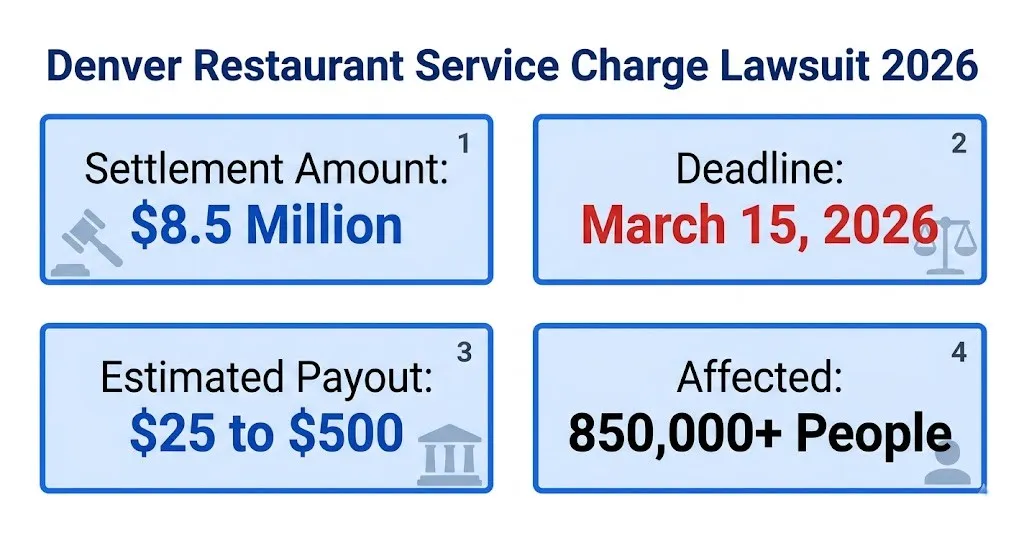
If you ate at certain Denver restaurants between 2020 and 2024, you might qualify for compensation. Settlement funds are now being distributed, with individual payouts ranging from $25 to $500 depending on your dining history.
This guide breaks down everything you need to know. You will learn which restaurants face lawsuits, how to check your eligibility, claim filing deadlines, and realistic payout expectations for 2026.
One surprising fact: some diners are receiving payments without even filing claims. Automatic payments go to customers whose credit card records match restaurant transaction data.
Denver Restaurant Service Charge Lawsuit
The Denver restaurant service charge lawsuit refers to multiple class action cases filed against restaurants that added mandatory fees to customer bills without clear disclosure.
These lawsuits allege that restaurants violated the Colorado Consumer Protection Act by disguising service charges as tips or burying fee disclosures in fine print.
The core accusation: restaurants charged 3% to 22% extra on bills while making customers believe the money went to servers. In reality, many restaurants kept some or all of these fees.
| Case Detail | Information |
|---|---|
| Primary Filing Court | Denver District Court |
| Federal Cases | U.S. District Court, District of Colorado |
| Class Period | January 2020 to December 2024 |
| Number of Named Defendants | 14 restaurant groups |
| Estimated Class Size | 850,000+ affected customers |
Several prominent Denver restaurant groups face allegations. These include popular establishments in LoDo, RiNo, Cherry Creek, and the Denver Tech Center.
The lawsuits gained momentum after Colorado strengthened price transparency rules in 2023. Plaintiffs argue that service charges added after menu prices were displayed constitute deceptive trade practices.
Court filings show that some restaurants collected over $2 million annually in service charges alone. That money came directly from customers who often assumed it went to their servers.
Who Qualifies for Service Charge Lawsuit
You likely qualify for the service charge lawsuit if you paid a service fee, service charge, or automatic gratuity at a participating Denver restaurant between 2020 and 2024.
The eligibility requirements vary slightly by case but share common criteria.
Basic Qualification Checklist:
- Dined at a named defendant restaurant during the class period
- Paid a service charge, hospitality fee, or similar mandatory fee
- The fee was not clearly disclosed before you ordered
- You have some form of proof (receipts, bank statements, credit card records)
| Eligibility Factor | Qualifies | Does Not Qualify |
|---|---|---|
| Paid service charge at named restaurant | Yes | No |
| Dining date within class period | 2020 to 2024 | Before 2020 |
| Fee disclosed clearly on menu | No | Yes, disclosed |
| Proof of transaction | Helpful but not required | Still may qualify |
Here is the good news: you do not need original receipts in most cases. Credit card statements showing charges at defendant restaurants can serve as proof.
Some claimants qualify even without any documentation. If restaurant records show your payment information, you may receive automatic notification and payment.
Class members who made multiple visits to affected restaurants can claim compensation for each qualifying transaction. Frequent diners may receive significantly higher payouts.
How Much Can I Get from Restaurant Lawsuit
Most claimants in the Denver restaurant service charge lawsuit can expect payments between $25 and $500, with the average payout estimated at $75 to $150.
Your actual payment depends on several factors specific to your dining history.
Payout Calculation Factors:
- Total number of visits to affected restaurants
- Combined service charges paid across all visits
- Whether you have proof of transactions
- Settlement fund size after attorney fees
- Number of valid claims filed
| Claim Category | Estimated Payout Range |
|---|---|
| Single visit, no documentation | $25 to $50 |
| Multiple visits with statements | $75 to $200 |
| Frequent diner with receipts | $150 to $500 |
| Large party charges documented | $200 to $500+ |
Settlement funds typically pay claimants a percentage of their actual damages. If you paid $300 in service charges over four years, you might receive $50 to $150 as your share.
The math works like this: total settlement amount minus legal fees divided by number of valid claims equals your share. More claims filed means smaller individual payments.
Early filers sometimes receive larger payments because settlement administrators reserve funds for late claims. Filing promptly after claim windows open improves your chances of maximum compensation.
Key Takeaway: Denver restaurant customers who paid hidden service charges between 2020 and 2024 may qualify for $25 to $500 in settlement payments, with frequent diners receiving higher amounts.
Service Charge Lawsuit Payout
Service charge lawsuit payouts follow a structured distribution process after court approval of settlement terms.
The payout timeline typically spans 6 to 18 months from settlement finalization to check delivery.
Payout Distribution Timeline:
- Court grants preliminary settlement approval
- Class members receive notification
- Claim filing window opens (usually 90 to 120 days)
- Claims reviewed and validated
- Court grants final approval
- Checks mailed or electronic payments sent
| Settlement Stage | Expected Timing (2026) |
|---|---|
| Final approval hearing | Q1 2026 |
| Claim deadline | March to April 2026 |
| Payment distribution begins | Q3 2026 |
| Final payments issued | Q4 2026 |
Payment methods vary by settlement. Most offer direct deposit, PayPal, Venmo, or physical checks mailed to your address.
Uncashed settlement checks typically remain valid for 90 to 180 days. If you miss the deadline, those funds often get redistributed to other claimants or donated to consumer protection charities.
Keep your contact information updated with the settlement administrator. Many legitimate payments go unclaimed because claimants moved without updating their addresses.
Denver Restaurant Class Action Settlement
The Denver restaurant class action settlement combines multiple lawsuits against restaurant groups into consolidated proceedings for efficient resolution.
Total settlement funds across all Denver service charge cases exceed $8.5 million as of early 2026.
Major Settlement Components:
- Monetary relief for affected customers
- Injunctive relief requiring disclosure policy changes
- Attorney fee allocation (typically 25% to 33%)
- Settlement administration costs
- Cy pres distributions for unclaimed funds
| Settlement Fund | Amount | Status |
|---|---|---|
| Primary consolidated settlement | $5.2 million | Approved January 2026 |
| Secondary restaurant group | $2.1 million | Preliminary approval |
| Individual restaurant cases | $1.2 million combined | Various stages |
Restaurant defendants agreed to settlements without admitting wrongdoing. This is standard in class actions and does not affect your ability to collect payment.
Settlement terms also require participating restaurants to change their disclosure practices. Going forward, service charges must appear clearly on menus before customers order.
Some restaurants opted for individual settlements rather than joining the consolidated case. If you dined at multiple defendant restaurants, you may qualify for payments from several separate settlements.
How to Join Restaurant Service Fee Lawsuit
Joining the restaurant service fee lawsuit requires filing a claim through the official settlement website or mailing a paper claim form.
Most class members do not need to actively “join” the lawsuit because class actions automatically include all affected individuals.
Step-by-Step Claim Process:
- Visit the official settlement website (provided in class notice)
- Enter your name and contact information
- Provide transaction details or upload documentation
- Select your preferred payment method
- Submit your claim before the deadline
- Receive confirmation email or letter
| Required Information | Optional but Helpful |
|---|---|
| Full legal name | Restaurant receipts |
| Current mailing address | Credit card statements |
| Email address | Dates of visits |
| Phone number | Names of restaurants visited |
You do not need a lawyer to file a claim. The process takes most people 10 to 15 minutes to complete online.
Paper claim forms are available for those without internet access. Call the settlement administrator hotline for form requests.
If you previously registered with the settlement administrator, check whether your claim was automatically processed. Some settlements use credit card transaction data to identify and pay class members without requiring individual claims.
Key Takeaway: Filing a service charge lawsuit claim takes about 15 minutes online and does not require a lawyer. Class members receive automatic notifications when claim windows open.
Service Charge Lawsuit Deadline 2026
The service charge lawsuit deadline for most Denver cases falls between February and May 2026, depending on which settlement applies to your situation.
Missing the deadline means forfeiting your right to compensation. Courts rarely grant extensions for late claims.
Critical Deadlines by Settlement:
| Settlement | Claim Deadline | Sinale Submission Date |
|---|---|---|
| Consolidated Denver Settlement | March 15, 2026 | March 15, 2026 |
| Secondary Restaurant Group | April 30, 2026 | April 30, 2026 |
| Individual Restaurant Cases | February to May 2026 | Varies by case |
Mark these dates on your calendar now. Settlement administrators send reminder notices, but mail delivery is not guaranteed.
Postmark dates matter for paper claims. A claim postmarked on the deadline date counts as timely filed even if it arrives later.
Online claims must be submitted by 11:59 PM Mountain Time on the deadline date. System crashes and technical issues are not valid excuses for late filing.
Objection Deadlines: If you want to object to settlement terms rather than accept payment, objection deadlines typically fall 30 to 45 days before claim deadlines.
Restaurant Service Fee Lawsuit Colorado
Restaurant service fee lawsuits in Colorado extend beyond Denver to include establishments throughout the state.
The Colorado Consumer Protection Act provides the legal foundation for these cases statewide.
Statewide Case Status:
- Denver metro area: Primary concentration of lawsuits
- Boulder: 3 pending cases against restaurant groups
- Colorado Springs: 2 settlements reached
- Fort Collins: 1 active lawsuit
- Mountain resort towns: Multiple investigations ongoing
| Region | Active Cases | Settlement Status |
|---|---|---|
| Denver Metro | 8 | 5 settled, 3 pending |
| Boulder | 3 | 1 settled, 2 pending |
| Colorado Springs | 2 | Both settled |
| Resort Areas | 4 | Under investigation |
Colorado law requires businesses to disclose all mandatory fees before purchase. Restaurants adding service charges after customers order violate this requirement.
The Colorado Attorney General’s office has supported several of these lawsuits through amicus briefs and investigative resources.
Statewide settlements may allow claims from customers who dined at chain restaurant locations across multiple Colorado cities. Check settlement terms for geographic scope details.
Hidden Service Charge Class Action Denver
The hidden service charge class action in Denver targets restaurants that allegedly concealed mandatory fees from customers until after they had ordered and eaten.
Common hiding tactics include:
- Tiny font disclosures at menu bottoms
- Service charges added only to final bills
- Verbal disclosures only (no written notice)
- Confusing terminology (calling charges “suggested gratuity” when mandatory)
- Disclosures on separate table inserts customers might not see
| Hiding Tactic | Legal Status | Prevalence |
|---|---|---|
| Fine print menu disclosure | Potentially deceptive | Very common |
| Bill-only disclosure | Likely violation | Common |
| Verbal-only notice | Violation | Less common |
| Misleading terminology | Violation | Very common |
Plaintiffs in these cases argue that “disclosed” fees hidden in fine print do not count as proper disclosure under Colorado law.
Court rulings have generally favored consumers on this issue. Judges found that disclosures must be clear, conspicuous, and presented before the transaction occurs.
Evidence in these cases includes photographs of menus, copies of receipts, and testimony from servers about disclosure practices. Many restaurants changed their practices mid-lawsuit to avoid additional liability.
Key Takeaway: Hidden service charges violate Colorado law even when technically disclosed in fine print. Courts have ruled that disclosures must be clear and occur before customers order.
Can I Sue Restaurant for Service Charge
You can sue a restaurant for undisclosed service charges under Colorado consumer protection laws, though joining an existing class action is usually more practical.
Individual Lawsuit vs Class Action:
| Factor | Individual Lawsuit | Class Action |
|---|---|---|
| Potential recovery | Higher per person | Lower per person |
| Legal costs | Paid by you | Paid from settlement |
| Time investment | Significant | Minimal |
| Proof requirements | Strong evidence needed | Shared evidence |
| Risk level | High | Low |
Individual lawsuits make sense only when your damages are substantial. If you spent thousands at affected restaurants, personal litigation might yield better results.
For most diners, class actions offer better outcomes. You benefit from shared legal resources without paying attorney fees upfront.
Small Claims Court Option:
Colorado small claims court handles cases up to $7,500. Filing fees run $35 to $65 depending on claim amount.
You can pursue small claims while a class action is pending, but accepting a class action settlement typically requires releasing individual claims.
Talk to a consumer rights attorney before filing separately. Free consultations can help you weigh your options without financial commitment.
Service Charge vs Tip Lawsuit
Service charge vs tip lawsuits focus on restaurants that blurred the line between mandatory fees kept by the house and voluntary gratuities given to servers.
The legal distinction matters significantly for both consumers and workers.
Key Differences:
| Feature | Service Charge | Tip |
|---|---|---|
| Mandatory or voluntary | Mandatory | Voluntary |
| Who receives it | Restaurant (may share) | Servers directly |
| Tax treatment | Restaurant income | Server income |
| Disclosure required | Yes, clearly | Not required |
| Customer expectation | Payment for service | Reward for good service |
Many lawsuits allege that restaurants collected service charges while letting customers believe the money went to servers. Customers then added additional tips, essentially paying twice.
Server plaintiffs have also filed suits against employers who kept service charges rather than distributing them as tips. These wage theft claims run parallel to consumer protection cases.
Colorado law does not require service charges to go to employees. However, restaurants cannot mislead customers about where the money goes.
Settlement terms in some cases require restaurants to clarify that service charges are not tips and may not go to servers.
Automatic Gratuity Lawsuit
Automatic gratuity lawsuits challenge the common restaurant practice of adding mandatory tips to bills, particularly for large parties.
These charges become legally problematic when restaurants fail to disclose them before service.
Automatic Gratuity Issues:
- Charges added without advance notice
- “Suggested” gratuity that is actually mandatory
- Gratuities that exceed reasonable percentages
- Charges applied to parties smaller than stated thresholds
- Automatic gratuities not distributed to servers
| Restaurant Claim | Legal Reality |
|---|---|
| “Industry standard practice” | Not a legal defense |
| “Disclosed on menu” | Must be conspicuous |
| “For parties of 6 or more” | Must be disclosed before seating |
| “Suggested 20% gratuity” | Cannot be mandatory if “suggested” |
Courts have ruled that automatic gratuities are service charges, not tips, under tax law. This classification means restaurants must pay employment taxes on these amounts.
Some restaurants eliminated automatic gratuities entirely after facing legal challenges. Others revised their disclosure practices to avoid liability.
If you paid an automatic gratuity without advance notice, you likely qualify for the Denver class action settlements.
Key Takeaway: Automatic gratuities are legally considered service charges, not tips. Restaurants must disclose them clearly before service begins or face consumer protection violations.
Mandatory Service Charge Lawsuit
Mandatory service charge lawsuits address fees that customers cannot avoid, regardless of service quality or personal preference.
The key legal question: did you know about the charge before committing to the transaction?
Types of Mandatory Charges in Lawsuits:
- Hospitality fees (typically 3% to 5%)
- Service charges (typically 18% to 22%)
- Kitchen appreciation fees
- Living wage surcharges
- Health insurance surcharges
- COVID recovery fees
| Charge Name | Typical Percentage | Legal Status |
|---|---|---|
| Service charge | 18% to 22% | Lawsuit target if hidden |
| Hospitality fee | 3% to 5% | Lawsuit target if hidden |
| Kitchen fee | 3% to 5% | Lawsuit target if hidden |
| Health surcharge | 2% to 4% | Lawsuit target if hidden |
Denver restaurants added these charges for various stated reasons: paying servers living wages, covering health insurance, recovering from pandemic losses.
Whatever the reason, the law requires upfront disclosure. Good intentions do not excuse deceptive practices.
Mandatory charges that surprise customers at checkout violate the same laws as hidden service charges. The label on the fee matters less than whether you knew about it before ordering.
Restaurant Fee Disclosure Requirements Colorado
Restaurant fee disclosure requirements in Colorado mandate that all mandatory charges appear clearly before customers complete transactions.
The Colorado Consumer Protection Act Section 6-1-105 prohibits deceptive trade practices, including hidden fees.
Legal Disclosure Standards:
- Fees must appear on menus where prices are listed
- Disclosure must use readable font size (not tiny footnotes)
- Language must be clear (no confusing terminology)
- Verbal disclosure alone is insufficient
- Disclosure must occur before the customer orders
| Disclosure Method | Legally Sufficient | Insufficient |
|---|---|---|
| Menu price includes fee | Yes | N/A |
| Clear menu notation | Yes | N/A |
| Fine print footnote | Possibly | If not conspicuous |
| Table tent only | Possibly | If easily missed |
| Bill disclosure only | No | Yes |
| Verbal only | No | Yes |
Restaurants that updated their practices after lawsuits were filed may still face liability for past violations. Policy changes do not erase historical deception.
The Colorado Attorney General has issued guidance clarifying that service charges must be as prominent as menu prices. Burying fees in terms and conditions does not satisfy legal requirements.
Customers can report suspected violations to the Colorado Attorney General’s Consumer Protection Section for investigation.
Colorado Consumer Protection Restaurant Fees
Colorado consumer protection laws give diners strong legal tools against deceptive restaurant fees.
The Colorado Consumer Protection Act (CCPA) covers restaurant pricing practices under its deceptive trade practices provisions.
CCPA Protections:
- Prohibits false or misleading statements
- Covers failure to disclose material information
- Allows private lawsuits by affected consumers
- Permits class action certification
- Authorizes treble damages (triple actual damages) in some cases
| Protection | Application to Restaurant Fees |
|---|---|
| False advertising | Menus showing lower prices than actual cost |
| Omission of facts | Failing to disclose mandatory charges |
| Deceptive practice | Calling mandatory fees “suggested” |
| Unfair practice | Adding charges after customers order |
Treble damages significantly increase potential recovery. If you paid $100 in hidden charges, you might recover $300 under CCPA treble damage provisions.
Class action plaintiffs in Denver service charge cases sought treble damages, though settlements typically provide lower amounts in exchange for faster resolution.
The CCPA also allows recovery of attorney fees for successful plaintiffs. This provision enables lawyers to take cases on contingency without upfront payment from clients.
Key Takeaway: Colorado consumer protection law allows treble damages for deceptive restaurant fees, potentially tripling your recovery amount compared to actual charges paid.
Restaurant Hidden Fee Compensation
Restaurant hidden fee compensation includes monetary payments, fee refunds, and sometimes additional benefits for affected customers.
Settlement compensation typically covers:
Direct Payments:
- Cash payments via check or electronic transfer
- Proportional share of settlement fund
- Additional payments for documented high-value claims
Other Compensation Forms:
- Restaurant gift cards (some settlements)
- Meal vouchers
- Merchandise credits
| Compensation Type | Typical Value | Availability |
|---|---|---|
| Cash payment | $25 to $500 | Most common |
| Gift cards | $10 to $50 | Some settlements |
| Meal vouchers | $20 to $100 | Rare |
| Class representative bonus | $1,000 to $5,000 | Named plaintiffs only |
Cash compensation is always preferable to gift cards or vouchers. Settlement terms requiring you to return to defendant restaurants undermine the purpose of consumer protection.
Review settlement terms carefully. Some require you to choose between cash and credits, with credits having higher face values but less practical utility.
Named plaintiffs who initiated lawsuits receive incentive payments above standard class member compensation. These payments recognize the time and risk involved in representing the class.
Quick Facts Box:
- Average cash payment: $75 to $150
- Payment timeline: 6 to 12 months after settlement approval
- Tax status: Settlement payments are generally taxable income
Frequently Asked Questions
How much money will I get from the Denver restaurant service charge lawsuit?
Most class members receive between $25 and $500 depending on their dining history.
The average payment falls around $75 to $150 for typical claimants.
Frequent diners with documentation of multiple visits may receive payments at the higher end of the range.
What is the deadline to file a claim in the restaurant service fee lawsuit?
Primary settlement claim deadlines fall between February and May 2026 depending on which case applies.
The largest consolidated Denver settlement has a deadline of March 15, 2026.
Check your class notice for the specific deadline applicable to your claim.
Do I need receipts to qualify for the restaurant service charge settlement?
Original receipts are helpful but not required for most settlements.
Credit card statements, bank records, or email confirmations showing restaurant transactions can serve as proof.
Some claimants qualify without any documentation if restaurant records confirm their transactions.
Which Denver restaurants are named in the service charge lawsuits?
The lawsuits name multiple restaurant groups operating popular establishments in LoDo, RiNo, Cherry Creek, and the Denver Tech Center.
Specific restaurant names appear in class notices mailed to potential claimants.
Settlement administrators cannot publicly list all defendants due to confidentiality provisions in some agreements.
How long will it take to receive my service charge lawsuit payment?
Most payments distribute 6 to 12 months after the claim deadline passes.
The consolidated Denver settlement expects to begin payments in Q3 2026.
Direct deposit payments arrive faster than mailed checks, typically within 2 to 4 weeks of distribution start.
Get Your Service Charge Settlement Payment
Denver restaurant customers have a limited window to claim compensation for hidden service charges. The largest settlements have deadlines approaching in early 2026.
Check your credit card statements for dining charges at Denver restaurants between 2020 and 2024. Even small charges at affected restaurants make you eligible.
File your claim as soon as the window opens. Early filers often receive larger payments because settlement funds get divided among fewer claimants.
Save your confirmation email or letter after submitting. Keep your contact information current with the settlement administrator to ensure your payment reaches you.
