
Minnesota is fighting the federal government over ICE arrests at state courthouses. Attorney General Keith Ellison filed a major lawsuit claiming these arrests violate the Constitution and state sovereignty.
The Minnesota ICE lawsuit argues that federal agents cannot enter state courthouses to detain people. This case has huge implications for anyone who needs to appear in a Minnesota court.
Why does this matter right now? Because courthouse arrests have spiked dramatically. Reports show ICE detained dozens of people at Minnesota courthouses in early 2025 alone.
This article breaks down everything you need to know about this lawsuit in 2026. You will learn the legal arguments, current status, your rights, and exactly what to do if you encounter ICE at a courthouse.
Minnesota ICE Lawsuit
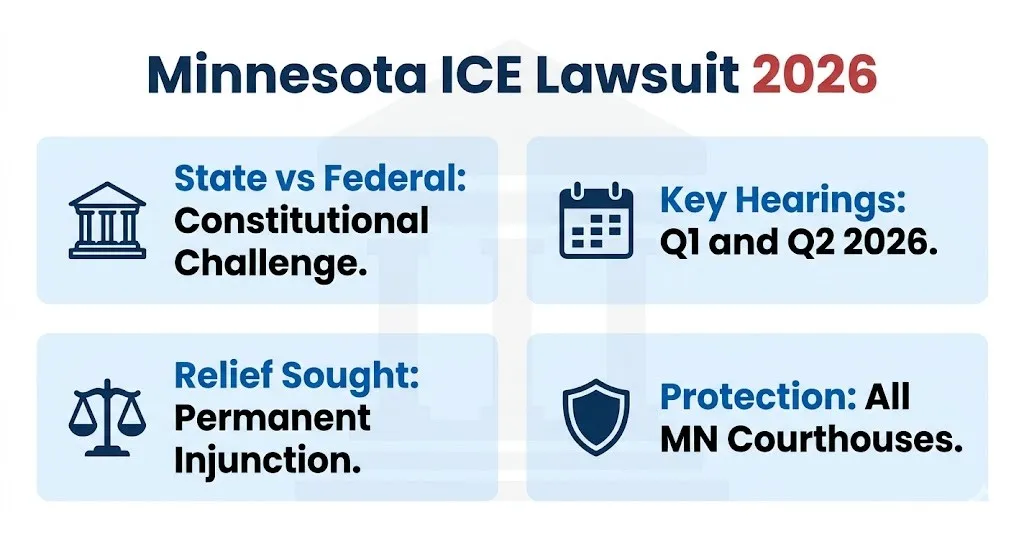
The Minnesota ICE lawsuit is a federal case challenging immigration enforcement at state courthouses. Attorney General Keith Ellison filed this suit to stop ICE agents from arresting people inside or near Minnesota court buildings.
Minnesota argues the federal government cannot use state property for immigration enforcement without state permission. The lawsuit claims ICE courthouse arrests violate both constitutional rights and state sovereignty.
This is not a money settlement case. It seeks an injunction, which is a court order that would ban ICE from making courthouse arrests in Minnesota.
| Key Case Details | Information |
|---|---|
| Case Name | State of Minnesota v. U.S. Immigration and Customs Enforcement |
| Court | U.S. District Court, District of Minnesota |
| Filed | Early 2025 |
| Type | Civil rights, constitutional challenge |
| Relief Sought | Preliminary and permanent injunction |
| Defendants | ICE, DHS, federal government |
The case joins similar lawsuits filed by other states including New York, California, and Massachusetts. Each state argues that courthouse arrests undermine the justice system.
People skip court dates because they fear arrest. Witnesses refuse to testify. Victims avoid reporting crimes. The entire legal system suffers when people cannot safely access courts.
Minnesota Attorney General ICE Lawsuit
The Minnesota attorney general ICE lawsuit represents official state action against federal immigration policy. Keith Ellison filed this case using his authority to protect Minnesota residents and state institutions.
Ellison announced the lawsuit at a press conference surrounded by immigrant advocates and community leaders. He called courthouse arrests “an assault on justice itself.”
The attorney general’s office spent months building this case. They gathered evidence of specific arrests, documented the chilling effect on court participation, and researched constitutional arguments.
Key Legal Claims Filed:
- Tenth Amendment violation: Federal government cannot commandeer state facilities
- Fourth Amendment violation: Arrests without judicial warrants
- State sovereignty: Minnesota controls access to state courthouses
- Interference with state functions: Arrests disrupt court operations
This lawsuit carries significant weight because it comes from the state itself. Individual lawsuits can be dismissed more easily. State versus federal cases receive closer judicial scrutiny.
Ellison has experience with high-profile federal litigation. His office previously sued pharmaceutical companies and big tech firms. This ICE lawsuit follows that pattern of using state power to challenge corporate and governmental overreach.
Minnesota ICE Lawsuit Update 2026
The Minnesota ICE lawsuit update for 2026 shows the case is moving through federal court with several key developments. A preliminary injunction hearing is expected in the first half of 2026.
The federal judge assigned to the case has scheduled multiple hearings. Both sides have submitted extensive briefs arguing their positions.
Minnesota filed for a temporary restraining order in early 2025. The court’s response to that motion set the tone for how this case will proceed.
| 2026 Case Timeline | Expected Events |
|---|---|
| Q1 2026 | Preliminary injunction hearing |
| Q2 2026 | Potential ruling on injunction request |
| Q3 2026 | Discovery phase if case proceeds |
| Q4 2026 | Possible trial date or settlement talks |
| 2027 | Appeals likely regardless of outcome |
The federal government has vigorously defended its enforcement actions. DOJ lawyers argue that immigration enforcement is exclusively a federal power that states cannot restrict.
Both sides have submitted declarations from experts. Minnesota brought constitutional scholars. The federal government countered with immigration enforcement officials.
Court watchers expect this case to eventually reach the Eighth Circuit Court of Appeals. Some legal analysts predict it could even reach the Supreme Court if the circuit courts split on similar cases.
Key Takeaway: The Minnesota ICE lawsuit is actively progressing through federal court, with major decisions expected throughout 2026 that could determine whether courthouse arrests continue.
Keith Ellison ICE Lawsuit
Keith Ellison leads the ICE lawsuit as Minnesota’s top law enforcement official. He has made immigration rights a central priority of his tenure as attorney general.
Ellison brings unique credibility to this fight. Before becoming attorney general, he served in Congress representing Minneapolis. He was the first Muslim elected to Congress and has long championed immigrant communities.
His decision to sue the federal government was not made lightly. The attorney general’s office spent significant resources building this case.
“Courthouses must be safe spaces for everyone,” Ellison stated when announcing the lawsuit. “When people fear arrest for seeking justice, our entire legal system breaks down.”
Ellison coordinated with attorneys general from other states before filing. This coordination means the legal arguments are consistent across multiple jurisdictions.
Ellison’s Track Record on Major Litigation:
- Led prosecution of Derek Chauvin in George Floyd case
- Sued opioid manufacturers, winning settlements
- Challenged big tech companies on antitrust grounds
- Filed environmental lawsuits against polluters
Critics argue Ellison is overstepping his authority. They say immigration enforcement belongs solely to the federal government. Supporters counter that protecting state courthouses falls squarely within state power.
The political stakes are high. This lawsuit positions Ellison as a leading voice against federal immigration crackdowns. It could influence his political future and shape immigration policy nationwide.
Minnesota Courthouse ICE Arrests Lawsuit
The Minnesota courthouse ICE arrests lawsuit focuses specifically on federal agents detaining people at court buildings. This is the core issue driving the entire case.
ICE agents have been stationed at or near Minnesota courthouses in multiple counties. They target individuals appearing for court dates, meeting with attorneys, or simply conducting legal business.
These arrests happen in parking lots, courthouse lobbies, and hallways. Some occur inside courtrooms themselves.
| Reported Arrest Locations | County |
|---|---|
| Hennepin County Courthouse | Minneapolis |
| Ramsey County Courthouse | St. Paul |
| Dakota County Judicial Center | Hastings |
| Anoka County Courthouse | Anoka |
| Stearns County Courthouse | St. Cloud |
The lawsuit documents specific incidents where people were arrested while attending court. These real examples form the factual basis for the legal claims.
One documented case involved a domestic violence victim arrested while seeking a protective order. Another involved a witness in a criminal case detained before testifying.
These arrests create a ripple effect throughout the justice system. Defense attorneys report clients refusing to appear for court dates. Prosecutors struggle to bring witnesses forward.
Minnesota courts have seen measurable drops in appearance rates since courthouse enforcement increased. This data supports the state’s argument that ICE actions harm state court operations.
Can ICE Arrest You at Courthouse Minnesota
Can ICE arrest you at a courthouse in Minnesota right now? Yes, they legally can until or unless a court issues an injunction stopping them. The lawsuit seeks to change this.
Federal law gives ICE broad authority to enforce immigration laws anywhere in the United States. No state law currently prevents courthouse arrests in Minnesota.
However, the pending lawsuit could change everything. If Minnesota wins, ICE would be barred from making arrests at state courthouses.
Your Current Legal Reality:
- ICE can legally arrest you at Minnesota courthouses today
- No warrant from a judge is typically required for immigration arrests
- ICE uses administrative warrants signed by ICE officials, not judges
- You have the right to remain silent during any encounter
- You can refuse to sign documents without an attorney present
The lawsuit argues these arrests are unconstitutional despite current federal practice. Until a court rules, ICE maintains authority to act.
Certain factors may increase your risk. Having an active immigration case, a deportation order, or a criminal history can make you a priority target.
People with no immigration violations face lower risk. But courthouse enforcement has affected people with pending asylum cases and long-term residents alike.
The uncertainty itself causes harm. People cannot predict whether attending court will result in detention. This unpredictability undermines the justice system.
Key Takeaway: ICE currently has legal authority to make courthouse arrests in Minnesota, but the pending lawsuit seeks a court order to stop this practice throughout the state.
ICE Enforcement Minnesota Courts
ICE enforcement at Minnesota courts has increased dramatically since 2024. Federal agents now regularly monitor courthouse entrances and public court records.
Immigration enforcement at courts is not new. But the scale and aggressiveness of current operations marks a significant shift from previous years.
Agents use court calendars to identify targets. They can see who has upcoming court dates and sometimes their immigration status based on other database checks.
| Enforcement Tactics | Description |
|---|---|
| Courthouse surveillance | Agents watch entrances and exits |
| Calendar monitoring | Reviewing public court schedules |
| Plainclothes operations | Officers not in uniform |
| Vehicle patrols | Unmarked cars in parking areas |
| Courtroom presence | Agents inside hearing rooms |
These tactics create constant anxiety for immigrant communities. People cannot distinguish between random individuals and undercover agents.
The federal government defends these actions as necessary for public safety. They argue that courthouses provide efficient locations to find individuals with immigration violations.
Minnesota officials call this approach counterproductive. They say it makes communities less safe by discouraging crime reporting and court cooperation.
Local law enforcement has largely refused to cooperate with ICE operations. Minneapolis and St. Paul police departments have sanctuary-type policies limiting collaboration.
This creates tension between federal and local authorities. ICE operates independently while local officials publicly criticize their presence.
Minnesota Sues Federal Government ICE
Minnesota sues the federal government over ICE operations in a direct challenge to federal authority. This state versus federal battle has major constitutional implications.
The lawsuit names multiple federal defendants. ICE itself is the primary target. The Department of Homeland Security is also named as the parent agency.
Individual federal officials are named in their official capacities. This includes the ICE director and the DHS secretary.
Minnesota seeks several forms of relief from the court:
Relief Requested in Lawsuit:
- Temporary restraining order stopping arrests immediately
- Preliminary injunction during litigation
- Permanent injunction after trial
- Declaratory judgment that arrests violate Constitution
- Court order requiring ICE to leave courthouse premises
The federal government has significant resources to fight this lawsuit. The Department of Justice represents all federal defendants with experienced litigators.
But Minnesota also has capable legal teams. The attorney general’s office includes attorneys who specialize in constitutional litigation.
Similar lawsuits in other states have produced mixed results. Some courts granted preliminary injunctions. Others sided with federal authority.
The Eighth Circuit, which covers Minnesota, has not ruled on this specific issue. This means the Minnesota case could set precedent for the entire region.
Minnesota ICE Arrest Injunction
The Minnesota ICE arrest injunction is the primary goal of this lawsuit. An injunction would be a court order legally preventing ICE from making courthouse arrests.
Injunctions come in different forms. Minnesota is seeking all of them at various stages of the case.
A temporary restraining order provides immediate but brief protection. It can be issued quickly, sometimes within days. TROs typically last only 14 days.
A preliminary injunction provides longer protection while the case proceeds. It requires a higher legal standard but can last months or years during litigation.
| Injunction Types | Duration | Standard Required |
|---|---|---|
| Temporary Restraining Order | Up to 14 days | Likelihood of irreparable harm |
| Preliminary Injunction | During litigation | Likely to succeed, balance of harms |
| Permanent Injunction | Indefinite | Win at trial or summary judgment |
Minnesota must prove several things to get an injunction. First, they must show likelihood of success on the legal merits.
Second, they must demonstrate irreparable harm without the injunction. The state argues harm to court operations and constitutional rights qualifies.
Third, the balance of harms must favor Minnesota. This means the state’s interests outweigh the federal interest in immigration enforcement.
Fourth, an injunction must serve the public interest. Minnesota argues protecting court access benefits everyone.
If granted, an injunction would immediately stop courthouse arrests. ICE would face contempt charges for violations.
Key Takeaway: Minnesota seeks a court injunction to legally stop ICE courthouse arrests, with different types of injunctions possible at various stages of the litigation.
ICE Sensitive Locations Policy Minnesota
The ICE sensitive locations policy traditionally protected courthouses from enforcement actions. That policy has changed dramatically, affecting Minnesota directly.
For years, ICE maintained guidelines designating certain locations as “sensitive.” Enforcement was generally avoided at schools, churches, hospitals, and courthouses.
The rationale was simple. People should not fear deportation when seeking education, worship, medical care, or justice.
Previous Sensitive Locations Included:
- Schools and school bus stops
- Churches and religious institutions
- Hospitals and medical facilities
- Courthouses and legal proceedings
- Public demonstrations
- Weddings and funerals
Recent policy changes eliminated or reduced these protections. The Trump administration in 2025 announced courthouses would no longer receive automatic protection.
This policy shift triggered the Minnesota lawsuit. Without voluntary federal restraint, states like Minnesota turned to the courts.
Minnesota argues that regardless of federal policy, the Constitution limits courthouse enforcement. State sovereignty and individual rights apply even when ICE policy changes.
The policy debate reveals fundamental disagreements. Immigration hardliners say no location should be off limits for lawbreakers. Advocates say certain spaces must remain accessible for society to function.
ICE officials claim the new policy makes enforcement more efficient. Critics counter that efficiency cannot justify constitutional violations.
Federal vs State Immigration Lawsuit
The federal versus state immigration lawsuit in Minnesota tests core constitutional principles. Who controls what happens at state courthouses?
The Constitution creates a federal system. Some powers belong to the national government. Others belong to states. Some are shared.
Immigration enforcement is clearly a federal power. Only Congress can set immigration law. Only federal agencies can enforce those laws.
| Constitutional Issues | Federal Argument | State Argument |
|---|---|---|
| Supremacy Clause | Federal law prevails | Does not authorize courthouse entry |
| Tenth Amendment | Immigration is federal | State controls state property |
| Fourth Amendment | Administrative warrants valid | Judicial warrants required |
| State Sovereignty | Limited in immigration | Extends to courthouse operations |
But state sovereignty includes control over state facilities. Minnesota owns its courthouses. The state operates its court system.
This creates the core legal tension. Federal enforcement power versus state property rights.
Minnesota argues the federal government cannot simply occupy state courthouses. Permission or a judicial warrant should be required.
The federal government counters that immigration enforcement can occur anywhere. State borders and property lines do not limit federal authority.
Past Supreme Court cases support both sides to some degree. The ultimate resolution may require the high court to clarify these boundaries.
This case will likely influence similar disputes nationwide. Whatever happens in Minnesota could shape the law for years.
Minnesota Civil Rights ICE Lawsuit
The Minnesota civil rights ICE lawsuit frames courthouse arrests as constitutional violations. This is not just about immigration policy but fundamental American rights.
The Fourth Amendment protects against unreasonable searches and seizures. Minnesota argues that arresting people without judicial warrants violates this protection.
ICE typically uses administrative warrants. These are signed by ICE officials, not judges. No neutral magistrate reviews the evidence.
Constitutional Rights at Issue:
- Fourth Amendment: Protection from unreasonable seizure
- Fifth Amendment: Due process before deprivation of liberty
- Fourteenth Amendment: Equal protection under the law
- First Amendment: Right to access courts without retaliation
- Tenth Amendment: State sovereignty over state institutions
Equal protection concerns also arise. Courthouse enforcement disproportionately affects Latino and immigrant communities. This could constitute discriminatory enforcement.
The right to access courts is fundamental. People must be able to seek justice without fear of government retaliation. Courthouse arrests chill this access.
Due process requires fair procedures before the government takes away liberty. Grabbing someone in a courthouse hallway arguably bypasses proper procedures.
These civil rights arguments strengthen Minnesota’s case beyond simple policy disagreements. Constitutional violations receive heightened judicial scrutiny.
Federal courts take civil rights claims seriously. Judges may be more willing to intervene when fundamental freedoms are at stake.
Key Takeaway: Minnesota frames the ICE lawsuit as a civil rights case involving multiple constitutional amendments, which may receive stronger protection from federal courts than simple policy disputes.
Minnesota Immigrant Rights Courthouse
Minnesota immigrant rights at courthouses are central to this entire legal battle. The lawsuit aims to protect people who need court access regardless of immigration status.
Everyone has the right to access courts. This includes filing lawsuits, defending against charges, seeking protection orders, and participating as witnesses.
That right becomes meaningless if exercising it leads to arrest. People will simply avoid courthouses entirely.
| Who Needs Courthouse Access | Why They Come |
|---|---|
| Crime victims | Seeking protection orders, testifying |
| Defendants | Facing criminal or civil charges |
| Witnesses | Providing testimony |
| Family court parties | Custody, divorce, support matters |
| Landlord-tenant disputes | Eviction proceedings |
| Small claims | Debt collection, property disputes |
The Minnesota lawsuit documents how fear has already changed behavior. Attorneys report clients refusing to appear. Advocates describe victims unwilling to seek help.
This affects everyone, not just immigrants. When witnesses disappear, criminal prosecutions fail. When victims stay home, abusers escape accountability.
Minnesota courts function best when everyone participates freely. The state has a direct interest in maintaining that participation.
Immigrant rights organizations support the lawsuit strongly. Groups like the Immigrant Law Center of Minnesota have provided research and documentation.
Community members have shared their stories publicly. These accounts put human faces on legal arguments.
Minnesota Sanctuary State Lawsuit
The Minnesota sanctuary state lawsuit label gets applied to this case, though technically Minnesota is not a formal sanctuary state. The issues overlap significantly.
Sanctuary policies generally limit local cooperation with federal immigration enforcement. Some cities and states refuse to honor ICE detainer requests.
Minnesota has not passed a statewide sanctuary law. However, Minneapolis, St. Paul, and other cities have adopted sanctuary-type policies.
Minnesota’s Current Status:
- No statewide sanctuary law exists
- Several cities have sanctuary policies
- State agencies generally do not ask immigration status
- Local police do not typically enforce federal immigration law
- This lawsuit seeks courthouse-specific protection
The ICE lawsuit functions like a targeted sanctuary measure. It would create protected space at courthouses without broader sanctuary implications.
Critics conflate the issues deliberately. They call the lawsuit an attempt to create sanctuary through the courts rather than legislation.
Supporters distinguish the cases. Courthouse protection involves state sovereignty and court access, not general non-cooperation with immigration enforcement.
The legal arguments differ from typical sanctuary litigation. This case focuses on constitutional rights and state control of facilities, not general immigration non-cooperation.
Whatever the label, the practical effect would protect people at courthouses. That protection is the lawsuit’s core purpose.
What to Do If ICE at Minnesota Courthouse
What should you do if ICE approaches you at a Minnesota courthouse? Knowing your rights could make a critical difference in your situation.
First, stay calm. Panicking or running can escalate the situation. Take a breath and remember that you have rights.
You have the right to remain silent. You do not have to answer questions about your immigration status, birthplace, or how you entered the country.
Your Rights During an ICE Encounter:
- Remain silent: You do not have to answer questions
- Ask if you are free to leave: If yes, walk away calmly
- Do not sign anything: Documents may waive your rights
- Do not lie: False statements can have legal consequences
- Request an attorney: You have the right to legal representation
- Do not resist physically: This can result in additional charges
Ask clearly: “Am I being detained or am I free to go?” The answer determines your options.
If they say you are free to go, leave calmly. Do not run. Do not make sudden movements.
If they say you are detained, invoke your rights. State clearly: “I am choosing to remain silent. I want to speak with an attorney.”
Do not sign any documents without an attorney reviewing them. Some forms waive your rights or agree to voluntary departure.
Memorize an emergency contact number. If detained, you may be allowed one phone call.
Carry a know-your-rights card. Several organizations provide wallet-sized cards with your rights printed on them.
Key Takeaway: If ICE approaches you at a Minnesota courthouse, remain calm, ask if you are free to leave, do not answer questions about immigration status, do not sign anything, and request an attorney immediately.
Minnesota Courthouse Sanctuary Policy
A Minnesota courthouse sanctuary policy would create formal protection at court buildings throughout the state. The lawsuit could achieve this through judicial order.
Currently, no official sanctuary policy exists at Minnesota courthouses. Individual courts may have informal practices, but nothing legally binding.
If Minnesota wins this lawsuit, the court order itself becomes the sanctuary policy. ICE would be legally prohibited from courthouse enforcement.
| Potential Outcomes | What It Means |
|---|---|
| Full injunction | ICE banned from all state courthouses |
| Limited injunction | Restrictions on arrest methods or locations |
| Loss at trial | No change to current enforcement |
| Settlement | Negotiated limits on enforcement |
| Appeal | Years more litigation before final resolution |
Some Minnesota courts have already taken informal steps. Judges have expressed displeasure with ICE presence. Some buildings have adjusted security protocols.
But informal measures provide little real protection. Only a court order or legislation can truly limit federal enforcement.
The legislature could also act. State lawmakers could pass a courthouse protection law separate from the lawsuit.
Legislative efforts face political challenges. The state government is divided, and immigration remains controversial.
The lawsuit represents the most likely path to protection. Attorney General Ellison is pursuing this remedy aggressively.
If successful, Minnesota would join other states with courthouse protections. This growing list shows momentum for limiting ICE courthouse enforcement.
Frequently Asked Questions
What is the Minnesota ICE lawsuit about?
The Minnesota ICE lawsuit challenges federal immigration arrests at state courthouses.
Attorney General Keith Ellison filed the case arguing these arrests violate constitutional rights and state sovereignty.
Minnesota seeks a court order permanently banning ICE from making arrests at Minnesota court buildings.
Can ICE legally arrest someone at a Minnesota courthouse in 2026?
Yes, ICE can currently make courthouse arrests in Minnesota until a court says otherwise.
The pending lawsuit seeks to change this, but no injunction has been issued yet.
If Minnesota wins, courthouse arrests would become illegal in the state.
Who filed the Minnesota ICE lawsuit and why?
Minnesota Attorney General Keith Ellison filed the lawsuit on behalf of the state.
He argues that courthouse arrests undermine the justice system and violate constitutional rights.
The lawsuit aims to protect all people who need to access Minnesota courts.
What happens if Minnesota wins the ICE lawsuit?
A Minnesota victory would result in a court order banning ICE from courthouse arrests statewide.
ICE agents would face contempt charges for violating the order.
The decision could influence similar cases nationwide and potentially reach the Supreme Court.
How does the Minnesota ICE lawsuit affect my court date?
The lawsuit does not change your obligation to appear for scheduled court dates.
Until an injunction is issued, ICE can still operate near courthouses.
Consider consulting with an immigration attorney before your appearance if you have concerns.
Take Action Now
This lawsuit could change how federal immigration enforcement works in Minnesota. The outcome affects thousands of people who need safe court access.
Stay informed as the case progresses through 2026. Major hearings and decisions are expected in the coming months.
Know your rights before any courthouse visit. Preparation matters more than anything if you encounter federal agents. Check your court dates, consult with an attorney if needed, and keep emergency contact numbers ready.
