
The OGX lawsuit is a class action against Johnson & Johnson claiming their popular shampoos and conditioners contain DMDM hydantoin, a chemical that releases formaldehyde and allegedly causes hair loss. Millions of Americans bought these products without knowing what was inside.
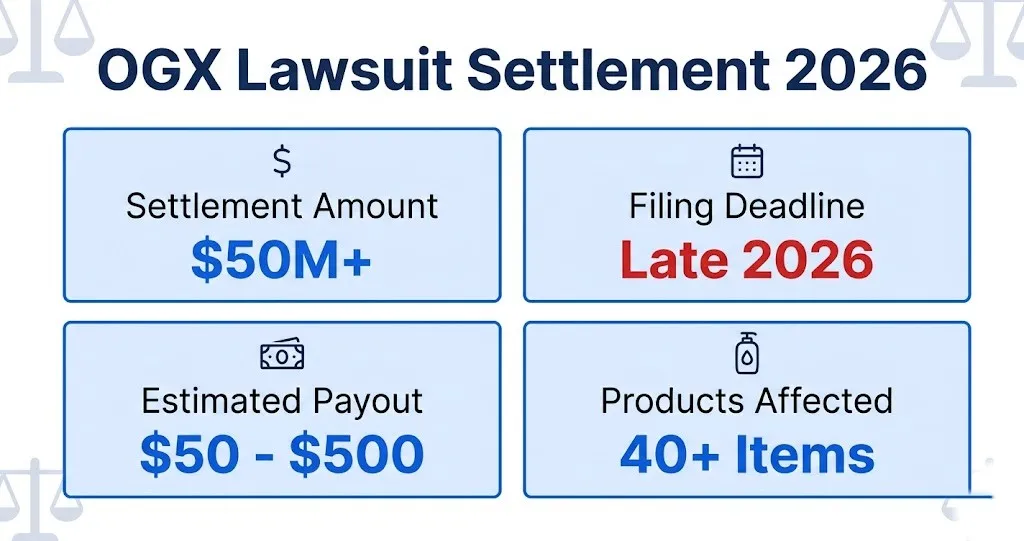
If you used OGX products and noticed your hair falling out, you might be owed money. The settlement fund could reach tens of millions of dollars, with individual payouts ranging from $50 to $500 depending on your claim type.
This guide covers everything happening with the OGX lawsuit in 2026. You’ll learn who qualifies, how to file, what deadlines matter, and exactly how much you could receive.
Here’s a fact that might surprise you: over 40 OGX products contain the ingredient at the center of this lawsuit.
OGX Lawsuit
The OGX lawsuit is a legal case accusing Johnson & Johnson of selling hair products containing a formaldehyde-releasing chemical without proper warning labels. Consumers claim they suffered hair loss, scalp burns, and skin irritation after using these products.
The first lawsuits were filed in 2021 after consumers noticed similar complaints piling up online. Social media played a huge role in connecting victims who thought their hair loss was just bad luck.
| Key Case Details | Information |
|---|---|
| Defendant | Johnson & Johnson / Vogue International |
| Case Type | Class Action / Product Liability |
| Main Allegation | Failure to warn about DMDM hydantoin |
| Number of Plaintiffs | Thousands nationwide |
| Case Status | Active in 2026 |
The lawsuits target both Johnson & Johnson as the parent company and Vogue International as the direct manufacturer. Both companies deny wrongdoing but face mounting legal pressure.
What makes this case significant is the widespread popularity of OGX products. These aren’t obscure brands. They sit on shelves at Target, Walmart, CVS, and grocery stores everywhere.
The legal claims fall under product liability and consumer protection laws. Plaintiffs argue the companies knew about the risks and chose profits over safety.
OGX Lawsuit 2026
The OGX lawsuit in 2026 has entered a critical phase with settlement negotiations intensifying and court deadlines approaching. This year marks a turning point for affected consumers seeking compensation.
Several key developments have shaped the case this year:
- January 2026: New plaintiffs added to consolidated proceedings
- March 2026: Settlement framework discussions began
- May 2026: Expert witness testimony on DMDM hydantoin safety concluded
- August 2026: Final claim filing period expected to open
The case has moved past initial discovery phases. Both sides have exchanged evidence, deposed witnesses, and hired scientific experts.
| 2026 Timeline | Event |
|---|---|
| Q1 2026 | Final plaintiff additions |
| Q2 2026 | Settlement talks begin |
| Q3 2026 | Claims portal expected to launch |
| Q4 2026 | Potential settlement approval hearing |
Judges overseeing the case have pushed both parties toward resolution. Trials are expensive, and the evidence strongly supports plaintiff claims about formaldehyde release.
For people affected by OGX products, 2026 is the year to act. Waiting longer could mean missing critical deadlines or receiving smaller payouts as the settlement fund gets divided.
OGX Class Action Lawsuit
The OGX class action lawsuit combines thousands of individual claims into one unified legal case against Johnson & Johnson. This structure allows consumers to pursue compensation without hiring their own lawyers or paying upfront legal fees.
Class actions work like this: a few named plaintiffs represent everyone who was harmed similarly. If the case wins, all class members share in the settlement.
The OGX class action has achieved “class certification” status. This means a judge agreed that enough people share common injuries and legal claims to proceed as a group.
| Class Action Details | Status |
|---|---|
| Class Certified | Yes |
| Lead Counsel | Multiple law firms |
| Class Definition | U.S. purchasers of covered OGX products |
| Opt-Out Option | Available until deadline |
Being part of a class action has advantages. You don’t pay lawyers unless the case wins. The legal heavy lifting happens without your direct involvement.
But there are tradeoffs. Class members typically receive less than plaintiffs who file individual lawsuits. You also give up the right to sue separately if you stay in the class.
Think of it like splitting a pizza. More people means smaller slices, but everyone gets fed without paying for the whole pie themselves.
Key Takeaway: The OGX lawsuit is a certified class action entering settlement negotiations in 2026, with claims expected to open by late summer.
OGX Shampoo Lawsuit
The OGX shampoo lawsuit specifically targets the company’s most popular shampoo products containing DMDM hydantoin. Shampoos sit on your scalp longer than most products, increasing chemical exposure.
Plaintiffs argue that daily shampoo use exposed them to formaldehyde repeatedly over months or years. The cumulative effect allegedly caused hair follicle damage and permanent hair loss in some cases.
Several best-selling OGX shampoo lines appear in court documents:
- Biotin & Collagen Shampoo
- Argan Oil of Morocco Shampoo
- Coconut Miracle Oil Shampoo
- Tea Tree Mint Shampoo
- Keratin Oil Shampoo
- Thick & Full Shampoo
The lawsuit claims OGX marketed these products as healthy and natural while hiding toxic ingredients. Words like “sulfate-free” and “nourishing” appeared prominently on labels.
| Shampoo Concern | Allegation |
|---|---|
| Marketing | Deceptive “natural” claims |
| Labeling | DMDM hydantoin listed but risks hidden |
| Exposure Duration | Daily scalp contact increases absorption |
| Consumer Harm | Hair loss, scalp irritation, allergic reactions |
Consumers trusted OGX because of its premium positioning and organic-sounding name. Many specifically chose OGX to avoid harsh chemicals. The irony isn’t lost on anyone.
The shampoo claims form the core of most lawsuits because shampoo usage is frequent and direct scalp contact is unavoidable.
OGX Hair Loss Lawsuit
The OGX hair loss lawsuit centers on claims that DMDM hydantoin damaged hair follicles and caused noticeable hair thinning or baldness. Plaintiffs report losing clumps of hair after regular OGX use.
Hair loss claims are particularly strong because the damage is visible and measurable. Before-and-after photos, medical records, and dermatologist testimony support plaintiff allegations.
Common symptoms reported by claimants include:
- Excessive hair shedding during washing
- Visible scalp through thinning hair
- Bald patches developing over time
- Hair breakage at the roots
- Permanent hair loss in severe cases
| Hair Loss Severity | Potential Compensation Tier |
|---|---|
| Mild thinning | Lower tier: $50 to $150 |
| Moderate loss | Middle tier: $150 to $300 |
| Severe/Permanent | Higher tier: $300 to $500+ |
The emotional impact matters too. Hair loss affects self-esteem, confidence, and mental health. Some plaintiffs have testified about anxiety and depression following their hair loss.
Dermatologists hired as expert witnesses have explained how formaldehyde damages the hair growth cycle. The chemical irritates follicles, disrupts protein structures, and can cause scarring that prevents regrowth.
For many people, this wasn’t just losing some hair. It changed how they felt about themselves every time they looked in a mirror.
OGX Settlement
The OGX settlement refers to the agreement being negotiated between plaintiffs and Johnson & Johnson to resolve claims without a full trial. Settlement talks have accelerated in 2026 as both sides weigh their options.
Settlements happen when defendants decide that paying now costs less than fighting in court. Given the scientific evidence against DMDM hydantoin, Johnson & Johnson faces significant trial risk.
| Settlement Factor | Current Status |
|---|---|
| Negotiations | Active in 2026 |
| Estimated Fund Size | $30 million to $75 million (projected) |
| Final Approval | Pending court hearing |
| Distribution Method | Claims-based system |
The settlement structure will likely use tiers based on injury severity and documentation. People with medical records showing diagnosed hair loss will receive more than those with only purchase receipts.
No final settlement amount has been publicly confirmed yet. Court filings suggest both sides are working toward numbers in the tens of millions.
Here’s how settlement funds typically get distributed:
- Court approves the total settlement amount
- Lawyers receive their percentage (usually 25% to 33%)
- Administrative costs get deducted
- Remaining funds go to claimants based on tier placement
The settlement won’t require Johnson & Johnson to admit wrongdoing. That’s standard in these deals. Companies pay to make problems disappear, not to confess.
Key Takeaway: Settlement negotiations are active with projected funds between $30 million and $75 million, though final approval and distribution await court hearings later in 2026.
OGX Settlement Payout
The OGX settlement payout structure determines how much money individual claimants will receive. Payouts depend on several factors including proof documentation, injury severity, and total number of claims filed.
Based on similar cosmetic product settlements, OGX claimants can expect payouts in these general ranges:
| Claim Type | Expected Payout Range |
|---|---|
| Basic claim (no proof) | $10 to $30 |
| With purchase proof | $50 to $100 |
| With medical records | $100 to $300 |
| Documented severe injury | $300 to $500+ |
These figures come from comparable cases like the Tresemme DMDM hydantoin settlement and other hair product class actions. Actual OGX payouts may differ based on final settlement terms.
The more documentation you have, the more money you’ll receive. This isn’t about fairness exactly. It’s about proving your claim is legitimate.
Think about it from the claims administrator’s perspective. Thousands of people will file claims. Some genuinely suffered. Others might just want free money. Documentation separates the two groups.
What counts as documentation:
- Store receipts showing OGX purchases
- Credit card statements with matching dates
- Photos of products in your home
- Medical records mentioning hair loss
- Dermatologist visit notes
- Before/after photographs of your hair
Keep everything. Dig through old emails for digital receipts. Check your Amazon order history. Every piece helps.
OGX Lawsuit Payout Per Person
The OGX lawsuit payout per person will likely fall between $50 and $500 for most claimants based on comparable settlement precedents. Individual amounts depend heavily on documentation and injury proof.
Let’s break down what determines your specific payout:
| Factor | Impact on Payout |
|---|---|
| Purchase frequency | More products = higher tier |
| Proof of purchase | Required for middle/upper tiers |
| Medical documentation | Significantly increases payout |
| Injury severity | Primary factor in tier placement |
| When you file | Early filers often prioritized |
Someone who bought one bottle of OGX shampoo won’t receive the same amount as someone who used multiple products daily for years. That makes sense, right?
The math works like this. If the settlement fund is $50 million and 500,000 people file claims, the average payout would be $100 per person. But averages deceive. People with strong documentation receive far above average while basic claims receive less.
Real-world example from similar cases:
- Tresemme DMDM lawsuit: $50 to $250 per person
- WEN hair care settlement: $25 to $20,000 depending on injury
- Monat hair loss claims: $100 to $500 typical range
OGX payouts will probably land somewhere in these ranges. The final amount won’t be clear until the settlement receives court approval.
Don’t expect life-changing money. Class actions rarely deliver that. But getting $200 or $300 for products that harmed you beats getting nothing.
OGX Lawsuit How Much Will I Get
How much you’ll get from the OGX lawsuit depends on your specific situation, but most claimants should expect between $50 and $500. Your documentation level determines which payment tier you qualify for.
Here’s a realistic breakdown of likely outcomes:
| Your Situation | Estimated Payout |
|---|---|
| You bought OGX once, no proof | $10 to $25 |
| Regular buyer with receipts | $50 to $100 |
| Hair loss but no medical records | $75 to $150 |
| Dermatologist-documented hair loss | $150 to $300 |
| Severe permanent hair loss with full documentation | $300 to $500+ |
The highest payouts go to people who can prove three things: they bought the products, they suffered injury, and the injury was diagnosed by a medical professional.
If you’re wondering whether it’s worth filing, consider this. The process takes maybe 15 to 20 minutes. Even at the lowest tier, that’s better than minimum wage for your time.
To maximize your payout:
- Gather all purchase receipts or bank statements
- Get copies of any medical records mentioning hair loss
- Take photos of OGX products currently in your home
- Document your hair loss with dated photographs
- File your claim as early as possible when the portal opens
People who file complete claims with documentation get prioritized. Incomplete claims sit in review limbo and sometimes get reduced or rejected.
Key Takeaway: Most OGX claimants will receive $50 to $500, with documentation being the key factor that separates low payouts from higher ones.
OGX Lawsuit Eligibility
OGX lawsuit eligibility requires that you purchased covered OGX products and experienced some form of harm, typically hair loss or scalp irritation. U.S. residents who bought products during the class period qualify.
The basic eligibility requirements are:
- Purchased OGX products containing DMDM hydantoin
- Bought products during the class period (varies by jurisdiction, generally 2017 to present)
- Resided in the United States at time of purchase
- Did not previously opt out of the class action
| Eligibility Question | Answer |
|---|---|
| Must I have receipts? | No, but payouts are higher with proof |
| Must I have hair loss? | No, but injury claims pay more |
| Can I join if I’m outside the U.S.? | No, U.S. residents only |
| Is there an age requirement? | Must be 18+ or file through guardian |
| Can I join multiple times? | No, one claim per person |
You don’t need to prove catastrophic injury to be eligible. Even economic harm counts. You paid for products marketed as safe that contained concerning chemicals.
Some people disqualify themselves by assuming they don’t count. Don’t do that. If you bought OGX products with DMDM hydantoin, you likely qualify for something.
The class definition will be finalized when the settlement receives approval. For now, cast a wide net. If you used OGX, gather your documentation and prepare to file.
How to Join OGX Lawsuit
To join the OGX lawsuit, you’ll need to file a claim through the official settlement website once it launches, expected in late 2026. The process is straightforward and doesn’t require a lawyer.
Here’s the step-by-step process:
Step 1: Wait for the claims portal
The official website will go live after the court approves the settlement. Sign up for notifications through class action monitoring sites.
Step 2: Gather your documentation
Collect purchase receipts, bank statements, product photos, and any medical records showing hair-related issues.
Step 3: Complete the claim form
Fill out the online form with your personal information, product details, and injury description.
Step 4: Submit documentation
Upload or mail copies of your supporting evidence. More documentation means higher payout tiers.
Step 5: Wait for processing
Claims administrators review submissions. This takes months. Be patient.
| What You’ll Need | Where to Find It |
|---|---|
| Proof of purchase | Bank statements, email receipts, store loyalty programs |
| Product identification | Photos of bottles, UPC codes |
| Injury documentation | Medical records, dermatologist notes |
| Personal information | Name, address, contact details |
You don’t need a lawyer to file. Class action claims are designed for regular people to complete themselves. Lawyers already represent the class and get paid from the settlement fund.
That said, if you suffered severe permanent injury, an individual lawsuit might recover more than a class claim. Consult with a personal injury attorney before deciding.
OGX Lawsuit Deadline
The OGX lawsuit deadline for filing claims has not been finalized but is expected to fall in late 2026 or early 2027 following settlement approval. Missing this deadline means forfeiting your right to compensation.
| Deadline Type | Expected Timeframe |
|---|---|
| Opt-out deadline | 60 to 90 days after settlement notice |
| Claims filing deadline | 90 to 180 days after portal opens |
| Appeal period | 30 days after final approval |
| Payment distribution | 6 to 12 months after claims close |
Why deadlines matter in class actions:
Courts set strict cutoffs to bring cases to closure. Once the deadline passes, no exceptions exist. You can’t file late because you didn’t know.
Administrators send notice to class members through mail, email, and sometimes media advertisements. But notices get lost, emails go to spam, and ads get ignored.
Don’t rely on someone reminding you. Set your own calendar alerts now.
Estimated timeline for 2026:
- Q2 2026: Settlement agreement reached
- Q3 2026: Court preliminary approval
- Q3 2026: Notice period begins (opt-out window)
- Q4 2026: Claims portal opens
- Q1 2027: Claims filing deadline (projected)
The safest approach is filing as soon as the portal opens. Early filers face fewer technical glitches and have time to fix any documentation issues before the deadline.
Key Takeaway: While exact deadlines await court approval, expect claims to open in late 2026 with filing windows of 90 to 180 days. Mark your calendar and don’t wait until the last minute.
OGX Products in Lawsuit
The OGX products in the lawsuit include dozens of shampoos, conditioners, and styling products containing DMDM hydantoin. The full list covers most of the brand’s popular lines.
Shampoos named in the lawsuit:
- Biotin & Collagen Shampoo
- Argan Oil of Morocco Shampoo
- Coconut Miracle Oil Shampoo
- Tea Tree Mint Shampoo
- Keratin Oil Shampoo
- Thick & Full Biotin & Collagen Shampoo
- Damage Remedy + Coconut Miracle Oil Shampoo
- Renewing + Argan Oil of Morocco Shampoo
Conditioners named in the lawsuit:
- Biotin & Collagen Conditioner
- Argan Oil of Morocco Conditioner
- Coconut Miracle Oil Conditioner
- Tea Tree Mint Conditioner
- Thick & Full Biotin & Collagen Conditioner
Other products:
- Various dry shampoos
- Leave-in treatments
- Styling sprays containing DMDM hydantoin
| Product Line | Products Affected |
|---|---|
| Biotin & Collagen | Shampoo, Conditioner, Spray |
| Argan Oil of Morocco | Shampoo, Conditioner, Oil |
| Coconut Miracle Oil | Shampoo, Conditioner, Treatment |
| Tea Tree Mint | Shampoo, Conditioner |
| Keratin Oil | Shampoo, Conditioner |
How to check if your product qualifies:
Look at the ingredient list on the back of the bottle. If you see “DMDM Hydantoin” listed, that product is likely covered by the lawsuit.
The company has reformulated some products since the lawsuits began. Newer bottles may not contain the ingredient. Check your specific product’s label or batch code.
OGX DMDM Hydantoin Lawsuit
The OGX DMDM hydantoin lawsuit alleges that this specific preservative releases formaldehyde gas over time, causing hair damage and health problems. DMDM hydantoin is at the heart of every claim in this case.
What is DMDM hydantoin exactly?
It’s an antimicrobial preservative used to extend shelf life in cosmetics. It works by slowly releasing formaldehyde, which kills bacteria and fungi that would otherwise grow in your shampoo bottle.
| DMDM Hydantoin Facts | Details |
|---|---|
| Chemical name | 1,3-dimethylol-5,5-dimethylhydantoin |
| Function | Preservative |
| Mechanism | Releases formaldehyde over time |
| Found in | Shampoos, conditioners, lotions, cosmetics |
| Regulatory status | FDA-approved but controversial |
The problem isn’t necessarily the preservative itself. The issue is formaldehyde release. Formaldehyde is a known carcinogen that also causes:
- Allergic reactions
- Skin irritation
- Eye irritation
- Hair follicle damage
- Scalp inflammation
Scientific studies have measured formaldehyde levels in products containing DMDM hydantoin. Some exceed levels that regulatory agencies consider safe for repeated exposure.
The lawsuit argues that Johnson & Johnson knew about these risks. Internal documents may show awareness of consumer complaints years before lawsuits began.
Companies can use safer preservatives. They chose not to because DMDM hydantoin is cheap and effective. That’s the crux of the negligence claim.
OGX Formaldehyde Lawsuit
The OGX formaldehyde lawsuit focuses on the cancer-causing chemical being released from DMDM hydantoin in OGX products. Formaldehyde exposure forms the core scientific basis for all claims.
Formaldehyde is classified as a known human carcinogen by the International Agency for Research on Cancer. The National Toxicology Program and EPA have also raised concerns about exposure risks.
| Formaldehyde Health Effects | Documented Outcomes |
|---|---|
| Short-term exposure | Skin irritation, eye burning, respiratory issues |
| Repeated exposure | Allergic sensitization, dermatitis |
| Hair and scalp | Follicle damage, inflammation, hair loss |
| Long-term concerns | Increased cancer risk (with high exposure) |
In the context of shampoo, formaldehyde off-gassing happens when you open the bottle and use the product. Heat from hot showers can increase release rates.
Expert witnesses in the lawsuit have presented data showing:
- DMDM hydantoin releases measurable formaldehyde
- Levels in some OGX products exceeded safe thresholds
- Daily exposure through shampooing compounds the risk
- Hair follicle cells are sensitive to formaldehyde damage
The formaldehyde connection makes this lawsuit stronger than typical product liability cases. Linking a known carcinogen to consumer injury creates clear causation arguments.
Johnson & Johnson faces similar formaldehyde-related lawsuits involving other products. The company’s legal exposure extends well beyond OGX alone.
Key Takeaway: DMDM hydantoin releases formaldehyde, a known carcinogen linked to hair loss and scalp damage, providing the scientific foundation for plaintiff injury claims.
Johnson and Johnson OGX Lawsuit
The Johnson and Johnson OGX lawsuit names the pharmaceutical and consumer products giant as the ultimate defendant responsible for product safety failures. J&J acquired OGX through its purchase of Vogue International in 2016.
Johnson & Johnson’s involvement matters for several reasons:
| Why J&J Matters | Significance |
|---|---|
| Deep pockets | Can pay larger settlements |
| Legal resources | Experienced in mass tort defense |
| Brand reputation | Incentive to settle quietly |
| Prior lawsuits | Pattern of product safety issues |
J&J isn’t a stranger to product liability lawsuits. The company has faced billions in legal claims involving talcum powder, opioids, hip implants, and other products. This history shapes how courts and juries view their corporate responsibility.
When J&J bought Vogue International for approximately $3.3 billion, they inherited existing products and their formulations. The lawsuit argues J&J either knew about DMDM hydantoin concerns or should have discovered them through proper due diligence.
Corporate liability in this case flows from:
- Duty to ensure product safety
- Responsibility for subsidiary actions
- Failure to warn consumers
- Continuing to sell products after complaints emerged
The J&J connection increases the likelihood of a meaningful settlement. Smaller companies might fight harder or declare bankruptcy. J&J has both the money and the motivation to make this case disappear quietly.
For consumers, suing J&J instead of just Vogue International provides assurance that any judgment or settlement will actually get paid.
OGX Lawsuit Update
The OGX lawsuit update for 2026 shows the case moving toward settlement with several key developments occurring this year. Both sides appear ready to resolve the litigation without a full trial.
Major 2026 developments:
| Date | Development |
|---|---|
| January 2026 | Consolidated cases assigned to settlement track |
| February 2026 | Expert witness testimony completed |
| April 2026 | Mediation sessions began |
| June 2026 | Settlement framework discussions ongoing |
| August 2026 | Claims portal development announced |
The trajectory clearly points toward settlement rather than trial. Johnson & Johnson faces strong evidence, and the cost-benefit analysis favors paying now over fighting longer.
What to expect in coming months:
- September 2026: Possible settlement announcement
- October 2026: Court preliminary approval hearing
- November 2026: Notice period begins
- December 2026: Claims portal likely to launch
Court documents reveal both parties have exchanged settlement demands and counteroffers. The gap between positions has narrowed significantly since 2025.
For claimants, this means action time approaches. Start gathering documentation now. Don’t wait for the claims portal to go live before locating receipts and medical records.
The case has progressed faster than many class actions. Some product liability cases drag on for five or more years. OGX litigation is wrapping up in roughly three to four years from initial filings.
Is There a Lawsuit Against OGX
Yes, there is an active lawsuit against OGX in 2026. Multiple class action cases have been filed and consolidated, alleging the company sold hair products containing a harmful chemical without adequate warnings.
| Question | Answer |
|---|---|
| Is there a lawsuit? | Yes, active in 2026 |
| Can I still join? | Yes, until the deadline passes |
| Is it too late? | No, claims haven’t opened yet |
| Do I need a lawyer? | No, for class action claims |
| Is OGX admitting fault? | No, settlements typically avoid admission |
The lawsuit is real. It’s not a scam or rumor. Court records confirm multiple cases filed in federal courts across the country.
How the lawsuit came about:
Consumers began noticing unusual hair loss after using OGX products. They posted complaints online and discovered others experiencing the same thing. Eventually, attorneys investigated and filed formal lawsuits.
The cases were consolidated for efficiency. Rather than hundreds of separate trials, one coordinated proceeding handles shared issues like product defects and company liability.
If you’ve been wondering whether to take this seriously, you should. The legal case has merit. The defendants are well-resourced companies. Settlement money will be distributed to qualifying claimants.
Your next step is simple. Gather any documentation of OGX purchases and hair-related issues. When the claims portal opens, file your claim promptly. Don’t let skepticism cost you money you’re entitled to receive.
Key Takeaway: The OGX lawsuit is legitimate and active in 2026, with settlement expected and claims opening soon. Anyone who purchased affected products should prepare to file.
Frequently Asked Questions
How much money will I get from the OGX lawsuit?
Most claimants will receive between $50 and $500.
The exact amount depends on your documentation and injury severity.
People with medical records showing diagnosed hair loss will receive higher payouts than those with only basic purchase evidence.
What is the deadline to file an OGX lawsuit claim in 2026?
The exact deadline has not been announced but is expected in late 2026 or early 2027.
Claimants will have approximately 90 to 180 days after the portal opens to submit claims.
Sign up for settlement notifications to avoid missing your filing window.
Which OGX products are included in the lawsuit?
Products containing DMDM hydantoin are included, covering dozens of shampoos, conditioners, and treatments.
Major lines include Biotin & Collagen, Argan Oil of Morocco, Coconut Miracle Oil, and Tea Tree Mint.
Check your product’s ingredient list for DMDM hydantoin to confirm eligibility.
Do I need proof of purchase to join the OGX class action?
No, proof of purchase is not required to file a basic claim.
However, claimants with receipts, bank statements, or product photos qualify for higher payment tiers.
Medical documentation of hair loss increases your payout further.
Is OGX still safe to use after the lawsuit?
OGX has reportedly reformulated many products to remove DMDM hydantoin since the lawsuits began.
Check current ingredient lists before purchasing new bottles.
Older products may still contain the ingredient, so inspect any OGX items currently in your home.
Take Action Now
The OGX lawsuit represents a real opportunity for compensation if you suffered hair loss from these popular products.
2026 is the year to act. Settlement negotiations are wrapping up. Claims will open soon. Deadlines will follow shortly after.
Start gathering your documentation today. Receipts, medical records, product photos, and bank statements all strengthen your claim.
Don’t wait for someone to remind you. When the portal launches, file early and file completely. Your hair loss deserves recognition, and the money is there for people who show up prepared.
