The Life360 lawsuit is real, and you might be owed money. If you used this family tracking app between 2016 and 2023, the company may have sold your precise location data to brokers without telling you.
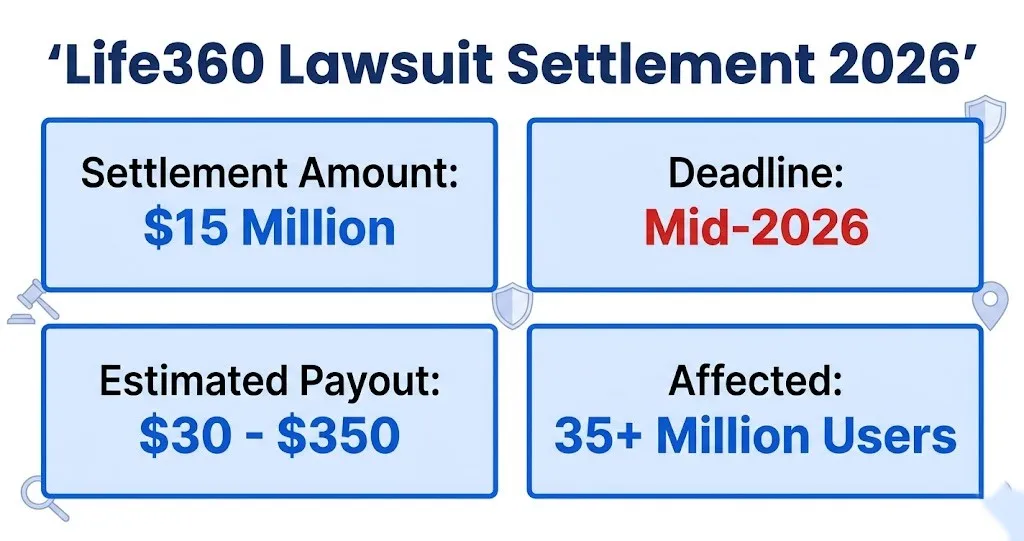
Millions of users are now eligible for cash payments. The settlement fund sits at approximately $15 million, with individual payouts ranging from $30 to $350 depending on how long you used the app.
This guide covers everything you need to know. You will learn who qualifies, how much you can expect, the exact deadline to file, and the step-by-step process to submit your claim.
Time matters here. The filing window closes in 2026, and once it shuts, you lose your chance forever. More than 35 million people used Life360 during the affected period.
Life360 Lawsuit
The Life360 lawsuit is a federal class action alleging the company secretly sold user location data to third-party data brokers for profit. This case centers on privacy violations that affected tens of millions of app users across the United States.
Life360 marketed itself as a family safety app. Parents used it to track their kids. Couples used it to share locations. The whole pitch was about keeping loved ones safe.
Behind the scenes, something different was happening. The company allegedly collected hyper-accurate GPS data and sold it to companies like X-Mode Social, Cuebiq, and SafeGraph.
| Key Lawsuit Details | Information |
|---|---|
| Case Type | Federal Class Action |
| Court | U.S. District Court, Northern District of California |
| Defendant | Life360 Inc. |
| Primary Allegation | Unauthorized sale of user location data |
| Affected Users | Estimated 35+ million |
| Settlement Fund | Approximately $15 million |
These data brokers then resold that information. Your movements ended up with advertisers, hedge funds, and even government agencies.
The lawsuit argues Life360 violated state privacy laws, including the California Consumer Privacy Act. Users never consented to having their real-time location sold for corporate profit.
Life360 Class Action Lawsuit
The Life360 class action lawsuit combines thousands of individual claims into one large legal action. This structure allows affected users to seek compensation without hiring their own attorneys or filing separate cases.
Class actions work like this: a few named plaintiffs represent everyone in a similar situation. When the case settles, all qualifying members share the recovery.
Here, the class includes anyone who used Life360’s mobile app in the United States during the relevant period. You automatically became a class member if you downloaded and used the app.
What makes this a class action:
- Common legal questions affect all members
- Individual claims are too small to justify separate lawsuits
- One resolution binds everyone in the class
- Attorneys work on contingency, taking fees from the settlement
The lead law firms handling this case include Keller Lenkner LLC and Hagens Berman. Both have extensive experience in privacy litigation.
You did not need to sign up initially. The class was certified by the court, meaning all eligible users were included automatically unless they specifically opted out.
Life360 Settlement Payout
Life360 settlement payouts will likely range from $30 to $350 per claimant based on the current fund size and expected participation rates. Your exact amount depends on several factors unique to your app usage.
The total settlement fund is approximately $15 million. After attorney fees (typically 25% to 33%) and administrative costs, roughly $10 to $11 million remains for distribution.
Here is how payout calculations typically work:
| Factor | Impact on Payout |
|---|---|
| Length of app usage | Longer use = higher payment |
| Premium subscription | Paid users may receive more |
| Number of total claims | More claimants = smaller individual shares |
| Proof submitted | Documentation can increase your share |
If only 10% of eligible users file claims (common in class actions), individual payouts increase significantly. If 50% file, everyone gets less.
The settlement administrator divides available funds based on a points system. Each month of app usage earns points. Premium subscribers earn bonus points.
Example payout scenarios:
- Used app 6 months, free tier: approximately $30 to $50
- Used app 2 years, free tier: approximately $75 to $125
- Used app 3+ years, premium subscriber: approximately $200 to $350
Your actual check amount will be confirmed after the claims deadline passes and all submissions are counted.
Key Takeaway: The Life360 lawsuit is a legitimate class action with a $15 million settlement fund, and individual payouts range from $30 to $350 based on your usage history.
How to Claim Life360 Lawsuit
Filing a Life360 lawsuit claim takes about 10 minutes if you have your information ready. The process is straightforward, and you do not need a lawyer to participate.
Step-by-step claim process:
- Visit the official settlement website (provided in your notice or court records)
- Enter your email address associated with your Life360 account
- Verify your identity with basic personal information
- Confirm your usage dates if prompted
- Select your payment preference (check, PayPal, or Venmo)
- Submit your claim and save your confirmation number
The online form is the fastest method. Paper claims are available but take longer to process.
You will need the following information:
- Full legal name
- Current mailing address
- Email used for Life360 account
- Approximate dates you used the app
- Whether you had a free or paid subscription
| Claim Method | Processing Time | Recommended? |
|---|---|---|
| Online form | Fastest (immediate confirmation) | Yes |
| Paper mail | 4-6 weeks to process | Only if necessary |
| Phone claim | Available for accessibility needs | Call settlement line |
After submitting, you receive a confirmation email. Keep this as proof of your claim. The settlement administrator may contact you if additional information is needed.
No claim means no money. The settlement does not automatically send checks to everyone. You must actively submit a claim to receive payment.
Life360 Lawsuit Eligibility
Life360 lawsuit eligibility depends on three main criteria: when you used the app, where you lived, and whether you opted out of the class. Meeting these requirements makes you a valid class member.
Basic eligibility requirements:
- Used the Life360 mobile app between January 2016 and December 2023
- Resided in the United States during your usage period
- Did not previously opt out of the class action
- Have not released claims against Life360 through another legal action
You qualify whether you used the free version or paid for a premium subscription. Both groups are included in the settlement class.
| Eligibility Question | Qualifying Answer |
|---|---|
| Used Life360 app? | Yes, during 2016-2023 |
| U.S. resident? | Yes |
| Opted out of class? | No |
| Current user counts? | Yes, if used during affected period |
Minors who used the app also qualify. A parent or guardian must file claims on their behalf.
It does not matter if you deleted the app years ago. Your historical usage still makes you eligible.
One common question: Do I qualify if I only used the app briefly? Yes. Even one day of use during the class period technically qualifies you. However, shorter usage typically means a smaller payout.
Who Qualifies for Life360 Lawsuit
Anyone who downloaded and actively used the Life360 app during the class period qualifies for this lawsuit. You do not need to prove the company specifically sold your data; membership in the class assumes exposure to the alleged conduct.
You qualify if:
- You created a Life360 account
- You used the app to share or track locations
- Your account was active at any point from 2016 to 2023
- You lived in any U.S. state or territory
You may not qualify if:
- You only visited the website without downloading the app
- You downloaded the app but never created an account
- You opted out during the initial notice period
- You already received compensation from Life360 through another legal settlement
Family members on the same Life360 Circle each qualify separately. If your household had four people on one plan, that is potentially four individual claims.
| Scenario | Qualifies? |
|---|---|
| Used free version for 3 months | Yes |
| Paid subscriber for 2 years | Yes |
| Downloaded but never opened app | Likely no |
| Child tracked by parent | Yes (parent files) |
| Account created in Canada | No (U.S. residents only) |
The settlement administrator uses Life360’s records to verify claims. They have access to historical account data showing when each user was active.
Key Takeaway: You qualify for the Life360 lawsuit if you used the app between 2016 and 2023, lived in the U.S., and did not opt out of the class.
Life360 Lawsuit Deadline 2026
The Life360 lawsuit deadline for filing claims is expected in mid-2026, with the exact date determined by the final approval hearing. Missing this deadline permanently disqualifies you from receiving any payment.
Class action deadlines are strict. Courts do not grant extensions for individual claimants. If you file one day late, your claim gets rejected automatically.
Critical dates to track:
| Milestone | Expected Timeframe |
|---|---|
| Final approval hearing | Q1 2026 |
| Claims deadline | 60-90 days after approval |
| Objection deadline | 30 days before approval |
| Settlement distribution | Q3-Q4 2026 |
The final claims deadline will be announced after the court grants final approval. This typically happens 60 to 90 days post-approval.
To stay informed:
- Register your email with the settlement administrator
- Check the official settlement website monthly
- Set calendar reminders for expected deadline windows
- File early to avoid last-minute technical issues
Why do people miss deadlines? Procrastination is the biggest reason. Many people intend to file but keep putting it off until it is too late.
File your claim as soon as the window opens. Early submission protects you from website crashes, forgotten passwords, or life getting in the way.
Life360 Lawsuit How Much Will I Get
Your Life360 lawsuit payment will likely fall between $30 and $350, with most claimants receiving around $50 to $150. Several factors determine where you land in this range.
The settlement uses a pro-rata distribution model. This means the total fund gets divided among all valid claimants based on weighted factors.
Factors affecting your payout:
- Duration of use: Each month of app activity earns points
- Subscription type: Premium users get bonus multipliers
- Claim volume: Fewer total claims means higher individual payments
- Documentation: Providing proof can strengthen your claim
| User Type | Estimated Payout Range |
|---|---|
| Casual user (under 1 year, free) | $30 to $60 |
| Regular user (1-2 years, free) | $60 to $120 |
| Long-term user (3+ years, free) | $100 to $200 |
| Premium subscriber (any duration) | $150 to $350 |
These estimates assume moderate claim participation rates. If claim rates are low (under 5%), payouts could exceed $500 for heavy users.
Here is the math: A $10 million distribution fund split among 100,000 claimants equals $100 per person on average. If only 50,000 file, that jumps to $200.
Your payment will not make you rich. But it represents recognition that the company wronged you and must pay for privacy violations.
Lawsuit Against Life360
The lawsuit against Life360 accuses the company of treating user location data as a product to sell rather than information to protect. Plaintiffs claim Life360 prioritized revenue over the privacy promises it made to customers.
Life360 generated significant income from data sales. Reports indicate the company earned millions annually by licensing precise GPS coordinates to data brokers.
Core allegations:
- Sold location data updated every few minutes
- Shared data with military contractors and government agencies
- Failed to disclose data sales in privacy policy clearly
- Continued sales even after promising to stop
- Collected data from children using the family app
The data brokers who purchased Life360 information included X-Mode Social (linked to military tracking), Cuebiq (advertising analytics), and SafeGraph (location intelligence).
| Data Broker | Primary Use of Location Data |
|---|---|
| X-Mode Social | Government and military contractors |
| Cuebiq | Advertising targeting |
| SafeGraph | Retail and business analytics |
| Placer.ai | Commercial real estate insights |
Life360 initially denied wrongdoing. The company later announced it would stop selling raw location data to brokers following media investigations.
This lawsuit forces accountability. Without legal action, companies face no real consequences for treating personal data carelessly.
Key Takeaway: Life360 allegedly sold precise user location data to multiple brokers, including those connected to government agencies, generating millions in revenue from information users thought was private.
Life360 Data Selling Lawsuit
The Life360 data selling lawsuit focuses specifically on how the company monetized user location data through third-party broker relationships. This is the heart of the privacy violation claims.
What data did Life360 sell? Not just general location information. The company allegedly provided pinpoint GPS coordinates accurate to within a few meters, updated every few minutes.
Data points allegedly sold:
- Real-time GPS coordinates
- Movement patterns and routines
- Home and work addresses (inferred from patterns)
- Frequent locations (schools, churches, doctors)
- Speed of travel (indicating vehicle use)
The buyers used this data for purposes users never imagined when installing a family safety app.
| Buyer Category | How They Used Life360 Data |
|---|---|
| Advertisers | Targeted ads based on location visits |
| Hedge funds | Predicted retail traffic patterns |
| Government | Surveillance and tracking purposes |
| Insurance | Risk assessment and verification |
Life360’s privacy policy mentioned data sharing but in vague terms. Users did not understand they were handing over detailed movement histories.
The company earned an estimated $16 million in one year from data licensing alone. That figure represented nearly 20% of total company revenue at its peak.
This lawsuit argues users deserved clear disclosure. If people knew their family safety app doubled as a surveillance tool for sale, many would never have downloaded it.
Life360 Privacy Lawsuit
The Life360 privacy lawsuit frames data selling as a fundamental betrayal of user trust. When people downloaded this app, they expected their location data would help family members stay connected, not enrich data brokers.
Privacy means controlling who sees your information. Life360 allegedly stripped that control away without meaningful consent.
Privacy violations alleged:
- No clear opt-in for data sales
- Buried disclosure language in lengthy terms
- Continued collection even when app was closed
- Sold data of users who disabled location sharing features
- Failed to honor requests to delete data
California’s Consumer Privacy Act (CCPA) gives residents specific rights. These include knowing what data companies collect, requesting deletion, and opting out of data sales.
| Privacy Right (CCPA) | Life360’s Alleged Violation |
|---|---|
| Right to know | Inadequate disclosure of sales |
| Right to delete | Did not honor all requests |
| Right to opt out | No clear mechanism provided |
| Right to non-discrimination | N/A |
Plaintiffs argue Life360 violated these rights systematically. The company treated privacy notices as legal checkboxes rather than genuine protections.
Beyond California, users in other states have claims under common law privacy principles. Everyone has a reasonable expectation that family apps will not sell their movements.
Life360 Lawsuit Claim
Your Life360 lawsuit claim is the formal document requesting your share of the settlement fund. Without submitting a claim, you receive nothing, even if you qualify perfectly.
The claim form asks basic questions. It is not designed to trick you or require extensive documentation.
Claim form sections:
- Personal information: Name, address, email, phone
- Account verification: Email used for Life360 account
- Usage confirmation: Dates of app usage (approximate is fine)
- Subscription details: Free or paid, and for how long
- Payment selection: How you want to receive money
| Claim Question | What to Provide |
|---|---|
| Account email | The email you registered with Life360 |
| Usage dates | Your best estimate (exact dates not required) |
| Subscription type | Free, Plus, or Driver Protect |
| Payment method | Check, PayPal, Venmo, or direct deposit |
You do not need perfect records. The settlement administrator cross-references your information with Life360’s account database.
However, accuracy matters. If your claim contains major discrepancies, it may be flagged for review or rejected.
Submit your claim once. Duplicate submissions can cause processing delays. If you made an error, contact the settlement administrator directly to request a correction.
Life360 Claim Lawsuit
Filing your Life360 claim lawsuit participation correctly ensures you actually receive money. Common mistakes can delay payments or disqualify claims entirely.
Mistakes to avoid:
- Using a different email than your Life360 account
- Providing an outdated mailing address
- Forgetting to select a payment method
- Submitting multiple claims for the same person
- Missing required fields on the form
The settlement administrator processes thousands of claims. They use automated systems to verify information. Errors create manual review requirements that slow everything down.
| Common Error | Consequence |
|---|---|
| Wrong email | Claim may not match records |
| Old address | Check returned as undeliverable |
| No payment method selected | Default to paper check (slowest) |
| Incomplete form | Claim rejected or delayed |
After submission, track your claim status. The settlement website typically offers a lookup tool where you can enter your confirmation number.
If you spot an error after submitting, act quickly. Contact the administrator through their official channels. Do not try to submit a second claim to “fix” the first one.
Keep all confirmation emails and screenshots. If any dispute arises about whether you filed, this documentation protects you.
Key Takeaway: Submit your Life360 lawsuit claim carefully, avoiding common errors like wrong email addresses or incomplete forms, and save your confirmation for records.
Life360 Lawsuit Proof Required
Proof requirements for the Life360 lawsuit are minimal for most claimants. The settlement administrator has access to Life360’s user database, so basic verification happens automatically.
What you do NOT need:
- Screenshots of the app
- Credit card statements
- Downloaded data exports
- Email receipts from Life360
- Witnesses to your app usage
What helps strengthen your claim:
- The email address linked to your Life360 account
- Approximate dates of usage
- Knowledge of your subscription tier
- Confirmation of your device type (helpful but not required)
| Proof Type | Required? | Helpful? |
|---|---|---|
| Account email | Yes | Essential |
| Usage dates | Approximate | Yes |
| Subscription receipts | No | Can increase payout |
| App screenshots | No | Not necessary |
| Credit card records | No | Useful if disputes arise |
If you cannot remember your exact usage dates, provide your best estimate. The administrator checks this against Life360’s records.
For users who no longer have access to their original email account, alternative verification methods exist. You may need to provide additional identity confirmation.
Premium subscribers should mention their subscription if possible. Paid users may qualify for larger payments due to the enhanced data collection associated with premium features.
Life360 Lawsuit Status 2026
The Life360 lawsuit status in 2026 is in the final settlement distribution phase, with claim processing underway and payments expected later in the year. The case has cleared most legal hurdles.
Timeline of case progress:
| Year | Major Development |
|---|---|
| 2021 | Initial complaints filed |
| 2022 | Class certification granted |
| 2023 | Settlement negotiations begin |
| 2024 | Preliminary settlement approval |
| 2025 | Final approval hearing |
| 2026 | Claims processing and distribution |
The court granted preliminary approval in late 2024. This allowed the notice process to begin, informing class members of their rights.
Final approval means the settlement terms are locked in. Life360 cannot back out, and the claims process moves forward definitively.
Current phase activities:
- Settlement administrator processing submitted claims
- Verification of claimant eligibility ongoing
- Payment calculations being finalized
- Distribution timeline being confirmed
Any remaining objections have been resolved. The appeals window has closed. Nothing significant should delay the settlement now.
If you have not filed yet, you still have time. The claims deadline has not passed as of early 2026. Check the official settlement website for the exact cutoff date.
Life360 Settlement Check
Your Life360 settlement check arrives after the claims deadline closes and the administrator completes all processing. Most claimants should receive payment in the second half of 2026.
Payment timeline:
| Phase | Expected Timing |
|---|---|
| Claims deadline | Mid-2026 |
| Verification complete | 60-90 days after deadline |
| Payment calculations | 30 days post-verification |
| Checks mailed | Q3-Q4 2026 |
You can choose how to receive your payment. Options typically include:
- Paper check: Mailed to your address on file
- PayPal: Faster digital transfer
- Venmo: Another digital option
- Direct deposit: If available, fastest method
Paper checks take longest because mail delivery adds time. Digital payments can arrive within days of distribution.
If your check does not arrive:
- Verify your claim was approved on the settlement website
- Confirm your mailing address is current
- Contact the settlement administrator
- Request a replacement check if necessary
Checks typically expire 90 to 180 days after issuance. If you receive one, deposit it promptly. Do not let it sit in a drawer and become void.
Uncashed checks often cannot be reissued after the settlement fund closes. Your window to receive payment has real limits.
Class Action Lawsuit Life360
The class action lawsuit against Life360 represents one of the largest privacy-related settlements involving a family app. This case set precedents for how location tracking companies must handle user data.
Why this case matters beyond your payment:
- Forces transparency in data monetization
- Establishes that buried privacy terms are not sufficient
- Creates financial consequences for data selling
- Warns other apps that similar conduct brings lawsuits
| Case Significance | Impact |
|---|---|
| Settlement size | Among largest for app privacy cases |
| Class size | 35+ million potential members |
| Industry effect | Increased scrutiny of tracking apps |
| Legal precedent | Strengthens future privacy claims |
Life360 is not the only app that sells location data. Dozens of popular apps monetize user movements. This lawsuit puts them on notice.
After this settlement, Life360 announced policy changes. The company claims it no longer sells raw location data to third-party brokers. Whether those changes are permanent remains to be seen.
Your participation matters. Class action success depends on people actually filing claims. Low participation rates embolden companies to continue questionable practices.
By filing your claim, you are not just collecting money. You are voting with your action that privacy violations have consequences.
Key Takeaway: The Life360 class action is a landmark privacy case affecting 35+ million users, and your participation helps establish real consequences for companies that sell user data without clear consent.
Frequently Asked Questions
How much money will I get from the Life360 lawsuit?
Most claimants will receive between $30 and $350.
Your exact amount depends on how long you used the app and whether you had a paid subscription.
Premium users and long-term members typically receive larger payments.
What is the deadline to file a Life360 lawsuit claim?
The claims deadline is expected in mid-2026, with the exact date announced after final court approval.
Missing this deadline means you cannot receive any payment.
File early to avoid last-minute issues.
Do I need proof to claim the Life360 settlement?
No, you do not need physical proof or documentation to file a claim.
The settlement administrator verifies eligibility using Life360’s account records.
Providing your account email address is typically sufficient.
How do I know if I qualify for the Life360 class action?
You qualify if you used the Life360 app between 2016 and 2023 while living in the United States.
Both free and paid users are eligible.
You must not have previously opted out of the class.
When will Life360 settlement checks be mailed?
Settlement checks are expected to be mailed in the second half of 2026.
Processing begins after the claims deadline passes and verification completes.
Digital payment options like PayPal may arrive faster than paper checks.
Get Your Share of the Life360 Settlement
The Life360 lawsuit offers real money to real users. If you used the app, you likely qualify for a payment.
File your claim before the 2026 deadline closes. The process takes about 10 minutes and requires no proof beyond your account email.
Check the official settlement website for exact deadline dates. Set a reminder now so you do not forget.
Your location data had value to Life360. Now it is time to get your share of what they earned from it.