
ICE detention facilities must give you specific written notices about your rights. When they fail, you may have grounds for an ICE facility notice requirement lawsuit that could result in compensation.
Thousands of detainees never receive required documents. Some never learn about their right to an attorney. Others miss bond hearings because no one told them the date.
These failures are not just administrative errors. They are potential legal violations that courts have increasingly recognized as actionable claims.
This guide covers everything you need to know in 2026. You will learn who qualifies to sue, how much settlements pay, filing deadlines, and the exact evidence you need to build a strong case.
One federal lawsuit in 2024 resulted in individual payouts exceeding $15,000 for detainees who proved systematic notice failures.
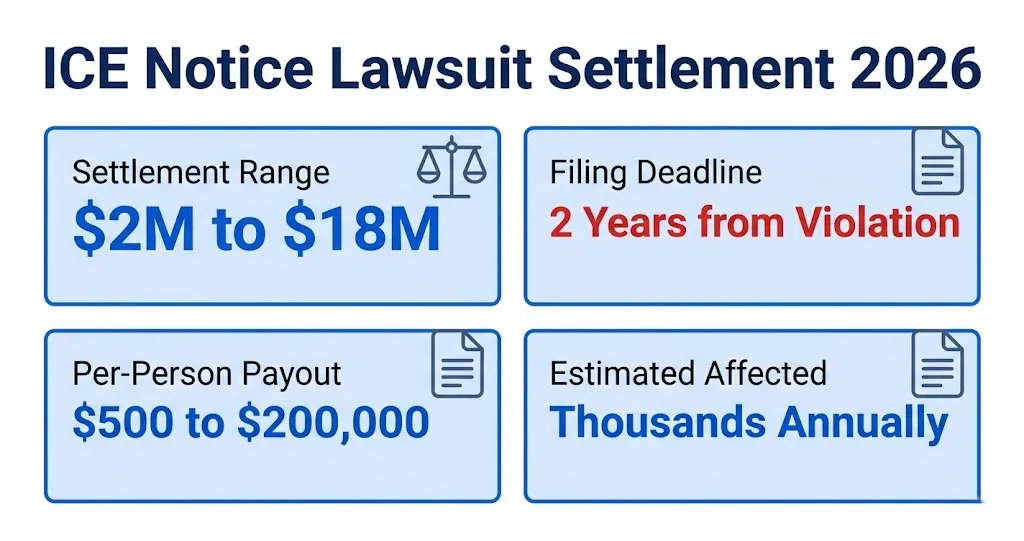
ICE Facility Notice Requirement Lawsuit Overview
An ICE facility notice requirement lawsuit is a legal claim filed when detention centers fail to provide mandatory written notices to people in their custody.
Federal law requires ICE to inform detainees about their legal rights, upcoming hearings, medical care options, and grievance procedures. The Performance Based National Detention Standards (PBNDS) outline dozens of specific notice obligations.
When facilities skip these requirements, detainees may suffer real harm. Missed court dates can lead to deportation. Lack of medical care notices can cause health crises. Failure to explain legal rights can mean someone sits in detention for months without understanding they could post bond.
| Notice Type | When Required | Consequence of Failure |
|---|---|---|
| Legal rights handbook | Within 12 hours of arrival | Potential rights violation claim |
| Court hearing notice | 48 hours before hearing | Possible case dismissal |
| Medical care access | At intake | Medical negligence exposure |
| Grievance procedures | At intake | Due process violation |
| Consular notification | Immediately upon request | Vienna Convention violation |
Lawsuits target both the federal government and private contractors like CoreCivic and GEO Group. Courts have allowed claims to proceed under multiple legal theories.
The Ninth Circuit ruled in 2023 that systematic notice failures can constitute deliberate indifference. That ruling opened doors for detainees to seek damages.
Can I Sue ICE for Not Giving Notice
Yes, you can sue ICE for failing to provide required notices, but the legal pathway depends on your specific situation and the type of violation.
The federal government enjoys sovereign immunity. That means you cannot sue the government unless it agrees to be sued. Fortunately, two major exceptions apply to ICE detention claims.
The Federal Tort Claims Act (FTCA) waives immunity for negligent or wrongful acts by federal employees. If an ICE officer or detention staff member failed to give you required notices, the FTCA may apply.
Bivens actions allow lawsuits directly against individual federal officers who violate constitutional rights. If notice failures violated your Fifth Amendment due process rights, a Bivens claim might work.
Private detention companies are different. You can sue CoreCivic, GEO Group, or other contractors directly. No sovereign immunity protects them.
Who Can File:
- Current detainees who experienced notice violations
- Former detainees who suffered harm from missed notices
- Family members in certain wrongful death situations
- Legal representatives on behalf of incapacitated individuals
One major hurdle exists. You must typically exhaust administrative remedies first. That means filing internal grievances before going to court.
Courts have waived this requirement when facilities made grievance procedures unavailable or failed to explain how to use them. Ironic, right? The failure to provide notice about grievance procedures can itself bypass the exhaustion requirement.
ICE Facility Lawsuit Eligibility Requirements
To qualify for an ICE facility notice requirement lawsuit in 2026, you must meet specific criteria that courts have established through years of case law.
Basic Eligibility Checklist:
- You were held in ICE custody at a facility covered by PBNDS or NDS standards
- The facility failed to provide one or more required notices
- You suffered actual harm because of the missing notice
- You filed administrative grievances OR exhaustion was excused
- Your claim falls within the statute of limitations
The harm requirement matters most. Courts have rejected cases where detainees could not show real damage from missing notices. Getting a handbook two days late probably will not win your case.
| Eligible Situations | Not Typically Eligible |
|---|---|
| Missed bond hearing due to no notice | Minor delays in receiving handbook |
| Medical emergency from no care notice | Receiving notice in wrong language if translator available |
| Deportation without court date notice | Technical violations with no resulting harm |
| Extended detention from procedural failures | Situations where you had actual knowledge anyway |
Strong cases involve detainees who missed immigration court hearings because facilities never told them the date. Some spent extra months in detention because no one explained their bond eligibility.
Class action eligibility requires showing the violation affected many people similarly. Individual lawsuits have lower bars but must still prove specific personal harm.
Key Takeaway: To sue ICE for notice violations, you need proof of a specific failure and evidence that this failure caused you real, measurable harm.
ICE Detention Class Action Lawsuit 2026
Several ICE detention class action lawsuits are active or pending in 2026, targeting systematic notice failures across multiple facilities.
Class actions work when the same violation affected many people the same way. Instead of hundreds of individual lawsuits, one case covers everyone. This saves court resources and increases pressure on defendants to settle.
Active Class Actions in 2026:
The Western District of Texas certified a class in late 2025 involving notice failures at three major detention centers. That case covers approximately 4,200 detainees who passed through those facilities between 2022 and 2024.
A Ninth Circuit case challenging language access failures in California facilities affects an estimated 8,000 class members. The claim alleges that non-English speakers never received translated rights notices.
The Southern District of Florida has a pending certification motion involving medical care notice failures. If certified, the class could include over 3,000 individuals.
| Case | Location | Est. Class Size | Current Status |
|---|---|---|---|
| Rodriguez v. ICE | W.D. Texas | 4,200 | Certified, discovery ongoing |
| Nguyen v. DHS | C.D. California | 8,000 | Certification pending |
| Sanchez v. CoreCivic | S.D. Florida | 3,000 | Motion filed January 2026 |
To join a class action, you typically do not need to do anything. If the class is certified, you automatically become a member unless you opt out. Settlement administrators will try to locate class members when payouts begin.
Some detainees choose to opt out and file individual lawsuits. This makes sense when your damages far exceed the average class member’s harm. Individual suits take longer but can yield larger awards.
ICE Facility Lawsuit Settlement Amount
ICE facility lawsuit settlement amounts in 2026 range from $2 million to $18 million for class actions, with individual case values varying dramatically based on harm severity.
The federal government has settled several notice-related cases in recent years. A 2024 settlement in the Central District of California totaled $7.8 million for 2,100 class members. Each person received between $800 and $12,500 depending on their documented harm.
Private detention companies have paid more in some cases. GEO Group settled a conditions case in 2023 for $14.2 million. CoreCivic paid $8.5 million in a 2024 language access failure case.
| Settlement | Year | Total Amount | Per-Person Range |
|---|---|---|---|
| Martinez v. ICE | 2024 | $7.8 million | $800 to $12,500 |
| Williams v. GEO Group | 2023 | $14.2 million | $1,500 to $18,000 |
| Thompson v. CoreCivic | 2024 | $8.5 million | $600 to $9,200 |
| Pending: Rodriguez v. ICE | 2026 | Est. $12 million | TBD |
Factors that increase settlement values include documented physical harm, extended detention periods, and evidence of deliberate misconduct rather than simple negligence.
Courts consider administrative costs when approving settlements. Typically, 25% to 35% goes to attorneys. Another portion covers notice and claims administration. Class members receive what remains.
Individual lawsuit settlements often exceed class action per-person amounts. One 2025 case involving a detainee who missed her asylum hearing due to notice failure settled for $145,000.
ICE Detention Lawsuit Payout Amounts
Individual ICE detention lawsuit payout amounts in 2026 typically range from $5,000 to $200,000 depending on the type of violation and resulting harm.
The payment you receive depends on several factors. How long were you detained because of the notice failure? Did you suffer physical harm? Did you get deported when you had a valid defense?
Typical Payout Ranges by Violation Type:
| Violation Category | Low End | High End | Average |
|---|---|---|---|
| Missed hearing causing extended detention | $15,000 | $75,000 | $35,000 |
| Medical notice failure with injury | $25,000 | $200,000 | $85,000 |
| Language access failure affecting case | $8,000 | $45,000 | $22,000 |
| Bond eligibility not explained | $5,000 | $30,000 | $12,000 |
| Deportation due to missed court date | $50,000 | $200,000+ | $95,000 |
Wrongful deportation cases pay the most. When notice failures lead to someone being removed from the country despite having a valid asylum or other relief claim, courts award significant damages.
Economic damages are easier to prove. Lost wages, legal fees spent trying to fix the situation, and costs of family separation all count. Emotional distress adds to the total but requires more documentation.
Some cases include punitive damages. When evidence shows facilities intentionally ignored notice requirements or covered up failures, courts may award extra money to punish the defendant.
Key Takeaway: Your potential payout depends directly on how much harm you can document, with medical injuries and wrongful deportations commanding the highest compensation.
How to File Lawsuit Against ICE Detention
Filing a lawsuit against ICE for notice failures requires following specific steps in the right order, starting well before you ever see a courtroom.
Step 1: Document Everything Now
Write down every detail you remember. Dates, names of officers, what notices you did or did not receive, and how the failure affected you. Get medical records, detention records, and any paperwork from your case.
Step 2: Exhaust Administrative Remedies
File a formal grievance with the detention facility. If that fails, appeal to the ICE Field Office Director. For FTCA claims, you must file an administrative claim with DHS before suing. Use Standard Form 95.
| Remedy Step | Where to File | Typical Timeline |
|---|---|---|
| Facility grievance | Detention center | 5 to 20 days response |
| ICE Field Office appeal | Regional office | 30 days response |
| DHS administrative claim | DHS Office of General Counsel | 6 months to deny or settle |
| Federal lawsuit | U.S. District Court | After DHS denial or 6-month wait |
Step 3: Gather Supporting Evidence
Request your A-file (immigration file) through FOIA. Get detention facility records. Obtain any communications between you and ICE. Medical records matter if you claim health-related harm.
Step 4: Find Legal Representation
Most immigration detention lawsuits require attorneys. Look for civil rights organizations, immigration legal services, or private attorneys who handle FTCA and Bivens claims. Many work on contingency for strong cases.
Step 5: File in the Correct Court
FTCA claims go to federal district court in the district where the violation occurred. Bivens actions can be filed where the defendant lives or works, or where the violation happened.
The complaint must state your claims clearly, identify defendants, and request specific relief. Your attorney handles the technical drafting.
ICE Violation Lawsuit Deadline 2026
The deadline to file an ICE violation lawsuit in 2026 depends on when your detention occurred and which type of claim you pursue.
For FTCA claims against the federal government, you have two years from the date of the violation to file an administrative claim with DHS. Miss this deadline, and your case dies.
After filing with DHS, you wait six months. If DHS denies your claim or does not respond, you then have six months to file a lawsuit in federal court. That is a hard deadline.
2026 Filing Calendar:
| If Violation Occurred | Admin Claim Deadline | Lawsuit Deadline |
|---|---|---|
| January 2024 | January 2026 | July 2026 or 6 months after denial |
| June 2024 | June 2026 | December 2026 or 6 months after denial |
| January 2025 | January 2027 | July 2027 or 6 months after denial |
| Ongoing in 2026 | 2 years from violation date | 6 months after DHS response |
Bivens claims against individual officers face different deadlines. Courts typically apply the personal injury statute of limitations from the state where the violation occurred. This ranges from one to six years depending on the state.
Class action deadlines work differently. When a class is certified, the statute of limitations may be tolled (paused) for class members. This protects people who join later.
Do not wait until the last minute. Gathering evidence takes time. Finding an attorney takes time. Filing administrative claims takes time. Start the process as early as possible.
ICE Detention Lawsuit Statute of Limitations
The statute of limitations for ICE detention lawsuits varies by claim type, and missing these deadlines permanently bars your case regardless of how strong your evidence is.
FTCA Claims: Two Years Plus Six Months
You must file your administrative claim within two years of the violation. After DHS responds or six months pass, you have another six months to sue. The total maximum window is roughly 2.5 years.
Bivens Claims: State Law Applies
Federal courts borrow state personal injury statutes of limitations for Bivens actions. Look at the state where the detention facility is located.
| State | Limitations Period | 2024 Violation Deadline |
|---|---|---|
| Texas | 2 years | 2026 |
| California | 2 years | 2026 |
| Arizona | 2 years | 2026 |
| Florida | 4 years | 2028 |
| New York | 3 years | 2027 |
Contract Claims Against Private Companies: Varies
If suing CoreCivic or GEO Group under state law, the statute depends on your legal theory. Contract claims may have longer windows. Negligence claims follow state personal injury rules.
Tolling Exceptions
Courts can pause the clock in certain situations. If you were deported and could not reasonably access the legal system, tolling may apply. Mental incapacity during detention can also extend deadlines.
Minors get special treatment. The clock typically does not start until they turn 18.
Key Takeaway: For most 2024 violations, the absolute deadline for starting your case falls somewhere in 2026, making this year critical for thousands of potential claims.
ICE Notice Requirements: What Documents Are Required
ICE must provide detainees with multiple specific documents within set timeframes, and failure to deliver any of these can form the basis of a lawsuit.
Mandatory Notices Under PBNDS 2011:
The Performance Based National Detention Standards require facilities to give you a detainee handbook within 12 hours of arrival. This handbook must explain your rights, facility rules, and how to file grievances.
| Document | Timing | Language Requirements |
|---|---|---|
| Detainee handbook | Within 12 hours | Must offer in detainee’s language |
| Legal rights orientation | Within 72 hours | Interpreter required if needed |
| Medical screening notice | At intake | Written and verbal explanation |
| Grievance procedures | At intake | Clear written instructions |
| Court hearing notice | 48+ hours before | Must include date, time, location |
| Bond eligibility info | At intake or when status changes | Written explanation required |
Consular Notification Rights
Under the Vienna Convention, ICE must inform foreign nationals of their right to contact their consulate. This notice must come without delay after detention begins.
Language Access Requirements
Executive Order 13166 requires meaningful access for people with limited English. Facilities cannot simply hand you an English handbook and call it done. Translation and interpretation must be available.
Transfer Notifications
When ICE moves you to another facility, they must provide advance notice except in emergencies. You have the right to notify family and legal representatives of transfers.
Courts have found violations when facilities provided handbooks in the wrong language, gave oral-only explanations without written backup, or delivered hearing notices too late for detainees to prepare.
ICE Detention Notice of Rights Violations
ICE detention notice of rights violations happen when facilities fail to properly inform detainees about their legal protections, and these failures occur far more often than most people realize.
A 2024 Department of Homeland Security Office of Inspector General report found that 34% of inspected facilities had documented notice deficiencies. Some facilities went weeks without providing handbooks to new arrivals.
Common Violation Patterns:
| Violation Type | Frequency Found | Impact Level |
|---|---|---|
| Delayed handbook distribution | 34% of facilities | Moderate |
| No translated materials available | 28% of facilities | High |
| Missing legal orientation programs | 22% of facilities | High |
| Late hearing notifications | 18% of cases reviewed | Severe |
| No grievance procedure explanation | 15% of facilities | Moderate |
The most damaging violations involve hearing notices. When someone misses their immigration court date because the facility never told them about it, they may be ordered deported in absentia. Reversing those orders requires proving the notice failure.
Language access failures particularly harm asylum seekers. If you do not understand your rights because no one explained them in your language, you may miss deadlines for filing asylum applications. The one-year filing deadline is strict.
Some facilities create paper trails showing notices were given when they actually were not. Detainees report signing forms they could not read. Guards sometimes check boxes indicating handbook delivery without actually providing the document.
These patterns support class action claims showing systematic rather than isolated failures.
ICE Notice Failure Lawsuit: Evidence Needed
Building a strong ICE notice failure lawsuit requires specific evidence that proves both the violation and the harm it caused.
Primary Evidence Categories:
Documentation showing what notices you did or did not receive forms the foundation. Request your detention file through FOIA. This file should contain intake forms, signature sheets, and records of orientations attended.
| Evidence Type | Where to Obtain | Usefulness |
|---|---|---|
| Detention intake records | FOIA request to ICE | High |
| Facility sign-in sheets | Discovery during lawsuit | High |
| Your A-file (immigration file) | FOIA request to USCIS | Medium |
| Medical intake records | FOIA or direct request | Medium |
| Grievance filings and responses | Facility or FOIA | High |
| Witness statements from other detainees | Direct contact | High |
Proving the Violation Occurred
Missing signatures on required forms help your case. If the facility cannot produce a signed acknowledgment that you received the handbook, that supports your claim.
Testimony from other detainees who experienced similar failures strengthens class action claims and corroborates individual cases.
Proving Harm Resulted
The harder part is connecting the notice failure to actual damage. You need evidence showing:
- You missed a hearing you would have attended if properly notified
- You did not pursue relief you were eligible for because no one explained it
- Your health suffered because you did not know medical care was available
- You remained detained longer than necessary because no one explained bond
Immigration court records showing an in absentia deportation order are powerful. They prove you missed court, and if you can show the facility never notified you, causation becomes clear.
Keep everything. Emails to family about confusion over your rights, letters from attorneys about missed deadlines, and any documentation of your mental state during detention all matter.
Key Takeaway: Successful ICE notice lawsuits combine proof that the facility failed to give required notices with evidence showing that failure directly caused you specific, documentable harm.
Bivens Action Against ICE Officers
A Bivens action lets you sue individual federal officers who violated your constitutional rights, but winning these cases has become harder after recent Supreme Court decisions.
The original Bivens v. Six Unknown Named Agents case from 1971 allowed damages claims against federal officers for Fourth Amendment violations. Courts later extended Bivens to cover Fifth and Eighth Amendment claims.
How Bivens Applies to Notice Failures:
When ICE officers deliberately withhold required notices, they may violate your Fifth Amendment due process rights. If that deprivation causes harm, a Bivens claim might apply.
| Bivens Element | What You Must Prove |
|---|---|
| Constitutional violation | Officer’s action violated 5th Amendment |
| Individual responsibility | Named officer personally involved |
| No alternative remedy | Congress has not provided other path |
| No special factors | National security not implicated |
The Qualified Immunity Problem
Officers can claim qualified immunity unless you show they violated “clearly established” rights. This means finding a prior case with very similar facts where a court ruled the conduct was unconstitutional.
Notice requirement cases sometimes clear this bar. Courts have held that deliberate denial of court hearing notices violates clearly established due process rights. However, less direct failures face steeper climbs.
Recent Supreme Court Limitations
The 2022 Egbert v. Boule decision made Bivens extensions harder. The Court said judges should hesitate before creating new Bivens claims in areas where Congress could act.
Immigration-related Bivens claims face extra scrutiny. Courts ask whether national security concerns counsel against allowing the lawsuit. ICE detention cases sometimes get dismissed on these grounds.
Despite limitations, some notice failure Bivens claims succeed. Cases involving deliberate, retaliatory withholding of notices have survived qualified immunity motions.
Federal Tort Claims Act ICE Detention
The Federal Tort Claims Act provides the main pathway for suing the federal government over ICE detention notice failures, with specific procedural requirements you must follow exactly.
FTCA waives sovereign immunity for negligent or wrongful acts by federal employees acting within their job scope. Unlike Bivens, FTCA claims target the government itself rather than individual officers.
FTCA Claim Requirements:
| Requirement | Details | Deadline |
|---|---|---|
| Administrative claim first | File SF-95 with DHS | Within 2 years of incident |
| Wait period | Allow 6 months for response | Before filing lawsuit |
| Federal court filing | After denial or 6-month wait | Within 6 months of denial |
| State law standard | Claim must meet state negligence law | Varies by state |
What FTCA Covers
Negligent training of detention staff can support FTCA claims. If ICE failed to properly train officers on notice requirements, and that failure caused your harm, the government may be liable.
Negligent supervision matters too. When supervisors knew about systematic notice failures and did nothing, FTCA claims become stronger.
What FTCA Does Not Cover
FTCA excludes intentional torts by federal employees in most circumstances. However, notice failures are often better characterized as negligence anyway. The officer forgot to give you the handbook rather than deliberately hiding it.
FTCA also excludes discretionary functions. Policy decisions about detention operations may be shielded. But routine duties like delivering handbooks are not discretionary.
Damages Under FTCA
You can recover compensatory damages including medical expenses, lost wages, and pain and suffering. FTCA does not allow punitive damages against the government.
Settlement is common. DHS often prefers to resolve valid FTCA claims administratively rather than face trial and potential precedent-setting court rulings.
ICE Detention Legal Rights Not Explained
When ICE facilities fail to explain detainees’ legal rights, serious consequences follow, and these failures form the basis for many active lawsuits in 2026.
Detainees have numerous rights that facilities must explain. The problem is that many people never learn these rights exist until after the damage is done.
Rights Facilities Must Explain:
| Right | What It Means | Consequence of Not Knowing |
|---|---|---|
| Bond eligibility | You may be able to pay for release | Unnecessary continued detention |
| Asylum application | You can apply for protection | Miss one-year deadline |
| Voluntary departure | Leave voluntarily to preserve future options | Formal removal has worse consequences |
| Legal representation | You can hire or find free lawyer | Proceed unrepresented with worse outcomes |
| Appeal rights | You can challenge adverse decisions | Miss appeal deadlines |
| Consular access | Your country’s consulate can help | Lose potential assistance |
The Language Barrier Multiplier
Limited English speakers suffer most. Even when facilities technically provide written materials, non-English speakers often cannot understand them. Courts have found this effectively denies notice.
A 2023 Ninth Circuit case held that providing an English-only handbook to a Spanish speaker who requested translation violated due process. That ruling opened doors for similar claims.
Impact on Case Outcomes
Studies show unrepresented detained immigrants win relief in only 4% of cases. Those with attorneys succeed 21% of the time. When facilities fail to explain how to find legal help, they effectively reduce success rates.
Asylum seekers face particular harm. The one-year filing deadline runs regardless of whether anyone told you it exists. Missing that deadline creates a bar that is extremely difficult to overcome.
Key Takeaway: ICE facilities must actively explain legal rights in languages detainees understand, and failure to do so has measurable impacts on case outcomes that courts recognize as compensable harm.
ICE Facility Conditions Lawsuit
ICE facility conditions lawsuits often overlap with notice requirement claims, as poor conditions and notice failures frequently occur together at the same problematic facilities.
When facilities fail to inform detainees about medical care access, food service procedures, or grievance options, conditions deteriorate. People do not know how to get help. Problems go unreported.
Common Conditions Issues Linked to Notice Failures:
| Condition Problem | Related Notice Failure |
|---|---|
| Medical emergencies mishandled | No explanation of sick call procedures |
| Dietary needs unmet | No notice of how to request accommodations |
| Religious practices denied | No notice of accommodation request process |
| Discipline without process | No notice of disciplinary procedures and rights |
| Isolation without review | No notice of segregation review procedures |
Recent Settlements for Conditions Claims
A 2024 settlement in Texas paid $8.3 million to detainees held in overcrowded conditions who were never told how to file complaints about safety issues. The failure to explain grievance procedures compounded the conditions problem.
GEO Group settled a 2025 case for $11.2 million involving inadequate medical care at a Louisiana facility. Part of the case centered on failure to provide medical care access information at intake.
Building a Conditions Case
Document everything while detained if possible. Write down dates, officer names, and specific incidents. Medical records matter enormously for conditions claims.
Photographs rarely exist, but written contemporaneous records help. Letters to family describing conditions can be dated evidence if you kept copies.
Conditions claims can proceed alongside notice claims. A single detention stay might generate multiple legal theories. Your attorney can evaluate which combination makes the strongest case.
ICE Detention Compensation Claim Process
The ICE detention compensation claim process involves multiple steps and can take one to three years from start to finish depending on whether you settle or go to trial.
Process Overview:
| Stage | Timeline | What Happens |
|---|---|---|
| Gather evidence | 1 to 3 months | Collect records, identify witnesses |
| Administrative claim | 6+ months | File SF-95, wait for DHS response |
| Federal lawsuit | 6 to 18 months | File complaint, discovery, motions |
| Settlement or trial | Varies | Negotiate or present case to judge/jury |
| Payment | 1 to 6 months after resolution | Treasury issues check |
Starting Your Claim
Request your records immediately. FOIA requests to ICE can take months. Start early. Get your A-file, detention records, medical records, and any documentation of grievances you filed.
Find an attorney before filing anything. FTCA claims require specific formatting. Mistakes can doom your case. Most civil rights attorneys offer free consultations for detention cases.
The Administrative Phase
Your SF-95 must state your claim clearly and request a specific dollar amount. That amount caps your later lawsuit recovery in most cases, so do not lowball yourself.
DHS has six months to respond. They may deny your claim, offer a settlement, or simply ignore you. Any of these outcomes allows you to proceed to court.
Settlement Negotiations
Most ICE notice cases settle before trial. The government prefers to avoid precedent-setting rulings. Your attorney will negotiate based on case strength and comparable settlements.
If You Win
Court judgments or settlements against the federal government are paid from the Judgment Fund at Treasury. Private company defendants pay from their own funds or insurance. Payments typically arrive within 60 to 90 days of final resolution.
Attorney fees come out of your recovery unless you negotiated otherwise. Typical contingency arrangements take 33% to 40%.
Frequently Asked Questions
What notice must ICE provide to detainees under federal law?
ICE must provide a detainee handbook within 12 hours of arrival explaining your rights and facility rules.
Additional required notices include hearing dates at least 48 hours in advance, medical care access information, grievance procedures, bond eligibility if applicable, and consular notification rights.
All notices must be available in your language or with interpretation services.
How much compensation can I receive from an ICE notice violation lawsuit?
Class action members typically receive between $500 and $15,000 depending on their documented harm level.
Individual lawsuits can result in settlements or verdicts ranging from $5,000 for minor violations to over $200,000 for cases involving wrongful deportation or serious medical harm.
Your specific amount depends on what notice you missed and what damage resulted.
What is the deadline to file an ICE detention lawsuit in 2026?
For FTCA claims, you must file an administrative claim within two years of the violation.
If your detention occurred in early 2024, your administrative deadline falls in early 2026.
After filing with DHS, you have six months from their response or denial to file a federal lawsuit.
Can undocumented immigrants sue ICE for notice violations?
Yes, immigration status does not prevent you from filing civil rights claims in federal court.
The Constitution protects all persons within U.S. borders, not just citizens.
Courts have allowed undocumented individuals to pursue FTCA claims, Bivens actions, and join class action lawsuits against ICE and private detention contractors.
What evidence do I need to prove ICE failed to give required notice?
Request your detention file through FOIA to see what acknowledgment forms exist.
Missing signatures or incomplete intake records support your claim.
Statements from other detainees who experienced similar failures help establish patterns.
Medical records, immigration court records showing missed hearings, and any grievances you filed also serve as valuable evidence.
Take Action on Your ICE Notice Violation Claim
Filing deadlines in 2026 affect thousands of people detained in 2024. If ICE failed to give you required notices, your window to seek compensation is closing.
Gather your records now. Request your detention file through FOIA immediately. This process takes months.
Strong cases have three things: proof of missing notices, evidence of real harm, and documentation connecting the two. Start building your file today.
The process takes time, but recoveries can reach six figures for serious violations. Do not let your deadline pass.
