
A wrongful death lawsuit lets surviving family members seek financial compensation when someone dies due to another party’s negligence or intentional harm. These cases can recover medical bills, funeral costs, lost income, and damages for emotional suffering.
Every state has different rules about who can file and how much time you have. Some states cap damages. Others allow punitive awards.
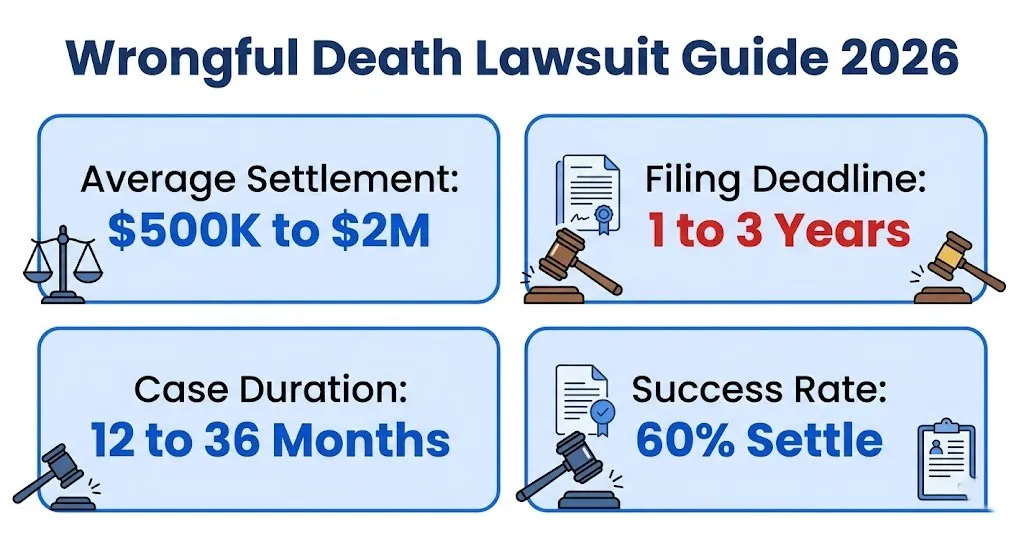
In 2026, wrongful death settlements range from $500,000 to over $10 million depending on circumstances. The average case takes 12 to 24 months to resolve.
This guide breaks down everything you need to know. You will learn state-specific filing rules, who qualifies, what payouts look like, and how the process actually works from start to finish.
One surprising fact: nearly 40% of wrongful death lawsuits settle before trial even begins.
What Is a Wrongful Death Lawsuit
A wrongful death lawsuit is a civil claim filed when someone dies because of another person’s or company’s negligent, reckless, or intentional actions. This legal action allows surviving family members to recover financial damages for their loss.
Think of it as a personal injury lawsuit the deceased person would have filed themselves if they had survived. The family steps into their shoes.
These cases differ from criminal charges. The government prosecutes murder or manslaughter. Families pursue wrongful death claims for money damages in civil court.
| Aspect | Wrongful Death Lawsuit | Criminal Case |
|---|---|---|
| Filed By | Family or estate | Government prosecutor |
| Standard of Proof | Preponderance of evidence | Beyond reasonable doubt |
| Outcome | Money damages | Prison, fines |
| Control | Family controls case | State controls case |
Common causes of wrongful death include car accidents, medical malpractice, workplace incidents, defective products, and nursing home neglect.
Quick Facts Box:
- Definition: Civil lawsuit for death caused by negligence
- Purpose: Financial compensation for survivors
- Filed By: Spouse, children, parents, or estate representative
- Time Limit: 1 to 6 years depending on state
You do not need a criminal conviction to win a wrongful death case. O.J. Simpson was acquitted criminally but lost the civil wrongful death lawsuit. The civil standard is much lower.
How Does a Wrongful Death Lawsuit Work
A wrongful death lawsuit works by proving the defendant’s negligence directly caused the death and resulted in measurable damages to survivors. The plaintiff must establish four legal elements to win.
Element 1: Duty of Care
The defendant owed the deceased a legal duty. Doctors owe patients proper care. Drivers owe others safe driving. Manufacturers owe consumers safe products.
Element 2: Breach of Duty
The defendant violated that duty through action or inaction. A drunk driver breaches duty. A hospital that ignores infection protocols breaches duty.
Element 3: Causation
The breach directly caused the death. This requires medical evidence and expert testimony in most cases.
Element 4: Damages
Survivors suffered quantifiable losses. Medical bills, funeral costs, lost income, and emotional suffering all count.
| Stage | Timeline | What Happens |
|---|---|---|
| Investigation | 1-3 months | Attorney gathers evidence, hires experts |
| Filing | 1 day | Complaint submitted to court |
| Discovery | 6-12 months | Both sides exchange documents, take depositions |
| Mediation | 1-2 days | Settlement negotiation with neutral mediator |
| Trial | 1-3 weeks | Jury hears evidence, decides verdict |
Most cases never reach trial. Insurance companies prefer settling to avoid unpredictable jury verdicts. Settlement negotiations often begin during discovery.
Your attorney handles everything. You focus on your family while lawyers manage paperwork, court deadlines, and negotiations.
Who Can File a Wrongful Death Lawsuit
The people who can file a wrongful death lawsuit depend entirely on state law. Every state has a specific list of eligible parties, and standing outside that list means no case.
Spouses almost always have priority filing rights. Surviving husbands and wives can sue in all 50 states without question.
Children rank second in most states. Adult and minor children both qualify. Adopted children have equal rights to biological children.
Parents can sue for a child’s death in every state. When an unmarried adult child dies, parents often become primary claimants.
Typical Filing Priority:
- Surviving spouse
- Children (biological and adopted)
- Parents
- Siblings (in some states)
- Financial dependents
- Estate representative
Some states limit claims to immediate family only. California, Texas, and Florida all have specific statutory lists.
Other states allow anyone who was financially dependent on the deceased. A live-in partner of 20 years might qualify in these jurisdictions.
The personal representative of the estate often files on behalf of all beneficiaries. This consolidates claims and simplifies court proceedings.
Key Takeaway: Your ability to file a wrongful death lawsuit depends on your relationship to the deceased and your state’s specific eligibility rules. Check your state statute before assuming you can sue.
Who Can File a Wrongful Death Lawsuit in California
California limits wrongful death lawsuit eligibility to a specific group defined by Code of Civil Procedure section 377.60. The state uses a tiered priority system.
First Priority: Surviving spouse and children. These parties have automatic standing. Domestic partners registered with the state have equal rights to legal spouses.
Second Priority: Anyone entitled to property under intestate succession. If no spouse or children exist, this includes parents, siblings, and other heirs.
Third Priority: Putative spouse and stepchildren. These parties can sue if they were financially dependent on the deceased.
| California Eligible Parties | Conditions |
|---|---|
| Spouse | Automatic standing |
| Domestic Partner | Must be registered |
| Children | Biological or adopted |
| Parents | If no spouse or children |
| Stepchildren | If financially dependent |
| Putative Spouse | Good faith belief of valid marriage |
California has a two-year statute of limitations. You must file within two years of the death date. Missing this deadline typically bars your claim forever.
Medical malpractice deaths have special rules. MICRA caps non-economic damages, though recent reforms increased these caps significantly.
One notable exception: government entity claims require filing an administrative claim within six months. City buses, state hospitals, and public agencies all have shortened deadlines.
Wrongful Death Lawsuit California Laws and Requirements
California wrongful death lawsuit laws allow recovery for both economic and non-economic damages without any cap for most case types. The state provides strong protections for plaintiffs.
Economic Damages Include:
- Lost financial support the deceased would have provided
- Medical bills from final illness or injury
- Funeral and burial costs
- Value of household services lost
- Loss of gifts and benefits
Non-Economic Damages Include:
- Loss of love and companionship
- Loss of comfort and moral support
- Loss of training and guidance for children
- Loss of intimacy for spouses
California does not allow punitive damages in wrongful death cases. However, a separate survival action can recover punitive damages for the deceased’s pre-death suffering.
| Damage Type | California Rules |
|---|---|
| Economic Damages | No cap |
| Non-economic Damages | No cap (except medical malpractice) |
| Punitive Damages | Not allowed in wrongful death |
| Survival Action Punitive | Allowed separately |
Filing requires submitting a complaint in Superior Court. The complaint names defendants, describes negligent conduct, and lists damages sought.
Recent 2024 reforms expanded MICRA caps from $250,000 to $500,000 for medical malpractice deaths, increasing to $1 million over 10 years.
Wrongful Death Lawsuit Florida Filing Rules
Florida wrongful death lawsuits operate under Florida Statute 768.16-768.26, which creates a unique system where only the personal representative of the estate can file. Individual family members cannot sue directly.
The personal representative acts as the legal plaintiff. However, damages get distributed to specific survivors based on their relationship to the deceased.
Florida Eligible Survivors:
- Surviving spouse
- Children (minor and adult)
- Parents (if deceased was a minor)
- Blood relatives and adoptive siblings who were partly dependent
| Florida Survivor | Recoverable Damages |
|---|---|
| Spouse | Lost support, companionship, mental pain |
| Minor Children | Lost parental guidance, support, services |
| Adult Children | Mental pain and suffering (if no spouse/minor children) |
| Parents of Minor | Mental pain, lost support, medical/funeral costs |
Florida has a two-year statute of limitations from the date of death. Medical malpractice cases also have a two-year limit but with a four-year cap from the incident.
One critical difference: adult children in Florida can only recover damages if there is no surviving spouse or minor children. This limitation surprises many families.
The estate can also recover the deceased’s lost earnings from the time of injury until death, plus medical and funeral expenses.
Key Takeaway: Florida’s wrongful death system requires filing through the estate’s personal representative, and damage recovery depends heavily on which family members survive and their specific relationships.
Wrongful Death Lawsuit Texas Eligibility and Damages
Texas wrongful death lawsuits provide broad recovery options under Texas Civil Practice and Remedies Code Chapter 71. The state allows surviving family members to sue directly without going through the estate.
Texas Eligible Plaintiffs:
- Surviving spouse
- Children (biological and adopted)
- Parents of the deceased
These three categories cover most families. Texas does not extend standing to siblings, grandparents, or other relatives regardless of financial dependency.
The law requires plaintiffs to file within two years of the death. After two years, the court dismisses claims as time-barred.
| Texas Damage Category | What It Covers |
|---|---|
| Pecuniary Loss | Lost earning capacity, lost inheritance, lost services |
| Mental Anguish | Emotional suffering of survivors |
| Loss of Companionship | Relationship value with deceased |
| Loss of Consortium | Spousal relationship damages |
| Exemplary Damages | Punitive awards for gross negligence |
Texas allows exemplary (punitive) damages when the defendant acted with gross negligence or malice. These awards can reach millions in severe cases.
The state does not cap wrongful death damages in most cases. Medical malpractice cases face a $250,000 cap on non-economic damages against physicians and a $500,000 cap against healthcare facilities.
If no eligible survivor files within three months, the estate representative can bring the action. Priority goes to family members first.
Wrongful Death Lawsuit in Georgia State Rules
Georgia wrongful death lawsuits follow O.C.G.A. Section 51-4-1 and create a unique “full value of life” standard that differs from most states. Georgia measures damages by the deceased’s total life value rather than just survivor losses.
Georgia Filing Priority:
- Surviving spouse (holds exclusive right while living)
- Children (if no surviving spouse)
- Parents (if no spouse or children)
- Estate administrator (last resort)
The surviving spouse controls the lawsuit completely. Children cannot sue independently while a spouse lives, even adult children seeking their own damages.
| Georgia Unique Feature | Explanation |
|---|---|
| Full Value of Life | Damages based on deceased’s life worth |
| Spouse Priority | Spouse has exclusive control |
| Two-Year Limit | Statute of limitations period |
| No Damage Cap | No limits on recovery amounts |
Georgia calculates damages by asking: what was this person’s life worth? This includes tangible losses like income plus intangible value like life enjoyment.
The state allows separate survival actions for the deceased’s pre-death pain and suffering. The estate files survival claims, while family members file wrongful death claims.
Recent Georgia cases have produced verdicts exceeding $20 million. The state has no caps on wrongful death damages outside medical malpractice contexts.
Wrongful Death Lawsuit Statute of Limitations by State
The wrongful death lawsuit statute of limitations sets the maximum time you have to file after a death occurs. Miss this deadline and you lose your right to sue permanently. No exceptions exist in most circumstances.
Most states give families between one and three years. Some extend to six years. Others compress to just one year.
| State | Statute of Limitations | Special Notes |
|---|---|---|
| California | 2 years | 6 months for government claims |
| Texas | 2 years | No discovery rule for wrongful death |
| Florida | 2 years | 4-year cap from incident date |
| New York | 2 years | From appointment of estate representative |
| Georgia | 2 years | Strict deadline enforcement |
| Illinois | 2 years | Can extend 5 years from act causing death |
| Arizona | 2 years | Standard civil statute applies |
| Michigan | 3 years | Longer than most states |
| Indiana | 2 years | From date of death |
| Kentucky | 1 year | Shortest major state deadline |
| Maine | 2 years | With some exceptions |
The clock typically starts on the date of death. Not the date of injury. Not the date you discovered wrongdoing. The death date controls.
Some states apply the discovery rule for latent injuries. If cancer from toxic exposure takes years to develop, the statute might start when death occurred rather than when exposure happened.
Critical Warning: Government defendants often have much shorter notice periods. Federal claims require notice within two years. Many state and local agencies demand six-month administrative claims before lawsuits.
Filing even one day late destroys your case. Courts strictly enforce these deadlines.
Key Takeaway: Check your state’s specific statute of limitations immediately after a wrongful death. Government entity claims have shorter deadlines, and missing any deadline means losing your case entirely.
Nursing Home Wrongful Death Lawsuit Claims
Nursing home wrongful death lawsuits arise when resident deaths result from neglect, abuse, understaffing, or inadequate medical care. These cases have increased significantly as regulatory oversight struggles to keep pace with facility growth.
Common Nursing Home Death Causes:
- Bedsore infections leading to sepsis
- Fall injuries from inadequate supervision
- Medication errors and overdoses
- Malnutrition and dehydration
- Wandering incidents and elopement
- Choking from improper feeding assistance
| Evidence Type | Why It Matters |
|---|---|
| Medical Records | Shows treatment gaps and decline |
| Staffing Logs | Proves understaffing during incident |
| Inspection Reports | Documents prior violations |
| Witness Statements | Staff and other residents |
| Autopsy Results | Confirms cause of death |
Nursing home cases often involve both corporate defendants and individual employees. The facility owner, management company, and negligent staff members may all face liability.
Many nursing homes require arbitration clauses in admission contracts. These clauses push disputes to private arbiters rather than public courts. Some states now limit arbitration enforcement in wrongful death cases.
Average nursing home wrongful death settlements range from $250,000 to $1 million. Cases involving documented abuse or gross neglect settle higher.
State health department records often reveal prior violations. Facilities with repeated citations face greater liability exposure.
Wrongful Death Lawsuit Against Hospital
A wrongful death lawsuit against hospital defendants targets institutional negligence that contributed to a patient’s death. These cases combine medical malpractice principles with wrongful death statutes.
Hospital Liability Theories:
- Direct negligence in policies and procedures
- Vicarious liability for employee errors
- Negligent credentialing of physicians
- Understaffing that caused harm
- Equipment failures and maintenance neglect
| Hospital Case Type | Common Issues |
|---|---|
| Surgical Errors | Wrong site, retained objects, anesthesia problems |
| Diagnostic Failures | Missed conditions, delayed testing |
| Medication Mistakes | Wrong drug, wrong dose, allergic reactions |
| Infection Control | Hospital-acquired infections, sepsis |
| Emergency Room Delays | Triage errors, inadequate monitoring |
Proving hospital negligence requires expert testimony. Board-certified physicians must review records and testify about standard of care violations.
Hospitals carry significant insurance coverage, typically $1 million to $10 million per occurrence. This coverage means settlements can reach substantial amounts.
MICRA-type laws in many states cap damages against hospitals. California, Texas, and several other states limit non-economic damages in medical malpractice deaths.
Settlement Ranges:
- Minor negligence contributing to death: $250,000 to $500,000
- Clear malpractice causing death: $500,000 to $2 million
- Gross negligence or misconduct: $2 million to $10 million+
Hospital systems often fight cases aggressively. They hire experienced defense firms and well-paid expert witnesses. Strong evidence proves essential.
Medical Wrongful Death Lawsuit Cases
Medical wrongful death lawsuit cases hold healthcare providers accountable when professional negligence causes patient deaths. These claims require proving the provider violated accepted medical standards.
Medical Wrongful Death Categories:
- Physician malpractice
- Surgical team errors
- Nursing negligence
- Pharmacy mistakes
- Diagnostic laboratory failures
- Radiology misreadings
Every medical wrongful death case needs expert testimony. You cannot win without a qualified physician testifying that the defendant breached standard of care.
| Specialty | Common Fatal Errors |
|---|---|
| Emergency Medicine | Missed heart attacks, stroke misdiagnosis |
| Obstetrics | Birth injuries, maternal hemorrhage |
| Surgery | Complications, wrong procedures |
| Oncology | Delayed cancer diagnosis |
| Cardiology | Missed warning signs |
The standard of care means what a reasonably competent provider would do in similar circumstances. It varies by specialty, location, and available resources.
Case Building Steps:
- Obtain complete medical records
- Hire qualified expert reviewers
- Identify specific standard violations
- Connect violations to death causally
- Calculate family damages
Medical malpractice insurance policies typically provide $1 million per claim and $3 million aggregate coverage. Larger claims may involve multiple defendants and policies.
These cases average 18 to 36 months from filing to resolution. The complexity of medical evidence extends timelines.
Key Takeaway: Medical wrongful death lawsuits require expert physician testimony to establish negligence. Without credible experts, these cases cannot succeed regardless of how obvious the error seems.
Wrongful Death Lawsuit Against Police
A wrongful death lawsuit against police officers faces unique legal hurdles not present in other cases. Qualified immunity and government claim procedures create significant obstacles for families.
Qualified Immunity Explained:
Officers receive immunity from lawsuits unless they violated “clearly established” constitutional rights. Courts often side with officers when legal standards remain unclear.
Recent cases have chipped away at qualified immunity. Some states now limit or eliminate this protection for certain violations.
| Legal Pathway | Requirements |
|---|---|
| Section 1983 Federal Claim | Constitutional violation, no qualified immunity |
| State Wrongful Death Claim | Negligence standard, notice requirements |
| Municipal Liability | Policy or custom caused violation |
| Supervisor Liability | Deliberate indifference to training |
Notice Requirements:
Before suing government entities, you must file administrative claims. Federal claims require notice within two years. State and local claims often demand six-month notice periods.
Settlement amounts vary dramatically based on circumstances:
- Unjustified shootings: $1 million to $20 million
- Excessive force deaths: $500,000 to $5 million
- Pursuit-related deaths: $250,000 to $2 million
Cities and counties carry liability insurance and often settle rather than face jury trials. High-profile cases create political pressure for resolution.
Video evidence from body cameras and bystanders has transformed these cases. Clear recordings of misconduct dramatically increase settlement values.
Department of Justice pattern-or-practice investigations can strengthen civil claims by documenting systemic problems.
Wrongful Death Lawsuit Examples and Outcomes
Wrongful death lawsuit examples demonstrate how these cases work in practice and what outcomes families can realistically expect. Studying actual cases helps set appropriate expectations.
Notable Recent Cases:
Case 1: Automotive Defect Death (2024)
A family received $15 million after proving a car manufacturer knew about airbag defects. Evidence showed the company hid testing data from regulators.
Case 2: Nursing Home Neglect (2023)
Surviving children recovered $3.2 million when their mother died from untreated bedsores. Staffing records proved the facility operated below minimum requirements.
Case 3: Medical Malpractice (2024)
A husband received $4.5 million after his wife died from a misdiagnosed heart condition. The emergency room physician ignored classic symptoms.
| Case Type | Average Settlement Range | Trial Verdict Range |
|---|---|---|
| Auto Accidents | $1M to $3M | $2M to $10M |
| Medical Malpractice | $500K to $2M | $1M to $15M |
| Product Liability | $2M to $5M | $5M to $50M+ |
| Nursing Home | $250K to $1M | $500K to $5M |
| Police Misconduct | $1M to $5M | $2M to $20M |
Settlement typically pays 70 to 80 cents on the dollar compared to trial verdicts. Families accept less to avoid trial uncertainty and delays.
Insurance policy limits often cap actual recovery. A $2 million policy means $2 million maximum regardless of jury verdict.
Disney Wrongful Death Lawsuit Case Analysis
The Disney wrongful death lawsuit made national headlines in 2024 when the company initially tried to force arbitration based on a Disney+ streaming subscription. The case illustrates how corporations attempt to limit legal exposure.
Case Background:
A man’s wife died after eating at a Disney Springs restaurant despite informing staff of severe allergies. The restaurant allegedly served food containing allergens she specifically identified.
Disney’s initial defense argued the husband agreed to arbitrate all disputes with the company when he signed up for Disney+ years earlier. This strategy sparked widespread outrage.
| Timeline | Event |
|---|---|
| October 2023 | Death occurred at Disney Springs restaurant |
| February 2024 | Wrongful death lawsuit filed |
| August 2024 | Disney claims arbitration applies |
| September 2024 | Disney drops arbitration defense |
| 2025 | Case proceeds in court |
Legal Significance:
This case highlighted how broad arbitration clauses in unrelated consumer agreements can threaten wrongful death rights. Public backlash forced Disney to reverse course.
What This Means for 2026:
Expect courts to scrutinize arbitration clause scope more carefully. Wrongful death claims may receive special protection from agreements buried in streaming service terms.
The case remains pending. Settlement discussions likely continue privately. Disney faces significant reputational pressure to resolve fairly.
Restaurant wrongful death cases involving allergies have increased. Chains now face greater scrutiny over allergen protocols and staff training.
Key Takeaway: The Disney wrongful death lawsuit shows how major corporations attempt to limit wrongful death claims through arbitration clauses, but public pressure and judicial scrutiny can overcome these tactics.
How Long Does a Wrongful Death Lawsuit Take
A wrongful death lawsuit typically takes 12 to 36 months from filing to resolution. The timeline depends on case complexity, defendant cooperation, and court schedules.
Phase-by-Phase Timeline:
| Phase | Duration | Activities |
|---|---|---|
| Pre-Filing Investigation | 1-6 months | Evidence gathering, expert review |
| Filing and Response | 2-4 months | Complaint filed, defendant answers |
| Discovery | 6-18 months | Documents, depositions, expert reports |
| Mediation | 1-2 months | Settlement negotiation attempts |
| Trial Preparation | 2-4 months | Motions, witness prep, exhibits |
| Trial | 1-4 weeks | Jury selection through verdict |
Most cases settle during or after discovery. Insurance companies evaluate settlement once they see all evidence.
Factors That Lengthen Cases:
- Multiple defendants with separate counsel
- Complex medical causation issues
- Government defendants with special procedures
- Disputed liability requiring extensive investigation
- High damages justifying aggressive defense
Factors That Shorten Cases:
- Clear liability with video evidence
- Single defendant with adequate insurance
- Reasonable insurance adjuster
- Straightforward damages calculation
Medical malpractice wrongful death cases take longest, averaging 24 to 48 months. The expert testimony requirements extend every phase.
Government defendant cases also run longer due to administrative claim procedures and sovereign immunity arguments.
Who Gets the Money in a Wrongful Death Lawsuit
The distribution of wrongful death lawsuit proceeds follows state law formulas or court-approved allocations. Family dynamics and contribution to the case affect final splits.
Distribution Methods by State:
| State Approach | How Money Divides |
|---|---|
| Statutory Formula | Law dictates percentages |
| Court Approval | Judge decides fair allocation |
| Family Agreement | Beneficiaries negotiate split |
| Estate Distribution | Follows will or intestacy |
California Distribution:
The court divides proceeds based on each survivor’s actual losses. Factors include financial dependency, relationship closeness, and age of surviving children.
Florida Distribution:
Personal representative distributes to survivors per statutory guidelines. Surviving spouse and minor children receive majority shares.
Texas Distribution:
Each plaintiff recovers their own damages. Spouse gets loss of consortium. Children get loss of parental guidance. No pooling required.
Common Distribution Factors:
- Financial dependency on deceased
- Age of surviving children
- Length of marriage
- Deceased’s income contribution
- Emotional bond documented
- Living arrangements
Minor children’s shares typically go into structured settlements or court-supervised trusts. Courts protect children from mismanagement of funds.
Attorney fees come off the top before distribution. Most wrongful death attorneys charge 33 to 40 percent contingency fees.
Who Pays for a Wrongful Death Lawsuit
Wrongful death lawsuit costs get paid on a contingency fee basis, meaning families pay nothing upfront. The attorney advances all expenses and collects only if the case wins.
Contingency Fee Structure:
The lawyer takes a percentage of the final recovery. Standard rates range from 33% for settlements to 40% for trial verdicts.
| Cost Item | Who Pays Initially | Who Pays Finally |
|---|---|---|
| Attorney Time | Law firm advances | Comes from recovery |
| Filing Fees | Law firm advances | Comes from recovery |
| Expert Witnesses | Law firm advances | Comes from recovery |
| Court Reporters | Law firm advances | Comes from recovery |
| Medical Records | Law firm advances | Comes from recovery |
Expense Breakdown for Typical Case:
- Filing fees: $400 to $600
- Expert witnesses: $5,000 to $50,000
- Depositions: $2,000 to $10,000
- Medical record retrieval: $500 to $2,000
- Trial exhibits: $1,000 to $5,000
If the case loses, the family owes nothing in most contingency arrangements. The law firm absorbs all losses.
Some firms require expense reimbursement even if the case loses. Read the fee agreement carefully before signing.
Who Actually Writes the Check:
The defendant’s insurance company pays most wrongful death settlements. Personal assets rarely come into play unless the defendant lacks adequate coverage.
Corporate defendants self-insure or carry large commercial policies. Individual defendants rely on auto, homeowner, or umbrella policies.
Frequently Asked Questions
How much is the average wrongful death settlement in 2026?
Average wrongful death settlements in 2026 range from $500,000 to $2 million for standard cases.
High-value cases involving clear liability and significant income loss can exceed $10 million.
The actual amount depends on the deceased’s earnings, family size, defendant resources, and state damage laws.
Can I file a wrongful death lawsuit without a lawyer?
You can technically file without a lawyer, but success is extremely unlikely.
Wrongful death cases require expert testimony, complex evidence handling, and courtroom skills.
Insurance companies exploit unrepresented plaintiffs and offer far lower settlements.
What evidence do I need for a wrongful death lawsuit?
Essential evidence includes the death certificate, medical records, accident reports, and witness statements.
Expert witness opinions proving negligence caused death are mandatory.
Financial records documenting the deceased’s income and your dependency strengthen damage claims.
Do wrongful death settlements get taxed?
Compensatory damages for physical injury or death are generally not taxable under federal law.
Punitive damages and interest on awards are taxable as income.
Consult a tax professional about your specific settlement structure.
What happens if the person who caused the death has no money?
Insurance policies often cover negligent parties even when they lack personal assets.
Employers may be vicariously liable for employee negligence.
If no coverage exists, collection becomes difficult regardless of verdict amount.
Take Action on Your Wrongful Death Claim
Wrongful death lawsuits give families a path to financial recovery and accountability. Every state has specific rules about who can file and how much time you have.
Statutes of limitations run quickly. Waiting too long destroys your legal rights.
Gather documents, research your state’s laws, and speak with an experienced wrongful death attorney. Most offer free consultations and work on contingency.
Your family deserves answers and fair compensation. Start the process today while evidence remains fresh and deadlines stay open.
