
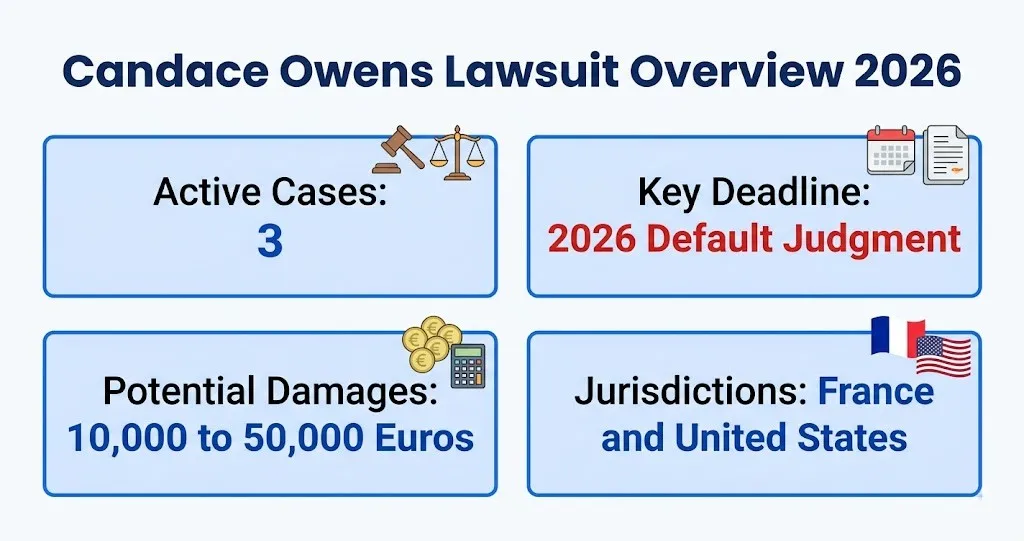
The Candace Owens lawsuit story has turned into one of the most talked-about legal sagas in media. From a defamation case filed by France’s First Lady Brigitte Macron to a lesser-known dispute involving Erika Kirk, Owens faces legal pressure on multiple fronts.
This article breaks down every active and resolved case tied to Candace Owens as of 2026. You’ll get the facts on the Macron defamation suit, French jurisdiction questions, the Daily Wire split, and what’s actually happened in court.
One fact that surprises most people: French defamation law doesn’t work like American defamation law. The burden of proof flips. That single difference shapes everything about the Macron case.
Here’s the full picture, case by case, with timelines and outcomes.
Candace Owens Lawsuit
The Candace Owens lawsuit refers to multiple legal cases involving the conservative commentator. The most high-profile is the defamation suit brought by Brigitte Macron, France’s First Lady, over Owens’ repeated public claims about Macron’s gender identity.
Owens made these claims starting in late 2023 on her YouTube show and social media accounts. She alleged, without verified evidence, that Brigitte Macron was born male. Those statements triggered legal action under French law.
But the Macron case isn’t the only one. Owens has also been involved in disputes connected to her departure from The Daily Wire and a separate claim involving a woman named Erika Kirk.
| Case | Plaintiff | Core Allegation | Status (2026) |
|---|---|---|---|
| Macron Defamation | Brigitte Macron | Gender identity defamation | Pending/Active |
| Daily Wire Dispute | The Daily Wire / Owens | Contract and separation terms | Resolved |
| Erika Kirk Case | Erika Kirk | Personal claims against Owens | Under review |
Each of these cases tells a different story. Together, they paint a picture of a public figure whose words have generated serious legal consequences.
The Macron case stands out because it crosses international borders. That raises questions about enforcement, jurisdiction, and whether a French court ruling could actually affect an American citizen.
Candace Owens Macron Lawsuit
The Candace Owens Macron lawsuit is a defamation case filed in France by Brigitte Macron. It targets Owens’ public statements claiming that France’s First Lady was born a man named Jean-Michel Trogneux.
Brigitte Macron’s legal team filed the complaint in a French court, arguing that Owens spread false and harmful claims to millions of followers. Under French law, defamation involving a private person’s identity carries specific penalties, including fines and potential damages.
Owens responded publicly by doubling down. She posted on X (formerly Twitter) that she welcomed the lawsuit and viewed it as an opportunity to prove her claims in court.
Key fact: French defamation law presumes statements are defamatory once published. The defendant must prove truth as a defense. This is the opposite of U.S. law, where the plaintiff carries the burden of proof.
The case has drawn international attention because it tests the limits of cross-border speech. Can a French court hold an American commentator accountable for statements made on American platforms?
- Owens made her claims primarily on YouTube and X
- Brigitte Macron filed in a Paris-based tribunal
- The case involves allegations about gender identity and personal history
- Owens has not appeared in French court as of early 2026
Legal experts say enforcement of any French judgment in the U.S. would face steep hurdles under the SPEECH Act, a federal law protecting Americans from foreign defamation judgments that conflict with the First Amendment.
Candace Owens Defamation Lawsuit
The Candace Owens defamation lawsuit centers on whether her statements about Brigitte Macron qualify as defamation under French civil law. In France, defamation is defined as any public allegation of a fact that damages a person’s honor or reputation.
This is not an opinion-based standard. French courts treat factual claims differently than opinions. If Owens stated as fact that Brigitte Macron was born male, she would need to prove that claim is true to avoid liability.
The lawsuit was filed under the Loi du 29 juillet 1881, France’s press and speech law. This statute covers all public statements, including those made online or through social media.
| Legal Standard | France | United States |
|---|---|---|
| Burden of Proof | Defendant proves truth | Plaintiff proves falsity |
| Public Figure Doctrine | Limited protection | Strong protection (actual malice) |
| Online Speech | Covered by press law | Protected by First Amendment |
| Statute of Limitations | 3 months from publication | Varies by state (1 to 3 years) |
Under French rules, Owens has a very narrow window to defend herself. She would need documentary proof, not speculation or circumstantial claims.
In the U.S., public figures like Brigitte Macron would need to show “actual malice,” meaning Owens knew her statements were false or acted with reckless disregard for the truth. That’s a much harder bar to clear.
This gap between legal systems is the core tension of the case.
Key Takeaway: The Candace Owens lawsuit saga spans multiple cases, but the Macron defamation suit is the most legally complex because French and American defamation standards are almost mirror opposites.
Brigitte Macron Candace Owens Lawsuit
The Brigitte Macron Candace Owens lawsuit was filed after Owens repeatedly aired claims about Macron’s gender identity to audiences numbering in the millions. Brigitte Macron’s legal team characterized these statements as a coordinated campaign of defamation.
Macron’s lawyers reportedly filed the complaint in late 2024. The filing came after months of Owens posting about the topic on her YouTube show, on X, and in interviews.
Brigitte Macron, born Brigitte Marie-Claude Trogneux in 1953 in Amiens, France, has been a public figure for decades. She married Emmanuel Macron in 2007 and became First Lady when he won the presidency in 2017.
Owens’ claims about Macron’s birth identity circulated widely in conspiracy-oriented online spaces. But Owens was the most prominent media figure to state them openly and repeatedly.
- The lawsuit specifically targets statements made on platforms accessible in France
- French law allows suits against foreign nationals for speech that causes harm within France
- Brigitte Macron’s team argued the claims damaged her reputation and personal dignity
Legal analysts noted that Macron’s decision to sue was unusual for a sitting First Lady. Most political figures avoid defamation suits because they draw more attention to the original claims.
But Macron’s team argued that silence would be interpreted as confirmation. Filing suit was a deliberate choice to fight the narrative head-on.
Candace Owens Brigitte Macron Lawsuit
The Candace Owens Brigitte Macron lawsuit, viewed from Owens’ side, has been framed as a free speech battle. Owens has repeatedly stated that she believes the lawsuit validates her claims and that she looks forward to a legal discovery process.
On her self-produced show in early 2025, Owens said she had “evidence” to support her assertions. She did not specify what that evidence was or present it publicly.
Owens’ legal position rests on several arguments:
- She argues her statements are protected opinion, not actionable defamation
- She questions whether a French court has jurisdiction over an American citizen
- She contends that Brigitte Macron, as a public figure, should expect public scrutiny
- She has suggested the lawsuit is politically motivated
Bold fact: Owens has not retained French legal counsel as of early 2026, according to public court records reviewed by legal journalists.
That’s a significant detail. Without French representation, Owens cannot meaningfully participate in proceedings before a Paris tribunal. A default judgment becomes more likely if she continues to skip the process.
From Owens’ perspective, she has no obligation to submit to French jurisdiction. From Macron’s perspective, the speech caused harm in France and should be addressed under French law.
This standoff is what makes the case so unusual. It’s not just about what was said. It’s about which country’s rules apply.
Macron Lawsuit Candace Owens
The Macron lawsuit against Candace Owens has broader implications beyond this single case. It touches on how public figures worldwide can respond to defamation that originates in a foreign country and spreads through the internet.
Think of it like this: if someone in New York writes something defamatory about a person in Tokyo, which court handles it? The internet makes borders almost meaningless for speech, but legal systems still operate within national boundaries.
France has taken an aggressive stance on online defamation in recent years. The country updated its digital content regulations in 2024, giving courts more power to address cross-border online harms.
| Timeline | Event |
|---|---|
| Late 2023 | Owens begins making public claims about Brigitte Macron |
| Early 2024 | Claims go viral; Macron’s office issues denial |
| Mid 2024 | Macron’s legal team sends formal notice to Owens |
| Late 2024 | Defamation complaint filed in French court |
| 2025 | Court proceedings begin; Owens does not appear |
| 2026 | Case remains active; no final ruling yet |
The case has also sparked debate in legal circles about whether the SPEECH Act would block enforcement of a French judgment in the U.S. That federal law, passed in 2010, specifically prevents U.S. courts from enforcing foreign defamation judgments that don’t meet First Amendment standards.
So even if Macron wins in France, collecting damages from Owens in America would require a separate legal battle.
Key Takeaway: The Macron lawsuit against Owens is as much about international law and internet speech as it is about the specific claims, and enforcement of any French ruling in the U.S. would face serious legal barriers.
Candace Owens Lawsuit Dropped
As of 2026, the Candace Owens lawsuit has not been dropped. Reports that the Macron defamation case was dismissed or abandoned are not accurate based on available court records.
This confusion likely stems from several factors. Owens herself has made statements suggesting the case is going nowhere. Some social media accounts have shared unverified claims that Macron withdrew the suit. Neither of these is confirmed by court filings.
French defamation cases under the 1881 press law have a short statute of limitations of just three months from the date of publication. However, each new publication or repetition of the defamatory statement can restart that clock.
Because Owens continued to make similar claims well into 2024 and 2025, the statute of limitations argument doesn’t work in her favor. Every new post potentially created a fresh cause of action.
- The lawsuit has not been dropped as of early 2026
- No public withdrawal notice has been filed by Macron’s legal team
- French court proceedings are continuing
- Owens has not filed any motion to dismiss in French court
Quick Fact: French defamation cases can proceed even without the defendant’s physical presence. A default judgment is a real possibility if Owens continues to not participate.
Anyone searching for confirmation that this case was dropped should look for official court records, not social media commentary.
Candace Owens Lawsuit Update 2026
The latest Candace Owens lawsuit update in 2026 shows that the Macron defamation case remains active in French courts. No final judgment has been issued. No settlement has been announced.
Here’s what we know as of mid-2026:
- French court proceedings are ongoing
- Owens has not appeared or sent legal representation to the Paris tribunal
- Brigitte Macron’s legal team has continued to press the case
- No default judgment has been entered yet, but legal experts say one could come at any time
- The Daily Wire dispute appears to be fully resolved
- The Erika Kirk matter remains under review
| Case | 2026 Status | Next Expected Action |
|---|---|---|
| Macron Defamation | Active | Potential default judgment |
| Daily Wire Dispute | Resolved | No further action expected |
| Erika Kirk Case | Under review | Awaiting court scheduling |
Owens has continued to discuss the Macron case on her independent media platform. She has not changed her position on the underlying claims. Her public stance remains that she welcomes legal scrutiny.
Legal observers say 2026 could be the year this case reaches a conclusion, at least in French courts. Whether that ruling has any practical effect on Owens in the United States is a separate question entirely.
The most likely scenario, according to French legal experts, is a default judgment in Macron’s favor with a symbolic fine and damages award.
Candace Owens French Defamation Case
The Candace Owens French defamation case is governed by laws that are fundamentally different from what Americans are used to. Understanding those differences is essential to making sense of this lawsuit.
In France, defamation is primarily a criminal matter, not just a civil one. The 1881 Press Freedom Law treats defamation as a press offense. Penalties can include fines of up to 12,000 euros for basic defamation and higher amounts when the defamation targets someone based on personal characteristics.
Here’s how French defamation cases typically work:
- The plaintiff files a complaint identifying the specific defamatory statements
- The defendant receives notice and can file a defense
- Truth is an absolute defense, but the defendant must prove it with admissible evidence
- The court examines whether the statements were factual claims or mere opinions
- Opinions are generally protected; stated-as-fact claims are not
For Owens, the challenge is clear. She stated her claims about Brigitte Macron as facts, not opinions. She said “Brigitte Macron is a man” and presented it as a truth she had uncovered.
Under French law, that framing turns her statements into factual assertions that she would need to prove. Speculation and circumstantial reasoning don’t meet the evidentiary bar.
Bold stat: French courts award defamation damages ranging from 1,000 to 50,000 euros in most cases. High-profile cases involving public figures sometimes see awards at the upper end of that range.
Key Takeaway: French defamation law puts the burden of proof on the person who made the statement, which is the opposite of U.S. law and creates a much harder defense for Owens.
Candace Owens Sued for Defamation
Candace Owens was sued for defamation because she made specific, repeated, public claims about Brigitte Macron’s gender identity. Those claims were presented as facts, not speculation, which is what triggered the legal response.
Being sued for defamation is serious for anyone, but it carries particular weight for media personalities. A defamation judgment can affect advertising deals, platform partnerships, speaking engagements, and overall credibility.
Owens is not the first American media figure to face a foreign defamation suit. But her case is one of the most visible examples in recent years.
Several factors made this lawsuit almost inevitable:
- Owens has millions of followers across multiple platforms
- She repeated the claims dozens of times over several months
- She framed the claims as investigative findings, not gossip
- Brigitte Macron’s team warned her before filing suit
- Owens publicly refused to retract the statements
The comparison to other high-profile defamation cases is instructive. Alex Jones faced massive damages for his Sandy Hook claims. Rudy Giuliani was hit with a judgment for election-related defamation. In both cases, the defendants repeatedly stated false claims as fact and refused to back down.
Owens’ case follows a similar pattern, though the legal system and potential penalties are very different because the case is in France, not the U.S.
The key question remains: will a French judgment have any real teeth in America?
Erika Kirk Candace Owens Lawsuit
The Erika Kirk Candace Owens lawsuit is a separate legal matter that has received far less media attention than the Macron case. Erika Kirk filed claims against Owens related to personal disputes that became public.
Details of the Kirk case are limited in public records. What is known is that Kirk’s claims involve allegations of personal harm connected to statements or actions by Owens.
This case is distinct from the Macron defamation suit in several ways:
| Factor | Kirk Case | Macron Case |
|---|---|---|
| Jurisdiction | United States | France |
| Type of Claim | Personal harm | Defamation |
| Public Attention | Low | Very high |
| Legal System | American civil courts | French press law |
| Status (2026) | Under review | Active |
The Kirk case matters because it shows that Owens faces legal challenges on multiple fronts, not just the international stage. Managing several lawsuits simultaneously is expensive, time-consuming, and distracting for any public figure.
Owens has not publicly commented on the Kirk lawsuit in detail. Her media appearances have focused almost entirely on the Macron case.
Quick Fact: Legal costs for defending multiple simultaneous lawsuits can easily exceed $500,000 per year in attorney fees alone, even before any judgments or settlements.
As of 2026, the Kirk case appears to be in early stages. No trial date has been set, and no settlement discussions have been reported.
Candace Owens Daily Wire Lawsuit
The Candace Owens Daily Wire lawsuit refers to the legal and contractual dispute surrounding Owens’ departure from the conservative media company in 2024. While not a traditional lawsuit in the public sense, the separation involved lawyers on both sides and potential legal claims.
Owens left The Daily Wire in early 2024 after a very public falling out with co-founder Ben Shapiro. The split centered on disagreements over editorial direction, particularly Owens’ comments about Israel and Jewish-related topics.
The contractual dispute reportedly involved:
- Non-compete clauses in Owens’ employment agreement
- Ownership of content she produced while at The Daily Wire
- Financial terms of the separation
- Restrictions on using The Daily Wire’s brand or intellectual property
Both sides made public statements that suggested legal tensions. Shapiro posted about “contractual obligations.” Owens posted about being “silenced.”
By mid-2025, the dispute appears to have been resolved privately. Neither party filed a public lawsuit. The terms of any settlement or agreement remain confidential.
Bold fact: Owens launched her own independent media platform after leaving The Daily Wire, which she has used to continue her commentary on the Macron case and other topics.
The Daily Wire situation is relevant to the broader Candace Owens lawsuit picture because it shows how her legal exposure has grown across personal, professional, and international spheres within just two years.
Key Takeaway: Owens faces legal challenges on three separate fronts: the Macron defamation case in France, the Erika Kirk claims in the U.S., and the now-resolved Daily Wire contractual dispute.
Candace Owens Legal Battles
Candace Owens’ legal battles in 2026 represent a pattern of escalating conflicts between her public statements and the legal consequences that follow. She is not just dealing with one lawsuit; she’s managing a web of disputes across multiple jurisdictions.
For a media personality, this level of legal exposure is unusual but not unprecedented. Other commentators who have faced similar situations include:
- Alex Jones: Faced defamation suits that resulted in over $1 billion in damages
- Rudy Giuliani: Hit with a $148 million defamation judgment
- Tucker Carlson: Named in lawsuits related to Fox News coverage
Owens’ cases are smaller in scale than these examples. But the pattern is similar: bold public claims, refusal to retract, and eventual legal accountability.
What sets Owens apart is the international dimension. Fighting a case in French courts while managing U.S. disputes creates logistical and strategic complications that most defendants don’t face.
Her legal bills are not public, but attorneys familiar with cross-border defamation cases estimate they could run into the hundreds of thousands of dollars by the time all matters are resolved.
Owens has continued to use her platform to discuss her legal situations. She frames them as attacks on free speech. Her critics frame them as consequences of irresponsible speech.
The truth, as with most legal matters, sits somewhere in the middle. But the cases are real, the courts are active, and 2026 may bring resolutions.
Did Candace Owens Lose Her Lawsuit
Candace Owens has not lost her lawsuit as of 2026. No final judgment has been entered against her in any of her active cases.
However, the trajectory of the Macron defamation case suggests that a loss, at least in French courts, is a realistic possibility. Here’s why:
- Owens has not appeared in French court
- She has not retained French legal counsel
- She has not filed any defense or response to the complaint
- French courts can and do issue default judgments
A default judgment would mean the court rules in Macron’s favor without Owens having contested the claims. It’s like losing a game because you didn’t show up to play.
That said, a French judgment has limited practical effect in the United States. The SPEECH Act of 2010 protects Americans from foreign defamation judgments that would violate the First Amendment.
| Scenario | Likelihood | Impact on Owens |
|---|---|---|
| Default judgment in France | High | Symbolic; limited U.S. effect |
| Owens appears and wins | Very low | Would validate her claims |
| Case settled privately | Moderate | Terms would be confidential |
| Case dismissed | Low | Would require Macron to withdraw |
The most likely outcome is a French default judgment that Macron’s team celebrates publicly but cannot easily enforce in America. Owens would likely frame it as a victory for free speech.
For the Kirk case and any remaining Daily Wire issues, no losses have been recorded either.
Candace Owens Court Case Outcome
The Candace Owens court case outcome remains pending for the Macron defamation matter. No verdict has been handed down. No damages have been awarded. The case is still working through the French legal system.
For the Daily Wire dispute, the outcome appears to be a private resolution. Both Owens and The Daily Wire moved on without filing public lawsuits. Whatever agreement they reached is not part of the public record.
The Kirk case also lacks a final outcome. It remains in preliminary stages with no trial date set.
Here’s what each case’s outcome would mean:
If Macron wins:
- Financial damages awarded, likely in the range of 10,000 to 50,000 euros
- A public statement from the court declaring Owens’ claims defamatory
- Potential difficulty for Owens traveling to France or EU countries
- No direct enforcement mechanism in the U.S. under the SPEECH Act
If Owens wins or the case is dismissed:
- A major blow to Macron’s credibility on the issue
- A precedent that would complicate future cross-border defamation cases
- Validation for Owens’ claims in public discourse, if not in fact
If settled:
- Confidential terms that neither side can discuss
- The public never learns the truth of the underlying claims
- Both sides claim victory in their own media
Most legal observers expect a default judgment in France rather than a contested trial, given Owens’ refusal to participate in French proceedings.
Macron Candace Owens Lawsuit
The Macron Candace Owens lawsuit, viewed from a 2026 vantage point, is a case study in how the internet has outpaced international law. Speech crosses borders instantly. Legal systems still operate within national lines.
Brigitte Macron filed this lawsuit to protect her reputation and personal dignity. Owens made her claims to a global audience of millions. The two are now connected by a legal dispute that neither of their countries’ legal systems was designed to handle alone.
This case raises questions that go beyond Owens and Macron:
- Should public figures in one country be able to sue commentators in another?
- Does the internet create a universal jurisdiction for defamation?
- How do courts balance free speech rights against personal dignity?
- Can social media platforms be held responsible for hosting defamatory content?
None of these questions have clean answers. The Macron Candace Owens lawsuit is one of several active cases around the world testing these boundaries.
Quick Fact: At least 12 cross-border defamation cases were filed in European courts in 2025 alone, targeting statements made by non-European nationals on social media platforms.
The outcome of this case, whatever it is, will likely be cited in future disputes between international public figures and media commentators. That makes it significant beyond the personalities involved.
Whether you support Owens’ right to say what she wants or Macron’s right to protect her reputation, this lawsuit matters. It’s shaping the rules for how speech and law interact in the digital age.
Key Takeaway: The Macron vs. Owens case is not just a celebrity feud; it’s a test case for how international law handles online defamation in an era when speech has no borders but legal systems still do.
Frequently Asked Questions
What is the Candace Owens lawsuit about?
The Candace Owens lawsuit primarily involves a defamation case filed by Brigitte Macron, France’s First Lady.
Macron sued Owens over repeated public claims about her gender identity.
Owens also faces separate legal matters involving Erika Kirk and a resolved dispute with The Daily Wire.
Did Brigitte Macron win her defamation case against Candace Owens?
No final judgment has been issued as of 2026.
The case is still active in French courts.
A default judgment in Macron’s favor is considered likely because Owens has not participated in French proceedings.
Was the Candace Owens Macron lawsuit dropped?
The Macron lawsuit has not been dropped.
Reports of dismissal are inaccurate based on available court records.
Brigitte Macron’s legal team continues to press the case in French courts as of 2026.
Who is Erika Kirk in the Candace Owens lawsuit?
Erika Kirk is a plaintiff in a separate legal matter against Candace Owens.
The case involves claims of personal harm and is being handled in U.S. courts.
It has received much less media coverage than the Macron defamation case.
Can Candace Owens be sued in France from the United States?
Yes, French law allows defamation suits against foreign nationals when the harmful speech is accessible in France.
However, enforcing a French judgment in the U.S. would face barriers under the SPEECH Act of 2010.
That federal law protects Americans from foreign defamation judgments that conflict with the First Amendment.
The Candace Owens lawsuit story is still developing. The Macron case could reach a conclusion in 2026, but enforcement in the U.S. remains uncertain.
If you’re following these cases, keep an eye on French court records and Owens’ own statements for real-time updates. Don’t rely on social media rumors about cases being dropped or settled.
The facts will come from courtrooms, not comment sections.
