
The University of Metaphysical Sciences has faced growing scrutiny from former students, consumer protection agencies, and Reddit communities who question whether its degrees hold any real-world value. Discussions about a potential university of metaphysical sciences lawsuit on Reddit have exploded in 2026, with thousands of students sharing stories of wasted tuition and worthless credentials.
This guide breaks down what the legal complaints actually say, what Reddit threads reveal, and what your real options are if you paid for a UMS degree.
You’ll learn whether a formal lawsuit exists, how to file a refund claim, and what state and federal agencies are doing about unaccredited online schools like this one.
One critical fact: the University of Metaphysical Sciences operates under a California religious institution exemption, which means it is not required to meet the same educational standards as traditional colleges. That exemption is now at the center of every legal challenge former students are raising.
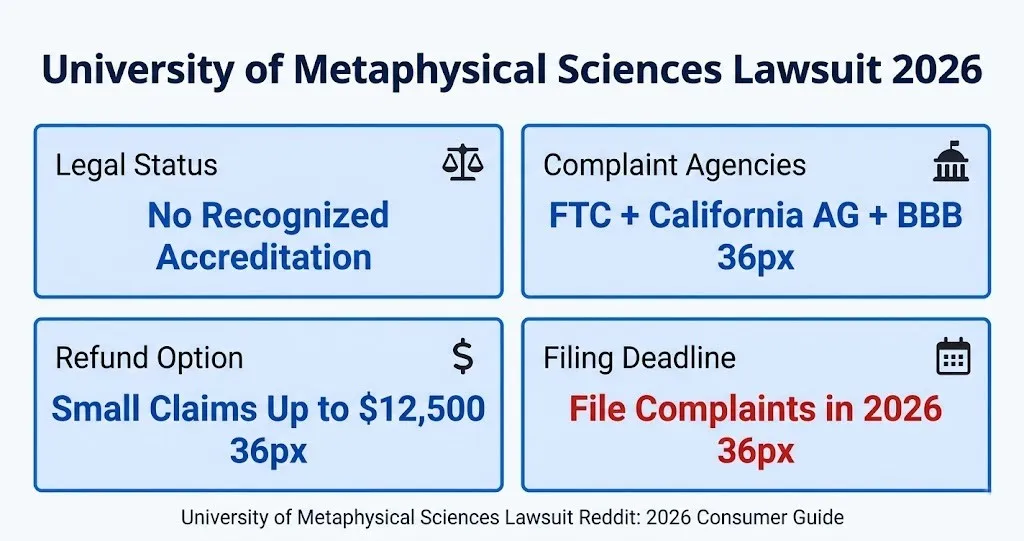
University of Metaphysical Sciences Lawsuit Reddit: What People Are Actually Saying
Reddit discussions about the University of Metaphysical Sciences paint a consistent picture of buyer’s remorse, degree rejection, and mounting anger.
Threads in r/Scams, r/DegreeMill, and r/personalfinance dating back years have accumulated thousands of comments. In 2026, those threads are more active than ever.
The most common complaints center on three themes:
- Degrees not recognized by any licensing board or accredited employer
- Tuition paid for coursework that holds no transferable academic credit
- Customer service that refuses refund requests without explanation
One recurring theme on Reddit is the “religious exemption” angle. Users point out that UMS claims exemption from California’s Bureau for Private Postsecondary Education oversight by registering as a religious institution. Critics call this a legal loophole that lets the school collect tuition without meeting educational accountability standards.
| Reddit Concern | Frequency Reported |
|---|---|
| Degree not recognized by employers | Very high |
| No transferable academic credit | High |
| Refund denied after completion | High |
| Misleading accreditation language | Moderate |
| Course quality vs. price mismatch | Moderate |
Reddit is not a court. But the volume and consistency of these complaints is exactly the kind of pattern that attracts state attorney general investigations.
Key Takeaway: Reddit threads in 2026 reveal a sustained, consistent pattern of student harm centered on degree value, accreditation misrepresentation, and denied refunds.
Is University of Metaphysical Sciences a Scam?
Whether UMS qualifies as a scam depends on how you define the word in legal terms.
Under California consumer protection law, a business practice can be considered deceptive if it creates a false impression of value. Selling degrees that lack recognized accreditation while implying professional legitimacy could meet that standard.
UMS offers degrees in metaphysical sciences, spiritual counseling, and related areas. These programs are not recognized by the U.S. Department of Education or any nationally or regionally accredited body.
Here is what separates a “scam” from a “bad deal” legally:
- A scam involves intentional misrepresentation for financial gain
- A bad deal involves a product that simply isn’t worth what you paid
- The line gets crossed when marketing language implies credentials that do not exist
Former students on Reddit report that UMS materials suggest graduates can work as “doctors of metaphysical sciences.” But no state licensing board recognizes that title for healthcare, counseling, or therapeutic practice.
That gap between what the school implies and what the degree actually delivers is where the legal exposure sits.
University of Metaphysical Sciences Accreditation Fraud Explained
Accreditation fraud refers to misrepresenting a school’s accreditation status to attract students and tuition payments.
UMS does not hold accreditation from any body recognized by the U.S. Department of Education. The school has been accredited by organizations that consumer watchdogs and federal agencies categorize as “accreditation mills,” meaning bodies that sell accreditation without meaningful academic review.
This matters legally for a specific reason. If a school implies its accreditation means the same thing as regional or national accreditation, and students pay tuition based on that implication, that can constitute deceptive enrollment under California Education Code and the FTC Act.
The key organizations involved:
| Entity | Role |
|---|---|
| U.S. Department of Education | Does not recognize UMS accreditors |
| California BPPE | UMS claims religious exemption from oversight |
| CHEA (Council for Higher Education Accreditation) | Does not list UMS accreditors as recognized |
| FTC | Oversees deceptive educational marketing nationwide |
The “accreditation mill” angle is the strongest legal argument former students have. It’s also the argument most likely to interest a state attorney general’s consumer protection division.
Is University of Metaphysical Sciences Accredited?
The University of Metaphysical Sciences is not accredited by any organization recognized by the U.S. Department of Education.
UMS holds approval from the International Metaphysical Ministry and similar bodies. These organizations are not recognized by the Department of Education or the Council for Higher Education Accreditation.
This has real consequences for graduates:
- UMS degrees cannot be used to transfer credits to accredited universities
- Employers requiring accredited degrees will not accept UMS credentials
- State licensing boards for counseling, therapy, or healthcare will reject UMS qualifications
- Federal student loans cannot be used at UMS because it lacks recognized accreditation
The school cites its California religious institution exemption as justification for operating without BPPE oversight. That exemption, found in California Education Code Section 94874, allows religious institutions to confer degrees without state authorization.
Critics argue this exemption was never intended to cover commercial online universities charging thousands of dollars in tuition. That argument is at the heart of ongoing 2026 legal discussions.
Key Takeaway: UMS holds no recognized accreditation, its degrees cannot transfer to any accredited institution, and the religious exemption it relies on is being challenged as misused.
UMS Diploma Mill Lawsuit: What the Legal Record Shows
A diploma mill is an institution that sells degrees without requiring meaningful coursework or without holding legitimate accreditation.
No single class action lawsuit labeled specifically as a “UMS diploma mill lawsuit” had been certified as of early 2026. However, individual consumer complaints, state agency inquiries, and consumer fraud claims filed in small claims courts have accumulated over the past several years.
What the legal record does show:
- Multiple Better Business Bureau complaints citing misrepresentation
- California Department of Consumer Affairs records noting UMS operates under religious exemption
- FTC complaints filed by former students alleging deceptive marketing
- At least one documented California small claims filing over tuition refund denial
The absence of a single high-profile class action does not mean legal action is impossible. Consumer attorneys have noted that UMS’s business model, charging tuition for degrees with no recognized value, fits patterns that have resulted in class action suits against other unaccredited online schools.
The legal theory most applicable is unjust enrichment. If UMS collected tuition by implying value that did not exist, students may have grounds to recover that money.
University of Metaphysical Sciences Complaints: The Full Picture
Student complaints against UMS follow a predictable pattern that consumer protection experts recognize as a red flag cluster.
The most common complaints documented across the BBB, Reddit, and consumer complaint boards in 2026 include:
- Tuition paid for degrees that serve no professional or academic purpose
- Misleading course descriptions implying clinical or therapeutic credentials
- Refund requests ignored or denied after course completion
- Degree titles that imply professional status not backed by licensing
- Poor communication from school administration on accreditation questions
These are not just unhappy customer reviews. Legally, this type of pattern can form the basis of a consumer protection enforcement action when filed with a state attorney general.
| Complaint Type | Legal Weight |
|---|---|
| Misrepresented accreditation | High: potential deceptive trade practice |
| Refused refund without policy basis | Moderate: breach of contract possibility |
| Degree title implying false credentials | High: potential false advertising |
| No recognized credit transfer | Moderate: failure of material purpose |
| Marketing implying professional licensure | High: FTC Act section 5 concern |
The pattern matters more than any single complaint. State attorneys general look for patterns when deciding whether to open a consumer protection investigation.
University of Metaphysical Sciences BBB Complaints Breakdown
The Better Business Bureau file for the University of Metaphysical Sciences reflects a history of unresolved consumer disputes.
BBB complaints against UMS cite refund denials, misleading program descriptions, and failure to respond to consumer inquiries. The school’s BBB rating has fluctuated, and multiple complaints have been marked as unresolved.
BBB complaints matter for two reasons. First, they are public records that document a pattern of consumer harm. Second, state attorneys general often review BBB complaint histories when deciding whether to investigate a business.
What BBB records show for UMS in the context of 2026 research:
- Complaints filed span multiple years, suggesting the issues are systemic
- The school has not consistently responded to all BBB inquiries
- Complaint categories match the legal theories most applicable to consumer fraud cases
A BBB complaint alone won’t win you a lawsuit. But it creates a paper trail, adds to the aggregate complaint record, and costs you nothing to file.
Key Takeaway: BBB records, combined with Reddit threads and state agency complaints, form a documented pattern of consumer harm that strengthens any individual refund claim or legal action.
Can I Get a Refund from University of Metaphysical Sciences?
Yes, getting a refund from the University of Metaphysical Sciences is possible, but it requires knowing which legal tools to use.
UMS has a stated refund policy. But former students report that the school routinely denies refund requests, particularly after coursework has begun or been completed. That denial pattern opens several legal pathways.
Your refund options in 2026:
- Credit card chargeback: If you paid by credit card within the last 60 to 120 days, file a chargeback for services not rendered as described. Success rates are higher when you can document misrepresented accreditation.
- Small claims court: California small claims courts handle disputes up to $12,500. You do not need an attorney. Filing fees are typically under $100.
- State consumer protection complaint: Filing with the California Attorney General’s office creates an official record and may trigger a refund demand from the AG’s office directly.
- FTC complaint: The FTC does not resolve individual disputes, but your complaint adds to enforcement data.
| Refund Method | Cost to You | Estimated Timeline |
|---|---|---|
| Credit card chargeback | Free | 30 to 90 days |
| Small claims court | Under $100 | 60 to 180 days |
| California AG complaint | Free | Varies |
| FTC complaint | Free | No individual resolution |
| Private attorney negotiation | Contingency possible | 3 to 12 months |
The strongest individual cases involve documented proof that UMS marketing implied accreditation, licensure, or professional recognition that the degree cannot actually provide.
UMS Student Refund Claim Process: Step by Step
Filing a refund claim against UMS is a process that works best when you follow specific steps in order.
Do not start by calling UMS customer service and asking for a refund verbally. That approach almost never works and leaves no paper trail.
Here is the correct sequence:
Step 1: Gather your documentation.
Collect every email, enrollment agreement, course description, marketing material, and payment receipt. Screenshot any web pages that made accreditation or professional recognition claims.
Step 2: Send a written refund demand.
Send a certified letter to UMS stating your demand, the amount, and the legal basis. Reference California’s Consumer Legal Remedies Act if you are a California resident. This creates a legal record.
Step 3: File a credit card chargeback if applicable.
Contact your card issuer with documentation showing the service was misrepresented. Reference “services not as described” as your dispute reason.
Step 4: File a BPPE complaint.
Even though UMS claims religious exemption, filing a complaint with the California Bureau for Private Postsecondary Education creates an official record.
Step 5: File with the California Attorney General.
The AG’s consumer protection division handles complaints against businesses engaged in deceptive practices.
Step 6: File in small claims court.
If all else fails, small claims court in your California county is your legal backstop. Bring all documentation from steps one through five.
University of Metaphysical Sciences Legal Action 2026
Legal pressure on UMS increased noticeably heading into 2026.
Consumer protection attorneys began reviewing the school’s enrollment and marketing practices more closely after the volume of student complaints crossed a threshold that typically precedes formal enforcement. The California Attorney General’s consumer fraud division has publicly stated interest in investigating unaccredited online schools that misuse the religious exemption.
No class action lawsuit against UMS had been certified as of early 2026. But the conditions that typically lead to class certification are present:
- A defined class of affected consumers (students who paid tuition)
- A common legal question (was accreditation status misrepresented)
- Damages that are calculable per class member (tuition paid)
- A defendant with documented assets sufficient to satisfy a judgment
| Class Action Requirement | UMS Status |
|---|---|
| Defined class | Present: enrolled students |
| Common legal question | Present: accreditation misrepresentation |
| Calculable damages | Present: tuition paid per student |
| Named defendant | Present: UMS as legal entity |
| Attorney interest | Growing in 2026 |
If a class action is filed in 2026, affected students who have already filed individual complaints will be in the strongest position to participate.
Key Takeaway: No class action has been certified against UMS as of 2026, but all the legal prerequisites are present, and attorney interest is rising significantly.
How to Report University of Metaphysical Sciences
Reporting UMS to the right agencies in 2026 creates the legal paper trail that supports both your individual claim and any broader enforcement action.
Many former students make the mistake of only posting on Reddit. Reddit posts are valuable for community awareness, but they carry no legal weight. Official reports do.
Here is where to file:
Federal Trade Commission (FTC):
Go to ReportFraud.ftc.gov. Select “Education” as your category. Describe exactly how UMS marketing implied accreditation or professional credentials that do not exist.
Consumer Financial Protection Bureau (CFPB):
If you financed tuition through any financial product, file a complaint with the CFPB at ConsumerFinance.gov/complaint.
California Bureau for Private Postsecondary Education (BPPE):
File even knowing UMS claims exemption. Your complaint forces the BPPE to document the exemption claim and review whether it qualifies.
California Attorney General:
File through the AG’s online complaint portal. Describe the specific misrepresentations in marketing materials.
Better Business Bureau:
File at BBB.org. This adds to the public complaint record.
Filing with multiple agencies takes about two hours total. It costs nothing. And it creates the kind of complaint volume that triggers enforcement investigations.
UMS Attorney General Complaint: How to File
Filing a California Attorney General complaint against UMS is one of the most effective individual actions you can take in 2026.
The California AG’s consumer protection division enforces the California Consumer Legal Remedies Act, the Unfair Competition Law (Business and Professions Code Section 17200), and the False Advertising Law (Business and Professions Code Section 17500). All three potentially apply to UMS’s conduct.
Your complaint should include:
- The specific language UMS used in marketing that implied accreditation or professional recognition
- The date you enrolled and the tuition amount you paid
- Evidence that the degree has no recognized value (employer rejection letters work well)
- Copies of any refund denial from UMS
- Copies of any other complaints you have filed
The AG’s office does not guarantee individual refunds. But when enough complaints about the same entity stack up, the AG can demand refunds, impose fines, or seek injunctions as part of a broader enforcement action.
California’s Unfair Competition Law allows the AG to seek civil penalties up to $2,500 per violation. Each deceptive enrollment could constitute a separate violation.
| Relevant California Law | Potential Penalty |
|---|---|
| Unfair Competition Law (B&P 17200) | Up to $2,500 per violation |
| False Advertising Law (B&P 17500) | Up to $2,500 per violation |
| Consumer Legal Remedies Act | Actual damages plus attorney fees |
| Education Code violations | Injunctive relief, restitution |
Unaccredited Online University Consumer Fraud Lawsuits
UMS is not the first unaccredited online school to face legal action, and the precedents from other cases matter for what might happen next.
The most instructive precedents involve schools that used religious or similar exemptions to avoid state oversight while collecting significant tuition:
Corinthian Colleges: The for-profit chain collapsed in 2015 after state attorneys general and the Department of Education found systematic misrepresentation of job placement rates. The result was over $5.8 billion in student loan forgiveness and multiple settlement funds.
Trump University: Settled for $25 million in 2016 after the New York AG proved deceptive marketing of educational value.
A.B.C. Bartending Schools v. FTC: The FTC successfully argued that implying professional certification without recognized credentials violates Section 5 of the FTC Act.
The pattern is consistent. Schools that imply credential value they cannot actually deliver face consumer fraud liability when enough evidence of systematic misrepresentation accumulates.
UMS fits this pattern. The school charges tuition for degrees that carry implied professional value but hold no recognized standing. That gap is the legal core of every successful education fraud case in recent history.
Key Takeaway: Precedent from Corinthian Colleges, Trump University, and FTC actions against credential mills shows that UMS-style accreditation misrepresentation has resulted in nine-figure settlements when pursued aggressively by state and federal agencies.
University of Metaphysical Sciences California Consumer Protection
California has some of the strongest consumer protection laws in the country, and they apply directly to what UMS is accused of doing.
The three primary California statutes that former UMS students can invoke:
California Unfair Competition Law (Business and Professions Code 17200): Prohibits any business act that is unfair, unlawful, or fraudulent. Charging tuition for unrecognized degrees using misleading marketing language potentially satisfies all three prongs.
California False Advertising Law (Business and Professions Code 17500): Prohibits false or misleading advertising. If UMS materials implied regional or national accreditation, this statute applies directly.
California Consumer Legal Remedies Act (Civil Code 1750): Prohibits deceptive practices in the sale of services. Education is a service. Misrepresenting the nature or quality of that service is a direct violation.
California courts have consistently held that educational services sold under false pretenses qualify for consumer protection remedies. The religious exemption UMS relies on does not shield the school from these statutes when the conduct involves commercial deception.
| California Statute | Who Can File | Remedy Available |
|---|---|---|
| B&P 17200 | AG or private plaintiff | Injunction, restitution |
| B&P 17500 | AG or private plaintiff | Injunction, civil penalty |
| Civil Code 1750 | Private plaintiff only | Actual damages, attorney fees |
California’s private attorney general statute also allows individual plaintiffs to sue on behalf of the public and recover attorney fees if they win. That provision makes consumer fraud cases economically viable for private law firms.
University of Metaphysical Sciences Settlement 2026
No publicly announced settlement between UMS and a class of affected students existed as of early 2026.
However, the legal landscape is shifting. Consumer protection attorneys who monitor unaccredited school complaints have flagged UMS for potential class action review. The school’s pattern of complaint response, combined with the volume of documented student harm, meets the preliminary screening criteria most consumer class action firms use.
What a potential settlement could look like, based on comparable cases:
| Settlement Component | Comparable Case Benchmark |
|---|---|
| Per-student tuition refund | 50% to 100% of tuition paid |
| Total settlement fund | Depends on class size |
| Attorney fees | Typically 25% to 33% of fund |
| Claims deadline | 90 to 180 days from court approval |
| Proof required | Enrollment records and payment receipts |
If a settlement is announced in 2026, former students who have already filed complaints with the AG, BPPE, BBB, or FTC will have the documentation needed to file claims quickly.
Students who never filed any official complaint will still likely qualify based on enrollment records alone. But documented complainants tend to receive stronger consideration in class eligibility disputes.
The most important thing any former UMS student can do right now: preserve every document related to enrollment, tuition payment, and degree receipt.
University of Metaphysical Sciences Reviews 2026
Student reviews of UMS in 2026 reflect a sharply divided experience, with the divide falling almost entirely along one line: what the student expected the degree to do.
Students who enrolled purely for personal or spiritual development with no expectation of professional recognition report neutral to positive experiences. They got what they came for.
Students who enrolled expecting a credential with professional, academic, or therapeutic value report overwhelmingly negative experiences. Their degrees did exactly nothing in the professional world.
That divide is legally significant. It suggests UMS marketing language successfully creates an impression of professional utility that the degree cannot actually provide. Delivering an experience that matches some customers’ expectations while failing others based on misrepresentation is the classic consumer protection violation.
2026 reviews on Google, Reddit, and consumer boards show:
| Review Category | Sentiment in 2026 |
|---|---|
| Personal/spiritual growth only | Mostly positive |
| Professional credential seekers | Overwhelmingly negative |
| Employer recognition of degree | Universally negative |
| Credit transfer to accredited school | Universally rejected |
| Refund experience | Mostly negative |
| Customer service | Mixed to poor |
The reviews are useful as legal evidence. If you are building a refund claim or complaint file, screenshot and save every review that matches your experience.
Key Takeaway: UMS reviews in 2026 confirm the core legal problem: the school’s marketing implies professional value that the degree universally fails to deliver, which is the textbook definition of consumer misrepresentation.
Frequently Asked Questions
Is the University of Metaphysical Sciences a real accredited school?
UMS is a real operating institution but holds no accreditation recognized by the U.S. Department of Education.
It operates under a California religious institution exemption that allows it to confer degrees without state oversight.
This means its degrees have no recognized standing with employers, licensing boards, or accredited universities.
Has anyone sued the University of Metaphysical Sciences and won?
No widely publicized class action judgment against UMS had been recorded as of early 2026.
Individual students have pursued small claims court actions and credit card chargebacks with varying success.
Consumer protection attorneys are actively reviewing the school’s practices for potential class action eligibility in 2026.
Can I get my money back from the University of Metaphysical Sciences?
Yes, refund recovery is possible through credit card chargebacks, small claims court, or California Attorney General complaints.
Your strongest argument is that UMS marketing misrepresented the accreditation status or professional value of its degrees.
Document everything, including enrollment agreements, marketing materials, and payment receipts, before filing any claim.
What do Reddit users say about the University of Metaphysical Sciences in 2026?
Reddit users in 2026 consistently describe UMS degrees as professionally worthless and warn prospective students away.
Threads in r/Scams and r/DegreeMill cite degree rejection by employers, no credit transfer options, and denied refund requests.
The community consensus is that UMS exploits a religious exemption to collect tuition for credentials that carry no recognized value.
How do I file a complaint against the University of Metaphysical Sciences?
File complaints with the FTC at ReportFraud.ftc.gov, the California Attorney General’s consumer protection portal, and the BBB.
Include specific examples of misleading accreditation or professional recognition claims from UMS marketing materials.
Filing multiple complaints across agencies creates a documented pattern that increases the likelihood of formal enforcement action.
What Former UMS Students Should Do Right Now
The evidence in 2026 is clear. UMS degrees carry no recognized professional or academic value. The school’s marketing implies a level of credential legitimacy that its graduates never actually receive.
If you paid tuition to UMS expecting a professionally useful credential, you have legal options. Start by gathering every document related to your enrollment. Then file complaints with the California AG, the FTC, and the BBB.
Do not wait for a class action to appear before you act. The students who have documented their complaints now will be in the strongest position when enforcement actions or settlements materialize.
