
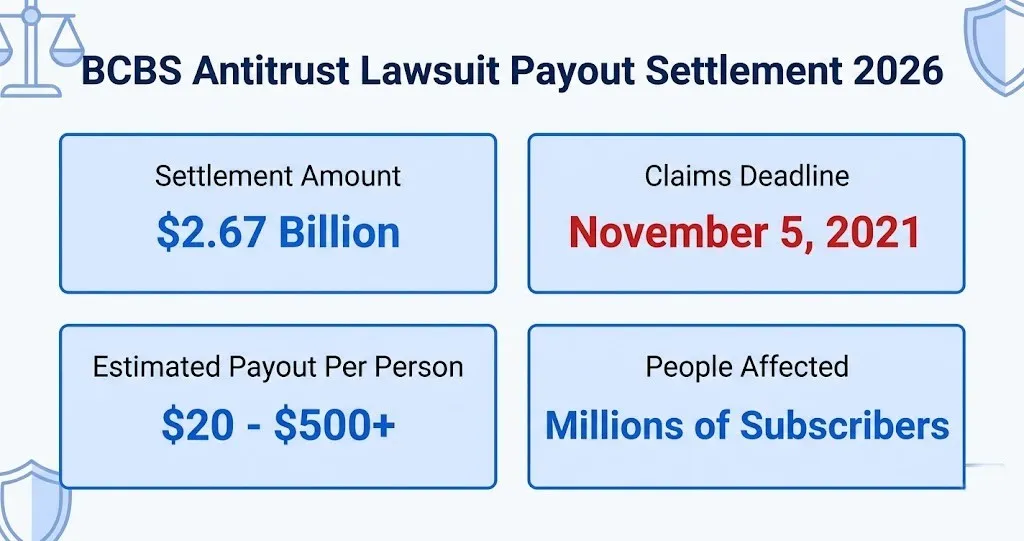
The BCBS antitrust lawsuit payout comes from a $2.67 billion settlement fund, one of the largest health insurance antitrust settlements in U.S. history. If you paid Blue Cross Blue Shield premiums between February 7, 2008 and October 16, 2020, there is a real chance money is waiting for you.
Most people have no idea this settlement exists. Even fewer understand how the payout is calculated or what the current status is in 2026.
This guide covers everything: who qualifies, how much you can expect, how the fund is being distributed, and what the 2026 payment status actually looks like.
BCBS Antitrust Lawsuit Payout: What You Actually Get
The BCBS antitrust lawsuit payout refers to monetary compensation paid to qualifying subscribers and self-funded accounts from the $2.67 billion settlement fund established in the case In re: Blue Cross Blue Shield Antitrust Litigation, Case No. 2:13-CV-20000-RDP.
Payments come in two forms depending on which class you fall into.
Individual subscribers typically receive smaller amounts. Large self-funded employer accounts receive larger distributions based on premium volume.
Quick Facts: BCBS Payout Overview
| Detail | Information |
|---|---|
| Total Settlement Fund | $2.67 billion |
| Case Name | In re: Blue Cross Blue Shield Antitrust Litigation |
| Case Number | 2:13-CV-20000-RDP |
| Court | U.S. District Court, Northern District of Alabama |
| Settlement Effective Date | October 2022 |
| Eligible Coverage Period | Feb 7, 2008 to Oct 16, 2020 |
The settlement does not require you to prove personal harm. You only need to demonstrate you were a covered BCBS subscriber during the eligible period.
That’s what makes this case unusual. Antitrust settlements typically require individual damage proof. This one does not.
How Much Will I Get From the BCBS Settlement?
Most individual subscribers can expect a payout ranging from $20 to $500, depending on how much they paid in premiums and how many valid claims were submitted in their region.
Large self-funded employer plans received far more. Some received payments in the tens of thousands of dollars based on total premium volume.
The settlement uses a pro rata formula. Your payment is proportional to the premiums you paid during the eligible window. The more premiums, the larger your share.
Estimated Payout Ranges by Claimant Type:
| Claimant Category | Estimated Payout Range |
|---|---|
| Individual Subscriber | $20 to $500 |
| Small Group Plan Subscriber | $50 to $1,500 |
| Large Self-Funded Account | $1,000 to $100,000+ |
| Fully Insured Employer Group | $100 to $5,000 |
These are estimates. The final amount per person depends on total valid claims filed.
If fewer people filed claims than expected, individual payouts go up. If millions filed, the per-person amount shrinks.
BCBS Settlement Amount 2026: Where the Money Stands
The total BCBS settlement amount is $2.67 billion, approved by Judge R. David Proctor in October 2022.
Of that amount, attorney fees and administrative costs reduced the net fund available to class members. The court approved attorney fees of approximately $667.5 million, or roughly 25% of the total fund.
That leaves approximately $2 billion available for direct distribution to class members.
| Settlement Fund Breakdown | Amount |
|---|---|
| Total Settlement Fund | $2.67 billion |
| Attorney Fees (approx. 25%) | $667.5 million |
| Administrative Costs | Estimated $50 to $100 million |
| Net Available for Distribution | Approximately $2 billion |
In 2026, the settlement remains active. The Epiq Class Action and Claims Solutions firm continues to manage the distribution.
Some claimants who filed valid claims are still waiting on second-round distribution. The process has taken longer than initially projected.
Key Takeaway: The net distribution pool after fees is approximately $2 billion, with individual payouts scaled by premium volume paid between 2008 and 2020.
BCBS Settlement Payout Per Person: Breaking Down the Math
The BCBS settlement payout per person is not a flat amount. It is calculated using a specific formula tied to your documented premium payments.
Here is how it works in plain terms.
The settlement administrator takes the total net fund. It divides that pool among all valid claimants based on each claimant’s share of total eligible premiums paid across all class members.
Think of it like a pizza. The total pizza is about $2 billion. Your slice depends on how big your piece of the premium pie was over a 12-year period.
Payout Calculation Formula (Simplified):
| Factor | What It Means |
|---|---|
| Your Eligible Premiums Paid | Total amount you paid during Feb 2008 to Oct 2020 |
| Total Eligible Premiums (All Claimants) | The denominator in the calculation |
| Your Share | Your premiums divided by all claimants’ premiums |
| Your Payment | Your share multiplied by the net distribution fund |
Someone who paid $500 per month for 10 years paid about $60,000 in premiums. Their share would be meaningfully larger than someone who was covered for one year.
Multiple rounds of distribution are possible. If unclaimed funds remain after the first round, a second distribution may occur to valid claimants who accepted their first payment.
Who Qualifies for the BCBS Settlement?
You qualify for the BCBS settlement if you were a subscriber under a Blue Cross Blue Shield health insurance plan between February 7, 2008 and October 16, 2020.
The case covered people insured in the individual and small group markets. Large self-funded employer groups were included under the Self-Funded Account Class.
There are some exclusions.
Eligibility Summary:
| Criteria | Details |
|---|---|
| Coverage Period | Feb 7, 2008 to Oct 16, 2020 |
| Plan Type | Individual, small group, large group, self-funded |
| Geographic Scope | All 50 states and Washington D.C. |
| Excluded Parties | Medicare Advantage, Medicaid-only plans, BCBS employees |
Government-sponsored plans administered by BCBS but funded by Medicare or Medicaid generally did not qualify.
BCBS shareholders and members of the judiciary involved in the case were also excluded.
If you purchased coverage through the ACA marketplace from a BCBS insurer during the eligible window, you likely qualify.
BCBS Class Action Lawsuit Eligibility: The Full Criteria
The full eligibility criteria for the BCBS class action lawsuit settlement are slightly more specific than just “having a BCBS plan.”
There are two classes: the Subscriber Class and the Self-Funded Account Class. Your eligibility bucket affects your payout calculation.
Subscriber Class covers individuals and fully insured groups. Self-Funded Account Class covers employer groups that funded their own health plans but used a BCBS plan for administration.
Detailed Eligibility Criteria:
| Class | Who Is Included |
|---|---|
| Subscriber Class | Individuals, families, fully insured small and large group members |
| Self-Funded Account Class | Employers/plan sponsors using BCBS administrative services |
| Excluded from Both | Government-funded plan members, BCBS employees, shareholders |
You do not need to have suffered any specific medical or financial harm. The antitrust violation itself was the harm.
The court found that BCBS plans artificially suppressed competition. This drove up premiums for everyone in the covered period. That’s the theory of damages.
Key Takeaway: There are two qualifying classes with different payout structures. Individual subscribers fall under the Subscriber Class, while employer-sponsored self-funded plans fall under the Self-Funded Account Class.
Blue Cross Blue Shield Subscriber Class Settlement Explained
The Blue Cross Blue Shield Subscriber Class settlement is the portion of the $2.67 billion fund specifically allocated to individuals and fully insured group members.
This is the class most everyday people fall into.
The Subscriber Class was certified by Judge R. David Proctor in the U.S. District Court for the Northern District of Alabama. Certification happened after years of legal battles over whether the class was broad enough to represent all affected policyholders.
Settlement funds for the Subscriber Class are distributed pro rata. Individual payments vary widely based on the total volume of claims filed and each person’s premium history.
The settlement also required BCBS to make certain behavioral changes. BCBS plans agreed to lift some territorial and competitive restrictions as part of the consent order.
Subscriber Class Key Terms:
| Term | Meaning |
|---|---|
| Pro Rata Distribution | Payment proportional to your premium share |
| Fully Insured Group | Employer-sponsored plan where BCBS assumes the risk |
| Consent Order | Behavioral requirements BCBS must follow post-settlement |
| Claims Administrator | Epiq Class Action and Claims Solutions |
These behavioral changes were arguably as important as the cash payout. They prevent BCBS plans from re-engaging in the same territorial allocation practices that caused the lawsuit in the first place.
BCBS Antitrust Lawsuit Defendants: Who Got Sued?
The defendants in the BCBS antitrust lawsuit were the Blue Cross Blue Shield Association and its 36 independent member health insurance plans operating across the United States.
This is not one company. The BCBS system is a federation of independently operating regional insurers that license the Blue Cross and Blue Shield names.
The lawsuit alleged that these separate companies, instead of competing with each other, agreed not to compete in each other’s territories. That agreement is the heart of the antitrust claim.
Major Defendants in the Case:
| Defendant | Territory |
|---|---|
| Blue Cross Blue Shield Association | National coordinating body |
| Blue Cross of Alabama | Alabama |
| Anthem Blue Cross Blue Shield | Multiple states (Indiana, Ohio, California, etc.) |
| Highmark Blue Cross Blue Shield | Pennsylvania, West Virginia |
| BlueCross BlueShield of Tennessee | Tennessee |
| Blue Cross and Blue Shield of Florida | Florida |
All major BCBS plans were named. Some settled earlier or had specific carve-outs negotiated.
The Blue Cross Blue Shield Association, based in Chicago, served as the coordinating defendant. It set the rules that member plans were alleged to have followed when carving up geographic markets.
BCBS Antitrust Violation Explained: Why This Case Existed
The BCBS antitrust violation refers to an alleged agreement among BCBS member plans to divide up the U.S. health insurance market by geography and limit each other’s ability to compete nationally.
Under antitrust law, competitors are not allowed to agree to stay out of each other’s markets. That is called market allocation, and it violates the Sherman Antitrust Act.
BCBS plans operated under a system called Exclusive Service Areas. Each plan was assigned a territory. The rules also included a National Best Efforts requirement, which capped how much business each plan could do outside its home territory.
Antitrust Violation Summary:
| Allegation | Legal Basis |
|---|---|
| Market allocation by territory | Sherman Act Section 1 |
| National Best Efforts cap on out-of-territory revenue | Sherman Act Section 1 |
| Suppression of competition in individual/group markets | Antitrust per se violation claim |
The plaintiffs argued these restrictions artificially inflated premiums. Without competition, BCBS plans could charge more without losing customers to rival BCBS affiliates.
Imagine if every pizza chain agreed that Domino’s would only deliver west of the Mississippi and Pizza Hut would only deliver east. Then they both raised prices. That is market allocation in simple terms.
Key Takeaway: The core antitrust violation was a market allocation agreement among independent BCBS plans, preventing them from competing against each other and allegedly allowing premiums to rise artificially.
BCBS Antitrust Lawsuit History: How We Got Here
The BCBS antitrust lawsuit began formally in 2012 and 2013, when dozens of individual lawsuits were filed by subscribers and providers across the country.
These cases were consolidated into a multidistrict litigation (MDL) in the U.S. District Court for the Northern District of Alabama in 2013. Case No. 2:13-CV-20000-RDP was assigned to Judge R. David Proctor.
BCBS Antitrust Lawsuit Timeline:
| Year | Event |
|---|---|
| 2012 to 2013 | Individual lawsuits filed nationwide |
| 2013 | Cases consolidated into MDL in Northern District of Alabama |
| 2018 | Class certification granted for Subscriber Class |
| October 2020 | Preliminary settlement agreement announced |
| October 16, 2020 | Class period end date established |
| November 2021 | Court preliminary approval of settlement |
| October 2022 | Final settlement approval by Judge Proctor |
| 2022 to 2023 | Claims filing period |
| 2024 to 2026 | Distribution and payment processing |
The road to settlement took nearly a decade. That’s not unusual for antitrust MDL cases of this scale.
The case involved expert economists, millions of pages of discovery documents, and multiple rounds of appeals before the settlement was reached.
BCBS Antitrust Case Details: Court, Judge, and Case Number
The BCBS antitrust case is officially titled In re: Blue Cross Blue Shield Antitrust Litigation, filed in the U.S. District Court for the Northern District of Alabama, Southern Division.
The presiding judge is Judge R. David Proctor, who has overseen the case since its MDL consolidation in 2013.
Official Case Details:
| Detail | Information |
|---|---|
| Case Name | In re: Blue Cross Blue Shield Antitrust Litigation |
| Case Number | 2:13-CV-20000-RDP |
| Court | U.S. District Court, Northern District of Alabama |
| Division | Southern Division |
| Presiding Judge | Judge R. David Proctor |
| Settlement Administrator | Epiq Class Action and Claims Solutions |
| Settlement Website | Managed by Epiq (no URL included here) |
The claims administration process is handled entirely by Epiq, a professional settlement administration company. All claims were routed through their portal or by mail.
Judge Proctor’s final approval order in October 2022 set the parameters for how distributions would work, including the timeline for administrator reports and secondary distributions.
Key Takeaway: The case is Case No. 2:13-CV-20000-RDP, presided over by Judge R. David Proctor in the Northern District of Alabama, with Epiq handling all claims processing and fund distribution.
BCBS Settlement Fund Distribution: How the Money Gets Divided
The BCBS settlement fund distribution works in defined phases. Not all $2.67 billion goes out at once, and not everyone gets paid at the same time.
The first step was establishing a qualified settlement fund (QSF). This is a court-supervised account that holds the money until it is properly allocated and distributed.
Distribution Process:
| Phase | Action |
|---|---|
| Phase 1 | Settlement funds deposited into QSF |
| Phase 2 | Attorney fees and administrative costs deducted |
| Phase 3 | Claims validated and verified by administrator |
| Phase 4 | Initial pro rata payments calculated |
| Phase 5 | First-round payments issued |
| Phase 6 | Unclaimed or rejected funds redistributed |
| Phase 7 | Second-round distribution to accepting claimants |
Self-funded accounts that submitted documentation of their premium volumes received higher initial allocations.
Individual subscribers who filed without detailed premium records received allocations based on estimated average premiums for their region and plan type.
The distribution is not instantaneous. Processing millions of claims while verifying records from a 12-year period takes time. That’s why some payments continued into 2025 and 2026.
How to File a BCBS Settlement Claim in 2026
Filing a new BCBS settlement claim in 2026 is no longer possible through the original claims period. The primary claims deadline has passed.
However, in 2026, certain actions remain available to people who filed valid claims.
If you submitted a valid claim and have not received payment, you can check your claim status through Epiq’s settlement claims administration system.
What You Can Still Do in 2026:
| Action | Status in 2026 |
|---|---|
| File a new original claim | Closed (deadline passed) |
| Check existing claim status | Open |
| Accept or reject payment offer | Open for pending claimants |
| Request reissuance of expired check | May be available |
| Participate in second distribution | Open to those who accepted first payment |
If you received a check that expired before you cashed it, contact the settlement administrator directly. Reissuance requests are handled case by case.
Some class members never received their initial notice. If that applies to you, contacting the administrator with documentation of your BCBS coverage may still yield results.
BCBS Settlement Deadline: Don’t Miss Your Window
The original BCBS settlement claims filing deadline was November 5, 2021 for most class members who received direct notice.
Extended deadlines were granted for certain groups, particularly those who did not receive proper notice of the settlement.
Important Deadlines Reference:
| Deadline | Date | Status |
|---|---|---|
| Original Claims Filing Deadline | November 5, 2021 | Passed |
| Objection Deadline | November 5, 2021 | Passed |
| Opt-Out Deadline | November 5, 2021 | Passed |
| Final Approval Order | October 2022 | Complete |
| First Distribution Period | 2023 to 2024 | Active/Ongoing |
| Second Distribution (est.) | 2025 to 2026 | Active |
If the original deadline has passed and you did not file, your options in 2026 are limited. However, if you never received notice and can document your BCBS enrollment during the covered period, it is worth contacting Epiq.
Courts have occasionally allowed late filings in exceptional circumstances. This requires demonstrating you did not receive notice and acted promptly upon learning of the settlement.
Key Takeaway: The original filing deadline was November 5, 2021, and has passed. In 2026, the focus is on payment processing, second-round distributions, and resolving pending claims for those who filed on time.
Blue Cross Blue Shield Settlement Check: What to Expect
The Blue Cross Blue Shield settlement check is issued directly by Epiq, the court-appointed settlement administrator.
Checks are mailed to the address provided at the time of claim filing. If you moved and did not update your address, your check may have been returned or expired.
Settlement Check Details:
| Detail | Information |
|---|---|
| Issuer | Epiq Class Action and Claims Solutions |
| Payment Method | Paper check (primary) or electronic payment (some cases) |
| Check Validity Period | Typically 90 to 180 days from issue date |
| Amount | Varies by claim; $20 to $500+ for most individuals |
| What to Do If Expired | Contact Epiq for reissuance request |
If your check expired and you have not cashed it, do not throw it away. Contact the administrator. Reissuance requests have been honored in multiple large settlements when claimants act quickly.
Electronic payment options were available to some claimants who opted in during the claim filing process.
The envelope containing the check may look like generic mail. Many people threw theirs away without opening it. If you are unsure whether you received a check, contact Epiq with your claim ID.
BCBS Settlement Payment Date 2026: When Will You Get Paid?
BCBS settlement payments in 2026 are primarily second-round distributions and delayed processing for claims that required additional verification.
The first major distribution wave occurred in 2023 and 2024. The second distribution wave, which includes unclaimed funds from the first round and adjustments for disputed claims, is ongoing into 2026.
Payment Timeline 2026:
| Payment Type | Expected Timing |
|---|---|
| First Distribution (primary wave) | 2023 to 2024 |
| Second Distribution (pending/unclaimed) | 2025 to 2026 |
| Reissued Checks (expired/undelivered) | Rolling in 2026 |
| Final Distribution (if applicable) | TBD by court order |
There is no single fixed payment date in 2026. Payments are issued on a rolling basis as claims are processed and verified.
If you are waiting on a first payment and believe your claim was valid, the most direct step is contacting Epiq’s settlement administration line with your claim confirmation number.
Second-round distributions are typically smaller than first-round payments. They represent the remaining pool after the initial allocation is complete.
BCBS Settlement Claim Status 2026: How to Check Your Payment
Checking your BCBS settlement claim status in 2026 requires your claim ID number and the contact information you used when filing.
The primary method is through Epiq’s claims administration portal. You can enter your claim ID to see the current status of your claim.
Ways to Check Your Claim Status:
| Method | Details |
|---|---|
| Online Claims Portal | Epiq settlement portal (requires claim ID) |
| Phone | Epiq customer service line (listed on settlement documents) |
| Written inquiry to Epiq settlement address | |
| Available through the settlement administrator’s contact form |
Common status messages you might see include: Claim Under Review, Claim Approved, Payment Issued, Payment Returned, or Claim Deficient.
If your status says “Claim Deficient,” it means Epiq needs additional documentation. You should respond promptly. Deficient claims that are not cured within the response window may be disqualified.
Claim status changes can take weeks to reflect in the system. If your status has not changed in several months, a direct call to Epiq is the fastest resolution path.
BCBS Antitrust Lawsuit Payout Update 2026: Latest Developments
The BCBS antitrust lawsuit payout update for 2026 shows the case is still active in its distribution phase, with ongoing payments to qualifying class members.
As of 2026, the case has not concluded entirely. The settlement administrator continues to process claims, issue reissued checks, and manage second-round distributions.
2026 Case Status Summary:
| Area | 2026 Status |
|---|---|
| Original Claims Filing | Closed |
| First Distribution | Largely complete |
| Second Distribution | Ongoing in 2026 |
| Behavioral Requirements (BCBS) | In effect |
| Court Oversight | Ongoing per Judge Proctor’s order |
| Final Case Closure | Not yet announced |
A significant development involves the behavioral remedies portion of the settlement. BCBS plans agreed to lift certain anti-competitive restrictions. Monitoring compliance with these requirements continues.
Consumer advocates have noted that the premium inflation caused by the alleged antitrust behavior accumulated over 12 years. The settlement compensates for a fraction of total estimated overcharges.
For most individual subscribers, the 2026 update means patience. Payments are coming. The process is slow. The fund is real. If you filed a valid claim, your payment will be processed.
Frequently Asked Questions
How much is the BCBS antitrust lawsuit payout per person?
Most individual subscribers can expect between $20 and $500 from the BCBS antitrust lawsuit payout.
The exact amount depends on how much you paid in premiums between 2008 and 2020 and how many valid claims were filed.
Large self-funded employer accounts may receive significantly higher payments based on total premium volume.
Who qualifies for the Blue Cross Blue Shield antitrust settlement?
You qualify if you were enrolled in a Blue Cross Blue Shield health insurance plan between February 7, 2008 and October 16, 2020.
Both individual subscribers and employer-sponsored plan members are included, with certain exclusions for Medicare Advantage and Medicaid-only plans.
BCBS employees and shareholders are excluded from claiming.
Has the BCBS settlement been paid out yet in 2026?
Yes, the first major distribution wave was paid in 2023 and 2024, with second-round distributions continuing into 2026.
Not all claimants have received payment yet, particularly those whose claims required additional verification.
If you filed a valid claim and have not been paid, check your status through Epiq’s claims administration system.
What was the total BCBS antitrust settlement amount?
The total BCBS antitrust settlement amount is $2.67 billion, one of the largest health insurance antitrust settlements in U.S. history.
After attorney fees of approximately $667.5 million and administrative costs, roughly $2 billion remains for direct distribution to class members.
The settlement was finally approved by Judge R. David Proctor in October 2022.
Can I still file a claim for the BCBS settlement in 2026?
The original filing deadline of November 5, 2021 has passed, and new claims are generally not being accepted in 2026.
However, if you filed a valid claim and have not received your payment, you can still check your status and request assistance from Epiq.
In rare cases where proper notice was never received, contacting the settlement administrator with documentation of your coverage may still produce results.
The BCBS antitrust lawsuit payout is one of the most significant consumer recoveries from a health insurance company in recent memory. $2.67 billion was set aside specifically because millions of Americans were allegedly overcharged on their premiums for over a decade.
If you filed a claim, the money is in process. Check your status, update your address, and watch for your payment through 2026.
If you missed the original filing window, your options are limited but not necessarily zero. Contact Epiq, document your coverage, and ask directly. The worst they can say is no.
Create a clean, professional infographic layout sized at 1200×630 pixels for a blog featured image. The background is white (#FFFFFF). At the top center, display the bold title text “BCBS Antitrust Lawsuit Payout Settlement 2026” in dark blue (#1e40af) at 48px bold. Below the title, arrange a 2×2 grid of four information boxes. Each box has a light blue background (#dbeafe) with a blue border (#2563eb). Box 1 (top left): Label in regular 18px reads “Settlement Amount” and the value “$2.67 Billion” appears in extra bold 36px blue (#2563eb). Box 2 (top right): Label reads “Claims Deadline” and the value “November 5, 2021” appears in bold red (#dc2626) at 36px for urgency. Box 3 (bottom left): Label reads “Estimated Payout Per Person” and the value “$20 – $500+” appears in extra bold 36px blue (#2563eb). Box 4 (bottom right): Label reads “People Affected” and the value “Millions of Subscribers” appears in extra bold 36px blue (#2563eb). Use abstract legal icons (scales of justice, shield icon, document icon) as decorative elements in corners. No real human faces. No watermarks. No logos. No stock photo feel. Sharp, professional, mobile-optimized.