
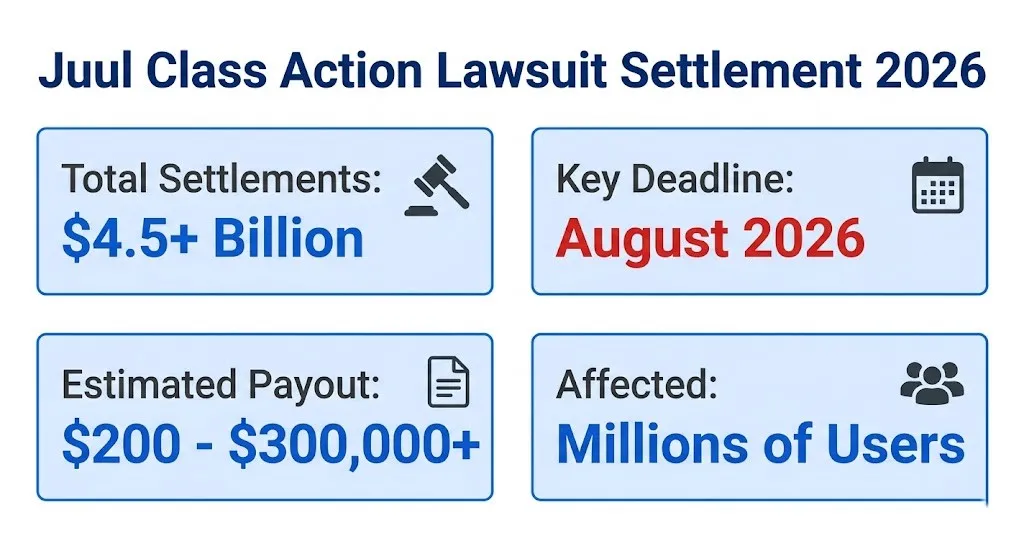
The Juul class action lawsuit has produced over $4.5 billion in settlements since litigation began. If you vaped JUUL products or your child did, you may still have a path to compensation in 2026.
This fight started because JUUL Labs allegedly marketed addictive nicotine products to teenagers. States, school districts, and individual users all filed claims. The result has been one of the largest product liability cases in American history.
Here’s what you’ll find in this guide: the current status of every major JUUL settlement, who qualifies right now, how much money claimants are actually getting, and the exact steps to file. Some deadlines have already passed, but certain claim windows remain open.
One stat that puts it all in perspective: JUUL controlled over 70% of the U.S. e-cigarette market at its peak in 2018. Millions of people used these products. Many of them still don’t know they could be owed money.
What Is the Juul Class Action Lawsuit?
The Juul class action lawsuit is a collection of legal claims filed against JUUL Labs Inc. for allegedly designing, marketing, and selling addictive e-cigarettes while targeting underage users.
These cases began piling up around 2018 and 2019. Plaintiffs argued that JUUL knew its products were dangerously addictive. They also claimed the company used social media campaigns, fruity flavors, and sleek device designs to attract teenagers.
The litigation isn’t just one single lawsuit. It’s actually a web of cases that includes:
- State attorney general lawsuits (filed by 33+ states)
- School district lawsuits (thousands of districts nationwide)
- Individual personal injury claims (filed by users and parents)
- A federal MDL (multidistrict litigation consolidating thousands of cases)
| Detail | Info |
|---|---|
| Primary Defendant | JUUL Labs Inc. |
| Co-Defendant | Altria Group |
| Federal Court | U.S. District Court, N.D. California |
| MDL Case Number | MDL No. 2913 |
| Presiding Judge | Judge William Orrick |
| Total Settlements to Date | Over $4.5 billion |
The core accusation is simple. JUUL put profits ahead of public health. And millions of young people paid the price with nicotine addiction.
Juul Lawsuit Settlement: Billions Paid So Far
The Juul lawsuit settlement total has exceeded $4.5 billion across all resolved cases as of early 2026. That number includes state settlements, school district agreements, and individual claim resolutions.
The biggest chunk came from state attorney general cases. In 2023, JUUL agreed to pay $462 million to settle claims from six states and Washington, D.C. That was just the beginning. More states followed with their own deals throughout 2024 and 2025.
Individual state settlement amounts have varied widely:
| State | Settlement Amount | Year Finalized |
|---|---|---|
| Minnesota | $60.5 million | 2023 |
| Washington | $22.5 million | 2023 |
| West Virginia | $7.9 million | 2023 |
| California | $175 million | 2024 |
| New York | $112 million | 2024 |
| Illinois | $67 million | 2024 |
School districts collectively secured over $1.7 billion through a separate settlement track. These funds were earmarked for vaping prevention programs, counseling services, and educational resources.
Not every dollar has been distributed yet. Settlement fund administrators are still processing claims in several states. The sheer volume of claimants has slowed the payout pipeline.
Juul Settlement 2026: What’s Happening Now
The Juul settlement landscape in 2026 is focused on distribution of already-approved funds and resolution of remaining individual claims. Most of the large-scale settlements have been finalized.
Several state settlement funds began issuing payments in late 2025. Others have distribution timelines stretching into mid-2026. If you filed a claim through your state’s attorney general settlement, your payment may already be in process.
Here’s the current status breakdown:
- Fully distributed: Minnesota, West Virginia, Washington
- Payments in progress: California, New York, Illinois, North Carolina
- Still processing claims: Texas, Florida, Ohio, Pennsylvania
- Individual claims in MDL: Select cases still pending in federal court
The federal MDL has wound down considerably. Most cases either settled or were resolved through bellwether trial outcomes. A small number of individual personal injury cases remain active for claimants with severe health complications.
Key 2026 development: JUUL Labs entered a corporate restructuring process in late 2025. This has affected the timeline for some remaining payments. The company’s ability to fund future settlements depends on its ongoing business operations and Altria’s financial backing.
Key Takeaway: Over $4.5 billion in JUUL settlements have been reached, with 2026 focused on distributing those funds to claimants across dozens of states while a small number of individual cases remain active.
Juul Lawsuit Update for 2026
The latest Juul lawsuit update shows that the mass litigation phase is largely over, but individual claims and payment distributions are still active in 2026.
In the federal MDL (No. 2913), Judge William Orrick has been managing the remaining docket. The bellwether trials that took place in 2024 and early 2025 set important precedents for how individual cases get valued.
Key updates for 2026 include:
- January 2026: Final approval granted for the school district global settlement distribution plan
- March 2026: California begins Phase 2 individual claim payouts from its $175 million fund
- Q2 2026: Federal MDL expected to close most remaining cases through individual settlements or dismissals
- Ongoing: Altria Group continues to face shareholder lawsuits related to its $12.8 billion JUUL investment
The FDA’s stance on JUUL has also evolved. After initially issuing a marketing denial order in 2022 (later partially reversed), the FDA in 2025 allowed limited JUUL product sales under strict conditions. This regulatory back-and-forth has been referenced in several pending cases.
One thing to watch: some plaintiffs’ attorneys are exploring whether JUUL’s corporate restructuring could shield remaining assets from judgment. Courts haven’t ruled definitively on this question yet.
Juul Settlement Payout: How the Money Gets Divided
The Juul settlement payout structure depends entirely on which type of claim you’re part of. State settlements, school district funds, and individual claims each follow different distribution models.
For state attorney general settlements, the money typically goes into a state-managed fund. Each state’s attorney general office decides how to allocate it. Some states distribute directly to affected residents who file claims. Others funnel the money into public health programs.
Here’s how the distribution generally breaks down:
| Claim Type | Who Gets Paid | How It’s Distributed |
|---|---|---|
| State AG Settlement | State residents who filed claims | Through state-run claims process |
| School District Settlement | Public school districts | Based on enrollment and vaping prevalence data |
| Individual PI Claim | Personal injury plaintiffs | Negotiated case-by-case or via settlement tiers |
| Tribal Claims | Native American tribes | Separate settlement agreements |
For individual personal injury cases, payouts are based on several factors:
- Severity of nicotine addiction
- Documented health complications
- Age at time of first JUUL use
- Duration and frequency of use
- Medical expenses incurred
The school district settlement uses a formula based on student population size and documented vaping incidents. Larger districts with higher vaping rates receive proportionally more funding.
Juul Lawsuit Payout Per Person
The Juul lawsuit payout per person ranges from a few hundred dollars to over $100,000, depending on the claim type and individual circumstances.
For people who filed through state attorney general consumer claim programs, the typical payout has been modest. Most consumer claimants receive between $200 and $2,000. These are people who purchased JUUL products and can show proof of purchase or use.
Individual personal injury claimants see much higher numbers. Settlements for cases involving severe nicotine addiction, respiratory damage, or seizures have ranged from $25,000 to $150,000 or more. The strongest cases involve minors who became addicted.
| Claim Category | Estimated Payout Range |
|---|---|
| Consumer class member (proof of purchase) | $200 to $2,000 |
| Individual addiction claim (adult) | $10,000 to $50,000 |
| Individual addiction claim (minor) | $25,000 to $150,000+ |
| Severe health injury claim | $75,000 to $300,000+ |
| Wrongful death claim | $500,000+ |
These numbers come from reported settlement ranges in the MDL and state cases. Your actual payout depends on the strength of your evidence. Medical records, purchase receipts, and testimony from doctors all affect the final amount.
Think of it like car insurance claims. A fender bender gets a small check. A totaled car with injuries gets a much bigger one. JUUL payouts follow the same logic.
Key Takeaway: Individual JUUL payouts vary dramatically, from a few hundred dollars for basic consumer claims to six figures for minors with documented addiction and health damage.
Who Has Juul Lawsuit Eligibility?
Juul lawsuit eligibility depends on your connection to JUUL products, when you used them, and what harm you experienced. Not everyone who vaped JUUL qualifies for every type of claim.
The broadest eligibility category covers people who purchased JUUL products in states where attorney general settlements included consumer restitution funds. You generally need to show you bought JUUL products during a specific window, often 2015 to 2022.
Here are the main eligibility groups:
- Individual users who became addicted to nicotine through JUUL products
- Parents or guardians of minors who used JUUL and suffered addiction or health effects
- School districts that spent resources addressing student vaping
- Former minors who were underage when they started using JUUL (strongest claims)
- Users who developed health conditions linked to JUUL use
You generally do not qualify if:
- You never used JUUL products (other vape brands have separate litigation)
- You used JUUL only once or twice with no adverse effects
- You were an adult who used JUUL with full knowledge of nicotine risks and suffered no addiction or health issues
- You already received a settlement payout and signed a release
The strongest candidates are people who started using JUUL as teenagers and developed lasting nicotine dependence. Courts have treated these cases with the most sympathy.
How to File a Juul Lawsuit in 2026
Filing a Juul lawsuit in 2026 requires checking which claim paths are still open and gathering your documentation before any remaining deadlines pass.
The process looks different depending on your situation. Here’s a step-by-step overview:
Step 1: Determine your claim type. Are you filing as an individual personal injury claimant, a consumer seeking restitution through a state fund, or a parent filing on behalf of a minor?
Step 2: Check your state’s status. Some state settlement claim windows have closed. Others remain open or have been extended into 2026. Your state attorney general’s office is the source for this information.
Step 3: Gather documentation. You’ll want:
- Medical records showing nicotine addiction diagnosis or related health issues
- Proof of JUUL purchases (receipts, bank statements, online orders)
- Personal statement describing your experience and harm
- For parents: records showing your child’s age during JUUL use
Step 4: Submit your claim or contact an attorney. For state settlement funds, you typically submit directly through the claims administrator. For individual personal injury claims, you’ll need to work with a law firm experienced in JUUL litigation.
| Filing Path | Where to Submit | Attorney Needed? |
|---|---|---|
| State AG consumer fund | State claims administrator | No |
| Individual personal injury | Through a plaintiff’s law firm | Yes |
| School district claim | District’s legal counsel | Handled by school attorneys |
| Parent claim for minor | Either path above | Depends on claim type |
Most plaintiff’s attorneys handling JUUL cases work on contingency. That means you pay nothing upfront. They take a percentage of your settlement, usually 30% to 40%.
Is the Juul Lawsuit Still Open?
Yes, the Juul lawsuit is still open in certain categories as of 2026, though most large-scale settlements have been finalized and many claim deadlines have passed.
The federal MDL (No. 2913) still has active individual cases on its docket. These are primarily severe injury claims that didn’t settle during the mass resolution phases. Judge William Orrick has indicated the court expects to resolve most remaining cases by late 2026.
Here’s a quick status check:
| Lawsuit Category | Status in 2026 |
|---|---|
| State AG settlements | Mostly finalized; some distributions ongoing |
| School district global settlement | Approved; payments being distributed |
| Federal MDL individual claims | Some still active |
| New individual PI claims | Limited; depends on statute of limitations |
| State consumer claim funds | Some still accepting late claims |
Can you still file a brand-new lawsuit? It depends on your state’s statute of limitations for personal injury or product liability claims. In most states, you have 2 to 3 years from when you discovered (or should have discovered) the harm. For minors, the clock often doesn’t start until they turn 18.
If you’re just now realizing you have a claim, don’t assume it’s too late. Statutes of limitations have exceptions, especially for cases involving minors or fraud-based concealment of product dangers.
Key Takeaway: The JUUL lawsuit isn’t completely closed in 2026; individual personal injury cases remain active in the federal MDL, and some state claim funds are still distributing payments or accepting late submissions.
Juul Lawsuit for Parents of Teen Vapers
Parents of teenagers who used JUUL products have some of the strongest claims in this entire litigation. Courts have consistently viewed underage nicotine addiction as the most compelling injury category.
If your child started using JUUL as a minor and became addicted to nicotine, you can file a claim on their behalf. In most states, parents or legal guardians must bring the case because minors can’t sue on their own.
What makes parent claims strong:
- Youth targeting evidence: Internal JUUL documents showed the company studied teen social media habits and designed marketing campaigns around them
- Addiction in developing brains: Medical research confirms that adolescent brains are far more susceptible to nicotine addiction than adult brains
- Long-term harm: Teens who became addicted to JUUL often transitioned to other nicotine products, creating lasting dependency
To file as a parent, you’ll need:
- Proof your child was under 18 during JUUL use
- Medical records documenting addiction or health effects
- Any available evidence of JUUL purchases (even witnesses count)
- Your child’s willingness to provide a statement (helpful but not always required)
Some parents have received settlements in the range of $25,000 to $150,000 for their children’s claims. Cases involving hospitalization, seizures, or long-term respiratory issues have commanded higher amounts.
The emotional weight of these cases matters too. Judges and juries understand that parents trusted product safety standards. JUUL broke that trust.
Juul Addiction Lawsuit Claims
Juul addiction lawsuit claims focus on one central allegation: JUUL products were engineered to deliver nicotine more efficiently than traditional cigarettes, creating rapid and severe dependency.
JUUL’s proprietary nicotine salt formulation is at the heart of these claims. A single JUUL pod contained as much nicotine as an entire pack of 20 cigarettes. The company’s benzoic acid formulation made high-concentration nicotine smooth enough to inhale without the harsh throat hit that might have warned users about the dose.
Addiction claims require medical documentation. Here’s what courts and settlement administrators typically look for:
- Formal diagnosis of nicotine use disorder (ICD-10 code F17.210 or similar)
- Records of cessation attempts (patches, gum, prescriptions like Chantix or Wellbutrin)
- Duration of JUUL use and estimated daily consumption
- Impact on daily life, work, school performance, or relationships
| Addiction Severity | Typical Evidence Required | Settlement Range |
|---|---|---|
| Mild (short-term use, successful cessation) | Basic medical records, personal statement | $5,000 to $15,000 |
| Moderate (extended use, multiple quit attempts) | Medical records, cessation program records | $15,000 to $50,000 |
| Severe (ongoing addiction, health complications) | Extensive medical history, expert testimony | $50,000 to $150,000+ |
The strongest addiction cases involve people who had no prior nicotine history before JUUL. If you never smoked cigarettes and JUUL was your introduction to nicotine, your claim carries extra weight. It demonstrates that JUUL created the addiction rather than feeding an existing one.
Juul School District Settlement Explained
The Juul school district settlement is a $1.7 billion agreement that resolved claims from thousands of public school districts across the United States. It’s one of the largest education-related legal settlements in history.
School districts argued that JUUL’s youth vaping epidemic forced them to spend enormous resources on:
- Installing vape detectors in bathrooms and hallways
- Hiring additional counselors for addicted students
- Creating anti-vaping educational programs
- Dealing with disciplinary issues related to on-campus vaping
- Addressing health emergencies from nicotine overconsumption
The settlement was structured as a global resolution. Districts that participated agreed to release JUUL from future claims. Payments are calculated using a formula that considers:
| Factor | How It Affects Payout |
|---|---|
| Student enrollment size | Larger districts receive more |
| Documented vaping incidents | Higher rates mean higher payouts |
| Money spent on vaping prevention | Reimbursable expenses |
| Geographic region | Some regions had higher JUUL penetration |
Distribution began in late 2025 and continues through 2026. Individual district payouts range from a few thousand dollars for small rural schools to millions for large urban districts.
Think of it like a class-wide group project. Every school district that participated gets a share, but the districts that can show they did the most work (spent the most money fighting the vaping problem) get the biggest piece.
Key Takeaway: The $1.7 billion school district settlement is now distributing funds based on enrollment size and documented vaping impact, with payments continuing throughout 2026 for participating districts.
The Juul MDL: How Federal Cases Were Handled
The Juul MDL, officially known as In Re: JUUL Labs, Inc., Marketing, Sales Practices, and Products Liability Litigation (MDL No. 2913), consolidated thousands of federal lawsuits into one court for efficiency.
MDL stands for multidistrict litigation. It’s not the same as a class action. In a class action, one outcome applies to everyone. In an MDL, each plaintiff keeps their individual case, but pretrial proceedings like discovery and motions happen together.
Judge William Orrick in the U.S. District Court for the Northern District of California has overseen this MDL since 2019. At its peak, the MDL contained over 10,000 individual cases.
Here’s how the MDL process worked:
- Discovery phase: All plaintiffs shared access to JUUL’s internal documents, emails, and marketing data
- Bellwether selection: A handful of representative cases were chosen for trial to test legal theories
- Bellwether trials: These trials in 2024 and 2025 produced mixed results but established valuation benchmarks
- Mass settlement negotiations: After bellwether outcomes, JUUL offered structured settlement programs for remaining plaintiffs
- Remand or dismissal: Cases that didn’t settle were either sent back to their home courts or dismissed
By early 2026, the MDL’s active caseload has shrunk dramatically. Most plaintiffs accepted settlement offers. The remaining cases involve complex medical injury claims that require individual adjudication.
The MDL produced a treasure trove of internal JUUL documents. These records proved that company executives knew teenagers were using their products in massive numbers and chose to keep selling anyway.
Juul Lawsuit Deadline: Key Dates to Know
The most important Juul lawsuit deadlines in 2026 relate to remaining claim submission windows and statute of limitations cutoffs.
Many major deadlines have already passed. The school district settlement required participation by September 2025. Most state attorney general consumer claim programs set their initial deadlines in 2024 and 2025.
However, several time-sensitive dates remain:
| Deadline | Date | What It Affects |
|---|---|---|
| California consumer fund late claims | June 30, 2026 | Last chance for CA residents to file |
| Federal MDL individual settlement program | August 2026 | Final offer window for remaining MDL plaintiffs |
| Statute of limitations (varies by state) | Ongoing | 2 to 6 years from injury discovery |
| Minor’s claims (SOL tolling) | Varies | Clock starts at age 18 in most states |
| School district distribution completion | December 2026 | Target for all district payments |
Statutes of limitations are the biggest variable. Each state sets its own timeline. Personal injury claims typically have a 2 to 3 year window from when you knew (or should have known) about your injury. Product liability claims sometimes allow 3 to 6 years.
For minors, most states “toll” (pause) the statute of limitations until the person turns 18. That means someone who used JUUL at age 15 in 2019 may have until 2025 or 2026 to file after turning 18.
Don’t sit on this. If you think you have a claim, check your state’s specific deadlines immediately.
Juul Settlement Claim Form: Step by Step
The Juul settlement claim form varies depending on which settlement program you’re filing through. State consumer funds and individual claims use different forms and processes.
For state attorney general consumer settlements, the claim form is typically available through your state’s AG website or through a court-appointed claims administrator. These forms are usually straightforward.
Here’s what a typical state consumer claim form asks for:
- Personal information: Name, address, date of birth, contact details
- Purchase history: When and where you bought JUUL products, approximate quantities
- Proof of purchase: Receipts, bank or credit card statements, online order confirmations
- Statement of harm: Brief description of how JUUL affected you
- Signature and attestation: Swearing that your information is truthful
For individual personal injury claims, the process is more involved:
- Your attorney files the claim on your behalf
- Medical records, expert opinions, and evidence packages are submitted
- Settlement negotiations happen between your legal team and JUUL’s attorneys
- You review and approve any settlement offer before it’s accepted
| Form Type | Complexity | Average Processing Time |
|---|---|---|
| State consumer claim | Simple (1 to 3 pages) | 3 to 6 months |
| Individual PI claim | Complex (attorney-prepared) | 6 to 18 months |
| School district claim | Moderate (institutional) | 3 to 9 months |
Pro tip: make copies of everything you submit. Keep a record of your confirmation number and submission date. Claims get lost sometimes, and having backup documentation protects you.
Key Takeaway: Claim forms range from simple one-page consumer submissions to complex attorney-prepared personal injury packages, and keeping copies of everything you submit is essential for tracking your payout.
Juul Health Effects Lawsuit: What Injuries Qualify
Juul health effects lawsuits cover a wide range of medical conditions linked to JUUL’s high-nicotine e-cigarette products. The most common qualifying injuries involve nicotine addiction, respiratory problems, and cardiovascular damage.
Courts and settlement programs have recognized these health effects as claim-worthy:
- Nicotine addiction/dependence (the most common claim)
- Seizures linked to nicotine toxicity
- Respiratory issues: chronic cough, bronchitis, shortness of breath, lung inflammation
- Cardiovascular problems: elevated heart rate, hypertension, heart palpitations
- Mental health effects: anxiety, depression, and irritability from addiction and withdrawal
- Dental and oral health damage: gum disease, tooth decay from vaping
- EVALI (e-cigarette or vaping product use-associated lung injury)
Not every health issue automatically qualifies. You need medical documentation linking your condition to JUUL use. A doctor’s diagnosis carries far more weight than a personal statement alone.
| Health Condition | Strength of Claim | Documentation Needed |
|---|---|---|
| Nicotine addiction (diagnosed) | Strong | Medical records, cessation history |
| Seizures during JUUL use | Very strong | ER records, neurologist report |
| Chronic respiratory illness | Strong | Pulmonologist records, imaging |
| EVALI | Very strong | Hospitalization records |
| Anxiety/depression | Moderate | Psychiatrist/therapist records |
| Dental damage | Moderate | Dental records, photos |
The FDA has confirmed that JUUL products contain nicotine levels comparable to traditional cigarettes. Scientific studies published between 2019 and 2025 have strengthened the link between JUUL use and multiple health outcomes. This research has been instrumental in proving causation in court.
Juul Youth Marketing Lawsuit Allegations
The Juul youth marketing lawsuit allegations form the foundation of nearly every case filed against the company. Plaintiffs argued that JUUL deliberately designed its marketing to attract teenagers and young adults.
The evidence was damning. Internal documents revealed during the MDL discovery process showed that JUUL’s early marketing strategy included:
- Social media campaigns featuring young, attractive models on Instagram, Twitter, and Snapchat
- Flavor offerings like Mango, Fruit Medley, Cool Mint, and Creme Brulee designed to appeal to younger palates
- The “Vaporized” launch campaign in 2015, which used bright colors and youthful imagery reminiscent of cigarette ads from the 1950s and 1960s
- Placement at events popular with young people, including music festivals and parties
- A sleek, USB-like design that made the device easy to hide from parents and teachers
One particularly explosive piece of evidence: JUUL hired a consulting firm that studied teenage behavior patterns. Internal emails discussed the “youth appeal” of their products, even as the company publicly denied targeting minors.
The contrast between JUUL’s public statements and private actions was stark. Publicly, the company said it existed to help adult smokers quit. Privately, its fastest-growing customer base was people aged 15 to 24.
State attorneys general used this evidence to secure massive settlements. The marketing allegations were so strong that JUUL could not risk jury trials in most jurisdictions. Juries tend to react very badly to evidence of corporations knowingly targeting children.
These marketing practices violated multiple state consumer protection laws, FDA regulations on tobacco marketing to minors, and common law standards of care.
Juul Lawsuit: How Much Money Can You Get?
How much money you can get from the Juul lawsuit depends on your claim type, the severity of your injuries, and the evidence you can provide. There is no single dollar figure that applies to everyone.
Here’s a realistic breakdown based on reported settlements and court outcomes through early 2026:
| Scenario | Realistic Payout Range |
|---|---|
| State consumer fund claim with proof of purchase | $200 to $2,000 |
| Adult who became addicted, no major health issues | $10,000 to $35,000 |
| Adult with respiratory or cardiovascular damage | $35,000 to $100,000 |
| Minor who became addicted (filed by parent) | $25,000 to $150,000 |
| Minor with seizures or hospitalization | $100,000 to $300,000+ |
| Wrongful death linked to JUUL use | $500,000 to $2,000,000+ |
Several factors increase your potential payout:
- You were under 18 when you started using JUUL
- You had no prior nicotine use before JUUL
- You have extensive medical records documenting your condition
- You suffered severe or permanent health damage
- You can show proof of purchase over an extended period
Factors that may reduce your payout:
- You were an adult with prior smoking history
- Limited medical documentation
- Short duration of JUUL use
- You signed a release in a prior settlement without realizing it covered future claims
Remember that attorney fees (typically 33% to 40%) come out of individual claim settlements. A $100,000 settlement might net you $60,000 to $67,000 after legal fees.
The best way to estimate your specific payout is to have an attorney review your case details. Every claim is different, and the range is wide for a reason.
Key Takeaway: JUUL lawsuit payouts range from a few hundred dollars for basic consumer claims to seven figures for wrongful death cases, with the strongest claims involving minors who had no prior nicotine history and suffered documented health damage.
Frequently Asked Questions
How much money will I get from the Juul class action lawsuit?
Most consumer claimants receive between $200 and $2,000 from state settlement funds.
Individual personal injury claims have settled for $10,000 to $300,000 or more, depending on the severity of addiction and health damage.
Cases involving minors with documented injuries tend to receive the highest payouts.
Is it too late to file a Juul lawsuit in 2026?
It depends on your state’s statute of limitations and which settlement programs remain open.
Some state consumer claim funds are still accepting submissions, and individual personal injury claims may still be viable if you’re within your state’s filing window.
For former minors, the statute of limitations clock often doesn’t start until age 18, which may extend your deadline.
Do parents qualify for the Juul lawsuit on behalf of their children?
Yes, parents and legal guardians can file JUUL claims on behalf of minor children who used the products.
These cases are among the strongest in the litigation because courts view youth nicotine addiction as a particularly serious harm.
You’ll need medical records, evidence of your child’s age during JUUL use, and any available proof of product purchase.
What health conditions qualify for a Juul lawsuit?
Qualifying conditions include nicotine addiction, seizures, respiratory illness, cardiovascular problems, EVALI, mental health effects from addiction, and dental damage.
You need a medical diagnosis linking your condition to JUUL use.
The stronger your medical documentation, the higher your potential settlement value.
How long does it take to receive a Juul settlement payment?
State consumer fund payments typically arrive 3 to 6 months after claim approval.
Individual personal injury settlements can take 6 to 18 months from the time you accept an offer to receiving your check.
Delays in 2026 are partly caused by JUUL’s corporate restructuring and the high volume of claims being processed simultaneously.
This is the moment to check your eligibility. Whether you vaped JUUL yourself or watched your teenager struggle with addiction, these settlements exist because real people were harmed.
Review the deadlines listed above for your state. Gather your medical records and any purchase documentation you can find. Time matters because claim windows are closing.
Your next step is simple: find out which category you fall into and act before the remaining deadlines pass.
