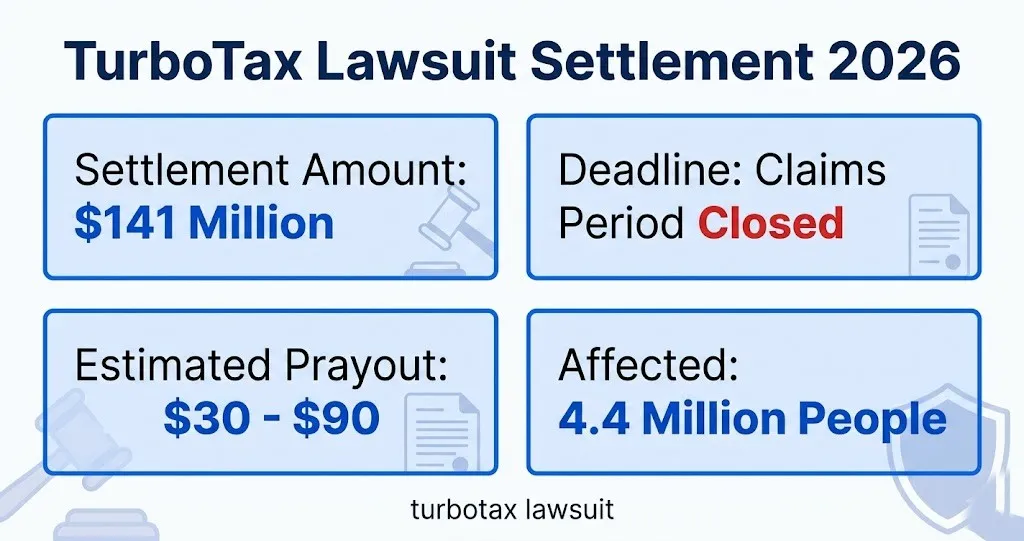
The turbotax lawsuit resulted in a $141 million settlement after Intuit was caught steering millions of people toward paid products they didn’t need. If you used TurboTax between 2016 and 2018 and got tricked into paying when you qualified for free filing, you might be owed money right now.
About 4.4 million TurboTax customers are affected. Many have already received checks. Others still haven’t claimed their share.
This article covers everything that matters in 2026. You’ll learn who qualifies, how much you can expect, whether claims are still open, and what steps to take next.
Some eligible users got roughly $30 for each tax year they were charged. That’s real money sitting uncollected for people who don’t even know about this case.
What Is the TurboTax Lawsuit About?
The TurboTax lawsuit is about Intuit’s deliberate efforts to trick people into paying for tax preparation that should have been completely free. The company ran ads promoting “free” filing while hiding the fact that most users would be pushed into paid tiers.
Intuit, the parent company behind TurboTax, participated in the IRS Free File program. This program required Intuit to offer genuinely free tax filing to people earning below a certain income threshold. Instead of honoring that deal, TurboTax used confusing website design to funnel eligible users away from the truly free version.
The bait-and-switch worked like this. You’d start your return on what seemed like the free version. Halfway through, the software would tell you that your tax situation required an upgrade. Suddenly, you owed $39 to $119 or more for something the government said you should get at no cost.
| Detail | Info |
|---|---|
| Defendant | Intuit Inc. |
| Product | TurboTax tax filing software |
| Core Allegation | Deceptive “free” advertising |
| Affected Users | 4.4 million customers |
| Settlement Amount | $141 million |
This wasn’t an accident or oversight. Internal documents showed that Intuit knew what it was doing. The company actively worked to make the genuinely free version harder to find through search engines.
TurboTax Class Action Lawsuit Explained
A TurboTax class action lawsuit is a legal case where millions of affected customers are grouped together as one class rather than filing individual lawsuits. This approach made it possible for everyday people to take on a corporation worth billions without hiring their own attorneys.
The class in this case included anyone who qualified for free tax filing under the IRS Free File program but was instead directed to a paid TurboTax product. These were primarily low-income earners making roughly $34,000 or less per year and active-duty military members.
Class action lawsuits work well for situations exactly like this one. No single person lost enough money to justify hiring a lawyer. But when you combine 4.4 million people who each lost $30 to $90 per year, you get a case worth fighting.
The legal team representing consumers argued that Intuit’s behavior wasn’t just misleading. It was a calculated business strategy designed to profit from people who could least afford it.
- Consumers didn’t need to hire their own attorneys
- Settlement funds are distributed automatically to identified class members
- Intuit denied wrongdoing but agreed to pay
- The case covered tax years 2016, 2017, and 2018
Who Filed the Class Action Lawsuit Against TurboTax?
The class action lawsuit against TurboTax was filed by all 50 state attorneys general plus the District of Columbia, led by New York Attorney General Letitia James. This was not a private lawsuit brought by one person or one law firm.
Having every state attorney general sign on made this case unusually powerful. It signaled that the deception wasn’t isolated to one region. Intuit’s misleading practices affected users across the entire country.
The investigation began after ProPublica published a series of investigative reports in 2019 exposing how TurboTax deliberately hid its free filing option from search engines. ProPublica’s reporting showed that Intuit added code to its genuinely free product page that prevented Google from indexing it. People searching for “TurboTax free” would never find the real free version.
| Key Players | Role |
|---|---|
| Letitia James (NY AG) | Lead attorney general |
| All 50 State AGs | Co-plaintiffs |
| ProPublica | Investigative reporting that sparked the case |
| Intuit Inc. | Defendant |
The state attorneys general accused Intuit of violating consumer protection laws in every state. Their coordinated effort resulted in the $141 million multistate settlement announced in May 2022.
Key Takeaway: The TurboTax lawsuit was driven by all 50 state attorneys general after journalists exposed Intuit’s scheme to hide its free filing product from search engines and push low-income users into paid tiers.
TurboTax Lawsuit Update for 2026
As of 2026, the TurboTax lawsuit settlement has moved into its final distribution phases. Most eligible claimants who were identified through Intuit’s own records have already received their payments, either by check or direct deposit.
The settlement administrator, Rust Consulting, handled the bulk of payment distributions starting in late 2023 and continuing through 2024. If you were part of the affected group, you likely received a notice by email or mail.
Here’s what’s different about 2026 compared to earlier years. The original claim window has closed for the state AG settlement. However, the separate FTC administrative case against Intuit followed a different legal path and timeline, which we’ll cover in the next section.
For people who never cashed their settlement checks, some states have escheatment deadlines. This means unclaimed funds may eventually be turned over to state unclaimed property offices. If you think you received a check but never deposited it, check your state’s unclaimed property database immediately.
- Most settlement payments were distributed in 2023 and 2024
- The original claim filing window is now closed
- Uncashed checks may be transferred to state unclaimed property
- The FTC’s separate case followed its own timeline
- No major new class action against TurboTax has been certified as of early 2026
There’s still activity worth watching. Consumer advocacy groups continue to monitor Intuit’s advertising practices. New complaints about misleading “free” claims surface each tax season.
The FTC Lawsuit Against TurboTax
The FTC lawsuit against TurboTax is a separate federal action from the state attorney general settlement. The Federal Trade Commission filed an administrative complaint against Intuit in March 2022, accusing the company of running deceptive advertisements for its “free” tax filing products.
This distinction matters a lot. The FTC case and the 50-state AG settlement are two completely different legal proceedings. You could potentially be affected by both, depending on the outcomes.
The FTC’s complaint specifically targeted TurboTax commercials and online ads that prominently featured the word “free.” According to the FTC, roughly two-thirds of tax filers could not actually use TurboTax for free despite seeing those ads. Anyone with a 1099 form, farm income, rental income, or certain other common tax situations was ineligible for the free version.
| FTC Case Detail | Info |
|---|---|
| Agency | Federal Trade Commission |
| Filed | March 2022 |
| Case Type | Administrative complaint |
| Core Claim | Deceptive “free” advertising |
| Key Finding | Two-thirds of filers couldn’t use free version |
Intuit challenged the FTC’s authority to bring the case and fought back aggressively. The company argued that its ads were truthful because some people genuinely could file for free.
In 2023, an FTC administrative law judge found that Intuit had engaged in deceptive practices. Intuit appealed and the legal battle continued into 2024 and beyond. The FTC sought to permanently ban Intuit from advertising “free” services unless they are genuinely free for the majority of users.
TurboTax Deceptive Advertising Lawsuit Details
The TurboTax deceptive advertising lawsuit centers on Intuit’s multimillion-dollar ad campaigns that blanketed television, radio, and the internet with the word “free.” The company spent heavily on Super Bowl commercials and digital ads that made “free” the dominant message.
The deception was layered and deliberate. TurboTax didn’t just say “free” in ads. The company designed its entire online experience to funnel users toward paid products. This practice is sometimes called a dark pattern in digital design.
Here’s how the deception played out for a typical user:
- You saw a TV ad or Google result saying TurboTax is free
- You clicked through and started entering your tax information
- After investing 30 to 60 minutes of your time, you hit a paywall
- The software told you that your “tax situation” required an upgrade
- You either paid up or abandoned your partially completed return
- Starting over with a competitor meant re-entering everything
Think of it like a restaurant advertising a free meal, then telling you halfway through dinner that the plate costs $60 because you ordered chicken instead of salad. By the time you find out, you’ve already invested time and effort.
ProPublica documented that Intuit added specific code (a “robots.txt” directive) to block search engines from showing the legitimately free version of TurboTax. This meant that the only “free” version people could find through Google was the commercial product that would later demand payment.
Key Takeaway: Intuit didn’t just run misleading ads; the company actively engineered its website, search visibility, and product design to trap users into paying for services that should have been free.
How the Intuit TurboTax Settlement Was Reached
The Intuit TurboTax settlement was reached through negotiations between Intuit and all 50 state attorneys general after their investigation confirmed widespread deceptive practices. The $141 million agreement was announced on May 4, 2022.
The path to this settlement started years earlier. After ProPublica’s reporting in 2019, state attorneys general launched their own investigations. They subpoenaed internal Intuit documents, interviewed company employees, and gathered consumer complaints from across the country.
What they found was damning. Internal communications showed that Intuit executives knew the “free” advertising was misleading. The company tracked how many users were converted from free to paid tiers, treating it as a key business metric.
Settlement negotiations moved quickly once the evidence was assembled. Intuit chose to settle rather than face trials in all 50 states simultaneously. That would have been a legal and public relations nightmare.
| Settlement Timeline | Event |
|---|---|
| 2019 | ProPublica investigation published |
| 2019-2021 | State AG investigations begin |
| May 2022 | $141 million settlement announced |
| Late 2022 | Settlement administration begins |
| 2023-2024 | Payments distributed to eligible users |
As part of the deal, Intuit agreed to stop using deceptive advertising and was required to clearly disclose which products are truly free. The company also withdrew from the IRS Free File Alliance in 2021, before the settlement was finalized.
Intuit did not admit any wrongdoing. That’s standard in settlements like this. The company maintained that its advertising was accurate, even as it wrote a check for $141 million.
The TurboTax $141 Million Settlement Breakdown
The TurboTax $141 million settlement fund was divided among approximately 4.4 million affected customers across all 50 states and D.C. The money went directly to consumers who were identified through Intuit’s own billing records as having been charged for services they should have received for free.
The math breaks down simply. Each affected customer received approximately $30 per tax year they were wrongly charged. Since the settlement covered the 2016, 2017, and 2018 tax years, a person affected in all three years could receive roughly $90 total.
| Payout Breakdown | Amount |
|---|---|
| Per affected tax year | Approximately $30 |
| Maximum (3 tax years) | Approximately $90 |
| Total settlement fund | $141 million |
| Number of claimants | 4.4 million |
| Average per claimant | $32 |
Not everyone received the same amount. Your payout depended on how many qualifying tax years you had and whether you filed in a state that negotiated slightly different terms.
Some people expected more. A $30 check might feel insulting if you spent $119 on TurboTax Live. But settlements like this are about providing some restitution to millions of people, not full refunds to each one. The goal was partial compensation at scale.
The settlement also included non-monetary terms. Intuit was required to change its business practices, improve advertising transparency, and stop using dark patterns to funnel people into paid products.
TurboTax Lawsuit Eligibility Requirements
TurboTax lawsuit eligibility was based on two main factors: your income level and whether you were charged for a product you should have received for free. You qualified if you started TurboTax’s free product and then were redirected to a paid version during the 2016, 2017, or 2018 tax years.
Specifically, eligible users fell into these categories:
- Low-income filers who qualified for the IRS Free File program (generally earning $34,000 or less annually, though the threshold varied slightly by year)
- Active-duty military members with an AGI of $66,000 or less
- Users who qualified for Free File but were charged for TurboTax Deluxe, Premier, or Self-Employed editions
The good news was that you didn’t need to prove anything yourself. Intuit’s internal billing and tax records were used to identify eligible customers. The settlement administrator cross-referenced these records with IRS Free File eligibility data.
| Eligibility Factor | Requirement |
|---|---|
| Tax years covered | 2016, 2017, 2018 |
| Income threshold | Generally $34,000 or less |
| Military threshold | AGI $66,000 or less |
| Must have been charged | Yes, for a product that should have been free |
| Proof required by claimant | No, records were used automatically |
If you filed with TurboTax during those years but earned above the income thresholds, you were not part of this settlement. The case was specifically about people who qualified for free filing under the IRS Free File program.
Key Takeaway: You qualified for the TurboTax settlement if you earned $34,000 or less (or were active-duty military under $66,000) and were charged for TurboTax filing during 2016, 2017, or 2018.
The TurboTax Free File Lawsuit Connection
The TurboTax Free File lawsuit connection traces back to a deal between the IRS and the tax software industry. Starting in 2003, the IRS agreed not to build its own free tax filing system. In exchange, companies like Intuit promised to offer genuinely free filing to low-income Americans through the IRS Free File Alliance.
This arrangement was supposed to benefit everyone. The government saved money. Tax companies got to keep their market. Low-income filers got free help. But Intuit broke the bargain.
Instead of making free filing easy to find, TurboTax buried it. The company created a confusing array of products with similar names. “TurboTax Free Edition” was the commercial product that charged most users. “TurboTax Free File Program” was the genuinely free version hidden from search engines.
The naming was intentionally confusing. A regular person searching for “free TurboTax” had virtually no chance of finding the truly free version. That was the whole point.
- TurboTax Free Edition: Commercial product, free only for the simplest returns
- TurboTax Free File Program: IRS-mandated free version for eligible users, hidden from search engines
- The names were designed to create confusion
- Intuit withdrew from the Free File Alliance in July 2021
Intuit’s departure from the Free File program didn’t fix the damage already done. It just meant the company no longer had to pretend to offer free filing to low-income users. The IRS has since moved toward building its own Direct File system, which launched as a pilot in 2024.
TurboTax Lawsuit: How Much Will I Get?
Most TurboTax lawsuit claimants received approximately $30 per qualifying tax year, with a maximum of about $90 for people affected across all three covered years (2016, 2017, 2018). Your exact amount depended on how many years you were wrongly charged.
That might sound low. And honestly, it is. If you paid $59 or $119 for TurboTax in each of those years, getting $30 back per year means you recovered roughly a quarter to half of what you spent. But class action settlements almost never provide full refunds.
Here’s a realistic way to think about it. If you got hit with a $10 parking ticket you didn’t deserve, would you drive across town to fight it? Probably not. But if the city wrote you a $4 check without you doing anything, you’d cash it. That’s basically how this settlement works.
| Scenario | Estimated Payout |
|---|---|
| Affected in 1 tax year | ~$30 |
| Affected in 2 tax years | ~$60 |
| Affected in 3 tax years | ~$90 |
Some claimants reported receiving slightly different amounts. Payment calculations factored in the specific product tier you were charged for and the state where you filed. A few states negotiated marginally different distribution formulas.
The payments went out via check or direct deposit. If you were still using the same bank account from your tax filing, the settlement administrator could deposit the money directly. Otherwise, a paper check was mailed to your address on file.
TurboTax Settlement Payout Amounts and Timing
TurboTax settlement payout distribution began in late 2023, with the majority of payments reaching eligible users by mid-2024. The settlement administrator, Rust Consulting, processed payments in waves based on state and verification status.
The timing worked like this:
| Distribution Phase | Timeframe |
|---|---|
| Settlement finalized | May 2022 |
| Eligible users identified | Late 2022 to early 2023 |
| First wave of payments | Late 2023 |
| Second wave of payments | Early to mid-2024 |
| Final distributions | Late 2024 |
| Unclaimed funds period | 2025 into 2026 |
Direct deposit payments arrived first. Intuit had bank account information for users who received tax refunds through TurboTax. Those people often got their settlement money without lifting a finger.
Paper checks took longer. If your address changed since 2016, 2017, or 2018, the check might have gone to an old address. Returned checks were held by the settlement administrator and eventually might be redistributed or sent to state unclaimed property programs.
For anyone who thinks they were eligible but never received payment, the first step is to check with your state’s unclaimed property office. Typing your name into your state’s unclaimed property website could reveal money waiting for you.
Key Takeaway: Most TurboTax settlement payments were distributed between late 2023 and mid-2024, with unclaimed funds potentially available through state unclaimed property offices in 2026.
TurboTax Settlement Status in 2026
The TurboTax settlement in 2026 is essentially in its wind-down phase for the state attorney general case. The $141 million fund has been largely distributed, and the formal claim filing period has ended.
But the legal story isn’t completely over. Several threads remain active:
- The FTC’s administrative case against Intuit continued through appeals processes into 2025 and 2026
- Consumer advocacy groups are monitoring whether Intuit is complying with the settlement’s advertising restrictions
- The IRS Direct File program, born partly from the TurboTax controversy, continues expanding
- New consumer complaints about TurboTax pricing surface every tax season
The FTC case deserves special attention. Unlike the state AG settlement, the FTC sought a permanent injunction that would bar Intuit from advertising any product as “free” unless it’s genuinely free for the majority of users. If the FTC prevails fully, it could reshape how all tax software companies market their products.
| 2026 Status | Detail |
|---|---|
| State AG Settlement | Payments largely distributed |
| Claim Filing | Closed for new claims |
| FTC Case | Ongoing through appeals |
| New Lawsuits | No new certified class action as of early 2026 |
| Compliance Monitoring | Active by state AGs |
There’s no new class action lawsuit against TurboTax that’s been certified as of early 2026. However, individual complaints and smaller lawsuits related to TurboTax’s pricing practices continue to be filed in various state courts.
How to File a TurboTax Lawsuit Claim
Filing a TurboTax lawsuit claim was designed to be as simple as possible for most people. In fact, the majority of eligible users didn’t need to file a claim at all because the settlement administrator used Intuit’s records to identify and pay them automatically.
Here’s what the process looked like:
- Step 1: The settlement administrator identified you through Intuit’s billing records
- Step 2: You received a notice by email or postal mail confirming your eligibility
- Step 3: If you had a valid bank account on file, payment was deposited directly
- Step 4: If not, a check was mailed to your last known address
- Step 5: You cashed the check. Done.
For people who believed they were eligible but never received a notice, there was a claims process through the official settlement website. That window is now closed for the state AG settlement.
If you missed the boat entirely, your options in 2026 are limited but not zero. Check your state’s unclaimed property database first. Search your email (including spam folders) for messages from the settlement administrator. Look through old mail for uncashed checks.
The process was different from most class action settlements where you have to proactively submit a claim form. This case was designed so that payments went out automatically. That’s actually unusual and reflects the scale of Intuit’s misconduct.
TurboTax Lawsuit Claim Process Step by Step
The TurboTax lawsuit claim process followed a straightforward path that prioritized getting money to people quickly. Because Intuit kept detailed records of every customer transaction, the settlement administrator could verify eligibility without requiring consumers to dig up old receipts.
Step-by-step breakdown:
| Step | Action | Who Does It |
|---|---|---|
| 1 | Cross-reference Intuit billing data with Free File eligibility | Settlement administrator |
| 2 | Send eligibility notices to affected users | Settlement administrator |
| 3 | Verify bank account information | Automated |
| 4 | Issue direct deposits or mail checks | Settlement administrator |
| 5 | Handle returned mail and undeliverable payments | Settlement administrator |
| 6 | Transfer unclaimed funds per state law | Settlement administrator / State |
What if you never got a notice but you’re sure you qualify? That’s a common frustration. The most likely reasons are:
- Your email address changed since you last used TurboTax
- Your physical address changed and mail was returned
- You actually didn’t meet the income eligibility threshold
- You used a different tax product (like the free version that actually worked)
For anyone still searching for their payment, the best resource in 2026 is your state’s unclaimed property office. Each state maintains a searchable database where you can look up funds held in your name.
Key Takeaway: The TurboTax claim process was mostly automatic, using Intuit’s own records to find and pay eligible users, but anyone who missed their payment should search their state’s unclaimed property database in 2026.
TurboTax Lawsuit Deadline You Need to Know
The primary TurboTax lawsuit deadline for filing claims has passed. The state attorney general settlement’s claim period closed, and payments have been distributed. However, there are still time-sensitive actions you can take in 2026.
Deadlines and dates that matter:
| Deadline | Status |
|---|---|
| Original settlement announcement | May 4, 2022 |
| Initial claim filing period | Closed |
| Payment distribution window | Late 2023 through late 2024 |
| Check cashing deadline | Varies by state (typically 90 to 180 days) |
| Unclaimed property transfer | Ongoing through 2026 |
| FTC case final resolution | Pending |
If you received a settlement check but never cashed it, that’s the most urgent deadline to worry about. Settlement checks typically expire after 90 to 180 days. Once expired, the funds may be returned to the settlement fund or transferred to your state’s unclaimed property program.
Don’t assume it’s too late. State unclaimed property programs hold funds for years before they’re absorbed into the state’s general fund. The window for claiming that money through your state is much longer than the original check’s expiration date.
For the FTC case, deadlines are still evolving. If the FTC’s order is upheld and additional consumer remedies are ordered, new deadlines could emerge in late 2026 or beyond. This is worth monitoring.
The bottom line: act now rather than waiting. Every month you delay reduces the chance of recovering money you’re owed.
Frequently Asked Questions
Is the TurboTax lawsuit still open for new claims in 2026?
The state attorney general settlement’s claim filing period has closed as of 2026.
Most eligible users were identified automatically and paid between late 2023 and mid-2024.
If you missed your payment, check your state’s unclaimed property database for funds held in your name.
How much money will I get from the TurboTax settlement?
Most eligible claimants received approximately $30 per qualifying tax year.
The maximum payout was roughly $90 for people charged in all three covered years (2016, 2017, 2018).
Exact amounts varied slightly by state and product tier.
Who qualifies for the TurboTax class action lawsuit payout?
You qualified if you earned $34,000 or less (or were active-duty military earning under $66,000) and were charged for TurboTax during the 2016, 2017, or 2018 tax years.
Eligibility was based on Intuit’s own billing records matched against IRS Free File program criteria.
You did not need to submit proof of income or purchase receipts.
Do I need a lawyer to file a TurboTax lawsuit claim?
No, you did not need a lawyer to receive your TurboTax settlement payment.
The process was handled automatically by the settlement administrator using Intuit’s records.
Payments were issued via direct deposit or mailed checks without any legal representation required.
When will TurboTax settlement checks be mailed out?
The bulk of TurboTax settlement checks were mailed between late 2023 and mid-2024.
As of 2026, new checks are not being issued through the original settlement process.
Unclaimed funds may be available through your state’s unclaimed property office.
Intuit’s TurboTax scheme affected 4.4 million people who trusted a product that was supposed to help them. The $141 million settlement provided partial justice, even if it didn’t make everyone whole.
If you haven’t received your payment yet, search your state’s unclaimed property database today. Don’t leave money on the table that’s rightfully yours.
Stay alert during tax season. Watch how TurboTax advertises its products. The legal battles that changed this industry started because consumers and journalists refused to look the other way.