
The 23XI Racing NASCAR lawsuit is one of the most significant antitrust cases in professional motorsports history. Filed in late 2024, this legal battle puts two NASCAR team owners directly against the sport’s governing body over allegations of illegal market control.
Michael Jordan and Denny Hamlin, co-owners of 23XI Racing, claim NASCAR used its charter system to restrict competition and suppress team revenues. The case has dragged into 2026 with major court rulings, a denied injunction, and no clear settlement in sight.
This article covers every angle: the legal claims, key players, court status, what a 2026 resolution might look like, and what the outcome means for everyone who follows NASCAR.
One striking detail: the lawsuit seeks treble damages, meaning if 23XI wins, NASCAR could owe three times the actual financial harm caused. That number could reach into the hundreds of millions of dollars.
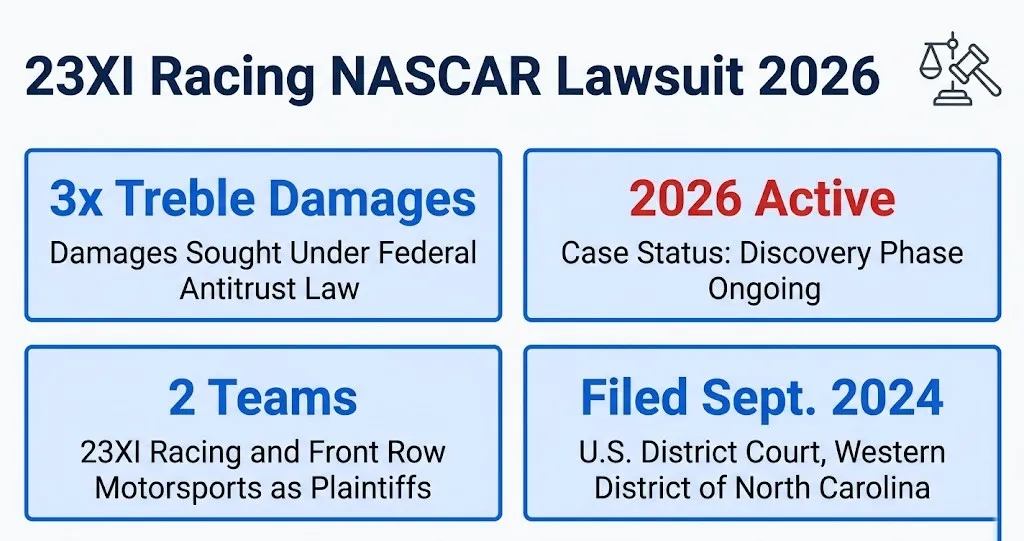
23XI Racing NASCAR Lawsuit: The Core Story
The 23XI Racing NASCAR lawsuit is an antitrust action filed in federal court alleging that NASCAR illegally monopolized the professional stock car racing market. The case, filed in the United States District Court for the Western District of North Carolina, landed in late September 2024.
The lawsuit names NASCAR as the defendant and argues the sanctioning body used its control over the Cup Series charter system to lock teams into unfair agreements.
Think of it like a mall landlord who controls every store location in town and forces all retailers to sign one-sided leases with no right to negotiate. NASCAR, the plaintiffs argue, operates the same way over race teams.
| Key Case Detail | Information |
|---|---|
| Case Filed | September 2024 |
| Court | U.S. District Court, Western District of North Carolina |
| Plaintiffs | 23XI Racing, Front Row Motorsports |
| Defendant | NASCAR |
| Legal Basis | Sherman Antitrust Act, Sections 1 and 2 |
| Damages Sought | Treble damages under federal antitrust law |
The case number associated with the filing is 3:24-cv-00886. That reference points to the Charlotte division of the Western District, which makes geographic sense given NASCAR’s headquarters in Concord, North Carolina.
What Is the 23XI Racing NASCAR Lawsuit About?
The 23XI Racing NASCAR lawsuit is about whether NASCAR illegally used its charter system to control how teams earn money, access races, and negotiate agreements. In plain terms, the teams say NASCAR rigged the game in its own favor.
The core complaint covers two major areas. First, the teams allege NASCAR coordinated with charter holders to impose anti-competitive restrictions. Second, they argue NASCAR maintained an illegal monopoly over the market for premier stock car racing.
The practical grievance is straightforward. Teams like 23XI cannot simply leave NASCAR and race at the same level elsewhere. There is no competing series with the same broadcast deals, fan base, or prize money. That dependency, the lawsuit argues, is exactly what gave NASCAR the power to impose unfair terms.
The lawsuit also flags specific financial concerns:
- Revenue sharing formulas that heavily favor NASCAR over teams
- Restrictions on how teams can sell or transfer charter rights
- Terms that tied team participation to accepting NASCAR’s conditions without genuine negotiation
- Limitations on teams seeking outside investors or alternative revenue streams
The teams are not asking to dissolve NASCAR. They are asking the court to declare the charter system’s most restrictive terms illegal and award damages for past financial harm.
23XI Racing Antitrust Lawsuit Explained
The 23XI Racing antitrust lawsuit rests on two main legal theories drawn from the Sherman Antitrust Act, the foundational federal law against anti-competitive business practices.
Section 1 of the Sherman Act prohibits agreements that unreasonably restrain trade. The teams argue the charter agreement, as structured and enforced by NASCAR, qualifies as exactly that kind of unlawful restraint.
Section 2 of the Sherman Act prohibits monopolization or attempted monopolization of a market. 23XI and Front Row Motorsports argue NASCAR holds a monopoly over the relevant market, which they define as premier-level professional stock car racing in the United States.
| Legal Claim | What It Means | What 23XI Must Prove |
|---|---|---|
| Section 1 Sherman Act | Unlawful agreement restraining trade | Charter agreement unreasonably restricts competition |
| Section 2 Sherman Act | Illegal monopoly maintenance | NASCAR controls the only viable market with no real alternative |
| Treble Damages | Triple actual damages | Calculated financial loss multiplied by three |
To win on the monopoly claim, 23XI must show two things. First, NASCAR holds dominant market power in a clearly defined market. Second, NASCAR willfully maintained that power through exclusionary conduct rather than through superior performance or legitimate business decisions.
That second element is where cases like this get complicated. Courts do not punish companies simply for being dominant. They punish companies for using that dominance in ways that harm competition.
Key Takeaway: The 23XI Racing antitrust lawsuit uses two Sherman Act claims to argue NASCAR illegally controlled the racing market and damaged teams financially through its charter agreement system.
NASCAR Charter System Lawsuit: Why the Charter Matters
The NASCAR charter system is at the heart of this lawsuit. A charter is essentially a license that guarantees a team a spot in every Cup Series race, access to more prize money than non-chartered teams, and the ability to sell or transfer that spot as a business asset.
NASCAR introduced the charter system in 2016. The goal was to give teams more financial stability and make franchises easier to value for potential investors and sponsors.
The problem, according to the lawsuit, is how NASCAR structured the terms of those charters. 23XI and Front Row Motorsports argue that the agreement teams signed was not a negotiated contract. It was presented as a take-it-or-leave-it offer with no meaningful input from the teams.
What charters control in the Cup Series:
- Guaranteed entry into all 36 points races each season
- A larger share of the prize fund compared to open teams
- The right to sell the charter as a business asset worth millions
- Priority pit stall assignments and garage access at race events
- Eligibility for NASCAR’s performance incentive programs
The lawsuit claims NASCAR used charter renewals as a pressure point. Teams that did not sign the latest charter agreement faced losing their guaranteed race entries, which would effectively destroy the value of their franchises overnight.
That kind of leverage, the plaintiffs say, is the textbook definition of anti-competitive coercion.
NASCAR Sherman Act Violation Claims
The Sherman Act violation claims in this lawsuit are specific and detailed. The teams allege two distinct categories of conduct that they say crossed legal lines.
The first category involves horizontal coordination. 23XI argues that NASCAR, as the organizer, worked alongside charter-holding teams to agree on terms that locked out competition from new entrants and suppressed the bargaining power of all teams collectively.
The second category involves exclusionary monopoly conduct. This is the argument that NASCAR, knowing it controlled the only viable premier racing market in America, used that control to impose contract terms no team could realistically reject.
Sherman Act violation claims at a glance:
| Alleged Conduct | Legal Category | Potential Consequence |
|---|---|---|
| Charter terms imposed without negotiation | Section 1 restraint of trade | Void contract provisions, damages |
| Restricting team revenue streams | Section 1 and 2 overlap | Treble damages award |
| Blocking new competition in the market | Section 2 monopolization | Structural or behavioral remedies |
| Tying race access to charter acceptance | Exclusive dealing / Section 1 | Damages and injunctive relief |
One critical legal question the court must answer is how to define the relevant market. If the court accepts the plaintiffs’ definition (premier professional stock car racing in the U.S.), NASCAR’s dominance becomes obvious. If the court defines the market more broadly to include other motorsports series, NASCAR’s market share shrinks significantly.
That market definition battle is often where antitrust cases are won or lost before a single merits argument is made.
NASCAR Monopoly Lawsuit: Is NASCAR Actually a Monopoly?
Whether NASCAR qualifies as a monopoly depends entirely on how the court draws the market boundaries. The NASCAR monopoly lawsuit argument hinges on one central fact: there is no other racing series in the United States where top-tier stock car racing talent, major television contracts, and national sponsorship money all converge at the same level.
NASCAR has broadcast deals with Fox Sports and NBC/Amazon Prime, massive fan attendance figures, and a national sponsorship ecosystem that no other domestic racing series comes close to matching. That combination, 23XI argues, makes NASCAR the only viable employer for professional stock car racing teams at the highest level.
Courts look at several factors when analyzing monopoly claims:
- Market share: Does the defendant control the overwhelming majority of the defined market?
- Entry barriers: How hard is it for a new competitor to enter and challenge the dominant firm?
- Pricing power: Can the dominant firm set terms without fear of customers switching to alternatives?
- Exclusionary conduct: Did the firm take actions specifically designed to prevent competition?
23XI’s argument checks most of those boxes. No new sanctioning body for premier stock car racing has emerged to challenge NASCAR in decades. The cost of creating a rival series with comparable television deals, tracks, and team infrastructure would be astronomical.
Key Takeaway: The monopoly question in the 23XI NASCAR lawsuit turns on whether courts accept that premier stock car racing is its own market, separate from other motorsports, effectively leaving teams with no alternative to NASCAR’s terms.
Michael Jordan NASCAR Lawsuit: His Role and Stake
Michael Jordan’s involvement in the 23XI Racing NASCAR lawsuit is both personal and financial. Jordan co-founded 23XI Racing in 2020 alongside Denny Hamlin, making him one of the highest-profile team owners in NASCAR’s modern era.
Jordan has significant business experience outside of basketball. He understood from the start that NASCAR team ownership would require navigating the economics of the charter system. What he apparently did not anticipate was finding those economics fundamentally unfair enough to litigate.
His involvement gives the lawsuit a level of national media attention that a typical motorsports legal dispute would never receive. Jordan’s name alone puts the case on the front page of mainstream sports coverage, not just racing outlets.
Jordan’s specific interests in this lawsuit:
- 23XI Racing fields multiple Cup Series cars, meaning multiple charters and multiple revenue streams affected by the disputed terms
- As co-owner, his business investment is directly tied to how profitable team ownership can be under the current charter framework
- A favorable ruling or settlement could significantly increase the value of his team by improving revenue sharing and charter flexibility
Jordan has been publicly outspoken about the lawsuit. He has framed it not just as a business dispute but as a matter of fairness within a sport he chose to invest in at a significant level.
His presence also signals that this is not a lawsuit driven by a small operator who felt squeezed out. This is a major, well-funded legal action backed by sophisticated business minds who chose litigation deliberately.
Denny Hamlin NASCAR Lawsuit: His Dual Role
Denny Hamlin occupies a uniquely uncomfortable position in this lawsuit. He is simultaneously an active NASCAR Cup Series driver and a co-owner of 23XI Racing, the team suing the very sanctioning body that oversees his races.
That dual role creates real tension. Hamlin competes in NASCAR Cup Series events under NASCAR rules and governance while his co-owned team fights NASCAR in federal court. It is a situation without many parallels in professional sports history.
Hamlin has been the most publicly vocal advocate for the lawsuit’s goals. He has spoken at length about what he sees as structural unfairness in how NASCAR distributes revenue between the sanctioning body and the teams that actually put cars on the track.
Hamlin’s stated concerns about NASCAR economics:
- Teams receive what he characterizes as a disproportionately small share of total NASCAR revenue
- The charter system gave teams some stability but not enough economic participation in the sport’s overall growth
- Broadcast rights revenues, which grew significantly with recent TV deals, did not translate into proportional increases in team prize money
Hamlin’s driver status did not insulate him from NASCAR’s response to the lawsuit. When 23XI Racing and Front Row Motorsports refused to sign the new charter agreement in September 2024 and filed suit instead, NASCAR initially indicated those teams would race without charters in 2025.
That created immediate financial and competitive consequences that underscored exactly the leverage the teams claimed NASCAR held over them.
Key Takeaway: Denny Hamlin’s role as both an active Cup Series driver and a lawsuit plaintiff against NASCAR created unprecedented tension in the sport and gave the legal battle a very public, personal dimension.
Front Row Motorsports NASCAR Lawsuit
Front Row Motorsports joined 23XI Racing as a co-plaintiff in the lawsuit, making this a two-team legal action rather than a single grievance. Front Row Motorsports, owned by Bob Jenkins, is a smaller operation than 23XI Racing but faces the same structural pressures from the charter system.
The inclusion of Front Row Motorsports matters legally. It shows this is not just one wealthy owner with a personal complaint. Two separate racing organizations, with different ownership structures and business profiles, reached the same conclusion: the charter system as structured violates federal antitrust law.
Front Row Motorsports at a glance:
| Detail | Information |
|---|---|
| Team Owner | Bob Jenkins |
| Cup Series Cars | Two chartered entries |
| Engine Supplier | Ford Performance |
| Founded | 2004 |
| Role in Lawsuit | Co-plaintiff alongside 23XI Racing |
Front Row Motorsports operates on tighter margins than Michael Jordan’s operation. For smaller teams, the financial terms embedded in the charter system can be the difference between sustainability and losses.
That economic reality gives the lawsuit a broader significance beyond just the high-profile Jordan and Hamlin angle. If the charter system’s terms are oppressive for a well-capitalized team like 23XI, they are potentially devastating for smaller operations like Front Row Motorsports.
The co-plaintiff structure also strengthens the legal argument. Courts pay attention when multiple independent parties make the same antitrust claim. It suggests the problem is systemic rather than situational.
23XI Racing vs NASCAR Court Case Details
The formal court case details place this lawsuit in the United States District Court for the Western District of North Carolina, Charlotte Division. The case was assigned Case No. 3:24-cv-00886.
The plaintiffs’ legal team filed a complaint in September 2024 that ran to dozens of pages of detailed factual allegations and legal arguments. The complaint outlined the history of the charter system, the specific terms the teams objected to, and the financial harm they claimed to have suffered as a result.
NASCAR responded by filing a motion to dismiss in late 2024, arguing the claims lacked merit and that the charter agreement represented a legitimate business arrangement that teams voluntarily entered.
Timeline of key court events:
| Date | Event |
|---|---|
| September 2024 | Complaint filed, preliminary injunction sought |
| October 2024 | Court hearing on preliminary injunction |
| November 2024 | Preliminary injunction denied by district court |
| Late 2024 | NASCAR files motion to dismiss |
| Early 2025 | Teams file opposition to motion to dismiss |
| 2025 | Discovery phase begins |
| 2026 | Case progresses toward trial or resolution |
The denial of the preliminary injunction was a significant early setback for the plaintiffs. To get a preliminary injunction, a party must show it is likely to win on the merits and that it will suffer irreparable harm without immediate court action.
The court found 23XI and Front Row Motorsports had not met that standard at the preliminary stage. That does not mean they will lose the case. Injunction denials and ultimate case outcomes are different legal determinations.
23XI Racing Lawsuit Update 2026
The 23XI Racing lawsuit update for 2026 shows the case has moved into serious litigation territory. As of early 2026, the case is in active discovery, meaning both sides are exchanging documents, financial records, and communications that will form the backbone of each party’s argument at trial.
Discovery in antitrust cases of this scale can take years and generate enormous volumes of evidence. Both sides are likely examining NASCAR’s internal financial models, charter negotiation records, communications between NASCAR executives, and data on how revenue flows through the Cup Series system.
What to watch in 2026:
- Whether the court rules on NASCAR’s motion to dismiss (if not already resolved)
- Whether either side files motions for summary judgment, which could end the case before trial
- Whether settlement talks begin in earnest as litigation costs mount for both parties
- Any appellate proceedings if the preliminary injunction denial is appealed further
One important development heading into the 2026 NASCAR season: reports from early 2025 indicated that 23XI Racing and Front Row Motorsports reached a temporary arrangement with NASCAR to continue racing under charter-like terms while the litigation proceeds. This preserved their competitive standing without resolving the underlying legal dispute.
The case has not been assigned a formal trial date as of early 2026. That suggests the court anticipates extended pre-trial proceedings before any jury or bench trial takes place.
Key Takeaway: The 23XI Racing lawsuit in 2026 is in active discovery with no trial date set, both teams racing competitively under interim arrangements with NASCAR while the core antitrust claims work through the federal court system.
23XI Racing Injunction Ruling: What the Court Decided
The 23XI Racing injunction ruling was one of the most closely watched early decisions in this case. The teams filed for a preliminary injunction at the same time they filed their lawsuit, asking the court to immediately restore their charter status while the case proceeded.
A preliminary injunction is an emergency request. It asks a court to preserve the status quo or prevent immediate harm before a full trial can determine the final outcome.
The federal district court denied the preliminary injunction in late 2024. The judge found that 23XI and Front Row Motorsports had not demonstrated they were likely to succeed on the merits at that stage, and had not shown sufficient evidence of irreparable harm that could not be remedied by money damages later.
What the injunction ruling means:
| Aspect | Explanation |
|---|---|
| Injunction denied | Teams did not get immediate charter restoration via court order |
| Merits not decided | Denial does not mean the teams will lose the full case |
| Irreparable harm standard | Court found financial harm could be compensated by damages later |
| Case continues | Full litigation proceeds on the antitrust claims |
The practical effect of the denial was significant. Without the injunction, the teams had to reach a separate working arrangement with NASCAR to maintain their race entries during the 2025 season.
The injunction denial also sent a signal about the early strength of the legal arguments. Plaintiffs in antitrust cases against powerful sports organizations face real uphill battles at the preliminary stage because courts are cautious about disrupting established business arrangements before all the facts are heard.
23XI Racing Lawsuit Outcome: What Could Happen
The 23XI Racing lawsuit outcome in 2026 could go several different directions. No trial verdict has been reached as of this writing, and the case remains in active litigation.
The possible outcomes break down like this:
Scenario 1: NASCAR wins on a motion to dismiss or summary judgment.
If the court finds the antitrust claims legally insufficient, the case ends without a trial. 23XI and Front Row Motorsports walk away without damages. NASCAR’s charter system continues unchanged.
Scenario 2: The case goes to trial and 23XI wins.
A jury verdict for the plaintiffs could result in actual damages calculated from financial losses, then tripled under federal antitrust law. A win could also include injunctive relief restructuring the charter system’s most restrictive terms.
Scenario 3: The parties reach a settlement.
This is statistically the most likely outcome for complex antitrust litigation. Settlements in cases like this often involve a payment by the defendant, changes to the disputed contract terms, and confidential releases of all claims.
Scenario 4: The case is partially resolved.
Courts sometimes grant partial summary judgment, deciding some claims in favor of one party while sending others to trial.
| Outcome | Likelihood | What It Means |
|---|---|---|
| Dismissal | Moderate | NASCAR wins without trial, system unchanged |
| Trial verdict for plaintiffs | Lower near-term | Major damages, possible charter reform |
| Settlement | Highest overall | Financial payment, possible rule changes |
| Partial resolution | Moderate | Mixed result, some claims survive |
The financial stakes make settlement appealing to both sides. A treble damages award against NASCAR could be enormous. Continued litigation costs are also substantial for both parties.
NASCAR Lawsuit Settlement 2026: Is a Deal Possible?
A NASCAR lawsuit settlement in 2026 is possible but has not been announced as of this article’s publication. Settlement discussions in major antitrust litigation typically begin when both sides have completed enough discovery to understand the strength and weakness of each other’s positions.
In complex antitrust cases against large organizations, that process often takes two to three years from the initial filing. Given the September 2024 filing date, serious settlement talks would most logically begin sometime in 2026 after discovery is substantially complete.
Factors pushing toward settlement:
- Litigation costs for both sides are mounting rapidly
- A jury verdict is unpredictable and exposes NASCAR to massive treble damage liability
- A settlement could allow both sides to reshape the charter system without a court ordering structural changes
- Both parties have ongoing business relationships within NASCAR that a court battle could permanently damage
Factors pushing against quick settlement:
- Both sides appear committed to their legal positions based on public statements
- The teams may want a court ruling that sets precedent for team rights in all sports leagues
- NASCAR may prefer to fight and win rather than pay any settlement that signals the charter system was unlawful
If a settlement does occur, the terms would likely remain confidential. But any resolution would almost certainly involve some revision to how the charter agreement is structured going forward.
Key Takeaway: A settlement in the 23XI Racing NASCAR lawsuit is the statistically most likely outcome for 2026, but no deal has been reached, and both sides appear willing to continue litigation into and beyond this year.
Did 23XI Racing Win the Lawsuit?
As of 2026, 23XI Racing has not won the lawsuit. The case remains active in federal court. No trial verdict has been delivered, and no settlement has been publicly announced.
The preliminary injunction denial in late 2024 was an early loss for the teams. But that ruling specifically addressed whether an emergency order was warranted. It was not a ruling on the full merits of the antitrust claims.
Current scorecard of legal developments:
| Development | Result | Impact |
|---|---|---|
| Preliminary injunction | Denied (2024) | Setback, no immediate charter restoration |
| Motion to dismiss | Pending or denied | Case continues if motion fails |
| Discovery phase | Active (2025-2026) | Both sides building their cases |
| Trial | Not yet scheduled | Final outcome still undecided |
| Settlement | Not reached | Negotiations possible but not confirmed |
The legal reality is that antitrust cases against powerful organizations in professional sports are hard to win. Courts have historically been cautious about imposing antitrust liability on sports leagues and sanctioning bodies.
That said, 23XI Racing’s case has some genuine legal strength. The charter system’s structure, the lack of meaningful negotiation, and the absence of competing premier racing series all provide ammunition for the antitrust claims.
The case is far from over. And the teams’ willingness to continue litigating despite the injunction denial suggests they believe the evidence gathered in discovery will support their core arguments.
What the 23XI NASCAR Lawsuit Means for Teams and Fans
The 23XI NASCAR lawsuit carries consequences that stretch well beyond the two teams that filed it. If the plaintiffs succeed, the entire structure of how NASCAR operates its Cup Series business could face court-ordered changes.
For team owners across the Cup Series, a plaintiff victory could mean renegotiated revenue sharing, more transparent charter terms, and greater team participation in the sport’s financial growth. Teams have long argued they do not receive a fair share of NASCAR’s broadcast and sponsorship revenues.
For drivers, the lawsuit’s outcome matters indirectly. Teams with stronger revenue positions can attract better sponsorships, invest in better equipment, and sign or retain top-tier talent. A healthier team economics environment benefits the drivers who depend on those teams for their careers.
For fans, the changes could be subtle but real. More financially stable teams mean fewer mid-season sponsorship collapses, fewer teams folding between seasons, and a more competitive field when every team can afford to develop competitive cars.
Potential impacts across NASCAR stakeholders:
| Stakeholder | If 23XI Wins | If NASCAR Wins |
|---|---|---|
| Team owners | Better revenue share, reformed charter terms | Status quo, current system continues |
| Drivers | More stable team funding | No structural change in team economics |
| Sponsors | More predictable team stability | Current sponsorship dynamics unchanged |
| Fans | More competitive, financially stable teams | No change to race format or competition |
| NASCAR (defendant) | Structural and financial reforms required | Full vindication, current model preserved |
| New team investors | Lower barriers to entry | Existing barriers remain |
This lawsuit also functions as a warning shot across the bow of professional sports governance more broadly. Other leagues and sanctioning bodies are watching closely. A plaintiff victory here could inspire similar antitrust actions in other sports where a single governing body controls the entire market for a specific athletic competition.
Frequently Asked Questions
What is the 23XI Racing NASCAR lawsuit about?
The 23XI Racing NASCAR lawsuit is a federal antitrust case alleging NASCAR illegally used its charter system to control the professional stock car racing market.
The lawsuit, filed in September 2024, claims NASCAR’s charter agreement imposed anti-competitive restrictions that violated the Sherman Antitrust Act.
The teams seek treble damages and changes to the charter system’s most restrictive terms.
Who filed the lawsuit against NASCAR and why?
23XI Racing and Front Row Motorsports filed the lawsuit against NASCAR in the U.S. District Court for the Western District of North Carolina.
The teams filed because they believed NASCAR’s charter agreement was structured as a take-it-or-leave-it contract that suppressed team revenues and restricted competition.
The filing came after the teams refused to sign the latest charter agreement in September 2024.
What happened with the 23XI Racing injunction ruling?
The federal court denied the preliminary injunction request filed by 23XI Racing and Front Row Motorsports in late 2024.
The court found the teams had not shown they were likely to win on the merits at that early stage or that their harm could not be compensated by money damages later.
The denial was a setback but did not end the case or decide the underlying antitrust claims.
Will the 23XI Racing NASCAR lawsuit settle in 2026?
A settlement is possible but has not been announced as of 2026.
Both sides face significant litigation costs, and the complexity of the antitrust claims makes a negotiated resolution financially attractive for NASCAR given the risk of treble damages at trial.
Settlement terms would likely remain confidential but could include payments and changes to the charter agreement.
What does the NASCAR lawsuit mean for Cup Series teams and fans?
A plaintiff victory could restructure NASCAR’s revenue sharing model and give teams more economic power within the sport.
Fans could benefit indirectly through more financially stable racing teams and a more competitive field on the track.
A NASCAR victory would preserve the current charter system without major changes to how teams earn money or access races.
The 23XI Racing NASCAR lawsuit is still unfolding in 2026, but it has already changed the conversation about how professional racing teams are treated by their governing body.
Watch for discovery developments, any summary judgment rulings, and whether settlement talks become public later in 2026. The outcome will set the tone for team-sanctioning body relationships across motorsports for years to come.
If you own a business in the racing ecosystem, follow NASCAR professionally, or simply care about fair competition in sports, this case deserves your attention. Stay updated as new court filings and rulings emerge throughout the year.
