
The Prime drink lawsuit is one of the biggest beverage legal battles of 2026. Multiple class action cases allege that Prime Energy and Prime Hydration contain dangerous caffeine levels, toxic PFAS chemicals, and misleading labels that target children.
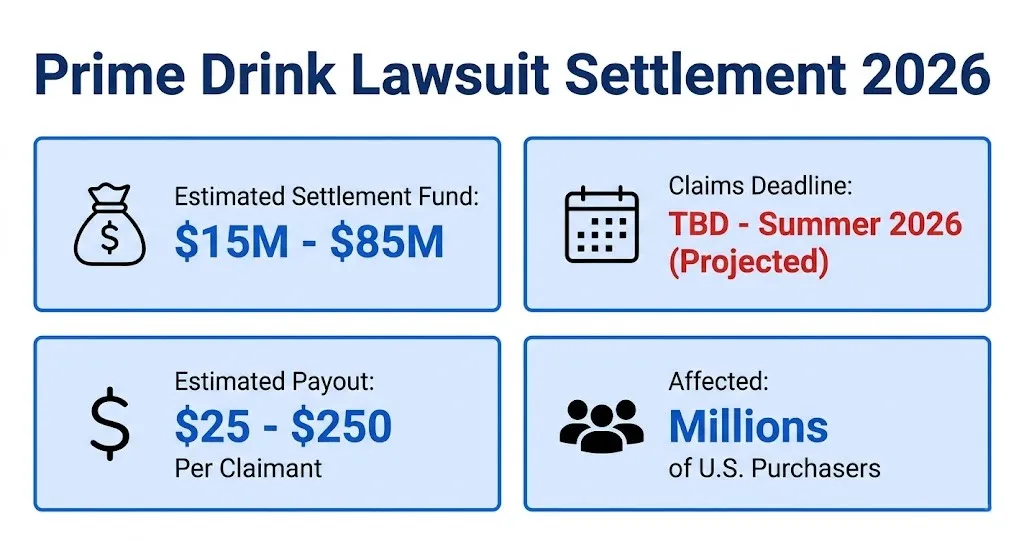
If you bought Prime products, you might be owed money. Estimated payouts range from $25 to $250 per claimant, depending on the case outcome and your purchase history.
This article breaks down every active lawsuit against Prime. You’ll find the latest 2026 updates, settlement projections, filing deadlines, and step-by-step instructions for joining a claim.
One fact that caught our attention: a single can of Prime Energy packs 200 milligrams of caffeine, roughly equal to six cans of Coca-Cola.
What Is the Prime Drink Lawsuit About?
The Prime drink lawsuit refers to multiple legal cases filed against Prime Hydration LLC and its parent company, Congo Brands. These lawsuits challenge the safety, labeling, and marketing of Prime beverages sold across the United States.
At the heart of every case is a simple accusation: Prime misled consumers. Plaintiffs say the company hid health risks, overstated nutritional benefits, and deliberately marketed a high-caffeine product to kids.
The legal claims fall into several categories:
- Product liability for dangerous caffeine concentrations
- Consumer fraud for deceptive labeling and advertising
- Negligence for failing to warn about PFAS contamination
- False advertising for exaggerated health and hydration claims
| Lawsuit Category | Core Allegation |
|---|---|
| Caffeine Content | 200mg per can, unsafe for minors |
| PFAS Contamination | Toxic forever chemicals detected |
| False Advertising | Misleading health and hydration claims |
| Marketing to Minors | Influencer-driven campaigns targeting children |
These cases span federal and state courts. Some have been consolidated, while others remain independent filings in states like New York, Pennsylvania, and California.
The sheer volume of complaints signals that this isn’t a frivolous situation. Real people reported real health problems after drinking Prime products.
Prime Energy Drink Lawsuit in 2026
The Prime energy drink lawsuit has entered a critical phase in 2026. Several cases are moving toward class certification, which would allow thousands of affected consumers to participate in a single legal action.
As of early 2026, federal judges have allowed key claims to survive motions to dismiss. That’s a significant hurdle cleared. It means courts found enough merit in the allegations to let the cases proceed.
One of the most watched cases is pending in the U.S. District Court for the Southern District of New York. The plaintiffs in that case argue Prime Energy contains caffeine levels that violate FDA guidance for conventional beverages.
Quick Facts: 2026 Case Status
| Detail | Status |
|---|---|
| Federal Cases Active | At least 4 |
| State Cases Active | At least 7 |
| Class Certification | Pending in multiple courts |
| Discovery Phase | Ongoing through mid-2026 |
| Earliest Trial Date | Late 2026 or early 2027 |
Discovery is the phase where both sides exchange evidence. Prime’s internal emails, marketing plans, and lab test results are being reviewed right now. Whatever those documents reveal could shape settlement talks later this year.
Prime Drink Lawsuit Update for 2026
The most recent Prime drink lawsuit update confirms that settlement negotiations have started in at least two cases. Neither side has publicly confirmed a dollar figure, but the fact that talks are happening is a positive sign for consumers.
In January 2026, a federal judge in Pennsylvania ordered both parties to attend mediation. Mediation is a structured negotiation process with a neutral third party. If it works, a settlement could be announced before summer.
Separately, a California state court granted class certification in a PFAS-related Prime case in February 2026. That ruling covers all California residents who purchased Prime Hydration between 2022 and 2025.
Key developments to watch:
- March 2026: Mediation sessions scheduled in Pennsylvania federal case
- May 2026: Expert witness reports due in New York caffeine case
- July 2026: Class certification ruling expected in Southern District of New York
- Fall 2026: Possible preliminary settlement announcement
Think of it like a slow-moving train. It’s been building speed for two years, and 2026 is when it could finally arrive at the station.
Key Takeaway: Multiple Prime drink lawsuits are moving through courts in 2026, with settlement negotiations actively underway and class certification advancing in several jurisdictions.
Prime Drink Class Action Lawsuit
A class action lawsuit lets one group of plaintiffs represent thousands of others with the same complaint. Several Prime drink class action lawsuits are active in 2026, each covering slightly different claims and geographic regions.
The advantage of a class action for consumers is simple: you don’t need your own lawyer. If a class is certified and you fall within the defined group, you’re automatically included unless you choose to opt out.
Here’s how the major class actions break down:
| Case | Court | Focus | Class Definition |
|---|---|---|---|
| Smith v. Prime Hydration LLC | S.D.N.Y. | Caffeine content | All U.S. purchasers of Prime Energy |
| Johnson v. Congo Brands | E.D. Pa. | False advertising | Purchasers in PA, NJ, DE |
| Martinez v. Prime Hydration | CA Superior Court | PFAS contamination | California purchasers of Prime Hydration |
| Williams v. Prime Hydration | N.D. Ill. | Marketing to minors | Parents of minors who consumed Prime |
Not all of these have received class certification yet. But the ones that have are actively building member lists.
If you bought Prime products and haven’t heard from a claims administrator, don’t panic. Class member notifications typically go out after certification is finalized and a settlement is reached.
Prime Hydration Lawsuit Explained
The Prime hydration lawsuit is separate from the energy drink cases, though the two product lines share a parent company. Prime Hydration is the sports drink version, marketed as a healthier alternative to brands like Gatorade.
Lawsuits targeting Prime Hydration focus on two primary issues. First, the presence of PFAS chemicals detected in independent lab testing. Second, allegedly misleading claims about the drink’s hydration benefits and nutritional content.
PFAS are sometimes called “forever chemicals” because they don’t break down in the human body. Exposure has been linked to thyroid disease, kidney problems, and certain cancers.
Independent testing by groups like the Clean Label Project found measurable levels of PFAS in Prime Hydration samples. Prime has disputed these findings, calling the testing methodology flawed.
What’s different about the hydration cases:
- They focus on PFAS, not caffeine
- The product is marketed as “healthy,” making false advertising claims stronger
- Children are the primary consumer group
- Testing evidence from third parties supports the claims
The distinction matters because Prime Hydration doesn’t carry the same caffeine warnings. Parents bought it thinking it was safe for kids. If PFAS contamination is proven, the liability exposure for Prime could be enormous.
Prime Drink PFAS Lawsuit Details
The Prime drink PFAS lawsuit centers on the detection of per- and polyfluoroalkyl substances in Prime Hydration products. PFAS are synthetic chemicals used in manufacturing that have been linked to serious long-term health problems.
In 2023, the Clean Label Project published test results showing PFAS in several Prime Hydration flavors. The levels found were above what many toxicologists consider acceptable, though there is no formal federal limit for PFAS in beverages.
Plaintiffs argue Prime knew or should have known about the contamination. They claim the company failed to test adequately and continued selling products without disclosing the chemical presence to consumers.
| PFAS Allegation | Detail |
|---|---|
| Chemical Found | PFAS (per- and polyfluoroalkyl substances) |
| Testing Source | Clean Label Project, independent labs |
| Products Affected | Prime Hydration (multiple flavors) |
| Health Risks Alleged | Thyroid disruption, kidney damage, cancer risk |
| Prime’s Response | Disputes testing methodology |
What makes PFAS cases particularly strong is the growing body of scientific evidence. The EPA has been tightening PFAS regulations for drinking water, which strengthens the argument that any detectable level in a consumer beverage is unacceptable.
Several state attorneys general have also expressed interest in the PFAS findings. If state regulators join the fight, Prime’s legal exposure grows substantially.
Key Takeaway: PFAS contamination claims against Prime Hydration are backed by independent lab testing and align with growing federal and state regulatory action against forever chemicals.
Prime Caffeine Lawsuit: What’s at Stake
The Prime caffeine lawsuit alleges that Prime Energy contains dangerously high caffeine levels that are unsafe for its core audience. A single 12-ounce can of Prime Energy contains 200 milligrams of caffeine.
To put that in perspective, the FDA recommends no more than 400 milligrams per day for healthy adults. For adolescents, the American Academy of Pediatrics recommends no caffeine at all. One can of Prime Energy delivers half an adult’s daily maximum.
The lawsuits argue this caffeine concentration makes Prime Energy a dietary supplement, not a conventional beverage. If classified as a supplement, it would face stricter labeling requirements and marketing restrictions.
Caffeine comparison by product:
| Beverage | Caffeine per 12 oz |
|---|---|
| Prime Energy | 200 mg |
| Red Bull | 114 mg |
| Monster Energy | 120 mg |
| Coca-Cola | 34 mg |
| Coffee (brewed) | 136 mg |
Adverse event reports filed with the FDA include incidents of heart palpitations, anxiety, and hospitalizations among teenagers who consumed Prime Energy. At least one case involved a child under 10.
The caffeine cases are among the strongest because the facts are straightforward. The label shows 200mg. The audience is clearly young. The health risks of excessive caffeine in minors are well documented.
Prime Drink False Advertising Lawsuit
The Prime drink false advertising lawsuit targets claims made on Prime’s packaging, website, and social media. Plaintiffs argue that Prime exaggerated the health benefits of its drinks while hiding potential risks.
Specific false advertising claims include:
- Labeling Prime Hydration as having “zero sugar” while containing artificial sweeteners with their own health concerns
- Marketing the drink as a superior hydration product without clinical evidence
- Using terms like “10% coconut water” to imply natural ingredients while the product is primarily synthetic
- Promoting “BCAA” (branched-chain amino acids) content at levels too low to provide any real benefit
These claims fall under state consumer protection statutes. In states like California, New York, and Illinois, consumer fraud laws allow plaintiffs to recover damages without proving individual harm. They just need to show the advertising was deceptive.
One key piece of evidence is Prime’s own marketing language. Phrases like “drink Prime, be Prime” and endorsements from Logan Paul and KSI created an aspirational brand image that plaintiffs say distracted from the product’s actual nutritional profile.
Think of it like putting racing stripes on a minivan. The product didn’t match the promise.
Prime Drink Marketed to Children Lawsuit
The Prime drink marketed to children lawsuit may be the most damaging allegation facing the company. Plaintiffs argue that Prime deliberately designed its branding, distribution strategy, and influencer partnerships to attract underage consumers.
Evidence cited in the lawsuits:
- Logan Paul and KSI’s combined social media following exceeds 100 million, with a heavily youth-skewed audience
- Prime was sold at elementary school cafeterias and youth sports events
- The bottle design mimics sports drink packaging that kids already recognize
- TikTok and YouTube marketing campaigns featured challenges popular with teens
- Limited-edition flavors created “hype culture” scarcity that appealed to children as young as 8
The FDA has not set formal age restrictions on energy drink consumption. But the American Academy of Pediatrics and the American Medical Association both advise against children consuming high-caffeine beverages.
| Marketing Tactic | Target Audience Impact |
|---|---|
| Influencer endorsements | Youth-dominated social media followings |
| School and sports event sales | Direct access to minors |
| Limited-edition releases | Created collecting behavior among kids |
| Bright packaging and branding | Designed to appeal to younger demographics |
Several states are now considering legislation that would restrict energy drink sales to minors. If those laws pass, Prime’s liability in existing cases could increase.
Key Takeaway: Claims that Prime deliberately marketed high-caffeine products to children are supported by the company’s own influencer strategy, distribution choices, and social media campaigns targeting young audiences.
Prime Drink Side Effects Lawsuit
The Prime drink side effects lawsuit covers health problems consumers experienced after drinking Prime products. These aren’t just vague complaints. Specific adverse events have been documented through FDA filings and medical records.
Reported side effects linked to Prime consumption include:
- Heart palpitations and rapid heartbeat
- Anxiety and restlessness
- Insomnia and sleep disruption
- Nausea and digestive distress
- Headaches and dizziness
- Seizures in rare but documented cases
The FDA’s adverse event reporting system has logged dozens of complaints related to Prime Energy. While the FDA hasn’t issued a formal recall, it sent a warning letter to Prime Hydration LLC in 2023 regarding caffeine content concerns.
Plaintiffs in side effects cases must typically prove causation. That means showing their health problem was directly caused by Prime consumption, not some other factor.
Medical records, emergency room visits, and expert testimony from toxicologists will play a major role. Cases involving children tend to be stronger because kids are more vulnerable to caffeine’s effects and have fewer alternative explanations for sudden cardiac symptoms.
The strongest individual claims involve hospitalization. If someone ended up in the ER after drinking Prime, that’s concrete evidence a jury can evaluate.
Logan Paul Prime Lawsuit: Celebrity Liability
The Logan Paul Prime lawsuit raises an important legal question: can a celebrity endorser be held personally liable for a product they promote? In Prime’s case, Logan Paul isn’t just a spokesperson. He’s a co-founder.
Paul and KSI launched Prime in January 2022. As co-founders, they hold equity in Prime Hydration LLC and have decision-making authority over branding, marketing, and product development.
This distinction matters legally. A typical celebrity endorser might escape liability by arguing they didn’t know about product defects. But a co-founder and equity partner can’t make that argument as easily.
Logan Paul’s involvement:
| Role | Legal Implication |
|---|---|
| Co-founder | Direct liability for product decisions |
| Equity partner | Financial stake creates duty of care |
| Marketing lead | Personally directed campaigns targeting youth |
| Social media promoter | Used personal platforms with millions of minor followers |
KSI faces similar exposure. Both influencers personally promoted Prime to audiences that are predominantly under 18. Court filings reference specific social media posts and YouTube videos as evidence.
If the cases go to trial, Paul and KSI could face personal financial liability beyond what insurance covers. That’s a powerful incentive for them to push for a settlement.
Congo Brands Prime Lawsuit
Congo Brands is the parent company behind Prime Hydration LLC, and the Congo Brands Prime lawsuit targets the corporate entity responsible for manufacturing, distribution, and quality control.
Based in Louisville, Kentucky, Congo Brands handles the operational side of Prime’s business. While Logan Paul and KSI are the public faces, Congo Brands manages the supply chain, ingredient sourcing, and regulatory compliance.
Why Congo Brands matters in these lawsuits:
- They control the manufacturing process where PFAS contamination would occur
- They are responsible for label accuracy and FDA compliance
- They manage the business relationships with retailers
- They have deeper financial resources than the individual co-founders
Congo Brands also produces other beverage and supplement brands. If the Prime lawsuits result in significant findings about manufacturing negligence or quality control failures, those other brands could face scrutiny too.
In several filings, plaintiffs have named Congo Brands as the primary defendant. The logic is straightforward: Congo Brands made the decisions about ingredients, testing, and labeling. They had the technical expertise and the responsibility to get it right.
Key Takeaway: Congo Brands, not just Logan Paul and KSI, bears primary corporate responsibility for the manufacturing, labeling, and quality control failures at the center of Prime drink lawsuits.
Prime Drink FDA Investigation
The Prime drink FDA investigation began in 2023 when the agency received multiple adverse event reports and consumer complaints. While the FDA hasn’t issued a recall, it has taken several notable actions.
In July 2023, Senator Chuck Schumer publicly called on the FDA to investigate Prime Energy’s caffeine content and its marketing to children. That political pressure accelerated the agency’s review.
The FDA subsequently:
- Sent a warning letter to Prime Hydration LLC about caffeine labeling
- Reviewed adverse event reports submitted by consumers and healthcare providers
- Began evaluating whether Prime Energy should be classified as a dietary supplement rather than a conventional beverage
- Requested additional information from Congo Brands about testing protocols
| FDA Action | Date | Significance |
|---|---|---|
| Warning letter issued | 2023 | Flagged caffeine content concerns |
| Adverse events reviewed | 2023-2024 | Documented health complaints |
| Classification review | 2024-2026 | Could change how Prime is regulated |
| Congressional pressure | 2023 | Senator Schumer’s public call for investigation |
If the FDA reclassifies Prime Energy as a dietary supplement, the product would face stricter requirements. It would need pre-market safety evidence and could be restricted from sale to minors in certain states.
The FDA investigation also strengthens the civil lawsuits. When a federal agency flags the same concerns plaintiffs are raising, it adds weight to the legal arguments.
Prime Lawsuit Settlement Projections
No Prime lawsuit settlement has been officially announced as of early 2026, but legal experts expect a resolution in at least one case before the end of the year. Settlement talks are underway in multiple jurisdictions.
Based on comparable beverage class action settlements, analysts estimate the total settlement fund could range from $15 million to $85 million, depending on how many cases are consolidated and how strong the evidence proves.
Comparable settlement benchmarks:
| Case | Settlement Amount | Per Claimant Payout |
|---|---|---|
| Red Bull false advertising (2014) | $13 million | $10 per claimant |
| Monster Energy PFAS (2024) | $24 million | $25 to $75 per claimant |
| 5-Hour Energy deceptive ads (2023) | $42 million | $50 to $200 per claimant |
| Celsius caffeine case (2024) | $7.8 million | $15 to $50 per claimant |
Prime’s cases involve more serious allegations than most of these comparables. PFAS contamination and marketing to children create higher liability than simple false advertising.
If Prime settles for the higher end of projections, individual claimants with proof of purchase could receive $50 to $250. Claimants without receipts would likely receive a smaller amount, possibly $25 to $50.
Individual personal injury claims, like hospitalizations, would be handled separately and could result in much larger payouts.
How Much Will the Prime Lawsuit Payout Be?
The Prime lawsuit payout will vary depending on your claim type and evidence. Class action members who purchased Prime products can expect $25 to $250 based on comparable cases and current settlement projections.
Three factors will determine your individual payout:
- Proof of purchase: Receipts, bank statements, or loyalty program records increase your payout
- Volume of purchases: Frequent buyers may receive higher compensation
- Health impact: If you experienced documented side effects, your claim is worth more
Estimated payout tiers:
| Claim Type | Estimated Payout |
|---|---|
| No receipt, no health issues | $25 to $50 |
| Receipt, no health issues | $50 to $150 |
| Receipt, documented side effects | $150 to $250 |
| Hospitalization or serious injury | $1,000 to $50,000+ (individual claim) |
The wide range for serious injury claims reflects the fact that those cases are typically resolved individually, not through the class action. If you or your child was hospitalized after drinking Prime, your case may be worth pursuing separately with a personal injury attorney.
Keep in mind that class action payouts are almost always smaller than what people hope for. The trade-off is convenience. You don’t need to hire a lawyer or go to court.
Key Takeaway: Most Prime class action claimants should expect $25 to $250, but individuals with documented health injuries could recover significantly more through separate personal injury claims.
Who Qualifies for the Prime Drink Lawsuit?
You may qualify for the Prime drink lawsuit if you purchased Prime Energy or Prime Hydration products in the United States during the relevant class period. Most cases define the class period as 2022 to 2025, though some extend to 2026.
General eligibility criteria:
- You bought Prime Energy or Prime Hydration during the class period
- You are a U.S. resident (some cases are state-specific)
- You purchased the product for personal use, not for resale
- You experienced financial loss (paid for a product that wasn’t what it claimed to be)
Enhanced eligibility for larger claims:
- You have receipts or bank statements showing purchases
- You experienced health problems after consuming Prime
- Your child consumed Prime and experienced adverse effects
- You have medical records documenting side effects
| Eligibility Factor | Impact on Claim |
|---|---|
| U.S. purchaser during class period | Required for basic eligibility |
| Proof of purchase available | Increases payout amount |
| Documented health effects | Qualifies for enhanced compensation |
| Minor child consumed product | Strengthens negligence and marketing claims |
| California, New York, or Illinois resident | Additional state consumer protection rights |
You don’t need to have gotten sick to qualify. The false advertising and PFAS claims cover anyone who paid money for a product that was deceptively marketed or contaminated. Your financial loss is the purchase itself.
If you bought Prime even once during the class period, you likely meet the basic threshold.
How to Join the Prime Drink Lawsuit
Joining the Prime drink lawsuit depends on which type of case you want to participate in. For class actions that have been certified, you may already be included automatically.
For class action participation:
- Check if a class has been certified in your state or in a federal case that covers your situation
- Watch for a class notice sent by the claims administrator via mail or email
- When the claims process opens, submit a claim form with your purchase information
- Provide any receipts, bank statements, or medical records you have
- Wait for the settlement to be approved and payments to be distributed
For individual personal injury claims:
- Gather all medical records related to health problems from Prime consumption
- Collect proof of purchase (receipts, digital payment records, photos)
- Contact a product liability attorney who handles food and beverage cases
- Your attorney will file an individual claim or negotiate directly with Prime’s legal team
Documents to gather now:
- Receipts from Prime purchases
- Credit or debit card statements showing Prime transactions
- Photos of Prime products you purchased
- Medical records if you sought treatment for side effects
- Screenshots of social media posts about your Prime experience (if any)
The most important step you can take right now is to save your receipts and purchase records. Even if no settlement has been announced yet, those documents will be your ticket to compensation when the time comes.
Prime Drink Lawsuit Deadline in 2026
No final Prime drink lawsuit deadline has been set for 2026 because most cases are still in the pre-settlement phase. However, once a settlement is approved, claimants will typically have 60 to 120 days to file.
Key dates to track in 2026:
| Event | Expected Timing |
|---|---|
| Mediation sessions | March to April 2026 |
| Preliminary settlement announcement | Summer 2026 (projected) |
| Class member notification | 30 to 60 days after preliminary approval |
| Claims filing window | 60 to 120 days after notification |
| Final settlement approval hearing | Late 2026 or early 2027 |
| Payout distribution | 2027 (estimated) |
The statute of limitations is a separate concern. For consumer fraud and product liability cases, most states have a statute of limitations between 2 and 6 years. Since Prime launched in 2022, most claims are still well within the filing window.
If you’re considering an individual personal injury claim, don’t wait. Statutes of limitations for personal injury are often shorter, sometimes just 2 years from the date of injury in states like California and Texas.
Think of deadlines like an expiration date on milk. You don’t want to realize it’s passed after it’s too late to do anything about it.
Key Takeaway: While no final claims deadline exists yet, the filing window will likely be short once a settlement is approved, so gathering your purchase records and medical documentation now is the smartest move.
Frequently Asked Questions
How much money will I get from the Prime drink lawsuit?
Most class action claimants can expect between $25 and $250.
The exact amount depends on whether you have proof of purchase and whether you experienced health effects.
Payouts are expected to begin in 2027 after final settlement approval.
Is there a class action lawsuit against Prime energy drinks?
Yes, multiple class action lawsuits are active against Prime Hydration LLC and Congo Brands.
These cases cover caffeine content, PFAS contamination, false advertising, and marketing to children.
Several cases are moving toward class certification in federal and state courts in 2026.
What is the deadline to join the Prime drink lawsuit in 2026?
No final claims deadline has been announced yet because settlements are still being negotiated.
Once a settlement is approved, claimants will typically have 60 to 120 days to submit claims.
Monitor the claims administrator’s website for your specific case once it’s announced.
Does the Prime lawsuit cover both Prime Energy and Prime Hydration?
Yes, separate lawsuits target both product lines.
Prime Energy cases focus on dangerous caffeine levels and marketing to minors.
Prime Hydration cases focus on PFAS contamination and false advertising about health benefits.
Do I need a receipt to file a Prime drink lawsuit claim?
A receipt increases your payout, but it isn’t always required.
Many class action settlements allow claims without proof of purchase for a reduced amount, typically $25 to $50.
If you have bank statements, digital payment records, or loyalty program data showing purchases, those can work as alternatives.
The Prime drink lawsuit is shaping up to be one of the most significant beverage industry legal battles of the decade. Whether you’re a parent, a consumer, or someone who experienced health problems, your claim has value.
Start gathering your receipts and medical records today. When the claims window opens, you want to be ready to file immediately.
Stay informed as settlement talks progress through 2026. The companies behind Prime will be held accountable, and affected consumers deserve their share.
