The Sierra Mist lawsuit refers to a collection of legal claims and viral stories tied to PepsiCo’s discontinued lemon-lime soda. Some of these claims involve real false advertising allegations. Others stem from a widely shared social media story that has been largely debunked.
As of 2026, the legal picture around Sierra Mist is complicated. PepsiCo retired the brand in 2023 and replaced it with Starry. That move triggered its own set of questions and complaints from consumers.
This article breaks down every angle of the Sierra Mist lawsuit story. You’ll get the facts on the viral “lawsuit girl” claim, the real false advertising cases, the Starry transition, and whether you can still take legal action in 2026.
One thing might surprise you: some of the most important legal issues were never about the soda itself. They were about what PepsiCo printed on the label.
What Is the Sierra Mist Lawsuit About?
The Sierra Mist lawsuit refers to multiple legal disputes involving PepsiCo’s lemon-lime soda brand. These cases span false advertising claims, ingredient labeling issues, and a viral internet story about a young girl allegedly suing the company.
No single “Sierra Mist lawsuit” exists as one unified case. Instead, the term covers a mix of real consumer protection claims and internet misinformation that went viral on platforms like TikTok and Twitter.
The real legal claims center on PepsiCo’s marketing language. For years, Sierra Mist was sold with labels saying “Made with Real Sugar” and “Natural” on its packaging. Consumer advocacy groups argued those terms were misleading because the soda contained artificial and processed ingredients like citric acid manufactured through industrial processes.
| Detail | Info |
|---|---|
| Defendant | PepsiCo Inc. |
| Product | Sierra Mist lemon-lime soda |
| Core Claim | Misleading “natural” labeling |
| Brand Status | Discontinued in January 2023 |
| Replacement | Starry soda |
The viral component of the story spread separately. Social media posts claimed a young girl sued PepsiCo and won millions. That story requires its own fact-check, which we’ll cover below.
What matters for consumers in 2026 is knowing which claims were real and whether any active cases still allow new filings. The rest of this article answers both questions in detail.
Sierra Mist Lawsuit 2026 Update
As of 2026, no major active class action lawsuit against PepsiCo specifically branded as the “Sierra Mist lawsuit” is accepting new plaintiffs. The brand was discontinued over three years ago, and most related legal activity has either settled quietly or been dismissed.
PepsiCo’s shift to Starry in January 2023 effectively ended new claims tied specifically to Sierra Mist labeling. Courts generally require an ongoing harm or a product still on shelves for consumer fraud claims to move forward.
That said, some state-level consumer protection complaints filed between 2021 and 2024 are still working through the system. A handful of these cases target PepsiCo’s broader marketing practices, not just Sierra Mist alone.
- Federal cases: Most dismissed or settled by late 2024
- State-level complaints: A few remain active in California and New York
- New filings: Extremely unlikely to succeed given the product’s discontinuation
- Starry-related claims: Separate legal track (covered below)
If you bought Sierra Mist and feel misled, the window for filing a new individual claim is nearly closed. Statutes of limitations for consumer fraud vary by state but typically run 2 to 4 years from the date of purchase.
The biggest shift in 2026 is that legal attention has moved from Sierra Mist to Starry. Attorneys tracking PepsiCo’s beverage practices are now watching the new brand for similar labeling issues.
Is the Sierra Mist Lawsuit Real?
Yes and no. Real legal claims about Sierra Mist’s labeling exist and have been filed in actual courts. But the most viral version of the story, the one millions of people saw on social media, is either fabricated or heavily distorted.
The confusion comes from two separate things being called the same name. Real false advertising complaints were filed against PepsiCo by consumer groups. These are documented in court records and legal databases.
The viral story, however, involves a young girl who supposedly sued PepsiCo and received a massive payout. No court records support that specific narrative. Fact-checkers from multiple outlets investigated and found no evidence of such a case.
| Claim | Verdict |
|---|---|
| PepsiCo faced false advertising claims about Sierra Mist | True |
| A girl sued PepsiCo over Sierra Mist and won millions | Unverified/Likely false |
| Sierra Mist was discontinued because of a lawsuit | False |
| Consumer complaints about “natural” labeling were filed | True |
The real cases were relatively quiet compared to the social media explosion. Think of it like this: a real fender-bender happened, but the internet turned it into a ten-car pileup.
For people searching “is the Sierra Mist lawsuit real,” the honest answer is that real legal issues existed around the product’s marketing. The viral blockbuster lawsuit story, though, doesn’t hold up under scrutiny.
Key Takeaway: Real false advertising claims were filed against PepsiCo over Sierra Mist labeling, but the viral “million-dollar lawsuit” story spread on social media remains unverified and likely false.
Sierra Mist Lawsuit Girl: What Actually Happened
The Sierra Mist lawsuit girl story exploded on social media in late 2022 and early 2023. Posts claimed a young girl filed a lawsuit against PepsiCo, alleging she was harmed by Sierra Mist, and received a huge settlement. The story is almost certainly not true.
No verified court filing matches the details shared in viral posts. The girl’s name, the case number, and the settlement amount vary wildly depending on which version of the story you read. That’s a red flag.
Some versions claim the girl was allergic to an ingredient in Sierra Mist. Others say she found a foreign object in the bottle. A few say she simply got sick. None of these versions can be traced to an actual docket entry in any U.S. court.
- The story first gained traction on TikTok in late 2022
- It spread to Twitter/X and Facebook in early 2023
- No news organization has confirmed the story
- PepsiCo has not acknowledged such a case
The timing is suspicious too. The viral posts started circulating right around when PepsiCo announced the Sierra Mist discontinuation. Some media analysts believe the story was either a hoax designed for engagement or a misinterpretation of a different beverage-related lawsuit.
What’s clear is that the “Sierra Mist lawsuit girl” became a cultural moment online. Millions of people believed it. But believing something on social media doesn’t make it a court-verified fact.
Sierra Mist Lawsuit Fact Check
A thorough Sierra Mist lawsuit fact check shows a mix of truth and fiction surrounding the brand’s legal history. The key is separating verified court activity from social media noise.
What’s true:
- PepsiCo faced consumer complaints about Sierra Mist’s “natural” marketing claims
- The FDA does not have a strict definition of “natural” on food labels, creating legal gray areas
- Several consumer advocacy lawsuits were filed in federal and state courts between 2018 and 2023
- PepsiCo discontinued Sierra Mist in January 2023 and replaced it with Starry
What’s false or unverified:
- No confirmed case of a young girl suing PepsiCo over Sierra Mist and winning millions
- Sierra Mist was not pulled from shelves due to a lawsuit; PepsiCo said it was a brand refresh decision
- No verified reports of Sierra Mist causing specific injuries or illness at a scale warranting mass litigation
Fact-checking organizations including Snopes and others have looked into the viral claims. Their conclusions: the story lacks supporting evidence.
| Claim | Status | Source |
|---|---|---|
| Girl sued and won millions | Unverified | No court records found |
| “Natural” labeling was challenged | True | Federal court filings |
| Sierra Mist caused health problems | Unverified | No FDA reports |
| PepsiCo settled quietly | Unverified | No public settlement records |
The lesson here is straightforward. When a lawsuit story goes viral, always check for a case number, a court name, and a verifiable plaintiff. Without those, it’s a rumor dressed up as news.
Sierra Mist Starry Lawsuit: Did the Rebrand Create New Legal Issues?
The Sierra Mist Starry lawsuit question centers on whether PepsiCo’s decision to replace Sierra Mist with Starry in 2023 triggered fresh legal exposure. The short answer: it opened the door to new scrutiny, but no major Starry-specific lawsuit has gained traction as of 2026.
PepsiCo positioned Starry as a completely new product, not just a rebrand. The company gave it a different formula, new packaging, and a marketing campaign aimed at younger consumers. That strategic distance was likely intentional from a legal standpoint.
By framing Starry as separate from Sierra Mist, PepsiCo made it harder for plaintiffs to argue that Starry inherited Sierra Mist’s legal baggage. It’s like a restaurant closing and reopening under a new name with a new menu. The old health code violations don’t automatically transfer.
- Starry launched: January 2023
- Target demographic: Gen Z consumers
- Key difference from Sierra Mist: Different formula, no “natural” claims on label
- Lawsuits filed against Starry: None of significant scale as of 2026
Some consumer groups have raised questions about Starry’s ingredient list and marketing claims. But these haven’t resulted in formal class action filings.
The Sierra Mist-to-Starry transition is worth watching. If PepsiCo makes similar labeling choices with Starry, the legal playbook from Sierra Mist could apply again. For now, Starry is operating without the legal cloud that hung over its predecessor.
Key Takeaway: PepsiCo strategically distanced Starry from Sierra Mist’s legal issues by launching it as a new product with a different formula and no “natural” labeling claims.
Sierra Mist Rebrand Lawsuit: Legal Fallout From Killing a Brand
The Sierra Mist rebrand lawsuit angle explores whether PepsiCo’s decision to discontinue Sierra Mist created legal liability. Killing a well-known brand doesn’t usually generate lawsuits, but the circumstances here raised eyebrows.
Some consumers argued that PepsiCo’s rebrand amounted to a bait-and-switch. They had brand loyalty to Sierra Mist. They bought it based on specific taste and ingredient expectations. When PepsiCo replaced it with a different-tasting product, some felt deceived.
Legally, though, companies have wide latitude to discontinue products. There’s no law requiring PepsiCo to keep selling Sierra Mist forever. Courts have consistently ruled that brand discontinuation is a business decision, not a consumer rights violation.
| Legal Question | Answer |
|---|---|
| Can PepsiCo legally discontinue Sierra Mist? | Yes |
| Do consumers have a right to a specific product? | No |
| Could the rebrand support a fraud claim? | Only if deceptive marketing is involved |
| Were rebrand-specific lawsuits filed? | No major cases |
The real legal risk from the rebrand wasn’t the discontinuation itself. It was what PepsiCo said during the transition. If marketing materials implied Starry was “the same great taste” when the formula was different, that could theoretically support a deceptive advertising claim.
No attorney has successfully pursued that angle yet. But the principle matters for future cases involving major brand changes across the food and beverage industry.
PepsiCo Sierra Mist Lawsuit: The Corporate Defendant
PepsiCo is the corporate defendant in all Sierra Mist-related legal matters. The company is headquartered in Purchase, New York, and operates as one of the largest food and beverage corporations in the world.
PepsiCo’s legal team is enormous. The company has in-house counsel plus relationships with major law firms that handle product liability and consumer protection cases. Fighting a class action against PepsiCo is like going up against a professional sports team with unlimited substitutes on the bench.
That power imbalance is part of why most Sierra Mist claims settled quietly or were dismissed before reaching trial. Individual plaintiffs rarely have the resources to outlast a Fortune 500 company in court.
- PepsiCo annual revenue (2025): Over $85 billion
- Legal department size: Hundreds of attorneys
- Previous food labeling lawsuits: Multiple, including Naked Juice, Tropicana, and Quaker Oats cases
- Sierra Mist years on market: 1999 to 2023
PepsiCo has a history of facing and resolving labeling lawsuits. The Naked Juice settlement in 2013 cost the company $9 million over “all natural” claims. The Tropicana “100% Pure” case followed a similar pattern.
That history matters because it shows PepsiCo has been through this before. The company knows how to manage labeling controversies. Sierra Mist’s “natural” claims fit a pattern that PepsiCo has dealt with across multiple brands.
For consumers, this means PepsiCo is a known target for these types of claims. But it also means the company is experienced at limiting payouts and controlling legal exposure.
Sierra Mist False Advertising Claims Explained
Sierra Mist false advertising claims focused on the brand’s use of words like “natural” and “Made with Real Sugar” on its packaging. Plaintiffs argued these terms misled consumers into thinking the product was healthier or more natural than it actually was.
The core argument: Sierra Mist contained ingredients produced through industrial chemical processes. Citric acid, one of the main ingredients, is typically manufactured using a fungal fermentation process. It doesn’t come from squeezing lemons, even though the brand imagery showed fresh citrus fruits.
Calling something “natural” when it contains industrially manufactured ingredients is a legal gray area. The FDA has no formal definition of “natural” for food labeling purposes. That regulatory gap creates both opportunity and confusion.
- “Natural” on food labels: Not formally defined by the FDA
- “Made with Real Sugar”: Technically accurate if cane sugar is present, but potentially misleading about overall product composition
- Citrus imagery: Could imply fresh, natural sourcing when ingredients are synthetic
- Legal standard: Varies by state consumer protection laws
Some states, particularly California, have stricter consumer protection statutes. The California Consumer Legal Remedies Act and Unfair Competition Law give plaintiffs more tools to challenge misleading labels.
The false advertising angle was the strongest legal argument against Sierra Mist. It had precedent from other food labeling cases, and it targeted specific, provable claims on the packaging rather than vague consumer dissatisfaction.
Key Takeaway: The strongest legal claims against Sierra Mist targeted specific labeling language like “natural” and “Made with Real Sugar,” exploiting the FDA’s lack of a formal definition for “natural” on food products.
Sierra Mist Natural Ingredients Lawsuit
The Sierra Mist natural ingredients lawsuit centered on whether PepsiCo’s marketing misrepresented the product’s composition. At its peak, Sierra Mist was advertised as a cleaner, more natural alternative to competitors like Sprite and 7UP.
PepsiCo leaned hard into this positioning. In 2010, the company reformulated Sierra Mist and renamed it “Sierra Mist Natural.” The product used real sugar instead of high fructose corn syrup. The packaging was redesigned with green colors and nature-inspired imagery.
But “natural” is a loaded word. Consumers interpreted it to mean the soda was free of artificial ingredients. The reality was more complicated. The reformulated product still contained processed ingredients that most people wouldn’t consider “natural” in everyday language.
| Ingredient | Consumer Expectation | Reality |
|---|---|---|
| Citric acid | From real lemons | Industrially manufactured via fermentation |
| “Real Sugar” | Minimally processed cane sugar | Refined cane sugar (heavily processed) |
| “Natural Flavors” | From fruit sources | Could include lab-processed compounds |
| Carbonated water | Simple and clean | Accurate; this one checks out |
The gap between marketing and reality was the legal vulnerability. Plaintiffs didn’t need to prove Sierra Mist was dangerous. They just needed to show the labels would mislead a reasonable consumer.
PepsiCo eventually dropped the “Natural” sub-branding. By the time the product was discontinued in 2023, the packaging no longer emphasized natural claims as aggressively. But the lawsuits were already in motion.
Sierra Mist Citric Acid Lawsuit
The Sierra Mist citric acid lawsuit is a narrower piece of the larger false advertising puzzle. Some plaintiffs specifically challenged the presence of manufactured citric acid (MCA) in a product marketed as natural.
Citric acid sounds harmless. It occurs naturally in citrus fruits. But the citric acid in most processed foods and beverages is not squeezed from oranges. It’s produced by feeding sugars to a black mold called Aspergillus niger in industrial fermentation tanks.
That manufacturing process is completely standard in the food industry. It’s been used for over a century. But calling a product “natural” when it contains an ingredient made from industrial mold fermentation strikes many consumers as dishonest.
- Natural citric acid: Found in lemons, oranges, limes
- Manufactured citric acid (MCA): Produced via Aspergillus niger fermentation
- FDA stance: MCA is generally recognized as safe (GRAS)
- Consumer perception: Most people assume citric acid comes from fruit
Some health advocates have raised concerns about MCA sensitivity. A 2018 article in Toxicology Reports documented cases of people experiencing inflammatory reactions to manufactured citric acid. This gave plaintiffs an additional, though difficult to prove, angle.
The citric acid argument was always a supporting claim rather than a standalone case. It worked best when combined with the broader “natural” labeling challenge. On its own, it was unlikely to survive a motion to dismiss because MCA is so widely used and FDA-approved.
Sierra Mist Class Action Lawsuit
A Sierra Mist class action lawsuit would allow a large group of consumers to sue PepsiCo together rather than individually. Several attorneys explored this route, but no certified class action reached a verdict or large public settlement.
Class certification requires meeting specific legal standards. A proposed class needs to show that all members were harmed in the same way by the same conduct. For Sierra Mist, this meant proving that every buyer was misled by the same label in the same way.
That’s harder than it sounds. PepsiCo’s defense could argue that different consumers bought Sierra Mist for different reasons. Some liked the taste. Some wanted the sugar content. Not everyone relied on the “natural” claim when making their purchase.
Requirements for class certification:
- Numerosity: Enough plaintiffs (easily met for a national brand)
- Commonality: Shared legal questions (arguable)
- Typicality: Named plaintiffs’ claims must match the class (tricky)
- Adequacy: Named plaintiffs must fairly represent the class (usually met)
| Factor | Sierra Mist Case Strength |
|---|---|
| Numerosity | Strong: millions of buyers |
| Commonality | Moderate: labeling was uniform |
| Typicality | Weak: varied reasons for purchase |
| Adequacy | Moderate: depends on named plaintiffs |
The class action path for Sierra Mist was always uphill. Without a clear, provable harm shared by all class members, certification was doubtful. That’s likely why most claims were pursued individually or settled without class certification.
Key Takeaway: Despite millions of potential plaintiffs, a Sierra Mist class action faced certification challenges because consumers bought the product for different reasons, making it hard to prove uniform reliance on the “natural” label.
Sierra Mist Settlement: What Happened With Payouts?
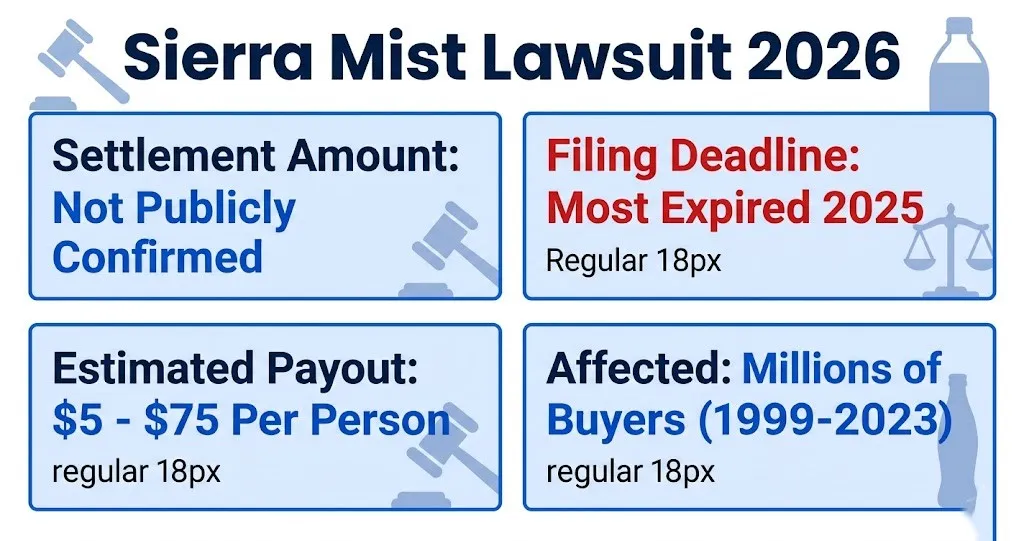
No large, publicly announced Sierra Mist settlement has been confirmed as of 2026. Unlike high-profile food labeling cases such as the Red Bull $13 million settlement or the Naked Juice $9 million payout, Sierra Mist-related claims appear to have been resolved quietly or dismissed.
That doesn’t mean no money changed hands. Companies like PepsiCo frequently settle consumer complaints through confidential agreements. These settlements include non-disclosure clauses that prevent plaintiffs from discussing the terms publicly.
Small individual settlements likely occurred. When a company knows it has labeling exposure, paying a few thousand dollars to make a complaint go away is cheaper than litigating. Think of it like paying a parking ticket versus fighting it in court for months.
- Publicly confirmed Sierra Mist settlement amount: None
- Estimated individual settlements: Unknown, likely small
- Comparable settlements: Red Bull ($13M in 2014), Naked Juice ($9M in 2013)
- Likelihood of future large settlement: Low, given product discontinuation
| Comparison | Settlement Amount | Year | Issue |
|---|---|---|---|
| Red Bull | $13 million | 2014 | “Gives You Wings” false claims |
| Naked Juice | $9 million | 2013 | “All Natural” labeling |
| Vitaminwater | $5.8 million (est.) | 2015 | Health claims |
| Sierra Mist | None publicly confirmed | N/A | “Natural” labeling |
The absence of a public settlement is notable. It suggests either the cases were too weak to force PepsiCo’s hand, or settlements were so small they stayed confidential. Either way, consumers hoping for a big payout from Sierra Mist are likely out of luck.
Sierra Mist Lawsuit Payout: How Much Could Claimants Receive?
The Sierra Mist lawsuit payout for individual consumers would likely be small, based on comparable cases. In similar food and beverage false advertising settlements, individual payouts typically range from $5 to $50 without proof of purchase.
If proof of purchase is provided, payouts can be higher. In the Red Bull settlement, consumers could claim up to $4 per can or a free four-pack. In the Naked Juice case, claimants received up to $75 with receipts.
For Sierra Mist, no formal claims process exists in 2026. But if a future settlement were reached, here’s what history suggests:
| Payout Scenario | Estimated Amount | Condition |
|---|---|---|
| No proof of purchase | $5 to $15 | Self-attestation of buying the product |
| With receipts | $20 to $75 | Documented purchase history |
| Documented harm | $100 to $500 | Medical records or allergic reaction evidence |
| Class representative | $2,000 to $10,000 | Named plaintiff bonus |
These numbers are estimates based on precedent, not confirmed Sierra Mist figures. The actual payout depends on the total settlement fund, the number of claimants, and attorney fees (which typically take 25% to 33% of the fund).
The math is simple but sobering. Even a $10 million settlement, split among hundreds of thousands of claimants after attorney fees, leaves each person with pocket change. That’s the reality of most consumer class action payouts.
Who Can File a Sierra Mist Lawsuit Claim?
Anyone who purchased Sierra Mist during the period covered by a specific legal claim could potentially qualify. In practice, the window for new filings is nearly closed in 2026 due to statutes of limitations and the product’s discontinuation.
To have standing, a potential plaintiff typically needs to show:
- They purchased Sierra Mist during the relevant time period
- They relied on specific marketing claims (like “natural”) when making their purchase
- They suffered some form of economic harm (overpaying for a product based on misleading claims)
Physical injury isn’t required for false advertising claims. The “harm” is financial: you paid a premium price for a product you believed was natural, and it wasn’t what you thought.
| Eligibility Factor | Details |
|---|---|
| Who qualifies | Consumers who bought Sierra Mist |
| Time period | Varies by claim, typically 2010 to 2023 |
| Required proof | Receipts helpful but not always required |
| Geographic limits | Some claims are state-specific (California, New York) |
| Filing deadline | Most expired by late 2025 or early 2026 |
State matters a lot here. California and New York have the strongest consumer protection laws for food labeling cases. Residents of those states had the best chance of qualifying.
If you’re reading this in 2026 and haven’t filed yet, your options are limited. Check with a consumer rights attorney in your state to confirm whether any open claims still accept new participants.
Key Takeaway: Most filing windows for Sierra Mist claims have closed by 2026, but consumers in states with strong consumer protection laws like California may still have limited options worth exploring.
Sierra Mist Discontinued Lawsuit: Can You Sue Over a Dead Brand?
The Sierra Mist discontinued lawsuit question comes up because the product is no longer sold. Can you sue over a product that doesn’t exist anymore? Legally, yes. Practically, it gets complicated.
Discontinuing a product doesn’t erase past misconduct. If PepsiCo’s labeling was misleading while Sierra Mist was on shelves, that violation doesn’t vanish just because the product is gone. Courts look at what happened during the period of sale.
The challenge is practical, not legal. Once a product is discontinued:
- Evidence becomes harder to gather (old labels, packaging, ads)
- Consumer memory fades (did you really read the label?)
- Courts question ongoing relevance (why are we litigating a dead product?)
- Judges may deprioritize the case on crowded dockets
PepsiCo can also argue that discontinuation mooted the case. If the misleading label no longer exists, what’s the court supposed to order? You can’t demand they change a label on a product they don’t sell.
The counterargument is damages. Even if the product is gone, consumers who overpaid deserve compensation. Courts have accepted this reasoning in other cases, but judges tend to be skeptical when years have passed since the product was pulled.
| Legal Principle | Application to Sierra Mist |
|---|---|
| Past harm still actionable | Yes, but harder to prove |
| Mootness defense | Strong for PepsiCo |
| Damages still available | Yes, for overpayment |
| Practical litigation value | Low in 2026 |
The bottom line: suing over a discontinued product isn’t impossible, but the odds get worse every year the product has been off shelves. By 2026, Sierra Mist has been gone for three years. That’s a long time in litigation terms.
Frequently Asked Questions
Is the Sierra Mist lawsuit real or fake?
Real lawsuits about Sierra Mist’s “natural” labeling were filed in U.S. courts against PepsiCo.
The viral social media story about a girl winning millions is unverified and likely fabricated.
Always check for court case numbers before believing lawsuit stories online.
Who is the Sierra Mist lawsuit girl?
The “Sierra Mist lawsuit girl” is a figure from viral social media posts claiming a young girl sued PepsiCo.
No court records, news reports, or legal databases confirm this specific case.
The story spread widely on TikTok and Twitter in late 2022 but lacks any verified source.
Can I still file a Sierra Mist lawsuit claim in 2026?
Most filing windows have closed since Sierra Mist was discontinued in January 2023.
Statutes of limitations for consumer fraud typically run 2 to 4 years from the purchase date.
Contact a consumer rights attorney in your state for case-specific guidance.
How much money will I get from the Sierra Mist settlement?
No public Sierra Mist settlement has been announced as of 2026.
Based on comparable food labeling cases, individual payouts would likely range from $5 to $75.
Claimants with proof of purchase and documented harm would receive more.
Did PepsiCo replace Sierra Mist with Starry because of the lawsuit?
PepsiCo stated the switch was a brand refresh decision, not a response to legal action.
The company wanted to better compete with Sprite in the lemon-lime soda market.
Timing with legal complaints was coincidental according to PepsiCo’s public statements.
This story isn’t over, but the main chapter is closing. The real Sierra Mist legal issues were about labeling, not the dramatic tales that spread online. If you bought Sierra Mist and feel misled, check whether your state has any remaining filing options.
Stay informed about Starry-related developments. PepsiCo’s history with labeling disputes suggests this pattern could repeat. Watch for announcements from consumer advocacy groups tracking beverage industry practices.
Your best next step: verify your state’s statute of limitations for consumer fraud claims. Time is running out if it hasn’t already.