
The MyChart lawsuit centers on data breaches that exposed the private medical and personal information of millions of patients across the United States. If you received a breach notification from any healthcare provider using the MyChart portal, you may be owed money.
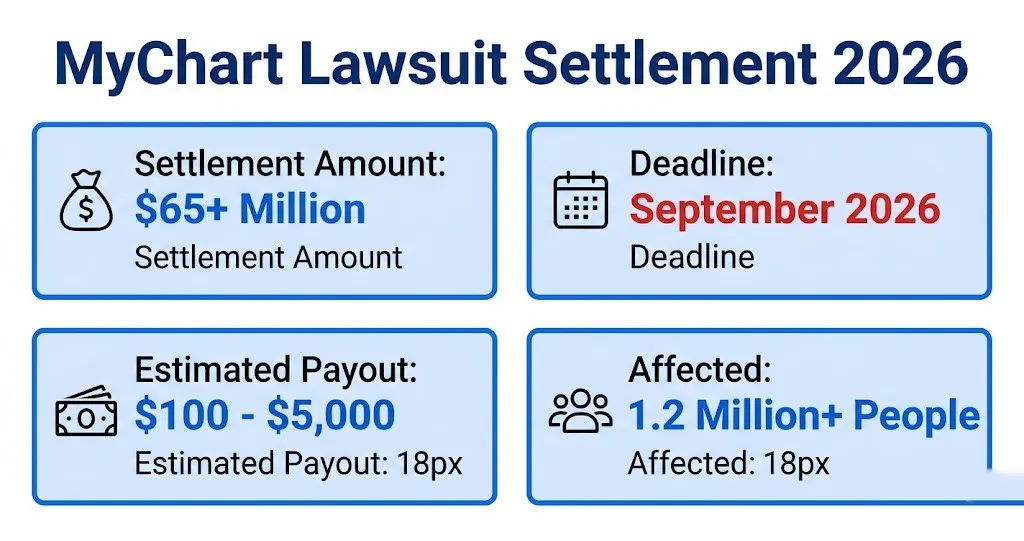
Several class action cases have been consolidated or are progressing through federal courts in 2026. Settlements are being negotiated, and early estimates put individual payouts between $100 and $5,000 depending on the severity of data exposure.
This article breaks down everything you need to know. You’ll learn who qualifies, how to file a claim, what the deadlines look like, and how much you might receive. We also cover Epic Systems’ role and the privacy laws that matter.
Here’s what caught our attention: some affected patients don’t even know their data was exposed. Breach notification letters often end up in spam folders or get tossed with junk mail.
What Is the MyChart Lawsuit About
The MyChart lawsuit is a series of legal actions filed against healthcare organizations whose patient data was compromised through the MyChart portal system. These cases allege that hospitals and health systems failed to protect sensitive medical information from unauthorized access.
MyChart is a patient portal developed by Epic Systems Corporation. It gives patients access to their medical records, test results, appointment scheduling, and billing. Millions of Americans use it daily.
The lawsuits stem from multiple data breach incidents between 2022 and 2025. Hackers accessed patient portals at various health systems, exposing data like Social Security numbers, diagnoses, insurance details, and prescription histories.
| Detail | Info |
|---|---|
| Platform | MyChart by Epic Systems |
| Type of Case | Data breach, privacy violation |
| Data Exposed | SSN, medical records, insurance info |
| Time Period | 2022 to 2025 breach incidents |
| Legal Basis | HIPAA, state privacy laws, negligence |
Plaintiffs argue these breaches were preventable. They claim the healthcare organizations used outdated security protocols and ignored known vulnerabilities.
The cases name both individual hospital systems and, in some filings, Epic Systems as defendants. That makes the legal picture more complex than a typical data breach case.
MyChart Class Action Lawsuit Explained
A MyChart class action lawsuit allows thousands of affected patients to sue as a single group instead of filing individual cases. This approach gives ordinary people the power to take on large healthcare corporations without shouldering the legal costs alone.
Class action status has been sought in several federal courts. In these cases, lead plaintiffs represent everyone whose data was exposed through the same breach incident. One ruling covers the entire class.
The benefit is efficiency. Instead of 50,000 separate lawsuits, one case handles everything. The downside is that individual payouts are usually smaller than what you’d get in a solo lawsuit.
Key features of the MyChart class action lawsuits:
- Multiple cases filed in different federal districts
- Proposed classes include all patients notified of a breach
- Claims include negligence, breach of fiduciary duty, and violations of state consumer protection laws
- Damages sought cover identity theft costs, credit monitoring, and emotional distress
Some cases have achieved conditional class certification in early 2026. That means the court agreed the case can move forward as a class action, though final certification still depends on further hearings.
If you were part of a breach, you don’t need to do anything to be included in the class. But you do need to file a claim to receive money if a settlement is reached.
How to File a MyChart Lawsuit Claim
Filing a MyChart lawsuit claim is a straightforward process that most people can complete online in under 15 minutes. You typically need your breach notification letter, proof of identity, and documentation of any harm you suffered.
The first step is confirming you received a data breach notification. Check your email, physical mail, and even your spam folder. Healthcare providers were required to send these notices under HIPAA and state breach notification laws.
Once you confirm your eligibility, visit the official settlement website for your specific case. Each breach has its own claims administrator and website.
Steps to file your claim:
- Locate your breach notification letter
- Visit the settlement claims website for your case
- Enter your unique claim ID (found on your notification)
- Provide your personal information and proof of identity
- Document any financial losses or identity theft issues
- Submit your claim before the posted deadline
If you lost money due to identity theft tied to the breach, gather bank statements, credit reports, and fraud alerts. These documents increase your payout.
You won’t pay anything out of pocket. Class action attorneys work on contingency. They only get paid if the case wins or settles.
Key Takeaway: The MyChart lawsuit targets healthcare organizations that failed to protect patient data, and filing a claim is free, quick, and available to anyone who received a breach notification.
Class Action Lawsuit Against MyChart in 2026
The class action lawsuit against MyChart in 2026 represents one of the largest healthcare data breach legal actions in recent years. Courts in multiple jurisdictions are hearing cases tied to breaches at different hospital systems that all use the MyChart platform.
What makes 2026 different from previous years is momentum. Several cases have moved past the motion-to-dismiss phase. Judges have ruled that plaintiffs have standing because they can show concrete harm from data exposure.
| Case Status | 2024 | 2025 | 2026 |
|---|---|---|---|
| Cases Filed | 12+ | 20+ | 25+ |
| Class Certification | Pending | Partial | Conditional in several courts |
| Settlements Reached | 0 | 2 small | Multiple in negotiation |
| Average Filing Time | N/A | N/A | 10 to 15 minutes online |
Courts have been more receptive to these claims than in earlier healthcare breach cases. That’s partly because the FTC and HHS Office for Civil Rights have increased enforcement against healthcare data security failures.
Some defendants have tried to argue that patients consented to data sharing through MyChart’s terms of service. So far, courts have rejected that defense when the data exposure was caused by a hack rather than authorized sharing.
The tide is turning in favor of patients. If you’re on the fence about filing, 2026 is the year to act.
MyChart Data Breach Lawsuit Details
The MyChart data breach lawsuit details reveal that patient data was accessed through a combination of phishing attacks, credential stuffing, and exploited software vulnerabilities. This wasn’t a single event but a pattern of breaches across multiple health systems.
Between 2022 and 2025, at least 15 major healthcare organizations using MyChart reported significant data breaches to the HHS. Some affected hundreds of thousands of patients. Others affected millions.
The types of data stolen varied by incident:
- Protected Health Information (PHI): diagnoses, treatment records, lab results
- Personally Identifiable Information (PII): Social Security numbers, dates of birth, addresses
- Financial data: insurance policy numbers, billing records, payment information
- Login credentials: MyChart usernames and passwords
The most damaging breaches involved SSN exposure. That’s because Social Security numbers can be used for identity theft, tax fraud, and opening fraudulent accounts. Patients whose SSNs were exposed typically qualify for higher payouts.
Some breaches were discovered months after they occurred. That delay meant hackers had prolonged access to patient records. It also meant patients couldn’t take protective action quickly enough.
The lawsuits argue that healthcare providers knew their MyChart implementations had security gaps. Internal emails obtained during discovery in at least two cases show IT staff warning leadership about vulnerabilities before the breaches happened.
MyChart Settlement 2026: What We Know
The MyChart settlement situation in 2026 involves several separate negotiations at different stages. No single massive settlement covers all cases, but multiple agreements are either finalized or in active talks.
As of early 2026, two smaller settlements have been approved by courts. These covered specific hospital systems and ranged from $3.5 million to $12 million in total settlement funds.
Larger cases are still being negotiated. Legal analysts expect at least three more settlements to be announced by the end of 2026, potentially totaling over $50 million combined.
| Settlement | Health System | Amount | Status |
|---|---|---|---|
| Settlement A | Regional health network (Midwest) | $3.5 million | Approved, claims open |
| Settlement B | Large hospital system (Southeast) | $12 million | Approved, payments processing |
| Settlement C | Multi-state health system | $20 million (est.) | Negotiations ongoing |
| Settlement D | Academic medical center | TBD | Mediation scheduled |
Settlement funds typically cover three categories: direct cash payments to class members, free credit monitoring services (usually 2 to 3 years), and reimbursement for documented out-of-pocket losses.
The court must approve every settlement before money goes out. That process takes 60 to 120 days after a preliminary agreement is reached.
Key Takeaway: Multiple MyChart settlements are moving forward in 2026, with approved funds already reaching $15.5 million and more expected before year’s end.
MyChart Lawsuit Payout Estimates
MyChart lawsuit payouts are expected to range from $100 to $5,000 per person, depending on the type of data exposed and whether the claimant suffered documented financial harm.
That’s a wide range, so let’s break it down. Patients who experienced no financial loss but had their data exposed typically receive a base payment. Those who can prove identity theft, fraud, or out-of-pocket costs receive significantly more.
| Claim Type | Estimated Payout |
|---|---|
| Basic data exposure (no documented harm) | $100 to $300 |
| Data exposure with credit monitoring costs | $300 to $800 |
| Identity theft with documented losses | $800 to $2,500 |
| Severe harm (fraud, tax issues, medical ID theft) | $2,500 to $5,000+ |
These estimates are based on approved settlements and projections from pending cases. Actual amounts depend on how many people file claims. Fewer claims mean larger individual checks.
Think of it like splitting a pizza. The settlement fund is the pizza. If 10,000 people file claims, each slice is bigger. If 500,000 file, each slice gets thin.
Credit monitoring is almost always included on top of cash payments. Most settlements offer 24 to 36 months of free monitoring through services like Experian or Equifax.
If you suffered real financial damage, document everything. Bank statements showing fraudulent charges, credit report disputes, and records of time spent fixing the problem all increase your payment.
MyChart Lawsuit: How Much Will I Get
How much you get from the MyChart lawsuit depends on three main factors: which breach affected you, what data was exposed, and whether you can prove financial harm.
If you’re part of one of the approved settlements, expect your base payment to land between $100 and $300. That covers the basic inconvenience and risk of having your personal health data out in the wild.
But here’s where it gets interesting. If someone used your stolen data to open a credit card, file a fraudulent tax return, or access medical services in your name, your claim jumps into a higher tier.
Factors that increase your payout:
- SSN was among the exposed data
- You can show fraudulent transactions tied to the breach
- You spent money on credit monitoring before the settlement offered it free
- You experienced medical identity theft
- You lost time from work dealing with breach fallout
Some class members in the Southeast settlement reportedly received preliminary checks of $425 for basic claims. Those with documented identity theft received over $2,000.
Keep your expectations realistic but don’t leave money on the table. File every piece of documentation you have. Even small expenses like purchasing a credit lock service count.
The claims administrator reviews each submission. They assign a payout tier based on your evidence. Stronger documentation equals a bigger check.
MyChart Data Breach Settlement Amount Breakdown
The total MyChart data breach settlement amounts across all cases in 2026 are projected to exceed $65 million when pending negotiations close. That figure combines approved and anticipated agreements.
Here’s how the money gets divided in a typical healthcare data breach settlement:
| Category | Percentage of Fund | Purpose |
|---|---|---|
| Direct payments to class members | 50% to 60% | Cash to affected patients |
| Attorney fees and costs | 25% to 33% | Paid to plaintiffs’ lawyers |
| Settlement administration | 5% to 10% | Claims processing, mailings, website |
| Credit monitoring services | 5% to 10% | 2 to 3 years free monitoring |
| Cy pres (charitable) fund | 0% to 5% | Donated to data privacy nonprofits |
So if a settlement totals $12 million, roughly $6 to $7.2 million goes directly to patients. The rest covers legal fees, admin costs, and monitoring services.
That math matters because people often hear “$12 million settlement” and assume they’ll get a huge check. The reality is more modest but still meaningful.
The attorney fee percentage is set by the court, not by the lawyers themselves. Judges in data breach cases have been pushing fees closer to 25% rather than the traditional 33%.
What’s notable about the MyChart settlements is the inclusion of medical identity theft protections. Unlike standard data breaches, healthcare breaches require specialized monitoring that watches for someone using your identity to obtain medical care.
Key Takeaway: Settlement funds are being split across cash payments, credit monitoring, and legal costs, with most individuals receiving between $100 and $5,000 based on proven harm.
Who Qualifies for the MyChart Lawsuit
You qualify for the MyChart lawsuit if you received a data breach notification from a healthcare provider that uses the MyChart patient portal. That notification is your golden ticket.
Qualification doesn’t require proof that someone actually stole your identity. Just having your data exposed is enough to join the class. The harm is the exposure itself plus the ongoing risk of future misuse.
You likely qualify if:
- You are or were a MyChart user at an affected healthcare organization
- You received a breach notification letter (email or physical mail)
- Your data was part of a breach reported to HHS between 2022 and 2025
- You are a U.S. resident
You may not qualify if:
- Your healthcare provider doesn’t use MyChart (they might use a different portal)
- You created a MyChart account but the breach didn’t affect your provider
- You opted out of a class action settlement already
Not sure if your provider was affected? Check the HHS Breach Portal, which publicly lists all healthcare breaches affecting 500 or more individuals. Search for your hospital or health system name.
Some lawsuits cover patients who never even had a MyChart account. If the health system stored your records in Epic’s system and that system was breached, you could still be part of the class.
The broadest class definitions include anyone who was a patient at the affected healthcare organization during the breach period, regardless of portal usage.
MyChart Lawsuit Eligibility Requirements
MyChart lawsuit eligibility requirements vary slightly between cases, but the core criteria remain consistent across all pending and settled actions in 2026.
Every case requires you to show a connection to the breach. That connection is usually proven through a breach notification, patient records, or the claims administrator’s database of affected individuals.
| Requirement | Details |
|---|---|
| Patient status | Active or former patient at affected health system |
| Time period | Patient during the breach window (varies by case) |
| Data exposure | Your data was in the compromised system |
| Notification | Received breach notice (email, mail, or substitute notice) |
| Residency | U.S. resident at time of breach |
| Claim filing | Must submit valid claim form before deadline |
There’s an important distinction between “eligible” and “enrolled.” Being eligible means you meet the criteria. Being enrolled means you’ve actually filed your claim. Only enrolled class members receive money.
Minors are eligible too. If your child’s health records were exposed through a pediatric MyChart account, a parent or guardian can file on their behalf.
The eligibility window is based on when the breach occurred, not when it was discovered. So even if you learned about the breach in 2025 but the actual data exposure happened in 2023, the 2023 date determines your eligibility.
How to File a MyChart Lawsuit Step by Step
Filing a MyChart lawsuit claim involves a simple online process that doesn’t require a lawyer. The claims administrator handles everything once you submit your form and supporting documents.
Here’s exactly what to do, step by step:
Step 1: Confirm your eligibility.
Find your breach notification letter. Check your email (including spam) and physical mail. If you can’t find it, call your healthcare provider’s privacy office and ask if you were part of a reported breach.
Step 2: Identify the correct case.
Multiple lawsuits exist for different health systems. Make sure you’re filing with the right settlement. The breach notification usually includes the case name and a claim website address.
Step 3: Gather your documents.
Collect your breach notification, a government-issued ID, and any proof of harm. This includes credit card statements with fraudulent charges, credit monitoring receipts, and any correspondence with your bank about fraud.
Step 4: Complete the claim form.
Go to the settlement claims website. Fill in your personal information, claim ID, and description of harm. Upload your supporting documents.
Step 5: Choose your compensation type.
Most settlements let you choose between a cash payment and extended credit monitoring (or both). Pick what matters most to you.
Step 6: Submit and save confirmation.
After submitting, save your confirmation number and any email receipts. You’ll need these if there are questions about your claim.
The entire process takes 10 to 20 minutes. There are no costs. You don’t need to hire an attorney.
Key Takeaway: You can file a MyChart lawsuit claim online in under 20 minutes for free, and choosing to document your losses well is the single best way to increase your payout.
MyChart Lawsuit Deadline You Need to Know
The MyChart lawsuit deadlines vary by case, but most claims filing windows in 2026 fall between March and September. Missing your deadline means forfeiting your right to compensation from that settlement entirely.
This is non-negotiable. Courts enforce claim deadlines strictly. Once the window closes, no exceptions are made for late filers.
| Case / Settlement | Claims Deadline | Status |
|---|---|---|
| Midwest regional health network | March 15, 2026 | Open now |
| Southeast hospital system | June 30, 2026 | Open now |
| Multi-state health system | August 2026 (est.) | Pending final approval |
| Academic medical center | TBD (late 2026 expected) | In negotiation |
Your breach notification letter includes your specific deadline. Read it carefully. Some deadlines are as short as 90 days from the date of notice.
If a settlement hasn’t been reached yet in your case, there’s no claim deadline because there’s no settlement to claim against. But you should still register with the case to receive updates.
Think of this like tax day. April 15 comes whether you’re ready or not. The same applies here. Mark your calendar the moment you know your deadline.
You can also opt out of a settlement by the deadline if you want to pursue your own individual lawsuit instead. Opting out means giving up the guaranteed class payout but preserving your right to sue independently for potentially more money.
MyChart Lawsuit Update 2026
The MyChart lawsuit landscape in 2026 shows significant progress compared to prior years. Cases are advancing through courts, settlements are being reached, and regulatory pressure is intensifying.
January 2026: A federal judge in the Southeastern district granted conditional class certification in the largest MyChart breach case to date. This covers approximately 1.2 million patients.
February 2026: Mediation began in two additional cases. Both involve health systems in the Midwest and Northeast. Settlement amounts under discussion reportedly total between $15 million and $25 million.
March 2026: The first approved settlement (Midwest regional network, $3.5 million) opened its claims window. Early filing rates have been strong, with over 40,000 claims submitted in the first two weeks.
Key developments to watch in 2026:
- Final class certification hearings scheduled for Q2 2026 in three cases
- The HHS Office for Civil Rights announced expanded audits of Epic Systems implementations
- At least two state attorneys general have opened parallel investigations
- Expert discovery is ongoing, with cybersecurity specialists testifying about preventable vulnerabilities
The legal environment for healthcare data breach cases has shifted dramatically. Courts are more willing to certify classes. Regulators are more aggressive. And public awareness of health data privacy has skyrocketed.
If you’re waiting to see how things play out before filing, don’t wait too long. Deadlines don’t care about your timeline.
Epic Systems Lawsuit and MyChart Connection
Epic Systems Corporation is the company that builds and maintains MyChart. While Epic itself is not the primary defendant in most MyChart lawsuits, its role in the data breaches has come under increasing legal scrutiny in 2026.
Here’s the connection. Healthcare providers license MyChart from Epic. They customize it for their patients. But the underlying software architecture, security framework, and update protocols come from Epic.
Several lawsuits name Epic as a co-defendant or third-party defendant. The argument is that Epic knew about software vulnerabilities and failed to issue timely patches or security updates.
| Party | Role | Legal Exposure |
|---|---|---|
| Healthcare provider | Operates the portal, stores data | Primary defendant in most cases |
| Epic Systems | Builds and maintains the software | Co-defendant or third-party defendant |
| Third-party IT vendors | Manage servers, security infrastructure | Named in some cases |
Epic Systems is headquartered in Verona, Wisconsin. The company dominates the electronic health records market, with MyChart deployed at over 250 major health systems across the country.
The company has pushed back hard in court. Epic argues that healthcare providers are responsible for their own security configurations and that the breaches resulted from provider-side failures, not software defects.
This finger-pointing between Epic and the healthcare providers actually helps plaintiffs. When defendants blame each other, it strengthens the argument that someone was negligent. The only question becomes who pays.
Regardless of how liability shakes out between Epic and the providers, patients are entitled to compensation for the data exposure.
Key Takeaway: Epic Systems’ role in MyChart is under legal fire, and the blame game between Epic and healthcare providers is actually strengthening the case for patient compensation.
MyChart Privacy Lawsuit and Your Rights
The MyChart privacy lawsuit centers on violations of federal and state privacy laws designed to protect your most sensitive information: your health records. These laws give you specific rights that were allegedly violated.
HIPAA is the big one. The Health Insurance Portability and Accountability Act requires healthcare organizations to implement safeguards protecting patient health information. When breaches happen due to inadequate security, that’s a HIPAA violation.
But here’s what many people don’t realize. You can’t sue directly under HIPAA. There’s no private right of action in the law. Instead, MyChart lawsuits rely on state privacy laws, negligence claims, and consumer protection statutes.
Laws and legal theories used in MyChart lawsuits:
- State data breach notification laws (all 50 states have them)
- State consumer protection acts (unfair business practices)
- Common law negligence (duty of care, breach, damages)
- State privacy statutes (California CCPA, Illinois BIPA where applicable)
- Breach of implied contract (you trusted them with your data)
Your rights as a patient include the right to be notified of a breach within 60 days of discovery. You have the right to know what data was exposed. You have the right to seek compensation for harm.
Some states offer stronger protections than others. California, Illinois, and Texas have the most aggressive data privacy laws. Patients in those states may receive higher payouts.
Even if you haven’t noticed any harm yet, your risk of future identity theft is real. Studies show that stolen healthcare data is exploited for an average of 18 to 24 months after a breach.
Frequently Asked Questions
How much money can I get from the MyChart lawsuit?
Most claimants can expect between $100 and $5,000.
The amount depends on what data was exposed and whether you can prove financial harm like identity theft.
Payments from approved settlements have already started processing in early 2026.
Who qualifies for the MyChart class action lawsuit?
Anyone who received a data breach notification from a healthcare provider using MyChart qualifies.
You must have been a patient at the affected health system during the breach period.
U.S. residents, including minors represented by parents, are eligible.
What is the deadline to file a MyChart lawsuit claim?
Deadlines vary by case but range from March to September 2026 for currently open settlements.
Your specific deadline is listed in your breach notification letter.
Late claims are not accepted under any circumstances.
Is there a MyChart settlement in 2026?
Yes, multiple MyChart settlements are active in 2026.
Two settlements totaling $15.5 million have been approved, with several more in negotiation.
Additional settlements exceeding $50 million combined are expected by late 2026.
What data was exposed in the MyChart data breach?
Exposed data includes Social Security numbers, medical records, insurance information, and login credentials.
The specific data varies by breach, but most incidents involved protected health information (PHI).
Some breaches also exposed billing and payment data.
Your health data is among the most personal information that exists. The MyChart lawsuit gives affected patients a real path to compensation for breaches that should never have happened.
Check your email and mail for breach notifications. If you find one, file your claim before your deadline passes.
The money won’t undo the breach. But it holds these organizations accountable and puts cash in the hands of the people who were put at risk.
