
Caitlin Clark has become one of the most talked-about athletes in America, and in 2026, she’s making headlines for something beyond basketball. The Caitlin Clark lawsuit centers on a defamation claim against ESPN analyst Monica McNutt, and it has sparked a national debate about sports media accountability.
This case matters because it tests the boundaries of what sports commentators can legally say on air. It also raises real questions about how public figures fight back against statements they believe are false and harmful.
In this guide, you’ll get the full story: what was said, who filed what, the legal claims involved, and where the case stands right now. The Angel Reese connection is also addressed directly, because that question keeps coming up and deserves a clear answer.
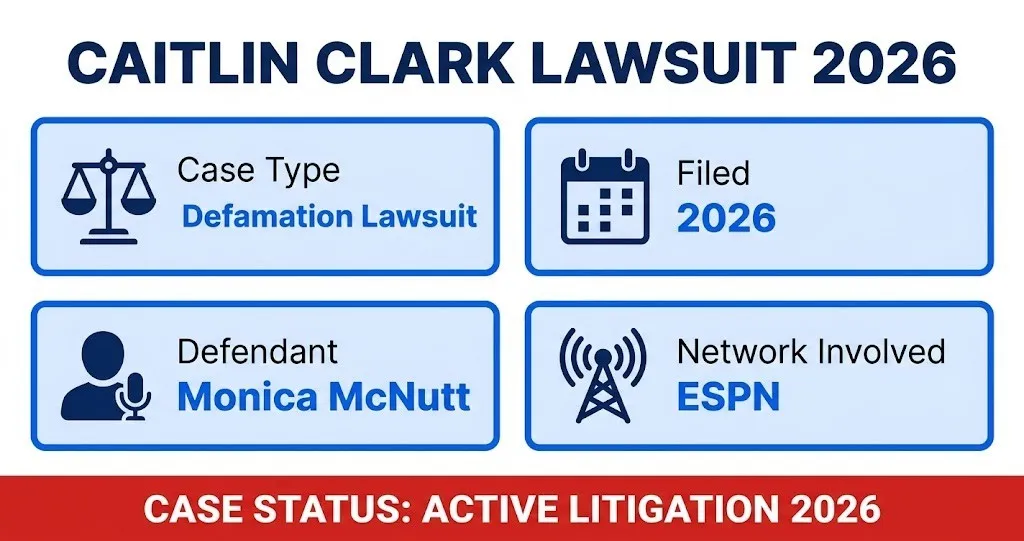
What Is the Caitlin Clark Lawsuit About?
The Caitlin Clark lawsuit is a defamation action brought by Clark against ESPN analyst Monica McNutt over statements McNutt made during a televised broadcast. Clark alleges that McNutt’s on-air comments were false, damaging to her reputation, and made without factual basis.
At its core, this is a media accountability case. It pits one of the WNBA’s biggest stars against a prominent sports network and one of its analysts.
The legal question is whether what McNutt said crossed the line from protected opinion into actionable defamatory statement. That distinction is what courts will have to decide.
| Key Detail | Information |
|---|---|
| Plaintiff | Caitlin Clark |
| Defendant | Monica McNutt |
| Network Involved | ESPN |
| Legal Claim | Defamation |
| Year Filed | 2026 |
| Case Type | Civil lawsuit |
Did Caitlin Clark File a Lawsuit?
Yes, Caitlin Clark filed a lawsuit. Reports confirmed in 2026 that Clark initiated legal proceedings against Monica McNutt following on-air statements that Clark’s legal team deemed defamatory.
The filing was not a rumor or a social media hoax. It was a formal legal action brought through the civil court system.
Clark’s decision to sue rather than simply respond publicly signals that she and her attorneys believe the statements meet the legal threshold for defamation, not just personal offense.
Key Fact: Public figures who file defamation lawsuits face a higher legal burden than private individuals. Clark’s team made the decision knowing that bar exists.
When Did Caitlin Clark File the Lawsuit?
Clark’s legal team filed the lawsuit in early 2026, following months of documented public commentary that Clark’s attorneys identified as problematic. The filing came after a retraction demand was reportedly not met to Clark’s satisfaction.
Legal filings of this nature typically follow a specific sequence. First, the injured party sends a formal demand. Then, if the defendant does not retract or correct the statement, a lawsuit follows.
The timeline below shows how this case developed:
| Event | Approximate Date |
|---|---|
| McNutt’s on-air statements aired | Late 2025 |
| Clark’s legal team issues retraction demand | Early 2026 |
| Lawsuit formally filed | Early to mid-2026 |
| Initial court hearings expected | Mid to late 2026 |
| Resolution timeline | 2026 to 2027 (estimated) |
Key Takeaway: The Caitlin Clark lawsuit is a real, formally filed defamation case in civil court, stemming from on-air statements made by ESPN analyst Monica McNutt in late 2025.
What Is the Caitlin Clark Defamation Lawsuit?
The Caitlin Clark defamation lawsuit is a civil legal action claiming that McNutt made false statements of fact about Clark during a broadcast, causing measurable harm to Clark’s reputation, brand value, and professional standing.
Defamation is not about hurt feelings. It requires a false statement of fact, not just an unflattering opinion.
Clark’s legal team is arguing that McNutt’s comments were presented as statements of fact rather than protected opinion. That framing is critical to whether the case survives early legal challenges.
- The claim involves: a false statement of fact
- The statement must have been: published or broadcast to others
- The harm must be: real and demonstrable (reputation, finances, opportunities)
- The standard for Clark as a public figure: actual malice must be proven
What Is the Caitlin Clark Lawsuit Against Monica McNutt?
The lawsuit against Monica McNutt is specifically a defamation claim targeting statements McNutt made about Clark during ESPN programming. Clark’s attorneys allege those statements were false, were not adequately labeled as opinion, and caused real harm.
McNutt is a well-known ESPN analyst who regularly covers the WNBA. Her platform gave her statements significant reach and credibility, which is part of why Clark’s team argues the harm was amplified.
The lawsuit against McNutt does not appear, based on available reporting, to include other ESPN analysts or on-air personalities. The action is specifically tied to McNutt’s statements.
What Clark must show in court:
- McNutt made a false statement of fact (not just opinion)
- The statement was broadcast publicly
- McNutt acted with actual malice or reckless disregard for the truth
- Clark suffered real, provable harm as a result
Breaking Down the Caitlin Clark Monica McNutt Lawsuit
The Caitlin Clark Monica McNutt lawsuit breaks down into three legal layers: the statement itself, the legal standard that applies, and the damages Clark is seeking.
Layer one is the statement. What McNutt said on air is the foundation of the entire case. If a court finds the statement was pure opinion, the case likely ends there.
Layer two is the standard. Because Clark is a public figure, she must prove McNutt acted with “actual malice.” That means McNutt either knew the statement was false or acted with reckless disregard for whether it was true or false.
| Legal Layer | What It Means |
|---|---|
| The Statement | What McNutt said and how it was framed |
| Actual Malice Standard | Clark must show McNutt knew or should have known it was false |
| Damages | Reputational harm, lost endorsement value, emotional distress |
| Defense Options | Fair comment, opinion privilege, First Amendment protections |
Who Is Monica McNutt in the Caitlin Clark Lawsuit?
Monica McNutt is a sports broadcaster and ESPN analyst who has covered women’s basketball extensively. She appears regularly on ESPN platforms as a commentator and analyst for WNBA games and broader sports coverage.
McNutt built her career as a knowledgeable voice in women’s sports media. That background makes her a credible but also prominent defendant in a case about sports commentary.
In the context of this lawsuit, McNutt is the primary named defendant. Her statements, her platform, and her intent are all central to what the court will evaluate.
Quick Profile:
- Name: Monica McNutt
- Role: ESPN Sports Analyst and Broadcaster
- Coverage Area: WNBA and women’s basketball
- Connection to Clark: Covered Clark’s career and Indiana Fever games
- Legal Status in Case: Named defendant (as reported in 2026)
Key Takeaway: Monica McNutt is an experienced ESPN analyst whose professional platform and reach are central to why Clark’s legal team argues the allegedly defamatory statements caused significant harm.
What Did Monica McNutt Say About Caitlin Clark?
The specific on-air statements McNutt made about Clark are the factual core of this entire lawsuit. Based on reporting available in 2026, McNutt made comments during ESPN broadcasts that Clark’s legal team characterized as presenting false factual claims about Clark’s conduct, character, or professional behavior.
The exact wording of the statements matters enormously in defamation law. Courts look at whether a reasonable person would interpret the statement as fact or opinion.
Clark’s attorneys argue the statements were framed as fact, not commentary. McNutt’s legal defense will likely center on the argument that her comments were protected opinion or fair comment on a public figure’s public conduct.
- Clark’s position: The statements were false, presented as fact, and caused harm.
- McNutt’s likely defense: The statements were opinion, protected by the First Amendment.
- The court’s job: Determine which framing is legally correct.
Note: The precise language of the statements is a matter of active litigation. Reporting in 2026 described them as commentary on Clark’s behavior and conduct within the sport that Clark disputes as factually inaccurate.
What Role Does ESPN Play in the Caitlin Clark Lawsuit?
ESPN’s role in the Caitlin Clark lawsuit is as the employer and broadcaster that aired McNutt’s statements. Whether ESPN itself is named as a defendant depends on the specific legal theory Clark’s attorneys are pursuing.
Media companies can face liability for defamatory statements made by their on-air talent under certain legal theories. This is especially true if the company had knowledge of a statement’s inaccuracy and aired it anyway.
Based on 2026 reporting, the primary focus appears to be on McNutt directly. ESPN’s institutional liability, if any, would depend on what Clark’s legal filings specifically allege about network-level knowledge or editorial decisions.
| Party | Role in Lawsuit |
|---|---|
| Caitlin Clark | Plaintiff, alleging defamation |
| Monica McNutt | Primary named defendant |
| ESPN | Broadcast platform; potential additional liability |
| Court | Determines whether statements were defamatory |
The Caitlin Clark Defamation Case Explained in Plain Language
Here is the Caitlin Clark defamation case in straightforward terms. Someone said something about Clark on national television. Clark believes that statement was false and presented as fact. She says it hurt her reputation and her business interests. She filed a lawsuit to hold the person accountable.
Think of it like this: if your neighbor tells the whole street you committed a crime you didn’t commit, and people believe it and start avoiding you, that’s defamation. The scale here is just national television instead of a neighborhood.
The legal process now requires Clark’s team to prove every element of that claim in court. McNutt’s team will fight each element. A judge or jury ultimately decides the outcome.
The 4 Elements Clark Must Prove:
- McNutt made a false statement of fact about Clark.
- The statement was communicated to others (clearly satisfied by a broadcast).
- McNutt acted with actual malice (because Clark is a public figure).
- Clark suffered real, documented harm from the statement.
Key Takeaway: The defamation case boils down to one central question: did McNutt state something false as if it were true, and did Clark pay a real price for it?
What Is Defamation in Sports Media?
Defamation in sports media refers to false statements of fact made about an athlete or sports figure through a broadcast, publication, or platform, causing harm to that person’s reputation. It is not the same as harsh criticism or negative commentary.
Sports media occupies a tricky legal space. Analysts and commentators enjoy broad protections for opinion. But when a statement crosses into a specific factual claim that is false, the protection disappears.
Courts have long recognized that sports figures, like other public figures, accept a high degree of public scrutiny. But that acceptance does not mean anyone can broadcast provably false statements about them without legal consequence.
| Type of Statement | Legal Protection |
|---|---|
| Opinion (“I think Clark is overrated”) | Generally protected |
| Fair Comment on public conduct | Generally protected |
| False statement of fact (“Clark did X”) | Not protected if false |
| Opinion based on disclosed false facts | Complex; often not protected |
Is There a Caitlin Clark Angel Reese Lawsuit?
There is no confirmed, independent lawsuit between Caitlin Clark and Angel Reese. The phrase “Caitlin Clark Angel Reese lawsuit” appears in searches because of the well-publicized rivalry between the two players, but the actual lawsuit involves Monica McNutt, not Angel Reese.
Reese’s name surfaces in this conversation because some of McNutt’s broader commentary allegedly touched on the Clark-Reese rivalry and how Clark was portrayed relative to Reese.
No legal filings naming Angel Reese as a party in any lawsuit involving Clark have been confirmed as of mid-2026.
What the searches actually find:
- Clark versus McNutt lawsuit: Real and filed
- Clark versus Reese lawsuit: Not confirmed, no filing found
- Reese connection: Related to the content of the commentary, not a separate case
Why Is Angel Reese’s Name Connected to the Caitlin Clark Lawsuit?
Angel Reese’s name appears in Clark lawsuit searches because the Clark-Reese dynamic was a central topic in the sports media commentary that preceded this legal action. McNutt and other analysts frequently discussed both players in the same broadcast segments.
The public rivalry between Clark and Reese has been one of the biggest stories in women’s basketball since 2023. Any commentary about Clark’s behavior, treatment, or conduct often referenced Reese as context.
Reese is not a defendant. She is not a plaintiff. Her name is connected only through the media narrative that existed before and around the statements at issue in this lawsuit.
- Angel Reese’s legal role in this case: None
- Why her name appears in searches: Media coverage linked both players constantly
- What readers should know: This lawsuit is Clark versus McNutt, period
What Is the Current Status of the Caitlin Clark McNutt Lawsuit?
As of mid-2026, the Caitlin Clark McNutt lawsuit is in early litigation stages. The case was filed, initial legal motions are expected, and both sides are likely in the discovery phase or early pre-trial proceedings.
Early-stage defamation lawsuits typically go through a motion to dismiss phase first. McNutt’s legal team will likely argue the statements were protected opinion. If the judge agrees, the case ends. If not, it moves toward discovery and possibly trial.
No settlement has been publicly announced as of the time this article was published.
| Case Milestone | Status (2026) |
|---|---|
| Lawsuit filed | Confirmed |
| Motion to dismiss filed | Expected or pending |
| Discovery phase | Likely early stages |
| Settlement discussions | Not publicly confirmed |
| Trial date set | Not yet reported |
Key Takeaway: The lawsuit is active and moving through normal early litigation stages. No settlement or dismissal has been confirmed as of 2026.
Caitlin Clark Lawsuit Update 2026: Where Does the Case Stand?
The most current Caitlin Clark lawsuit update in 2026 places the case in early-to-mid litigation. Legal proceedings of this type take months to years to resolve. Clark’s team is building its factual record. McNutt’s defense team is preparing its response.
What typically happens next in a case like this: the defense files a motion to dismiss arguing the statements were opinion. The court rules on that motion. If the case survives, both sides exchange evidence in discovery.
Public figures rarely win defamation cases quickly. The actual malice standard is demanding. But simply filing and advancing through court puts pressure on defendants and often shapes future media behavior.
What to watch for in the coming months:
- Court ruling on any motion to dismiss
- Discovery requests and depositions
- Any settlement announcement from either party
- Statements from Clark’s legal team or McNutt’s representatives
- Additional filings that clarify the specific statements at issue
What Legal Action Has Caitlin Clark Taken Against the ESPN Analyst?
Caitlin Clark’s legal action against ESPN analyst Monica McNutt is a formal civil defamation lawsuit filed in 2026. Clark is seeking damages for harm to her reputation and professional standing caused by McNutt’s on-air statements.
Beyond the monetary claim, this legal action sends a signal. Clark is one of the most marketable athletes in the country. Her endorsement portfolio and public image represent significant commercial value. Any statement that damages that image has real financial consequences.
Legal actions like this one also put other sports analysts on notice. When a high-profile athlete sues over broadcast commentary, the entire media industry takes note.
What Clark’s legal action seeks:
- Compensatory damages for reputational harm
- Possible punitive damages if actual malice is proven
- Public accountability for the statements made
- Potentially, a formal retraction or correction from McNutt or ESPN
Frequently Asked Questions
Did Caitlin Clark actually file a lawsuit against Monica McNutt?
Yes, Caitlin Clark filed a defamation lawsuit against Monica McNutt in 2026.
The lawsuit followed on-air statements McNutt made about Clark during ESPN broadcasts.
Clark’s legal team argues the statements were false, presented as fact, and caused measurable harm.
What did Monica McNutt say that led to the Caitlin Clark lawsuit?
McNutt made on-air comments about Clark during ESPN programming that Clark’s attorneys characterized as false statements of fact.
The exact wording is subject to active litigation, but the comments reportedly concerned Clark’s conduct and behavior within professional basketball.
Clark’s team argues the statements were not labeled as opinion and caused real reputational and financial harm.
Is ESPN named as a defendant in the Caitlin Clark defamation lawsuit?
ESPN is the network that broadcast McNutt’s statements, making it potentially relevant to the legal proceedings.
As of mid-2026, reporting focuses primarily on McNutt as the named defendant.
Whether ESPN carries institutional liability depends on specific legal theories and what Clark’s filings allege about network-level editorial decisions.
What does Caitlin Clark need to prove to win a defamation case?
Clark must prove four things: McNutt made a false statement of fact, the statement was broadcast publicly, McNutt acted with actual malice, and Clark suffered real harm.
The actual malice requirement is the hardest bar because Clark is a public figure.
She must show McNutt either knew the statement was false or acted with reckless disregard for the truth.
Is the Caitlin Clark Angel Reese lawsuit real or a rumor?
There is no confirmed lawsuit between Caitlin Clark and Angel Reese.
Searches connecting both names to a lawsuit arise from their high-profile rivalry and shared media coverage, not from any actual legal filing.
The real lawsuit involves Clark as plaintiff and Monica McNutt as defendant.
The Bottom Line on the Caitlin Clark Lawsuit
This case matters beyond basketball. It tests whether athletes can hold media personalities legally accountable for false on-air statements, even when those personalities enjoy First Amendment protections as commentators.
Watch for court decisions on any motion to dismiss. That ruling will tell you whether this case has legs or ends early.
Stay current on 2026 developments as this case moves through the courts. The next major update will likely come from a judicial ruling, a settlement announcement, or a discovery filing that reveals the specific statements at issue.
