The girl scout cookies lawsuit alleges that popular cookie varieties sold by Girl Scouts of the USA contain dangerous levels of heavy metals, including lead and cadmium. These claims have sparked a class action that could affect millions of families who bought cookies between 2020 and 2025.
Independent lab testing found heavy metal concentrations in several best-selling varieties. Some results exceeded limits set by California’s Proposition 65 standards.
This article covers every angle of the case as it stands in 2026. You’ll find out which cookies are affected, what payouts might look like, who qualifies, and how to file a claim.
One thing stands out: the cookies at the center of this case are among the most trusted snack products in America.
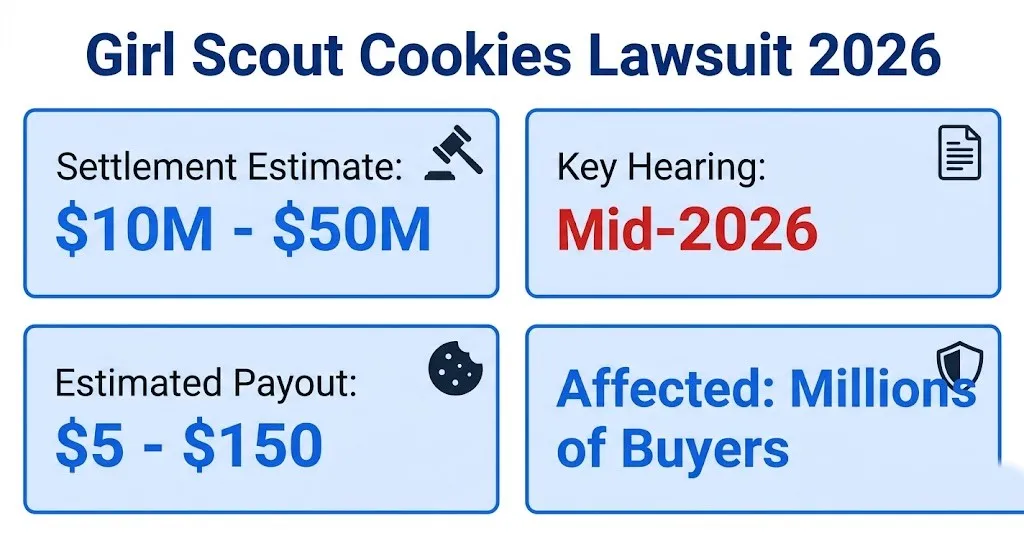
Girl Scout Cookies Lawsuit
The girl scout cookies lawsuit is a consumer protection case filed against Girl Scouts of the USA and its licensed cookie manufacturers. Plaintiffs claim the organization sold cookies containing unsafe levels of toxic heavy metals without disclosing the risk to buyers.
The case was originally filed in 2024. It has continued to develop through 2025 and into 2026, with new plaintiffs joining and additional test data being submitted to the court.
At its core, this lawsuit is about trust. Parents buy these cookies believing they’re safe for children. The allegations suggest that belief may have been misplaced.
| Detail | Info |
|---|---|
| Case Type | Consumer class action / product liability |
| Defendants | Girl Scouts of the USA, ABC Bakers, Little Brownie Bakers |
| Allegations | Undisclosed heavy metals (lead, cadmium) in cookies |
| Filed | 2024 |
| Status as of 2026 | Active, pre-settlement |
The plaintiffs are asking for damages, refunds, and changes to how Girl Scout cookies are manufactured and tested going forward.
Girl Scout Cookies Heavy Metals Lawsuit
The girl scout cookies heavy metals lawsuit centers on lab results showing lead and cadmium in multiple cookie products. Third-party testing conducted by consumer safety groups detected metals at levels that alarmed health researchers.
Lead and cadmium are both classified as toxic to humans. Even low-level exposure over time can cause harm, especially in children whose bodies are still developing.
The lawsuit argues that Girl Scouts of the USA and its bakers knew or should have known about these contamination risks. Plaintiffs say the organization failed to test its products adequately or warn consumers.
Key metals found in testing include:
- Lead (Pb): Linked to developmental delays, learning disabilities, and neurological damage in children.
- Cadmium (Cd): Associated with kidney damage and bone density loss with prolonged exposure.
- Trace arsenic: Detected in some samples at lower levels.
This isn’t just about cookies. It’s part of a broader wave of food safety lawsuits targeting chocolate, baby food, and snack products for hidden metal contamination.
Girl Scout Cookies Class Action Lawsuit
The girl scout cookies class action lawsuit is a legal case where one or more named plaintiffs represent a larger group of affected buyers. Instead of each person filing separately, the class action bundles thousands of similar claims together.
This structure matters because individual cookie purchases might only cost a few dollars. No one would sue over a single box. But when millions of boxes were sold with the same alleged defect, the collective harm becomes significant.
The proposed class includes anyone in the United States who purchased Girl Scout cookies during the relevant time period. Courts have not yet certified the class as of early 2026, which means the judge is still deciding whether the case qualifies for class action treatment.
| Class Action Detail | Current Status |
|---|---|
| Class Certification | Pending (expected mid-2026) |
| Proposed Class | All U.S. purchasers of affected varieties (2020 to 2025) |
| Named Plaintiffs | Multiple parents in several states |
| Legal Theories | Product liability, consumer fraud, breach of warranty |
If the class gets certified, it opens the door for a much larger settlement.
Key Takeaway: The girl scout cookies lawsuit is an active class action alleging that popular cookie varieties contain undisclosed heavy metals like lead and cadmium, potentially affecting millions of American buyers.
Girl Scout Cookies Lawsuit 2026
As of 2026, the girl scout cookies lawsuit is in the discovery and class certification phase. Both sides are exchanging documents, expert reports, and testing data.
The plaintiffs’ attorneys submitted updated lab results in early 2026 showing continued presence of heavy metals in cookies sold during the most recent cookie season. The defense has pushed back, arguing that the levels detected fall within acceptable federal guidelines.
A key hearing on class certification is expected by mid-2026. This hearing will determine whether the case moves forward as a class action or gets broken into individual claims.
Here’s a quick timeline of how this case has progressed:
| Date | Event |
|---|---|
| Late 2023 | Third-party testing reveals heavy metals in Girl Scout cookies |
| Early 2024 | First lawsuit filed |
| Mid-2024 | Additional plaintiffs join the case |
| 2025 | Discovery phase begins; expert reports submitted |
| Early 2026 | Updated test results filed with court |
| Mid-2026 (expected) | Class certification hearing |
| Late 2026 (projected) | Possible settlement talks or trial date |
The next six months are the most important period for this case.
Lawsuit Against Girl Scout Cookies
The lawsuit against girl scout cookies names three main defendants: Girl Scouts of the USA (GSUSA), ABC Bakers, and Little Brownie Bakers. These are the organizations responsible for branding, manufacturing, and distributing the cookies nationwide.
Girl Scouts of the USA licenses its brand and cookie recipes to two bakeries. ABC Bakers, a subsidiary of Interbake Foods (owned by George Weston Limited), produces cookies for about half the councils. Little Brownie Bakers, owned by the Italian confectionery giant Ferrero, handles the other half.
The plaintiffs’ argument is straightforward. All three entities share responsibility because they all profited from selling a product they allegedly knew was contaminated.
The defense has responded with several arguments:
- Heavy metal levels in Girl Scout cookies are comparable to other chocolate products on the market.
- No federal law sets a strict limit on lead or cadmium in cookies.
- The amounts detected are too small to cause documented harm.
Still, consumer expectations play a big role here. People don’t expect cookies sold by children to contain any amount of lead. That gap between expectation and reality is what drives this case.
Girl Scout Cookies Lawsuit Settlement
No official girl scout cookies lawsuit settlement has been reached as of early 2026. The case remains in active litigation, and formal settlement talks have not been publicly announced.
That said, legal experts familiar with food contamination class actions say settlement is the most likely outcome. Very few of these cases go to trial. The defendants face enormous reputational risk, and drawn-out litigation could hurt Girl Scout cookie sales for years.
Based on similar food safety class actions, here’s what a potential settlement could look like:
| Settlement Factor | Estimated Range |
|---|---|
| Total Settlement Fund | $10M to $50M |
| Per-Claimant Payout (no receipts) | $5 to $25 |
| Per-Claimant Payout (with receipts) | $25 to $150 |
| Attorney Fees | 25% to 33% of total fund |
| Settlement Timeline | Late 2026 to mid-2027 |
Think of it like the tuna settlement from a few years back. Millions of people bought the product. The total fund was large, but individual checks were modest. This case will likely follow the same pattern.
If GSUSA decides to settle, it will probably include non-monetary terms too, like mandatory third-party testing and updated labeling.
Key Takeaway: No settlement has been finalized yet, but legal experts project a fund between $10M and $50M, with individual payouts ranging from $5 to $150 depending on proof of purchase.
Girl Scout Cookies Lawsuit Payout
The girl scout cookies lawsuit payout for individual claimants will depend on several factors. The biggest variable is whether you can prove how many boxes you bought.
In most food product class actions, there are two tiers of payments. People who submit receipts or bank statements showing purchases get larger checks. People who file claims without documentation get smaller flat-rate payments.
Here’s a realistic breakdown based on comparable cases:
- Tier 1 (no proof of purchase): Flat payment of $5 to $25 per household.
- Tier 2 (with receipts or statements): Payment scaled to purchase volume, typically $25 to $150.
- Tier 3 (documented health effects): Potentially higher, but requires medical evidence linking symptoms to heavy metal exposure.
Don’t expect a windfall from this case. The real value is in the systemic change it forces. If GSUSA commits to heavy metal testing and transparent labeling, that protects millions of future buyers.
For context, the average American family buys about 3 to 5 boxes of Girl Scout cookies per year. At $5 to $6 per box, that’s $15 to $30 in annual purchases. Payouts will roughly reflect those spending levels.
Which Girl Scout Cookies Have Heavy Metals
Several popular Girl Scout cookie varieties tested positive for heavy metals in independent lab analyses. The cookies with the highest detected levels were chocolate-based products, which tracks with broader research linking cocoa sourcing to lead and cadmium contamination.
Here are the varieties most frequently cited in court filings and third-party reports:
| Cookie Variety | Primary Metal Detected | Level (relative to Prop 65) |
|---|---|---|
| Thin Mints | Lead, Cadmium | Above Prop 65 thresholds |
| Samoas / Caramel deLites | Cadmium | Near or above thresholds |
| Tagalongs / Peanut Butter Patties | Lead | Above Prop 65 thresholds |
| Do-si-dos | Lead (trace) | Below thresholds |
| Trefoils | Minimal detection | Within safe limits |
The pattern is clear. Cookies with more chocolate content tend to show higher metal levels. This is consistent with studies by Consumer Reports and other organizations that found lead and cadmium in many popular chocolate brands.
Trefoils (the classic shortbread cookie) showed the lowest contamination levels. That makes sense because they contain no chocolate.
Girl Scout Cookies Lead Contamination
Lead contamination in girl scout cookies is the most alarming allegation in this lawsuit. Lead is a neurotoxin with no safe level of exposure, according to the CDC and the World Health Organization.
The FDA has set “action levels” for lead in certain foods, particularly baby food and candy. But there is no specific federal limit for lead in cookies sold to the general public. California’s Proposition 65 fills part of that gap by requiring warnings when products contain lead above 0.5 micrograms per serving.
Testing cited in the lawsuit found lead levels in some Girl Scout cookie varieties that exceeded that Proposition 65 threshold. The amounts were measured in parts per billion (ppb), and while they sound small, repeated exposure adds up.
Quick Facts: Lead in Girl Scout Cookies
- Lead detected in chocolate-based varieties at levels above 0.5 mcg per serving
- No warning labels were placed on packaging
- Children are especially vulnerable because they absorb lead more readily than adults
- The FDA’s interim reference level for children is 2.2 mcg per day from all dietary sources
Even if a single cookie sitting alone seems harmless, it contributes to a child’s total daily lead intake from all food sources. That cumulative effect is what concerns health experts.
Key Takeaway: Chocolate-based Girl Scout cookies like Thin Mints and Tagalongs showed the highest lead and cadmium levels, with some exceeding California’s Proposition 65 safety thresholds.
Girl Scout Cookies Cadmium Levels
Cadmium levels in Girl Scout cookies have drawn particular attention because cadmium accumulates in the body over time. Unlike some toxins that flush out quickly, cadmium stays in your kidneys and bones for decades.
The primary source of cadmium in chocolate products is the cocoa bean itself. Cocoa trees absorb cadmium from the soil, and certain growing regions (especially parts of Latin America) have naturally high cadmium concentrations.
Testing results referenced in the lawsuit show cadmium levels in certain Girl Scout cookie varieties ranging from 5 to 15 ppb per serving. For comparison, the European Union caps cadmium in chocolate at roughly 100 to 800 ppb depending on cocoa content, while the U.S. has no specific limit.
| Standard | Cadmium Limit |
|---|---|
| EU (milk chocolate) | 100 ppb |
| EU (dark chocolate, 50%+ cocoa) | 800 ppb |
| California Prop 65 (daily intake) | 4.1 mcg/day trigger |
| U.S. Federal (cookies) | No specific limit |
The lawsuit argues that even without a strict federal limit, selling products with detectable cadmium to children without disclosure violates consumer protection laws.
It’s worth knowing that cadmium exposure symptoms are rarely immediate. The damage shows up years later, which makes prevention all the more important.
Girl Scout Cookies Lawsuit Eligibility
You may be eligible for the girl scout cookies lawsuit if you purchased Girl Scout cookies in the United States between approximately 2020 and 2025. Eligibility is not limited to a single state, though certain state consumer protection laws may offer stronger claims.
Here are the basic criteria being used to define the proposed class:
- You bought Girl Scout cookies during the relevant time period (2020 to 2025).
- You purchased affected varieties (primarily chocolate-based cookies like Thin Mints, Samoas, or Tagalongs).
- You were not aware of the heavy metal contamination at the time of purchase.
- You reside in the United States.
You do not need to prove you got sick. Product liability and consumer fraud claims focus on whether you paid for a product that was defective or misleadingly marketed. Getting sick strengthens a claim but isn’t required.
| Eligibility Factor | Requirement |
|---|---|
| Purchase Location | United States |
| Purchase Period | 2020 to 2025 |
| Product Type | Girl Scout cookie varieties (especially chocolate-based) |
| Proof Needed | Helpful but not required for basic claims |
| Health Injury Required | No |
If you ordered cookies through a troop’s online portal, your purchase history may still be accessible. Check your email for order confirmations.
How to Join the Girl Scout Cookies Lawsuit
Joining the girl scout cookies lawsuit is a relatively simple process. Most class action cases allow potential claimants to register through a claims administrator’s website once a settlement is approved.
As of early 2026, the case has not yet reached the settlement or claims-filing stage. But there are steps you can take right now to prepare:
- Save your receipts. Any proof of Girl Scout cookie purchases from 2020 to 2025 will strengthen your claim. Bank statements, credit card records, or email confirmations all count.
- Document your purchases. Write down which varieties you bought, how many boxes, and from which troop or council.
- Sign up for case updates. The law firms handling this case maintain notification lists. Registering ensures you’ll be alerted when claims open.
- Don’t throw away packaging. If you still have unopened boxes from recent cookie seasons, keep them. They could serve as evidence.
Once a settlement is reached (or the court certifies the class), a formal claims process will begin. You’ll typically have 60 to 120 days to submit your claim after the notice goes out.
Think of it like filing a rebate. You fill out a short form, attach any proof you have, and wait. The claims administrator handles the rest.
Key Takeaway: Anyone who bought Girl Scout cookies (especially chocolate varieties) between 2020 and 2025 may qualify for this lawsuit, and saving receipts or purchase records now will help maximize any future payout.
Girl Scout Cookies Health Risks Heavy Metals
The health risks from heavy metals in Girl Scout cookies depend on how much you ate and how often. For most adults who eat a few cookies during cookie season, the risk is low. For children who eat them regularly, the concern is more serious.
Lead and cadmium affect the body differently, but both are dangerous with repeated exposure:
Lead health effects:
- Developmental delays in children
- Reduced IQ and attention problems
- Kidney damage in adults
- Cardiovascular issues with chronic exposure
Cadmium health effects:
- Kidney damage (primary concern)
- Bone weakening and osteoporosis risk
- Potential carcinogen (classified by IARC as Group 1)
- Reproductive harm at higher exposures
Children face greater risk for two reasons. Their smaller bodies concentrate toxins faster. Their developing brains and organs are more vulnerable to damage.
The lawsuit doesn’t claim that eating a single box of cookies will make someone sick. The argument is about cumulative exposure and the right to know what’s in the food you’re buying, especially food marketed to and sold by children.
If you’re concerned about past exposure, a simple blood test can check lead levels. Cadmium testing is less common but available through your doctor.
Are Girl Scout Cookies Safe to Eat
Girl Scout cookies are still being sold in 2026, and neither the FDA nor Girl Scouts of the USA has issued a recall. Based on current federal standards, the cookies are technically legal to sell.
But “legal” and “safe” aren’t always the same thing. The lawsuit highlights a gap between what federal regulations allow and what many parents consider acceptable, especially for food marketed to children.
Here’s the reality as it stands:
- The FDA has not set specific limits for lead or cadmium in cookies.
- California’s Proposition 65 requires warnings for products above certain thresholds, but those warnings are often absent.
- Independent testing has found detectable metals in chocolate-based Girl Scout cookies.
- GSUSA states its cookies meet all applicable food safety regulations.
If you want to reduce exposure while the lawsuit plays out, consider these steps:
- Choose non-chocolate varieties like Trefoils or Lemon-Ups, which showed lower contamination.
- Limit how many cookies children eat in a single sitting.
- Balance cookie consumption with foods high in iron and calcium, which can reduce metal absorption.
The bottom line: the cookies won’t send anyone to the hospital from a single box. The concern is about long-term, low-level exposure, particularly for kids.
Girl Scout Cookies Lawsuit Update
The most recent girl scout cookies lawsuit update as of early 2026 shows the case moving toward a critical juncture. Discovery is wrapping up, and both sides are preparing for the class certification hearing.
Key developments in 2025 and early 2026:
- Q2 2025: Plaintiffs filed supplemental expert reports from toxicologists and food safety scientists.
- Q3 2025: The defendants (GSUSA, ABC Bakers, Little Brownie Bakers) filed motions to dismiss certain state-law claims. The court denied most of those motions.
- Q4 2025: Additional testing data submitted showing metals present in cookies from the 2025 cookie season.
- Q1 2026: Both sides submitted briefings on class certification. A hearing date is expected in mid-2026.
The denial of the defendants’ motions to dismiss was a significant win for plaintiffs. It means the court found enough evidence to let the case proceed on the merits.
| Update Timeline | Status |
|---|---|
| Motions to Dismiss | Mostly denied (late 2025) |
| Discovery | Nearing completion |
| Class Certification Hearing | Expected mid-2026 |
| Settlement Talks | Not yet public |
| Trial Date (if no settlement) | Possibly late 2027 |
Watch for the class certification ruling. If the judge certifies the class, settlement pressure on GSUSA will increase dramatically.
Key Takeaway: The lawsuit survived motions to dismiss in late 2025, and a class certification hearing expected in mid-2026 will be the most important moment yet in this case.
Girl Scout Cookies Recall 2026
There has been no Girl Scout cookies recall in 2026. Neither the FDA nor GSUSA has issued a voluntary or mandatory recall of any cookie variety.
This might seem surprising given the lawsuit. But recalls typically happen when there’s an acute safety hazard, like bacterial contamination or undeclared allergens. Heavy metal contamination cases rarely trigger recalls because the risk is chronic, not immediate.
Here’s why a recall hasn’t happened:
- No federal limit exists for lead or cadmium specifically in cookies.
- The detected levels, while concerning, don’t violate any existing FDA regulation.
- GSUSA maintains that its products are safe and fully compliant with food safety laws.
- The FDA has historically been slow to act on heavy metals in food, as seen with baby food cases.
That doesn’t mean a recall is impossible. If the lawsuit produces more damaging test results or public pressure mounts, GSUSA could issue a voluntary recall of specific batches.
For comparison, several baby food brands issued voluntary recalls after similar heavy metal findings. But those cases involved products for infants, a population regulators prioritize more aggressively.
Quick Facts: Recall Status
- Voluntary recall issued: No
- FDA enforcement action: None
- GSUSA public statement: Cookies meet all safety standards
- Consumer action available: File a claim through the class action
Who Is Suing Girl Scout Cookies
The plaintiffs suing Girl Scout cookies are primarily parents who purchased cookies for their families. The named plaintiffs in the class action represent a broader class of all U.S. consumers who bought affected products.
While individual plaintiff names are part of public court filings, the lead attorneys driving the case come from consumer rights law firms that specialize in food safety and product liability litigation.
The defendants include:
- Girl Scouts of the USA (GSUSA): The national organization that licenses the Girl Scout brand and oversees the cookie program.
- ABC Bakers (Interbake Foods LLC): One of two licensed bakeries. Owned by George Weston Limited, a Canadian food conglomerate.
- Little Brownie Bakers: The other licensed bakery. Owned by Ferrero Group, the Italian company behind Nutella and Ferrero Rocher.
It’s notable that two major international food corporations are behind the actual baking. This isn’t a small operation. These are industrial-scale manufacturers with the resources and expertise to test for contaminants.
The plaintiffs argue that GSUSA, as the brand owner, bears responsibility for ensuring its licensed products are safe. The bakeries bear responsibility as the actual producers. All three entities profited from the sales, so all three are named as defendants.
Key Takeaway: The lawsuit names Girl Scouts of the USA and its two licensed bakeries (ABC Bakers and Little Brownie Bakers, owned by major international food corporations) as defendants, with parents filing claims on behalf of all affected U.S. consumers.
Frequently Asked Questions
How much money will I get from the Girl Scout cookies lawsuit?
Most claimants can expect between $5 and $150 depending on proof of purchase.
Those with receipts or bank statements will receive higher payments.
Payments are projected to begin in late 2026 or early 2027 if a settlement is reached.
Which Girl Scout cookies contain heavy metals?
Chocolate-based varieties showed the highest levels of lead and cadmium.
Thin Mints, Samoas, and Tagalongs had the most significant detections in third-party testing.
Non-chocolate cookies like Trefoils showed minimal or no contamination.
How do I join the Girl Scout cookies class action lawsuit?
You can prepare now by saving receipts and signing up for case notifications through the law firms handling the case.
Formal claims filing will open once a settlement is approved or the class is certified.
The process will involve submitting a short form with purchase details.
Is there a deadline to file a claim in the Girl Scout cookies lawsuit?
No formal deadline exists yet because the case has not reached the settlement phase.
Once a settlement is approved, claimants will typically have 60 to 120 days to file.
Watching for the class certification ruling in mid-2026 is the best way to stay informed.
Have Girl Scout cookies been recalled because of heavy metals?
No recall has been issued as of 2026.
The FDA has not taken enforcement action, and GSUSA says its products meet all safety regulations.
The absence of a recall does not affect your ability to file a claim through the class action lawsuit.
This case is far from over. The next few months will shape whether millions of cookie buyers receive compensation and whether Girl Scout cookies undergo meaningful safety reforms.
Start gathering your purchase records now. Save any receipts, bank statements, or email confirmations from orders placed between 2020 and 2025.
When the claims window opens, being prepared is the difference between a quick payout and a missed opportunity.