
The Exxon Cuba confiscation lawsuit is one of the largest property seizure cases in American legal history. ExxonMobil is seeking billions of dollars for oil refineries and assets that Cuba’s revolutionary government took in 1960.
This case rests on the Helms-Burton Act, a federal law that sat dormant for over two decades. When the Trump administration activated Title III in 2019, it opened the courthouse doors for companies and individuals to sue.
The claim traces back more than 65 years. Exxon’s predecessor, Esso Standard Oil, lost everything on the island when Fidel Castro nationalized foreign-owned businesses.
In this guide, you will learn the full case history, the dollar amounts at stake, who qualifies to file similar claims, the latest court rulings, and what to expect in 2026 and beyond.
What Is the Exxon Cuba Confiscation Lawsuit?
The Exxon Cuba confiscation lawsuit is a federal court case in which ExxonMobil seeks compensation for oil properties that Cuba seized in 1960. It is filed under Title III of the Helms-Burton Act.
ExxonMobil’s predecessor company, Esso Standard Oil, operated oil refineries, fuel storage facilities, and distribution networks across Cuba. The Castro government nationalized these assets without paying fair compensation.
| Detail | Info |
|---|---|
| Plaintiff | ExxonMobil Corporation |
| Defendant | Republic of Cuba and affiliated entities |
| Court | U.S. District Court, D.C. |
| Law Used | Helms-Burton Act, Title III |
| Properties at Issue | Oil refineries, storage, distribution |
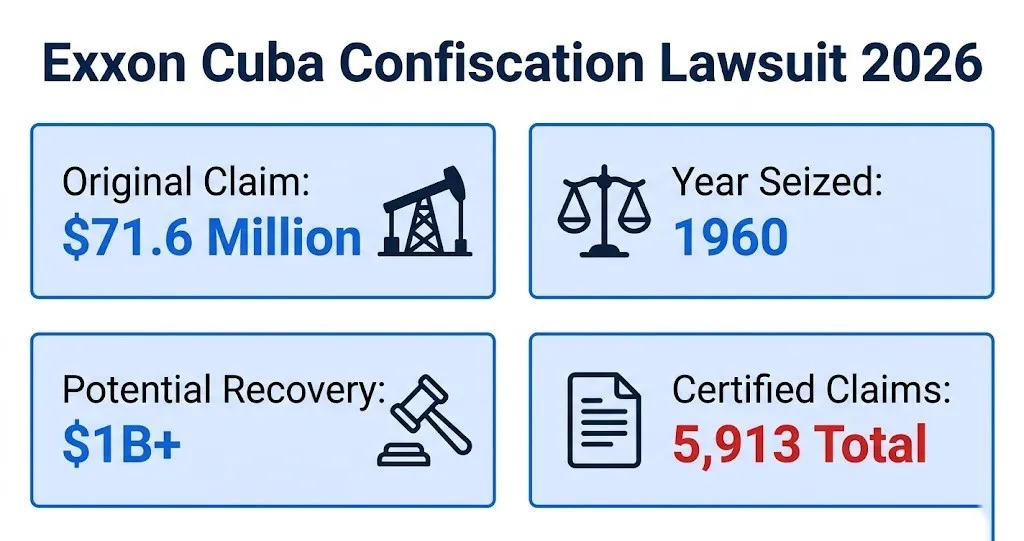
| Year of Confiscation | 1960 |
The case sits in the U.S. District Court for the District of Columbia. Cuba has not appeared to defend itself, which creates a unique legal dynamic.
This is not a class action lawsuit. It is a direct corporate claim by one of the world’s largest energy companies against a foreign government.
Exxon Cuba Lawsuit 2026: Where the Case Stands Now
As of early 2026, the Exxon Cuba lawsuit remains active in federal court with no final resolution. The case has moved through several procedural stages since it was first filed in 2019.
Cuba has refused to participate in the proceedings. That means Exxon has largely been arguing its case without opposition in the courtroom.
The court has been considering whether to issue a default judgment. In cases where a defendant does not show up, the plaintiff can ask the court to rule in their favor automatically.
But default judgments against sovereign nations are complicated. The court must still verify that it has jurisdiction and that the claims are legally valid under the Foreign Sovereign Immunities Act.
Key 2026 Status Points:
- Case remains pending in U.S. District Court, D.C.
- Cuba continues to refuse participation
- Default judgment proceedings are ongoing
- No trial date has been scheduled
- Enforcement of any judgment against Cuba remains a major open question
Even if Exxon wins a judgment, collecting money from Cuba is a separate problem entirely. Cuba has very few assets within reach of U.S. courts.
Exxon Cuba Lawsuit Settlement Amount
There is no settlement in the Exxon Cuba case. Cuba has not negotiated, and no settlement talks are expected in 2026.
This is a critical distinction. A settlement requires both sides to agree on a dollar figure. Since Cuba does not recognize the court’s authority and has not participated, settlement is not on the table.
What exists instead is a certified claim. The Foreign Claims Settlement Commission (FCSC) certified Exxon’s original claim decades ago at approximately $71.6 million in 1960 dollars.
| Financial Detail | Amount |
|---|---|
| Original FCSC Certified Claim | ~$71.6 million (1960 dollars) |
| Estimated Value with Interest | $280 million+ |
| Potential Treble Damages (3x) | $800 million to $1 billion+ |
| Helms-Burton Claim Sought | Billions (exact figure varies by filing) |
Under the Helms-Burton Act, plaintiffs can seek treble damages. That means the court could award three times the certified value, plus decades of accrued interest.
Some estimates put Exxon’s total potential recovery in the range of several billion dollars when interest and treble damages are calculated together.
Key Takeaway: The Exxon Cuba confiscation lawsuit seeks billions for 1960s-era oil assets, but Cuba’s refusal to participate makes both judgment and collection extremely difficult.
How Much Money Is Exxon Seeking from Cuba?
ExxonMobil is seeking compensation that could reach into the billions when adjusted for interest and treble damages under the Helms-Burton Act.
The base certified claim from the FCSC was roughly $71.6 million. That figure reflected 1960 property values. Adjusted for six decades of interest, the number grows dramatically.
Think of it like a house you bought for $50,000 in 1960. By 2026, that same house might be worth $1 million or more. The same logic applies to industrial oil assets, except the scale is enormous.
Helms-Burton allows for treble damages, which triples the award. This provision was designed to punish entities that “traffic” in confiscated property.
Breakdown of how the claim grows:
- Base certified value: ~$71.6 million
- Six percent annual simple interest over 65+ years adds hundreds of millions
- Treble damages triple the total
- Legal fees and costs get added on top
The exact dollar figure Exxon has requested in its court filings has not been publicly disclosed in full. Court documents reference “damages to be proven at trial” rather than a single fixed number.
No payout has been issued. None is expected in 2026 unless a dramatic shift occurs in Cuba’s legal posture.
Helms-Burton Act Title III Lawsuits Explained
The Helms-Burton Act is a 1996 federal law that gives Americans the right to sue anyone who profits from property confiscated by Cuba. Title III is the section that creates this private right of action.
For over 20 years, every U.S. president suspended Title III. They did this to avoid angering European and Canadian allies whose companies operated in Cuba.
In May 2019, Secretary of State Mike Pompeo announced that the Trump administration would fully activate Title III for the first time. That decision unlocked a wave of lawsuits.
| Helms-Burton Act Basics | Details |
|---|---|
| Full Name | Cuban Liberty and Democratic Solidarity Act |
| Year Enacted | 1996 |
| Key Provision | Title III: private right of action |
| Suspended By | Every president from 1996 to 2019 |
| Activated By | Trump administration, May 2, 2019 |
| Who Can Sue | U.S. nationals with certified or uncertified claims |
Title III allows two categories of plaintiffs. First, those whose claims were certified by the FCSC (mostly large corporations). Second, Cuban Americans who were not U.S. citizens at the time of confiscation but later became citizens.
The second category is controversial. It dramatically expanded the pool of potential plaintiffs to include hundreds of thousands of Cuban Americans.
Who Can Sue Under the Helms-Burton Act?
Any U.S. national who owned property confiscated by Cuba after January 1, 1959, can potentially file a lawsuit under Title III. This includes both individuals and corporations.
There are two main groups of eligible claimants:
Group 1: Certified Claimants
- Had their claims reviewed and certified by the FCSC
- Roughly 5,913 certified claims exist
- Total certified value: approximately $1.9 billion (1960s dollars)
- Includes major corporations like ExxonMobil, Coca-Cola, and others
Group 2: Uncertified Claimants
- Were Cuban nationals at the time of confiscation
- Later became U.S. citizens or permanent residents
- Estimated 75,000 to 200,000 potential claims
- Must prove property ownership and confiscation
To file a Helms-Burton suit, you need to prove three things. You must show you owned the property. You must show Cuba confiscated it. And you must show someone is currently “trafficking” in that property.
“Trafficking” has a broad definition under the law. It can mean using, benefiting from, or simply possessing the confiscated property. A hotel chain operating a resort built on seized land could qualify as trafficking.
Key Takeaway: The Helms-Burton Act allows both certified corporate claimants and individual Cuban Americans to sue, but proving “trafficking” in confiscated property is the key legal hurdle.
Exxon Cuba Case Court Ruling History
Several court rulings have shaped the Exxon Cuba confiscation case since it was filed in 2019. Most of these rulings deal with procedural questions rather than the merits of Exxon’s claim.
The first major issue was service of process. Exxon had to formally notify Cuba of the lawsuit. Serving a foreign government that refuses diplomatic engagement with U.S. courts is not simple.
Under the Foreign Sovereign Immunities Act (FSIA), plaintiffs must follow specific procedures to serve sovereign nations. Exxon used diplomatic channels through the State Department.
Key Rulings and Procedural Milestones:
- 2019: Exxon files complaint in U.S. District Court, D.C.
- 2020: Service of process on Cuba completed through diplomatic channels
- 2021-2022: Cuba fails to respond; Exxon moves for default
- 2023: Court reviews jurisdictional questions under FSIA
- 2024-2025: Default judgment briefing continues
- 2026: Case remains pending; no final judgment issued
The court must independently verify jurisdiction even when the defendant does not appear. This is required under the FSIA for all lawsuits against foreign governments.
One of the trickiest legal questions is whether the “expropriation exception” to sovereign immunity applies. This exception strips a foreign government of its immunity when it takes property in violation of international law.
Exxon Helms-Burton Act Lawsuit Update for 2026
The most current update as of 2026 is that Exxon’s Helms-Burton lawsuit is still working through the default judgment process. No final ruling has been issued.
Court dockets show continued briefing on damages calculations. Exxon has submitted expert reports detailing the current value of confiscated assets, including interest computations spanning more than six decades.
The Biden administration did not reverse the Title III activation during its term. The current political posture in Washington suggests Title III will remain active for the foreseeable future.
What to watch for in 2026:
- Potential default judgment ruling from the court
- Any diplomatic shifts between the U.S. and Cuba
- Whether the current administration signals changes to Helms-Burton enforcement
- Related cases that could set precedent for Exxon’s claims
Enforcement remains the elephant in the room. Even a multi-billion-dollar judgment on paper means nothing if there are no Cuban assets to seize within U.S. jurisdiction.
Some legal analysts have suggested that frozen Cuban assets in U.S. banks could be targeted. Others point to potential future trade normalization as a moment when confiscation claims could be resolved as part of a broader diplomatic deal.
ExxonMobil Cuba Property Seizure: What Was Taken
ExxonMobil’s predecessor, Esso Standard Oil, had substantial operations in Cuba before the revolution. The Castro government nationalized these assets in August 1960 as part of a sweeping confiscation campaign.
The seized properties included:
- Oil refinery in Havana: One of Cuba’s largest refining operations
- Oil refinery in Santiago de Cuba: Major eastern Cuba facility
- Fuel storage terminals: Multiple locations across the island
- Distribution network: Gas stations, pipelines, and transport infrastructure
- Office buildings and equipment: Corporate facilities and machinery
| Asset Category | Description |
|---|---|
| Refineries | Two major refineries (Havana, Santiago) |
| Storage | Fuel terminals across Cuba |
| Distribution | Gas stations, pipelines, trucks |
| Real Estate | Office buildings, warehouses |
| Equipment | Refining machinery, vehicles |
The confiscation was triggered by a specific dispute. Cuba demanded that Esso, Shell, and Texaco refine Soviet crude oil. When the companies refused on orders from the U.S. government, Castro seized their refineries.
This was one of the pivotal moments in the breakdown of U.S.-Cuba relations. It happened just months before the full U.S. trade embargo was imposed.
Key Takeaway: Exxon’s confiscated Cuban assets included two major oil refineries, fuel terminals, and an entire distribution network, all seized in August 1960 after a dispute over refining Soviet oil.
Exxon Cuba Oil Refineries Confiscated in 1960
The confiscation of Exxon’s Cuban oil refineries was a direct result of Cold War tensions between the United States and the Soviet Union playing out on Cuban soil.
In early 1960, Cuba struck a deal with the Soviet Union to purchase crude oil. Cuba then ordered the three foreign oil companies operating refineries on the island, Esso (Exxon), Shell, and Texaco, to process the Soviet crude.
The U.S. government told the companies to refuse. They did. Castro responded by seizing the refineries in late June and early July 1960.
Timeline of the refinery seizures:
- February 1960: Cuba signs oil deal with Soviet Union
- June 1960: Cuba orders refineries to process Soviet crude
- June 29, 1960: Texaco refinery seized
- July 1, 1960: Esso (Exxon) and Shell refineries seized
- August 6, 1960: Broader nationalization law passed, sweeping up remaining U.S. properties
The Havana refinery was a crown jewel of Esso’s Caribbean operations. It processed tens of thousands of barrels per day and served as a regional hub.
After the seizures, Cuba placed the refineries under state control. They continued operating with Soviet technical assistance for decades. Many of these facilities still operate today under Cuban state oil company CUPET.
Cuba Expropriation Claims Timeline
The timeline of Cuba expropriation claims stretches over six decades, from the original seizures in 1959-1960 to the active lawsuits of 2026.
| Year | Event |
|---|---|
| 1959 | Castro takes power; early confiscations begin |
| 1960 | Mass nationalization of U.S. properties including Exxon refineries |
| 1964-1972 | FCSC certifies 5,913 claims worth ~$1.9 billion |
| 1996 | Helms-Burton Act signed into law; Title III immediately suspended |
| 1996-2019 | Every president suspends Title III every six months |
| May 2, 2019 | Trump administration activates Title III |
| 2019-2020 | Wave of lawsuits filed, including Exxon’s |
| 2020-2025 | Cases progress through courts; Cuba refuses participation |
| 2026 | Multiple cases pending; no final judgments yet |
Understanding this timeline matters because it shows why the case feels so slow. The legal machinery for these claims was frozen for over 20 years.
Once Title III was activated, everything had to start from scratch. Service of process, jurisdictional briefing, damages calculations. All of it takes years, especially against a sovereign defendant that will not show up.
The FCSC certification process in the 1960s and 1970s is also relevant. Those certified claims carry significant legal weight because they were already vetted by a government agency.
Helms-Burton Act Title III Activation in 2019
Title III of the Helms-Burton Act was activated on May 2, 2019, after being suspended for 23 consecutive years by every president from Clinton through Obama.
Secretary of State Mike Pompeo made the announcement. He framed it as part of a broader policy shift toward increased pressure on Cuba, Venezuela, and Nicaragua.
The activation was immediate and full. Unlike previous partial considerations, the Trump administration allowed all categories of claimants to file suit, including both certified and uncertified claimants.
Why the activation mattered:
- It unlocked the right for roughly 5,913 certified claimants to sue
- It opened the door for an estimated 75,000 to 200,000 Cuban American claimants
- It created legal exposure for European, Canadian, and other foreign companies operating in Cuba
- It dramatically escalated tensions with U.S. allies who had business interests on the island
The European Union and Canada immediately protested. Both had passed “blocking statutes” years earlier to shield their companies from Helms-Burton lawsuits.
Despite international pushback, the activation has not been reversed. Neither the Biden administration nor the current administration has re-suspended Title III. This means lawsuits continue to be filed and litigated.
Key Takeaway: The 2019 activation of Title III ended a 23-year freeze and unleashed a wave of confiscation lawsuits, including Exxon’s, that continue moving through courts in 2026.
Cuba Property Confiscation Lawsuits History
Cuba’s property confiscation campaign was one of the most sweeping in the Western Hemisphere. Between 1959 and 1960, the revolutionary government seized virtually all foreign-owned and many domestic private properties.
The confiscations were not limited to oil companies. They hit every sector of the economy.
Industries affected by Cuban confiscation:
- Oil and gas (Exxon, Texaco, Shell)
- Sugar production (United Fruit Company, others)
- Mining (Freeport Minerals, Moa Bay Mining)
- Banking (Chase Manhattan, First National City Bank)
- Hotels and tourism (Hilton, others)
- Manufacturing (Procter & Gamble, Colgate-Palmolive)
- Agriculture (thousands of individual farms and ranches)
The FCSC eventually certified 5,913 claims from U.S. nationals. The total certified value was approximately $1.9 billion in original dollars. Adjusted for interest, that figure exceeds $8 billion today.
Most of these claims sat dormant for decades. Property owners had no legal mechanism to pursue recovery because Title III was always suspended.
The 2019 activation changed everything. But the sheer volume of potential claims, combined with Cuba’s refusal to participate, means the legal system is processing these cases very slowly.
Companies Suing Cuba for Confiscated Property
ExxonMobil is not alone. Several major corporations and thousands of individuals have filed or are preparing to file lawsuits under the Helms-Burton Act.
| Company | Industry | Estimated Claim Value |
|---|---|---|
| ExxonMobil | Oil and Gas | $1 billion+ |
| Coca-Cola | Beverages | $27.5 million (certified) |
| Procter & Gamble | Consumer Goods | $9.3 million (certified) |
| Starwood (Marriott) | Hotels | Undisclosed |
| Carnival Corporation | Cruise Lines | Sued under Helms-Burton |
| Various Cuban Americans | Individual Properties | Varies widely |
Carnival Corporation faced one of the most publicized cases. Cuban Americans sued the cruise line for “trafficking” in confiscated Havana harbor property by docking ships there.
In 2024, a federal court ruled against Carnival in a related case, finding that the cruise company had used port facilities built on confiscated land. That ruling sent shockwaves through the business community.
European hotel chains like Melia Hotels International have been named as defendants. They operate resorts on land that was seized from Cuban and American owners.
These cases collectively represent tens of billions of dollars in potential claims. The legal landscape is crowded and complicated.
Fidel Castro Property Seizures and Their Legal Legacy
Fidel Castro’s property seizure campaign began almost immediately after he took power in January 1959. It started with political opponents and quickly expanded to foreign businesses and wealthy Cubans.
The seizures were justified under Cuban revolutionary law. Castro’s government argued that the properties were being reclaimed for the Cuban people after decades of exploitation.
Phases of Castro’s confiscation campaign:
- 1959: Land reform; seizure of large estates and farms
- Early 1960: Nationalization of U.S. oil refineries (Exxon, Texaco, Shell)
- August 1960: Mass nationalization law; all major U.S. businesses seized
- October 1960: Remaining private Cuban businesses nationalized
- 1961-1968: Small businesses and remaining private property absorbed
From a legal standpoint, international law requires “prompt, adequate, and effective” compensation when a government seizes foreign property. Cuba never paid.
That failure to compensate is the legal foundation of every Helms-Burton lawsuit, including Exxon’s. It is also why the “expropriation exception” to sovereign immunity applies.
Castro’s seizures displaced an entire economic class. Hundreds of thousands of Cubans fled to the United States, many bringing property deeds and business records that now serve as evidence in court.
Key Takeaway: Castro’s sweeping confiscation campaign seized billions in property without compensation, creating the legal foundation for thousands of claims that are now being litigated six decades later.
Cuba Confiscation Lawsuit Defendants: Who Is Being Sued?
The defendants in Cuba confiscation lawsuits fall into three categories: the Cuban government itself, Cuban state-owned enterprises, and foreign companies that profit from confiscated property.
Category 1: The Republic of Cuba
- Named as the primary defendant in cases like Exxon’s
- Refuses to appear in U.S. courts
- Claims sovereign immunity
Category 2: Cuban State Enterprises
- CIMEX S.A. (retail and import conglomerate)
- CUPET (Cuba’s state oil company, operates former Exxon refineries)
- Gaviota S.A. (military-linked tourism company)
- These entities are treated as arms of the Cuban state
Category 3: Foreign Companies Operating in Cuba
- Melia Hotels International (Spain): operates resorts on seized land
- Trivago, Booking.com: listed as co-defendants for facilitating bookings
- Carnival Corporation (U.S.): cruise operations using confiscated ports
| Defendant Type | Examples | Legal Basis |
|---|---|---|
| Sovereign Government | Republic of Cuba | Expropriation exception to FSIA |
| State Enterprises | CUPET, CIMEX, Gaviota | Treated as government instrumentalities |
| Foreign Companies | Melia, Carnival | “Trafficking” in confiscated property |
The “trafficking” theory is powerful. It means a European hotel chain that had nothing to do with the original confiscation can still be sued for benefiting from stolen property.
This has made doing business in Cuba risky for any foreign company. The threat of Helms-Burton litigation hangs over every investment on the island.
Frequently Asked Questions
What is the Exxon Cuba confiscation lawsuit about?
The Exxon Cuba confiscation lawsuit is a federal case where ExxonMobil seeks compensation for oil refineries and assets seized by Cuba in 1960.
The case is filed under Title III of the Helms-Burton Act in U.S. District Court in Washington, D.C.
Cuba has refused to participate in the proceedings.
How much money is Exxon seeking from Cuba?
Exxon’s original certified claim was approximately $71.6 million in 1960 dollars.
With decades of interest and potential treble damages, the total sought could exceed $1 billion.
No payout has been issued as of 2026.
Who can file a lawsuit under the Helms-Burton Act?
Any U.S. national whose property was confiscated by Cuba after January 1, 1959, can file a Title III lawsuit.
This includes both certified corporate claimants and Cuban Americans who later became U.S. citizens.
Plaintiffs must prove ownership, confiscation, and current “trafficking” in the property.
What happened to Exxon’s oil refineries in Cuba?
Cuba seized Exxon’s refineries in July 1960 after the company refused to process Soviet crude oil.
The refineries were placed under Cuban state control and continue operating today under CUPET.
Exxon has never been compensated for these assets.
Will the Exxon Cuba lawsuit result in a payout?
A court judgment is possible, but actual payment is extremely unlikely in the near term.
Cuba has minimal assets within reach of U.S. courts and does not recognize the proceedings.
Any eventual compensation would likely require a broader diplomatic resolution between the two countries.
The Exxon Cuba confiscation lawsuit represents one of the longest-running property disputes in modern history. The legal tools now exist to pursue these claims, but enforcement against Cuba remains the biggest obstacle.
If you hold confiscated Cuban property claims, staying informed on court developments and Helms-Burton enforcement policy is essential. Track the case docket and monitor any shifts in U.S.-Cuba diplomatic relations.
This fight is far from over. The courtroom battles of 2026 could set precedents that shape confiscation law for decades to come.
