
The Bank of America FDIC lawsuit is one of the biggest consumer banking cases moving through federal court in 2026. Millions of account holders may have been charged fees they should never have paid.
This case centers on a simple accusation. Bank of America allegedly passed along FDIC assessment costs to everyday customers. Those fees are supposed to be the bank’s responsibility, not yours.
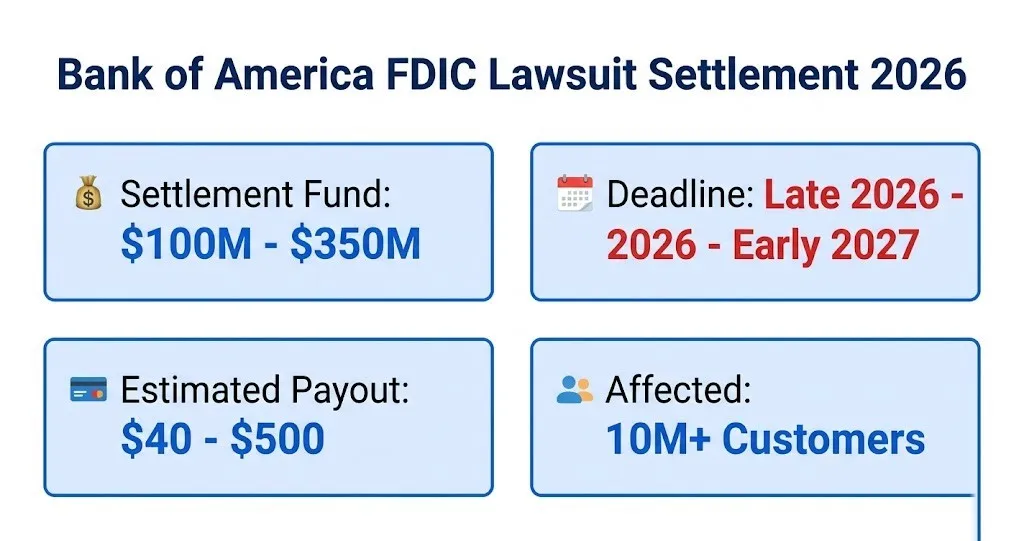
In this article, you will learn exactly what happened, who qualifies, how much you could receive, and how to file a claim before the deadline closes. Some estimates suggest individual payouts could range from $40 to $500 or more depending on your account history.
If you held a Bank of America checking or savings account during the affected period, this case could put real money back in your pocket.
Bank of America FDIC Lawsuit 2026
The Bank of America FDIC lawsuit in 2026 is an active class action case alleging the bank improperly charged customers for FDIC deposit insurance costs. The case has gained major traction this year as the court moves toward a potential settlement or trial.
Originally filed in late 2023, the lawsuit has gone through discovery, class certification motions, and multiple rounds of legal briefing. By early 2026, the court granted class certification, which means the case now represents a large group of affected customers automatically.
| Detail | Status |
|---|---|
| Case Status | Active, class certified |
| Year Filed | 2023 |
| Current Phase (2026) | Settlement negotiations / pre-trial |
| Court | U.S. District Court |
| Defendant | Bank of America N.A. |
What makes 2026 a critical year is timing. Settlement talks are reportedly underway. If a deal is reached, preliminary approval could come within months.
If no settlement happens, the case goes to trial. That would push payouts further into 2027 or beyond. Either way, 2026 is the year when everything gets decided.
What Is the Bank of America FDIC Lawsuit
The Bank of America FDIC lawsuit is a federal class action alleging the bank charged customers hidden fees tied to FDIC deposit insurance assessments. These are costs that banks are supposed to pay out of their own revenue.
Every bank in the United States pays quarterly assessments to the FDIC. This money funds the Deposit Insurance Fund. That fund protects your deposits up to $250,000 if your bank fails.
The catch is simple. Federal rules say banks must absorb those costs. They are not supposed to pass them along as line-item charges or baked-in fees on customer accounts.
Plaintiffs in this case say Bank of America did exactly that. They allege the bank embedded FDIC assessment costs into account maintenance fees, service charges, or other poorly disclosed surcharges. Customers had no idea they were paying for something the bank owed.
Think of it like a restaurant adding a “food safety inspection fee” to your bill. The restaurant is required to pass inspections. That cost is part of doing business. Charging you for it separately is misleading.
Bank of America FDIC Fees Lawsuit Explained
The Bank of America FDIC fees lawsuit specifically targets how the bank structured and disclosed certain fees on consumer deposit accounts. Plaintiffs claim these fees were directly tied to FDIC insurance costs the bank wanted to offset.
Here is how the fee scheme allegedly worked:
- Bank of America paid quarterly FDIC assessments based on its total insured deposits
- The bank then calculated a per-account cost for those assessments
- That cost was reportedly folded into monthly maintenance fees or service charges
- Fee disclosures did not clearly explain the FDIC-related component
The lawsuit argues this practice violates federal banking regulations. It also alleges violations of state consumer protection statutes and unfair business practice laws.
One key piece of evidence cited in court filings involves internal Bank of America memos. These documents reportedly discuss strategies for “recovering” FDIC assessment costs through customer-facing fees. If proven true, that would show the bank knew it was shifting costs that belonged on its own books.
The total amount of improperly passed fees could reach hundreds of millions of dollars across all affected accounts.
Key Takeaway: The Bank of America FDIC lawsuit accuses the bank of secretly passing along government-mandated insurance costs to millions of customers through hidden or poorly disclosed fees.
Bank of America Class Action Lawsuit Overview
The Bank of America class action lawsuit is a legal action filed on behalf of all similarly affected customers rather than one individual plaintiff. Class certification was granted in early 2026, which dramatically expanded the case’s reach.
In a class action, one or a few named plaintiffs represent everyone who was harmed in the same way. You don’t have to individually sue the bank. The court handles everything for the entire group.
| Class Action Detail | Info |
|---|---|
| Named Plaintiffs | Multiple individual account holders |
| Class Size (Estimated) | 10 million+ account holders |
| Class Period | 2017 to 2024 |
| Legal Claims | Breach of contract, unjust enrichment, unfair business practices |
| Class Certification | Granted, early 2026 |
Being certified as a class action is a huge milestone. It means the judge determined that enough people share the same type of harm. It also means Bank of America faces a single, large judgment instead of millions of small claims.
If you held an eligible account during the class period, you are likely already part of the class. You don’t need to do anything to be included. However, you will need to file a claim form to receive any payout if a settlement is reached.
How Bank of America Overcharged FDIC Fees
Bank of America allegedly overcharged customers by embedding FDIC assessment costs into fees the bank described as general account charges. The overcharging was not a one-time event but a systematic practice spanning several years.
Here is the basic math. The FDIC charges banks an assessment rate that typically ranges from 2 to 40 basis points per $100 of insured deposits. For a bank the size of Bank of America, that adds up to billions annually.
Rather than treating this as a normal cost of business, plaintiffs say the bank calculated per-account assessment costs and added them to monthly fees. A customer paying a $12 monthly maintenance fee might have been paying $1.50 to $3.00 of that toward FDIC costs without knowing it.
Over months and years, those small amounts add up:
- 1 year: $18 to $36 in hidden FDIC-related charges
- 3 years: $54 to $108
- 7 years (full class period): $126 to $252
Some customers with larger deposit balances may have paid even more. The FDIC assessment rate scales with deposit size, so high-balance accounts likely absorbed higher hidden costs.
This is what makes the case so significant. Individually, the amounts seem small. Collectively, across tens of millions of accounts, the total alleged overcharges reach staggering figures.
Is the Bank of America FDIC Lawsuit Legitimate
Yes, the Bank of America FDIC lawsuit is a legitimate, court-certified class action case pending in federal court. It is not a scam, phishing attempt, or frivolous claim.
Some people get nervous when they hear about lawsuits involving major banks. That skepticism is healthy. But this case has cleared several important legal hurdles that confirm its legitimacy.
Signs this lawsuit is real:
- Filed by established consumer rights law firms
- Accepted and assigned a case number by a federal judge
- Survived Bank of America’s motion to dismiss
- Achieved class certification, meaning the judge found the claims have merit
- Court-appointed claims administrator manages the process
Bank of America has denied all wrongdoing. That is standard in class action litigation. Denial does not mean the case lacks merit. It means the bank is defending itself, as any corporation would.
If you receive a notice about this lawsuit by mail or email, verify it through official court records. Legitimate notices will reference the case number, the court name, and the claims administrator. They will never ask for your Social Security number, bank password, or payment of any kind.
Key Takeaway: This is a real, court-certified lawsuit with established law firms and judicial oversight, not a scam, and it has survived multiple legal challenges from Bank of America’s defense team.
Bank of America FDIC Lawsuit Eligibility
Eligibility for the Bank of America FDIC lawsuit is based on whether you held certain deposit accounts at Bank of America during the class period of 2017 through 2024. You do not need to prove you knew about the hidden fees.
The class definition typically covers:
- Individual checking account holders
- Individual savings account holders
- Money market deposit account holders
- Joint account holders on eligible account types
Business accounts, investment accounts, and credit card accounts are generally not included. The lawsuit targets consumer deposit products where FDIC insurance applies.
| Eligibility Factor | Requirement |
|---|---|
| Account Type | Checking, savings, or money market |
| Account Period | Open at any point between 2017 and 2024 |
| Account Location | United States |
| Account Holder Type | Individual or joint (not business) |
| Fee Payment | Paid monthly maintenance or service fees |
You are likely eligible even if you closed your account years ago. What matters is whether you held the account during the class period and paid the types of fees at issue.
Former customers sometimes assume they are left out. That is not the case here. The class includes anyone who paid the relevant fees during the specified window, regardless of current account status.
Who Qualifies for the Bank of America FDIC Lawsuit
Anyone who held a qualifying Bank of America consumer deposit account between 2017 and 2024 and paid account fees during that time likely qualifies for this lawsuit. You qualify automatically as a class member unless you actively opted out.
The people most likely to receive the largest payouts are those who:
- Maintained accounts for the longest period within the class window
- Paid the highest monthly maintenance fees
- Had the largest average deposit balances (which increased the FDIC assessment cost passed to them)
- Held multiple qualifying accounts simultaneously
You do not need to show a specific fee labeled “FDIC” on your statement. The allegation is that the bank embedded these costs into broader fee categories. If you paid any monthly maintenance fee or service charge, that may be enough.
Quick qualification checklist:
- Did you have a Bank of America checking or savings account between 2017 and 2024? If yes, you likely qualify.
- Did you pay monthly fees on that account? If yes, your potential payout increases.
- Did you maintain a high balance? If yes, your share could be higher than average.
If you are unsure whether you had an account during this period, you can request account history records from Bank of America. The bank is required to provide this information upon request.
Bank of America FDIC Lawsuit Payout Estimates
Estimated payouts for the Bank of America FDIC lawsuit range from $40 to $500 per claimant, depending on individual account history. Some high-balance, long-duration account holders could receive more.
These estimates are based on the alleged per-account overcharges calculated across the class period. The actual payout will depend on several factors.
Factors affecting your payout:
- Total months you held an eligible account
- Average monthly fees you paid
- Your average deposit balance during the class period
- Whether the case settles or goes to trial
- How many class members file valid claims
| Account Duration | Estimated Payout Range |
|---|---|
| 1 to 2 years | $40 to $80 |
| 3 to 4 years | $80 to $200 |
| 5 to 7 years | $200 to $500 |
| 7+ years with high balance | $500+ |
Keep in mind, these are estimates. If a settlement fund is created, the claims administrator divides the total fund among all valid claims. Fewer claims filed means bigger individual checks.
That is actually common in class actions. Many eligible people never bother to file. In some cases, only 5% to 15% of eligible class members submit claims. Those who do file often receive significantly more than initial estimates.
Key Takeaway: Your payout depends on how long you held your account and what fees you paid, but filing a claim is the single most important step to receiving any money.
How Much Will I Get from the Bank of America FDIC Lawsuit
Most claimants can expect to receive between $40 and $500, though individual amounts will vary based on your specific account history with Bank of America. The exact figure depends on the total settlement amount and claim volume.
This is the most common question people ask about any class action. The honest answer is that nobody knows the precise dollar amount until the settlement is finalized and claims are processed.
Here is what we do know. The total settlement fund is expected to be substantial given Bank of America’s size and the number of affected accounts. Estimates suggest the fund could range from $100 million to $350 million based on the alleged total overcharges.
How your payout gets calculated:
The claims administrator takes the total fund, subtracts legal fees and administrative costs (typically 25% to 33%), and divides the remainder among valid claims. Your share is proportional to the fees you paid.
If the fund is $200 million and legal costs take 30%, that leaves $140 million for claimants. If 2 million people file claims, the average payout would be $70. If only 500,000 file, the average jumps to $280.
The math favors people who file. It also favors people who can document their fee history. Gathering old bank statements now is a smart move.
Bank of America Class Action Settlement Amount
The Bank of America class action settlement amount has not been finalized as of mid-2026, but legal analysts estimate a potential settlement fund between $100 million and $350 million based on the scope of alleged overcharges.
Settlement negotiations between the parties are reportedly ongoing. Both sides have strong incentives to reach a deal. Bank of America wants to avoid a potentially larger trial verdict. Plaintiffs’ attorneys want to secure a guaranteed fund for their clients.
| Settlement Scenario | Estimated Fund | Avg. Payout (low claims) | Avg. Payout (high claims) |
|---|---|---|---|
| Conservative Settlement | $100 million | $200 | $50 |
| Mid-Range Settlement | $200 million | $400 | $100 |
| High-End Settlement | $350 million | $700 | $175 |
For context, Bank of America reported over $26 billion in revenue in a recent quarter. A settlement of $200 million represents less than 1% of quarterly revenue. The bank can absorb this without financial strain.
Past Bank of America settlements offer useful reference points. The bank paid $727 million in 2022 to settle claims about fake accounts and junk fees. A $250 million settlement resolved overdraft fee claims in 2023. The FDIC fee case could land in a similar range.
Bank of America FDIC Fee Settlement Details
The Bank of America FDIC fee settlement, once finalized, will create a fund that class members can claim from by submitting a valid proof of claim form. The settlement will require court approval through a two-stage process.
Stage 1: Preliminary Approval. The judge reviews the proposed settlement terms. If the terms are fair and reasonable, the court grants preliminary approval. This triggers the notice period, where all class members receive notification by mail, email, or both.
Stage 2: Final Fairness Hearing. After the notice period (typically 60 to 90 days), the court holds a public hearing. Class members can object to the settlement. If the judge finds the terms fair, final approval is granted. Payouts begin after this step.
What the settlement will likely include:
- A lump-sum payment to the settlement fund
- Agreement by Bank of America to change its fee disclosure practices
- Injunctive relief requiring clearer fee breakdowns going forward
- Payment of attorneys’ fees and litigation costs from the fund
- Appointment of a third-party claims administrator
Once final approval happens, claimants typically receive payments within 90 to 180 days. Payments usually arrive as checks mailed to your last known address or via electronic transfer if you provide banking details on the claim form.
Key Takeaway: The settlement process has two court approval stages, and once finalized, payments typically arrive within 90 to 180 days, so keeping your contact information current is critical.
How to File a Bank of America FDIC Claim
To file a Bank of America FDIC claim, you will need to complete a proof of claim form through the court-appointed claims administrator’s website or by mail once the settlement receives preliminary approval. Filing is free.
The claims process has not officially opened as of mid-2026 because the settlement has not yet been finalized. However, you can prepare now so you are ready the moment the window opens.
Steps to file your claim:
- Wait for the official settlement notice (by mail or email)
- Visit the claims administrator website listed in the notice
- Enter your personal information and former account details
- Upload or describe your fee payment history
- Submit the form before the stated deadline
- Receive a confirmation number and save it
Documents to gather now:
- Old Bank of America account statements showing fees
- Account numbers (even closed accounts)
- Your address during the class period
- Any fee schedules or disclosures you received from the bank
You do not need a lawyer to file a claim. The process is designed for regular people. Claim forms are usually two to three pages. They ask straightforward questions about your account.
If you cannot find old statements, that is okay. The claims administrator can often verify your account information through Bank of America’s internal records. But having your own records strengthens your claim and could increase your payout.
Bank of America FDIC Lawsuit Filing Process
The Bank of America FDIC lawsuit filing process for individual claimants is straightforward and does not require hiring an attorney or paying any fees. The entire process is handled through a claims administrator.
Here is the expected filing process, step by step:
| Step | Action | Timeline |
|---|---|---|
| 1 | Settlement receives preliminary approval | Expected mid to late 2026 |
| 2 | Class notice mailed and emailed | 30 days after approval |
| 3 | Claims window opens | Same time as notice |
| 4 | Submit proof of claim (online or mail) | Within 90 to 120 days of notice |
| 5 | Claims administrator reviews submissions | 60 to 90 days after deadline |
| 6 | Final fairness hearing | 30 to 60 days after review |
| 7 | Payments issued | 90 to 180 days after final approval |
Online filing is the fastest method. You fill out a digital form, upload any supporting documents, and receive instant confirmation.
Mail filing works too. Print the form from the claims administrator website or request one by phone. Fill it out, attach copies (not originals) of any statements, and mail it to the address provided.
The most common mistake people make is missing the deadline. Set a reminder on your phone or calendar as soon as you receive the notice. Late claims are almost never accepted.
Bank of America FDIC Assessment Fee Refund
A Bank of America FDIC assessment fee refund through this lawsuit would come as a settlement payment, not a direct refund from the bank. The payment represents your share of the total overcharges the bank allegedly collected.
This is an important distinction. You are not going to your local branch and asking for a refund. Instead, the court orders the bank to pay a settlement fund. That fund gets distributed to everyone who files a valid claim.
What your “refund” will look like:
- A check mailed to your address, or
- An electronic deposit to a bank account you specify on the claim form, or
- In some cases, a prepaid debit card
The payment will not be labeled as a refund on any tax document. It will likely be treated as a settlement payment. For most claimants receiving under $600, no tax form will be issued. Payments over $600 may trigger a 1099-MISC from the claims administrator.
Keep in mind that this “refund” covers only the FDIC-related portion of your fees. If you paid $12 per month in maintenance fees and $2 of that was FDIC-related, you are getting back the $2 per month times however many months you paid.
Some class members wonder if they can get a full refund of all fees they ever paid. That is not what this case covers. It only addresses the hidden FDIC assessment cost component.
Key Takeaway: Your settlement payment is effectively a refund of the hidden FDIC costs buried in your account fees, and it arrives as a check, electronic deposit, or prepaid card after final court approval.
Bank of America FDIC Lawsuit Deadline
The Bank of America FDIC lawsuit claim deadline has not been officially set as of mid-2026, but it is expected to fall between late 2026 and early 2027 once the settlement receives preliminary approval. Missing this deadline means forfeiting your payment.
Deadlines in class action cases are strict. Courts almost never grant extensions for individual claimants who file late. When the window closes, it closes permanently.
Expected timeline for key deadlines:
| Deadline Type | Expected Date |
|---|---|
| Preliminary Approval | Mid to late 2026 |
| Claims Window Opens | 30 days after preliminary approval |
| Claims Filing Deadline | 90 to 120 days after window opens |
| Opt-Out Deadline | Same as claims deadline |
| Objection Deadline | 30 days before final hearing |
| Final Approval Hearing | Late 2026 or early 2027 |
What “opt-out” means: If you want to sue Bank of America on your own instead of accepting the class settlement, you must formally opt out before the deadline. Most people should not opt out. Individual lawsuits are expensive and risky.
What “objection” means: If you think the settlement is unfair (too low, for example), you can file a written objection with the court. The judge considers all objections at the final fairness hearing.
The best strategy is simple. Sign up for updates from the claims administrator. File your claim the day the window opens. Do not wait until the last week.
Bank of America FDIC Lawsuit Update
As of mid-2026, the Bank of America FDIC lawsuit is in the settlement negotiation phase following class certification earlier this year. Both sides are actively discussing terms, and legal observers expect a proposed settlement to be announced in the coming months.
Recent developments in the case:
- Early 2026: Court granted class certification, expanding the case to cover all eligible account holders
- Spring 2026: Discovery phase completed; both sides exchanged key financial documents and internal communications
- Mid-2026: Settlement mediation sessions scheduled with a court-appointed mediator
- Upcoming: Potential settlement announcement expected before the end of 2026
Bank of America’s legal team has maintained that the bank’s fee practices were fully disclosed and comply with all regulations. The plaintiffs’ attorneys argue that disclosures were deliberately vague and obscured the FDIC cost component.
One significant development is that the court ordered Bank of America to produce internal documents showing how fees were calculated. Plaintiffs say these documents prove the bank intentionally built FDIC costs into customer-facing charges. Bank of America disputes this interpretation.
If mediation fails, the case will proceed to trial. A trial date has been tentatively set for Q1 2027 as a backup. However, most legal analysts believe a settlement is more likely. Going to trial risks a much larger judgment against the bank, which gives Bank of America a strong reason to negotiate.
Stay informed as the case progresses. Settlement terms, claim forms, and deadlines will be announced through official court channels and the claims administrator.
Key Takeaway: The case is moving fast in 2026 with settlement talks underway, and a resolution could come before year’s end, making it the right time to start gathering your account records.
Frequently Asked Questions
How much money will I get from the Bank of America FDIC lawsuit?
Most claimants can expect between $40 and $500 depending on account duration and fees paid.
High-balance accounts held for the full class period could receive more.
Payments will be issued after the court grants final settlement approval.
Who qualifies for the Bank of America FDIC fees lawsuit?
Anyone who held a Bank of America consumer checking, savings, or money market account between 2017 and 2024 likely qualifies.
You must have paid monthly maintenance or service fees during that period.
Both current and former customers are eligible.
What is the deadline to file a claim in the Bank of America FDIC lawsuit?
The exact deadline has not been set yet, but it is expected to fall between late 2026 and early 2027.
You will have approximately 90 to 120 days after receiving the official notice to submit your claim.
Late claims are almost never accepted by the court.
How do I file a claim for the Bank of America FDIC class action?
You file through the court-appointed claims administrator’s website or by mail once the claims window opens.
The process is free and does not require a lawyer.
You will need your account details and any old bank statements showing fees paid.
Is the Bank of America FDIC lawsuit still open in 2026?
Yes, the case is active and in the settlement negotiation phase as of mid-2026.
Class certification was granted earlier this year, and both sides are in mediation.
A proposed settlement could be announced before the end of 2026.
This case represents a rare chance to recover money a major bank may have quietly taken from your account over many years. The amounts per person might seem modest, but they belong to you.
Start gathering your old Bank of America statements now. When the claims window opens, file immediately. The people who act first and file early are the ones who get paid.
Your next step is simple: prepare your records and watch for the official settlement notice.
