
Multiple Amazon class action lawsuits are active in 2026. They cover everything from price fixing to data privacy violations. If you’ve shopped on Amazon, used Alexa, driven for Flex, or sold products on the Marketplace, you might be owed money.
This guide breaks down every active case. You’ll find out who qualifies, how much you could get paid, and exactly how to file a claim.
Some of these settlements involve funds worth hundreds of millions of dollars. One case alone could pay individual claimants between $30 and $500.
Here’s what you need to know about each lawsuit, the deadlines you can’t miss, and the steps to get your share.
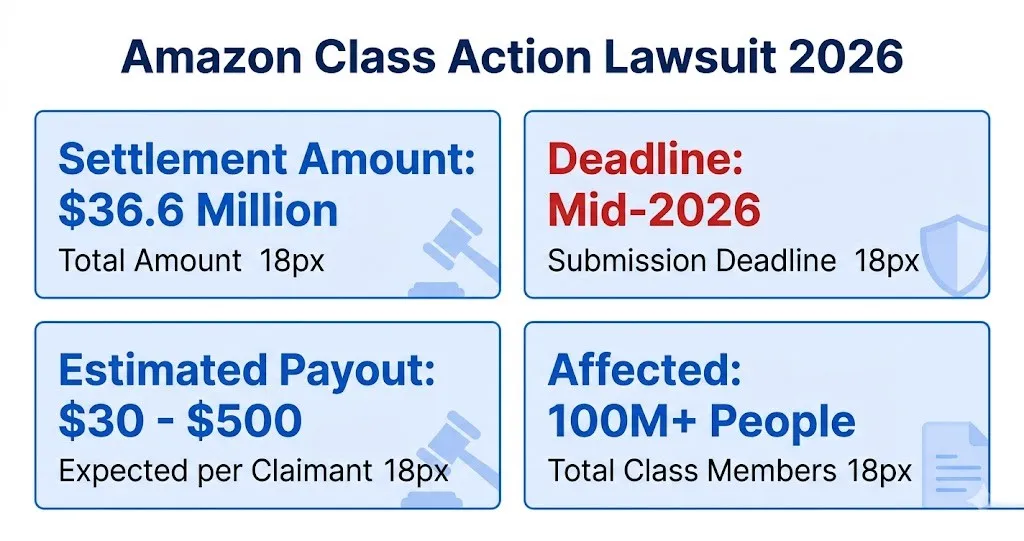
Amazon Class Action Lawsuit 2026
The Amazon class action lawsuit landscape in 2026 includes at least six major active cases against the company. These lawsuits target Amazon’s pricing practices, data collection habits, treatment of gig workers, and third-party seller policies.
Amazon has faced legal pressure from multiple directions. The FTC sued the company in September 2023 for allegedly using monopoly power to inflate prices and stifle competition. That case is still working through the courts in 2026.
| Case Type | Court | Status in 2026 |
|---|---|---|
| FTC Antitrust/Monopoly | U.S. District Court, W.D. Washington | Trial preparation |
| Prime Cancellation | Multiple federal courts | Settlement reached |
| Alexa Privacy | U.S. District Court, W.D. Washington | Settlement claims open |
| Seller Fee Overcharges | N.D. California | Class certification phase |
| Flex Driver Misclassification | Various state courts | Active litigation |
| Data Privacy/Ring | D.C. Federal Court | Settlement approved |
Several of these cases have reached the settlement stage. That means money is available to claim right now.
Others are still in litigation. Those won’t pay out for months or years.
The important thing is knowing which lawsuits apply to you. Each one has different eligibility rules and deadlines.
What Is the Amazon Class Action Lawsuit
A class action lawsuit against Amazon is a single legal case filed on behalf of a large group of people. Everyone in that group was harmed by the same Amazon practice or policy.
Think of it like a neighborhood complaint. Instead of each person hiring a lawyer individually, one legal team represents everybody at once. The court treats the group as a “class.”
Amazon’s size makes it a frequent target. The company handles over $600 billion in annual revenue and touches hundreds of millions of consumers.
These lawsuits allege that Amazon:
- Inflated prices by suppressing competition through its Buy Box algorithm
- Collected voice data from Alexa devices without proper consent
- Made Prime cancellation intentionally difficult using dark patterns
- Overcharged third-party sellers with hidden and excessive fees
- Misclassified Flex drivers as independent contractors to avoid paying benefits
Each allegation produced a separate class action. Some have settled. Some are still being fought in court.
Amazon has denied wrongdoing in most of these cases. Settlements are not admissions of guilt.
How to Join the Amazon Class Action Lawsuit
You can join most Amazon class action lawsuits by filing a claim through the settlement administrator’s website. No lawyer is required in most cases.
The process depends on which lawsuit you’re joining. Each case has its own claims process.
Here’s the general path for joining any active Amazon class action:
- Step 1: Identify which lawsuit applies to you based on how Amazon affected you
- Step 2: Visit the official settlement website for that specific case
- Step 3: Fill out the online claim form with your personal details
- Step 4: Provide any required proof (purchase receipts, account screenshots, delivery records)
- Step 5: Submit your claim before the posted deadline
For most cases, you won’t need to do anything beyond filling out the form online. The settlement administrator handles the rest.
Some lawsuits automatically include you as a class member. If Amazon has your purchase history on file, you might get a notice by email. That notice will explain your options: file a claim, opt out, or object.
If you received an email or letter from a settlement administrator about Amazon, don’t ignore it. That’s your ticket to getting paid.
Key Takeaway: You can join most Amazon class action lawsuits for free by submitting a simple online claim form before the deadline, and no attorney is needed.
Amazon Class Action Lawsuit Sign Up
Signing up for an Amazon class action lawsuit takes about 5 to 10 minutes online. You need your name, mailing address, email, and in some cases, your Amazon account information.
The sign-up process varies by case. Here’s what each major lawsuit requires:
| Lawsuit | Sign-Up Method | Info Required |
|---|---|---|
| Alexa Privacy Settlement | Online claim form | Name, email, Amazon account email |
| Ring Privacy Settlement | Online claim form | Name, address, Ring account details |
| Prime Dark Patterns | Auto-enrolled if notified | Respond to email notice |
| Seller Fee Overcharges | Online registration | Seller ID, store name, fee records |
| Flex Driver Case | Contact lead counsel | Employment dates, delivery records |
For the Alexa and Ring settlements, Amazon already has records of who owned the devices. You may just need to confirm your identity.
The Prime cancellation case is slightly different. The FTC’s action against Amazon’s “dark pattern” practices led to certain Prime members being auto-enrolled as class members.
If you’re unsure which case applies to you, start with the settlement notice you received. It will name the exact case and link to the right form.
Keep copies of everything you submit. Screenshot your confirmation page.
Amazon Class Action Lawsuit Claim Form
The Amazon class action lawsuit claim form is a short document you fill out to request your share of a settlement. Most claim forms are available online through the settlement administrator.
Each active case has its own form. They look different but ask similar questions.
A typical Amazon claim form will ask for:
- Full legal name (must match your Amazon account)
- Current mailing address (for check delivery)
- Email address tied to your Amazon account
- Dates of purchase or usage during the class period
- Proof of purchase (optional in some cases, required in others)
The Alexa privacy claim form, for example, asks you to confirm you owned an Echo device during the class period of 2014 to 2023. No receipts are needed for the basic claim.
The Ring settlement claim form requires you to confirm you had a Ring account and agree that your data was shared without your permission.
Quick Facts: Claim Forms
| Detail | Info |
|---|---|
| Format | Online (some accept paper by mail) |
| Time to Complete | 5 to 10 minutes |
| Proof Needed | Varies by case; often not required |
| Confirmation | Email receipt after submission |
| Help Available | Settlement administrator hotline |
Don’t wait until the last day. Settlement websites sometimes crash near deadlines due to high traffic.
Amazon Class Action Lawsuit Eligibility
Eligibility for an Amazon class action lawsuit depends on which case you’re considering and how you interacted with Amazon during the class period.
You don’t need to prove you personally suffered major financial harm. In class actions, the legal team proves harm for the entire group.
Here are the general eligibility rules for the major cases:
Alexa Privacy Case: You owned or used an Amazon Echo, Echo Dot, Echo Show, or any Alexa-enabled Amazon device between 2014 and 2023 in the United States.
Ring Privacy Case: You had a Ring doorbell or camera account, and your video data was accessed by employees or shared with third parties without consent during the class period.
Prime Dark Patterns Case: You were enrolled in Amazon Prime and experienced difficulty canceling your subscription. The FTC alleged Amazon used deceptive design to prevent cancellations.
Seller Overcharge Case: You sold products on Amazon Marketplace and were charged fees that exceeded Amazon’s stated rates during the relevant period.
Flex Driver Case: You drove for Amazon Flex and were classified as an independent contractor while allegedly performing duties consistent with employee status.
If you fall into any of these groups, you likely qualify. Check the settlement notice for the exact dates of the class period.
Amazon Lawsuit Payout Per Person
The payout per person in Amazon class action lawsuits typically ranges from $30 to $500, depending on the specific case and the strength of your claim.
Payouts vary widely. Someone who owned one Alexa device for a year will get less than someone who had five devices for a decade.
| Lawsuit | Estimated Payout Per Person | Settlement Fund |
|---|---|---|
| Alexa Privacy | $30 to $150 | Portion of $30.8M |
| Ring Privacy | $50 to $500 | Portion of $5.8M |
| Prime Dark Patterns | $5 to $50 (credits/refunds) | TBD by FTC order |
| Seller Fee Overcharges | Varies by fees paid | Pending |
| Flex Driver | Varies by hours worked | Pending |
The Ring settlement had a smaller fund but fewer claimants. That often means higher per-person payouts.
The Alexa settlement fund is larger at $30.8 million, but millions of people owned Echo devices. More claimants means each person’s share shrinks.
Your actual payout depends on three factors: the total fund size, the number of valid claims filed, and the strength of your individual claim documentation.
Key Takeaway: Amazon lawsuit payouts range from $30 to $500 per person, with the exact amount depending on the case, your proof of harm, and how many people file claims.
How Much Will I Get From the Amazon Class Action Lawsuit
Most Amazon class action claimants will receive between $30 and $500. The exact dollar amount won’t be finalized until the claims deadline passes and the settlement administrator calculates distributions.
Here’s why you can’t know the precise figure today. Settlement administrators divide the total fund by the number of valid claims. Until the deadline closes, nobody knows how many people will file.
Claims with documentation tend to pay more. If you can provide purchase receipts, account records, or device serial numbers, your claim may qualify for a higher tier.
Some settlements create two payout levels:
- Basic claim: No proof required. Lower payout (typically $30 to $75).
- Enhanced claim: Proof of purchase or usage submitted. Higher payout (typically $100 to $500).
The Ring settlement, for instance, allowed claimants who could show unauthorized video access to receive up to $500. Those who filed basic claims without documentation received smaller amounts.
Don’t expect a life-changing check. Class actions spread the money thin. But it’s free money you’re owed, and the process takes minutes.
Amazon Class Action Settlement 2026
Several Amazon class action settlements have reached final approval or are awaiting final approval hearings in 2026. The biggest involve the Alexa privacy case and the Ring doorbell data case.
The Alexa privacy settlement received final court approval in late 2025. Amazon agreed to pay $30.8 million to resolve claims that it stored children’s voice recordings and shared Alexa data without proper consent.
The Ring privacy settlement was finalized at $5.8 million. This resolved allegations that Ring employees improperly accessed customer video feeds.
| Settlement | Amount | Final Approval | Claims Status |
|---|---|---|---|
| Alexa Privacy | $30.8M | Approved late 2025 | Open for claims |
| Ring Privacy | $5.8M | Approved 2023 | Distribution phase |
| FTC Prime Case | TBD | Pending 2026 hearing | Not yet open |
| Seller Fees | TBD | Class certification | Not yet open |
The FTC’s Prime cancellation case is separate from these. That’s a government enforcement action, not a private class action. Any refunds or restitution from that case would come through the FTC directly.
Watch for new settlement announcements throughout 2026. Amazon faces ongoing litigation that could produce additional settlement funds.
Amazon Class Action Lawsuit Deadline
Deadlines for Amazon class action lawsuit claims vary by case. Some deadlines have already passed, while others remain open through mid to late 2026.
Missing a deadline means you lose your right to claim money. There’s no extension. No second chance.
| Lawsuit | Claim Deadline | Status |
|---|---|---|
| Ring Privacy | Expired (2024) | Closed |
| Alexa Privacy | Mid-2026 (check notice) | Open |
| FTC Prime | Not yet set | Pending |
| Seller Overcharges | Not yet set | Pending |
| Flex Driver | Not yet set | Pending |
For the Alexa case, the exact deadline is specified in your settlement notice. If you received an email from the settlement administrator, that email contains your personal deadline.
Set a calendar reminder at least two weeks before any deadline. File early to avoid website crashes and last-minute technical problems.
If you’re not sure whether a deadline has passed, check the settlement administrator’s website for the specific case. Expired claims are clearly marked.
Key Takeaway: The most urgent deadline in 2026 is for the Alexa privacy settlement; file your claim as soon as possible because once the deadline passes, your right to payment disappears permanently.
Amazon Prime Class Action Lawsuit
The Amazon Prime class action lawsuit stems from the FTC’s complaint that Amazon used deceptive design patterns to trick people into subscribing and make it extremely hard to cancel.
The FTC called Amazon’s cancellation process “Iliad” internally. That name referenced the epic length of Homer’s ancient poem. Amazon employees used it as a joke about how many steps it took to cancel Prime.
According to the FTC complaint filed in June 2023, Amazon:
- Enrolled users in Prime without clear consent during checkout
- Buried the cancellation button behind multiple pages and pop-ups
- Used confusing language designed to scare people out of canceling
- Added extra steps after users confirmed they wanted to cancel
This case is still active in 2026. It hasn’t reached a settlement yet.
If a settlement is reached, it could affect tens of millions of current and former Prime subscribers. Amazon had over 200 million Prime members worldwide as of 2024.
Potential remedies could include direct refunds to affected subscribers, subscription credits, or changes to Amazon’s cancellation process.
No claim form is available yet for this case. Keep an eye on the FTC’s announcements for updates.
Amazon Alexa Class Action Lawsuit 2026
The Amazon Alexa class action lawsuit in 2026 centers on a $30.8 million settlement resolving claims that Amazon violated privacy laws by recording and storing voice data from Alexa users, including children.
The allegations were serious. Plaintiffs claimed Amazon kept voice recordings indefinitely, even after users tried to delete them. The lawsuit also alleged Amazon used this data to improve its products and for targeted advertising.
Who qualifies: Anyone in the U.S. who used an Alexa-enabled Amazon device between 2014 and 2023.
That includes owners of:
- Echo and Echo Dot speakers
- Echo Show displays
- Fire TV devices with Alexa
- Third-party devices with Alexa built in
The settlement required Amazon to change its data practices. The company must now delete certain voice recordings and give users clearer control over their data.
| Detail | Info |
|---|---|
| Settlement Amount | $30.8 million |
| Class Period | 2014 to 2023 |
| Eligible Devices | All Alexa-enabled Amazon devices |
| Proof Required | Not required for basic claims |
| Estimated Payout | $30 to $150 per claimant |
If you ever said “Alexa” to a device in your home, you probably qualify. File the claim form before the deadline.
Amazon Seller Class Action Lawsuit
The Amazon seller class action lawsuit targets Amazon’s practice of allegedly overcharging third-party Marketplace sellers through hidden fees and anti-competitive practices.
Sellers have long complained that Amazon takes an ever-growing slice of their revenue. Referral fees, FBA fees, advertising costs, and storage charges can eat up 40% to 50% of a seller’s gross sales.
The main allegations include:
- Forcing sellers to use FBA (Fulfillment by Amazon) to win the Buy Box
- Raising fees without adequate notice or justification
- Penalizing sellers who offer lower prices on other platforms
- Using seller data to launch competing Amazon-branded products
Several lawsuits have been consolidated. The FTC’s broader antitrust case against Amazon also addresses seller treatment.
As of 2026, these cases are in the class certification stage. No settlement has been reached yet.
If you’re an Amazon Marketplace seller who operated between 2018 and 2025, you may eventually qualify for a payout. Document your fee history now.
Keep records of your Amazon seller statements, fee breakdowns, and any communications about fee increases. This evidence could strengthen your claim when a settlement opens.
Key Takeaway: Amazon sellers, Alexa owners, and Prime subscribers each face different lawsuits with separate timelines, so identify which case matches your experience and track its specific deadline.
Amazon Price Fixing Lawsuit
The Amazon price fixing lawsuit alleges that Amazon artificially inflated prices across online retail by punishing sellers who offered lower prices on competing websites.
This is one of the most significant antitrust cases in recent history. The FTC filed the complaint in September 2023 in the U.S. District Court for the Western District of Washington.
The core allegation is straightforward. Amazon’s algorithm monitors competitor prices. If a seller lists a product for less on Walmart.com or any other site, Amazon strips them of the Buy Box.
Losing the Buy Box means losing roughly 82% of Amazon sales for that product. So sellers keep prices high everywhere to maintain their Amazon placement.
The result, according to the FTC, is that consumers pay more across the entire internet. Not just on Amazon.
| Detail | Info |
|---|---|
| Filed By | Federal Trade Commission |
| Court | U.S. District Court, W.D. Washington |
| Core Allegation | Monopoly maintenance through price suppression |
| Defendant | Amazon.com, Inc. |
| Status in 2026 | Pre-trial/discovery phase |
This case hasn’t settled yet. If it does, the affected class could include virtually every American who shopped online during the class period.
The potential settlement fund could be enormous given the scope of harm alleged. But resolution is likely years away.
Amazon Data Privacy Lawsuit 2026
The Amazon data privacy lawsuits in 2026 address multiple allegations that the company improperly collected, stored, and shared user data across its devices and services.
Beyond the Alexa and Ring cases, Amazon faces separate privacy complaints related to its Kindle, Fire tablet, and Amazon shopping app data practices.
The biggest privacy cases include:
- Alexa voice recording storage (settled for $30.8M)
- Ring employee access to video feeds (settled for $5.8M)
- Children’s privacy violations through Alexa (FTC fine of $25M in 2023)
- Amazon shopping app location tracking (ongoing litigation)
- AWS data handling practices (regulatory investigations)
The FTC fined Amazon $25 million in 2023 specifically for violating the Children’s Online Privacy Protection Act (COPPA) through Alexa. That fine was separate from the class action settlement.
Privacy lawsuits against tech companies have accelerated sharply. Courts and regulators have become far less tolerant of data harvesting without explicit consent.
If you used any Amazon device or app and feel your data was mishandled, check whether a new class action has been filed covering your situation. New cases are being added regularly.
Amazon Flex Class Action Lawsuit
The Amazon Flex class action lawsuit alleges that Amazon misclassified delivery drivers as independent contractors instead of employees, denying them wages, benefits, and legal protections.
Amazon Flex drivers use their own cars to deliver packages. Amazon sets the routes, times, and pay rates. Drivers argue this level of control makes them employees under the law.
The key issues in these lawsuits include:
- No overtime pay despite working more than 40 hours per week
- No health insurance or retirement benefits
- Vehicle expenses (gas, maintenance, insurance) borne entirely by drivers
- Tip withholding allegations in some states
- Unfair deactivation without appeal or due process
Several state-level cases are active in California, Massachusetts, and Illinois. These states have stricter worker classification laws.
| Detail | Info |
|---|---|
| Workers Affected | Estimated 500,000+ Flex drivers nationwide |
| Key States | California, Massachusetts, Illinois |
| Core Allegation | Employee misclassification |
| Status in 2026 | Active litigation in multiple states |
| Potential Remedy | Back pay, benefits, expense reimbursement |
If you drove for Amazon Flex and were classified as an independent contractor, save your earnings statements and delivery records. These documents will matter if a settlement is reached.
The outcome of these cases could reshape how Amazon and other gig economy companies classify their workers.
Key Takeaway: Amazon faces privacy lawsuits over Alexa and Ring data, price fixing complaints from the FTC, and worker misclassification claims from Flex drivers, with each case at a different stage of resolution in 2026.
Amazon Class Action Settlement Check
Your Amazon class action settlement check will arrive by mail or direct deposit after the settlement administrator finishes processing all valid claims.
Here’s how the payment process works. After the claim deadline closes, the administrator reviews every submission. Invalid or duplicate claims get removed. Then the total fund is divided among approved claimants.
The typical timeline from deadline to payment:
| Phase | Estimated Duration |
|---|---|
| Claims deadline closes | Day 0 |
| Claim review and validation | 30 to 90 days |
| Final distribution calculation | 30 to 60 days |
| Checks mailed / deposits sent | 60 to 120 days after review |
| Check cashing deadline | 90 to 180 days after receipt |
Total time from deadline to check in your hand: roughly 4 to 12 months.
If you chose direct deposit on your claim form, you’ll get paid faster. Paper checks take longer due to mailing and processing.
When your check arrives, cash it promptly. Settlement checks expire. If you don’t cash it within the stated window (usually 90 to 180 days), you lose that money permanently.
Don’t throw away mail from settlement administrators. The envelopes often look like junk mail. Watch for names like Epiq, KCC, or Angeion Group on the return address.
Amazon Class Action Lawsuit Status Update
The status of Amazon class action lawsuits in 2026 shows a mix of settled cases, active litigation, and new filings.
Here’s a snapshot of where each major case stands right now:
| Case | 2026 Status | Next Step |
|---|---|---|
| Alexa Privacy ($30.8M) | Settlement approved, claims open | File before deadline |
| Ring Privacy ($5.8M) | Distribution complete or underway | Checks being mailed |
| FTC Prime Dark Patterns | Active litigation | Awaiting trial or settlement |
| FTC Antitrust/Monopoly | Discovery/pre-trial | Trial expected 2026-2027 |
| Seller Fee Overcharges | Class certification stage | Ruling expected mid-2026 |
| Flex Driver Cases | Active in multiple states | Varies by state |
The FTC antitrust case is the biggest wildcard. If Amazon settles, the fund could be worth billions. If it goes to trial and Amazon loses, the court could order structural changes to the company.
New Amazon lawsuits are filed regularly. Categories to watch include AI training data usage, counterfeit product liability, and warehouse worker safety.
Stay updated by checking settlement administrator websites for cases you’ve already filed claims on. New notices are posted when payment dates are set.
Key Takeaway: The Alexa privacy settlement is the most actionable case right now; it’s approved, claims are open, and checks are on the way for those who file before the deadline.
Frequently Asked Questions
How do I sign up for the Amazon class action lawsuit in 2026?
Visit the official settlement website listed in your claim notice and complete the online form.
You’ll need your name, address, email, and Amazon account information.
The process takes about 5 to 10 minutes and costs nothing.
How much money will I get from the Amazon class action lawsuit?
Most claimants can expect between $30 and $500 depending on the case.
The exact amount depends on the settlement fund size, number of claimants, and whether you submit proof of purchase.
Enhanced claims with documentation receive higher payouts.
What is the deadline to file an Amazon class action lawsuit claim?
Deadlines vary by case, but the Alexa privacy settlement deadline falls in mid-2026.
Check your settlement notice email for the exact date specific to your claim.
Missing the deadline permanently disqualifies you from receiving payment.
Do I need a lawyer to join the Amazon class action lawsuit?
No, you do not need a lawyer to join or file a claim in most Amazon class actions.
The class action attorneys represent all class members at no upfront cost.
Their fees come from the settlement fund, not from your individual payout.
When will Amazon class action settlement checks be mailed?
Settlement checks are typically mailed 4 to 12 months after the claims deadline closes.
The Ring privacy settlement checks began distribution in 2024 and 2025.
Alexa privacy settlement checks are expected in late 2026 for those who file on time.
If you’ve used Amazon in the last decade, at least one of these lawsuits probably applies to you. Free money is sitting on the table.
Check your email for settlement notices. File your claim forms now.
Don’t wait until deadlines sneak past you. A few minutes of effort today could put real dollars back in your pocket.
