The Nissan class action lawsuit over engine defects is picking up serious momentum in 2026. Owners of Nissan Rogue, Altima, and other models equipped with the VC-Turbo engine are at the center of legal claims alleging premature engine failure, excessive oil consumption, and dangerous stalling.
If you drive a Nissan built between 2019 and 2025 with this engine, this case could directly affect your wallet. Thousands of NHTSA complaints back up the claims. Some owners report total engine failure before hitting 50,000 miles.
This article breaks down every detail you need: which models qualify, what payouts could look like, the latest settlement status, and the exact steps to file. We’re covering everything the other guides leave out.
The VC-Turbo was supposed to be Nissan’s breakthrough engine. Instead, it became one of the brand’s biggest headaches.
Nissan Class Action Lawsuit Over Engine Defects
The Nissan class action lawsuit targets a design flaw in Nissan’s VC-Turbo engines that allegedly causes engines to fail far earlier than they should. Multiple lawsuits filed in federal courts across the United States claim Nissan knew about these defects and sold the vehicles anyway.
The core legal theory is straightforward. Plaintiffs argue Nissan engaged in fraudulent concealment by hiding known engine problems from buyers. They also claim breach of express and implied warranties under the Magnuson-Moss Warranty Act.
| Detail | Info |
|---|---|
| Defendant | Nissan North America, Inc. |
| Engine at Issue | VC-Turbo (KR15DDT / KR20DDET) |
| Legal Claims | Fraudulent concealment, breach of warranty, unjust enrichment |
| Federal Jurisdiction | Multiple U.S. District Courts |
| Approximate Complaints | 3,000+ NHTSA filings as of early 2026 |
These cases aren’t just about money. Owners describe terrifying situations. Engines dying at highway speeds. Sudden power loss in traffic. Thick smoke pouring from under the hood.
Several prominent law firms are handling these cases, including Hagens Berman and Chimicles Schwartz Kriner & Donaldson-Smith. The legal firepower behind these claims signals that attorneys believe the evidence is strong enough to push Nissan toward a resolution.
Nissan VC-Turbo Engine Defect Lawsuit Explained
The Nissan VC-Turbo engine defect lawsuit specifically targets the variable compression turbo engine, an engine Nissan marketed as a technological marvel when it debuted. The lawsuit alleges this engine’s unique mechanical design is inherently prone to catastrophic failure.
Here’s what makes this lawsuit different from a typical auto defect case. The VC-Turbo uses a multi-link connecting rod system that physically changes the engine’s compression ratio while running. No other production engine does this. That complexity, plaintiffs argue, is exactly the problem.
The lawsuits allege several specific defect modes:
- Connecting rod and multi-link mechanism failure causing internal engine destruction
- Excessive oil consumption burning through a quart or more every 1,000 miles
- Turbocharger failure linked to oil starvation from the consumption issue
- Engine control module software errors failing to warn drivers before damage occurs
Think of it like a watch with 100 moving parts versus one with 10. More complexity means more failure points. The VC-Turbo has significantly more moving parts inside the combustion chamber area than any conventional engine.
Court filings reference internal Nissan engineering documents and technical service bulletins that plaintiffs say prove Nissan identified these issues before some affected vehicles were even sold.
Nissan Engine Class Action Settlement in 2026
As of mid-2026, no final class action settlement has been approved in the Nissan VC-Turbo engine defect cases. The litigation is still in active pre-trial stages in federal court, with discovery ongoing and class certification motions being briefed.
That doesn’t mean nothing is happening. Settlement talks are widely expected to begin in the second half of 2026, based on the pace of similar automotive defect cases. Cases of this size and complexity typically reach settlement between 2 and 4 years after initial filing.
| Settlement Timeline | Status |
|---|---|
| Initial Lawsuits Filed | 2023-2024 |
| Discovery Phase | Ongoing through mid-2026 |
| Class Certification | Expected ruling late 2026 |
| Settlement Negotiations | Anticipated late 2026 to early 2027 |
| Potential Final Approval | 2027 (estimated) |
There’s a reason Nissan might want to settle. The NHTSA complaint database keeps growing. Every new engine failure adds another data point to the plaintiffs’ case. And every replaced engine creates a documented financial loss that’s easy to calculate.
Some individual owners have already resolved their claims through state lemon law proceedings or individual arbitration. But those individual outcomes won’t set the terms for a class-wide settlement. That still has to be negotiated or ordered by the court.
Key Takeaway: The Nissan VC-Turbo engine defect lawsuits are active and advancing through federal court in 2026, with settlement negotiations expected to begin before the year ends.
Nissan VC-Turbo Lawsuit Payout Estimates
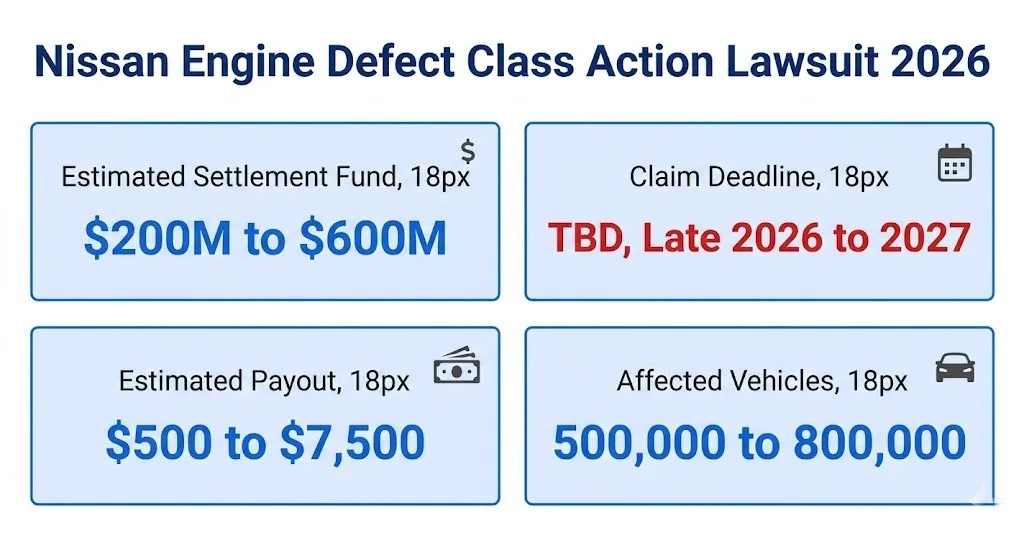
Individual payouts from the Nissan VC-Turbo lawsuit will likely range from $500 to $7,500 depending on the category of harm and whether the owner paid out of pocket for repairs. Owners who paid for a full engine replacement without warranty coverage could receive significantly more.
These estimates come from analyzing comparable automotive engine defect settlements. Cases like the Hyundai Theta II engine settlement and the GM Generation IV valve cover lawsuit provide useful benchmarks for what Nissan owners might expect.
| Claim Category | Estimated Payout Range |
|---|---|
| Oil consumption only (no engine failure) | $500 to $1,500 |
| Engine replaced under warranty | $1,000 to $3,000 |
| Engine replaced out of pocket | $3,000 to $7,500 |
| Vehicle buyback (lemon law states) | $15,000 to $35,000+ |
| Total vehicle loss / safety incident | Individually negotiated |
The payout you receive depends on what happened to your vehicle. Someone who burned oil but never had a breakdown won’t get the same amount as someone who paid $8,000 for a new engine at 40,000 miles.
Documentation matters more than anything else. Repair receipts, oil purchase records, dealer service printouts, and NHTSA complaints all strengthen your individual claim value. Start gathering those records now, even if the settlement is months away.
How Much Is the Nissan Engine Lawsuit Settlement?
The total Nissan engine lawsuit settlement amount has not been finalized because the case has not yet reached settlement. Based on the scope of affected vehicles and the severity of the defect, legal analysts project a total settlement fund between $200 million and $600 million.
That projection accounts for several factors:
- Number of affected vehicles: Estimated at 500,000 to 800,000 units sold in the U.S. with VC-Turbo engines
- Average repair cost: $4,000 to $9,000 for engine replacement
- Nissan’s financial exposure: Warranty extension costs, diminished brand value, regulatory risk
- Comparable settlements: Hyundai/Kia engine settlements totaled over $1.3 billion across multiple rounds
The Hyundai comparison is instructive. That case involved a simpler defect in a much larger vehicle population and still resulted in massive payouts. Nissan’s VC-Turbo defect is arguably more complex and affects a smaller but still substantial number of vehicles.
Don’t confuse the total settlement fund with your personal check. The total gets divided among all qualifying claimants after legal fees and administrative costs. Your share depends on your specific circumstances, which is why keeping records of every repair and oil top-off matters.
Nissan Class Action Lawsuit Eligibility Requirements
You likely qualify for the Nissan class action lawsuit if you own or lease a Nissan vehicle equipped with the VC-Turbo engine from model years 2019 through 2025 and experienced any engine-related problems. The class definition may vary slightly depending on which specific lawsuit you join.
General eligibility criteria based on current filings:
- You purchased or leased the vehicle in the United States
- Your vehicle has a VC-Turbo engine (1.5L KR15DDT or 2.0L KR20DDET)
- You experienced at least one qualifying issue: oil consumption, engine knock, stalling, power loss, or engine failure
- You have some documentation of the problem: dealer records, repair bills, or an NHTSA complaint
| Eligibility Factor | Requirement |
|---|---|
| Vehicle Location | Purchased or leased in the U.S. |
| Engine Type | VC-Turbo (1.5L or 2.0L) |
| Model Years | 2019 through 2025 |
| Documented Problem | At least one engine issue on record |
| Ownership Status | Current or former owner/lessee |
You do not need to have had a full engine failure to qualify. Oil consumption claims count. So do complaints about rough running, check engine lights, or reduced power. The class is expected to include several tiers of claimants based on severity of harm.
Former owners qualify too. If you sold the car because you were sick of the problems, you can still file a claim for the period you owned it.
Key Takeaway: Most owners and lessees of 2019 to 2025 Nissan vehicles with VC-Turbo engines qualify for this class action, even if their engine didn’t completely fail.
How to Join the Nissan Engine Lawsuit
Joining the Nissan engine lawsuit is free, and most people can start the process in under 15 minutes by submitting their information through one of the law firms handling the case. You do not need to hire your own attorney to participate in a class action.
Here’s the general process in 2026:
- Gather your vehicle information: VIN number, purchase date, mileage, service records
- Document your engine problems: Collect dealer repair orders, oil purchase receipts, any written complaints you’ve made
- File an NHTSA complaint: This creates an official government record of your issue
- Submit a case evaluation: Contact one of the law firms handling the litigation
- Wait for class certification: If the court certifies the class, you’ll be notified of your options
There’s an important distinction to understand. In most class actions, you’re automatically included in the class once it’s certified unless you opt out. But submitting your information early helps attorneys build a stronger case and may position you for a higher payout tier.
You won’t pay anything upfront. Class action attorneys work on contingency, meaning they get paid from the settlement fund, not from your pocket. The typical fee is 25% to 33% of the total settlement, which is deducted before individual payments go out.
Which Nissan Models Have the VC-Turbo Defect?
The Nissan models affected by the VC-Turbo engine defect include the Nissan Rogue, Nissan Altima, and the Infiniti QX50, all of which use some version of Nissan’s variable compression turbo engine. The Rogue has the highest volume of complaints by a wide margin.
| Model | Engine Version | Model Years Affected | Complaint Volume |
|---|---|---|---|
| Nissan Rogue (T33) | 1.5L VC-Turbo (KR15DDT) | 2021 to 2025 | Highest |
| Nissan Altima | 2.0L VC-Turbo (KR20DDET) | 2019 to 2024 | Moderate |
| Infiniti QX50 | 2.0L VC-Turbo (KR20DDET) | 2019 to 2024 | Moderate |
| Nissan Pathfinder | 1.5L VC-Turbo (select trims) | 2024 to 2025 | Lower (newer model) |
Not every vehicle with a turbo engine from Nissan is affected. The standard non-VC-Turbo engines in base model Altimas and older Rogues use a completely different design. Only vehicles with the variable compression turbo system are part of this lawsuit.
If you’re unsure which engine your Nissan has, check the engine cover under the hood. VC-Turbo equipped vehicles typically have branding on the engine cover. You can also verify by entering your VIN on the NHTSA website or calling your local Nissan dealer.
Nissan Rogue Engine Failure Lawsuit Details
The Nissan Rogue is the epicenter of the VC-Turbo engine failure lawsuits, accounting for more than 60% of all related NHTSA complaints. The 2021 to 2024 Rogue uses the 1.5-liter three-cylinder VC-Turbo, which has proven especially troublesome.
Rogue owners describe a common failure pattern:
- Gradual increase in oil consumption starting around 20,000 to 30,000 miles
- Check engine light or low oil pressure warning
- Rough idling and misfires
- Complete engine seizure or connecting rod failure, often before 60,000 miles
The 1.5L VC-Turbo in the Rogue is a smaller, three-cylinder version of the technology. Having fewer cylinders means each one works harder. The mechanical stress on the variable compression linkage system is intense, and the failure rates reflect that.
Some Rogue owners report engines dying without warning on highways. Others say their dealer replaced the engine under warranty, only to have the replacement engine develop the same problems within 20,000 miles. That repeat failure pattern is a strong indicator of a systemic design flaw, not a manufacturing anomaly.
The Rogue’s popularity makes this a massive case. Nissan sold hundreds of thousands of Rogues with this engine between 2021 and 2025. That’s a huge potential class.
Key Takeaway: The Nissan Rogue with the 1.5L VC-Turbo engine is the most heavily affected model, with owners reporting engine failures as early as 20,000 miles.
Nissan Altima VC-Turbo Lawsuit Update
The Nissan Altima VC-Turbo lawsuit involves the 2.0-liter four-cylinder version of the variable compression engine, found in select Altima SR and Platinum trims from model years 2019 through 2024. This engine has its own distinct set of problems.
The 2.0L version was the first VC-Turbo to reach production. Nissan introduced it in the 2019 Infiniti QX50 and then made it available in the Altima. Because it’s been on the market longer, there’s a larger body of complaint data to work with.
| Altima VC-Turbo Issue | Frequency |
|---|---|
| Excessive oil consumption | Very common |
| Turbocharger failure | Common |
| Engine knocking at cold start | Common |
| Complete engine failure | Less common than Rogue but documented |
| Reduced power / limp mode | Common |
The Altima’s 2.0L engine seems slightly more durable than the Rogue’s 1.5L three-cylinder. Failures tend to occur at higher mileage, often between 50,000 and 80,000 miles. But the oil consumption problem starts much earlier, sometimes within the first 10,000 miles.
Altima owners have a strong claim even if their engine hasn’t failed yet. Oil consumption alone reduces engine life, increases maintenance costs, and can void other warranty coverage if oil levels drop too low. These are all compensable harms in a class action.
Nissan VC-Turbo Engine Problems in 2026
Nissan VC-Turbo engine problems are continuing in 2026, with no engineering fix or updated engine design solving the core issues. Nissan has issued software updates and revised maintenance schedules, but owners say these band-aid solutions don’t stop the fundamental mechanical failures.
The most reported problems in 2026 include:
- Oil consumption above 1 quart per 1,000 miles in many vehicles
- Engine stalling at idle or during low-speed driving
- Catastrophic engine failure requiring full replacement
- Turbocharger damage caused by oil starvation
- Check engine lights illuminating with codes related to compression ratio control
What’s new in 2026 is the volume. More of these vehicles are hitting the 40,000 to 60,000 mile range, which appears to be the sweet spot for major failures. As the fleet ages, the failure rate is climbing.
Nissan has quietly revised its oil consumption testing procedures at dealerships. Some dealers now consider 1 quart per 1,200 miles “acceptable.” Owners and attorneys argue that’s absurd. For comparison, most modern engines should consume less than half a quart between oil changes.
Newer 2025 model year vehicles with the VC-Turbo are also showing problems, though at lower rates. This suggests Nissan may have made minor improvements but hasn’t addressed the root design flaw.
How the VC-Turbo Variable Compression System Fails
The VC-Turbo fails because its multi-link connecting rod mechanism, the very feature that makes it unique, creates extreme mechanical stress on internal components that wear out far too quickly. This isn’t a quality control problem. It’s a design problem.
Here’s how it works in simple terms. A normal engine has a fixed compression ratio. The VC-Turbo can change its compression ratio on the fly by physically adjusting the geometry of each piston’s connecting rod. An electric motor moves an actuator shaft, which rotates eccentric links, which change how far each piston travels.
Imagine opening and closing an adjustable wrench thousands of times per minute, under extreme heat and pressure. That’s essentially what the VC-Turbo mechanism does. The tolerances are incredibly tight, and any wear causes a cascade of problems.
The failure chain typically follows this path:
- Multi-link bearings wear, creating slight play in the mechanism
- Oil consumption increases as piston rings can’t seal properly against changing geometry
- Oil levels drop, starving the turbocharger and other components
- Metal-on-metal contact occurs inside the engine
- Catastrophic failure: connecting rod breaks or engine seizes
This is why software updates don’t fix the problem. You can’t reprogram physics. The mechanical components need to survive conditions that exceed their material durability.
Key Takeaway: The VC-Turbo’s variable compression mechanism is the root cause of these failures, and no software update or maintenance schedule change can solve a fundamental design flaw.
Nissan VC-Turbo Oil Consumption Lawsuit Claims
The Nissan VC-Turbo oil consumption lawsuit claims allege that these engines consume oil at rates 3 to 10 times higher than what Nissan represents as normal, causing progressive engine damage even in vehicles that haven’t suffered a complete breakdown.
Oil consumption is the canary in the coal mine for VC-Turbo problems. It’s usually the first symptom owners notice, and it often begins within the first 15,000 to 25,000 miles. By the time the engine fails, it’s been slowly destroying itself from the inside for months.
| Oil Consumption Metric | Normal Engine | VC-Turbo (Reported) |
|---|---|---|
| Quarts per 5,000 miles | Less than 0.5 qt | 2 to 5+ quarts |
| Nissan “acceptable” threshold | N/A | 1 qt per 1,200 miles |
| Industry standard concern level | Over 1 qt per 3,000 miles | Exceeded routinely |
The legal claims around oil consumption are strong because they’re easy to document. Every time you buy a quart of oil between changes, that’s evidence. Every time a dealer notes low oil on a service record, that’s evidence.
Plaintiffs argue Nissan knew about the consumption issue from testing and early warranty data but failed to disclose it. Internal documents cited in court filings suggest engineers raised concerns during development, but the engine was released on schedule anyway.
You don’t need to prove your engine blew up to benefit from this part of the lawsuit. Excessive oil consumption alone causes real costs: extra oil purchases, more frequent service visits, reduced engine lifespan, and lower resale value.
Nissan Rogue VC-Turbo Stalling Problems
Nissan Rogue VC-Turbo stalling is one of the most dangerous defects alleged in the lawsuit, with owners reporting their engines shutting off completely during highway driving with no warning. This creates an immediate safety hazard.
When the engine stalls, the power steering and power brakes stop working. At 65 miles per hour, the driver suddenly has to wrestle a 3,500-pound vehicle to the shoulder with no assist. Several NHTSA complaints describe near-miss accidents caused by this exact scenario.
The stalling problem has multiple potential triggers:
- Oil starvation causing the engine management system to shut down
- Compression ratio actuator failure preventing the engine from adjusting
- Software glitches in the engine control module
- Turbocharger surge or failure during acceleration
What makes this especially concerning is the lack of warning. Many owners say there was no check engine light, no unusual noise, and no performance change before the engine simply died. One second it’s running. The next second, nothing.
NHTSA has received hundreds of complaints specifically about stalling in the 2021 to 2024 Rogue. If the agency opens a formal investigation (as of early 2026, it has issued an Engineering Analysis), the pressure on Nissan to act increases dramatically.
Key Takeaway: VC-Turbo stalling at highway speeds is a life-threatening safety concern that strengthens the legal case and increases the chances of a recall or forced settlement.
Nissan Engine Defect NHTSA Complaints
NHTSA has received over 3,000 complaints related to Nissan VC-Turbo engine problems as of early 2026, making it one of the most complained-about engine systems in the agency’s database for vehicles from the 2021 to 2025 model years.
These complaints serve a dual purpose. They alert the government to potential safety hazards, and they create an official record that attorneys use as evidence in court.
| NHTSA Complaint Milestone | Status |
|---|---|
| Total complaints filed | 3,000+ (as of early 2026) |
| Most affected model | 2022 and 2023 Nissan Rogue |
| Most common complaint | Engine failure / stalling |
| Engineering Analysis opened | Yes |
| Formal recall ordered | Not yet |
Filing your own NHTSA complaint takes about 10 minutes. Go to the NHTSA vehicle complaint portal, enter your VIN, and describe the problem in detail. This is one of the single most important things you can do to protect your legal rights.
Every complaint adds weight. When NHTSA sees a pattern, it escalates its investigation. When attorneys reference 3,000 complaints in a court filing, judges pay attention. Your individual complaint becomes part of a much larger body of evidence that benefits every affected owner.
The complaints also reveal something important: the failure rate is accelerating. In 2024, about 800 complaints were filed. In 2025, over 1,200. The 2026 pace is tracking even higher.
Is There a Nissan Engine Defect Recall in 2026?
As of mid-2026, Nissan has not issued a formal recall for the VC-Turbo engine defect. NHTSA has opened an Engineering Analysis, which is one step before a recall determination, but no mandatory recall order has been issued yet.
There’s a difference between a recall and what Nissan has done. Nissan has released Technical Service Bulletins (TSBs) addressing specific VC-Turbo symptoms. TSBs are repair instructions for dealers, not mandatory fixes for all vehicles. Your car won’t get fixed under a TSB unless you bring it in and complain about the specific problem.
| Action | Status in 2026 |
|---|---|
| Formal NHTSA Recall | Not issued |
| NHTSA Engineering Analysis | Open and active |
| Nissan Technical Service Bulletins | Multiple TSBs issued |
| Nissan Voluntary Campaign | Limited (see warranty extension section) |
If NHTSA’s engineering analysis finds that the defect poses an unreasonable safety risk, the agency can order a mandatory recall. Given the stalling complaints and the volume of failures, many consumer advocates believe a recall is a matter of when, not if.
A recall would change the settlement calculus significantly. It would be a de facto admission that the defect exists and is dangerous. Nissan’s attorneys know this, which is why they’ll likely try to settle the class action before a recall is ordered.
Nissan Engine Warranty Extension for VC-Turbo
Nissan has extended the powertrain warranty on select VC-Turbo equipped vehicles to 7 years or 84,000 miles for engine-related defects, up from the standard 5 years or 60,000 miles. This extension applies to certain model years and specific failure types.
That sounds helpful. But there are catches.
- The extension covers only the engine long block and turbocharger, not related components like catalytic converters damaged by oil burning
- Nissan requires documented maintenance history to honor the extension
- Some dealers interpret the extension narrowly, refusing coverage for oil consumption claims
- The extension does not reimburse owners who already paid out of pocket for repairs before the extension was announced
| Warranty Detail | Standard | Extended |
|---|---|---|
| Duration | 5 years / 60,000 miles | 7 years / 84,000 miles |
| Covered Components | Engine, transmission | Engine long block, turbocharger |
| Oil Consumption Coverage | Not explicitly covered | Covered if failure results |
| Retroactive Reimbursement | N/A | Not guaranteed |
If your vehicle is still within the extended warranty window, take it to the dealer immediately. Document everything. Get the oil consumption test performed. Even if they say it’s “within spec,” having that test on record helps your legal claim later.
The warranty extension itself is used by plaintiffs’ attorneys as evidence. They argue it shows Nissan recognized the defect but tried to handle it quietly rather than issuing a full recall. That argument carries weight with juries.
Key Takeaway: Nissan’s warranty extension to 84,000 miles helps some owners but excludes many, and plaintiffs’ attorneys view it as an admission that Nissan knew about the VC-Turbo defect.
What Does VC-Turbo Replacement Cost Without Warranty?
A VC-Turbo engine replacement without warranty coverage costs between $6,000 and $12,000 at a Nissan dealership, depending on the model, location, and whether the turbocharger needs replacement too. Independent mechanics may charge less, but parts availability for this engine is limited.
| Cost Component | Estimated Range |
|---|---|
| VC-Turbo engine (remanufactured) | $4,000 to $7,000 |
| Labor (15 to 25 hours) | $1,500 to $3,500 |
| Turbocharger (if needed) | $800 to $1,500 |
| Fluids, gaskets, misc. parts | $300 to $500 |
| Total estimate | $6,000 to $12,000 |
These costs are part of why the class action has such strong support. Most owners don’t expect to replace an engine on a car with fewer than 60,000 miles. When you buy a new Nissan for $30,000 to $40,000, an $8,000 engine replacement at year three feels like a betrayal.
Some owners get stuck in an even worse position. They can’t afford the repair, so they sell the car at a steep loss. Or they continue driving a vehicle with dangerously low oil levels because they can’t keep up with the consumption rate.
Independent shops that work on VC-Turbo engines are rare. The multi-link variable compression system requires specialized tools and training. Most shops decline the work entirely, leaving owners dependent on dealership pricing.
Keep every receipt. Every one of those dollars is potentially recoverable through the class action or through individual legal claims under state consumer protection statutes.
Frequently Asked Questions
How much money can I get from the Nissan engine defect class action lawsuit?
Most claimants can expect between $500 and $7,500 depending on the severity of their engine problems.
Owners who paid out of pocket for engine replacement may receive the highest payouts.
Final amounts will be determined once a settlement is approved, which is expected in late 2026 or 2027.
Which Nissan vehicles are covered by the VC-Turbo engine lawsuit?
The lawsuit covers 2019 to 2025 Nissan Rogue, Altima, and Infiniti QX50 models with VC-Turbo engines.
The 2021 to 2024 Rogue with the 1.5L three-cylinder VC-Turbo is the most heavily affected.
Some 2024 to 2025 Pathfinder models with the VC-Turbo may also be included.
What is the deadline to join the Nissan engine class action in 2026?
No firm claim deadline has been set because the case is still in litigation as of mid-2026.
Once a settlement is reached, a claims submission period will open, typically lasting 90 to 180 days.
You should submit your information to a participating law firm now to protect your place.
Does Nissan have a recall for VC-Turbo engine problems?
Nissan has not issued a formal recall for VC-Turbo engine defects as of 2026.
NHTSA has opened an Engineering Analysis, which is one step before a potential recall order.
Nissan has issued Technical Service Bulletins and a limited warranty extension instead.
Can I still file a Nissan engine defect claim if my warranty expired?
Yes, the class action lawsuit is separate from your vehicle’s warranty.
You can file a claim based on state consumer protection laws, the Magnuson-Moss Warranty Act, and fraud theories.
Even if you sold the vehicle, you can still seek compensation for losses during your ownership period.
If you own a Nissan with the VC-Turbo engine, don’t sit on the sidelines. The evidence is stacking up, the legal teams are moving, and 2026 is shaping up to be a turning point in this case.
Gather your service records and repair receipts now. File your NHTSA complaint if you haven’t already. Submit your information to a law firm handling the litigation.
The window to build the strongest possible claim is right now. Use it.