
Quick Answer Box
- The McDonald’s coffee lawsuit is the 1994 case Liebeck v. McDonald’s Restaurants, not an active 2026 class action or mass tort.
- A person qualifies for a similar claim today only by suffering a documented burn injury from negligently served hot beverages, evaluated case by case.
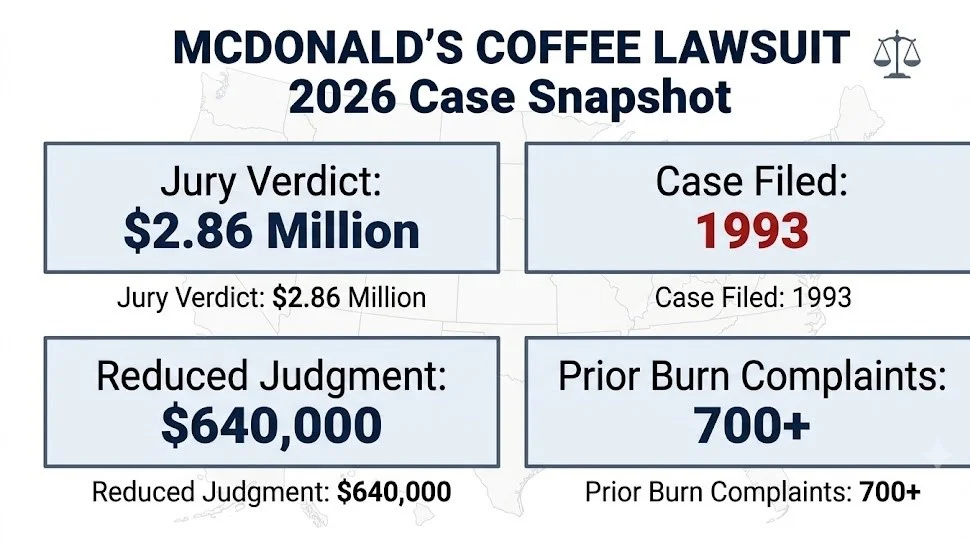
- The original case resulted in a $2.86 million jury verdict, later reduced and settled confidentially for an undisclosed lower amount.
Case Snapshot
| Detail | Info |
|---|---|
| Court | Second Judicial District Court, Bernalillo County, New Mexico |
| Case / Docket Number | No. CV-93-02419 |
| Filing Date | 1993, following a February 27, 1992 injury |
| Status | Closed. Resolved by confidential settlement in 1995 after appeal was filed |
| Settlement Fund | No mass settlement fund exists. This was a single-plaintiff case, not a class action |
There is no active McDonald’s coffee lawsuit moving through court in 2026. The famous case behind the phrase closed three decades ago.
What persists is the legal theory it established, and that theory still applies to burn injury claims filed against restaurants today. Stella Liebeck’s case remains one of the most misquoted verdicts in American legal history.
Most people repeat a number that was never actually paid. The jury awarded $2.7 million in punitive damages, but a judge cut that figure by more than 80 percent before the case settled confidentially.
This piece lays out what the original case actually proved in court, and what it means for anyone burned by a hot beverage in 2026.
What Was the McDonald’s Coffee Lawsuit About
The McDonald’s coffee lawsuit was a product liability and negligence case over coffee served at a temperature capable of causing third-degree burns within seconds. Stella Liebeck, then 79, suffered those burns after a cup spilled in her lap.
The case turned on two legal theories. The coffee itself was allegedly defective due to its temperature, and McDonald’s was allegedly negligent for continuing the practice despite hundreds of prior complaints.
Quick facts:
- Injury date: February 27, 1992
- Location: McDonald’s drive-through, Albuquerque, New Mexico
- Liebeck was a passenger in a parked vehicle, not driving
- McDonald’s required franchises to hold coffee at 180 to 190°F
Attorney Insight: Attorneys who handle burn injury claims point to the temperature standard itself as the heart of the case, not the spill, since the spill was foreseeable and the danger was allegedly known internally for years.
What Was the McDonald’s Hot Coffee Lawsuit
The McDonald’s hot coffee lawsuit is the same case, commonly referred to this way because the central evidentiary issue was beverage temperature, not the spill itself. The label distinguishes the legal substance from the popular shorthand.
Trial evidence showed McDonald’s coffee ran 20 to 30 degrees hotter than competitors. That gap is what transformed an ordinary spill into a catastrophic injury.
| Comparison | Temperature | Time to Third-Degree Burn |
|---|---|---|
| McDonald’s required serving temp | 180 to 190°F | 2 to 3 seconds |
| Typical competitor serving temp (1990s) | 160°F | Approximately 20 seconds |
| Home-brewed coffee | 135 to 140°F | Several minutes |
Litigation Watch: The entire case rested on a 17 to 20 second gap in survivable reaction time created by a single corporate temperature policy.
Attorney Insight: Attorneys describe this temperature gap as the clearest example of a defect claim built entirely on internal corporate policy rather than manufacturing error.
McDonald’s Coffee Lawsuit Burns
The burns at issue were third-degree, covering roughly 16 percent of Liebeck’s body, concentrated on her thighs, groin, and buttocks. Third-degree burns destroy skin layers completely and often require grafting.
She was hospitalized for eight days, underwent skin grafting, and endured roughly two years of follow-up treatment. Her weight dropped to 83 pounds during recovery.
Confirmed injury facts:
- Burn classification: third-degree, the most severe category
- Body surface affected: approximately 16 percent
- Hospitalization: 8 days
- Recovery period: nearly 2 years, including skin grafts
Attorney Insight: Attorneys handling burn cases note that third-degree classification alone often determines whether a claim proceeds to serious settlement negotiations, since it requires objective medical documentation rather than subjective pain reporting.
McDonald’s Coffee Lawsuit Burn Pictures
Photographs of Liebeck’s injuries were shown to the jury and were instrumental in the verdict. These images are graphic and depict severe third-degree burn damage.
Media coverage at the time largely omitted these photographs from public reporting, which contributed heavily to the case being mischaracterized as minor or frivolous. Jurors who saw the images later said the visual evidence changed their view of the case entirely.
- Photographs were presented as trial evidence, not released publicly by attorneys
- Coverage gap: most 1994 news reports did not include the images
- Jurors specifically cited the photographic evidence as decisive
Attorney Insight: Attorneys who litigate burn cases say jury exposure to actual injury photographs consistently produces outcomes very different from public assumptions based on headlines alone.
How Hot Was McDonald’s Coffee
McDonald’s coffee was served at 180 to 190 degrees Fahrenheit under corporate operations policy. That is hot enough to cause full-thickness burns almost immediately on contact with skin.
A McDonald’s quality assurance manager testified at trial that coffee at that temperature was not fit for consumption, since it would burn the mouth and throat if drunk immediately. The company maintained the policy anyway, citing customer preference for heat retention during commutes.
| Temperature | Outcome on Skin Contact |
|---|---|
| 180 to 190°F | Third-degree burns in 2 to 3 seconds |
| 160°F | Third-degree burns in roughly 20 seconds |
| 140°F or below | Burns generally avoidable with prompt reaction |
Attorney Insight: Attorneys point to this internal testimony as the single most damaging piece of evidence in the entire trial, since it came directly from a company representative, not an outside expert.
McDonald’s Lawsuit Coffee Settlement Amount
The jury’s punitive damages award was $2.7 million, equal to roughly two days of McDonald’s coffee revenue at the time. Compensatory damages were $200,000, reduced to $160,000 after the jury found Liebeck 20 percent at fault.
The trial judge later reduced punitive damages to $480,000, three times the compensatory award, for a combined judgment of $640,000. Both sides appealed, and the case settled confidentially before the appeal was decided.
Confirmed figures:
- Jury punitive award: $2.7 million
- Judge-reduced punitive award: $480,000
- Compensatory damages after fault reduction: $160,000
- Total court-ordered judgment before settlement: $640,000
- Final confidential settlement: undisclosed, lower amount
Attorney Insight: Attorneys often clarify that the $2.86 million figure people repeat was never actually paid, since both the punitive reduction and confidential settlement happened before any appellate ruling.
How Much Did Stella Liebeck Win
Stella Liebeck’s actual recovery is unknown because the final settlement was confidential. What is publicly documented is the court’s reduced judgment of $640,000 before settlement talks concluded the case.
The widely cited $2.86 million figure reflects the jury’s initial award, not what McDonald’s ultimately paid. This distinction matters for understanding what courts actually consider proportionate in similar cases today.
| Stage | Amount |
|---|---|
| Jury verdict (compensatory + punitive) | $2.86 million |
| After judicial reduction | $640,000 |
| Final settlement | Confidential, lower than $640,000 |
Litigation Watch: Every public reference to “the McDonald’s coffee settlement” describing a multi-million dollar payout is citing a number that was reduced before it was ever paid.
Attorney Insight: Attorneys handling product liability cases say this gap between headline verdict and final payout is common, and clients should expect settlement figures, not jury verdict figures, as the realistic outcome.
McDonald’s Coffee Lawsuit Payout
A McDonald’s-style burn injury payout today depends on burn severity, medical documentation, and comparative fault, not on a fixed formula. There is no standard payout figure because no mass settlement program exists.
Modern hot beverage burn claims against restaurant chains have settled for amounts ranging from the low tens of thousands for minor burns to seven figures for severe third-degree injuries with permanent scarring. Each case is evaluated individually.
Factors that drive payout size:
- Burn degree and percentage of body affected
- Documented medical treatment and grafting
- Lost income during recovery
- Evidence of prior similar complaints against the same defendant
- Comparative fault findings
Attorney Insight: Attorneys evaluating new burn claims say prior complaint history against a specific location or chain often becomes the deciding factor in settlement value, just as it was in 1994.
McDonald’s Coffee Lawsuit Court Case Number
The original case was filed as No. CV-93-02419 in the Second Judicial District Court, Bernalillo County, New Mexico. The presiding judge was Robert H. Scott.
This is public record, despite frequently being omitted from popular retellings of the case. The docket reflects the trial, the post-verdict motions, and the eventual settlement before appeal concluded.
Quick facts:
- Court: Second Judicial District Court, Bernalillo County, New Mexico
- Case number: CV-93-02419
- Presiding judge: Robert H. Scott
- Plaintiff’s attorneys: Reed Morgan and Kenneth Wagner
Attorney Insight: Attorneys researching precedent in burn injury cases still cite this docket directly, since the underlying legal theory remains good law in most states.
Was the McDonald’s Coffee Lawsuit Frivolous
No. According to court records, McDonald’s had received more than 700 prior burn complaints before Liebeck’s injury, including reports involving children. The trial judge characterized the company’s conduct as reckless and callous.
The “frivolous lawsuit” framing emerged largely from media coverage that omitted injury photographs and prior complaint history. Legal scholars have since pushed back on that characterization directly.
- Prior burn complaints documented before Liebeck’s case: over 700
- McDonald’s had known about the risk for more than 10 years
- Jury allocated 80 percent liability to McDonald’s
- Trial court found the conduct reckless, callous, and willful
Attorney Insight: Attorneys who study tort reform messaging point to this case as a primary example of media framing diverging sharply from the actual trial record.
Can You Still Sue McDonald’s for Hot Coffee in 2026
Yes, a burn injury claim against McDonald’s or any restaurant remains legally viable in 2026 if negligence and injury can be documented. The Liebeck precedent did not expire, it simply was never refiled as ongoing litigation.
Modern claims rely on the same product liability and negligence framework. A claimant still needs to show the beverage was served unreasonably hot, that injury resulted, and that the restaurant knew or should have known about the risk.
What a 2026 claim still requires:
- Documented burn injury with medical records
- Evidence the beverage was served at an unsafe temperature
- Proof of restaurant negligence or defective serving practices
- Filing within the applicable state statute of limitations
Attorney Insight: Attorneys note that statute of limitations deadlines vary significantly by state, often one to three years from the injury date, making early consultation important.
Hot Coffee Burn Lawsuit 2026
Hot beverage burn claims continue to be filed against multiple chains in 2026, not just McDonald’s. Starbucks, Dunkin’, Wendy’s, and Burger King have all faced similar litigation since Liebeck.
These cases are evaluated individually rather than as part of any consolidated litigation. There is no MDL, no class action, and no shared settlement fund covering hot beverage burns industry-wide.
| Chain | Litigation Status |
|---|---|
| McDonald’s | Individual claims only, no active mass tort |
| Starbucks | Individual burn injury claims filed periodically |
| Other major chains | Case-by-case litigation, no consolidation |
Attorney Insight: Attorneys handling these claims emphasize that each case stands alone, so outcomes depend entirely on the specific facts and documentation, not on any broader settlement structure.
Filing a Burn Injury Claim Against a Restaurant
Filing starts with medical documentation, followed by an assessment of negligence and comparative fault. This process applies whether the defendant is McDonald’s or another chain entirely.
Comparative negligence remains a significant factor. Liebeck herself was found 20 percent at fault, which reduced her compensatory damages accordingly.
Filing steps:
- Seek immediate medical treatment and document burn severity
- Preserve evidence, including the cup, lid, and any photographs
- Identify whether the location has prior similar complaints
- Consult a personal injury attorney before the statute of limitations runs
- File within your state’s deadline, typically one to three years from injury
Attorney Insight: Attorneys stress that photographic evidence taken immediately after injury often carries more weight than testimony given months later.
McDonald’s Coffee Lawsuit Lawyers
Burn injury claims against restaurants are typically handled by personal injury or product liability attorneys, usually on contingency. Liebeck’s case was handled by New Mexico attorney Reed Morgan, with Kenneth Wagner also representing her interests.
There is no specialized mass tort bar for this type of claim the way there is for pharmaceutical or chemical litigation, since each case is independent. Choosing an attorney with product liability and burn injury experience matters more than firm size.
What to ask a prospective attorney:
- Have they handled burn injury or hot beverage claims specifically
- What is the realistic settlement range given the injury severity
- How does comparative fault apply in your state
- What is their fee structure and case cost policy
Attorney Insight: Attorneys experienced in burn litigation say early case evaluation, before evidence like cups or surveillance footage disappears, significantly affects outcome.
McDonald’s Coffee Lawsuit Update 2026
There is no new McDonald’s coffee class action or settlement fund active in 2026. The closest related development is the 2023 case involving a young Florida girl burned by a McDonald’s chicken nugget, awarded $800,000 in damages.
That case, decided after Liebeck, confirms the underlying legal theory remains active and enforceable against the same company decades later. It involved negligence rather than coffee specifically, but applied a similar liability framework.
- 2023 Florida McDonald’s case: $800,000 awarded for a hot food burn injury to a child
- No active McDonald’s coffee class action exists as of 2026
- Individual claims against restaurant chains remain the only available legal path
Attorney Insight: Attorneys point to the 2023 verdict as proof that courts still hold McDonald’s accountable under the same legal theory established in 1994, just applied to different facts.
Frequently Asked Questions
What was the actual McDonald’s coffee lawsuit settlement amount?
The jury awarded $2.86 million combined in compensatory and punitive damages.
A judge later reduced the total court-ordered judgment to $640,000 before any appeal was decided.
The parties then settled confidentially for an undisclosed amount lower than that reduced figure.
Was the McDonald’s coffee lawsuit really frivolous?
No, court records show McDonald’s had received over 700 prior burn complaints before this case.
The trial judge described the company’s conduct as reckless and callous.
The frivolous lawsuit narrative came largely from media coverage that omitted injury photographs and prior complaint evidence.
How severe were Stella Liebeck’s burns?
She suffered third-degree burns covering approximately 16 percent of her body.
She was hospitalized for eight days and underwent skin grafting.
Her recovery took nearly two years, including ongoing medical treatment.
Can someone still sue McDonald’s for a hot coffee burn in 2026?
Yes, an individual burn injury claim remains legally viable today.
It requires documented injury, proof of unsafe serving temperature, and evidence of negligence.
There is no class action or mass settlement fund, so each claim is evaluated on its own facts.
What court handled the original McDonald’s coffee case?
The case was filed in the Second Judicial District Court, Bernalillo County, New Mexico.
The docket number is CV-93-02419, with Judge Robert H. Scott presiding.
This remains the controlling precedent cited in similar burn injury litigation today.
Should I talk to a lawyer if I was burned by hot coffee at a restaurant?
Yes, especially if the burn is severe enough to require medical treatment.
An attorney can evaluate negligence, documentation, and your state’s filing deadline.
Early consultation matters most, since evidence like cups and surveillance footage can disappear quickly.
The Bottom Line for 2026
The McDonald’s coffee lawsuit is not active litigation in 2026, it is a closed case still shaping how burn injury claims get evaluated today. The real verdict, the real injuries, and the real legal theory differ sharply from the popular myth.
Anyone burned by a hot beverage at a restaurant in 2026 still has a legal pathway, just not through this old case directly. Speaking with a personal injury attorney soon after the injury remains the most important step, particularly with state filing deadlines running independently of public memory of Liebeck.
