Quick Answer Box
- What the case is: Legal actions filed against the Society for Human Resource Management (SHRM) involve allegations of deceptive certification practices, membership fee disputes, and employment discrimination claims active in 2026.
- Who qualifies: Current and former SHRM members, SHRM-CP and SHRM-SCP certification holders, and individuals who paid fees for credentials or services they allege were misrepresented.
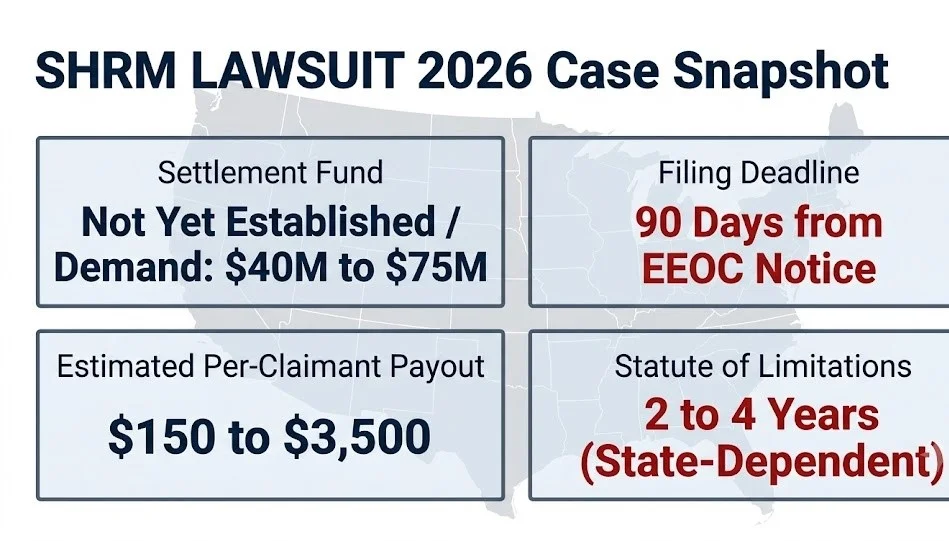
- What it may be worth: Individual claimant recovery estimates range from $150 to $3,500, depending on fees paid, damages sustained, and the class to which a claimant belongs.
Case Snapshot
| Detail | Information |
|---|---|
| Court | U.S. District Court, Eastern District of Virginia (primary jurisdiction near SHRM headquarters in Alexandria, VA); additional state court filings pending |
| Case / MDL Number | No MDL consolidation confirmed as of Q1 2026; individual dockets pending assignment |
| Filing Date | Initial complaints filed: late 2024 through Q1 2025; amended class complaints filed Q3 2025 |
| Status | Active litigation; class certification briefing ongoing as of early 2026 |
| Settlement Fund | No formal settlement fund established as of publication; demand figures in active negotiation |
Introduction
The SHRM lawsuit has drawn sustained legal attention heading into 2026, with claims targeting the Society for Human Resource Management across multiple fronts: certification fee disputes, membership misrepresentation, and employment discrimination allegations against the organization itself. SHRM is the world’s largest HR professional association, with over 340,000 members and a certification business generating tens of millions in annual revenue.
What makes these claims legally significant is the scope of the affected class. Certification holders who paid substantial fees for SHRM-CP or SHRM-SCP credentials allege the organization made material misrepresentations about credential value and recertification requirements.
Employment discrimination claims run on a separate track. Former employees and contractors allege the organization failed to uphold the same workplace standards it publicly promotes to HR professionals nationwide.
Both claim types are active in 2026. The litigation is not consolidated into a single MDL as of this writing, but plaintiff attorneys have begun pursuing parallel federal and state court filings.
What Is the SHRM Lawsuit in 2026?
The SHRM lawsuit in 2026 refers to a group of legal actions brought against the Society for Human Resource Management, the Alexandria, Virginia-based nonprofit that operates the world’s largest HR professional membership and certification programs.
The claims are not a single unified case. They fall into two primary categories: consumer protection claims centered on certification and membership fee practices, and employment discrimination claims filed by current or former SHRM employees.
On the consumer protection side, plaintiffs allege that SHRM misrepresented the career value and employer recognition of its SHRM-CP and SHRM-SCP credentials. They contend the organization charged escalating recertification fees without providing the substantive professional development those fees supposedly fund.
| Claim Category | Legal Theory | Primary Venue |
|---|---|---|
| Certification Fee Dispute | Consumer fraud, breach of contract | Federal court, Eastern District of Virginia |
| Membership Misrepresentation | Unfair business practices, unjust enrichment | State courts (VA, CA, TX, NY) |
| Employment Discrimination | Title VII, state anti-discrimination statutes | Federal court, EEOC referrals |
Attorney Insight: Attorneys handling these claims point to internal SHRM communications and marketing materials as central to establishing whether the organization made affirmative misrepresentations that a reasonable consumer would have relied upon when purchasing certification services.
Who Is SHRM and Why Are They Being Sued?
SHRM is not a government agency and not an academic institution. It is a membership-based nonprofit that generates significant revenue from professional certifications, annual conferences, and member dues.
That business model is central to why it is being sued. Plaintiffs argue that SHRM positioned its credentials as industry-standard qualifications comparable to regulated professional licenses. In practice, employer recognition of SHRM certifications varies substantially by industry and region.
The organization is headquartered in Alexandria, Virginia, which places it within the jurisdiction of the U.S. District Court for the Eastern District of Virginia. That court is known for its expedited docketing, sometimes called the “Rocket Docket,” which means discovery and motions practice in SHRM cases may move faster than comparable litigation in other districts.
Key facts about SHRM as a litigation target:
- Annual revenue exceeds $200 million across membership, certification, and conference operations
- Over 340,000 active members across 165 countries, with the majority in the United States
- SHRM-CP and SHRM-SCP exams cost between $300 and $500 per attempt, with recertification fees of $100 to $300 every three years
- The organization employs approximately 900 staff members at its Alexandria headquarters
Attorney Insight: Attorneys handling these claims note that SHRM’s nonprofit status does not shield it from consumer protection liability under the FTC Act or state unfair business practice statutes, provided plaintiffs can establish that the organization engaged in deceptive commercial conduct.
SHRM Class Action Lawsuit: How the Case Is Structured
The class action framework in SHRM litigation is still taking shape in 2026. Plaintiffs are pursuing Rule 23 class certification in federal court, which requires demonstrating numerosity, commonality, typicality, and adequacy of representation before any class can be formally certified.
The numerosity requirement is not in dispute. With over 340,000 members and hundreds of thousands of past certification candidates, the potential plaintiff pool is substantial. The more contested issues are commonality and typicality.
SHRM’s defense will likely argue that each claimant’s experience with its certification program is individualized, which is the standard argument used to defeat class certification in professional credential disputes. Plaintiff attorneys must show that a common course of conduct harmed all class members in substantially the same way.
Class structure being argued by plaintiffs:
- Subclass A: Individuals who purchased SHRM-CP or SHRM-SCP certifications on or after January 1, 2020
- Subclass B: SHRM members who paid annual dues during any period when alleged misrepresentations were in effect
- Subclass C: Current or former SHRM employees with discrimination or retaliation claims
Attorney Insight: Attorneys handling these claims indicate that the certification subclass is the strongest candidate for class certification because fee structures, exam costs, and recertification requirements were uniform and published, creating a common factual baseline across the class.
Litigation Watch: The class certification hearing is the next major procedural milestone. If the court certifies even one subclass, SHRM’s settlement exposure increases significantly.
SHRM Lawsuit Settlement Amount: What Numbers Are Being Discussed?
No formal settlement fund has been established in the SHRM lawsuit as of early 2026. Settlement negotiations are reported to be in early stages, with plaintiffs’ demand letters referencing aggregate damages in the range of $40 million to $75 million based on the estimated size of the affected class and the fees paid per claimant.
These figures are demand-side estimates, not court-approved settlement amounts. The actual fund, if a settlement is reached, would be determined through mediation or judicial approval of a negotiated agreement.
For context, comparable professional certification and membership fee class actions have settled in the range of $15 million to $85 million, depending on the size of the class and the strength of the liability evidence.
| Scenario | Estimated Settlement Fund | Per-Claimant Range |
|---|---|---|
| Low estimate (partial class certified) | $15 million to $25 million | $150 to $500 |
| Mid estimate (full class certified, negotiated settlement) | $40 million to $60 million | $500 to $1,500 |
| High estimate (adverse verdict or aggressive settlement) | $65 million to $85 million+ | $1,500 to $3,500 |
Attorney Insight: Attorneys handling these claims caution that per-claimant recovery in membership organization cases often comes in lower than plaintiffs expect, because settlement funds are divided across large plaintiff classes after attorneys’ fees and administrative costs are deducted.
Who Qualifies for the SHRM Lawsuit?
Qualification for the SHRM lawsuit depends on which claim category a potential plaintiff falls into. The certification fee subclass, the membership misrepresentation subclass, and the employment discrimination track each have distinct eligibility requirements.
For the certification subclass, the core qualifying criterion is payment of SHRM-CP or SHRM-SCP fees on or after January 1, 2020. That cutoff reflects the statute of limitations analysis applied by plaintiff attorneys to consumer fraud claims in Virginia and other key states.
For the membership subclass, qualification requires payment of annual SHRM membership dues during any period when allegedly deceptive marketing materials were in circulation.
Preliminary eligibility checklist:
- Paid for SHRM-CP or SHRM-SCP exam, application, or recertification on or after January 1, 2020
- Held active SHRM membership and paid dues between 2019 and 2026
- Experienced documented adverse employment action at SHRM as an employee or contractor
- Received written communications from SHRM that contained representations about credential value or employer recognition
- Suffered quantifiable harm: failed job applications citing credential issues, documented financial loss, or other measurable damages
Attorney Insight: Attorneys handling these claims emphasize that having documentation of the actual fee payments, marketing materials received, and any employer correspondence about SHRM credentials substantially strengthens an individual claim.
SHRM Lawsuit Eligibility: Documentation You Will Need
Eligibility alone does not guarantee recovery. Claimants who move forward with the SHRM lawsuit in 2026 should be prepared to produce specific documentation supporting their claims.
The evidentiary burden in consumer fraud cases shifts once class certification is granted, but individual claimants still need to demonstrate that they fall within the certified class and that they suffered concrete harm, not merely abstract disappointment with a credential’s market recognition.
Documentation categories plaintiff attorneys are requesting:
| Document Type | Why It Matters |
|---|---|
| SHRM payment receipts or bank records | Establishes the specific fees paid and dates of transaction |
| SHRM marketing emails or printed materials | Evidence of the representations made at the time of purchase |
| SHRM credential certificates or exam scores | Confirms membership in the affected class |
| Employer correspondence about SHRM credentials | Links credential misrepresentation to tangible career harm |
| SHRM membership renewal records | Documents the ongoing nature of the fee relationship |
Claimants do not need to locate all of these documents immediately. However, those who have already discarded SHRM marketing materials or failed to retain payment records may face a more difficult path to individual recovery.
Attorney Insight: Attorneys handling these claims note that SHRM’s own databases contain detailed member transaction records, and those records are subject to discovery once litigation proceeds, which means individual claimants who lack receipts may still benefit from production of organizational records.
Litigation Watch: Documentation from SHRM’s own marketing and enrollment systems is expected to be a central discovery battleground, with plaintiffs seeking broad production of materials showing how credentials were represented to prospective buyers.
SHRM Certification Lawsuit: The Credentials Controversy
The SHRM certification lawsuit centers on a specific allegation: that the organization marketed its SHRM-CP and SHRM-SCP credentials as the industry standard for HR professionals while knowing that significant portions of the employer market did not recognize or require those credentials over competing certifications from HRCI (the HR Certification Institute).
This is not a minor technical dispute. The certification market for HR professionals is competitive. SHRM and HRCI have operated in direct competition since SHRM launched its own credentials in 2014 after splitting from HRCI. Plaintiffs allege that SHRM’s post-split marketing made affirmative claims about SHRM credential superiority that were not supported by employer preference data.
The specific legal theory is that SHRM’s promotional language constituted deceptive trade practices under Section 5 of the FTC Act and analogous state statutes in Virginia, California, Texas, and New York.
Key allegations in the certification claim:
- SHRM represented its credentials as “globally recognized” without adequate qualification
- Exam difficulty and pass rates were allegedly manipulated to create artificial credential value
- Recertification requirements were changed without adequate notice, causing financial harm to existing holders
- Employers in healthcare, manufacturing, and government sectors showed documented preference for PHR/SPHR over SHRM credentials
Attorney Insight: Attorneys handling these claims are focusing on internal SHRM research reports and employer survey data from 2015 through 2023 to establish what the organization actually knew about employer recognition rates versus what it told prospective certification candidates.
SHRM Discrimination Lawsuit: Employment Claims Against the Organization
The employment discrimination track of the SHRM lawsuit involves claims by current and former SHRM employees who allege the organization engaged in race, gender, and age discrimination in hiring, promotion, and termination decisions.
There is particular irony in these allegations, given that SHRM’s public mission centers on advancing equitable workplace practices. Plaintiff attorneys have highlighted this gap between institutional messaging and alleged internal conduct as a factor relevant to damages, particularly with respect to punitive damages claims.
EEOC charges related to SHRM employment practices were filed beginning in 2023. Right-to-sue letters issued to some claimants triggered the federal court filing window, which under Title VII is 90 days from the date of EEOC notice.
Employment discrimination claim summary:
| Claim Type | Basis | Statute |
|---|---|---|
| Race discrimination | Alleged disparate treatment in promotion | Title VII, 42 U.S.C. 2000e |
| Gender discrimination | Pay equity disparities, hostile work environment | Title VII, Equal Pay Act |
| Age discrimination | Alleged targeting of employees over 40 in RIF decisions | ADEA, 29 U.S.C. 623 |
| Retaliation | Adverse action after internal HR complaints | Title VII Section 704(a) |
Attorney Insight: Attorneys handling these claims indicate that retaliation claims are often the most difficult for organizational defendants to defeat at summary judgment, because the temporal proximity between a protected complaint and an adverse employment action can itself create triable fact questions.
SHRM Lawsuit Payout: How Compensation Is Calculated
Payout calculation in the SHRM lawsuit depends on which subclass a claimant belongs to and what type of harm they can document. The three primary damages categories are restitution, compensatory damages, and, where applicable, punitive damages.
Restitution claims seek return of the fees paid. For a claimant who paid a $300 exam fee, a $150 application fee, and $200 in recertification fees over three years, the base restitution claim would be $650 before any multiplier.
Compensatory damages go further, seeking to recover consequential losses. A claimant who can show they were passed over for employment because an employer preferred an HRCI credential, and that SHRM’s marketing caused them to forgo HRCI certification, could claim lost wages or opportunity costs.
Payout structure by claim type:
| Claim Type | Damages Basis | Estimated Recovery Range |
|---|---|---|
| Certification fee restitution | Exam, application, recertification fees paid | $300 to $1,000 per claimant |
| Membership fee restitution | Annual dues paid during misrepresentation period | $150 to $400 per claimant |
| Consequential economic damages | Documented career or wage loss | $2,000 to $15,000+ (case-specific) |
| Employment discrimination | Lost wages, emotional distress, punitive damages | $25,000 to $300,000+ (individual litigation) |
Attorney Insight: Attorneys handling these claims note that claimants with documented career harm tied directly to SHRM credential misrepresentation will receive case-by-case attention rather than participating in a class settlement, because their individual damages substantially exceed what a class formula would provide.
Litigation Watch: Employment discrimination claimants should consider separate individual representation rather than waiting for a class settlement, since individual Title VII recoveries frequently exceed class settlement allocations by a significant margin.
SHRM Lawsuit Filing Deadline: Key Dates for 2026
Filing deadlines in the SHRM lawsuit vary by claim type and state of residence. Claimants who miss applicable statutes of limitations forfeit their right to participate in any recovery, regardless of how strong their underlying claim may be.
The most critical deadline for certification and membership fee claimants is tied to state consumer protection statutes of limitations. Virginia’s consumer protection act carries a two-year limitations period. California’s unfair competition law allows four years from the date of the alleged violation. Texas and New York each carry three-year statutes for consumer fraud claims.
For employment discrimination claimants, the EEOC charge must be filed within 180 days of the discriminatory act (or 300 days in states with their own anti-discrimination agencies, which covers Virginia, California, Texas, and New York). After receiving a right-to-sue letter, the federal lawsuit must be filed within 90 days.
2026 critical date calendar:
| Deadline | Date | Applies To |
|---|---|---|
| EEOC charge deadline (300-day states) | Rolling, based on last discriminatory act | Employment discrimination claimants |
| Federal right-to-sue filing window | 90 days from EEOC notice letter | Employment claimants with EEOC letters |
| Virginia consumer protection SOL | 2 years from discovery of harm | Certification and membership fee claimants in VA |
| California UCL deadline | 4 years from date of violation | California-based claimants |
| Class action opt-in / opt-out | To be set by court upon class certification | All certified class members |
| Anticipated class certification ruling | Q2 to Q3 2026 (estimated) | All subclass members |
Attorney Insight: Attorneys handling these claims advise that the opt-out deadline, once set by the court, is typically 30 to 45 days and is strictly enforced; claimants who want to pursue individual litigation rather than participate in a class settlement must opt out within that window.
SHRM Lawsuit Status 2026: Where the Case Stands Right Now
As of early 2026, the SHRM lawsuit is in active pre-trial litigation. No settlement has been reached. Class certification briefing is proceeding in the Eastern District of Virginia, with plaintiff attorneys having submitted their Rule 23 motion and SHRM’s opposition expected in Q1 to Q2 2026.
Discovery is ongoing. Document production requests served on SHRM include internal certification exam development records, employer survey data, marketing approval processes, and employee compensation and promotion records relevant to the discrimination track.
There is no trial date set as of this writing. Class action litigation of this type typically resolves through settlement rather than trial. However, the Eastern District of Virginia’s expedited docket means procedural milestones may arrive faster than in comparable cases pending in slower federal courts.
SHRM lawsuit 2026 status timeline:
| Phase | Status |
|---|---|
| Initial complaints filed | Complete (2024 to Q1 2025) |
| Amended class action complaints | Complete (Q3 2025) |
| Discovery (document production) | In progress (Q4 2025 to Q2 2026) |
| Class certification briefing | In progress (Q1 to Q3 2026) |
| Class certification ruling | Anticipated Q2 to Q4 2026 |
| Mediation or settlement talks | Early stage, not concluded |
| Trial (if no settlement) | Not yet scheduled |
Attorney Insight: Attorneys handling these claims indicate that SHRM’s litigation posture will likely shift toward settlement negotiation once the court rules on class certification, since an adverse ruling would expose the organization to significantly broader liability.
Litigation Watch: The class certification ruling expected in 2026 is the single most consequential procedural event in this litigation. A favorable ruling for plaintiffs transforms this from a parallel series of individual claims into a coordinated class action with substantially greater settlement leverage.
SHRM Consumer Protection Claim: The Regulatory Angle
The consumer protection dimension of the SHRM lawsuit introduces a regulatory angle that sits apart from the employment discrimination track. Federal and state consumer protection statutes prohibit deceptive representations in the sale of services, and professional certification programs fall within that framework.
Section 5 of the FTC Act prohibits “unfair or deceptive acts or practices in or affecting commerce.” SHRM, despite its nonprofit status, engages in commercial certification transactions. Plaintiffs argue that its marketing materials contained material misrepresentations about employer recognition rates, credential equivalency, and the career outcomes associated with SHRM credentials.
Several state attorneys general have received complaints about professional certification organizations in recent years, though no formal state AG action against SHRM has been publicly announced as of early 2026.
Consumer protection legal framework:
| Statute | Jurisdiction | Relevant Provision |
|---|---|---|
| FTC Act Section 5 | Federal | Deceptive acts or practices in commerce |
| Virginia Consumer Protection Act | Virginia | Fraudulent or misleading representations |
| California UCL (Bus. & Prof. Code 17200) | California | Unlawful, unfair, or fraudulent business acts |
| New York GBL Section 349 | New York | Deceptive acts or practices in consumer transactions |
| Texas DTPA | Texas | False, misleading, or deceptive acts in trade |
Attorney Insight: Attorneys handling these claims note that nonprofit status has been litigated as a defense to consumer protection claims in several circuits, with mixed results; courts have generally held that the commercial nature of the transaction, not the organizational structure of the seller, determines whether consumer protection statutes apply.
SHRM Professional Certification Dispute: The Accreditation Question
The SHRM professional certification dispute connects to a broader question about what standards, if any, govern HR professional credentials. Unlike medical, legal, or financial certifications, HR certifications are not regulated by a government agency. SHRM sets its own exam standards, pass rates, and recertification requirements.
Plaintiffs argue this creates a situation where SHRM can make unverified claims about credential quality without external accountability. The lack of independent accreditation oversight becomes a liability issue when those claims are alleged to be materially false.
SHRM’s SHRM-CP and SHRM-SCP credentials do carry accreditation from the Buros Center for Testing, which evaluates psychometric validity. However, plaintiffs contend that psychometric validity is a different question from employer market acceptance, and that SHRM conflated the two in its marketing.
Certification dispute core allegations:
- SHRM represented employer acceptance rates that were not supported by independent employer surveys
- The organization’s own 2018 and 2020 employer recognition studies were allegedly manipulated before publication
- Recertification requirements were expanded post-purchase, increasing the cost of maintaining credentials beyond what candidates were told at the time of enrollment
- Pass rates were allegedly adjusted in ways that prioritized revenue over credential integrity
Attorney Insight: Attorneys handling these claims are seeking production of internal psychometric analysis, employer survey methodology documents, and communications between SHRM leadership and exam development vendors to test these allegations against the documentary record.
SHRM Lawsuit What to Do Next: How to Protect Your Legal Rights
Potential claimants in the SHRM lawsuit should take specific, documented steps now, before deadlines begin to close the window on recovery. The nature of this litigation means that delay is not neutral. Statutes of limitations are running. Evidence is being gathered by plaintiff attorneys. Class certification is being briefed.
The first step is document preservation. Every email from SHRM, every payment receipt, every marketing brochure received before purchasing certification or membership, and every employer communication about SHRM credentials should be saved in its original form.
The second step is consulting with an employment law attorney or consumer protection attorney who handles class action or professional certification claims. These attorneys operate on contingency in class action contexts, meaning there is no upfront cost to the claimant for an initial evaluation.
Immediate action checklist:
- Locate and save all SHRM payment records (exam fees, application fees, membership dues)
- Preserve all SHRM marketing emails and promotional materials received prior to purchase
- If you are a former SHRM employee, preserve any EEOC correspondence, internal HR complaints, or performance review records
- Note the date of your last SHRM payment or adverse employment event, as this triggers the statute of limitations calculation
- Contact a plaintiff-side employment law attorney or class action attorney for a case evaluation
- Do not sign any SHRM release, settlement agreement, or arbitration acknowledgment without attorney review
Attorney Insight: Attorneys handling these claims advise that claimants who participated in SHRM’s internal complaint or dispute resolution processes may have made statements that SHRM will attempt to use in litigation, making early attorney consultation especially important for this subset of potential claimants.
Litigation Watch: Claimants who wait for news of a formal settlement before contacting an attorney may find that key deadlines have passed or that the class has been certified and opt-out windows have closed, limiting their options to the class settlement allocation rather than individual recovery.
Frequently Asked Questions
What is the SHRM lawsuit about in 2026?
The SHRM lawsuit in 2026 encompasses legal actions alleging that the Society for Human Resource Management misrepresented the value and employer recognition of its professional certifications, charged deceptive membership fees, and engaged in employment discrimination against its own staff.
The certification and membership claims proceed as putative class actions in federal court.
Employment discrimination claims are filed separately under Title VII and state anti-discrimination statutes.
Who qualifies to file a claim in the SHRM lawsuit?
Individuals who paid for SHRM-CP or SHRM-SCP certification on or after January 1, 2020, paid annual SHRM membership dues during the relevant period, or experienced employment discrimination as a SHRM employee or contractor may qualify.
Eligibility depends on which subclass is ultimately certified by the court.
Former employees with EEOC right-to-sue letters face a 90-day filing window that is strictly enforced.
How much could I receive from a SHRM lawsuit settlement?
Estimated per-claimant recovery ranges from $150 to $3,500 for certification and membership fee claimants, depending on the fees paid and the size of the certified class.
Employment discrimination claimants pursuing individual claims may recover substantially more, including lost wages, emotional distress damages, and potential punitive damages.
No settlement fund has been formally established as of early 2026.
What is the filing deadline for the SHRM lawsuit in 2026?
Deadlines vary by claim type and state.
Virginia consumer protection claims carry a two-year statute of limitations, while California claimants have four years under the UCL.
Employment discrimination claimants must file an EEOC charge within 300 days of the discriminatory act in most states, then file suit within 90 days of receiving a right-to-sue letter.
What type of attorney handles SHRM lawsuit claims?
Certification and membership fee claims are handled by consumer protection attorneys and class action plaintiff firms.
Employment discrimination claims against SHRM as an employer are handled by employment law attorneys with Title VII and ADEA litigation experience.
Both practice areas typically operate on contingency, meaning no upfront cost for an initial case evaluation.
Has SHRM responded to the lawsuit allegations?
SHRM has not issued a public admission of liability. The organization has filed standard responsive pleadings contesting the factual allegations and the appropriateness of class certification.
SHRM has characterized its certification program as the industry’s leading credential with independently validated psychometric standards.
Litigation is ongoing, and SHRM’s formal legal position will be further developed as discovery proceeds through 2026.
Closing
The SHRM lawsuit in 2026 presents a legitimate legal path for former and current members, certification holders, and former employees who suffered documented harm. The litigation is active. Deadlines are real. The most important thing a potential claimant can do right now is preserve documentation and understand which category of claim applies to their specific situation.
Certification and membership claimants should speak with a consumer protection or class action attorney. Former employees with EEOC letters should contact an employment law attorney immediately, given the strict 90-day filing window. Early consultation costs nothing and clarifies whether individual recovery or class participation is the stronger path.