By Daniel Whitfield, Legal Affairs Correspondent. Last updated June 2026.
Quick Answer
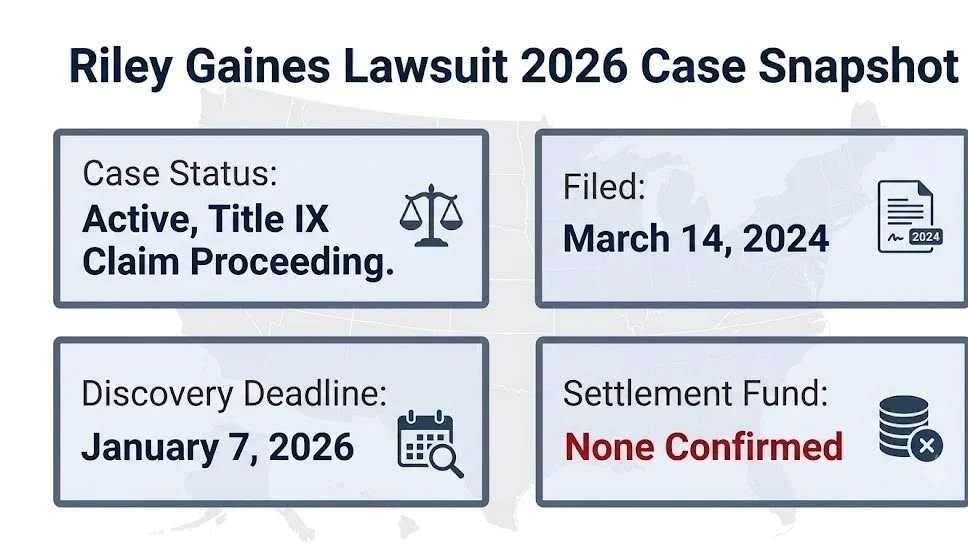
- The Riley Gaines lawsuit is a federal Title IX case, Gaines v. NCAA (No. 1:24-cv-01109, N.D. Ga.), filed by Gaines and 18 other female athletes against the NCAA over transgender eligibility policies.
- Only the 19 named plaintiffs are currently part of the case. It is a putative class action, and no class of additional athletes has been certified.
- No settlement exists as of this writing. Viral claims of a $32 million NCAA payout are not supported by the court docket, and the live issue is whether the NCAA is a Title IX funding recipient.
| Detail | Info |
|---|---|
| Court | U.S. District Court, Northern District of Georgia (Atlanta Division) |
| Case Number | 1:24-cv-01109 |
| Filing Date | March 14, 2024 |
| Status | Active. Title IX claim against the NCAA is in discovery. All other claims and defendants have been dismissed. |
| Settlement Fund | None confirmed. No settlement appears in the official docket as of mid-2026. |
Riley Gaines and 18 other female college athletes are suing the NCAA in federal court, and the case is still active in 2026. Their lawsuit, filed in the Northern District of Georgia, argues the NCAA’s old transgender eligibility rules violated Title IX. A federal judge has already thrown out most of the case, but the central Title IX claim survived.
That single surviving claim now hinges on a narrow legal question. Does the NCAA count as a federal funding recipient through its Department of Defense-linked concussion research? Nothing about a settlement, a dollar figure, or a final verdict has been confirmed by the court.
Online claims of a $32 million NCAA settlement have spread anyway. This article separates the documented record from the rumor mill, using the case number, the judge’s name, and the actual filing deadlines on file with the court.
Riley Gaines NCAA Lawsuit: Inside Gaines v. NCAA
The Riley Gaines NCAA lawsuit is the case Gaines v. National Collegiate Athletic Association, filed in the Northern District of Georgia. Nineteen current and former female college athletes brought the suit on March 14, 2024.
The named plaintiffs include Gaines, a former University of Kentucky swimmer, along with athletes such as Brooke Slusser, a former San Jose State volleyball player, and Caroline Hill, a former Rochester Institute of Technology track athlete. Each plaintiff describes competing against, or sharing facilities with, a transgender teammate or competitor.
The original complaint named several defendants beyond the NCAA, including the University System of Georgia and the Georgia Tech Athletic Association. Most of those additional defendants have since been dismissed from the case.
Quick facts:
- Filed: March 14, 2024
- Plaintiffs: 19 current and former female college athletes
- Original defendants: NCAA, University System of Georgia, Georgia Tech Athletic Association, individual officials
- Defendants remaining: NCAA only
Attorneys who handle Title IX litigation note that naming multiple defendants early is a common strategy, since it preserves claims while jurisdictional and standing issues get sorted out in motions practice.
What Is the Riley Gaines Lawsuit About
The Riley Gaines lawsuit is about whether the NCAA’s past transgender athlete policy violated Title IX rights of female college swimmers. The plaintiffs argue that allowing transgender women to compete in women’s events, based on testosterone suppression alone, denied them an equal competitive opportunity.
The dispute traces back to the 2022 NCAA Division I Women’s Swimming and Diving Championships at Georgia Tech in Atlanta. Gaines tied for fifth place in the 200-yard freestyle with University of Pennsylvania swimmer Lia Thomas. NCAA officials gave the fifth-place trophy to Thomas rather than splitting recognition between the two swimmers.
Plaintiffs also raised claims involving locker room access and bodily privacy. Those claims, along with constitutional claims under the Equal Protection Clause, have since been dismissed by the court. Only the Title IX claim against the NCAA remains active.
Litigation Watch: The case has narrowed from a broad multi-defendant constitutional challenge down to one focused Title IX question aimed solely at the NCAA.
Riley Gaines Lawsuit Settlement: Has the NCAA Paid Anything
No, the NCAA has not paid a settlement in the Riley Gaines lawsuit as of mid-2026. The Civil Rights Litigation Clearinghouse, a neutral academic case-tracking project, listed the case as ongoing as recently as February 2026, with no settlement on record.
Some websites describe a finalized $32 million settlement, complete with a claims process and payout tiers. None of those details match the actual docket. The real case has no certified class, no settlement administrator, and no court order approving any payment.
| Claim Circulating Online | Court Record |
|---|---|
| $32 million NCAA settlement | No settlement filed or approved |
| Payout tiers up to $75,000 | No claims process exists |
| “Judge Morrison” approved settlement | Case is assigned to Judge Tiffany R. Johnson |
Attorneys familiar with Title IX cases caution that settlement rumors often spread faster than verified filings, especially in politically charged litigation.
Riley Gaines Wins Lawsuit: What “Winning” Actually Means Here
Riley Gaines has not won a final judgment or a money award in this lawsuit. What she won, in September 2025, was a ruling that let her core Title IX claim survive a motion to dismiss.
That distinction matters. Surviving a motion to dismiss is a procedural step, similar to a criminal case clearing a preliminary hearing. It means the claim can move forward, not that the plaintiff has proven her case.
On September 25, 2025, U.S. District Judge Tiffany R. Johnson dismissed the constitutional claims and the bodily privacy claim against the NCAA. She let the Title IX claim proceed, citing a plausible allegation that NCAA-affiliated research receives Department of Defense funding.
- Win: Title IX claim survives dismissal
- Loss: Equal Protection and Section 1983 claims dismissed
- Loss: Bodily privacy claim dismissed
- Unresolved: Whether the NCAA is a Title IX funding recipient
Attorneys handling similar civil rights claims point out that a partial win at the dismissal stage is common in complex federal cases and rarely predicts the final outcome.
Riley Gaines Lawsuit Settlement Claims: Fact-Checking the $32 Million Rumor
The $32 million Riley Gaines settlement claim circulating online is not supported by any verified court record. It fits a pattern of fabricated financial claims that have followed Gaines since 2023.
Fact-checking organizations have already debunked several related hoaxes. Check Your Fact found no evidence behind a separate claim that Gaines secured a $50 million NCAA settlement in 2024. Snopes and other outlets separately debunked claims that Gaines won $8 million or $10 million from talk show host Whoopi Goldberg, a lawsuit that was never filed.
The 2026 version of the rumor adds invented procedural detail, including a judge’s name that does not appear anywhere in the actual case file. Readers should treat specific dollar figures tied to this case with real skepticism unless they trace back to a docket entry.
Bold callout: Zero verified monetary settlements have been confirmed in Gaines v. NCAA as of this writing.
Attorneys who track misinformation around high-profile litigation say invented settlement figures tend to spread fastest right after a real procedural win, when public attention peaks.
Riley Gaines Title IX Lawsuit: The Legal Theory Driving the Case
The Title IX theory behind this lawsuit is that the NCAA’s transgender eligibility rules denied female athletes an equal opportunity to compete, in violation of federal law. Title IX of the Education Amendments of 1972 bars sex discrimination in education programs that receive federal funding.
The legal complication is that the NCAA itself does not directly receive federal grants. Member schools do. Plaintiffs argue the NCAA should still count as a funding recipient because of its role in Department of Defense-funded concussion research involving college athletes.
This is similar to how a subcontractor can still be bound by federal rules tied to a prime contract, even without holding the contract directly. Judge Johnson found this argument plausible enough to let the claim continue into discovery, though she has not ruled on the merits.
- Core question: Is the NCAA a Title IX “recipient” of federal funds
- Mechanism cited: NCAA’s concussion-research partnership with the Department of Defense
- Outcome if yes: NCAA’s eligibility policies are reviewable under Title IX
- Outcome if no: Title IX claim likely fails for lack of coverage
Attorneys in education and civil rights law describe this funding-recipient question as the real fight in the case, more consequential than any individual policy dispute.
Riley Gaines Lawsuit Timeline: Key Dates From Filing to Today
The Riley Gaines lawsuit timeline runs from a March 2024 filing through ongoing 2026 discovery, with no trial date set. Each stage has a documented deadline.
| Date | Event |
|---|---|
| March 14, 2024 | Lawsuit filed in N.D. Ga. |
| May 2024 | National Women’s Law Center moves to intervene in support of NCAA |
| February 2025 | NCAA adopts new policy barring athletes assigned male at birth from women’s NCAA sports |
| April 2025 | Georgia signs the Riley Gaines Act, barring transgender women from women’s college sports in the state |
| September 25, 2025 | Judge Johnson dismisses most claims; Title IX claim against NCAA survives |
| October 9, 2025 | NCAA’s deadline to answer remaining Title IX claim |
| January 7, 2026 | Deadline for limited discovery on NCAA’s federal funding status |
| February 6, 2026 | Deadline for dispositive motion on the funding question |
Litigation Watch: Every dismissed claim in this case has a documented legal reason behind it, from mootness after policy changes to the NCAA’s standing as a private association rather than a state actor.
Riley Gaines Lawsuit Court and Judge: Who Is Deciding This Case
The Riley Gaines lawsuit is being decided by U.S. District Judge Tiffany R. Johnson in the Northern District of Georgia, Atlanta Division. Johnson was nominated to the federal bench during the Biden administration.
Johnson’s September 2025 order did most of the heavy lifting so far. She dismissed claims against the University System of Georgia and the Georgia Tech Athletic Association as moot, reasoning that Georgia’s new state law already accomplished what the plaintiffs sought from those defendants.
She also ruled that the NCAA is not a “state actor,” closing off the constitutional claims. The Title IX claim against the NCAA remains the only count still alive, and it remains in Johnson’s courtroom.
- Judge: Tiffany R. Johnson
- Court: U.S. District Court, Northern District of Georgia
- Appointed under: Biden administration
- Current task: Overseeing discovery on the NCAA’s funding-recipient status
Attorneys who litigate before this court note that a single judge handling every stage of a case, from dismissal through final judgment, is standard practice in federal district courts.
Riley Gaines Lawsuit Update 2026: Where Things Stand
The 2026 update on the Riley Gaines lawsuit is that the case remains active, with the parties working through a narrow discovery dispute. As of the most recent public docket entries, no settlement, trial date, or final ruling on the funding question has been issued.
Limited discovery concluded around January 7, 2026, focused entirely on the NCAA’s ties to Department of Defense-funded research. A dispositive motion on that issue was due February 6, 2026, with a joint case plan due February 13, 2026 if no such motion was filed.
Public case-tracking sources, including the Civil Rights Litigation Clearinghouse, listed the matter as ongoing as of February 2026. No subsequent ruling on the funding-recipient question had been entered into public case records at the time of this writing.
Bold callout: As of mid-2026, the case has not reached trial, settlement, or final judgment on the merits.
Attorneys monitoring the docket say the funding-recipient ruling, whenever it lands, will likely determine whether the case proceeds to trial or ends on a technical defense.
Who Is Riley Gaines Suing
Riley Gaines is currently suing only the NCAA in this lawsuit, after earlier dismissing additional defendants from the case. The original complaint also named Georgia state institutions and individual officials.
The University System of Georgia, the Georgia Tech Athletic Association, and several named officials were dismissed in September 2025. The court found their forward-looking claims moot once Georgia passed its own state law restricting transgender participation in women’s college sports.
That left the NCAA as the sole remaining defendant on the surviving Title IX claim. The National Women’s Law Center, represented by the ACLU, ACLU of Georgia, and Cooley LLP, separately sought to join the case in support of the NCAA’s position.
- Active defendant: NCAA
- Dismissed defendants: University System of Georgia, Georgia Tech Athletic Association, named officials
- Intervenor seeking to support NCAA: National Women’s Law Center
Attorneys point out that dismissing state defendants after a state law change is a routine mootness outcome, not a reflection of the underlying merits.
Riley Gaines Lawsuit and Lia Thomas: The 2022 Championship Connection
The Riley Gaines lawsuit grew directly out of the 2022 NCAA Women’s Swimming and Diving Championships, where Gaines competed against transgender swimmer Lia Thomas. Thomas, formerly a University of Pennsylvania men’s team swimmer, won the 500-yard freestyle and tied Gaines for fifth in the 200-yard freestyle.
NCAA officials awarded the fifth-place trophy to Thomas rather than to both swimmers, a moment Gaines has cited publicly as a turning point. The complaint also describes female athletes sharing a locker room with Thomas during the championships.
Thomas is not a defendant in this case. The lawsuit targets NCAA policy, not any individual athlete, and Thomas’s eligibility under current NCAA rules has since changed following the NCAA’s 2025 policy update.
Litigation Watch: The 2022 championship event supplies the factual backdrop for the suit, but the legal fight now centers on NCAA policy and federal funding status, not on any single competition result.
Attorneys in sports law note that naming a policy rather than an individual as the legal target is typical in institutional discrimination claims.
Riley Gaines Lawsuit NCAA Response and Defense
The NCAA’s defense in this lawsuit is that it is not subject to Title IX and that the case is largely moot. The association argues it does not directly receive federal financial assistance in the way that member schools do.
NCAA representatives have also pointed to the association’s February 2025 policy change, which bars athletes assigned male at birth from competing in NCAA women’s sports. The NCAA argues this policy shift already resolves the practical dispute, regardless of how the lawsuit ends.
A spokesperson told Sportico that the NCAA “will continue to promote Title IX” and align its policy with federal guidance. The association has not conceded that it qualifies as a Title IX funding recipient through its research partnerships.
- NCAA argument 1: Not a state actor
- NCAA argument 2: Not a direct Title IX funding recipient
- NCAA argument 3: Case is moot given the 2025 policy change
Attorneys defending institutional clients in similar cases say a mootness argument paired with a funding-recipient challenge is a standard two-track defense strategy.
Riley Gaines Lawsuit Eligibility: Who Actually Qualifies as a Plaintiff
Only the 19 named plaintiffs currently qualify as parties to this lawsuit, since no class has been certified. The complaint was filed as a putative class action, meaning the named athletes seek to represent a broader group, but a judge has not yet approved that group.
The named plaintiffs are former and current female college athletes who competed during the period the NCAA’s prior transgender policy was in effect. Their claims center on the 2022 championships and related competitive seasons.
Until a class is certified, no other athlete can file a claim, submit paperwork, or expect compensation tied to this case. Any website suggesting otherwise is describing a process that does not yet exist in this litigation.
| Eligibility Status | Current Reality |
|---|---|
| Named plaintiffs | 19 athletes, fully part of the case |
| Broader class | Putative only, not certified |
| Outside athletes | No filing mechanism currently exists |
| Claims administrator | None appointed |
Attorneys handling class action matters stress that certification is a separate court ruling, not an automatic feature of filing a class complaint.
Riley Gaines Lawsuit Impact by State
The most direct state-level impact of this litigation so far has been in Georgia, where lawmakers passed the Riley Gaines Act in response to the case. That law bars Georgia colleges from hosting or competing in events that allow athletes assigned male at birth into women’s competitions or facilities.
That state law was significant enough to moot the plaintiffs’ claims against Georgia’s own university system and Georgia Tech’s athletic association. Judge Johnson described the law as a form of “voluntary cessation” that resolved the forward-looking dispute at the state level.
Beyond Georgia, the case’s outcome could still shape NCAA-wide policy, since the NCAA governs member schools nationwide. A ruling against the NCAA on the funding-recipient question could expose the association to Title IX claims tied to programs in any state.
- Most directly affected state: Georgia, via the Riley Gaines Act
- Nationally affected entity: The NCAA, which governs schools across all 50 states
- Still pending: Supreme Court cases on related state transgender-athlete laws (Little v. Hecox, West Virginia v. B.P.J.)
Litigation Watch: The lawsuit’s state-level effects have already played out in Georgia, while its national effects depend on an unresolved federal funding question.
Attorneys following state sports legislation say Georgia’s law may serve as a template for other states watching this litigation closely.
Riley Gaines Lawsuit Attorney: Who Is Handling the Case
Attorney William Bock, representing the Independent Council on Women’s Sports, has been the public-facing counsel for Gaines and her co-plaintiffs. ICONS is an advocacy organization backing the litigation on the plaintiffs’ side.
Bock has stated publicly that his clients would only accept a settlement built around a legally enforceable consent decree, one that would lock in NCAA policy changes against future reversal. That statement reflects a negotiating position, not a finalized agreement.
On the other side, the NCAA’s institutional defense involves its own counsel, while the National Women’s Law Center has separately engaged the ACLU, ACLU of Georgia, and Cooley LLP to support the NCAA’s position in court filings.
- Plaintiffs’ public counsel: William Bock, Independent Council on Women’s Sports
- NCAA-supporting intervenor counsel: ACLU, ACLU of Georgia, Cooley LLP (for National Women’s Law Center)
Attorneys who litigate Title IX claims note that consent decrees, rather than cash payments, are often the real goal in policy-driven civil rights litigation like this one.
Riley Gaines Lawsuit: What Happens Next
What happens next in the Riley Gaines lawsuit depends on the unresolved ruling over whether the NCAA is a Title IX funding recipient. That single legal question now controls the entire remaining case.
If the court finds the NCAA is a covered funding recipient, the case proceeds toward further discovery and eventually trial or settlement negotiations on the merits. If the court finds it is not covered, the Title IX claim likely fails, closing out the lawsuit entirely.
A dispositive motion on this issue was due February 6, 2026, with a joint case plan due February 13, 2026 absent such a motion. No outcome on that motion had appeared in public case-tracking records at the time of this writing.
Bold callout: The entire surviving claim now rests on one funding-status ruling, not on a broader review of NCAA transgender policy.
Attorneys tracking the case say a ruling on the funding question could come with little advance notice, since it follows a fixed briefing schedule already set by the court.
Finding a Lawyer for a Title IX or Sports Discrimination Claim
Athletes considering a similar claim should look for an attorney with specific experience in Title IX and civil rights litigation, not a general personal injury practice. Title IX claims involve federal funding analysis, institutional defendants, and procedural hurdles like standing and mootness that differ from typical injury cases.
Relevant experience includes prior Title IX litigation against schools, athletic conferences, or governing bodies, along with familiarity with federal civil procedure in the relevant district. Attorneys who work with advocacy organizations, similar to how ICONS has supported the Gaines plaintiffs, often bring useful institutional resources to a complex federal case.
- Look for: Title IX litigation experience
- Look for: Federal civil rights case history
- Look for: Familiarity with class action procedure, if a group claim is involved
- Avoid: Attorneys promising a guaranteed settlement amount before filing
Litigation Watch: A case like this one shows why early legal guidance matters: most of the original claims here were dismissed at the pleading stage, before discovery ever began.
Attorneys in this field say the strength of a Title IX claim often turns on funding-recipient status long before it turns on the underlying facts of discrimination.
Frequently Asked Questions
Has Riley Gaines won her lawsuit against the NCAA?
No, Riley Gaines has not won a final judgment in this lawsuit.
A federal judge allowed her Title IX claim to survive a motion to dismiss in September 2025.
That is a procedural step, not a final verdict or damages award.
Is there a Riley Gaines NCAA settlement in 2026?
No, no settlement has been confirmed in the official court record as of mid-2026.
Viral claims of a $32 million settlement are not supported by docket entries in the case.
The case remains in active discovery on a narrow legal question.
What court is hearing the Riley Gaines lawsuit?
The case is being heard in the U.S. District Court for the Northern District of Georgia.
It is assigned to Judge Tiffany R. Johnson under case number 1:24-cv-01109.
The court is based in Atlanta, where the underlying 2022 championships took place.
Who else is suing the NCAA alongside Riley Gaines?
Eighteen other current and former female college athletes joined Gaines as named plaintiffs.
They include athletes such as Brooke Slusser and Caroline Hill, each citing experiences with transgender competitors or teammates.
All 19 plaintiffs filed together in March 2024.
Can other female athletes join the Riley Gaines lawsuit?
Not currently, because no class has been certified in this case.
The lawsuit was filed as a putative class action, meaning certification is still pending court approval.
Until that happens, only the 19 named plaintiffs are formally part of the case.
What happens next in the Riley Gaines NCAA case?
The case now turns on whether the NCAA counts as a Title IX federal funding recipient.
A dispositive motion on that question was due in February 2026, and its outcome will likely determine whether the case proceeds toward trial or ends on a technical ruling.
No trial date has been set as of this writing.
The Bottom Line for Readers Following This Case
The Riley Gaines lawsuit is real, active, and narrower than most headlines suggest. One Title IX claim against the NCAA remains alive, while every other claim and defendant has already been dismissed.
No settlement has been confirmed, despite persistent online rumors. Readers weighing a similar Title IX claim should track the actual docket and consult an attorney with federal civil rights experience before assuming any payout exists.