By Margaret Calloway, Legal Affairs Correspondent. Last updated June 2026.
QUICK ANSWER BOX
- What the litigation covers: Multiple civil actions against ABC’s The View, its on-air hosts, and Walt Disney Television spanning three distinct legal theories: defamation arising from broadcast statements, employment discrimination claims by former on-air contributors, and breach of contract litigation involving departed talent. No single consolidated case captures all of this activity.
- Who may qualify as a plaintiff: Any individual who was the identifiable subject of a false broadcast statement of fact, any former View employee or contributor who experienced discriminatory treatment or wrongful termination, or any talent whose contract with ABC’s production entity was allegedly breached.
- What it could be worth: Defamation damages in broadcast media cases with strong actual malice evidence have reached into the hundreds of millions. The Dominion Voting Systems settlement with Fox News at $787.5 million in April 2023 is the current market reference point. Employment and contract claims carry their own separate damages frameworks.
CASE SNAPSHOT
| Detail | Info |
|---|---|
| Primary Defamation Jurisdiction | U.S. District Court, Southern District of New York |
| Employment Claims Jurisdiction | U.S. District Court, Central District of California (production-related); S.D.N.Y. (New York talent) |
| Consolidated MDL | No single MDL designated as of June 2026 |
| Primary Network Defendant | ABC News / Walt Disney Television |
| Ultimate Corporate Parent | The Walt Disney Company |
| Legal Theories Active | Defamation; false light; tortious interference; Title VII discrimination; breach of contract |
| Presiding Judges | Case-specific; assigned by individual action in respective districts |
| Global Settlement Status | No publicly announced global settlement as of June 2026 |
| Anti-SLAPP Applicability | New York Civil Rights Law Section 76-a (amended November 2020) applies to defamation actions |
| Key Procedural Benchmark | Dominion v. Fox News Network, LLC (Del. Super. Ct., settled April 2023 at $787.5 million) |
The View lawsuit, as a legal category in 2026, encompasses more than a single defamation action. Three distinct bodies of litigation target different legal relationships between The View’s production entity, its on-air talent, and the individuals and organizations affected by what is broadcast.
The defamation track involves plaintiffs who allege that specific on-air statements, reaching more than six million daily viewers, crossed from protected opinion into actionable false statements of fact. The employment track involves former contributors and staff who allege discriminatory or retaliatory treatment. The contract track involves departed talent whose departure terms are disputed.
Each theory carries a different burden of proof, a different damages framework, and requires a different type of attorney.
Understanding which track applies to any specific situation is the first legal determination that matters.
The View Lawsuit: What the Full Litigation Picture Looks Like in 2026
The View lawsuit in 2026 is not a single case but a collection of distinct legal actions proceeding under different theories in different courts simultaneously.
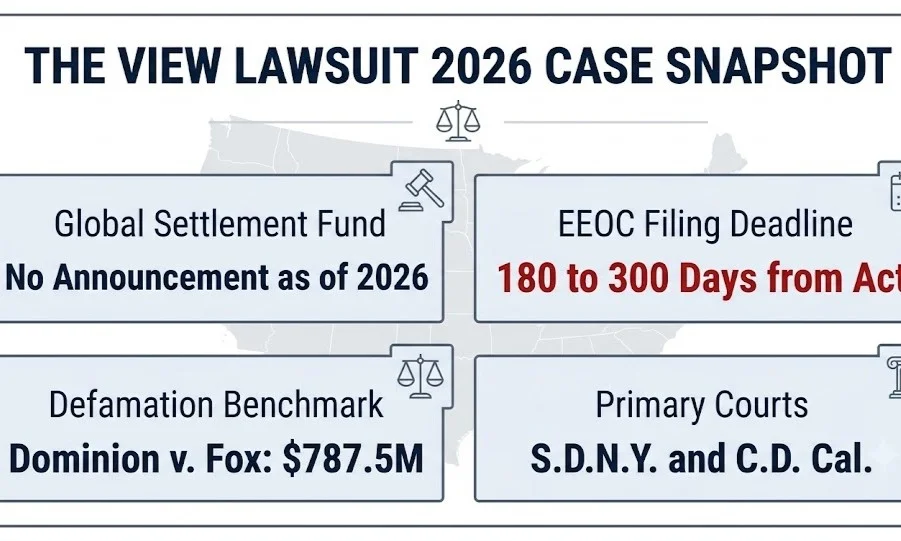
That distinction matters for readers trying to understand their own potential claims. A person who believes they were defamed by a broadcast statement pursues a radically different legal path than a former employee who experienced workplace discrimination. Both fall under the broad heading of lawsuits against The View, but the procedural mechanics, burdens of proof, and realistic outcomes differ substantially.
The defamation actions are the most publicly prominent. They proceed primarily in the Southern District of New York, where ABC News is headquartered. The employment claims have been filed in both S.D.N.Y. and the Central District of California, depending on where the employment relationship was centered.
The View Litigation Universe at a Glance:
| Legal Theory | Court(s) | Key Defendant | Attorney Type Needed |
|---|---|---|---|
| Defamation / false light | S.D.N.Y. | ABC News, individual hosts | Media defamation attorney |
| Employment discrimination | S.D.N.Y. / C.D. Cal. | ABC News production entity | Employment law attorney |
| Breach of entertainment contract | C.D. Cal. / S.D.N.Y. | Walt Disney Television | Entertainment contract attorney |
| Tortious interference | S.D.N.Y. | Production entity, hosts | Business tort attorney |
Attorney Insight: Attorneys who handle media and entertainment litigation note that plaintiffs frequently misidentify which legal theory applies to their situation, leading to complaints that are dismissed at the pleading stage for asserting defamation when the actual injury sounds in contract, or vice versa.
Bold Callout: Choosing the wrong legal theory at the filing stage is not a minor procedural error. Courts dismiss complaints that fail to state a cognizable claim, and re-filing after dismissal carries statute of limitations risks that can permanently extinguish otherwise valid claims.
Lawsuit Against The View: The Corporate Defendant Structure That Plaintiffs Must Navigate
A lawsuit against The View means suing multiple legal entities within the Walt Disney corporate structure, each carrying distinct liability exposure.
The program is produced by ABC News, a division of Walt Disney Television, owned by The Walt Disney Company. Plaintiffs who target only the show’s production entity, without naming the correct corporate parent entities, may limit their access to the insurance coverage and financial resources that ultimately fund any resolution.
Naming every relevant corporate tier is standard practice in serious media litigation. It is not an act of legal excess. It is the mechanism by which plaintiffs ensure that the full financial architecture of the defendant is before the court.
Walt Disney Corporate Defendant Tiers in View Litigation:
| Tier | Legal Entity | Liability Basis | Financial Significance |
|---|---|---|---|
| 1 | Individual named host | Direct personal liability for statements | Personal assets; indemnification claim against ABC |
| 2 | The View production entity | Direct production liability | Production-level insurance coverage |
| 3 | ABC News division | Respondeat superior; publisher liability | Divisional media liability coverage |
| 4 | Walt Disney Television | Corporate owner; vicarious liability | Subsidiary-level coverage |
| 5 | The Walt Disney Company | Ultimate parent; insurance access | Parent-level coverage; deepest resources |
Individual host defendants occupy a legally distinct position within that structure. Employment indemnification agreements between hosts and ABC are private contractual arrangements. Those agreements do not affect a plaintiff’s right to name and pursue individual hosts personally.
Attorney Insight: Attorneys handling media defamation claims against broadcast entities consistently name every corporate tier from the outset, not to establish direct editorial wrongdoing at the parent level, but because settlement negotiations are ultimately governed by the total available insurance coverage across all named entities.
The View Lawsuit Update: Key Procedural Developments Across All Active Actions
The View lawsuit update as of June 2026 reflects a litigation posture in which different actions are at materially different procedural stages.
Defamation cases filed earliest have moved past initial motion practice. Cases that survived Rule 12(b)(6) dismissal motions have entered the discovery phase, where the most consequential evidence in broadcast defamation litigation is typically found: pre-broadcast internal communications, editorial meeting notes, and producer correspondence showing what ABC knew before air time.
Employment discrimination actions filed by former on-air contributors have followed a parallel track. Several have cleared the Equal Employment Opportunity Commission administrative exhaustion requirement and proceeded to federal court. Some have settled confidentially without public disclosure of terms.
Procedural Status Matrix as of June 2026:
| Action Type | Stage | Key Pending Event |
|---|---|---|
| Defamation actions (earliest filed) | Discovery phase | Document production; depositions |
| Defamation actions (later filed) | Motion to dismiss pending | Court ruling on First Amendment grounds |
| Employment discrimination claims | Post-EEOC; federal court | Summary judgment briefing |
| Contract breach claims | Case-specific | Arbitration or federal court |
| Anti-SLAPP motions | Pending in some actions | Fee-shifting ruling |
Attorney Insight: Attorneys tracking the defamation actions note that the cases which survived dismissal motions carry disproportionate settlement value. A defendant who cannot terminate a case at the pleading stage faces the prospect of producing internal communications that may materially alter the litigation calculus.
Litigation Watch: The most consequential procedural event across all View-related defamation actions in 2026 is the outcome of discovery in cases that cleared the motion to dismiss threshold, because pre-broadcast internal communications are the evidentiary foundation of any viable actual malice claim.
The View Lawsuit Update 2026: What Is New and What Remains Unresolved
The 2026 litigation update for The View reflects three specific developments that distinguish the current landscape from prior years.
First, New York’s expanded anti-SLAPP statute, effective since November 10, 2020, has become an active litigation tool in View-related defamation cases. ABC’s legal team has invoked Section 76-a in multiple actions, seeking early dismissal and fee-shifting against complaints that lack a cognizable actual malice theory at the pleading stage.
Second, the post-2020 host roster changes at The View have generated new categories of potential employment and contract claims that were not part of the litigation picture in earlier years.
Third, the Dominion v. Fox News settlement at $787.5 million in April 2023 created a new evidentiary benchmark. Plaintiffs’ counsel in any broadcast defamation case now opens discovery specifically hunting for the type of internal communications that drove that settlement, knowing what that evidence is worth.
What Is New in 2026 View Litigation:
- Active anti-SLAPP motion practice under New York Civil Rights Law Section 76-a
- New employment discrimination filings from post-2022 roster period
- Discovery in surviving defamation cases targeting pre-broadcast editorial communications
- Increased plaintiff focus on producer and executive communications, not only host statements
Attorney Insight: Attorneys filing defamation claims against ABC in 2026 are conducting more rigorous pre-filing investigation than was standard five years ago, specifically because the anti-SLAPP fee-shifting risk makes weak cases expensive to file and the Dominion precedent has raised the evidentiary bar for what constitutes viable actual malice evidence.
The View Lawsuit Status 2026: Which Cases Are Active, Stayed, or Resolved
The View lawsuit status as of June 2026 varies materially across the three categories of active litigation.
On the defamation track, no final judgment or publicly announced settlement exists in any major action as of June 2026. Cases in discovery continue to generate disputes over the scope of document production and deposition access to senior ABC News editorial personnel.
On the employment track, at least two discrimination-related matters involving former on-air contributors have been resolved through confidential settlement. The terms of those resolutions are not publicly available. One matter remains in active federal court proceedings.
On the contract track, disputes involving talent whose departure from the program was contested have proceeded primarily through arbitration, consistent with standard entertainment contract provisions requiring private dispute resolution before any federal court filing.
Status Summary by Case Category:
| Category | Active Cases | Resolved Cases | Resolution Type |
|---|---|---|---|
| Defamation | Multiple; in discovery | None publicly confirmed | N/A |
| Employment discrimination | One active | At least two | Confidential settlement |
| Breach of contract | One in arbitration | Unknown | Arbitration (private) |
| Anti-SLAPP motions | Pending decisions | None confirmed granted | N/A |
Attorney Insight: Attorneys advising media defamation plaintiffs note that the absence of a publicly announced settlement does not mean cases have stalled. Confidential resolutions in entertainment and media litigation are the norm rather than the exception, precisely because both sides have strong institutional reasons to avoid public admissions.
What Is the View Lawsuit About: The Three Legal Theories in Plain Terms
The View lawsuit about, at its analytical core, encompasses three distinct legal theories that different plaintiffs have pursued through different procedural mechanisms.
The defamation theory alleges that specific on-air statements were presented with apparent factual authority, were verifiably false, and caused measurable harm to the subject. The employment theory alleges that ABC News and its production entity engaged in discriminatory or retaliatory conduct toward contributors based on protected characteristics. The contract theory alleges that ABC breached enforceable terms of talent agreements in connection with departures from the program.
Each theory requires proof of completely different elements and is handled by a different subspecialty of civil litigation attorney.
Three Legal Theories Compared:
| Theory | Core Allegation | Key Proof Required | Attorney Subspecialty |
|---|---|---|---|
| Defamation | False broadcast statement of fact caused harm | Falsity; fault; identifiable harm | Media defamation attorney |
| Employment discrimination | Adverse action based on protected characteristic | Discriminatory motive; causation | Employment law attorney |
| Breach of contract | ABC violated enforceable contract terms | Contract existence; breach; damages | Entertainment contract attorney |
Readers who search for the view lawsuit are frequently looking for information relevant to their own potential claim. The most important first step is identifying which of these three theories applies to their specific situation.
Attorney Insight: Attorneys conducting initial consultations on View-related claims report that many potential plaintiffs describe a mix of injuries that implicate more than one legal theory, requiring careful assessment of which claim offers the strongest evidentiary foundation and the most favorable procedural posture before any complaint is filed.
Litigation Watch: The View litigation in 2026 spans defamation, employment discrimination, and breach of contract theories simultaneously, and each theory requires a different type of attorney, a different court, and a materially different evidentiary strategy.
The View Defamation Lawsuit: The Specific Legal Elements Courts Require
The View defamation lawsuit rests on five discrete elements that every plaintiff must establish to survive the pleading stage and proceed to trial.
American defamation law, as applied to broadcast statements, requires proof of: a false statement of fact (not protected opinion); that the statement was of and concerning the specific plaintiff; that it was published to a third party (satisfied by national broadcast); that the defendant was at fault to the applicable standard; and that the statement caused quantifiable harm.
Broadcast defamation is classified as libel in virtually every American jurisdiction. That classification carries practical significance. Libel plaintiffs in many states may invoke the defamation per se doctrine, recovering presumed damages without proving a specific dollar figure of economic loss where the statement accused them of criminal conduct or harmed them in their profession.
Five Defamation Elements Applied to Broadcast Context:
| Element | Plaintiff’s Burden | View-Specific Application |
|---|---|---|
| False statement of fact | Objectively verifiable as false | Milkovich test; opinion privilege challenge |
| Of and concerning plaintiff | Statement identifies plaintiff | Direct naming or clear implication |
| Publication | Third-party communication | Satisfied by broadcast to millions |
| Fault | Actual malice (public) or negligence (private) | Depends on plaintiff’s public figure status |
| Damages | Documented harm or per se category | Reputational, financial, or presumed |
The opinion/fact distinction under Milkovich v. Lorain Journal Co., 497 U.S. 1 (1990), is the threshold legal question in every View defamation case. Courts examine whether the statement implies verifiable facts a reasonable viewer would understand as true, regardless of whether the host prefaced it with opinion language.
Attorney Insight: Attorneys litigating defamation claims against broadcast entities note that the strongest cases involve statements where on-screen graphics, documentary evidence displayed during the segment, or the show’s framing as an information program reinforced the apparent factual authority of the verbal assertion, substantially weakening the opinion defense.
Who Is Suing The View: Named Plaintiffs Across All Active Legal Theories
Multiple plaintiffs across three legal theories have filed or threatened formal legal action against The View, its hosts, and ABC’s production entity.
On the defamation track, plaintiffs include both public figures, individuals who entered the public sphere through professional or political activity and became subjects of View commentary, and private individuals who were referenced during broadcast segments without their participation. That distinction controls the fault standard each plaintiff must prove.
On the employment track, former on-air contributors and production staff have brought claims through the EEOC administrative process and, after exhaustion, in federal court. Some of these individuals are publicly known; others filed under seal or resolved matters before public disclosure.
Plaintiff Categories Across View Litigation:
| Plaintiff Category | Legal Theory | Fault Standard | Litigation Viability |
|---|---|---|---|
| All-purpose public figure | Defamation | Actual malice (clear and convincing) | Statistically difficult |
| Limited-purpose public figure | Defamation | Actual malice (contextual) | Difficult; context-dependent |
| Private figure | Defamation | Negligence (most states) | More viable; lower threshold |
| Former employee / contributor | Employment discrimination | Discriminatory motive; causation | Viable with documented adverse action |
| Departed talent | Breach of contract | Contract breach; damages | Viable with written contract |
Attorney Insight: Attorneys advising potential defamation plaintiffs against The View invest significant early resources in the public-private figure determination, because courts make that classification at the pleading stage and it controls everything that follows, including discovery scope, damages availability, and realistic settlement value.
The View Hosts Sued: How Individual Host Liability Works Under American Tort Law
When The View’s individual hosts are named as defendants, the personal liability analysis operates independently of the corporate liability picture.
Hosts are employed by ABC News. Their on-air statements are made within the scope of employment, creating respondeat superior liability for the network. That employer liability does not extinguish personal liability for the individual speaker. American tort law consistently holds that an employee’s personal liability for their own tortious conduct survives regardless of whether the employer is also named.
Employment indemnification agreements between hosts and ABC govern the internal financial relationship between them. Those agreements are private contracts that do not affect a plaintiff’s right to pursue the host personally.
Host Defendant Liability Framework:
| Factor | Legal Consequence |
|---|---|
| Statement made during broadcast | Within scope of employment; triggers employer liability |
| Statement made spontaneously, without editorial review | May support actual malice argument against host personally |
| Host independently knew statement was false | Strongest basis for personal actual malice claim |
| ABC indemnification agreement covers host | Private contract; plaintiff’s claim against host unaffected |
| Host is public figure | Irrelevant to plaintiff’s fault burden |
Discovery requests targeting individual host defendants focus on their personal communications, including texts, emails, and direct messages, in the period before the broadcast at issue. A host’s personal communications showing pre-broadcast awareness of a statement’s potential falsity are among the most damaging forms of evidence in broadcast defamation litigation.
Attorney Insight: Attorneys defending individual host defendants routinely move to limit discovery into personal communications by arguing scope and privilege, while plaintiffs’ counsel pursues those records as the primary source of actual malice evidence that cannot be obtained from corporate document repositories.
Litigation Watch: Individual host defendants face personal liability in defamation actions that is independent of ABC’s corporate co-liability, and pre-broadcast personal communications by hosts are the primary discovery target for plaintiffs attempting to establish actual malice.
Whoopi Goldberg Lawsuit 2026: The Legal Exposure From Her Moderator Role
Whoopi Goldberg has served as The View’s moderator since 2007 and has been identified in multiple formal complaints and pre-litigation demand letters involving broadcast statements she made.
The moderator role carries a legally distinct profile compared to co-host panelists. Goldberg frames segment discussions, introduces documentary evidence, and delivers concluding statements with structural authority that differentiates her function from commentary panelists. Courts applying the Milkovich totality-of-circumstances test examine not only what was said but who said it and in what apparent capacity within the broadcast format.
A moderator’s concluding statement on a factual matter carries greater apparent factual authority than the same words delivered by a panel commentator in the middle of a fast-paced exchange. That distinction affects the viability of the opinion privilege defense at the pleading stage.
Moderator Role and Defamation Exposure Compared to Panelist Role:
| On-Air Role | Opinion Defense Strength | Apparent Factual Authority | Discovery Focus |
|---|---|---|---|
| Moderator (Goldberg) | Weaker for concluding statements | Higher structural authority | Pre-show briefings; moderator notes |
| Commentary panelist | Stronger for spontaneous exchanges | Lower in fast-paced debate | Real-time communications; producer direction |
According to court records in analogous moderator-liability cases, plaintiffs have successfully argued that the moderator’s control over segment framing and conclusion signals to a reasonable viewer that the moderator is vouching for the factual accuracy of the discussion’s premises.
Attorney Insight: Attorneys targeting moderator-level statements note that pre-show briefing materials provided to the moderator are priority discovery targets, because those documents establish what factual information the moderator had access to before air time and what editorial choices were made about how to present contested information.
Joy Behar Defamation Claim: Legal Analysis of Commentary Host Liability
Joy Behar has been a co-host of The View since 1997 and has been identified in multiple demand letters and complaints involving statements made during her on-air appearances.
Behar’s established public identity as an explicit commentary voice is a significant asset for the defense at the pleading stage. Courts recognize that a host known for satirical and opinion-driven commentary provides contextual signals to viewers about how statements should be understood. That context supports the opinion privilege argument under Milkovich.
The embedded fact doctrine remains the critical legal complication. Under Milkovich, even a statement framed as personal opinion is actionable if it implies false underlying facts that the speaker asserts as true. A rhetorically styled statement that embeds a verifiable factual assertion does not escape defamation liability simply because of the speaker’s commentary reputation.
Embedded Fact Doctrine Applied to View Co-Host Statements:
| Statement Structure | Defamation Risk Level | Legal Analysis |
|---|---|---|
| Explicit satire with contextual signals | Low | Protected; reasonable viewer understands as non-fact |
| Opinion with embedded factual premise | High | Actionable if embedded fact is false |
| Direct factual assertion | High | Fully actionable if false and harmful |
| Rhetorical question implying misconduct | Moderate | Jurisdiction-specific; some courts find actionable |
| Accurate republication of third-party allegation | Moderate | Republication liability attaches; neutral reportage defense varies by state |
Attorney Insight: Attorneys defending commentary-role hosts note that the most effective pleading-stage defense combines the Milkovich opinion analysis with evidence of the broadcast’s editorial framing, demonstrating that the segment was presented to viewers as commentary rather than as a factual news report.
The View Employment Lawsuit: Discrimination and Retaliation Claims From Former Contributors
The View employment lawsuit refers to Title VII discrimination and retaliation actions filed by former on-air contributors and production staff against ABC News and its production entity.
At least two such matters have been resolved through confidential settlement as of June 2026. At least one active matter remains in federal court proceedings. Employment discrimination claims against broadcast media entities follow the standard Title VII framework: plaintiffs must file with the Equal Employment Opportunity Commission, exhaust administrative remedies, and obtain a right-to-sue letter before filing in federal court.
The specific discrimination theories asserted in View-related employment actions include race discrimination, sex discrimination, and retaliation for protected internal complaints. The production environment of a daily live broadcast program creates particular employment law exposure because of the fast-paced, personality-driven nature of editorial decisions about on-air talent.
Title VII Framework Applied to View Employment Claims:
| Step | Requirement | Timeline |
|---|---|---|
| EEOC charge filed | Within 180/300 days of discriminatory act | Jurisdictionally variable |
| EEOC investigation | Administrative process | Typically 6 to 18 months |
| Right-to-sue letter issued | After EEOC process completes | Triggers 90-day federal filing window |
| Federal complaint filed | Within 90 days of right-to-sue | Jurisdictionally mandatory |
| Discovery | Post-pleading stage | 12 to 24 months typical |
Attorney Insight: Attorneys handling employment discrimination claims against entertainment production entities note that the subjective, personality-driven nature of on-air talent decisions creates both evidentiary challenges and opportunities. Documented patterns of different treatment of similarly situated talent are the most powerful evidence in these cases.
Bold Callout: A former View contributor who experienced adverse employment action must file an EEOC charge within 180 days (or 300 days in states with their own anti-discrimination agencies) of the discriminatory act. Missing that deadline extinguishes the federal claim permanently.
Actual Malice Standard The View: The Constitutional Barrier That Governs Public Figure Claims
The actual malice standard is the most significant structural obstacle facing any public figure plaintiff who pursues a defamation claim against The View.
Established by the Supreme Court in New York Times Co. v. Sullivan, 376 U.S. 254 (1964), actual malice requires public figure plaintiffs to prove, by clear and convincing evidence, that the defendant made the statement with knowledge that it was false, or with reckless disregard for whether it was true or false.
Reckless disregard has a specific constitutional meaning. The Supreme Court clarified in St. Amant v. Thompson, 390 U.S. 727 (1968), that reckless disregard requires the plaintiff to prove the defendant actually entertained serious doubts about the truth of the statement before broadcasting it. Negligent failure to verify is constitutionally insufficient.
What Satisfies Actual Malice in Broadcast Defamation:
- Pre-broadcast knowledge of the statement’s falsity
- Internal communications showing serious doubt about accuracy before air time
- Deliberate decision to broadcast after receiving contradicting information
- Failure to investigate when investigation was obviously required and feasible
- Ignored prior corrections on the same factual subject
What Does Not Satisfy Actual Malice:
- Getting facts wrong despite reasonable verification effort
- Relying on a source that proved inaccurate
- Publishing a contested account genuinely believed to be true at air time
- Negligent editorial practices without evidence of subjective doubt
Attorney Insight: Attorneys pursuing actual malice theories against ABC News productions focus discovery almost entirely on the pre-broadcast internal record. The Dominion v. Fox News litigation demonstrated that a single internal communication expressing doubt about a statement’s accuracy, sent before broadcast, can transform a marginal case into a settlement-forcing one.
First Amendment Defense Daytime TV: How ABC Structures Its Constitutional Arguments
The First Amendment defense in daytime television defamation cases operates at two levels simultaneously: as a constitutional filter at the motion to dismiss stage and as a substantive defense at summary judgment.
At the pleading stage, federal courts apply a constitutional filter before reaching state-law defamation elements. If a complaint’s allegations, even taken as true, describe statements that fall within the First Amendment’s protection for opinion or commentary on matters of public concern, the court may dismiss without reaching whether the state-law elements are satisfied. That constitutional pre-screening is unique to defamation cases and does not apply in employment or contract litigation.
At the summary judgment stage, ABC will argue that the absence of clear and convincing actual malice evidence requires dismissal of any public figure plaintiff’s claim as a matter of law.
First Amendment Defense Deployment by Stage:
| Litigation Stage | Defense Argument | Likely Outcome If Successful |
|---|---|---|
| Rule 12(b)(6) motion | Statements constitute protected opinion; constitutional filter bars claim | Full dismissal before discovery |
| Anti-SLAPP motion | Action targets protected public participation; no substantial basis | Dismissal plus fee-shifting to plaintiff |
| Summary judgment | No genuine dispute on actual malice; First Amendment requires dismissal | Dismissal without trial |
| Trial | Jury must find actual malice by clear and convincing evidence | Verdict for defendant |
The roundtable format of The View strengthens the opinion defense at every stage. Courts consistently recognize that the program’s structure, explicit cross-talk, personality-driven commentary, and absence of on-screen news ticker or documentary sourcing, signals to a reasonable viewer that the content is opinion rather than factual news reporting.
Attorney Insight: Attorneys defending The View and ABC characterize the program’s format in every motion as a distinguishing feature that differentiates it from the news-format broadcast at issue in Dominion v. Fox, where Fox News presented contested claims as news reporting rather than opinion commentary.
Anti-SLAPP Motion the View New York: How the 2020 Statute Reshapes Litigation Economics
New York’s anti-SLAPP statute, substantially expanded by amendment effective November 10, 2020, has materially altered the early-stage economics of defamation litigation against The View.
New York Civil Rights Law Section 76-a, as amended, provides that any civil action arising from a defendant’s exercise of the right of free speech in connection with a public issue is subject to early motion practice and mandatory fee-shifting if the plaintiff cannot demonstrate that the action has a substantial basis in law and fact.
The practical consequence is direct: a plaintiff who files a View-related defamation complaint that lacks a cognizable actual malice theory, or whose public figure status is apparent from the complaint’s own allegations, faces not only dismissal but an obligation to pay ABC’s legal fees, costs, and compensatory damages.
Anti-SLAPP Motion Economics Under Section 76-a:
| Outcome | Effect on Plaintiff | Effect on Defendant |
|---|---|---|
| Motion granted | Dismissal plus fee obligation | Full attorney fee recovery; case terminated early |
| Motion denied | Case proceeds; no fee award | Must proceed to discovery |
| Interlocutory appeal of denial | Case stayed pending appeal | Delay in discovery |
| Plaintiff voluntarily dismisses | May still face fee motion | Fee motion may survive dismissal |
The 2020 amendment expanded Section 76-a’s scope significantly beyond its prior application. Pre-2020, the statute applied narrowly. Post-2020, it applies to any communication in a public forum on issues of public concern, which encompasses The View’s on-air commentary about political figures, public institutions, and matters of national debate.
Attorney Insight: Attorneys advising potential plaintiffs against ABC and The View in New York conduct a rigorous pre-filing anti-SLAPP risk assessment, because the fee-shifting exposure under the amended statute can reach hundreds of thousands of dollars in a case that ABC’s litigation team defends aggressively through the motion stage.
Litigation Watch: New York’s amended anti-SLAPP statute has created a structural fee-shifting risk that deters weak defamation filings against The View and has shifted the litigation calculus toward thorough pre-filing investigation of actual malice evidence before any complaint is drafted.
The View Lawsuit Settlement and Damages: The Full Financial Picture
No publicly announced global settlement exists in View-related litigation as of June 2026. Individual matters, particularly employment claims, have resolved confidentially.
The damages framework applicable to each category of View litigation differs substantially. Defamation damages span actual damages for proven economic harm, presumed damages where the statement is defamatory per se, and punitive damages where actual malice is proven by clear and convincing evidence. Employment discrimination damages include back pay, front pay, compensatory damages for emotional distress, and punitive damages capped by Title VII’s statutory limits. Contract breach damages are generally limited to the economic benefit of the bargain.
The Dominion settlement at $787.5 million is the current market benchmark for what broadcast defamation exposure can reach when pre-broadcast internal communications strongly support an actual malice finding. That figure should not, however, be misread as representative of typical broadcast defamation recoveries, which are substantially more modest in cases lacking equivalent internal evidence.
Damages Framework by Legal Theory:
| Legal Theory | Damages Available | Realistic Range | Controlling Variable |
|---|---|---|---|
| Defamation: actual | Proven economic loss | Highly variable | Documented financial harm |
| Defamation: presumed | Per se categories | Court/jury discretion | Per se classification |
| Defamation: punitive | Actual malice proven | Tens to hundreds of millions | Strength of internal evidence |
| Employment: Title VII | Back pay, compensatory, punitive | $50,000 to $300,000 cap (punitive) | Employer size; conduct severity |
| Contract breach | Benefit of bargain | Contract-specific | Contract value; damages clause |
Attorney Insight: Attorneys assessing the settlement value of defamation claims against ABC News productions consistently focus pre-litigation investigation on any publicly available information about the show’s editorial practices, because the damages ceiling in these cases is determined almost entirely by what discovery reveals about the pre-broadcast internal record.
Bold Callout: The $787.5 million Dominion settlement with Fox News in April 2023 was driven almost entirely by internal communications showing that Fox hosts and producers doubted their own reporting before broadcast. Without equivalent evidence, broadcast defamation settlements are measured in substantially smaller figures.
Frequently Asked Questions
What is the current lawsuit against The View about in 2026?
View-related litigation in 2026 spans three legal theories: defamation from broadcast statements, employment discrimination by former contributors, and breach of talent contracts.
No single consolidated case captures all of this activity; each theory proceeds through separate courts and separate procedural tracks.
The defamation actions are the most publicly prominent and proceed primarily in the Southern District of New York.
Who has filed legal action against The View or its hosts?
Plaintiffs across all categories include public figures who became subjects of on-air commentary, private individuals referenced during broadcast segments, former on-air contributors alleging employment discrimination, and departed talent disputing contract terms.
Public figure plaintiffs face the actual malice standard established by New York Times v. Sullivan; private figures face a lower negligence threshold.
The identities of all plaintiffs are not uniformly public, as some employment matters were filed confidentially or resolved before public disclosure.
What legal standard must plaintiffs meet to sue The View for defamation?
Public figure plaintiffs must prove actual malice by clear and convincing evidence, meaning ABC or its hosts knew the statement was false or acted with reckless disregard for its truth.
Private figure plaintiffs need only prove negligence, a substantially lower bar that makes private figure defamation claims meaningfully more viable.
Courts determine plaintiff status as public or private at the pleading stage, often at the motion to dismiss hearing, making that determination among the most consequential early events in any defamation action.
How does New York’s anti-SLAPP law affect lawsuits against The View?
New York Civil Rights Law Section 76-a, as amended in November 2020, allows ABC to seek early dismissal of defamation claims and mandatory fee-shifting against plaintiffs who cannot demonstrate a substantial legal and factual basis for their case.
If the motion is granted, the plaintiff must pay ABC’s attorneys’ fees, costs, and compensatory damages, creating a substantial financial deterrent against weak claims.
The statute applies to all civil actions arising from communications in a public forum on issues of public concern, which covers the vast majority of View-related defamation allegations.
Has any View-related lawsuit reached a settlement as of 2026?
No publicly announced global or defamation-specific settlement exists as of June 2026.
At least two employment discrimination matters involving former contributors have been resolved through confidential settlements with terms not publicly disclosed.
Confidential resolution is the standard outcome in entertainment and media litigation, because both institutional defendants and individual plaintiffs typically have strong reasons to avoid public admissions.
What damages can a plaintiff realistically recover in a lawsuit against The View?
Defamation plaintiffs can recover actual damages for proven economic harm, presumed damages where the statement was defamatory per se, and punitive damages where actual malice is proven by clear and convincing evidence.
The Dominion Voting Systems settlement with Fox News at $787.5 million in April 2023 established what internal-evidence-supported broadcast defamation cases can reach at their maximum; most cases without equivalent evidence settle for substantially less.
Employment discrimination claims are subject to Title VII punitive damage caps ranging from $50,000 to $300,000 depending on employer size, with back pay and compensatory damages added separately.
Closing
The litigation surrounding The View in 2026 is more legally varied than any single defamation headline conveys. Three distinct legal theories, three categories of plaintiff, and three different attorney subspecialties are all active simultaneously across courts in New York and California.
Any individual who believes they have a claim against The View’s production entity, its hosts, or ABC News should consult an attorney with specific experience in the relevant legal theory before any deadlines run. Defamation statutes of limitations, EEOC filing windows, and contract claims periods all operate independently.
The most consequential decision in any of these cases is made before the complaint is filed, not after.