
By Jonathan R. Stiles, Legal Affairs Correspondent. Last updated June 2026.
QUICK ANSWER BOX
- What is this case: A federal antitrust class action alleging that the National Association of Realtors and major real estate brokerages conspired to artificially inflate buyer-agent commissions through MLS cooperation rules, in violation of Section 1 of the Sherman Act. A jury returned a verdict of approximately $1.78 billion in October 2023, which trebled to roughly $5.36 billion before NAR agreed to a $418 million settlement in March 2024.
- Who qualifies: Home sellers who sold a property listed on a Burnett-applicable or Moehrl-applicable MLS during the relevant class period, generally between March 6, 2015 and August 17, 2024, subject to court-approved class definitions and geographic scope.
- What it could be worth: Individual payments depend on the total number of valid claims filed and the approved allocation formula. Early estimates from the claims administrator place individual payments in the range of $100 to $1,000 for most qualifying sellers, with higher payments possible for sellers of higher-value transactions.
CASE SNAPSHOT
| Detail | Info |
|---|---|
| Primary Court | U.S. District Court, Western District of Missouri |
| Primary Case Name | Burnett v. National Association of Realtors |
| Case Number | 4:19-cv-00332-SRB |
| MDL Designation | MDL No. 3055 |
| Presiding Judge | Judge Stephen R. Bough |
| Jury Verdict Date | October 31, 2023 |
| Verdict Amount | Approximately $1.78 billion (trebled to $5.36 billion) |
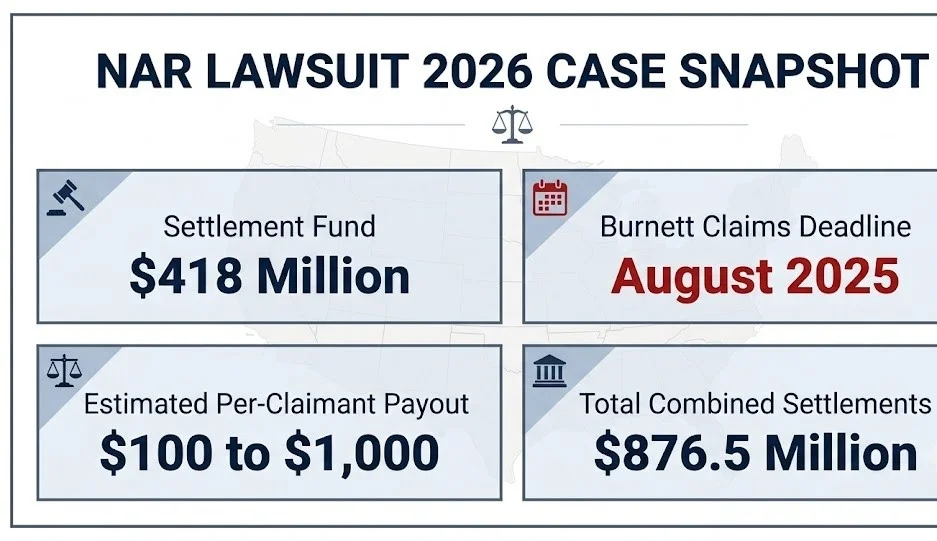
| NAR Settlement Amount | $418 million over approximately four years |
| Settlement Final Approval | Granted November 2024 |
| Related Case | Moehrl v. NAR, N.D. Ill., Case No. 1:19-cv-01610 |
| Status | Settlement distribution active; related cases ongoing in 2026 |
| Claims Deadline | August 2025 (Burnett class); verify current deadlines for active cases |
The NAR lawsuit stands as the most consequential antitrust action in American real estate history. A federal jury in Kansas City found in October 2023 that the National Association of Realtors and several of the country’s largest real estate brokerages had conspired for decades to suppress commission competition, awarding damages that trebled automatically to approximately $5.36 billion under antitrust law.
NAR settled for $418 million in March 2024, rather than face that judgment. The settlement also required sweeping rule changes to MLS commission practices nationwide.
The financial stakes were only part of the story. The structural changes imposed by the settlement have reshaped how real estate agents are compensated across every American market.
Litigation did not end with the NAR settlement. Related cases against brokerages and MLSs that were not party to the original settlement continue in federal courts as of 2026.
NAR Lawsuit: What the Case Is and Why It Matters
The NAR lawsuit is a federal antitrust class action alleging that NAR and cooperating brokerages engineered a commission-fixing conspiracy through MLS participation rules
The core mechanism was straightforward. MLS membership rules required listing agents to make an upfront offer of compensation to buyer’s agents as a condition of listing a property. That rule, plaintiffs argued, prevented commission negotiation and locked buyer-agent fees at artificially high levels, typically two to three percent of the sale price.
Home sellers bore the cost. They paid both their listing agent and the buyer’s agent, with no ability to negotiate the buyer-agent fee independently.
The legal theory was a Section 1 Sherman Act conspiracy: an agreement among competitors that unreasonably restrained trade. The Burnett jury agreed.
Core Antitrust Theory at a Glance:
| Element | Allegation |
|---|---|
| Agreement | NAR MLS rules requiring blanket buyer-agent commission offers |
| Parties | NAR plus major brokerage franchisors and franchisees |
| Restraint | Suppression of buyer-agent commission competition |
| Harm | Artificially inflated seller costs; estimated billions in overcharges |
| Legal Basis | Sherman Antitrust Act, Section 1 |
Attorney Insight: Attorneys handling antitrust class actions note that the buyer-agent commission structure was not incidental. It was, according to the trial record, a deliberately engineered market mechanism that insulated buyer-agent fees from competitive pressure for decades.
NAR Lawsuit News: Key Developments Since the Verdict
NAR lawsuit news since the October 2023 verdict has moved on two parallel tracks: settlement administration and continued litigation against non-settling defendants.
On the settlement track, Judge Bough granted final approval of the NAR settlement in November 2024. The claims process opened for the Burnett class, and hundreds of thousands of claims were submitted before the primary deadline. Distribution of settlement funds to approved claimants was underway in 2025 and continued into 2026.
On the litigation track, cases against brokerages and MLSs not covered by the NAR settlement have proceeded through discovery and motion practice in multiple federal districts.
Key Post-Verdict Milestones:
- October 31, 2023: Burnett jury returns verdict of approximately $1.78 billion
- March 15, 2024: NAR announces $418 million settlement agreement
- April 2024: Keller Williams, RE/MAX, Anywhere Real Estate, and HomeServices reach separate settlements totaling additional hundreds of millions
- November 2024: Judge Bough grants final approval of NAR settlement
- 2025: Claims distribution begins for approved Burnett class members
- 2026: Related cases in Illinois (Moehrl) and other jurisdictions continue
Attorney Insight: Attorneys tracking post-verdict developments note that the brokerage-level settlements, though less publicized than the NAR settlement, collectively add substantial funds to the overall pool available to class members.
Litigation Watch: The NAR settlement is approved and distributing funds in 2026, but related antitrust litigation against non-settling brokerages and MLSs remains active in multiple federal courts.
NAR Lawsuit Update 2026: Where Things Stand Right Now
The NAR lawsuit update for 2026 centers on three active fronts: claims distribution from the approved settlement, ongoing litigation in the Moehrl case in the Northern District of Illinois, and new commission-related antitrust filings by plaintiffs’ firms.
Settlement fund distribution under Judge Bough’s November 2024 order is being administered by the court-appointed claims administrator. Approved claimants in the Burnett class are receiving or have received their allocations.
The Moehrl case, which covers a broader geographic class of MLS markets, remains in active litigation posture as of June 2026. That case involves a different, though overlapping, class of home sellers and a different set of MLS defendants.
2026 Active Litigation Landscape:
| Case | Court | Status as of June 2026 |
|---|---|---|
| Burnett v. NAR | W.D. Mo. | Settlement distributing |
| Moehrl v. NAR | N.D. Ill. | Active litigation |
| New brokerage-level cases | Multiple districts | Early stage |
| DOJ investigation | Administrative | Ongoing monitoring |
Attorney Insight: Attorneys advising home sellers in 2026 note that participation in the Burnett settlement does not necessarily foreclose participation in Moehrl or other pending actions, depending on individual class membership determination and opt-out history.
NAR Commission Lawsuit: The Business Practice That Triggered Federal Antitrust Claims
The NAR commission lawsuit targeted a specific business practice: the MLS cooperative compensation rule.
Under that rule, a seller’s listing agent was required to offer a pre-set buyer-agent commission at the time of MLS listing. The offer was non-negotiable in the transaction itself. Buyers could not directly negotiate their agent’s fee. Sellers paid it regardless.
Plaintiffs’ economists testified at trial that this practice cost American home sellers tens of billions of dollars in excessive commissions over the class period. The $1.78 billion verdict represented damages in the Missouri and Kansas MLS markets alone.
How the Cooperative Compensation Rule Worked:
- Listing agent sets buyer-agent commission rate at time of MLS listing
- Rate typically ranged from 2.5 to 3 percent of sale price
- Buyer’s agent selection driven partly by commission offer level
- Sellers had no practical ability to reduce buyer-agent compensation after listing
- Commission structure was uniform across MLS participants
Attorney Insight: Attorneys presenting the antitrust case at trial argued that the cooperative compensation rule functioned like a price floor, insulating buyer-agent fees from the competitive negotiation that occurs in virtually every other service market.
Bold Callout: On a median-priced American home sale of $400,000, a three-percent buyer-agent commission equals $12,000 paid by the seller with no direct negotiation power over that figure.
NAR Antitrust Lawsuit: The Sherman Act Theory That Won at Trial
The NAR antitrust lawsuit succeeded at trial because plaintiffs persuaded a jury that NAR’s MLS rules constituted a horizontal agreement among competitors to fix prices, the most serious category of Sherman Act violation.
Section 1 of the Sherman Act prohibits contracts, combinations, or conspiracies in restraint of trade. A horizontal price-fixing agreement, meaning an agreement among competitors operating at the same level of the market, is treated as per se illegal. It does not require proof that the agreement was unreasonable.
Plaintiffs argued that NAR’s rules, adopted and enforced across thousands of MLSs nationally, constituted exactly that kind of horizontal agreement. Member brokerages, competing sellers of listing and buyer-agent services, all adhered to the same commission structure as a condition of MLS access.
Sherman Act Section 1 Framework Applied to NAR:
| Element | How Plaintiffs Proved It |
|---|---|
| Agreement | NAR MLS handbook rules mandating cooperative compensation |
| Among competitors | Member brokerages competing for listing and buyer clients |
| Restraint of trade | Suppression of buyer-agent commission competition |
| Per se vs. rule of reason | Plaintiffs argued horizontal price-fixing; per se standard |
| Damages | Econometric model estimating commission overcharges |
Attorney Insight: Attorneys analyzing the Burnett verdict note that the jury’s acceptance of the per se price-fixing theory was the critical determination. Under per se analysis, defendants cannot argue that the restraint was justified by procompetitive benefits.
Litigation Watch: The Burnett jury’s per se antitrust finding against NAR established that MLS cooperative compensation rules constitute illegal price-fixing, a ruling that now shapes every subsequent commission-related antitrust claim filed in federal court.
Sitzer Burnett Lawsuit NAR: The Trial That Changed Everything
The Sitzer Burnett lawsuit, formally captioned Burnett v. National Association of Realtors, Case No. 4:19-cv-00332-SRB, was the first NAR commission case to reach a jury verdict.
Filed in the Western District of Missouri in 2019, the case was litigated before Judge Stephen R. Bough over four years before reaching trial in October 2023. The trial lasted approximately two weeks. The jury deliberated for two hours and fifteen minutes before returning its verdict.
The speed of deliberation spoke to the clarity of the evidence. Internal NAR communications and MLS rule documents presented at trial showed that the cooperative compensation requirement was not an accidental market outcome. It was a deliberately maintained policy.
Burnett Case Key Facts:
- Case filed: February 2019
- Court: U.S. District Court, Western District of Missouri
- Judge: Hon. Stephen R. Bough
- Trial commenced: October 16, 2023
- Verdict: October 31, 2023
- Verdict amount: Approximately $1.78 billion
- Trebled amount: Approximately $5.36 billion
- Named plaintiffs: Missouri and Kansas home sellers
Attorney Insight: Attorneys who covered the Burnett trial note that the jury’s two-hour deliberation after a two-week trial indicated that the liability evidence was, in the jury’s assessment, not a close call.
NAR Lawsuit Verdict: What the Jury Found and What It Means
The NAR lawsuit verdict delivered October 31, 2023 found NAR and the named brokerage defendants liable for antitrust conspiracy and awarded approximately $1.78 billion in compensatory damages.
Under the Sherman Act, antitrust damages are automatically trebled. The verdict therefore exposed NAR and its co-defendants to a judgment of approximately $5.36 billion before any post-trial motions or appeals.
That exposure drove the settlement. NAR’s agreement to pay $418 million over roughly four years, combined with immediate rule changes, was presented to the court as a preferable resolution to the trebled judgment. Separately, Anywhere Real Estate, RE/MAX, Keller Williams, and HomeServices of America each reached their own settlement agreements.
Verdict and Settlement Comparison:
| Party | Role | Settlement Amount |
|---|---|---|
| National Association of Realtors | Primary defendant | $418 million |
| Anywhere Real Estate | Brokerage defendant | $83.5 million |
| RE/MAX | Brokerage defendant | $55 million |
| Keller Williams | Brokerage defendant | $70 million |
| HomeServices of America | Brokerage defendant | $250 million |
| Combined total | All settling defendants | Approximately $876.5 million |
Attorney Insight: Attorneys advising plaintiffs’ classes note that the combined settlement pool across all settling defendants exceeds $876 million, making this one of the largest antitrust settlement recoveries in American residential real estate history.
National Association of Realtors Lawsuit Settlement: Terms and Structure
The National Association of Realtors lawsuit settlement, approved by Judge Bough in November 2024, required NAR to pay $418 million over approximately four years and to implement immediate and permanent changes to MLS commission practices.
The settlement fund is being administered by the court-appointed claims administrator. After deducting attorneys’ fees, litigation costs, and administrative expenses, the net fund is distributed to approved class members based on the court-approved allocation formula.
Attorneys’ fees in the case were substantial. Plaintiffs’ counsel sought fees representing approximately 30 percent of the total settlement value. The court-approved fee award reduced the net distributable fund accordingly.
NAR Settlement Key Terms:
- Total payment: $418 million, disbursed over approximately four years
- Rule changes: Mandatory written buyer representation agreements before showings; prohibition on MLS offers of buyer-agent compensation
- Class period: March 6, 2015 through August 17, 2024
- Claims administrator: Appointed by Judge Bough
- Final approval: November 2024
- Distribution: Active in 2025 and continuing in 2026
Attorney Insight: Attorneys reviewing the settlement structure note that the rule changes NAR agreed to may ultimately have greater long-term market impact than the monetary payment, because they permanently sever the link between MLS listing and mandatory buyer-agent commission disclosure.
Litigation Watch: The combined defendant settlements exceed $876 million, final approval was granted in November 2024, and distribution to qualifying claimants is active in 2026 with related cases still pending.
NAR Settlement Amount: Breaking Down the $418 Million and What It Actually Pays Out
The NAR settlement amount of $418 million is the headline figure, but what reaches individual claimants is substantially less.
Courts in class action settlements routinely approve attorneys’ fee awards of 25 to 33 percent of the common fund. A 30 percent fee award on $418 million equals approximately $125 million in fees alone. Administrative costs and litigation expenses reduce the distributable fund further.
The claims administrator calculates individual awards by dividing the net fund by the weighted transaction values of all approved claimants. Higher-value home sales generally yield proportionally larger payments.
Settlement Fund Breakdown (Estimated):
| Fund Component | Estimated Amount |
|---|---|
| Gross NAR settlement | $418 million |
| Estimated attorneys’ fees (30%) | ~$125 million |
| Administrative and notice costs | ~$5 to $10 million |
| Estimated net distributable fund | ~$283 to $288 million |
| Estimated claimants | Potentially millions |
| Estimated per-claimant range | $100 to $1,000 for most claimants |
Attorney Insight: Attorneys reviewing class action settlement allocations consistently advise clients that per-claimant amounts in large nationwide settlements frequently disappoint relative to the headline number, precisely because the eligible class is enormous and administrative costs are substantial.
Important note: The above breakdown reflects estimates based on publicly available information about the settlement structure. The claims administrator’s final distribution figures will differ based on total validated claims.
NAR Lawsuit Who Qualifies: Eligibility Requirements Explained
The NAR lawsuit class members who qualify for a payment are home sellers who meet specific transaction and geographic criteria.
The Burnett class covers home sellers who sold residential real estate listed on certain MLSs in Missouri and Kansas within the class period, generally March 6, 2015 through August 17, 2024. The Moehrl class in the Northern District of Illinois covers a broader set of MLS markets with its own class definition.
Buyers who purchased homes during the class period are not class members in the current settlements. The antitrust harm alleged was borne by sellers, not buyers, because sellers paid both agents’ commissions.
Primary Eligibility Checklist:
- Sold residential real property during the applicable class period
- Property was listed on an MLS covered by the applicable settlement
- Paid a commission that included a buyer-agent component
- Did not validly opt out of the class before the opt-out deadline
- Submitted a timely and valid claim form
Who Does Not Qualify:
- Buyers who purchased homes during the class period
- Sellers who opted out of the class
- Sellers whose transactions occurred outside the geographic class definition
- Sellers whose transactions fall outside the class period dates
Attorney Insight: Attorneys advising potential claimants note that the MLS geographic scope is the most frequently misunderstood eligibility criterion. Not every MLS in every state was covered by the Burnett settlement, and some sellers may need to look to the Moehrl or other pending actions for potential recovery.
NAR Settlement Eligibility: How the Court Defined the Class
NAR settlement eligibility was defined by Judge Bough’s class certification order, which established specific geographic and temporal boundaries for the plaintiff class.
Class certification in antitrust cases requires the court to find that common legal and factual questions predominate over individual ones. Judge Bough certified the Burnett class on that basis, finding that the MLS cooperative compensation rule applied uniformly to all class members, making their claims suitable for collective resolution.
The class definition matters for eligibility in a practical sense. A seller who transacted in a non-covered MLS market, even during the class period, is not automatically a class member in the Burnett settlement. That seller may have claims under Moehrl or other pending actions.
Eligibility Determination Framework:
| Criterion | Burnett Class | Moehrl Class |
|---|---|---|
| Geographic scope | Missouri and Kansas MLSs (primarily) | Broader national MLS coverage |
| Class period | March 6, 2015 to August 17, 2024 | Overlapping but distinct dates |
| Property type | Residential real property | Residential real property |
| Transaction party | Seller | Seller |
| Court | W.D. Mo. | N.D. Ill. |
Attorney Insight: Attorneys reviewing client eligibility for NAR settlement payments recommend verifying which specific MLS listed the seller’s property, because that determination, not the state of residence, controls whether the Burnett or Moehrl class definitions apply.
NAR Lawsuit Claims Deadline 2026: What You Need to Know About Filing Now
The NAR lawsuit claims deadline for the primary Burnett class was set at August 2025 under the court’s scheduling order following the November 2024 final approval. That deadline has passed for most Burnett class members as of mid-2026.
Claimants who missed the Burnett deadline may have limited remedies. Courts rarely reopen claim submission windows after a deadline has passed unless the claimant can demonstrate that notice was inadequate or that extraordinary circumstances prevented timely filing.
The Moehrl case in the Northern District of Illinois, which covers a broader MLS geographic class, has its own distinct claims timeline. As of June 2026, that case had not reached final settlement approval, meaning its claims process had not opened under a court order.
Claims Timeline Overview:
| Deadline | Case | Action Required |
|---|---|---|
| August 2025 | Burnett v. NAR | Primary claim submission deadline (passed) |
| TBD | Moehrl v. NAR | Awaiting settlement or trial |
| TBD | Other pending cases | Case-specific; monitor court orders |
| Opt-out deadline | Burnett | Passed prior to final approval |
Attorney Insight: Attorneys advising clients who missed the Burnett claims deadline note that the most productive path forward in 2026 is determining whether any pending cases, including Moehrl, cover the client’s specific transaction and MLS market.
Bold Callout: Home sellers who missed the Burnett claims deadline should consult an antitrust attorney promptly to assess whether any active litigation covers their transaction before additional statute of limitations issues arise.
Litigation Watch: The Burnett claims deadline has passed as of mid-2026, but the Moehrl case and other related antitrust actions remain active for eligible sellers whose transactions fall within those broader class definitions.
NAR Settlement Payout Per Person: What Individual Claimants Can Realistically Expect
The NAR settlement payout per person depends entirely on the total number of valid approved claims and the weighted transaction allocation formula approved by Judge Bough.
Claims administrators in large antitrust settlements typically weight individual payments by transaction value. A seller who sold a $600,000 home may receive a proportionally higher payment than one who sold a $200,000 home, reflecting the proportionally higher commission overcharge alleged.
Early projections from the claims administration process estimated individual payments in the range of $100 to $1,000 for most claimants. High-volume sellers, such as real estate developers or investors who sold multiple properties during the class period, may receive higher aggregate payments.
Estimated Payment Ranges by Transaction Profile:
| Transaction Profile | Estimated Payment Range |
|---|---|
| Single home sale, below $300,000 | $100 to $300 |
| Single home sale, $300,000 to $600,000 | $300 to $700 |
| Single home sale, above $600,000 | $500 to $1,000+ |
| Multiple sales during class period | Cumulative calculation |
| Late or deficient claim filed | Potential reduction or denial |
Attorney Insight: Attorneys who have monitored the claims administration process note that the sheer volume of class members, potentially tens of millions of home sellers over a nine-year class period, means that per-claimant payments are modest despite the headline settlement amount.
NAR Lawsuit Commission Changes: What the Rules Look Like Now
The NAR lawsuit commission changes are the settlement’s most lasting structural impact on the real estate market.
Beginning August 17, 2024, NAR’s settlement-mandated rule changes took effect nationally. MLS platforms were prohibited from including offers of buyer-agent compensation on listing entries. Separately, buyer’s agents were required to enter into written representation agreements with buyers before showing any property, disclosing their compensation arrangement explicitly.
These changes effectively decoupled the buyer-agent commission from the MLS listing process. Sellers no longer automatically pay the buyer’s agent as a condition of listing. The buyer’s agent compensation is now a matter of direct negotiation between the buyer and their agent, with the outcome disclosed to all parties.
Before and After Commission Rule Changes:
| Practice | Before August 17, 2024 | After August 17, 2024 |
|---|---|---|
| Buyer-agent commission | Set by seller at listing | Negotiated between buyer and agent |
| MLS disclosure | Commission offers published in MLS | Commission offers prohibited in MLS |
| Written buyer agreements | Not required before showings | Required before showing any property |
| Who pays buyer’s agent | Seller (standard practice) | Negotiable; buyer or seller |
| Commission transparency | Limited | Mandatory disclosure in agreements |
Attorney Insight: Attorneys advising real estate professionals note that the written buyer representation requirement creates a new layer of legal documentation in every transaction, and that disputes over buyer-agent compensation disclosure are expected to generate new categories of consumer protection litigation.
NAR Lawsuit Buyer Agent Commission Rules: The New Framework in Detail
The NAR lawsuit buyer agent commission rules establish, for the first time in American real estate practice, a mandatory negotiation structure for buyer-side compensation.
Before the settlement-mandated changes, the standard practice was that the listing broker offered a pre-set buyer-agent commission in the MLS. Buyer’s agents would steer clients toward listings offering higher commissions, a practice plaintiffs called “steering.” That practice is now structurally constrained.
Under the new rules, buyer’s agents must disclose their compensation requirements in writing before any showing. Buyers know upfront what their agent costs. That cost is either paid by the buyer directly, negotiated into the transaction as a seller concession, or some combination.
New Buyer-Agent Compensation Framework:
- Written buyer representation agreement required before showings
- Agreement must specify the buyer-agent’s compensation amount or formula
- Compensation offer cannot be made through MLS
- Seller may offer to pay buyer-agent compensation as a concession in the purchase contract
- If seller declines, buyer is responsible for their agent’s compensation
- MLS rules no longer permit blanket offers of compensation visible only to agents
Attorney Insight: Attorneys tracking early market data from the post-August 2024 transition period note that while some buyers are negotiating seller-paid buyer-agent compensation as a contract concession, first-time buyers with limited funds are encountering new challenges in markets where sellers decline to cover that cost.
Bold Callout: The August 17, 2024 rule changes represent the most significant restructuring of American residential real estate commission practices since the MLS system was established in the 1960s.
NAR Lawsuit Impact on Home Buyers and Sellers: The 2026 Market Reality
The NAR lawsuit impact on home buyers and sellers in 2026 has been significant, though uneven across different market segments and regions.
For sellers, the immediate impact is the potential to negotiate a lower total commission by not automatically offering buyer-agent compensation in the listing. In practice, many sellers in competitive markets continue to offer buyer-agent compensation as a contract concession to attract a broader pool of buyers. The difference is that the offer is now transparent and negotiable.
For buyers, particularly first-time buyers and those with limited cash reserves, the new rules create a challenge. Paying a buyer’s agent out of pocket, or negotiating that cost into a purchase where sellers are unwilling to cover it, adds financial complexity to an already difficult market.
Market Impact by Buyer/Seller Profile:
| Market Participant | Impact Under New Rules |
|---|---|
| Sellers in competitive markets | Potential commission savings if buyer-agent cost not offered |
| Sellers in slower markets | Continued pressure to offer buyer-agent coverage to attract buyers |
| Experienced buyers with cash | More negotiating flexibility with agents |
| First-time buyers | New complexity; potential additional cost |
| Buyer’s agents | Must justify compensation explicitly and in writing |
| Listing agents | Less structural advantage from MLS commission display |
Attorney Insight: Attorneys advising buyers in 2026 real estate transactions note that the written buyer representation agreement requirement has created new disputes about compensation when transactions fall through, and that the enforceability of those agreements in various states remains an evolving legal question.
Frequently Asked Questions
What is the NAR lawsuit about?
The NAR lawsuit is a federal antitrust class action alleging that NAR and major brokerages conspired to fix buyer-agent commissions through MLS rules.
A federal jury in Missouri found NAR liable in October 2023, awarding approximately $1.78 billion in damages, which trebled to $5.36 billion under antitrust law.
NAR settled for $418 million in March 2024 rather than face that judgment.
Who qualifies for a payment from the NAR settlement?
Home sellers who sold residential property listed on a covered MLS between March 6, 2015 and August 17, 2024 may qualify for a payment.
The Burnett settlement covers primarily Missouri and Kansas MLS markets; the Moehrl case in Illinois covers a broader geographic class.
Buyers who purchased homes during the class period are not eligible, as the antitrust harm was borne by sellers.
How much will each claimant receive from the NAR settlement?
Most individual claimants in the Burnett settlement are estimated to receive between $100 and $1,000, depending on the value of their home sale and the total number of valid approved claims.
The net distributable fund after attorneys’ fees and administrative costs is substantially less than the $418 million headline figure.
Higher-value transactions and sellers with multiple qualifying sales during the class period may receive proportionally larger payments.
What is the claims filing deadline for the NAR lawsuit in 2026?
The primary Burnett class claims deadline was August 2025, and that window has closed for most qualifying sellers.
The Moehrl case in the Northern District of Illinois has its own timeline and had not reached final settlement approval as of June 2026.
Home sellers who missed the Burnett deadline should consult an antitrust attorney to assess whether any active case covers their transaction.
What changed about real estate commissions because of the NAR lawsuit?
Beginning August 17, 2024, NAR’s settlement-required rule changes prohibited MLS offers of buyer-agent compensation and required written buyer representation agreements before any property showings.
The practical effect is that buyer-agent compensation is now a matter of direct negotiation rather than a pre-set MLS condition paid automatically by sellers.
These are the most significant structural changes to American residential real estate commission practices in decades.
Is the NAR lawsuit still active in 2026?
The Burnett case has reached final settlement and distribution. The Moehrl case in the Northern District of Illinois remains in active litigation as of June 2026.
New antitrust filings targeting individual brokerages and MLS organizations not covered by the NAR settlement have also been filed in multiple federal districts.
The NAR settlement resolved NAR’s direct liability, but related commission-practice litigation continues across the country.
Closing
The NAR lawsuit altered American real estate in ways that extend beyond its $418 million settlement fund. The rule changes it imposed are permanent. The antitrust precedent the Burnett verdict established is durable.
Sellers who transacted during the class period and have not yet assessed their eligibility should do so promptly. For those affected by the new buyer-agent compensation rules, or facing disputes arising from written representation agreements, an attorney who handles real estate antitrust or consumer protection claims is the right resource.
The Moehrl case and related pending actions mean this litigation chapter is not fully closed.
