
Quick Answer Box
- The NASCAR antitrust lawsuit was a federal case brought by 23XI Racing and Front Row Motorsports, ending in a mid trial settlement on December 11, 2025.
- It applied directly to two race teams, but the settlement’s evergreen charter terms affect every chartered team in the NASCAR Cup Series.
- There is no individual claimant payout. The case sought injunctive relief and damages tied to team revenue, not consumer compensation.
Case Snapshot
| Detail | Info |
|---|---|
| Court | U.S. District Court for the Western District of North Carolina, Charlotte Division |
| Case / MDL Number | Civil Action No. 3:24-cv-00886-FDW-SCR |
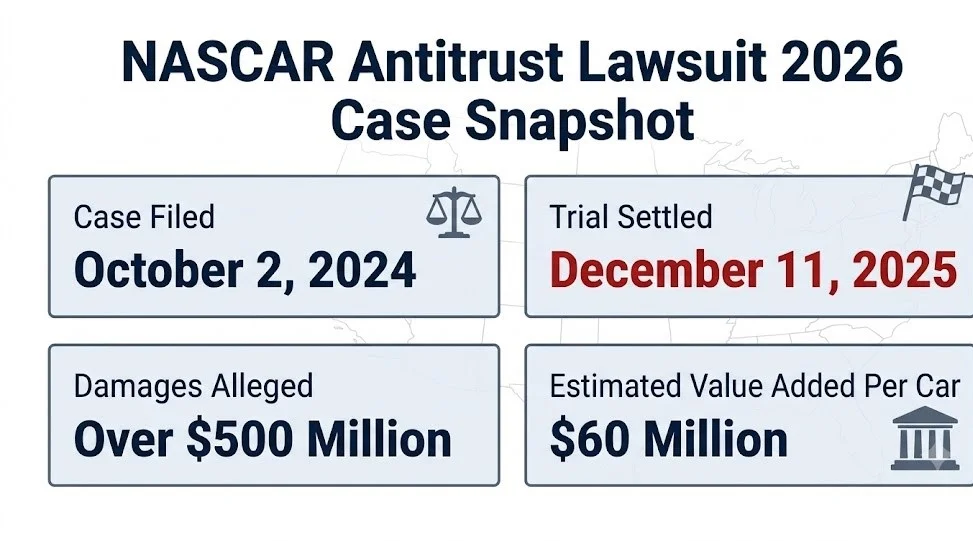
| Filing Date | October 2, 2024 |
| Status | Settled mid trial, December 11, 2025 |
| Settlement Fund | Financial terms not publicly disclosed |
The nascar antitrust lawsuit was the most consequential legal fight in the sport’s modern history. It pitted two Cup Series teams against NASCAR’s entire business model.
The case ran from an October 2024 filing through an eight day jury trial that ended in a settlement.
Along the way, it produced two competing injunction rulings, a reversed appellate decision, and sworn declarations from nearly every major team owner in the sport.
One number tells you how high the stakes ran. Teams alleged more than $500 million in potential damages tied to NASCAR’s charter system.
What Is the NASCAR Antitrust Lawsuit
The nascar antitrust lawsuit is a federal case alleging NASCAR violated the Sherman Act through its charter system.
23XI Racing and Front Row Motorsports filed the complaint on October 2, 2024, in the U.S. District Court for the Western District of North Carolina. The case was docketed as Civil Action No. 3:24-cv-00886-FDW-SCR.
The teams argued NASCAR holds monopoly and monopsony power over premier stock car racing. They pointed to NASCAR’s control of tracks, sanctioning rights, and team entry credentials.
Quick facts:
- Plaintiffs: 23XI Racing, Front Row Motorsports
- Defendants: NASCAR LLC, Jim France
- Filed: October 2, 2024
- Legal basis: Sherman Act Sections 1 and 2
- Lead plaintiffs’ attorney: Jeffrey Kessler, Winston and Strawn
Attorneys handling sports antitrust disputes point to the dual monopoly and monopsony framing as the case’s most aggressive feature, since it attacked NASCAR’s power as both seller and buyer in the same market.
Who Filed the Lawsuit and Why
23XI Racing and Front Row Motorsports filed the suit after refusing to sign NASCAR’s 2025 charter agreement.
23XI is co-owned by Michael Jordan, Denny Hamlin, and Curtis Polk. Front Row is owned by Bob Jenkins.
Both teams objected to a charter extension presented in September 2024 with a tight signing deadline. The agreement included a clause releasing NASCAR from existing and future antitrust claims.
- 13 of 15 Cup Series teams signed the 2025 charter agreement
- 23XI and Front Row were the only two holdouts
- Both teams raced as unchartered “open” teams for part of the 2025 season
Hamlin later testified that the deadline gave teams roughly six hours to review a 112 page document.
Attorneys reviewing the complaint point to the release clause as the strategic trigger, since signing it would have permanently waived the very claims the teams ultimately brought to court.
NASCAR Antitrust 23XI Lawsuit Explained
The nascar antitrust 23xi lawsuit centers on NASCAR’s charter system, introduced in 2016.
Charters guarantee a team entry into every Cup Series race and a share of broadcast and sponsorship revenue. 23XI and Front Row argued this system, combined with track ownership and single source parts suppliers, locked teams into an unfair structure.
The complaint identified specific practices: exclusivity provisions, the antitrust release clause, and control over the NextGen car’s parts supply chain.
| Allegation | What It Claims |
|---|---|
| Monopsony power | NASCAR is effectively the only buyer of premier team services |
| Track control | NASCAR owns or controls most major Cup Series venues |
| Exclusivity | Charter terms restrict teams from racing in rival series |
| Antitrust release | Charter signing required waiving future legal claims |
Litigation Watch: The case’s foundation rested on defining “premier stock car racing” as its own antitrust market, a question the court later resolved in the teams’ favor before trial concluded.
What Court and Judge Are Handling the Case
Judge Kenneth D. Bell of the U.S. District Court for the Western District of North Carolina presided over the entire case.
Bell, a Donald Trump appointee, handled every major ruling, from the original motion to dismiss through the trial itself. The Charlotte division was the proper venue, since NASCAR conducts substantial business in North Carolina despite being headquartered in Daytona Beach, Florida.
Any appeal from district court rulings would have gone to the Fourth Circuit Court of Appeals in Richmond, Virginia, which already weighed in once on the injunction question.
Quick facts on the court:
- Trial court: U.S. District Court, Western District of North Carolina
- Presiding judge: Kenneth D. Bell
- Appellate court of record: Fourth Circuit Court of Appeals
- Case track: Antitrust, civil, jury trial
Attorneys tracking the docket noted Bell’s willingness to rule quickly on dispositive motions, a pattern that shaped the case’s fast procedural pace compared to typical antitrust litigation timelines.
NASCAR Antitrust Lawsuit Dismissal Attempt
NASCAR’s motion to dismiss the entire case was denied by Judge Bell on January 10, 2025.
Bell ruled the teams had “sufficiently alleged one or more plausible antitrust claims.” He wrote that resolving the dispute required full discovery and, ultimately, a jury.
Notably, Bell’s order included a footnote finding the teams had plausibly alleged claims against Jim France individually, not just NASCAR as a corporate entity.
- Motion to dismiss the full case: denied
- Motion to require a litigation bond: also denied
- Jim France named individually: confirmed via footnote in the ruling
Bell’s language on France: the court found plaintiffs had plausibly alleged he “directed, controlled and/or ratified” NASCAR’s conduct.
Attorneys handling motion to dismiss strategy point to this footnote as unusually significant, since piercing to an individual executive defendant raises personal stakes beyond the corporate entity.
NASCAR Antitrust Lawsuit Injunction Denial
The nascar antitrust lawsuit injunction denial refers to Judge Bell’s September 3, 2025 ruling against the teams’ second injunction request.
This was a different ruling than the original December 2024 injunction grant. By September 2025, the teams sought renewed chartered status after losing it on appeal months earlier.
Bell denied the request, finding the teams could not show irreparable harm. NASCAR had assured the court it would not sell the six disputed charters before trial and would let the teams compete as open entries.
| Injunction Event | Date | Outcome |
|---|---|---|
| First injunction request | December 2024 | Granted by Judge Bell |
| Fourth Circuit appeal | June 5, 2025 | Injunction vacated |
| Second injunction request | September 3, 2025 | Denied by Judge Bell |
Bell wrote that any damage from drivers or sponsors leaving could be “compensated with money damages at trial.”
The Earlier Injunction Grant and Fourth Circuit Reversal
Judge Bell originally granted a preliminary injunction in December 2024, before the September 2025 denial.
That order forced NASCAR to let 23XI and Front Row compete as chartered teams for the 2025 season while the case proceeded. Bell found the teams showed a likelihood of success tied to the antitrust release clause.
The Fourth Circuit Court of Appeals reversed that injunction on June 5, 2025. The panel, including Judge Niemeyer, found the teams could not simultaneously ask for charter terms while arguing those terms were illegal.
- December 2024: District court grants injunction
- June 5, 2025: Fourth Circuit vacates the injunction
- Result: Teams reverted to open team status for the remainder of the 2025 season
Litigation Watch: The two injunction rulings worked against each other, with the December 2024 grant reversed on appeal and the September 2025 renewed request denied outright, leaving the teams unchartered heading into the December trial.
Attorneys handling preliminary injunction motions point to Niemeyer’s “cake and eat it too” framing as the case’s most quoted appellate line, capturing why courts resist injunctions that contradict the underlying legal theory.
NASCAR Owners Statements Antitrust Lawsuit
NASCAR submitted declarations from 11 Cup Series team owners and executives as part of its October 2025 summary judgment motion.
The nascar owners statements antitrust lawsuit filing included Rick Hendrick, Roger Penske, Richard Childress, Joe Gibbs, Brad Keselowski, and others. NASCAR asked each declarant voluntarily, framing the statements as evidence the charter system has broad team support.
- Rick Hendrick: described the charter agreement as critical to ecosystem stability
- Richard Childress: called charters essential to creating enterprise value
- Roger Penske: said he signed because further negotiation was unlikely
Plaintiffs’ attorney Jeffrey Kessler responded that the declarations were “supportive” of his clients’ position, since they confirmed teams cannot survive without charters.
Attorneys handling summary judgment opposition point to this response as a sharp tactical move, turning the defense’s own evidence into support for the plaintiffs’ core argument.
NASCAR Antitrust Lawsuit Gibbs Statement
Joe Gibbs submitted one of the most quoted declarations in the entire case.
Gibbs wrote that the most important thing to him was that the lawsuit be “resolved amicably, quickly, and in a manner that preserves the Charter system.” He stated he provided the declaration with “great reservation,” citing his decades long friendship with Jim France.
His daughter in law, Heather Gibbs, gave separate live testimony at trial in December 2025. She told the jury the 2025 charter deadline felt like “a gun to your head.”
| Declarant | Relationship to Case | Key Statement Theme |
|---|---|---|
| Joe Gibbs | Written declaration, October 2025 | Wants quick resolution, preserves charter system |
| Heather Gibbs | Live trial testimony, December 2025 | Described pressure to sign 2025 charter deal |
Joe Gibbs Racing operates four charters and roughly 450 employees, a scale that gave his statement particular weight with the court.
Attorneys handling declaration strategy note the contrast between Joe Gibbs’ written caution and Heather Gibbs’ blunt trial testimony, illustrating how the same family’s legal exposure produced two very different tones under oath.
Summary Judgment Rulings Before Trial
Judge Bell issued several summary judgment rulings in the weeks before trial, most favoring the plaintiffs.
On October 28, 2025, Bell dismissed NASCAR’s countersuit against the teams and Curtis Polk. NASCAR had alleged the teams ran an illegal cartel during charter negotiations.
On November 4, 2025, Bell ruled that NASCAR holds monopoly power in the properly defined market of premier stock car racing. He denied NASCAR’s own summary judgment motion the same day.
- NASCAR’s countersuit: dismissed via summary judgment
- Market definition: ruled in favor of 23XI and Front Row
- NASCAR’s summary judgment motion: denied
Litigation Watch: By early November 2025, every major pretrial ruling had gone against NASCAR, a string of losses that intensified settlement pressure ahead of the December 1 trial date.
The December 2025 Trial and Key Testimony
The trial began on December 1, 2025, with jury selection and Hamlin’s opening testimony.
Hamlin told the jury that team owners are “essentially just professional fundraisers” under NASCAR’s current model. Michael Jordan testified for roughly an hour, describing the case as fighting “for every person in NASCAR.”
NASCAR called its own witnesses, including commissioner Steve Phelps and Jim France, before the case settled on its ninth scheduled day.
- Day 1, December 1: Jury selected, Hamlin testifies
- Days 2 through 8: Witness testimony from owners and executives
- December 11, 2025: Settlement announced, jury dismissed
Jordan testified he has invested $35 to 40 million in 23XI Racing since 2021.
NASCAR Antitrust Lawsuit Timeline for 2026
Here is the confirmed sequence of events affecting the 2026 season.
- October 2, 2024: Lawsuit filed
- December 2024: First injunction granted
- January 10, 2025: Motion to dismiss denied
- June 5, 2025: Fourth Circuit vacates injunction
- September 3, 2025: Second injunction denied
- October 28, 2025: NASCAR countersuit dismissed
- November 4, 2025: Market definition ruling favors teams
- December 1, 2025: Trial begins
- December 11, 2025: Settlement announced mid trial
- February 15, 2026: Daytona 500 opens the 78th NASCAR season under new charter terms
What this means for 2026:
- Both teams retained charters for the season
- Evergreen charter provisions now apply across the Cup Series
- No further trial proceedings remain in this specific case
Attorneys following the docket note that settlements reached mid trial, like this one, produce no binding written opinion on the antitrust merits, leaving the underlying legal questions formally unresolved for future cases.
How the Settlement Resolved the Case
The case settled on December 11, 2025, after eight days of trial testimony.
NASCAR, 23XI Racing, and Front Row Motorsports issued a joint statement calling the resolution “a fair and equitable framework for long-term participation.” Financial terms were not disclosed.
Both teams retained their charters for the 2026 season. NASCAR agreed to issue charter amendments incorporating evergreen terms, subject to mutual agreement.
| Settlement Term | Outcome |
|---|---|
| 23XI and Front Row charters | Restored for 2026 |
| Charter structure | Moves toward evergreen, permanent status |
| Financial terms | Not publicly disclosed |
| Future litigation | Case closed, no appeal pending |
Jordan called the resolution proof that “compromise in every negotiation is one of the toughest things” a business can do.
What Evergreen Charters Mean for Teams
Evergreen charters are a permanent, condition based version of the entry rights teams previously held on limited terms.
Before the settlement, charters could expire or be denied renewal at NASCAR’s discretion. That uncertainty made charters function more like a lease than an owned asset.
Economist Edward Snyder, who testified in the case, estimated the shift to permanent status added roughly $60 million in value per car.
- 23XI and Front Row held six combined cars between them
- The other 13 signed teams collectively hold 30 cars
- Most of the aggregate value increase flows to teams that did not sue
Attorneys advising sports franchise clients point to this asymmetry as a cautionary lesson, since the teams that litigated bore the legal risk while non plaintiff teams captured most of the financial upside.
Does This Case Set Precedent for Other Sports
Not formally, since the case settled before a final judgment on the merits.
A settlement reached mid trial does not produce a binding appellate opinion. The underlying question, whether a charter or franchise system constitutes unlawful monopoly power, remains technically open.
That said, the case generated extensive public record through trial testimony and unsealed financial documents, material future litigants in other leagues could reference.
- No binding precedent created, since there was no final verdict
- Extensive discovery record now exists publicly
- Other membership based sports leagues face similar antitrust exposure theories
Litigation Watch: The settlement avoided a verdict on the core monopoly question, meaning other leagues with similar franchise or membership structures still lack a definitive court ruling to rely on.
Who Should Talk to a Lawyer About a Similar Antitrust Dispute
Anyone facing a take it or leave it contract tied to market access should consult an antitrust litigation attorney early.
Teams, vendors, or members locked into a single governing body’s terms face a similar structural problem to what 23XI and Front Row argued. Timing matters, since signing a release clause can foreclose future claims entirely.
Sports business attorneys and commercial litigators with antitrust experience are the right fit for disputes involving exclusivity clauses, single source supplier requirements, or membership controlled entry rights.
- Businesses facing exclusivity clauses: consult an antitrust attorney before signing
- Team or franchise owners: review release clauses carefully before any renewal deadline
- Sports organizations: consult counsel on declaration strategy if asked to support a defendant in similar litigation
Attorneys handling these disputes generally recommend documenting every negotiation deadline and pressure tactic in writing, since that record became central evidence in this case’s owner testimony.
Frequently Asked Questions
What was the NASCAR antitrust lawsuit about?
It was a federal case alleging NASCAR’s charter system violated the Sherman Act.
23XI Racing and Front Row Motorsports filed the complaint on October 2, 2024.
The case ended in a settlement during trial on December 11, 2025.
Did the court dismiss the NASCAR antitrust lawsuit?
No, Judge Kenneth Bell denied NASCAR’s motion to dismiss on January 10, 2025.
He found the teams had sufficiently alleged plausible antitrust claims to proceed.
The case moved forward into full discovery and eventually trial.
Why was the injunction denied in the NASCAR lawsuit?
The court denied a renewed injunction request on September 3, 2025, finding no irreparable harm.
NASCAR had assured the court it would not sell the disputed charters before trial.
This followed an earlier injunction grant in December 2024 that the Fourth Circuit vacated in June 2025.
What did Joe Gibbs say about the NASCAR lawsuit?
Joe Gibbs submitted a declaration saying he wanted the case resolved amicably and quickly.
He stated he provided the statement with great reservation, citing his friendship with Jim France.
His daughter in law, Heather Gibbs, later testified that the 2025 charter deadline felt coercive.
How did the NASCAR antitrust lawsuit end?
The case settled mid trial on December 11, 2025, after eight days of testimony.
Both 23XI Racing and Front Row Motorsports retained their charters for the 2026 season.
Financial terms of the settlement were not publicly disclosed.
Does the NASCAR settlement affect other race teams?
Yes, the settlement introduced evergreen charter provisions that apply across the Cup Series.
All 15 chartered teams benefit from the shift toward permanent charter status, not just the plaintiffs.
Economic estimates from trial testimony put the added value at roughly $60 million per car.
The NASCAR antitrust lawsuit reshaped how the sport’s biggest asset, the charter, actually works. It settled before a jury could rule, which means the core monopoly question never got a final answer.
Anyone facing a similar exclusivity clause or take it or leave it contract should talk to an antitrust attorney before signing, not after. Timing decided much of this case before it ever reached a jury.
