
Quick Answer Box
- The case is a Wisconsin lawsuit testing whether the WIAA holds governmental authority over public school athletic eligibility.
- It applies to one family, the Seidls, but the legal question could affect how every Wisconsin public school handles WIAA transfer disputes.
- There is no settlement fund or individual payout. The dispute seeks a court ruling and an injunction, not damages.
Case Snapshot
| Detail | Info |
|---|---|
| Court | Waukesha County Circuit Court, Wisconsin |
| Case / MDL Number | Not confirmed in public reporting as of this writing |
| Filing Date | August 19, 2025 |
| Status | Active, awaiting ruling following March 3, 2026 hearing |
| Settlement Fund | None. This is an injunction and certiorari case, not a damages claim |
The wiaa arrowhead high school waiver lawsuit is a Wisconsin court fight over who actually controls high school sports eligibility. A family sued the Wisconsin Interscholastic Athletic Association after it blocked their son from playing varsity football.
The case is formally Seidl v. WIAA, filed in Waukesha County Circuit Court.
What makes it unusual is the legal target. The Seidls are not just challenging one waiver denial. They are asking a judge to decide whether the WIAA has any legal authority over public schools at all.
That question has sat unanswered in Wisconsin courts for years.
What Is the WIAA Arrowhead High School Waiver Lawsuit
The wiaa arrowhead high school waiver lawsuit is a civil case filed by the family of Arrowhead High School senior Tristen Seidl against the WIAA.
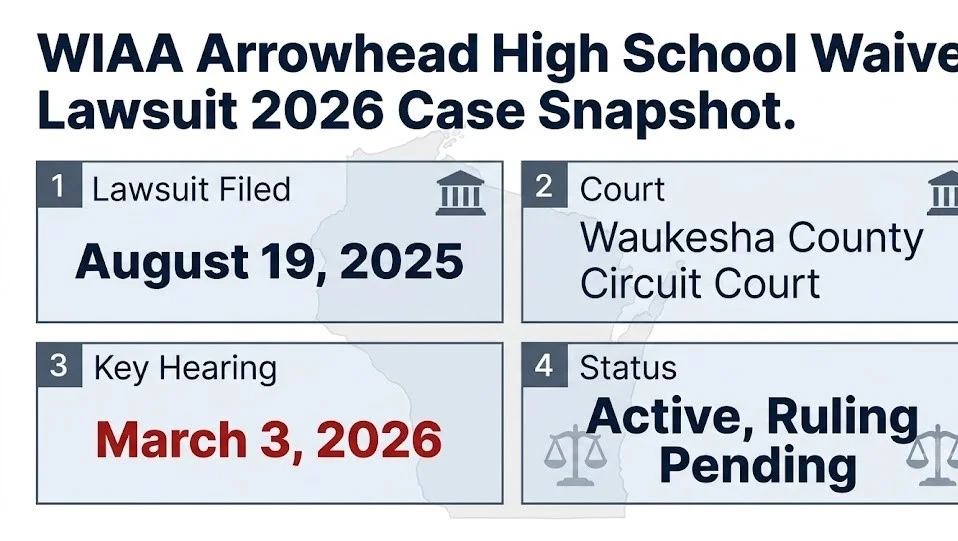
Tristen’s parents, Blayne and Jenell Seidl, filed the complaint on August 19, 2025. The suit followed the WIAA’s denial of a transfer waiver that would have let Tristen play varsity football immediately.
The family’s home in Dousman, Wisconsin, was destroyed by fire in October 2023. They lived in four temporary residences over the following 17 months while trying to keep Tristen enrolled at his original school, Kettle Moraine.
Quick facts:
- Plaintiffs: Blayne and Jenell Seidl, on behalf of Tristen Seidl
- Defendant: Wisconsin Interscholastic Athletic Association
- Court: Waukesha County Circuit Court
- Filed: August 19, 2025
- Involuntary plaintiff: Arrowhead Union High School District
Attorneys handling education law disputes point to the involuntary plaintiff designation as significant, since it shows the court treats the school district as a stakeholder even though Arrowhead did not initiate the suit.
Who Filed the Lawsuit and Why
Blayne and Jenell Seidl filed the lawsuit on behalf of their son, Tristen.
Their motive was immediate and concrete. The WIAA’s ruling would have forced Tristen to sit out his entire senior football season at Arrowhead High School.
The family argued this jeopardized a football scholarship offer from the University of Sioux Falls in South Dakota. Missing a senior season, they argued, risked irreparable harm to his recruiting prospects.
- The suit sought an injunction allowing Tristen to play immediately
- The suit sought a declaratory judgment on WIAA authority
- The suit asked the court to bar penalties against Arrowhead for fielding Tristen
Attorney William Rettko represented the Seidl family throughout the filings.
Attorneys handling these claims point to the dual structure of the complaint, an emergency injunction request paired with a slower constitutional claim, as a common strategy when a deadline is approaching fast.
What Happened to Tristen Seidl’s Transfer Waiver
Tristen’s waiver was denied because the WIAA found his move did not meet its standard for extenuating circumstances.
WIAA rules generally require junior and senior transfers to sit out one year unless the family made a “total and complete change of residence.” The WIAA ruled that standard was not met when Tristen first enrolled at Arrowhead in 2024 while his home was still under contracted repair.
The family appealed to the WIAA Board of Control on August 15, 2025. That appeal failed.
| Step | Date | Outcome |
|---|---|---|
| WIAA denies waiver | July 28, 2025 | Tristen ruled ineligible for varsity |
| Board of Control appeal | August 15, 2025 | Appeal denied |
| Lawsuit filed | August 19, 2025 | Seidl v. WIAA begins |
Both Kettle Moraine and Arrowhead approved the transfer on the school side. The WIAA’s ruling stood apart from that approval.
Attorneys reviewing transfer disputes note that school-level approval carries no legal weight against a separate WIAA eligibility ruling, a distinction many families misunderstand until it is too late.
What Court Is Hearing Seidl v WIAA
Waukesha County Circuit Court is hearing the case, with Judge Paul Bugenhagen Jr. presiding.
This is a Wisconsin state trial court, not a federal court and not an administrative tribunal. The case proceeds under ordinary Wisconsin civil procedure.
Judge Bugenhagen has issued two major rulings so far. He granted a temporary injunction in September 2025 and denied a motion to dismiss in December 2025.
Quick facts on the court:
- Court: Waukesha County Circuit Court, Wisconsin
- Presiding judge: Paul Bugenhagen Jr.
- Case type: Civil, certiorari and declaratory judgment claims
- Next major hearing: March 3, 2026, on governmental authority briefing
Attorneys tracking the docket note that Wisconsin circuit courts decide these governance disputes regularly, since the WIAA’s authority has never been squarely resolved by a higher Wisconsin court.
The Legal Theory Behind the Certiorari Claim
The certiorari claim asks the court to review a WIAA decision the way it would review a government agency’s ruling.
A writ of certiorari is normally reserved for reviewing actions by governmental or quasi-governmental bodies. The Seidls argue the WIAA functions as exactly that, even though it calls itself private.
Their brief stated the WIAA decision was “arbitrary, capricious and contrary to the law.” That phrase is the legal standard courts use to overturn agency rulings that lack a reasoned basis.
- Certiorari review only applies if the WIAA exercises governmental power
- The WIAA disputes that it exercises any such power
- The Seidls argue education, including athletics, counts as a government-provided benefit
Litigation Watch: The entire case pivots on whether the WIAA’s waiver decisions qualify for certiorari review, a question Wisconsin courts have repeatedly sidestepped.
Does the WIAA Have Governmental Authority
This is the central unresolved legal question in the case. The WIAA says no, it does not.
WIAA attorney Brent Jacobson argued the organization holds only contractual authority from its 513 member schools, not power delegated by the state. He pointed to Governor Tony Evers’ 2021 veto of a bill that would have created legislative exceptions to WIAA transfer rules.
Evers wrote at the time that he objected to the Legislature inserting itself into “the decision-making process of a private, member-driven organization.”
| Position | WIAA’s Argument | Seidl Family’s Argument |
|---|---|---|
| Legal status | Private contractual entity | Functions as a state actor |
| Source of authority | Member school agreements | Control over a government benefit |
| Review standard | Not subject to certiorari | Subject to certiorari as agency action |
A 2021 appellate decision once found the WIAA to be a state actor. The Wisconsin Supreme Court later reversed that finding without resolving the underlying question.
The September 2025 Temporary Injunction Explained
A temporary injunction is a court order preserving the status quo while a case proceeds.
Judge Bugenhagen issued the injunction on September 5, 2025. It blocked the WIAA from preventing Tristen from playing varsity football for the remainder of the season.
The judge based the ruling on irreparable harm. He found Tristen risked losing his college scholarship offer if forced to miss his senior season entirely.
What the injunction did:
- Allowed Tristen to play immediately
- Did not resolve the underlying certiorari or authority claims
- Remained in effect through the rest of the 2025 season
Tristen went on to play the final seven regular season games plus all five postseason games, finishing with 44 tackles, seven tackles for loss, and 4.5 sacks.
Attorneys handling injunction requests in eligibility disputes point to the speed of this ruling as notable, since the court acted within roughly two weeks of the initial filing.
The December 2025 Ruling on the Motion to Dismiss
Judge Bugenhagen partially denied the WIAA’s motion to dismiss on December 19, 2025.
He declined to dismiss the certiorari claim, which kept the September injunction in effect. He did not rule on the deeper governmental authority claim.
Instead, he ordered both sides to submit additional briefing on that authority question. That briefing fed directly into the March 3, 2026 hearing.
- Certiorari claim: survived the motion to dismiss
- Governmental authority claim: still pending as of the December ruling
- Arrowhead Union High School District: named as involuntary plaintiff, unrepresented at the hearing
Litigation Watch: The December 2025 ruling kept the injunction alive but left the case’s biggest legal question, WIAA governmental authority, unresolved heading into 2026.
Halter v WIAA and Why It Matters Here
Halter v. WIAA is the closest existing precedent, and both sides cited it directly in their December briefing.
The case involved former Waterford wrestler Hayden Halter, suspended by the WIAA for unsportsmanlike conduct. The Wisconsin Supreme Court found the WIAA acted reasonably in that specific ruling.
Critically, the court did not decide whether the WIAA is a state actor. Justice Brian Hagedorn, writing for the majority, called that question a “threshold issue” the court left unresolved.
| Case | Issue | Outcome |
|---|---|---|
| Halter v. WIAA | Suspension for conduct | WIAA’s action upheld, state actor question avoided |
| Seidl v. WIAA | Transfer waiver denial | Pending, same question now squarely raised |
Marquette Law professor Matthew Mitten has noted the Supreme Court reversed a lower appellate finding that the WIAA was a state actor, but never supplied its own answer.
Attorneys watching this area describe Halter as a near miss, a case that raised the authority question without forcing a final answer, which is exactly what Seidl could do instead.
Weigel v WIAA and the Pattern of Waiver Challenges
Seidl is not the first Wisconsin waiver fight to reach a courtroom, or close to one.
In February 2025, the Wisconsin Institute for Law and Liberty brought a constitutional challenge on behalf of Macy Weigel, a Baraboo softball player denied a waiver over financial hardship.
That dispute resolved differently. The WIAA reversed its own decision in May 2025, before the matter required a full court ruling.
- Weigel’s case ended through WIAA reversal, not a judicial ruling
- Seidl’s case has continued through full litigation
- Both cases involve the same underlying waiver category, extenuating circumstances
The pattern suggests families are increasingly willing to escalate WIAA waiver denials rather than accept them as final.
WIAA Arrowhead Lawsuit Timeline for 2026
Here is the confirmed sequence of events through 2026.
- October 2023: Seidl family home destroyed by fire
- March 2025: Family informed home cannot be restored
- July 28, 2025: WIAA denies transfer waiver
- August 15, 2025: Board of Control denies appeal
- August 19, 2025: Lawsuit filed in Waukesha County Circuit Court
- September 5, 2025: Temporary injunction granted
- November 21, 2025: Arrowhead wins Division 1 state championship with Seidl on the roster
- December 19, 2025: Motion to dismiss partially denied
- March 3, 2026: Hearing on governmental authority question
What remains unconfirmed as of this writing:
- The outcome of the March 3, 2026 hearing
- Whether a final ruling on governmental authority has been issued
- Whether either side has initiated formal settlement talks
Attorneys following the docket caution against assuming any outcome until the court issues a written order, since oral argument dates do not guarantee a same-day ruling.
What the March 2026 Hearing Was Set to Decide
The March 3, 2026 hearing addressed whether the WIAA improperly exercises governmental authority over public school athletics.
This is the deeper of the two claims in the case. A ruling against the WIAA here could reshape how the organization regulates eligibility statewide.
At the December hearing, Judge Bugenhagen had asked whether the litigation still needed to continue, since Seidl had already completed his senior season. Attorney Rettko responded that the family still sought a permanent injunction protecting Arrowhead from future sanctions.
- If the WIAA loses: its authority over public school eligibility decisions could require legislative backing
- If the WIAA wins: its current contractual authority model remains intact
- Either outcome could influence pending or future Wisconsin waiver disputes
No settlement talks had been confirmed publicly as of the most recent reporting reviewed for this article.
Does This Lawsuit Affect Other Wisconsin Schools
Potentially, yes, depending on how the governmental authority question is resolved.
A ruling that the WIAA lacks legal authority over public schools would not automatically void every past eligibility decision. It would, however, create a new legal basis for future challenges statewide.
The WIAA represents 513 member schools in Wisconsin. A ruling against the association’s authority model could prompt rule changes across that entire membership.
- Direct effect: limited to Tristen Seidl and Arrowhead in the short term
- Indirect effect: could open the door to broader challenges by other districts
- WIAA leadership has expressed concern specifically about the precedent this case could set
Attorneys advising school districts describe this as the kind of case worth monitoring closely, even for schools with no current eligibility dispute, since the legal theory could become a template.
What Happens to Arrowhead’s State Championship
Arrowhead’s 18-15 Division 1 state championship win over Bay Port, played November 21, 2025, stands for now.
The injunction allowing Seidl to play remained in effect throughout the postseason. No court has ordered a forfeiture as of this writing.
Arrowhead Superintendent Conrad Farner raised this exact risk publicly in September 2025, asking what would happen to team records if a later ruling found Seidl ineligible retroactively.
| Scenario | Outcome for Championship |
|---|---|
| Injunction remains valid permanently | Championship stands as played |
| Court later vacates the injunction | Forfeiture question becomes live again |
| WIAA wins on authority but not retroactively | Likely no effect on past games |
Attorney Rettko had requested a court order barring any future forfeiture, but Judge Bugenhagen declined to issue one at the December hearing.
Who Should Talk to a Lawyer About a WIAA Waiver Denial
Families facing a denied WIAA transfer waiver should consult an education or administrative law attorney before the season is at risk.
Timing matters more in these cases than in most civil disputes. An injunction request filed after a season has effectively ended carries far less urgency in court.
School administrators advising families through a transfer should also understand their own exposure, since districts can be named as involuntary parties even without initiating anything.
- Families with a denied waiver: consult an attorney experienced in education law and injunctive relief
- School administrators: consult counsel on the district’s exposure as an involuntary party
- Athletes nearing a scholarship deadline: act quickly, since irreparable harm arguments depend on timing
Attorneys handling these disputes generally recommend documenting every communication with WIAA officials in writing, since the Seidl case turned partly on conflicting statements made on a transfer form.
Frequently Asked Questions
What is the WIAA Arrowhead high school waiver lawsuit about?
It is a Wisconsin lawsuit testing whether the WIAA has legal authority over public school athletic eligibility.
The Seidl family sued after the WIAA denied their son a transfer waiver.
The case does not involve a settlement fund or individual payout.
Who is suing the WIAA in this case?
Blayne and Jenell Seidl filed the lawsuit on behalf of their son, Tristen Seidl.
They filed in Waukesha County Circuit Court on August 19, 2025.
Arrowhead Union High School District is named as an involuntary plaintiff.
Why was Tristen Seidl ruled ineligible?
The WIAA ruled his family’s move did not meet the standard for a “total and complete change of residence.”
A house fire in 2023 forced the family through four temporary residences before settling permanently.
The WIAA denied a waiver for extenuating circumstances on July 28, 2025.
What court is hearing Seidl v WIAA?
Waukesha County Circuit Court is hearing the case under Judge Paul Bugenhagen Jr.
A temporary injunction was granted in September 2025 and a motion to dismiss was partially denied in December 2025.
A hearing on the WIAA’s broader governmental authority was set for March 3, 2026.
Does this lawsuit affect other Wisconsin schools?
It could, if the court rules on whether the WIAA holds governmental authority over public school eligibility.
The WIAA represents 513 member schools, so a ruling against its authority model could influence rules statewide.
The direct legal effect, for now, applies only to the Seidl case.
Is Arrowhead’s state championship at risk because of this lawsuit?
Not as of this writing, since the injunction allowing Seidl to play has remained in effect.
The court has not ordered any forfeiture of Arrowhead’s November 2025 state title.
A future ruling vacating the injunction could reopen that question.
The Seidl case has already reshaped one family’s senior season, but its real impact depends on how a Wisconsin judge answers a question courts have dodged for years. That ruling could move beyond one football team fast.
Families facing a similar WIAA waiver denial should not wait for a season to start before calling a lawyer. An education law attorney can assess injunction timing while there is still a season left to protect.
