
PHA
Quick Answer Box
- The alaska cruise port lawsuit is a tax dispute between CLIA and the Borough of Skagway, not a personal injury or class action case.
- It does not create individual payouts. Cruise passengers and businesses are affected indirectly through pricing, not through claims they can file.
- Worth tracking if you operate a tour business, work in municipal law, or advise cruise lines on compliance, since the ruling could reshape how Alaska ports tax shore excursions.
Case Snapshot
| Detail | Info |
|---|---|
| Court | Alaska Superior Court, First Judicial District |
| Case / MDL Number | Not confirmed in public reporting as of this writing |
| Filing Date | May 8, 2025 |
| Status | Active, ordinance remains in effect during litigation |
| Settlement Fund | None. This is a regulatory challenge, not a damages claim |
The alaska cruise port lawsuit is the legal fight between the Cruise Lines International Association (CLIA) and the City and Borough of Skagway over a new sales tax ordinance. It is not the kind of mass tort or injury case readers might expect from that headline.
There are no individual claimants. There is no settlement fund waiting to be distributed.
What is happening instead is a constitutional challenge. CLIA argues Skagway’s tax on cruise line commissions breaks both the U.S. Constitution and Alaska state law.
The case matters because Alaska’s cruise ports have a documented history of suing each other into precedent. A nearly identical fight in Juneau ran for three years and ended in a $1.95 million fee settlement in 2019.
What Is the Alaska Cruise Port Lawsuit
The alaska cruise port lawsuit refers to CLIA’s legal challenge against Skagway’s expanded tax on cruise shore excursions.
Skagway passed Ordinance No. 24-12 in December 2024. It changed how the borough taxes shore excursions sold through cruise lines.
Before the ordinance, Skagway taxed only the base price of a tour. The commission cruise lines collect for arranging that tour was exempt.
The new rule taxes the full retail price, commission included. CLIA filed suit on May 8, 2025, naming Skagway’s borough manager and treasurer as defendants.
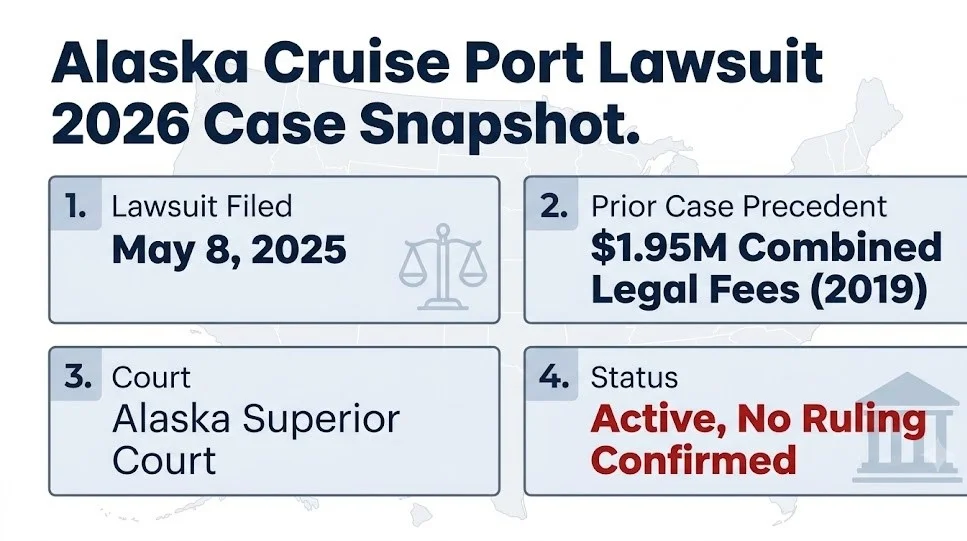
Quick facts:
- Ordinance passed: December 2024
- Lawsuit filed: May 8, 2025
- Filed by: Cruise Lines International Association
- Filed against: Skagway borough manager and treasurer
- Court: Alaska state court
Attorneys handling municipal tax disputes point to the timing here as deliberate. CLIA waited until the ordinance had taken effect before filing, giving the borough a working policy to defend rather than a proposal to debate.
Who Filed the Alaska Cruise Port Lawsuit and Why
CLIA filed the lawsuit on behalf of its member cruise lines operating in Southeast Alaska.
CLIA represents most major cruise operators, including Royal Caribbean, Carnival, and Norwegian. The association has standing to sue on behalf of the industry rather than requiring each line to file separately.
The motive is straightforward. Taxing the commission cuts directly into a revenue stream cruise lines depend on for excursion sales.
CLIA’s public statement called the policy a threat that risks “double taxation and placing undue financial strain on cruise guests and Alaska businesses alike.”
- CLIA seeks to have the ordinance struck down
- CLIA seeks reimbursement of its legal fees
- CLIA has not requested damages or back payments from the borough
Litigation Watch: Skagway’s Ordinance 24-12 triggered a May 2025 lawsuit from CLIA, which is fighting to remove the tax rather than collect any payment.
Skagway Ordinance 24-12 Explained
Ordinance 24-12 is the specific Skagway law at the center of this case.
It amends the borough’s sales tax code so that cruise line commissions on shore excursions are taxed the same as the underlying tour price. Before the change, the commission portion was carved out.
Skagway Borough Manager Emily Deach has defended the change publicly. She said the goal was to “treat tour sales by the cruise lines the same as other sales of products and services within the municipality.”
| Element | Before Ordinance 24-12 | After Ordinance 24-12 |
|---|---|---|
| Base tour price | Taxed | Taxed |
| Cruise line commission | Exempt | Taxed |
| Applies to bookings made | In Skagway only | Anywhere, including online |
Attorneys reviewing municipal tax codes note that Skagway’s approach is unusual nationally, since Borough Manager Deach has said she is not aware of another community with an identical structure.
Does the Alaska Cruise Port Lawsuit Affect Passengers
Yes, but indirectly. Passengers are not parties to the lawsuit and cannot file claims under it.
The practical effect shows up in excursion pricing. If Skagway’s tax holds, tours booked through cruise lines may carry a higher built-in cost than tours booked independently.
Cruise lines may also pass added cost through as line-item fees on invoices rather than absorbing it.
- Passengers cannot join the lawsuit as plaintiffs
- Passengers are not eligible for any settlement payout
- Passengers may see excursion price changes depending on the outcome
This is the single biggest point of confusion in search traffic around this topic. The keyword pattern resembles a class action, but the legal structure does not function like one.
Which Cruise Lines Are Tied to This Case
No individual cruise line is named as a plaintiff. CLIA filed as the trade association representing its members.
That includes the largest operators sailing Alaska’s Inside Passage. Royal Caribbean, Carnival, Norwegian, Princess, Celebrity, and Holland America all call on Skagway during the season.
CLIA’s structure means a single filing covers the industry rather than each line bringing separate suits.
Cruise lines connected through CLIA membership and Alaska operations:
- Royal Caribbean
- Carnival Cruise Line
- Norwegian Cruise Line
- Princess Cruises
- Celebrity Cruises
- Holland America Line
Attorneys familiar with trade association litigation note this structure cuts both ways. It spreads legal cost across the industry, but it also means no single line controls strategy or settlement terms.
Commerce Clause and Tonnage Clause Arguments
CLIA’s core legal theory rests on two constitutional provisions.
The first is the Commerce Clause, which limits how local governments can tax activity that crosses state lines. CLIA argues that booking a Skagway tour from outside Alaska, including from another country, lacks the “substantial relationship” to Skagway that local tax law requires.
The second is the Tonnage Clause, which bars states and municipalities from taxing vessels without congressional approval. This argument has surfaced in related cruise litigation, including Hawaii’s tax fight.
Anchorage tax attorney Steven Mahoney, who is not involved in the case, described the legal theory this way: the cruise line’s office work happens elsewhere, and taxing that margin is “problematic” under existing constitutional limits.
Attorneys handling these claims point to the substantial nexus requirement as the likely battleground, since it has decided similar municipal tax fights in other states.
Double Taxation Claims in the Lawsuit
CLIA’s second major argument is that the ordinance creates double taxation.
The claim is that passengers and cruise lines already pay multiple layers of state and local fees tied to cruise activity. Adding a tax on commissions, CLIA argues, stacks another charge on top of an already taxed transaction chain.
Skagway disputes this framing. The borough’s position is that the commission was never taxed before, so this is new revenue rather than duplicate revenue.
- CLIA’s framing: the commission tax duplicates existing fee structures
- Skagway’s framing: the commission was simply an overlooked gap, now closed
- Neither side has produced public financial modeling showing the dollar impact per passenger
Litigation Watch: The case turns on two constitutional theories, Commerce Clause nexus and Tonnage Clause limits, plus a contested double taxation claim that has no agreed-upon dollar figure yet.
What Court Is Hearing the Case
CLIA filed the lawsuit in Alaska state court, not federal court.
This is a meaningful choice. The 2016 Juneau dispute over passenger fees was filed in the U.S. District Court for the District of Alaska, a federal venue.
Filing in state court here suggests CLIA may be leaning more heavily on Alaska statutory tax law than on federal constitutional doctrine alone, though the federal claims remain part of the complaint.
| Case | Court | Venue Type |
|---|---|---|
| CLIA v. Skagway (2025) | Alaska Superior Court | State |
| CLIA Alaska v. CBJ (2016) | U.S. District Court, District of Alaska | Federal |
A specific docket number for the Skagway filing has not appeared in public reporting reviewed for this article. Readers should treat any number circulating online as unverified until confirmed through the Alaska Court System’s CourtView portal.
Alaska Cruise Port Lawsuit Timeline for 2026
Here is the confirmed sequence of events.
- December 2024: Skagway Assembly passes Ordinance No. 24-12
- May 8, 2025: CLIA files lawsuit against Skagway’s borough manager and treasurer
- 2025 through early 2026: Discovery and procedural motions proceed
- 2026: Case remains active with no public ruling confirmed as of this writing
Some industry blogs have circulated a claimed May 2026 summary judgment date. That date has not been independently confirmed through court records reviewed for this report.
What is confirmed for 2026:
- The ordinance remains in force
- No settlement has been announced
- No trial date has been publicly confirmed
Attorneys watching the docket caution against treating projected ruling dates as fact until the court actually issues a scheduling order confirming them.
The 2016 Juneau Precedent and Its Settlement
The most useful roadmap for this case is not Skagway. It is Juneau.
In April 2016, CLIA’s Alaska affiliate sued the City and Borough of Juneau in federal court, case number 1:16-cv-00008, over how the city spent marine passenger fees.
U.S. District Judge H. Russel Holland ruled in 2018 that collecting such fees was constitutional, but that revenue had to serve the vessel directly rather than fund general city projects.
The parties settled in March 2019. Total legal fees came to $1.95 million, split $1.5 million to CLIA and $450,000 to Juneau, reimbursed through the city’s general fund.
| Detail | 2016 Juneau Case | 2025 Skagway Case |
|---|---|---|
| Court | Federal (D. Alaska) | State (Alaska Superior Court) |
| Filed | April 2016 | May 2025 |
| Resolution | Settlement, March 2019 | Pending |
| Fee outcome | $1.95 million combined | Not yet determined |
This is the comparison most coverage of the current case skips entirely.
Juneau Docking Fee Dispute and Related Litigation
A separate friction point involves Juneau’s 2025 decision to raise docking fees.
The Juneau Assembly approved a plan to substantially increase docking fees, which the cruise industry has characterized as conflicting with the spirit of the 2019 settlement framework.
This has not yet produced a confirmed new lawsuit as of this writing, but it sits adjacent to the Skagway case as part of the same broader pattern.
- Juneau raised docking fees in 2025
- Industry groups have objected publicly
- No confirmed new federal or state filing tied specifically to the docking fee increase has been verified for this report
Litigation Watch: The 2016 Juneau case set the financial benchmark, a $1.95 million fee settlement, that both sides in the current Skagway dispute are likely measuring their own legal costs against.
Hawaii Cruise Tax Lawsuit and How It Connects
CLIA’s Tonnage Clause argument did not originate in Alaska. It mirrors a parallel fight in Hawaii.
Hawaii passed a law imposing an 11 percent tax on gross cruise fares, prorated by days spent in Hawaii ports. CLIA sued, and the 9th U.S. Circuit Court of Appeals temporarily blocked enforcement on December 31, 2025, while the challenge proceeds.
The two cases are not formally consolidated, but they share legal theory and, in some filings, similar language.
- Hawaii tax rate: 11 percent of gross fare, prorated by days in port
- Blocked by: 9th Circuit, pending appeal
- Shared legal theory with Skagway case: Tonnage Clause limits on local taxation of vessels
A favorable appellate ruling for CLIA in the Hawaii case could strengthen its position in Skagway, since both rely on similar constitutional ground.
Skagway’s Defense and Local Government Position
Skagway has not backed down from the ordinance since the lawsuit was filed.
The borough’s defense rests on consistency. Officials argue the tax simply applies the same rule to all tour sales, regardless of where or how the booking happened.
Local political support has been visible. Assembly member Deb Potter publicly welcomed the change at a December 2024 meeting, framing it as modernization rather than a new burden.
- Skagway’s position: equal tax treatment for all tour bookings
- Local sentiment: mixed, with some residents supporting added industry contribution
- Skagway hosts over 1.2 million cruise passengers annually, a figure cited by both sides
Attorneys representing municipalities in similar tax disputes often advise documenting the policy rationale early, exactly the kind of public statements Skagway officials have already made on record.
What Happens If CLIA Wins or Loses
The outcome reshapes how Alaska’s smaller cruise ports can structure local tax policy.
If CLIA wins:
- Skagway likely repeals or narrows Ordinance 24-12
- Skagway may owe CLIA’s legal fees
- Other Alaska ports considering similar tax expansions would likely pause
If Skagway wins:
- The ordinance stands as written
- Other ports, including Ketchikan, which adopted a related tax change in April 2025, gain a legal template
- CLIA would need to pursue federal court or legislative routes instead
| Outcome | Effect on Skagway | Effect on Industry |
|---|---|---|
| CLIA wins | Ordinance repealed or narrowed | Reduced tax exposure on commissions |
| Skagway wins | Ordinance upheld | Other ports may replicate the model |
Who Should Talk to a Lawyer About This Case
This case is not one where passengers need legal representation. The relevant audiences are narrower.
Tour operators in Skagway who collect or remit this tax should understand their compliance exposure regardless of the lawsuit’s outcome. A municipal tax attorney can clarify current obligations while litigation is pending.
Cruise lines and travel agencies booking Alaska excursions should track pricing implications, since invoice surcharges have already appeared on some 2026 bookings tied to port fee increases.
- Tour operators: consult a municipal tax or business compliance attorney
- Cruise lines and OTAs: consult counsel on pricing disclosure and surcharge practices
- Municipal officials in other Alaska ports: consult a constitutional or municipal law attorney before drafting similar ordinances
Attorneys who handle municipal taxation matters generally recommend waiting for a ruling before restructuring booking systems, since a reversal mid-season creates its own compliance headache.
Frequently Asked Questions
Is the Alaska cruise port lawsuit a class action?
No, it is not a class action.
It is a constitutional and tax dispute between a trade association, CLIA, and the Borough of Skagway.
There is no claims process for individual passengers or businesses.
Can cruise passengers file a claim in this lawsuit?
No, passengers cannot file a claim.
The lawsuit does not involve a settlement fund or individual compensation.
Any pricing effect on passengers would come indirectly, through future excursion costs.
What is Skagway Ordinance 24-12?
Ordinance 24-12 is the Skagway law taxing the full price of cruise shore excursions, including cruise line commissions.
It passed in December 2024 and took effect before CLIA’s lawsuit was filed.
Before the ordinance, only the base tour price was taxed.
When was the Alaska cruise port lawsuit filed?
CLIA filed the lawsuit on May 8, 2025.
It was filed in Alaska state court against Skagway’s borough manager and treasurer.
As of this writing, the case remains active with no public ruling confirmed.
How does this case compare to the 2016 Juneau lawsuit?
The 2016 case, CLIA Alaska v. City and Borough of Juneau, ended in a 2019 settlement totaling $1.95 million in combined legal fees.
That case was filed in federal court and addressed how Juneau spent passenger fees, a different legal question than Skagway’s tax on commissions.
It remains the closest precedent for how the current dispute might resolve.
Will this lawsuit raise the cost of Alaska cruises?
It could affect excursion pricing if Skagway’s tax stands, since cruise lines may pass the added cost to passengers.
Some cruise lines have already added port-related surcharges to 2026 invoices tied to broader fee increases in the region.
The lawsuit itself does not set prices, it determines whether the underlying tax is legal.
Skagway’s tax fight with CLIA is not a case readers can join, but it is one worth watching if you operate in Alaska’s tourism economy. The 2016 Juneau case shows these disputes can run for years before resolving.
Anyone with a direct financial stake, tour operators, cruise lines, or other Alaska municipalities watching the outcome, should talk to an attorney familiar with municipal tax and constitutional law before the ruling lands, not after.
META BLOCK
Meta Title: Alaska Cruise Port Lawsuit 2026: What the Case Means
Meta Title Chars: 57/59
Meta Desc: The Alaska cruise port lawsuit pits CLIA against Skagway over excursion taxes. See the 2026 court status, legal claims, and what comes next.
Meta Desc Chars: 153/159
Focus Keywords: alaska cruise port lawsuit, CLIA Skagway lawsuit, Skagway ordinance 24-12, cruise tax lawsuit Alaska, alaska cruise lawsuit 2026
Slug: /alaska-cruise-port-lawsuit/
